RESERVATION OF CHANNELS FOR HANDOFF USERS IN
VISITOR LOCATION BASED ON PREDICTION
1 M.AMSAVENI 2 S.MALATHY
1
Assistant Professor, Department of ECE, RVS College of Engineering And Technology, Coimbatore, Tamil Nadu, India
2 Professor, Department of ECE, RVS College of Engineering And Technology, Coimbatore,
Tamil Nadu, India
E-mail: [email protected], [email protected]
ABSTRACT
The available bandwidth must be efficiently utilized by the mobile user, because the mobile users are increasing gradually nowadays. The main goal of the channel reservation is to reduce the call dropping probability. An efficient channel allocation scheme can significantly reduce call dropping probability. Large number of channel assignment and allocation policies has been proposed. In this paper, the Prediction Based Channel Reservation (PBCR) algorithm is proposed. The PBCR algorithm allows the reservation of a channel for users in target cell before the user moves into that cell. Pre reservations are made when the users are within some distance of the new cell boundary. Channel Borrowing scheme and Queuing scheme are used in this PBCR algorithm for allocating the channel to predicted regular and irregular users. In channel borrowing scheme, free channels are selected from the central pool and optimally allocated to regular user. For irregular user, queuing scheme is applied. These schemes are used to reduce the call dropping probability and utilize the channel bandwidth effectively. So the performance of PBCR algorithm is better when compared to other existing algorithms.
Keywords: Channel Borrowing, Channel Reservation, Hand off calls, PBCR Algorithm.
1. INTRODUCTION
The Channel Reservation Management (CRM) is channel assignment, admission control, and hand off. To obtain a better performance, an integrated radio CRM scheme is used. This scheme is necessary for making tradeoff between the individual goals of these tasks.
The Call Admission Control (CAC) based on Channel Reservation schemes reserves channels in some of the neighbour cell with high probability
of receiving handoff traffic from other
neighbouring cell. The probability of receiving handoff traffic from the other cells is predicted using mobility information of new users. When a new user arrive, the bandwidth reservation is checked in the home cell and in all neighbouring cells. The reservation based CAC is based on mobility information of the users. In this scheme, cells expected to be visited in the future by a new user increases the reserved bandwidth by the amount of required bandwidth of the new user. This
reservation based CAC is mainly used to reduce the handoff failures. The bandwidth is reserved in each cell using information about user’s mobility and directivity in an adjacent cell.
The channel borrowing is one of the techniques of prioritization scheme. In channel borrowing scheme, the user can borrow the free channels from central pool. If the borrowed channel does not interfere with existing calls, the channel can be borrowed by a cell. There are several channel borrowing schemes are available in cellular networks. In this paper, the PBCR algorithm is used for reserving the channel to the predicted users. The regular users are high priority users, so the call dropping probability is less when compared to the irregular user by using channel borrowing scheme.
The call queuing scheme is applied for irregular users in PBCR algorithm. When there is no channel available in the system, the call is put in to the queue. If all the channels in the target cell occupied, the call can be queued. If any channel is released, it is assigned to the next handoff call waiting in the queue. The queue can be classified in to finite and infinite queue. The finite queue systems are more realistic and infinite queue systems are more convenient for analysis. First in First out (FIFO) queuing strategy is used in this analysis. The queuing scheme is used to improve the performance of the system. The important factor of the queuing scheme is call waiting time. The priority based queuing scheme gives the high priority to handoff calls over new calls waiting in the queue to gain access to available channels.
The number of channels in the system is the important parameter in reservation scheme. The main goal of the reservation scheme is minimizing the call dropping probability and call blocking probability. The static reservation results in poor resource utilization. To solve this problem, several dynamic reservation schemes were proposed. In dynamic scheme, the optimal numbers of channels are adjusted dynamically based on the user’s arrival. The reservation parameters are reservation level, user arrival and completion or rejection of calls. Future events are predicted in predictive approaches and parameters are adjusted in advance to prevent undesirable QoS degradations. The predictive approach estimates the global state of the network by using prediction technique based on information available locally.
2. LITERATURE REVIEW
(V.S. Kolate, et al. 2012) proposed survey of admission control schemes and handoff prioritization for cellular networks and the research
in this area. In this paper Handoff prioritization can improve handoff related system performance. (Mahesh, et al. 2012) proposed the channel reservation model for CAC in Next Generation Wireless Networks (NWGN) based on the user’s QoS needs. The simulation results for call blocking probability of different user classes are presented. The simulation results are optimistic and clearly indicate that high priority user classes have very low call blocking probability when compared to low priority user classes because of exclusive channel reservation of high priority users. (Dipti
Varpe and Girish Mundada, 2011) proposed the
Distributed Dynamic Channel allocation (DDCA) algorithm for originating calls. The DDCA algorithm achieves 0.6 call dropping probability. In this algorithm, the uniform traffic distribution has same channel demand in each cell and in non uniform traffic distribution each cell has different channel demand. So the blocking probability of non uniform distribution less as compared to uniform calls distribution. (Arunita Jaekel, et al. 2011) proposed a novel Integer Linear Programming (ILP) formulation. This formulation is based on the Carrier to Interference Ratio and optimizes the channel allocation and power control for incoming
calls. This formulation also guarantees that the
overall power requirement for the selected channel will be minimized as much as possible and that no ongoing calls will be dropped as a result of admitting the new call. The results indicate that this approach leads to significant improvements over existing techniques. (Alioune Nagom, et al. 2010) proposed the two efficient ILP formulations, for optimally allocating a channel to an incoming call. The first ILP1 does not allow channel reassignment of the existing calls. The second ILP2 allows such reassignment. The ILP formulation achieves 0.5 call dropping probability. The ILP formulations are used for optimally solving the hybrid channel
assignment problem. (Sudarshan Subhashrao
performs better. (Raj Kumar Samantaa, et al. 2009) proposed the mathematical model to estimate the dropping probabilities of cellular wireless networks by queuing handoff instead of reserving guard channels. This scheme with queuing handoff requests can achieve the probability of forced termination at the desired level almost as that obtained from the guard channel scheme whereas the probability of blocking of new calls reduced significantly. (Muhammed Salamah and Hashem Lababidi, 2005) proposed Dynamically Adaptive Channel Reservation Scheme (DACRS). The DACRS algorithm is designed to improve channel utilization while satisfying the QoS of the calls. The DACRS outperforms current reservation schemes and results in more statistical gain, and powerful channel utilization. (ZhongXu ZhenqiangYe, et al. 2002) proposed the Adaptive Channel Reservation (ACR) algorithm that uses Global Positioning System (GPS) measurements to determine when reservations are to be made. This scheme is used to minimize the effect of false reservations and to improve the channel utilization of the cellular systems. Simulation results show that the ACR scheme performs better in almost all typical scenarios than prior schemes.
3. MATERIALS AND METHODOLOGY
The PBCR algorithm designed in this paper is expected to utilize the bandwidth effectively and hence reduce the call dropping probability.
3.1 PBCR Algorithm
The PBCR algorithm performs better than the existing algorithm. The PBCR algorithm uses hybrid channel assignment scheme. This algorithm combines the Dynamic Load Balancing and Distributed Dynamic Channel Allocation Scheme. Channel Borrowing Scheme is used under Dynamic Load Balancing Based DCA Scheme. Queuing Scheme is used under Distributed Dynamic
Channel Allocation Scheme. Channel Borrowing is used for Regular User and Queuing is used for Irregular user. This PBCR algorithm achieves better QoS, reduces the call dropping probability and effectively utilizes the channel bandwidth.
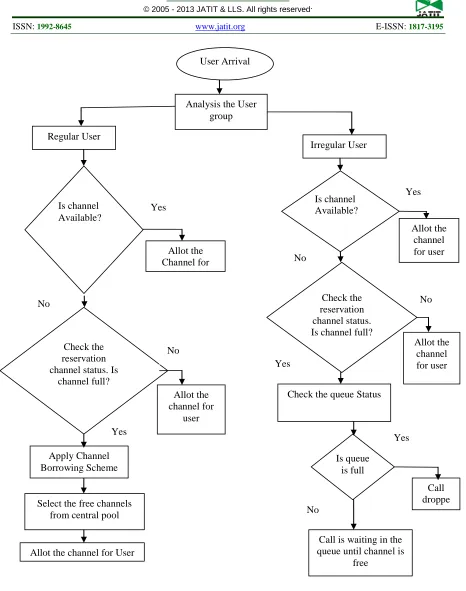
The PBCR algorithm procedure is shown in figure 3. The algorithm performs several steps to allot the channel for users. The first step of this algorithm is analysing the user group arrived in the system, whether it is regular user or irregular user. If the user is a regular user, the channel availability of the system is checked. If the channel is available, the channel is allotted for user. Otherwise the reserved channel status is checked. If the reserved channel status is full, then apply the channel borrowing scheme. In this, the free channels are obtained from the central pool. The central pool is located in the Mobile Telephone Switching Office (MTSO). All BS’s free channels are located in the central pool. Whenever the free channels are needed for the user, the user borrows the channels from central pool. After completion of the call, the channels are again returned to the central pool. This algorithm is applied to high priority regular users.
If the user is irregular user, then check the channel availability. If the channel is available, the channel is allotted for user. Otherwise, the channel reservation status is checked. If the channel reservation status is full, then the user is put into the queue. Otherwise the channel is allotted for user. Then the queue status is checked. If the queue is full, the call is dropped. Otherwise, call is waiting in the queue until the channel is free. After getting the requested channel, the user uses the channel.
The PBCR algorithm is simple and highly reliable. This PBCR algorithm maintains the local information of the user. This algorithm provides QoS guarantees.
The total number of users in this analysis is 100. The total number of channels available in the system is 45.The number of new user’s arrival in the system is 20.
Check the reservation channel status. Is
channel full?
User Arrival
Analysis the User group
Regular User
Irregular User
Is channel Available?
Allot the Channel for
Is channel Available?
Allot the channel for user
Apply Channel Borrowing Scheme
Select the free channels from central pool
Allot the channel for User
Is queue is full
Call is waiting in the queue until channel is
free Yes
No
No
Yes
No
Check the queue Status Yes
No
Allot the channel for user
Yes
Call droppe Check the
reservation channel status. Is channel full?
Allot the channel for
user No
[image:4.612.78.544.55.646.2]Yes
The remaining 80 users are existing users. The existing users are combination of regular and irregular user. So this algorithm targets to allot the channel for all users.
The length of the queue for irregular user is 10 and waiting time of call in the queue is 10s. If the queue status is full, the call will be dropped. Otherwise the call will locate in queue.
The average waiting time of queue in system is,
Average waiting time of Queue
E (w) = (1) Where μ is the service rate, E (v) is the average total time of 20s.
(1-ρ) (2) Where ρ=λ/μ where λ is the arrival rate.
4.
RESULTS AND DISCUSSIONS4.1 Performance Evaluation
The channel reservation is necessary for reducing the call dropping probability. The call dropping probability of regular user is less when compared to the irregular user. By combining channel borrowing scheme and queuing scheme, effective channel utilization is achieved. The performance of the system is determined based on the utilization of channel bandwidth. The performance of the PBCR algorithm is better when compared to existing algorithm. The dimension of the cell’s X and Y direction is 1000 x1000. The bandwidth range is 900MHz.
The simulation parameters used in this study are number of users, channel availability, queue length and queue waiting time. Total number of users considered in this system is 100 among which new users are 20 and existing users are 80. The channel availability is 45. The queue length is 10 and the queue waiting time is 10s.
[image:5.612.317.530.79.222.2]When compared to traditional algorithms, the PBCR algorithm achieves better call dropping probability. Table 1 compares the performance analysis of PBCR and ACR algorithms. It is indicate that the call dropping probability is less when PBCR is applied compared to ACR algorithm.
Table 1. Comparison Table
Number of Users
PBCR Algorithm
ACR Algorithm
20 0.05 0.25
40 0.1 0.45
60 0.15 0.5
80 0.23 0.55
100 0.25 0.6
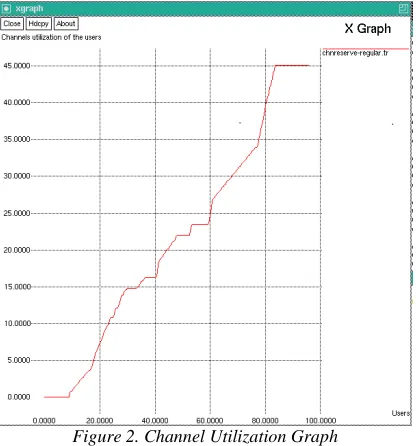
The Figure 2 shows the total channel utilization graph. The total number of users considered here is 100 and the number of available channel is 45.
Figure 2. Channel Utilization Graph
The application of PBCR algorithm shows that when 20 users arrives the cell, the channels used is minimum and as the number of users increase the utilization also increases respectively. Since the bandwidth utilization is dependent on the number of users, the bandwidth is not wasted unnecessarily. It is proved from Figure 2, that even at the maximum load, the channel utilization is better.
[image:5.612.315.523.277.500.2]Figure 3. Comparison of Call Dropping Probability Graph
It was possible to minimize the call dropping probability. From Figure 3 it is clear that, when 80 users arrive the cell the number of calls failed using ACR algorithm is 0.55. But when PBCR is applied the number of call failures is drastically reduced and it is only 0.25. it is proved that PBCR works better than the tradition CAC algorithms, since the call arrival is predicted and upon the prediction the channels are reserved and utilized.
5. CONCLUSION
By proper prediction of the movement of the users, it is possible to manage the critical scarcity of bandwidth. The channels are rationally shared among the users and hence the users may not feel difficult to get channels when they cross the cell boundaries. PBCR algorithm distinguishes the regular and irregular users and assigns high priority to regular users. So the regular users always enjoy the privilege and irregular users are promised with a guarantee service. Since the users are treated with level of priority, the available channels are shared effectively and call failures are also drastically reduced.
REFERENCES
[1]. Kolate, V. et al. (2012) “Call Admission
Control Schemes and Handoff Prioritization in 3G Wireless Mobile Networks” International Journal of Engineering and Innovative Technology, Volume 1, Issue 3.
[2]. Mahesh, G. et al. (2012) “Channel Reservation
Model for User Class Based Admission Control in Next Generation Wireless Networks” International Journal of Computer Science Issues, Volume 9, Issue 3, No 2.
[3]. Dipti Varpe and Girish Mundada (2011) “A
Distributed Dynamic Channel Allocation in Cellular Communication” pp. 114-126.
[4]. Arunita Jaekel et al. (2011) “Optimal
Channel Allocation with Dynamic Power Control in Cellular Networks” International Journal of Computer Networks and Communications, Volume 3, No.2.
[5]. 5.Alioune Ngom et al. (2010) “Optimized
Hybrid Resource Allocation in Wireless Cellular Networks with and without Channel Reassignment” Journal of Computer Systems, Networks and Communications, Volume 2010, 11 pages.
[6]. Sudarshan Subhashrao Sonawane (2010)
“Channel Allocation Scheme in Cellular Systems” International Journal Advanced Networking and Applications” Volume 02, Issue 01, Pages 452-457.
[7]. Rajkumar Samanta et al. (2009) “Performance
Analysis of Cellular Wireless Network by Queuing Priority Handoff Calls” International Journal of Electrical and Electronics Engineering, Volume 3, Issue.
[8]. Muhammed Salamah and Hashem Lababidi
(2005) “Dynamically Adaptive Channel
Reservation Scheme for Cellular Networks” Computer Networks, Volume 49.
[9]. Zhong Xu et al. (2002) “A New Adaptive