RELIABILITY ASSESSMENT OF FIRE IN HIGH-RISE
BUILDING BASED ON CLEAR RATIONAL NUMBER
YANCANG LI, CHENGUANG BAN, SHUJING ZHOU, SHUANGHONG PENG, LINGREN KONG
College of Civil Engineering, Hebei University of Engineering, Handan 056038, China
ABSTRACT
Reliability assessment is more and more important for the design and construction of the building. The common models used today have the shortcomings of subjectivity. In order to find a more effective method for the structure reliability assessment, a novel mathematic, the clear mathematics was proposed. After the brief introduction of the basic knowledge of the clear mathematic, the assessment model based on the clear set was set up. Engineering practice in the fire reliability assessment of a high-rise building shows the efficiency and the rationality of the method. This study provides a novel method for the structure fire reliability assessment and other comprehensive assessment.
Keywords: Fire Reliability Assessment, Clear Mathematics, Clear Rational Number
1 INTRODUCTION
The rapid development of the technology has prompted the development of basic construction, and more and more high-rise buildings were constructed. Some buildings are more than 500 meters. Accidents caused by the ignoring of the structural fire reliability are often occurred [1-7]. The fire reliability assessment of high-rise buildings has significance in theory and practice. But, the traditional methods employed have the many shortcomings, for example, the fuzzy set which is the common tool of comprehensive assessment does not meet the three principles of measurement and it has the shortcoming of subjectivity [8, 9]. This situation has signified the methods study of the reliability assessment of high-rise buildings.
Based on this, a novel mathematic tool, the clear mathematics was introduced. And the reliability assessment model was set up. Then, its efficiency and the rationality are shown through the application in the engineering practice.
The rest of the paper was organized as follows. First, the basic knowledge of the clear mathematics was briefly introduced. Then, the assessment model based on clear set was set up and was employed to the fire reliability assessment of a high-rise building. And the advantage of the method was introduced.
2 ASSESSMENT MODEL BASED ON
CLEAR SET
2.1. Brief Introduction Of The Clear Mathematics
Proposed by Wu Huaying and WU Heqin in 2007, the clear mathematics is a new mathematics which overcomes the shortcomings of the fuzzy mathematics and the unascertained mathematics. The biggest advantage of the clear mathematics is that it meets the three principles of the measurement. The basic knowledge of the clear mathematics was introduced in [10]. Here, we will not repeat them.
2.2. Fire Reliability Assessment Model
The fire reliability assessment of high-rise buildings was categorized into 5 grades: great negative influence, little negative influence, no influence, little positive influence and great positive influence, which were expressed by
1
,
2,
3,
4,
5υ υ υ υ υ
respectively. Then, the evaluation setV
=
{ ,
υ υ υ υ υ
1 2,
3,
4,
5}
was developed. Andevery factor in it was assigned with the value 2,4
which
u i
ij(
=
1 2
,
…
,
m j
;
=
1 2
,
…
,
n
)
wassubjected to
k
factorsu
ij=
{
u
ij1,
u
ij2……
u
ijk}
in the third level.
(1) Simple- level assessment
First, the clear rational number of factors in the bottom level (the third level) was determined through the marks given by the groups of experts. Take a factor
u
as an example, the marks given to the factoru
were the 5 assigned values in the evaluation set and these 5 assigned values were determined by 5 groups of experts1 2 3 m
{ ,
,
};
1, 2,3, 4,5
l
a a a
a
l
µ
=
……
=
respectively.If
m
1 experts in group of expertsa
agreed withthe assigned value
υ
, and otherm m
−
1 expertsdid not state their position or disagreed, then the experts who agreed with this assigned value made the set
∆ =
µ
l{ ,
a a a
1 2,
3……
a
m1}
.Then the clear rational number of the factor was determined as follows:
1 1 1 2 2 2 3 3 3 4 4 4 5 5 5
|
|
|
|
|
|
|
|
|
|
( )
|
|
|
|
|
|
|
|
|
|
A x
µ
α
µ
µ
α
µ
µ
α
µ
µ
α
µ
µ
α
µ
⎧ ∆
=
⎪
⎪
⎪ ∆
=
⎪
⎪
⎪ ∆
⎪
=
⎨
=
⎪
⎪ ∆
=
⎪
⎪
⎪ ∆
=
⎪
⎪⎩
(1)For the comprehensive marks, their clear rational number can be obtained by the Equation (2).
1 1 2 2 3 3 4 4 5 5
2
4
( )
6
8
10
x
x
C x
x
x
x
β
β
β
β
β
=
⎧
⎪
=
⎪⎪
=
⎨
=
⎪
=
⎪
=
⎪⎩
(3)And the mean value of clear rational number is:
5 1 5 1
( ( ))
i i i i ix
E C x
β
β
==
=
∑
∑
(4)(2) Multi-level assessment
Based on the method above, the first level clear
rational number set
1 2
{
ij( ),
ij( )
ijk( )}
ij
A
=
A
x A
x
…
A
x
and its meanset
E
ij=
{ (
E A
ij1( )), (
x
E A
ij2( ))
x
…
E A
(
ijk( ))}
x
can be obtained.
For the second level evaluation, the second level
clear rational number set
1 2
{
i( ),
i( )
in( )}
i
A
=
C
x C
x
…
C
x
and its meanset
E
i=
{ (
E C
i1( )), (
x
E C
i2( ))
x
…
E C
(
in( ))}
x
can be determined by Equation (2).
For the third level evaluation, the third level of
clear rational number set
1 2
{
( ),
( )
m( )}
A
=
C x C x
…
C
x
and mean set1 2
{ (
( )), (
( ))
(
m( ))}
E
=
E C x
E C x
…
E C
x
canbe determined by calculating
1
( )
( )
k
i i i
C x
w A x
=
=
∑
.Until now, through the calculation of
1 2
{ ( ), ( ) m( )}
A = C x C x …C x
of the third level of clear rational number, the final comprehensive clear
3 ENGINEERING PRACTICE
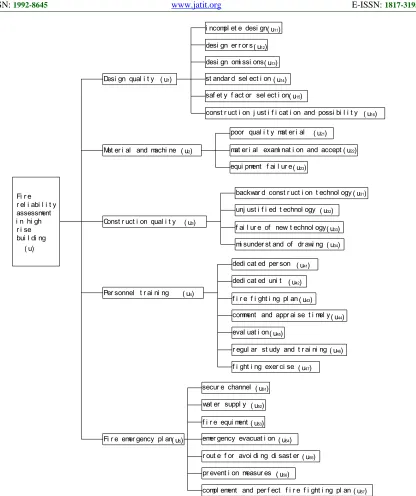
In order to verify the efficiency of the method proposed here, the assessment of a high-rise building was completed. The height of the high-rise building is 120m. The indexes system is shown in Figure 1.
By using this method, we can obtain the results of the first level assessment which is shown in Table 1
And the second level result is
(
0.121, 0.102, 0.113, 0.292, 0.372)
E=
. The final score of the high-rise building is 67.78, which belongs to the rank of “little positive influence”. By suing the fuzzy comprehensive assessment, we obtained the result is 70.13.
From the results, we can know that the given high-rise building should strengthen fire prevention activities. We can also know that the “Fire
emergency plan” (
u
5) and “Personnel training” (u
4)are the two most important factors.
Table I: Results Of The First Level Assessment
Indexes Results of the assessment
1
u (0.181, 0.277, 0.213, 0.092,0.120, 0.117)
2
u (0.381,0.212, 0.407)
3
u (0.233, 0.407, 0.211, 0.149)
4
u (0.073, 0.065, 0.177, 0.208, 0.055, 0.193, 0.229)
5
Fi r e r el i abi l i t y assessment i n hi gh r i se bui l di ng
Desi gn qual i t y
i ncompl et e desi gn
desi gn er r or s
st andar d sel ect i on
saf et y f act or sel ect i on desi gn omi ssi ons
const r uct i on j ust i f i cat i on and possi bi l i t y
Mat er i al and machi ne
Const r uct i on qual i t y
Per sonnel t r ai ni ng
Fi r e emer gency pl an
mat er i al exami nat i on and accept poor qual i t y mat er i al
equi pment f ai l ur e
backwar d const r uct i on t echnol ogy
unj ust i f i ed t echnol ogy
f ai l ur e of new t echnol ogy
mi sunder st and of dr awi ng
dedi cat ed per son
f i r e f i ght i ng pl an dedi cat ed uni t
comment and appr ai se t i mel y
eval uat i on
r egul ar st udy and t r ai ni ng
f i ght i ng exer ci se
secur e channel
f i r e equi ment wat er suppl y
emer gency evacuat i on
r out e f or avoi di ng di sast er
pr event i on measur es
compl ement and per f ect f i r e f i ght i ng pl an ( u)
( u1)
( u2)
( u3)
( u4)
( u5)
( u11)
( u12)
( u13)
( u14)
( u15)
( u16)
( u21)
( u22)
( u23)
( u31)
( u32)
( u33)
( u34)
( u41)
( u42)
( u43)
( u44)
( u45)
( u46)
( u47)
( u51)
( u52)
( u53)
( u54)
( u55)
( u56)
[image:4.612.102.518.79.575.2]ACKNOWLEDGEMENT
The work was supported by Natural Science Foundation of Hebei Province, China (No. E2012402030) and Foundation of Hebei Educational Committee(ZD2010222).
REFRENCES:
[1] J. C. Jiang, Z. L. Guo, Security systems engineering, Chemical Industry Press, Beijing. 2010, pp. 43-59.
[2] Ministry of Public Security Fire Station, 2010. Fire Yearbook, International Culture Publishing Company, Beijing, 2010, pp. 352.
[3] Zhang Y., “Analysis of fire characteristics on high-rise residential building”. Shanxi Architecture, No.31, 2008, pp.211-212.
[4] N. Krishnamurthy. “Safety in High-Rise Design and Construction”, Proceedings of 10th International Seminar on High Rise Structures, Mysore, India, 2006, pp.19-34.
[5] Gao Y., Zhang H., J. N. Yi, “Analysis on Fire Causes of High-rise Building and Fire Safety Countermeasures”, China Safety Science Journal. Vol.19, No.6, 2009, pp.149-153.
[6]W. Z. Black, Smoke movement in elevator shafts during a high-rise structural fire, Fire Safety Journal, Vol.44, No.2, 2009, pp.168-182. [7] R. S. Miller, D. Beasley, 2009. “On stairwell and
elevator shaft pressurization for smoke control in tall buildings,” Building and Environment Vol.44, pp.1306-1317.
[8] Yancang Li, Juanjuan Suo and Shujing Zhou, “New Reliability Assessment Model for Civil Engineering Structure”, International Workshop on Modelling, Simulation and Optimization, Hong Kong, 2008.
[9] Muyu Liu, “Comprehensive fuzzy assessment on the life-cycle environment impact of bridges”, Journal of Civil Engineering, Vol. 42, No.1, 2009, pp.55-59.