ISSN: 1992-8645 www.jatit.org E-ISSN: 1817-3195
A SECURE SCHEME FOR HETEROGENEOUS
WIRELESS SENSOR NETWORKS
1YUQUAN ZHANG
1Lecturer, School of Information Technology, Shandong Women’s University, Jinan, China
E-mail: [email protected]
ABSTRACT
A secure scheme for heterogeneous wireless sensor networks is presented. The wireless sensor networks have some sensor nodes and heterogeneous sensor nodes that have greater power and transmission capability than other nodes have. All kinds of sensor nodes are evenly distributed respectively in entire sensing area that is divided into a number of same cells and logical groups evenly. The pairwise keys between nodes including all kinds of nodes are set up through employing the concept of the overlap key sharing, the grid-based key predistribution scheme, and the random key predistribution scheme. The two-dimensional sensing square is divided into a number of small squares called cells, four of which are comprised of a cluster called logical group for class 1 nodes. Analysis shows that both the security and the connectivity of wireless sensor networks have been enhanced evidently with some heterogeneous nodes.
Keywords: Heterogeneous Wireless Sensor Networks, Security, Connectivity, OKS
1. INTRODUCTION
The recent advances in wireless communications, integrated electronics, and microelectromechanical systems (MEMS) technology have facilitated the development of wireless sensor networks[1]. A wireless sensor network can be considered a especial type of ad hoc network composed by a large number of tiny, cheap and highly resource constrained sensor nodes, known as motes[2]. Typically, a sensor node is a tiny device that includes three basic components: a sensing subsystem for data acquisition from the physical surrounding environment, a processing subsystem for local data processing and storage, and a wireless communication subsystem for data transmission. All sensor nodes have constraints on resource, including energy, memory, computation speed, and bandwidth because of their constraints on size and cost.
Wireless sensor networks have received tremendous attention in recent years because of their potential various applications in many fields, such as healthcare[3], greenhouse monitoring[4], and forest fires and plant fires monitoring[5] etc.
The unique constraints of sensor nodes and the requirements of wireless sensor networks have spurred considerable investigation into the security issue for wireless sensor network.
through using the grid-based key predistribution scheme. Cungang Yang, Celia Li, Jie Xiao[12] guarantee that any two nodes establish their pairwise key in the case there are no compromised node. In addition, Lai D et al.[13] presented the OKS (Overlap-Key-Sharing) protocol. The scheme generates a long bit-string to be the key-string-pool (KP) of the sensor network, and randomly assigns a subset of the key-string-pool to be the key-string stored in each sensor. Sensors in OKS protocol use the overlap intervals (number of bits overlapping between neighbors) of the key-strings as the shared secret key with their neighbor nodes.
This paper proposes a secure key management strategy for heterogeneous wireless sensor networks through utilizing the random key predistribution scheme, the overlap key sharing (OKS) concept, the grid-based key predistribution scheme, and dividing sensing area into two-dimensional clusters. The scheme investigates how the heterogeneous nodes affect the distributed wireless sensor networks. The overlap key sharing protocol creates long bit clusters as the key cluster pools and randomly distributes a sub-group to store every sensor as key cluster. The two-dimensional sensing square is divided into a number of small same squares called cells. In a certain cell, there are some class 0 nodes and a class 1 node, and all class 0 nodes are evenly distributed in the cell and the class 1 node is in the center of the cell. Four of cells are comprised of a cluster called logical group. In a certain logical group, the setup server generates and then distributes keys to all class 1 nodes to guarantee that any two class 1 nodes can establish a pairwise key. Analysis and comparison demonstrated in this strategy heterogeneous nodes improve the resilience of HWSNs, and enhance the network connectivity.
The rest of this paper is organized as follows. In section two, the distributed key management scheme for WSNs with heterogeneous nodes is given. The scheme contains classes of nodes, key generation and distribution for all kinds of nodes, location-based grids, and pair-wise key establishment among all kinds of nodes. The section three discusses the performance for wireless heterogeneous sensor network. The conclusion of this paper is in section four.
2. DISTRIBUTED KEY MANAGEMENT
SCHEME
In this paper, I present a key management strategy in distributed peer-to-peer wireless sensor networks that are composed of heterogeneous
sensor nodes. The scheme can be described in detail as follows.
2.1 Classes Of Nodes
We propose that there are I classes of sensor nodes in the WSNs, with Class 0 being the least powerful nodes, and Class
I
−
1
the most powerful nodes, in terms of their power. Particularly, we make some assumptions.(1) There are bi-directional links among sensor nodes.
(2) Let
r
i (0
≤ ≤ −
i
I
1
) denotes the communication range of classi
nodes, we alwayshave
1 2
i i
r
<
r
ifi
1<
i
2.Where, in this paper, we let
I
=
2.
We ought to differ the heterogeneous WSNs from the hierarchical WSNs. In the former, the communications among all different classes of nodes are still on distributed peer-peer basis, although the higher class nodes have more powerful computing processing capacity, communication capacity, and energy than the lower ones. On the other hand, in the latter, the clusters (or the base stations) are centralized nodes.
2.2 Key Generation And Distribution
The key generation of the heterogeneous distributed wireless sensor networks is based on the random key distributions, the grid-based key predistribution scheme, and the OKS (Overlap-Key-Sharing) protocol. Taking the heterogeneity into account, this paper employs a randomly generated long bit-string as a key pool for all kinds
of nodes in each cell and employs 2
m
kt
-degreebivariate polynomials as the key pool for all class 1 nodes in each logical group.
For all kinds of nodes in each cell, one of the challenging tasks in this strategy is how to distribute bit-string shares into different classes of nodes, we will firstly deal with the issue in this section.
Firstly, we divide equally the classes of sensor
nodes into J groups, denoted as
C
'00 ,
,' 0
C
j' ,
'0
C
J' , ' 10C
,
,C
1'j' ,
,'
1
C
J' ,
, '0
C
i' ,
, 'C
i j' ' ,
, 'C
i J' ' ,
,'
0
C
I' ,
, ' 'C
I j' ,
, 'C
I J' ' , where' '
0
≤ ≤
i
I
,' '
ISSN: 1992-8645 www.jatit.org E-ISSN: 1817-3195
unique group ID j is assigned to all those groups
and
j
=
0
,
,j
=
j
' ,
,j
=
J
' ,'
1
j
=
J
+
,
,j
=
J
'+ +
j
'1
,
,'
2
1
j
=
J
+
,
,j
=
i J
'(
'+
1)
,
,' ' '
(
1)
j
=
i J
+ +
j
,
,j
=
i J
'(
'+ +
1)
J
',
,' '
(
1)
j
=
I J
+
,
,j
=
I J
'(
'+ +
1)
j
' ,
,j
=
I J
'(
'+ +
1)
J
'.Secondly, the setup server generates
I
long bit-strings, where a unique key pool IDi
is assignedto each long bit-string, denoted as
S
0 ,1
S
,
,S
I−2,S
I−1, and then takesS
0, denoted as0
Ω
, as the key-string-pool for 0 class of sensor nodes, the combination ofS
0 andS
1, denotedas
Ω
1, as the key-string-pool for 1 class of sensornodes and so on. In this paper, we let
I
=
2
. Thirdly, a subset of those key-string-pools,denoted as
Ω
ij, can be created for nodes in classi
and group
j
. Particularly, we let0
( )
i
ij ij
k
k
Ω
Ω
=
=
, (1)W h e r e
Ω
ij(0)
⊆
Ω Ω
0,
ij(1)
⊆
Ω
1,
2
(2)
,
,
( )
ij ij
k
kΩ
⊆
Ω
Ω
⊆
Ω
, na me l y ,( )
ij
k
Ω
is a subset of the key-string-pool that is selected fromΩ
k.From (1), we can see that in group j, two classes
1
i
andi
2 (i
1<
i
2 ) will be able to share somecommon bit-strings if there exists
k
1 ,k
2(
k
1≤ <
i
1i
2) (k
2≤ <
i
1i
2) such that1
( )
1 2(
2)
i j
k
i jk
Ω
Ω
≠ ∅
(2)Where
1
(0)
0,
1(1)
1,
i j i j
Ω
⊂
Ω Ω
⊂
Ω
1
(2)
2,
,
1(
1)
1i j i j
k
kΩ
⊂
Ω
Ω
⊂
Ω
, namely1
( )
1 1;
2(0)
0,
2(1)
1,
i j
k
k i j i jΩ
⊂
Ω Ω
⊂
Ω Ω
⊂
Ω
2
(2)
2,
,
2(
2)
2i j i j
k
kΩ
⊂
Ω
Ω
⊂
Ω
, namely2
(
2)
2i j
k
kΩ
⊂
Ω
.
In this paper, two classes 0 and 1 in the same group will be able to share some common bit-strings if
0j
(0)
1j(0)
Ω
Ω
≠ ∅
(3)Where
Ω
0j(0)
⊂
Ω
0 andΩ
1j(0)
⊂
Ω
0. Similarly, for the same classi
, nodes in twodifferent groups
j
1≠
j
2 will be able to sharecommon bit-strings if there exists two different
k
1and
k
2(k
1≤
i
) (k
2≤
i
) such that1
( )
1 2(
2)
ij
k
ijk
Ω
Ω
≠ ∅
(4)Where
1
(0)
0,
1(1)
1,
ij ij
Ω
⊂
Ω Ω
⊂
Ω
1
(2)
2,
,
1(
1)
1ij ij
k
kΩ
⊂
Ω
Ω
⊂
Ω
, namely1
( )
1 1;
2(0)
0,
2(1)
1,
ij
k
k ij ijΩ
⊂
Ω Ω
⊂
Ω Ω
⊂
Ω
2
(2)
2,
,
2(
2)
2ij
C
ijk
kΩ
⊂
Ω
⊂
Ω
, namely2
(
2)
2ij
k
kΩ
⊂
Ω
.
In this paper, class 0 nodes in different groups
share nothing, namely,
1 2
0j
( )
k
1 0j( )
k
2Ω
Ω
= ∅
,where
1
0j
(0)
Ω
⊂
Ω
0 , and2
0j
(0)
Ω
⊂
Ω
0 , and class 1 nodes in different groups may share somecommon keys, namely,
1 2
1j
( )
k
1 1j( )
k
2Ω
Ω
≠ ∅
,where
1
1j
(0)
Ω
⊂
Ω
0 ,Ω
1j1(1)
⊂
Ω
1 ,2
1j
(0)
Ω
⊂
Ω
0,2
1j
(1)
Ω
⊂
Ω
1.At last, the setup server picks up a subset of
key-strings, denoted as
Φ
ijn(Φ ⊆
ijnΩ
ij) for a noden
in class
i
and groupj
, and then assigns the key-string shares of these key-key-strings to the node.2.3 Location-Based grids
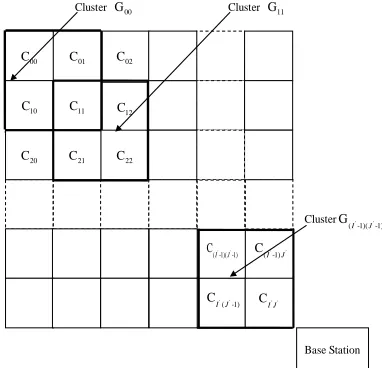
In Fig. 1, The sensor area
S
area is divided into' '
(
I
+
1)(
J
+
1)
same cells, denoted asC
00 ,01
C
,
,C
0j' ,
,C
0(J'-1) , 0C
J' ,C
10 ,C
11 ,
C
1j' ,
,C
1(J'-1) , 1C
J' ,
,C
i'0,C
i'1,
,C ,
i j' '
,C
i J'( '-1),C
i J' ',
,C
I'0,C
I'1,
,C
I j' ',
,C
I'(J'-1) ,C
I J' ' , where0
≤ ≤
i
'I
' and' '
locations. The sensor nodes in group
C
'i j' ' aredeployed in cell
C
i j' '. A logical group consists offour cells. For example, in Fig. 1, cluster
( 1)( 1)
G
I -' J -' consists of cellC
I J' ' ,C
I'(J -'1) ,( 1)
C
I -' J' andC
(I -'1)(J -'1) . IfI
'=
J
' , there are' 2
(
I
−
1)
=
' 2(
J
−
1)
logical groups.Suppose that
N
0 class 0 nodes are evenlydistributed in each cell and a class 1 node is in the center of each cell.
2.4 Pair-Wise Key Establishment
To establish pair-wise keys between the sensor nodes, we also utilize the three steps, namely, initialization, direct key setup, and (optional) path key setup, as the previous papers did. Firstly, the initialization step is finished in a key setup center before the deployment of all the sensor nodes. The setup server distributes a subset of the key-string-pool to different sensor nodes. Secondly, any two sensor nodes try to establish a pair-wise key; of course, they always firstly attempt to do so via direct key establishment in a distributed peer-peer manner. If the second step is successful, the third step is omitted. Otherwise, these sensor nodes start
00
C
( -1)
CI' J' ( -1)( -1)
CI' J' 01
C C02
10
C C11 C12
20
C C21 C22
CI J'' ( -1)
CI J' '
Cluster G11
ClusterG( -1)(I' J'-1)
Base Station
[image:4.612.104.295.443.627.2]Cluster G00
Figure 1. Location-Based Cells And Clusters path key setup to establish a pair-wise key with the help of other nodes. In this paper, the third step can be disabled because of the heterogeneity.
3. THE PERFORMANCE ANALYSIS FOR WIRELESS HETEROGENEOUS SENSOR NETWORK
3.1 The Importance Of Heterogeneous Nodes In Node Connectivity
In Fig.1, two kinds of nodes, class 0 nodes and class 1 nodes, are distributed evenly in the sensing area. Suppose that the cell is a
a
bya
square, thecommunication range of class 0 nodes is 2a 2
, and
the communication range of class 1 nodes is 2a .
We investigate a WSN with heterogeneity that is utilized to collect data in a distributed peer-to-peer case. In this scenario, sensor nodes should transmit their observation to the base station via the wireless sensor network, as shown in Fig. 2, where there are two types of sensor nodes and there are four class 0
nodes, namely
N
0=
4
, in each group. Obviously,lower class nodes employ the links between themselves and the higher-class nodes to transmit their observations because the higher nodes have a larger transmission range. For example, in Fig. 2, class 0 node A will tend to use the path “A-B-C-D-Base Station” to transmit its data, instead of sending the message by class 0 nodes (the dash line). The class 0 node A chooses the class 1 node B as it’s the first hop node, instead of using class 0 nodes, even though the class 0 node is closer than the class 1 node B. Next, the class 1 node B chooses the class 1 node C as the second hop node. Therefore, a higher class node will more likely be chosen as the next hop node candidate to relay data. The connection between a lower node and a higher node is more possible and more important than between two lower class nodes.
ISSN: 1992-8645 www.jatit.org E-ISSN: 1817-3195 Base Station A B C D
Class 0 node
Class 1 node
[image:5.612.91.300.73.257.2]area S
Figure 2. An Example For Wireless Heterogeneous Sensor Network
From the above discussion, we know that all the key-string-pools for i (
i
=
0,1,
, -1
I
) classes of sensor nodes contain the long bit-stringsS
0 and allthe key-string-pools for i (
i
=
1, 2,
, I -1
) classes of sensor nodes contain the long bit-stringsS
0 and1
S
, and so on. Therefore, the same subset of key-strings will generate multiple keys at different nodes and the total number of the keys, which a class 0 node will share with all powerful nodes, is the summation of the number of all shared subset of key-strings between the class 0 node and each of the more powerful nodes.Let
I
=
2
andS
be the size of the key-string-poolΩ
1. Suppose thatP
0 andP
1 be the number ofsubset of key-strings that can be stored in a class 0 node and a class 1 node respectively. In a certain group, we calculate the probability, denoted as
p
( )
α
, that a class 0 node sharesα
sub key-strings with a class 1 node as follows0 0 1 0 1
( )
S
P
S
S
P
P
p
S
S
P
P
α
α
α
α
α
−
−
−
−
=
(5)Any a class 0 node and a class 1 node can establish secure connection if they share a key, therefore, the scheme can guarantee that the class 0 node and a class 1 node establish secure connection
if
0
1
( ) 1
p
p
α
≥∑
. We can obtain this result through choosing reasonableS
,P
0 andP
1.The setup server[11] randomly generates
2
m
kt
-degree bivariate polynomials{
c( , ), c( , )}
c 0,1, , 1k
c r
i i i m
F = f x y f x y = −
over a finite field
q
F for all class 1 nodes in each logical group,
where
m
k=
N
1 , hereN
1 is the total sensor node number in the group. Then, the setup serverassigns
{
, c( , ), r( , )}
c r r c
i j
ID f j x f i x for each
class 1 node where
ID
is the grid-based index of the class 1 node. TheID
of the class 1 node at theintersection of column coordinate
i
c and rowcoordinate
j
r is denoted asi j
c,
r (see Fig.3).Generally, there are two nodes 1 S and 2
S in a logical group which will establish a pairwise key.
1
S c he c k s i f 1 2 S S
c =c o r 1 2
S S
r =r wh e re
c
S1,2 S
c
,r
S1andr
S2are the column and row coordinatesof node 1
S and node 2
S respectively. If 1 2
S S
c =c
or 1 2 S S
r =r , node 1
S and node 2
S share common
p o l y n o m i a l k e y
1,2
( , )
S c c
f
x y
o r1,2
( , )
S r r
f
x y
w h e r e
1
( , )
2( , )
1,2( , )
S S S
c c c
c c c
f
x y
=
f
x y
=
f
x y
,1
( , )
2( , )
1,2( , )
S S S
r r r
r r r
f
x y
=
f
x y
=
f
x y
, t h e y c a ndirectly establish a pairwise key by utilizing the polynomial-based key predistribution scheme. Otherwise, if cS1 ≠cS2 and rS1 ≠rS2, nodes
1 S
and node S2 can still establish pairwise key via
r m -1
f (x, y)
r m -2
f (x, y)
r
r j
f (x, y)
- 2
c
i ,m c' - 2
i ,m
c r
i , j c' r
i , j
c r'
i , j i , jc' r'
r 1
f (x, y)
r 0
f (x, y)
c 0
f (x, y) c 1
f (x, y) c
c i
f (x, y) c
m -2
f (x, y) c m
f (x, y)
[image:5.612.319.516.532.685.2]an intermediate node 12
S with column
c
S1 androw
r
S2or node 21S with column
c
S2 and rowr
S1.Obviously, the strategy guarantees that each pair of class 1 nodes can set up a pairwise key if the two sensors can communicate with each other and that the information can be sent to the base station safely. Additionally, in each cell, the class 1 nodes can establish a pairwise key with each of class 0 nodes. Therefore, our scheme guarantees that all nodes, including class 0 nodes and class 1 nodes are connective and can set up secure communication.
3.2 The Importance Of Heterogeneous Nodes In Information Security
We denote
G
0 as the class 0 nodes andG
1 asthe class 1 nodes. We define that a
G
1 node is theneighborhood of a
G
0 node if it can directlyreceive a broadcast message sent from the
G
1node. Namely, the
G
0 node can obtain bit-stringpool information sent by the
G
1 node without thehelp of other sensor nodes. To simplify the issue,
we assume that a
G
0 node can send data to anyG
1in its neighborhood through either a one-hop link if the distance between them is small enough, or a multi-hop manner if the distance is larger than a threshold.
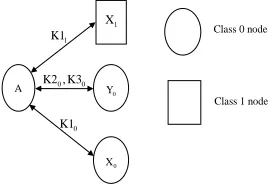
We give an example to illustrate this strategy in Fig. 4, where node A,
0
X and
Y
0 areG
0 nodes, and node1
X is a
G
1 node. In this case, node0
X ,
0
Y
and X1 are the only neighbor nodes of the nodeA. Additionally, node A shares key K1i(
i
=
0,1
) withi
X (
i
=
0,1
) respectively, similarly, node A shares key K20 and0
K3 with node
Y
0. In this scenario, if node A sends messages to the sink node, certainly, it will firstly choose the keyK1
1. If the distancefrom node A to nodeX1 is larger then a threshold,
moreover, in the path from node A to node
X
1, there are compromised nodes, the node A will not connect with it. In the same way, the node A will try to connect with a class 0 node,X0 orY
0, until its data transmit to the sink node. Obviously, in the WSNs with heterogeneous nodes, the communication is more resilient.Generally, If a class 0 node is captured and compromised by enemy in a certain cell, it will not reveal any information of class 0 nodes in other cells, because it shares no key with them. Additionally, the class 1 in the same cell is difficult to be compromised because the class 1 nodes are more powerful to attack than class 0 nodes. Therefore, the scheme improves the security for WSNs.
0
X A
Class 0 node
Class 1 node
0
Y
1
K1
0
K1
0 0
K2 , K3
1
[image:6.612.353.489.223.315.2]X
Figure 4. An Example In The Scheme
4. CONCLUSION
Key management is of importance to guarantee wireless sensor networks secure and it has been investigated recently. In most existing wireless sensor networks, however, all sensor nodes are assumed to have same capability. This paper research how heterogeneous nodes effect the performance including security and connectivity for WSNs. All kinds of sensor nodes are distributed evenly in sensing area that is divided into a number of same cells. For class 1 nodes, four of cells consist of a logical group. The pairwise keys between nodes including all kinds of nodes are established by employing the concept of the overlap key sharing, the grid-based key predistribution scheme, and the random key predistribution strategy. Analysis and comparison show some heterogeneous nodes improve both the security and connectivity effectively. Generally, it is difficult to improve the security and connectivity simultaneously in homogeneous wireless sensor networks, so this scheme deals with some WSNs limitations and has more applications including military and civilian fields.
REFRENCES:
ISSN: 1992-8645 www.jatit.org E-ISSN: 1817-3195
personal area networks. IEEE Communications Magazine, 2002, 40(8): 70-77.
[2] J. Yick, B. Mukherjee, D. Ghosal. Wireless sensor network survey. Computer Networks, 2008, 52(12): 2292-2330.
[3] J. Yoo, L Yan, S. Lee, Y. Kim, H.-J. Yoo. A 5.2 mw self-configured wearable body sensor network controller and a 12 w wirelessly powered sensor for a continuous health monitoring system. IEEE Journal of Solid-State Circuits, 2010, 45(1):178-188.
[4] M. Mancuso, F. Bustaffa. A Wireless Sensors Network for Monitoring Environmental Variables in a Tomato Greenhouse. at 6th IEEE International Workshop on Factory Communication Systems in Torino, Italy, June 28-30,2006, 2006, 107-110.
[5] A. S. Tanenhaum, C. Gamage, C. Crispo. Taking Sensor Networks from the Lab to the Jungle. IEEE Computer, 2006, 39(8):98-100. [6] L. Eschenauer. V. D. Gligor. A
key-management scheme for distributed sensor networks. in Proc. CCS’02: 9th ACM Conference on Computer and Communications Security. New York: ACM Press, Nov. 2002, 41-47.
[7] H. Chan, A. Perrig, D. Song. Random key predistribution schemes for sensor networks. in Proc. IEEE Symposium on Research in Security and Privacy, May 2003, 197-213. [8] P. Ning, R. Li, D. Liu, establishing pairwise
keys in distributed sensor networks, ACM Transactions on Information and System Security, 2005, 8(1): 41-77.
[9] M.F. Younis, K. Ghumman, M. Eltoweissy, Location-aware combinatorial key management scheme for clustered sensor networks, IEEE Transactions on Parallel and Distributed Systems, 2006, 17(8): 865-882. [10]H. Chan, A. Perrig. PIKE: peer intermediaries
for key establishment in sensor networks. In: Proceedings of the 24th annual joint conference of the IEEE Computer and communications societies (INFOCOM’05), Miami, FL, USA, March 2005, 524-35.
[11]D. Liu, P. Ning. Location-based pairwise key establishments for static sensor networks. in ACM Workshop on Security in Ad Hoc and Sensor Networks (SASN’03),2003,72-82.
[12]Y. Cungang, L. Celia, X. Jie. Location-based design for secure and efficient wireless sensor networks. Computer networks, 2008,52:3119-3129.