Hiding Data in Text using ASCII
MappingTechnology (AMT)
Souvik Bhattacharyya
Department of CSE University Institute of
Technology, The University of Burdwan
West Bengal,India
Pabak Indu
Department of CSE University Institute of
Technology, The University of Burdwan
West Bengal,India
Gautam Sanyal
Department of CSE National Institute of Technology,Durgapur
West Bengal,India
ABSTRACT
In current digitized world humane race is facing a great revolution over Internet technologies, as a result every single information needs to be transmitted through a communication network. This results a different level of attack over these information. This attacks, misuse or unauthorized access of this information are greatest concern of today‟s world. Steganography means “covered or hidden writing”, originated from Greek language, an ancient art of protecting information. Considerable amount of work has been carried out by different researchers on Steganography. In this paper the authors propose a novel text steganography method based on ASCII Mapping Technology (AMT) on English language producing stego text with which is visibly indistinguishable from the original cover text. There is an extra level of security which is achieved through a derived quantum gate. This solution is independent of the nature of the data to be hidden and produces a stego text with minimum degradation and applicable for other India languages also. Quality of the stego text is analyzed by tradeoff between no of bits used for mapping. Efficiency of the proposed method is illustrated by exhaustive experimental results and comparisons.
General Terms
Steganography, Cover Text, Stego Text, Quantum gates, C-NOT gate, SWAP gate, C-NOT gate.
Keywords
AMT (ASCII Mapping Technology), CS gate, CSN gate, POS file, Jaro-Winkler Distance.
1.
INTRODUCTION
In current world the main concern of the information transmission over a communication network is the protection of data from unauthorized user. To deal with this problem, there exists several information hiding mechanisms like, Steganography, Cryptography, Digital watermarking etc. The first two techniques provides protection on data where as the third one gives the authentication over the data using some tag or labeling on some objects like text, audio, video, image [1].
As the goal of steganography is to hide the presence of a message and to create a covert channel, it can be seen as the complement of cryptography, whose goal is to hide the content of a message. The message is hidden in anothermedia such that the transmitted data will be meaningful and innocuous looking to everyone. In summary it can be said
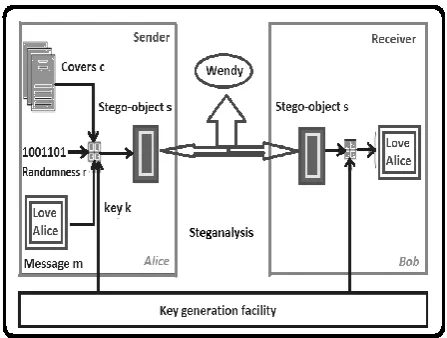
[image:1.595.317.541.445.614.2]cryptography attempting to conceal the content of the secret message, steganography conceals the very existence of that [2, 3]. Steganalysis is the art of detecting any hidden message on the communication channel. If the existence of the hidden message is revealed, the goal of steganography is defeated. A famous illustration of modern day steganography is Simmons‟ Prisoners‟ Problem [4]. An assumption can be made based on this model is that if both the sender and receiver share some common secret information then the corresponding steganography protocol is known as then the secret key steganography where as pure steganography means that there is none prior information shared by sender and receiver. If the public key of the receiver is known to the sender, the steganographic protocol is called public key steganography [3], [5] and [6]. For a more thorough knowledge of steganography methodology the reader is advised to see [7-8]. Figure 1 show below the framework of modern day steganography.
Figure 1: Frame work of modern day Steganography
A message is embedded in a Cover-Object with the help of a embedding algorithm and a key, which is shared by both sender and receiver, thus resulting an identical Stego-Object which is transmitted through a communication channel and the extraction algorithm extracts the secret message from the Stego-Media with the help of the key
Figure 2: Types of Steganography
[image:2.595.59.259.581.634.2]Among them Image Steganography is most popular of the lot. In this technique secret message is embedded into an image as a noise, whose detection is nearly impossible to an human eye [9, 10, 11]. Audio Steganography embeds the message into a cover audio file as noise at a frequency beyond human hearing range [12-13]. A video is nothing but a collection of moving images, with some audio associated. Video Steganography can be achieved by the same methods used previously. Linguistic Steganography or Text Steganography is a major, and perhaps most difficult kind of this category. The Text Steganography is a method of using written natural language to conceal secret message as defined by Chapman et al [14]. Some Steganographic model with high security features has been presented in [15-18].
In steganography two aspects are usually addressed. First, the cover-media and stego media should appear identical under all possible statistical attacks. Second, the embedding process should not degrade the media fidelity, that is, the difference between the stego media and the cover-media should be imperceptible to human perceptual system.
This paper has been organized as following sections:- Section II discusses about some of the related works done based on text steganography. Section III describes proposed text steganography method. Section IV describes the Mathematical formulation of the processes. Solution methodology has been provided in section V. Section VI describes different algorithms .Section VII contains the analysis of the results. Section VIII compares the proposed method with other existing and Section IX draws the conclusion.
2.
REVIEW OF RELATED WORKS IN
TEXT STEGANOGRAPHY
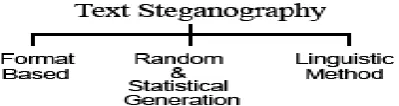
Depending upon the method used, the text steganography can be classified into three categories as shown in Figure 3.
Figure 3 : Classification of Text Steganography
2.1
Format-Based
Format-Based methods use and change the formatting of the cover-text to hide data. This method does not bring any change to any sentence or to any word. Thus the „value‟ of the cover-text is unharmed. A format-based text steganography method is open space method. In this method extra white spaces are added into the text to hide information. A single space represents “0” while two consecutive spaces are represented as “1”. By line and word shifting [19],
manipulating the white spaces between words and paragraph [20] this method can also be achieved. In line shifting method, vertical alignments of some lines of the text are shifted to create a unique hidden shape to embed message in it [21].
2.2
Random and Statistical Generation
Random and statistical generation methods are used to generate cover-text automatically according to the statistical properties of language. These methods use example grammars to produce cover-text in a certain natural language. A probabilistic context-free grammar (PCFG) is a commonly used language model where each transformation rule of a context-free grammar has a probability associated with it [22].The quality of the generated stego-message depends directly on the quality of the grammars used. Another approach to this type of method is to generate words having same statistical properties like word length and letter frequency of a word in the original message. The words generated are often without of any lexical value.
2.3
Linguistic Method
The Linguistic method [23] considers the linguistic properties of the text to modify it. To hide information the method uses the linguistic structure of the message. Syntactic method is a linguistic steganography method where some punctuation sign like comma (,) and full-stop (.) are placed in proper places in the document to embed data.
2.4
Changing Alphabet Letter Pattern
(CALP)
CALP is a new method for text steganography presented in [24, 25]. In this method, considering the structure of English alphabets each one or two bit of the binary sequence of the secret message has been mapped through some little structural modification of some of the alphabets of the cover text .This approach uses the idea of structural and feature changing of the cover carrier which is not visibly distinguishable from the original to the human beings and may be modified for other India language also. This solution is independent of the nature of the data to be hidden and produces a stego text with minimum degradation.
2.5
Other Methods
Except the above mentioned methods, there are some other methods proposed for text steganography, such as feature coding, text steganography by specific characters in words, abbreviations etc. [26] or by changing words spelling [27]. Some other methods like Text Steganography by Inter-word Spacing and Inter paragraph Spacing Approach [20] or Text Steganography by Using Letter Points and Extensions [28]. Text Steganography by Word Mapping Method (WMM) [29] are also exist.
3.
PROPOSED METHOD OF TEXT
STEGANOGRAPHY
USING
ASCII
MAPPING TECHNOLOGY
(AMT)
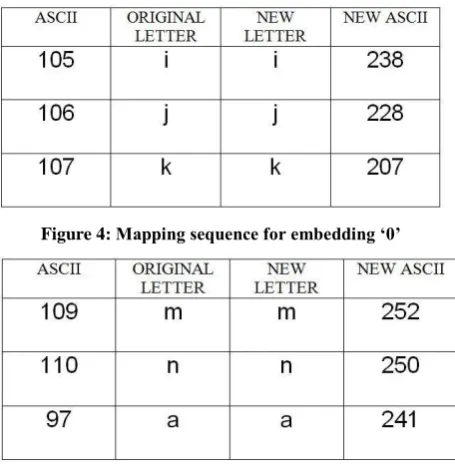
the secret message through the ASCII mapping technique of some alphabets of the cover text. Figure 5 and 6 below respectively shows the mapping sequence for embedding 0s and 1s through the ASCII mapping technique of some of the alphabets of the cover text. These ASCII mapping technique have been incorporated using some unused symbols in the ASCII chart. This method duplicates some of the alphabets as shown in figure 4 and 5 to some unused ASCIIs of the English language for embedding/mapping 0s and 1s respectively. Before mapping operation derived quantum logic has been used for selecting the valid embedding or mapping positions which added an extra level of security.
Figure 4: Mapping sequence for embedding ‘0’
Figure 5: Mapping sequence for embedding ‘1’
3.1
Derivation of the Quantum Logic
Authors have derived quantum logic through the combination of C-NOT gate, SWAP gate and quantum NOT gate. The figure 6 below illustrates the steps of the derivation.
Figure 6: Derivation steps of the Quantum Logic
As shown in the figure 6 there is a OR operation has been carried out between C-NOT gate and SWAP gate to generate 1st derived gate which in turn logically ORed with NOT gate results the desired quantum logic, used to increase an extra level of security.
3.2
Extra Level of Security through
Quantum Logic
As discussed in earlier section the quantum logic has been incorporated to provide an extra level of security. The derived quantum principle is placed over the cover text in a grid format and the 1‟s generated signifies valid embedding positions where 0‟s makes the embedding positions invalid. Figure 7 shows a sample cover text where the underlined letters are the embedding positions. After applying derived quantum logic (as shown in figure 8) over that cover text some embedding positions are discarded as marked in figure 9. The encrypted POS file contains the positional values of 0‟s from the secret messages and the user can decrypt it and compare with the secret message which has been extracted from the stego text for authentication. This encryption of POS file is done using integer wavelet transform (discussed in section 4.2).
[image:3.595.314.540.265.609.2]Figure 7: A Sample Cover Text
Figure 8: Derived quantum logic
Figure 9: After applying derived quantum logic, circular letters are discarded as embedding positions.
4.
MATHEMATICAL FORMULATION
OF THE PROCESSES
In this section the necessary essence of mathematical formulation of the algorithms are discussed.
4.1
Quantum Gates
[image:3.595.57.281.511.677.2]conventional digital circuits. Quantum logic gates are reversible like other classical logic gates. However, classical computing can be performed by the help of only reversible gates. Quantum gates are represented as matrices. A gate which acts on k qubits is represented by a 2k x 2k unitary matrix. The number of qubits in the input and output of the gate is equal. There are various types of quantum gates are represent the qubits. They are Hadamard gate, Pauli-X gate, Pauli-Y gate, Pauli-Z gate, Phase shift gates, Swap gate, Controlled gates, Toffoli gate, Fredkin gate, etc. Here we use Controlled gates to represent the qubits and control the operations. In this paper authors have used three quantum gates i.e. NOT gate, CNOT gate, SWAP gate. The figure 10, 11, 12 shows the truth table of these gates.
Figure 10: NOT gate
Figure 11: C NOT gate
Figure 12: SWAP gate
It can also write this in the form of a matrix, or as a graphic. The matrix form lists the lines in the truth table in the form <0>, <1>. The matrix field with 1's and 0's such that each horizontal or vertical line has exactly one 1, which is to be interpreted as a one-to-one mapping of the input to the output. The controlled gates act on 2 or more qubits, where one or more qubits act as a control for some operation. For example, the controlled not gate (or C-NOT) acts on 2 qubits, and performs the NOT operation on the second qubit only when the first qubit is , and otherwise leaves it unchanged. The swap gate swaps two qubits.
4.2
Integer Wavelet Transform
Authors have used integer wavelet transform [33-35] as the encryption function to encrypt the pos file which ensures that the message is sent from an authorized end. The integer wavelet transform through lifting scheme is an algorithm to calculate wavelet transforms in an efficient way. It is also a generic method to create so-called second-generation wavelets. They are much more flexible and can be used to define wavelet basis on an interval or on an irregular grid, or even on a sphere. The wavelet lifting scheme is a method for
decomposing wavelet transform into a set of stages. An advantage of lifting scheme is that they do not require temporary storage in the calculation steps and have required less no of computation steps. The lifting procedure consists of three phases, namely, (i) split phase, (ii) predict phase and (iii) update phase. Figure 13 shows the lifting scheme forward wavelet transformation
Figure 13: Lifting Scheme Forward Wavelet Transformation
Splitting: Split the signal x into even samples and odd samples:
𝒙𝒆𝒗𝒆𝒏 : 𝒔𝒊← 𝒙𝟐𝒊 . 𝒙𝒐𝒅𝒅 : 𝒅𝒊← 𝒙𝟐𝒊+𝟏 .
Prediction Predict the odd samples using linear interpolation:
𝒅𝒊← 𝒅𝒊− {(𝒔𝒊+ 𝒔𝒊+𝟏)/𝟐} .
Update: Update the even samples to preserve the mean value of the samples:
𝒔𝒊← 𝒔𝒊− {(𝒅𝒊−𝟏+ 𝒅𝒊)/𝟒} .
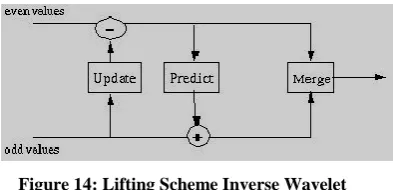
The output from the s channel provides a low pass filtered version of the input where as the output from the d channel provides the high pass filtered version of the input. The inverse transformed is obtained by reversing the order and the sign of the operations performed in the forward transform. Figure 14 demonstrates the lifting scheme inverse wavelet transformation.
[image:4.595.108.229.224.524.2]
Figure 14: Lifting Scheme Inverse Wavelet Transformation
4.3
Lifting Scheme Haar Transform
In the lifting scheme version of the Haar transform, the prediction step predicts that the odd element will be equal to the even element. The difference between the predicted value (the even element) and the actual value of the odd element replaces the odd element. For the forward transform iteration j
and element i, the new odd element, j+1,i would be
𝒐𝒅𝒅𝒋+𝟏,𝒊= 𝒐𝒅𝒅𝒋,𝒊− 𝒆𝒗𝒆𝒏𝒋,𝒊
In the lifting scheme version of the Haar transform the update step replaces an even element with the average of the even/odd pair (e.g., the even element si and its odd successor, si+1):
𝒆𝒗𝒆𝒏𝒋+𝟏,𝒊=
[image:4.595.337.534.485.580.2]The original value of the oddj,i element has been
replaced by the difference between this element and its even predecessor. Simple algebra lets us recover the original value:
𝒐𝒅𝒅𝒋,𝒊= 𝒆𝒗𝒆𝒏𝒋,𝒊+ 𝒐𝒅𝒅𝒋+𝟏,𝒊
Substituting this into the average,
𝒆𝒗𝒆𝒏𝒋+𝟏,𝒊=
𝒆𝒗𝒆𝒏𝒋,𝒊+ 𝒆𝒗𝒆𝒏𝒋,𝒊+ 𝒐𝒅𝒅𝒋+𝟏,𝒊 𝟐
𝒆𝒗𝒆𝒏𝒋+𝟏,𝒊= 𝒆𝒗𝒆𝒏𝒋,𝒊+
𝒐𝒅𝒅𝒋+𝟏,𝒊
𝟐
5.
SOLUTION METHODOLOGY
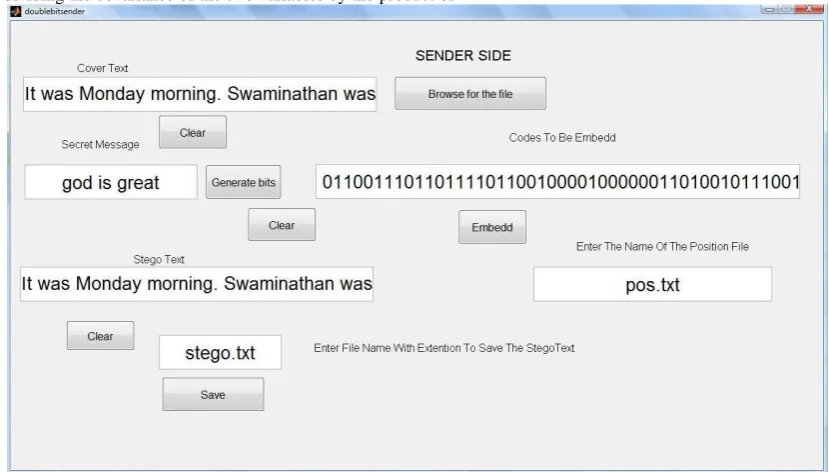
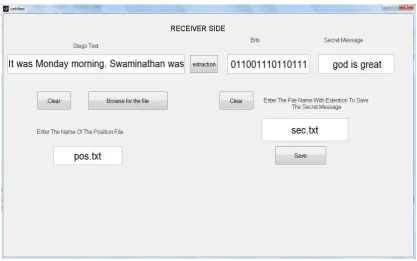
The proposed method contains of the following two windows. One is for sender side and one is for receiver side. The sender side takes the secret message and covers text, as an input and generates secret key, stego text and an encrypted pos file as output. The user should be able to generate secret message and cover text. The receiver side takes stego text and the encrypted pos file as input and retrieves the secret message. The user should be someone who is familiar with the process of information hiding and will have the knowledge of steganography system. Figure 15 and 16 shows the proposed methods for the corresponding GUI for the sender and receiver side of the proposed text steganography system respectively.
6.
ALGORITHMS
In this section different algorithmic approach for embedding and extraction process has been discussed. The secret message is converted into bits by their ASCII values and the secret bits are embedded through the embedding algorithm into the cover text to generate the stego text.
6.1
Algorithm for Embedding
Let COVER is cover text and STEGO is the string which consists of the stego text and MSG is the binary string of the secret message and N is the no of elements in the MSG. Initially COVER and STEGO are the same. Set two counters i , p , j and r initialize to 1. POS is an array which contains the positions of “0” bits of MSG and ENCRYPT is the function which encrypts a value using INTEGER WAELET TRANSFORM. QG contains the value of the derived quantum logic.
Step 1: Generate an appropriate COVER consisting of “a” or “m” or “n” and “i”, “j”, “k” Let l be the size of the COVER. Copy the contents of the COVER into STEGO.
Step 2: For j=1to l
Step 3: If QG(i)==1 then do
goto step 4 and i:=i+1
Else
j:=j+1, i:=i+1
Step 4: If (COVER(j)== “a” or “m” or “n” and MSG(r)== “1”)
then STEGO(j) := “a” or “m” or “n” and r := r+1
Else if (COVER(j)== “i” or “j” or “k” and MSG(r)== “0”)
then STEGO(j) := “i” or “j” or “k” and r := r+1
Step 5: End of IF statement
Step 6: End of IF statement
Step 7: End of For loop
Step 8: For i=1 to N Step 9: If (MSG(i)== “0”)
then pos(p)= ENCRYPT(i) and p := p+1
Step 10: End of If
Step 11: End of For loop
Step 12: End
6.2
Algorithm for Extraction
Let STEGO is the stego text and MSG is the binary string of the secret message and N is the no. of elements in the STEGO and i and r be two arbitrary variables and j is initialize to 1. POS is an array which contains the positions of “0” bits of MSG and DECRYPT is the function which reverses the encrypt action on a value LENGHT (MSG) gives the length of the secret message. SP is the number of element in the POS.
Step 1: For i=1 to N
Step 2: If ( STEGO(i)== “a” or “m” or “n”)
then MSG(r) := 1
Else if ( STEGO(i)== “i” or “j” or “k”)
then MSG(r) := 0
Step 3: End of If statement
Step 4 : End of For Loop
Step 5: For i=1 to SP
Step 6: IF(MSG(DECRYPT(POS(i))) == 0)
then message is authentic.
Step 7: End of If statement
Step 8: End of For loop
Step 9: End
7.
ANALYSIS OF THE RESULT
There are mainly three aspects should be taken into account when discussing the results of the proposed method of text steganography. They are security, capacity and robustness. The authors simulated the proposed system the results are shown in the figure 17, 18, 19 and 20 respectively. This method serves with better embedding capacity, security as well as authentication aspect also. It generates the stego text with zero degradation which is not very revealing to people about the existence of any hidden data, maintaining its security to the eavesdroppers. The embedding capacity increases as the size of the cover text increases and the encrypted file pos takes care of the authentication.
7.1
Similarity Measure of the Cover Text
and Stego Text through Shannon Entropy
Measure
associated with a random variable, i.e. the expected value of the information in the message [36]. Shannon entropy allows estimating the average minimum number of bits needed to encode a string of symbols based on the alphabet size and frequency of the symbols. The Shannon entropy is calculated using formula:
𝑯 𝑿 = 𝒑 𝒙𝒊 𝑰 𝒙𝒊 = 𝒏
𝒊=𝟏
𝒑 𝒙𝒊 𝒍𝒐𝒈𝒃 𝟏 𝒑 𝒙𝒊 𝒏
𝒊=𝟏
= − 𝒑 𝒙𝒊 𝒍𝒐𝒈𝒃 𝒑 𝒙𝒊 𝒏
𝒊=𝟏
Shannon entropy tells about the minimal number of bits per symbol needed to encode the information in binary form. Additionally, other formulas can be calculated, one of the simplest is metric entropy which is Shannon entropy divided by string length. Metric entropy will helps to assess the randomness of the message. It can take values from 0 to 1, where 1 means equally distributed random string.
7.2 Similarity Measure of the Cover Text
and Stego Text through Correlation
The most familiar measure of dependence between two quantities is the Pearson product-moment correlation coefficient [37], or ”Pearson‟s correlation.” It is obtained by dividing the covariance of the two variables by the product of
their standard deviations. Karl Pearson developed the coefficient from a similar but slightly different idea by Francis Galton. The Pearson correlation is +1 in the case of a perfect positive (increasing) linear relationship (correlation), -1 in the case of a perfect decreasing (negative) linear relationship (anti correlation) , and some value between -1 and 1 in all other cases, indicating the degree of linear dependence between the variables.
As it approaches zero there is less of a relationship (closer to uncorrelated). The closer the coefficient is to either -1 or 1, the stronger the correlation between the variables. If the variables are independent, Pearson‟s correlation coefficient is 0, but the converse is not true because the correlation coefficient detects only linear dependencies between two variables. If there is a series of n measurements of X and Y written as xi and yi where i = 1,2,…,n then the sample correlation coefficient can be used in Pearson correlation r between X and Y. The sample correlation coefficient is written as
𝑟
𝑥𝑦=
𝑥
𝑖− 𝑥
𝑛
𝑖=1
𝑦
𝑖− 𝑦
(𝑛 − 1) 𝑠
𝑥𝑠
𝑦 [image:6.595.52.467.365.601.2]where and are the sample means of X and Y, sx and sy are the sample standard deviations of X and Y.
Figure 16: GUI for Receiver Side
Figure 17: Cover text
Figure 18: Secret Message
Figure 19: Unicode Form of The Secret Message
Figure 20: Stego Text
7.3
Similarity Measure of the Cover Text
and Stego Text through Jaro Winkler
Distance
For comparing the similarity between cover text and the stego text, the Jaro-Winkler distance for measuring similarity between two strings has been computed. The Jaro-Winkler distance [38] is a measure of similarity between two strings. It is a variant of the Jaro distance metric [39], [40] and mainly used in the area of record linkage (duplicate detection). The higher the Jaro-Winkler distance for two strings is, the more similar the strings are. The score is normalized such that 0 equates to no similarity and 1 is an exact match. The Jaro distance metric states that given two strings s1 and s2 their distance dj is
m t m s m s m dj
2 1 3
considered matching only if they are not farther than
1 2
, max 1 2
S S
. Each character of s1is compared with
all its matching characters in s2. The number of matching (but
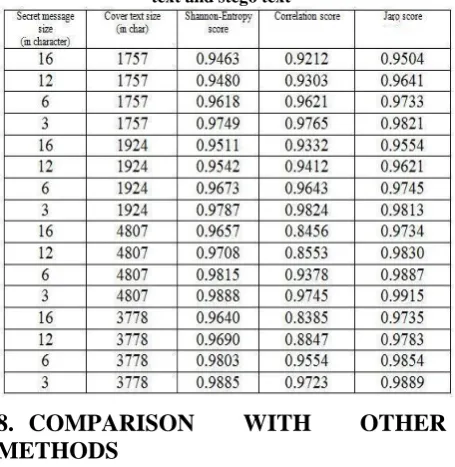
[image:8.595.317.544.85.394.2]different sequence order) characters divided by two defines the number of transpositions. Table 1 shows below the various similarity coefficients of the different sizes of cover text embedded with different secret message size.
Table 1: Similarity coefficient between different cover text and stego text
8.
COMPARISON
WITH
OTHER
METHODS
In this section a comparison has been shown with some other existing methods like Text steganography using Changing word spelling [27], Inter word spacing and inter paragraph spacing [20] or Text Steganography by using Letter Points and Extensions [28] or Text steganography using CALP[24,25]. From the comparative study shown in table 2 it has been observed that the proposed AMT Text Steganography method is better than the existing other methods in terms of embedding capacity and robustness. This method supports the authentication of the secret message. This method is a universal one and applicable to any other languages. A technique for measuring the similarity between the cover text and stego text also exist for this method.
9.
CONCLUSION
In this paper a novel approach of English text steganography method known as AMT has been presented .Stego text is generated by mapping the binary sequence of the secret message using ASCII mapping technique. Quantum logic technique for finding valid embedding position increases an additional level of security. This method takes care of the authentication problem also through POS file. From Table 1 it has been observed that AMT method generates the stego text with minimum or zero degradation as the Shannon Entropy, Correlation-coefficient and Jaro Score value is very high. This property enables the method to avoid the steganalysis. The proposed steganography technique through ASCII mapping is a new approach for the English steganography and this methodology can be extended to any other Indian language also.
Table 2: Comparison of the proposed method with others
10.
REFERENCES
[1] Digital Watermarking :A Tutorial Review S.P.Mohanty ,1999.
[2] Ross J. Anderson and Fabien A.P. Petitcolas, "On the limits of steganography," IEEE Journal on Selected Areas in Communications (J-SAC), Special Issue on Copyright & Privacy Protection, vol. 16 no. 4, pp 474-481, May 1998.
[3] T Mrkel,JHP Eloff and MS Olivier .”An Overview of Image Steganography,”in proceedings of the fifth annual Information Security South Africa Conference ,2005 .
[4] Gustavus J. Simmons, "The Prisoners' Problem and the Subliminal Channel", in Proceedings of CRYPTO '83, pp 51-67. Plenum Press (1984).
[5] “Stretching the Limits of Steganography", RJ Anderson, in Information Hiding, Springer Lecture Notes in Computer Science v 1174 (1996) pp 39-48.
[6] Scott Craver, "On Public-key Steganography in the Presence of an Active Warden," in Proceedings of 2nd International Workshop on Information Hiding, April 1998, Portland, Oregon, USA. pp. 355 - 368.
[7] W. Bender, D. Gruhl, N. Morimoto, and A. Lu, "Techniques for data hiding", IBM Systems Journal, vol. 35, Issues 3&4, 1996, pp. 313-336.
[8] N. F. Johnson and S. Jajodia, "Steganography: seeing the unseen," IEEE Computer.,Feb., 26-34 (1998).
[image:8.595.56.284.181.415.2][10] Analysis of LSB Based Image Steganography Techniques ,R. Chandramouli, Nasir Memon, Proc. IEEE ICIP, 2001.
[11] An Evaluation of Image Based Steganography Methods,Kevin Curran, Kran Bailey, International Journal of Digital Evidence,Fall 2003.
[12] K. Gopalan, "Audio steganography using bit modification", Proceedings of the IEEE International Conference on Acoustics, Speech, and Signal Processing, (ICASSP '03), vol. 2, 6-10 April 2003, pp. 421-424.
[13] K. Gopalan, "Audio steganography using bit modification", Proceedings of the IEEE International Conference on Acoustics, Speech, and Signal Processing, (ICASSP '03), vol. 2, 6-10 April 2003, pp. 421-424.
[14] M.Chapman, G. Davida, and M. Rennhard, “A Practical and Effective Approach to Large-Scale Automated Linguistic Steganography”, Proceedings of the Information Security Conference, October 2001, pp. 156-165.
[15] “Study of Secure Steganography model” by Souvik Bhattacharyya and Gautam Sanyal at the proceedings of “International Conference on Advanced Computing & Communication Technologies (ICACCT-2008),Nov, 2008, Panipat, India”
[16] “An Image based Steganography model for promoting Global Cyber Security” by Souvik Bhattacharyya and Gautam Sanyal at the proceedings of “International Conference on Systemics,Cybernetics and Informatics (ICSCI- 2009),Jan, 09,Hyderabad,India.”
[17] “Implementation and Design of an Image based Steganographic model” by Souvik Bhattacharyya and Gautam Sanyal at the proceedings of “ IEEE International Advance Computing Conference “(IACC-2009)”
[18] Novel Approach to Develop a Secure Image based Steganographic Model using Integer Wavelet Transform” at the proceedings of International Conference on Recent Trends in Information, Telecommunication and Computing (ITC 2010)” by Souvik Bhattacharyya, Avinash Prasad Kshitij and Gautam Sanyal. (Indexed by IEEE Computer Society).
[19] Y. Kim, K. Moon, and I. Oh, "A Text Watermarking Algorithm based on Word Classification and Inter-word Space Statistics", Proceedings of the Seventh International Conference on Document Analysis and Recognition (ICDAR’03), 2003, pp. 775–779.
[20] L.Y. Por and B. Delina, “Information Hiding: A New Approach in Text Steganography”, 7th WSEAS International Conference on Applied Computer & Applied Computational Science, April 2008, pp- 689-695.
[21] A.M. Alattar and O.M. Alattar, "Watermarking electronic text documents containing justified paragraphs and irregular line spacing ", Proceedings of SPIE - Volume5306, Security, Steganography, and Watermarking of Multimedia Contents VI, June 2004, pp- 685-695.
[22] P. Wayner, “Strong Theoretical Steganography”, Cryptologia,
XIX(3), July 1995, pp. 285-299.
[23] M. Niimi, S. Minewaki, H. Noda, and E.Kawaguchi, "A Framework of Text-based Steganography Using SD-Form Semantics Model", Pacific Rim Workshop on Digital Steganography 2003, Kyushu Institute of Technology, Kitakyushu, Japan, July 3-4, 2003.
[24] Hiding Data in Text Through Changing in Alphabet Letter Patterns (CALP) by Souvik Bhattacharyya, Pabak Indu , Sanjana Dutta , Ayan Biswas and Gautam Sanyal at Journal of Global Research in Computer Science (JGRCS) VOL 2, NO 3 (2011) MARCH-2011.
[25] “Text Steganography using CALP with High Embedding Capacity” by Souvik Bhattacharyya, Pabak Indu , Sanjana Dutta , Ayan Biswas and Gautam Sanyal at Journal of Global Research in Computer Science (JGRCS) VOL 2, NO 5 (2011) MAY-2011.
[26] M.H. Shirali-Shahreza and M. Shirali-Shahreza, "Text Steganography in Chat", Proceedings of the Third IEEE/IFIP International Conference in Central Asia on Internet the Next Generation of Mobile, Wireless and Optical Communications Networks (ICI 2007), Tashkent, Uzbekistan, September 26-28, 2007.
[27] Mohammad Shirali-Shahreza. Text steganography by changing words spelling. In ICACT, 2008.
[28] Gutub, A. A. and Fattani, M. M. Text steganography by using letter points and extensions. World Academy of Science, Engineering and Technology 27 ,2007, pages 13–27, 2007.
[29] Souvik Bhattacharyya, I. B. and Sanyal, G. A novel approach of secure text based steganography model using Word Mapping Method (WMM) International Journal of Computer and Information Engineering, 4:96–103, 2010.
[30] D. Deutsch. Quantum theory, the church-turing principle and the universal quantum computer. Proc. Roy. Soc. Lond. A, 400 (1985), 97-117.
[31] D. Deutsch. Quantum computational networks. Proc. Roy. Soc. Lond. A, 425 (1989), 73-90.
[32] R. P. Feynman. Quantum mechanical computers. Found. Phys. 16(1986), 507.
[33] Geert Uytterhoeven Dirk Roose Adhemar Bultheel. Integer wavelet transforms using the lifting scheme. In CSCC Proceedings, 1999.
[34] W. Sweldens. The lifting scheme. A construction of second generation wavelets. SIAM J. Math. Anal., 29:511–546, 1997. [35] W. Sweldens R. Calderbank, I. Daubechies and B.L. Yeo.
Wavelet transforms that map integers to integers. Appl. Comput. Harmon. Anal.,5:332–369, 1998.
[36] “A Mathematical Theory of Communication” By C. E. SHANNON, at The Bell System Technical Journal, Vol. 27, pp. 379–423, 623–656, July, October, 1948.
[37] S. Dowdy and S. Wearden. Statistics for research. Wiley. ISBN 0471086029, page 230, 1983.
[38] W. E. Winkler. The state of record linkage and current research problems. Statistics of Income Division, Internal Revenue Service Publication R99/04., 1999.
[39] M. A. Jaro. Advances in record linking methodology as applied to the 1985 census of tampa florida. Journal of the American Statistical Society. 84:414–420, 1989. [40] M. A. Jaro. Probabilistic linkage of large public health