On the Elements of an Accurate
Tree-to-String Machine Translation System
Graham Neubig, Kevin Duh
Graduate School of Information Science Nara Institute of Science and Technology 8916-5 Takayama-cho, Ikoma-shi, Nara, Japan
{neubig,kevinduh}@is.naist.jp
Abstract
While tree-to-string (T2S) translation the-oretically holds promise for efficient, ac-curate translation, in previous reports T2S systems have often proven inferior to other machine translation (MT) methods such as phrase-based or hierarchical phrase-based MT. In this paper, we attempt to clarify the reason for this performance gap by investigating a number of peripheral ele-ments that affect the accuracy of T2S sys-tems, including parsing, alignment, and search. Based on detailed experiments on the English-Japanese and Japanese-English pairs, we show how a basic T2S system that performs on par with phrase-based systems can be improved by 2.6-4.6 BLEU, greatly exceeding existing state-of-the-art methods. These results indi-cate that T2S systems indeed hold much promise, but the above-mentioned ele-ments must be taken seriously in construc-tion of these systems.
1 Introduction
In recent years, syntactic parsing is being viewed as an ever-more important element of statistical machine translation (SMT) systems, particularly for translation between languages with large dif-ferences in word order. There are many ways of incorporating syntax into MT systems, including the use of string-to-tree translation (S2T) to ensure the syntactic well-formedness of the output (Gal-ley et al., 2006; Shen et al., 2008), tree-to-string (T2S) using source-side parsing as a hint during the translation process (Liu et al., 2006), or pre-or post-pre-ordering to help compensate fpre-or repre-order- reorder-ing problems experienced by non-syntactic meth-ods such as phrase-based MT (PBMT) (Collins et al., 2005; Sudoh et al., 2011). Among these, T2S
translation has a number of attractive theoretical properties, such as joint consideration of global re-ordering and lexical choice while maintaining rel-atively fast decoding times.
However, building an accurate T2S system is not trivial. On one hand, there have been multiple reports (mainly from groups with a long history of building T2S systems) stating that systems us-ing source-side syntax greatly out-perform phrase-based systems (Mi et al., 2008; Liu et al., 2011; Zhang et al., 2011; Tamura et al., 2013). On the other hand, there have been also been multiple re-ports noting the exact opposite result that source-side syntax systems perform worse than Hiero, S2T, PBMT, or PBMT with pre-ordering (Ambati and Lavie, 2008; Xie et al., 2011; Kaljahi et al., 2012). In this paper, we argue that this is due to the fact that T2S systems have the potential to achieve high accuracy, but are also less robust, with a num-ber of peripheral elements having a large effect on translation accuracy.
Our motivation in writing this paper is to pro-vide a first step in examining and codifying the more important elements that make it possible to construct a highly accurate T2S MT system. To do so, we perform an empirical study of the effect of parsing accuracy, packed forest input, alignment accuracy, and search. The reason why we choose these elements is that past work that has reported low accuracy for T2S systems has often neglected to consider one or all of these elements.
As a result of our tests on English-Japanese (en-ja) and Japanese-English (ja-en) machine transla-tion, we find that a T2S system not considering these elements performs only slightly better than a standard PBMT system. However, after account-ing for all these elements we see large increases of accuracy, with the final system greatly exceeding not only standard PBMT, but also state-of-the-art methods based on syntactic pre- or post-ordering.
2 Experimental Setup
2.1 Systems Compared
In our experiments, we use a translation model based on T2S tree transducers (Graehl and Knight, 2004), constructed using the Travatar toolkit (Neu-big, 2013). Rules are extracted using the GHKM algorithm (Galley et al., 2006), and rules with up to 5 composed minimal rules, up to 2 non-terminals, and up to 10 terminals are used.
We also prepare 3 baselines not based on T2S to provide a comparison with other systems in the literature. The first two baselines are standard sys-tems using PBMT or Hiero trained using Moses (Koehn et al., 2007). We use default settings, ex-cept for setting the reordering limit or maximum chart span to the best-performing value of 24. As our last baselines, we use two methods based on syntactic pre- or post-ordering, which are state-of-the-art methods for the language pairs. Specifi-cally, for en-ja translation we use the head finaliza-tion pre-ordering method of (Isozaki et al., 2010b), and for ja-en translation, we use the syntactic post-ordering method of (Goto et al., 2012). For all systems, T2S or otherwise, the language model is a Kneser-Ney 5-gram, and tuning is performed to maximize BLEU score using minimum error rate training (Och, 2003).
2.2 Data and Evaluation
We perform all of our experiments on en-ja and ja-en translation over data from the NTCIR PatentMT task (Goto et al., 2011), the most stan-dard benchmark task for these language pairs. We use the training data from NTCIR 7/8, a total of approximately 3.0M sentences, and perform tun-ing on the NTCIR 7 dry run, testtun-ing on the NTCIR 7 formal run data. As evaluation measures, we use the standard BLEU (Papineni et al., 2002) as well as RIBES (Isozaki et al., 2010a), a reordering-based metric that has been shown to have high correlation with human evaluations on the NTCIR data. We measure significance of results using bootstrap resampling at p<0.05 (Koehn, 2004). In tables, bold numbers indicate the best system and all systems that were not significantly differ-ent from the best system.
2.3 Motivational Experiment
Before going into a detailed analysis, we first present results that stress the importance of the el-ements described in the introduction. To do so,
en-ja ja-en
[image:2.595.308.525.61.161.2]System BLEU RIBES BLEU RIBES PBMT 35.84 72.89 30.49 69.80 Hiero 34.45 72.94 29.41 69.51 Pre/Post 36.69 77.05 29.42 73.85 T2S-all 36.23 76.60 31.15 72.87 T2S+all 40.84 80.15 33.70 75.94
Table 1: Overall results for five systems.
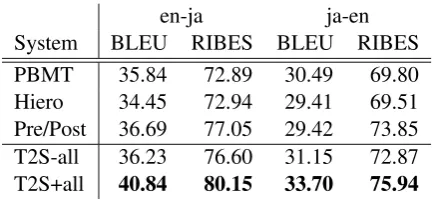
we compare the 3 non-T2S baselines with two T2S systems that vary the settings of the parser, alignment, and search, as described in the follow-ing Sections 3, 4, and 5. The first system “T2S-all” is a system that uses the worst settings1 for
each of these elements, while the second system “T2S+all” uses the best settings.2 The results for
the systems are shown in Table 1.
The most striking result is that T2S+all signif-icantly exceeds all of the baselines, even includ-ing the pre/post-orderinclud-ing baselines, which provide state-of-the-art results on this task. The gains are particularly striking on en-ja, with a gain of over 4 BLEU points over the closest system, but still sig-nificant on the ja-en task, where the use of source-side syntax has proven less effective in previous work (Sudoh et al., 2011). The next thing to notice is that if we had instead used T2S-all, our conclu-sion would have been much different. This system is able to achieve respectable accuracy compared to PBMT or Hiero, but does not exceed the more competitive pre/post-ordering systems.3 With this
result in hand, we will investigate the contribution of each of these elements in detail in the following sections. In the remainder of the paper settings follow T2S+all except when otherwise noted.
3 Parsing
3.1 Parsing Overview
As T2S translation uses parse trees both in train-ing and testtrain-ing of the system, an accurate syntactic parser is required. In order to test the extent that parsing accuracy affects translation, we use two
different syntactic parsers and examine the trans-lation accuracy realized by each parser.
For English, the two most widely referenced parsers are the Stanford Parser and Berkeley Parser. In this work, we compare the Stanford Parser’s CFG model, with the Berkeley Parser’s latent variable model. In previous reports, it has been noted (Kummerfeld et al., 2012) that the la-tent variable model of the Berkeley parser tends to have the higher accuracy of the two, so if the accu-racy of a system using this model is higher then it is likely that parsing accuracy is important for T2S translation. Instead of the Berkeley Parser itself, we use a clone Egret,4which achieves nearly
iden-tical accuracy, and is able to output packed forests for use in MT, as mentioned below. Trees are right-binarized, with the exception of phrase-final punctuation, which is split off before any other el-ement in the phrase.
For Japanese, our first method uses the MST-based pointwise dependency parser of Flannery et al. (2011), as implemented in the Eda toolkit.5
In order to convert dependencies into phrase-structure trees typically used in T2S translation, we use the head rules implemented in the Travatar toolkit. In addition, we also train a latent variable CFG using the Berkeley Parser and use Egret for parsing. Both models are trained on the Japanese Word Dependency Treebank (Mori et al., 2014).
In addition, Mi et al. (2008) have proposed a method for forest-to-string (F2S) translation us-ing packed forests to encode many possible sen-tence interpretations. By doing so, it is possible to resolve some of the ambiguity in syntactic inter-pretation at translation time, potentially increasing translation accuracy. However, the great majority of recent works on T2S translation do not consider multiple syntactic parses (e.g. Liu et al. (2011), Zhang et al. (2011)), and thus it is important to confirm the potential gains that could be acquired by taking ambiguity into account.
3.2 Effect of Parsing and Forest Input
In Table 2 we show the results for Stanford/Eda with 1-best tree input vs. Egret with trees or forests as input. Forests are those containing all edges in the 100-best parses.
First looking at the difference between the two parsers, we can see that the T2S system using
4http://code.google.com/p/egret-parser 5http://plata.ar.media.kyoto-u.ac.jp/tool/EDA
en-ja ja-en
[image:3.595.306.528.63.132.2]System BLEU RIBES BLEU RIBES Stan/Eda 38.95 78.47 32.56 73.03 Egret-T 39.26 79.26 32.97 74.94 Egret-F 40.84 80.15 33.70 75.94
Table 2: Results for Stanford/Eda, Egret with tree input, and Egret with forest input.
110 100
Forest n-best Cutoff 0.0
0.2 0.4 0.6 0.8 1.0
BLEU
39 40 41 42
1.75 2.03
2.58
3.06 3.21 3.70
3.734.61
en-ja ja-en
1 10 100
32 33 34 35
1.21 1.32
1.39 1.50 1.61 1.74 2.05
2.07
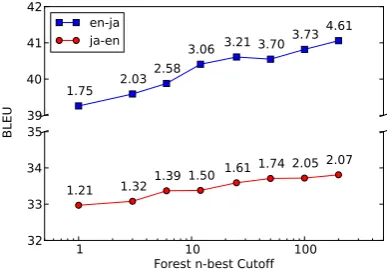
Figure 1: BLEU scores using various levels of for-est pruning. Numbers in the graph indicate decod-ing time in seconds/sentence.
Egret achieves greater accuracy than that using the other two parsers. This improvement is particu-larly obvious in RIBES, indicating that an increase in parsing accuracy has a larger effect on global reordering than on lexical choice. When going from T2S to F2S translation using Egret, we see another large gain in accuracy, although this time with the gain in BLEU being more prominent. We believe this is related to the observation of Zhang and Chiang (2012) that F2S translation is not nec-essarily helping fixing parsing errors, but instead giving the translation system the freedom to ignore the parse somewhat, allowing for less syntactically motivated but more fluent translations.
[image:3.595.320.514.191.326.2]in-crease in BLEU at the cost of an inin-crease in decod-ing time. Interestdecod-ingly, the increases in BLEU did not show any sign of saturating even when setting then-best cutoff to 200, although larger cutoffs re-sulted in exceedingly large translation forests that required large amounts of memory.
4 Alignment
4.1 Alignment Overview
The second element that we investigate is align-ment accuracy. It has been noted in many previ-ous works that significant gains in alignment accu-racy do not make a significant difference in trans-lation results (Ayan and Dorr, 2006; Ganchev et al., 2008). However, none of these works have ex-plicitly investigated the effect on T2S translation, so it is not clear whether these results carry over to our current situation.
As our baseline aligner, we use the GIZA++ im-plementation of the IBM models (Och and Ney, 2003) with the default options. To test the effect of improved alignment accuracy, we use the dis-criminative alignment method of Riesa and Marcu (2010) as implemented in the Nile toolkit.6 This
method has the ability to use source- and target-side syntactic information, and has been shown to improve the accuracy of S2T translation.
We trained Nile and tested both methods on the Japanese-English alignments provided with the Kyoto Free Translation Task (Neubig, 2011) (430k parallel sentences, 1074 manually aligned training sentences, and 120 manually aligned test sentences).7 As creating manual alignment data is
costly, we also created two training sets that con-sisted of 1/4 and 1/16 of the total data to test if we can achieve an effect with smaller amounts of manually annotated data. The details of data size and alignment accuracy are shown in Table 3.
4.2 Effect of Alignment on Translation
In Table 4, we show results when we vary the aligner between GIZA++ and Nile. For reference, we also demonstrate results when using the same alignments for PBMT and Hiero.
From this, we can see that while for PBMT and Hiero systems the results are mixed, as has been noted in previous work (Fraser and Marcu, 2007),
6http://code.google.com/p/nile
7This data is from Wikipedia articles about Kyoto City, and is an entirely different genre than our MT test data. It is likely that creating aligned data that matches the MT genre would provide larger gains in MT accuracy.
[image:4.595.314.521.62.132.2]Name Sent. Prec. Rec. F-meas GIZA++ 0 60.46 55.48 57.86 Nile/16 68 70.21 60.81 65.17 Nile/4 269 72.85 62.70 67.40 Nile 1074 72.73 63.97 68.07
Table 3: Alignment accuracy (%) by method and number of manually annotated training sentences.
en-ja ja-en
System BLEU RIBES BLEU RIBES PBMT-G 35.84 72.89 30.49 69.80 PBMT-N 36.05 71.84 30.77 69.75 Hiero-G 34.45 72.94 29.41 69.51 Hiero-N 33.90 72.63 28.90 69.83 T2S-G 39.57 78.94 32.62 75.19 T2S-N/16 40.79 80.05 32.82 74.89 T2S-N/4 40.97 80.32 33.35 75.46
T2S-N 40.84 80.15 33.70 75.94
Table 4: Results varying the aligner (GIZA++ vs.
Nile), including results for Nile when using 1/4 or 1/16 of the annotated training data.
Figure 2: Probabilities for SVO→SOV rules.
improving the alignment accuracy gives signifi-cant gains for T2S translation. The reason for this difference is two-fold. The first is that in rule extraction in syntax-based translation (Galley et al., 2006), a single mistaken alignment crossing phrase boundaries results not only in a bad rule be-ing extracted, but also prevents the extraction of a number of good rules. This is reflected in the size of the rule table; the en-ja system built using Nile contains 92.8M rules, while the GIZA++ system contains only 83.3M rules, a 11.2% drop.
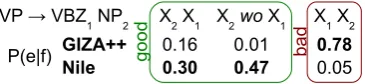
[image:4.595.326.509.396.438.2]the Japanese direct object particle “wo.” From the figure, we can see that the probabilities learned by Nile match this intuition, while the probabilities learned by GIZA heavily favor no reordering.
Finally, looking at the amount of data needed to train the model, we can see that a relatively small amount of manually annotated data proves suffi-cient for large gains in alignment accuracy, with even 68 sentences showing a 7.31 point gain in F-measure over GIZA++. This is because Nile’s fea-ture set uses generalizable POS/syntactic informa-tion and also because mis-alignments of common function words (e.g. a/the) will be covered even by small sets of training data. Looking at the MT results, we can see that even the smaller data sets allow for gains in accuracy, although the gains are more prominent for en-ja.
5 Search
5.1 Search Overview
Finally, we examine the effect that the choice of search algorithm has on the accuracy of transla-tion. The most standard search algorithm for T2S translation is bottom-up beam search using cube pruning (CP, Chiang (2007)). However, there are a number of other search algorithms that have been proposed for tree-based translation in gen-eral (Huang and Chiang, 2007) or T2S systems in particular (Huang and Mi, 2010; Feng et al., 2012). In this work, we compare CP and the hy-pergraph search (HS) method of Heafield et al. (2013), which is also a bottom-up pruning algo-rithm but performs more efficient search by group-ing together similar language model states.
5.2 Effect of Search
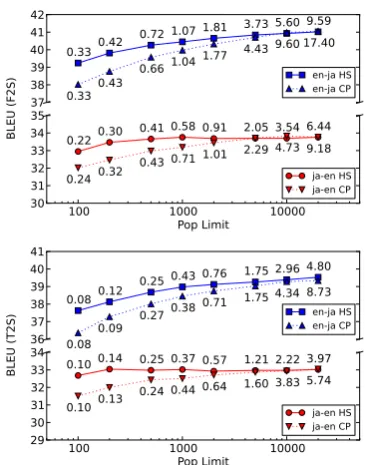
Figure 3 shows BLEU and decoding speed results using HS or CP on T2S and F2S translation, us-ing a variety of pop limits. From this, we can see that HS out-performs CP for both F2S and T2S, especially with smaller pop limits. Comparing the graphs for F2S and T2S translation, it is notable that the shapes of the graphs for the two meth-ods are strikingly similar. This result is somewhat surprising, as the overall search space of F2S is larger and it would be natural for the characteris-tics of the search algorithm to vary between these two settings. Finally, comparing ja-en and en-ja, search is simpler for the former, a result of the fact that the Japanese sentences contain more words, and thus more LM evaluations per sentence.
1001000 10000
Pop Limit 0.0 0.2 0.4 0.6 0.8 1.0 BLEU (F2S) 37 38 39 40 41 42 0.330.42
0.72 1.071.81 3.73 5.60 9.59
0.33 0.43
0.661.04
1.77 4.43 9.60 17.40
en-ja HS en-ja CP
100 1000 10000 30 31 32 33 34 35 0.220.30
0.41 0.58 0.91 2.05 3.54 6.44
0.240.32
0.43 0.71 1.01
2.29 4.73 9.18
ja-en HS ja-en CP
1001000 10000
Pop Limit 0.0 0.2 0.4 0.6 0.8 1.0 BLEU (T2S) 36 37 38 39 40 41 0.080.12
0.25 0.430.76 1.75 2.96 4.80
0.08 0.09
0.270.38 0.71
1.75 4.34 8.73
en-ja HS en-ja CP
100 1000 10000 29 30 31 32 33 34
0.100.14 0.25 0.37 0.57 1.21 2.22 3.97
0.100.13
0.24 0.44 0.64 1.60 3.83 5.74
ja-en HS ja-en CP
Figure 3: Hypergraph search (HS) and cube pruning (CP) results for F2S and T2S. Numbers above and below the lines indicate time in sec-onds/sentence for HS and CP respectively.
6 Conclusion
In this paper, we discussed the importance of three peripheral elements that contribute greatly to the accuracy of T2S machine translation: parsing, alignment, and search. Put together, a T2S sys-tem that uses the more effective settings for these three elements greatly outperforms a system that uses more standard settings, as well as the current state-of-the-art on English-Japanese and Japanese-English translation tasks.
Based on these results we draw three conclu-sions. The first is that given the very competitive results presented here, T2S systems do seem to have the potential to achieve high accuracy, even when compared to strong baselines incorporating syntactic reordering into a phrase-based system. The second is that when going forward with re-search on T2S translation, one should first be sure to account for these three elements to ensure a sturdy foundation for any further improvements. Finally, considering the fact that parsing and align-ment for each of these languages is far from per-fect, further research investment in these fields may very well have the potential to provide ad-ditional gains in accuracy in the T2S framework.
[image:5.595.325.508.61.294.2]References
Vamshi Ambati and Alon Lavie. 2008. Improving syn-tax driven translation models by re-structuring diver-gent and non-isomorphic parse tree structures. In Proc. AMTA, pages 235–244.
Necip Ayan and Bonnie Dorr. 2006. Going beyond AER: an extensive analysis of word alignments and their impact on MT. InProc. ACL.
David Chiang. 2007. Hierarchical phrase-based trans-lation.Computational Linguistics, 33(2):201–228. Michael Collins, Philipp Koehn, and Ivona Kucerova.
2005. Clause restructuring for statistical machine translation. InProc. ACL, pages 531–540.
Yang Feng, Yang Liu, Qun Liu, and Trevor Cohn. 2012. Left-to-right tree-to-string decoding with pre-diction. InProc. EMNLP, pages 1191–1200. Daniel Flannery, Yusuke Miyao, Graham Neubig, and
Shinsuke Mori. 2011. Training dependency parsers from partially annotated corpora. InProc. IJCNLP, pages 776–784.
Alexander Fraser and Daniel Marcu. 2007. Measuring word alignment quality for statistical machine trans-lation.Computational Linguistics, 33(3):293–303. Michel Galley, Jonathan Graehl, Kevin Knight, Daniel
Marcu, Steve DeNeefe, Wei Wang, and Ignacio Thayer. 2006. Scalable inference and training of context-rich syntactic translation models. InProc. ACL, pages 961–968.
Kuzman Ganchev, Jo˜ao V. Grac¸a, and Ben Taskar. 2008. Better alignments = better translations? In Proc. ACL.
Isao Goto, Bin Lu, Ka Po Chow, Eiichiro Sumita, and Benjamin K. Tsou. 2011. Overview of the patent machine translation task at the NTCIR-9 workshop. InProceedings of NTCIR, volume 9, pages 559–578. Isao Goto, Masao Utiyama, and Eiichiro Sumita. 2012. Post-ordering by parsing for Japanese-English sta-tistical machine translation. InProc. ACL, pages 311–316.
Jonathan Graehl and Kevin Knight. 2004. Training tree transducers. InProc. HLT, pages 105–112. Kenneth Heafield, Philipp Koehn, and Alon Lavie.
2013. Grouping language model boundary words to speed k–best extraction from hypergraphs. InProc. NAACL, pages 958–968.
Liang Huang and David Chiang. 2007. Forest rescor-ing: Faster decoding with integrated language mod-els. InProc. ACL, pages 144–151.
Liang Huang and Haitao Mi. 2010. Efficient incre-mental decoding for tree-to-string translation. In Proc. EMNLP, pages 273–283.
Hideki Isozaki, Tsutomu Hirao, Kevin Duh, Katsuhito Sudoh, and Hajime Tsukada. 2010a. Automatic evaluation of translation quality for distant language pairs. InProc. EMNLP, pages 944–952.
Hideki Isozaki, Katsuhito Sudoh, Hajime Tsukada, and Kevin Duh. 2010b. Head finalization: A simple reordering rule for SOV languages. InProc. WMT and MetricsMATR.
Rasoul Samad Zadeh Kaljahi, Raphael Rubino, Johann Roturier, and Jennifer Foster. 2012. A detailed analysis of phrase-based and syntax-based machine translation: The search for systematic differences. InProc. AMTA.
Philipp Koehn, Hieu Hoang, Alexandra Birch, Chris Callison-Burch, Marcello Federico, Nicola Bertoldi, Brooke Cowan, Wade Shen, Christine Moran, Richard Zens, Chris Dyer, Ondrej Bojar, Alexandra Constantin, and Evan Herbst. 2007. Moses: Open source toolkit for statistical machine translation. In Proc. ACL, pages 177–180.
Philipp Koehn. 2004. Statistical significance tests for machine translation evaluation. InProc. EMNLP.
Jonathan K Kummerfeld, David Hall, James R Cur-ran, and Dan Klein. 2012. Parser showdown at the wall street corral: an empirical investigation of er-ror types in parser output. InProc. EMNLP, pages 1048–1059.
Yang Liu, Qun Liu, and Shouxun Lin. 2006. Tree-to-string alignment template for statistical machine translation. InProc. ACL.
Yang Liu, Qun Liu, and Yajuan L¨u. 2011. Adjoin-ing tree-to-strAdjoin-ing translation. InProc. ACL, pages 1278–1287.
Haitao Mi, Liang Huang, and Qun Liu. 2008. Forest-based translation. InProc. ACL, pages 192–199.
Shinsuke Mori, Hideki Ogura, and Tetsuro Sasada. 2014. A Japanese word dependency corpus. In Proc. LREC.
Graham Neubig, Sakriani Sakti, Tomoki Toda, Satoshi Nakamura, Yuji Matsumoto, Ryosuke Isotani, and Yukichi Ikeda. 2013. Towards high-reliability speech translation in the medical domain. InProc. MedNLP, pages 22–29.
Graham Neubig. 2011. The Kyoto free translation task.http://www.phontron.com/kftt.
Graham Neubig. 2013. Travatar: A forest-to-string machine translation engine based on tree transduc-ers. InProc. ACL Demo Track, pages 91–96.
Franz Josef Och. 2003. Minimum error rate training in statistical machine translation. InProc. ACL, pages 160–167.
Kishore Papineni, Salim Roukos, Todd Ward, and Wei-Jing Zhu. 2002. BLEU: a method for automatic evaluation of machine translation. In Proc. ACL, pages 311–318.
Jason Riesa and Daniel Marcu. 2010. Hierarchical search for word alignment. In Proc. ACL, pages 157–166.
Libin Shen, Jinxi Xu, and Ralph Weischedel. 2008. A new string-to-dependency machine translation algo-rithm with a target dependency language model. In Proc. ACL, pages 577–585.
Katsuhito Sudoh, Xianchao Wu, Kevin Duh, Hajime Tsukada, and Masaaki Nagata. 2011. Post-ordering in statistical machine translation. InProc. MT Sum-mit.
Akihiro Tamura, Taro Watanabe, Eiichiro Sumita, Hi-roya Takamura, and Manabu Okumura. 2013. Part-of-speech induction in dependency trees for statisti-cal machine translation. InProc. ACL, pages 841– 851.
Jun Xie, Haitao Mi, and Qun Liu. 2011. A novel dependency-to-string model for statistical machine translation. InProc. EMNLP, pages 216–226. Hui Zhang and David Chiang. 2012. An exploration
of forest-to-string translation: Does translation help or hurt parsing? InProc. ACL, pages 317–321. Hao Zhang, Licheng Fang, Peng Xu, and Xiaoyun Wu.