Volume 2010, Article ID 897607,11pages doi:10.1155/2010/897607
Research Article
Joint Symbol Timing and CFO Estimation for OFDM/OQAM
Systems in Multipath Channels
Tilde Fusco (EURASIP Member),
1Angelo Petrella,
2and Mario Tanda
31Communications Regulatory Authority, Department for Studies, Research and Education, Centro Direzionale,
Isola B5, 80143 Napoli, Italy
2Selex Sistemi Integrati, Via Giulio Cesare 268, Bacoli, 80070 Napoli, Italy
3Dipartimento di Ingegneria Biomedica, Elettronica e delle Telecomunicazioni, Universit`a di Napoli Federico II,
Via Claudio 21, 80125 Napoli, Italy
Correspondence should be addressed to Mario Tanda,[email protected]
Received 27 May 2009; Revised 27 September 2009; Accepted 13 November 2009
Academic Editor: Faouzi Bader
Copyright © 2010 Tilde Fusco et al. This is an open access article distributed under the Creative Commons Attribution License, which permits unrestricted use, distribution, and reproduction in any medium, provided the original work is properly cited.
The problem of data-aided synchronization for orthogonal frequency division multiplexing (OFDM) systems based on offset quadrature amplitude modulation (OQAM) in multipath channels is considered. In particular, the joint maximum-likelihood (ML) estimator for carrier-frequency offset (CFO), amplitudes, phases, and delays, exploiting a short known preamble, is derived. The ML estimators for phases and amplitudes are in closed form. Moreover, under the assumption that the CFO is sufficiently small, a closed form approximate ML (AML) CFO estimator is obtained. By exploiting the obtained closed form solutions a cost function whose peaks provide an estimate of the delays is derived. In particular, the symbol timing (i.e., the delay of the first multipath component) is obtained by considering the smallest estimated delay. The performance of the proposed joint AML estimator is assessed via computer simulations and compared with that achieved by the joint AML estimator designed for AWGN channel and that achieved by a previously derived joint estimator for OFDM systems.
1. Introduction
In the last years, the interest for filter-bank multicarrier (FBMC) systems is increased, since they provide high spectral containment. Therefore, they have been taken into account for high-data-rate transmissions over both wired and wireless frequency-selective channels. Moreover, they have been considered for the physical layer of cognitive radio systems [1]. One of the most famous multicarrier modulation techniques is orthogonal frequency division multiplexing (OFDM), embedded in several standards such as digital audio and video broadcasting or Wi-Fi wire-less LANs IEEE 802.11a/g. Other known types of FBMC systems are Filtered Multitone (FMT) systems, that have been proposed for very high-speed digital subscriber line standards [2] and are under investigation also for broadband wireless applications [3] and, moreover, OFDM based on offset QAM modulation (OQAM), considered by the 3GPP standardization forum for improved down-link UTRAN interfaces [4].
Unlike OFDM, OFDM/OQAM systems do not require the presence of a cyclic prefix (CP) in order to combat the effects of frequency selective channels. The absence of the CP implies on one hand the maximum spectral efficiency and, on the other hand, an increased compu-tational complexity. However, since the subchannel filters are obtained by complex modulation of a single filter, efficient polyphase implementations are possible. Another fundamental difference between OFDM and OFDM/OQAM systems is the adoption in the latter case of pulse shaping filters very well localized in time and frequency [5,6].
joint CFO and ST estimator is proposed. Furthermore, in [10] a synchronization scheme for data-aided ST and CFO estimation with robust acquisition properties in dispersive channels is developed. Finally, in [11,12] a full synchroniza-tion method utilizing frequency domain scattered pilots in the time domain is proposed. However, all cited estimators are designed for down-link communications.
In this paper we consider the problem of data-aided synchronization for OFDM/OQAM systems in multipath channels. In particular, the joint maximum-likelihood (ML) estimator for CFO, amplitudes, phases, and delays, exploiting a short known preamble, is derived. The ML estimators for phases and amplitudes are in closed form. Moreover, under the assumption that the CFO is sufficiently small, a closed form approximate ML (AML) CFO estimator is obtained. By exploiting the obtained closed form solutions a cost function whose peaks provide an estimate of the delays is derived. In particular, the ST (i.e., the delay of the first multipath component) is obtained by considering the smallest esti-mated delay. The proposed joint estimator is derived with reference to a down-link scenario; however, by following an approach similar to that considered in [13], it can be easily modified to be exploited for up-link communications. The performance of the proposed joint AML estimator is assessed via computer simulations and compared with that achieved by the joint AML estimator designed for AWGN channel and that achieved by a previously derived joint estimator for OFDM systems. The paper is organized as follows. In Section 2 the OFDM/OQAM system model is described. InSection 3the proposed data-aided estimator is described. InSection 4numerical results obtained in AWGN and multipath channel are presented and discussed. Finally, conclusions are drawn inSection 5.
Notation 1. j √−1, superscript (·)∗denotes the complex
conjugation, R[·] real part,I[·] imaginary part, and | · | absolute value. Moreover, (·)T denotes transpose and ∠[·] the argument of a complex number in [−π,π). Finally, lower case boldface symbols denote column vectors.
2. System Model
Let us consider an OFDM/OQAM system withNsubcarriers in a multipath channel. The received signal, in the presence of a CFO normalized to subcarrier spacingε=Δf T, can be written as
r(t)=ej(2π/T)εt Nc
i=1
γiejφis(t−τi) +n(t), (1)
where s(t) is the information-bearing signal, Nc is the
number of multipath components, and,γi,φi, andτidenote
amplitude, phase, and delay, respectively, of the ith path. Moreover, in (1)n(t) is a zero-mean complex-valued white Gaussian noise process with independent real and imaginary part, each with two-sided power spectral densityσ2
n/2. The
received signalr(t) is filtered with an ideal lowpass filter with
a bandwidth of 1/Ts, whereTsdenotes the sampling period.
The sampled signals(kTs) is equal to
s(kTs)=
N
2Nu S−1
p=0
l∈A
ejl((2π/N)k+π/2)
×
aR p,lg
kTs−pT
+jaI
p,lg
kTs−pT−T
2 , (2)
where T = NTs is the OFDM/OQAM symbol interval
andSdenotes the number of information-bearing symbols in the burst. Moreover, in (2) A is the set of size Nu of
used subcarriers,aRp,landaIp,ldenote the real and imaginary
part of the complex data symbol transmitted on the lth subcarrier during the pth OFDM/OQAM symbol, while the real-valued and unit-energy pulse-shaping filterg(t) is bandlimited within [−1/T, 1/T].
3. Joint Symbol Timing and CFO Estimator
In this section we consider the problem of data-aided synchronization for OFDM/OQAM systems in multipath channels. In particular, we derive the joint ML estimator for CFO, amplitudes, phases, and delays, exploiting a short known preamble embedded in the received burst. Specifi-cally, the known preamble is given by
z(kTs)=
N
2Nu L−1
p=0
l∈P
ejl((2π/T)kTs+π/2)
×
aRp,lg
kTs−pT
+jaIp,lg
kTs−pT−T
2 , (3)
where L is the number of OFDM/OQAM symbols in the preamble, P is the set of pilot subcarriers, and aR
p,l, aIp,l ∈ {−1, 1}, 0 ≤ p ≤ L−1,l ∈ P, denote the known
pilot symbols. Note that the duration of the preamble is
D = (β+ 1/2 +L−1)T whereβis the overlap parameter, that is, the ratio between the length of the truncated pulse-shaping filter and the OFDM/OQAM symbol interval T. By considering an observations window of total lengthηN
containing the nonzero support of the received preamble, the likelihood function for the unknown parametersε, and,γi, φi, andτi,i=1,. . .,Nc, is given by
Λγ,φ,τ,ε
=exp ⎧ ⎪ ⎨ ⎪ ⎩−
Ts σ2
n ηN−1
k=0 r(kTs)−
Nc
i=1
γiejφizτi,ε(kTs)
2⎫⎪⎬
⎪ ⎭,
(4)
where γ = [γ1,γ2,. . .,γNc]
T
, φ = [φ1,φ2,. . .,φNc]
T
,τ = [τ1,τ2,. . .,τNc]
T
,
zτ,ε(kT
and the notation of the typexindicates trial value ofx. Thus, the log-likelihood function for the parameters of interest results to be (up to irrelevant factors)
lnΛγ,φ,τ,ε= − ηN−1
k=0
Nc
i=1
γiejφizτi,ε(kTs)
2
+ 2R ⎡ ⎣ηN−1
k=0
r(kTs) Nc
i=1
γie−jφizτi,ε(kTs)∗
⎤ ⎦.
(6)
The first term in the right-hand side (RHS) of (6) forN1 can be approximated as
ηN−1
k=0
Nc
i=1
γiejφizτi,ε(kTs)
2 Nc
i=1
γ2i ηN−1
k=0
|z(kTs−τi)|2. (7)
Therefore, the log-likelihood function can be written as
lnΛγ,φ,τ,ε= Nc
i=1
γiR
e−jφic(τ
i,ε)
−γi2d(τi)
, (8)
where
d(τ)= ηN−1
k=0
z(kTs−τ)2, (9)
c(τ,ε)=Δ l∈P
e−j(π/2)l L−1
p=0
aRp,lw
(l)
p (τ,ε)−jaIp,lw
(l)
p (τ,ε)
(10)
with
w(pl)(τ,ε)=Δ
2N
Nue j(2π/T)τl
ηN−1
k=0
r(kTs)
×gkTs−pT−τ
e−j(2π/N)k(l+ε),
(11)
wp(l)(τ,ε)=Δ w(pl)
τ+T
2,ε
e−jπl. (12)
From (8), it immediately follows that the ML estimator for phase and amplitude of theith path is given by
φiML(τi,ε)=arg max
φi
lnΛγ,φ,τ,ε=∠c(τi,ε), (13)
γiML(τi,ε)=arg max
γi
lnΛγ,φ,τ,ε=c(τi,ε)
2d(τi) . (14)
Moreover, by replacing the estimate of the phase and the amplitude of each path in (8) we get
lnΛγ(τ,ε),φ(τ,ε),τ,ε= Nc
i=1
c(τi,ε)2 2d(τi) .
(15)
Therefore, the joint estimatorfor CFO and delays is given by
(τML,εML)=arg max
(τ,ε) ⎧ ⎨ ⎩ Nc
i=1
|c(τi,ε)|2
2d(τi)
⎫ ⎬
⎭. (16)
The derived joint ML estimator evaluates, for each trial value of each delay τi, i = 1, 2,. . .,Nc, and for each trial
value of the CFO ε, the response of the filter matched to the pulse shaping filterg(·) to the CFO compensated and downconverted signalr(kTs)e−j(2π/N)εke−j(2π/N)klat the time
instants τi + pT and τi + pT + T/2, 0 ≤ p ≤ L− 1.
Specifically, the downconversion is performed by considering all the frequencies of the pilot subcarriers. Then, exploiting the known pilot symbols, these quantities are combined according to (11) (or (12)), (10), and (16). Note that the proposed algorithm can be exploited also in the up-link to estimate the desired parameters by considering only the subcarriers assigned to the user of interest. The joint ML estimate for delays and CFO is obtained by considering the value of (τ,ε) that maximizes the statistic in (15). The (Nc + 1)-dimensional maximization required by the
joint ML estimator in (16) undertakes heavy computational burden. Therefore, in the following is derived a more feasible synchronization scheme by exploiting the assumption that the CFO is sufficiently small. Specifically, taking into account that the observations window contains the nonzero support of the received preamble and that the prototype filterg(kTs)
is different from zero fork∈ {0,βN−1}, from (11) it follows that
w(pl)(τ,ε)=
2N Nue
−j2πεpe−j(2π/N)εθ
× βN−1
m=0
rm+pN+θTs
×e−j(2π/N)εm
×g(mTs)e−j(2π/N)ml,
(17)
where the integerθis the trial value of the delayτnormalized to the sampling interval, θ = τ/T s. Then, under the
assumption that the CFO is sufficiently small within a timeΔQcomparable with the length of the prototype filter
e−j(2π/N)εΔQ1, it results that
w(pl)(τ,ε)e−j2πεpe−j(2π/N)εθul
pN+θ, (18)
w(pl)(τ,ε)e−j2πε(p+(1/2))e−j(2π/N)εθe−jπlul
pN+N
2 +θ
, (19)
where
ul(k) βN−1
m=0
In particular, into the case of a training sequence composed ofL =1 OFDM/OQAM symbol, (10), taking into account (18)–(20), becomes
c(τ,ε)= l∈P
e−j(π/2)laR
0,lw
(l)
0 (τ,ε)−jaI0,lw
(l) 0 (τ,ε)
A(τ) +e−jπεB(τ)
(21)
with
A(τ)=Δ e−j(2π/N)εθ l∈P
e−j(π/2)laR
0,lul
θ, (22)
B(τ)=eΔ −j(2π/N)εθ l∈P
e−j(π/2)(l+1)aI
0,le−jπlul
N/2+θ. (23)
Therefore, under the assumption|ε| N/ΔQand in the case of a training sequence with L = 1 OFDM/OQAM symbol, the AML estimator for CFO, taking into account (16), is given by
εAML(τ)= arg max
ε
⎧ ⎪ ⎨ ⎪ ⎩
Nc
i=1
A(τi) +e−jπεB(τi)
2
2d(τi)
⎫ ⎪ ⎬ ⎪ ⎭
= 1
π∠
⎧ ⎨ ⎩
Nc
i=1
A∗(τi)B(τi) d(τi)
⎫ ⎬ ⎭.
(24)
Moreover, from (16) and (21)–(24) it follows that
τAML=arg max τ
⎧ ⎨ ⎩
Nc
i=1
|A(τi)|2+|B(τi)|2
2d(τi)
+
Nc
i=1
A∗(τi)B(τi) d(τi)
⎫ ⎬ ⎭.
(25)
Thus, although under the assumption of small CFO values a closed form approximate estimator can be obtained, the estimation of the delays remains an Nc−dimensional
problem. To simplify the estimation of the delays the last term in the RHS of (25) can be neglected, and, then, we obtain
τAML1=arg max τ
⎧ ⎨ ⎩
Nc
i=1
|A(τi)|2+|B(τi)|2
2d(τi)
⎫ ⎬
⎭. (26)
In this case, if the number of paths Nc is known, it
immediately follows that theNc-dimensional vector of delays
that maximize (26) can be obtained by considering the Nc
points where the cost function
MD(τ)= |A(τ)|
2
+|B(τ)|2
d(τ) (27)
presents the highestNc peaks. Moreover, the lowest among
the obtained delays represents an estimate of the ST. If the number of pathsNcis not known in advance, a sufficiently
high number of paths should be considered to avoid to lose a strong path and, moreover, to avoid to consider
very weak paths. The obtained delays can be substituted in (24) to obtain the CFO estimate, and, finally, phases and amplitudes can be obtained from (13) and (14), respectively. Note that the numerical results reported in the next section show that the considered approximation of (25) leads to a symbol timing estimator with satisfactory performance if the number of subcarriers is sufficiently large.
In Appendix A we analyzed the accuracy of the closed form AML CFO estimator (24) in the absence of noise in a single-path channel and in the case of perfect ST synchronization (Nc = 1 and τ1 = 0 in (1)). Specifically, it is shown that in this case also if the interference from the data burst following the training symbol is neglected, the CFO estimator is expected to exhibit a performance floor. However, it is shown in the next section that this performance floor can be substantially reduced if the training symbol satisfies the condition
l∈P aR
0,laI0,l=0. (28)
Moreover, inAppendix Bis derived an approximate expres-sion for the mean square error (MSE) of the AML CFO estimator in (24) for a single-path channel and in the case of perfect ST synchronization. In particular, inAppendix Bit is shown that in this case the MSE can be approximated by
E(ε−ε)2= 2 π2NSNR
1
βNk=0−1g(k)2ej(2π/N)εk
2, (29)
where SNR =Δ γ2/σ2
n and g(k) g(kTs)/! βNl=0−1g2(lTs).
Note that forε = 0 the MSE in (29) is coincident with the MSE of the CFO estimator for OFDM systems proposed by Schmidl and Cox (SC) in [14]. It is worthwhile to emphasize that the MSE in (29) has been derived by neglecting the interference at the output of each matched filter due to adjacent subcarriers. Therefore, the actual performance of the proposed AML CFO estimator presents a floor that is not predicted by (29). However, it is shown in the next section that the approximate expression in (29) can be exploited in the range of moderate SNR values.
4. Numerical Results and Comparisons
In this section the performance of the proposed joint AML estimator is assessed via computer simulations. A number of 5000 Monte Carlo trials has been performed under the following conditions (unless otherwise stated):
(1) the considered OFDM/OQAM system has a band-widthB=1/Ts=11.2 MHz;
(2) the data symbols aRp,l and aIp,l are the real and
imaginary part of QPSK symbols;
10−4 10−3 10−2 10−1
0 5 10 15 20 25 30 35 40
RMSE
(
ε
)
SNR (dB) AML1 OC1
AML2 OC1 AML1 OC2 AML2 OC2 AML1 OC3
AML2 OC3 AML1 OC4 AML2 OC4 TRMSE
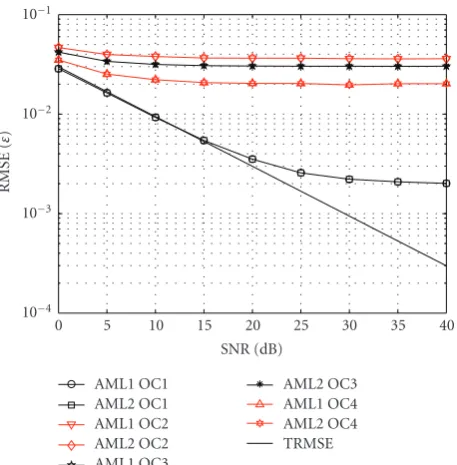
Figure1: Performance of the proposed AML CFO estimators in AWGN channel.
(4) the considered multipath fading channel model is the ITU Vehicular A [16], which has six multi-paths with differential delays 0, 0.31, 0.71, 1.09, 1.73, and 2.51 microseconds and relative powers 0,−1,−9,−10,−15, and−20 dB;
(5) the channel is fixed in each run but it is independent from one run to another.
In the first set of simulations we have tested the sensitivity of the performance of the derived CFO estimators to the condition (28) and to the interference due to the data burst sent after the training symbol. Specifically, four operating conditions have been considered:
(1) in the first case, denoted as OC1, condition (28) is satisfied and, moreover, to reduce the interference due to the data symbols, the useful data in the whole burst is delayed with respect to the preamble of the burst by one OFDM/OQAM symbol interval; (2) in the second case, denoted as OC2, condition (28) is
not satisfied and the data burst is not delayed; (3) in the third case, termed OC3, condition (28) is not
satisfied and the data burst is delayed;
(4) in the fourth case, termed OC4, condition (28) is satisfied and the data burst is not delayed.
Figures 1 and 2 display the root mean square error (RMSE) of the considered CFO estimators as a function of SNR in the previously described operating conditions and in the case where the number of subcarriers is N = 256 and the actual value of the normalized CFO is ε = 0.2. Specifically, the AML CFO estimator for multipath channel
10−4 10−3 10−2 10−1
0 5 10 15 20 25 30 35 40
RMSE
(
ε
)
SNR (dB) AML1 OC1
AML2 OC1 AML1 OC2 AML2 OC2 AML1 OC3
AML2 OC3 AML1 OC4 AML2 OC4 TRMSE
Figure2: Performance of the proposed AML CFO estimators in ITU Vehicular A multipath channel.
reported in (24) is denoted as AML1 while the label AML2 indicates the AML estimator for AWGN channel, that is, that based on the choiceNc = 1. In the case of the AML1
10−4 10−3 10−2 10−1
0 5 10 15 20 25 30 35 40
RMSE
(
ε
)
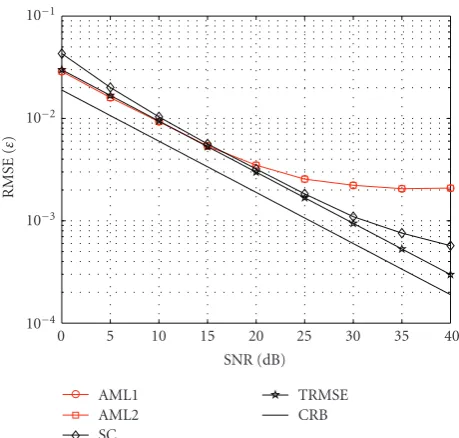
SNR (dB) AML1
AML2 SC
TRMSE CRB
Figure3: Performance of the considered CFO estimators in AWGN channel.
the proposed algorithm in an OFDM/OQAM system and the SC algorithm in an OFDM system, and, moreover, in the case of the SC algorithm an OFDM symbol with two equal parts is exploited. The results show that in multipath channel A the performance of both estimators presents a floor, but for different reasons. In the case of the SC estimator the floor is due to the inaccuracy in the ST estimate (normalized RMSE nearly equal to 2·10−1 (seeFigure 5)), while in the case of the AML estimator the floor is due (as well as in the AWGN channel (seeFigure 3)) to the interference from adjacent subcarriers. Moreover, in Figures3and4is reported also the Cram`er -Rao bound (CRB) on CFO estimation for OFDM/OQAM systems. The performance loss with respect to the CRB is quite contained for SNR values lower than 20 dB. Specifically, as it is shown in the following the accuracy is sufficient to assure a negligible degradation with respect to the case of perfect synchronization.
To gain some insight about the acquisition range of the considered estimators inFigure 6is reported the normalized RMSE of the AML CFO estimators as a function of the actual value of the normalized CFO εin AWGN (solid lines) and multipath channel A (dashed lines) for SNR = 10 dB. In
Figure 6is also reported the RMSE of the SC estimator. Note that in this case a number of 10000 Monte Carlo trials have been performed. The results show that although the AML estimators have been derived under the assumption of small values of CFO, they assure a satisfactory performance in the rangeε∈[−0.8, 0.8]. Of course if the value of the normalized CFO can belong to a larger interval, an additional stage at the beginning of the preamble needs to be inserted to obtain a coarse estimate of the CFO within a sufficiently wide range.
Figures 7 and 8 show the normalized RMSE of the considered CFO estimators as a function of the number of subcarriersNin AWGN (Figure 7) and in multipath channel A (Figure 8), and for two SNR conditions. The results show
10−4 10−3 10−2 10−1
0 5 10 15 20 25 30 35 40
RMSE
(
ε
)
SNR (dB) AML1
AML2 SC
TRMSE CRB
Figure4: Performance of the considered CFO estimators in ITU Vehicular A multipath channel.
10−3 10−2 10−1 10
0 5 10 15 20 25 30 35 40
RMSE
(
τ
/T
)
SNR (dB) AML1
AML2 SC
Figure 5: Performance of the considered ST estimators in ITU Vehicular A multipath channel.
0.008 0.01 0.03
−1 −0.5 0 0.5 1
RMSE
(
ε
)
ε
AML1 AML2 SC
Figure 6: Performance of the considered CFO estimators as a function of the actual value of the normalized CFO.
10−3 10−2 10−1
SNR=20 dB
64 128
SNR=10 dB
256 512
RMSE
(
ε
)
N
AML1 AML2 SC
TRMSE CRB
Figure 7: Performance of the considered CFO estimators as a function of the number of subcarriers in AWGN channel.
of the plateau. On the other hand, as regards the AML ST estimators no errors were observed in AWGN while a normalized RMSE less than 10−2was obtained forN≥64.
Finally, Figures9 and10 show, forN = 256 andε =
0.2, the bit error rate (BER) obtained with the adoption of the AML and SC estimators followed by a one-tap equalizer with perfect knowledge of the channel and of the residual synchronization errors. The performance is com-pared with that of the perfectly synchronized OFDM/OQAM system (PS-OFDM/OQAM) and with that of the perfectly synchronized OFDM system (PS-OFDM) with CP= N/4.
10−3 10−2 10−1
SNR=20 dB
64 128
SNR=10 dB
256 512
RMSE
(
ε
)
N
AML1 AML2 SC
TRMSE CRB
Figure 8: Performance of the considered CFO estimators as a function of the number of subcarriers in ITU Vehicular A multipath channel.
10−4 10−3 10−1
10−2 100
0 5 10 15 20
BER
SNR [dB] PS-OFDM/OQAM
AML1 AML2
PS-OFDM SC
Figure9: BER of the considered joint estimators in AWGN channel.
10−5 10−4 10−3 100
10−2 10−1
0 5 10 15 20 25 30 35 40
BER
SNR (dB) PS-OFDM/OQAM
AML1 AML2
PS-OFDM SC
Figure10: BER of the considered joint estimators in ITU Vehicular A multipath channel.
5. Conclusions
In this paper we have dealt with the problem of data-aided synchronization for OFDM/OQAM systems in multipath channels. In particular, the joint ML estimator for CFO, amplitudes, phases, and delays, exploiting a short known preamble, has been derived. Exploiting the closed form ML estimators for phases and amplitudes and the closed form AML CFO estimator for small CFO values, a cost function that can provide an estimate of the ST, has been obtained. The performance of the joint AML1 estimator for multipath channel has been assessed via computer simulations and compared with that achieved by the joint AML2 estimator designed for AWGN channel. Moreover, a comparison with the performance achieved by the SC estimator for OFDM systems has been made. The results have shown that if it satisfied a condition involving the training symbol and the data burst is delayed by one OFDM/OQAM symbol interval with respect to the training burst, the AML CFO estimators assure a performance similar to that achieved by the SC estimator in multipath channel A, while the AML ST estima-tors outperform the SC estimator. Moreover, an approximate expression for the MSE of the AML CFO estimators has been derived that can be exploited to predict the actual performance in the range of moderate SNR values. Finally, a comparison between the BER obtained with the adoption of the AML and SC estimators followed by a one-tap equalizer with perfect knowledge of the channel and of the residual synchronization errors has been made. The results have shown that both in AWGN and multipath channel A the AML estimators assure a negligible degradation with respect to the perfectly synchronized system while the adoption of the SC synchronization scheme leads to an error floor due essentially to the inaccuracy of the ST estimates.
Appendices
A.
In this appendix we analyze the accuracy of the AML CFO estimates in the absence of noise in a single-path channel and in the case of perfect ST synchronization (Nc=1 andτ1=0 in (1)). By considering a training symbol composed ofL=1 OFDM/OQAM symbol, taking into account (18) and (20) it follows that
w(0l)(0,ε)ul(0)= βN−1
m=0
r(mTs)g(mTs)e−j(2π/N)ml
=
N
2Nuγe
jφ
l1∈P ej(π/2)l1
×
⎡ ⎣aR
0,l1 βN−1
m=0
ej(2π/N)εm×g2(mT
s)e−j(2π/N)m(l−l1)
+jaI0,l1 βN−1
m=0
ej(2π/N)εmg
mTs−T
2
×g(mTs)e−j(2π/N)m(l−l1)
⎤ ⎦
=
N
2Nuγe jφej(π/2)l
×
⎡ ⎣aR
0,l βN−1
m=0
ej(2π/N)εmg2(mT
s)
+jaI
0,l βN−1
m=0
ej(2π/N)εmg
mTs−T
2
g(mTs)
⎤ ⎦
+Iw(l,ε),
(A.1)
where
Iw(l,ε)
N
2Nuγe
jφ
l1∈P,l1=/l ej(π/2)l1
×
⎡ ⎣aR
0,l1 βN−1
m=0
ej(2π/N)εmg2(mT
s)e−j(2π/N)m(l−l1)
+jaI
0,l1 βN−1
m=0
ej(2π/N)εmg
mTs−T
2
×g(mTs)e−j(2π/N)m(l−l1)
⎤ ⎦.
(A.2)
w0(l)(0,ε)e−jπεe−jπlul
N
2
=e−jπεe−jπl βN−1
m=0
r
m+N
2
Ts g(mTs)e−j(2π/N)ml
=
N
2Nuγe
jφe−jπεe−jπl
l1∈P ej(3π/2)l1
×
⎡ ⎣aR
0,l1 βN−1
m=0
ej(2π/N)ε(m+(N/2))g
mTs+T
2
×g(mTs)e−j(2π/N)m(l−l1)+jaI0,l1
× βN−1
m=0
ej(2π/N)ε(m+(N/2))g2(mT
s)e−j(2π/N)m(l−l1)
⎤ ⎦
=
N
2Nuγe
jφe−jπεej(π/2)lejπε
×
⎡ ⎣aR
0,l βN−1
m=0
ej(2π/N)εmg
mTs+T
2
g(mTs)
+jaI
0,l βN−1
m=0
ej(2π/N)εmg2(mT
s)
⎤ ⎦
+e−jπεe−jπlI
w(l,ε),
(A.3) where
Iw(l,ε)
N
2Nuγe
jφejπε
l1∈P,l1=/l ej(3π/2)l1
×
⎡ ⎣aR
0,l1 βN−1
m=0
ej(2π/N)εm
×g
mTs+T
2
g(mTs)e−j(2π/N)m(l−l1)
+jaI
0,l1 βN−1
m=0
ej(2π/N)εmg2(mT
s)e−j(2π/N)m(l−l1)
⎤ ⎦.
(A.4) Therefore, taking into account (18), (20), (22), and (A.1) it follows that
A(0)=
l∈P
e−j(π/2)laR0,lw
(l) 0 (0,ε)=
N
2Nuγe jφ × ⎡ ⎣ l∈P aR 0,l
2βN−1
m=0
ej(2π/N)εmg2(mT
s)
+j l∈P
aR0,laI0,l βN−1
m=0
ej(2π/N)εmg
mTs−T
2
g(mTs)
⎤ ⎦
+
l∈P
e−j(π/2)laR
0,lIw(l,ε).
(A.5)
Moreover, from (19), (20), (23), and (A.3) we have
B(0)= −jejπε
l∈P
e−j(π/2)laI
0,lw
(l) 0 (0,ε)
= −j
N
2Nuγe jφejπε
×
⎡ ⎣j
l∈P
aI0,l
2βN−1
m=0
ej(2π/N)εmg2(mTs)
+
l∈P aR0,laI0,l
βN−1
m=0
ej(2π/N)εmg
mTs+T
2
g(mTs)
⎤ ⎦
−j l∈P
e−j(3π/2)laI0,lIw(l,ε).
(A.6)
Note that if the training symbol satisfies the condition
l∈P
aR0,laI0,l=0, (A.7)
it follows that
A(0)=
N
2Nuγe
jφ
l∈P
aR0,l
2βN−1
m=0
ej(2π/N)εmg2(mTs)
+
l∈P
e−j(π/2)laR
0,lIw(l,ε),
(A.8)
B(0)=ejπε
N
2Nuγe
jφ
l∈P
aI0,l
2βN−1
m=0
ej(2π/N)εmg2(mT
s)
+
l∈P
e−j(π/2)(1+3l)aI
0,lIw(l,ε).
(A.9)
In this case, if the interference terms l∈Pe−j(π/2)laR0,lIw(l,ε)
and l∈Pe−j(π/2)(1+3l)aI0,lIw(l,ε) in the RHS of (A.8) and
(A.9), respectively, were negligible, the CFO estimate would be (see (24) for Nc = 1) (1/π)∠{A∗(0)B(0)} = ε. The
presence of the interference terms in the RHS of (A.8) and (A.9) leads to an error floor. Moreover, if condition (A.7) is not fulfilled an error floor can be observed also when the interference terms are negligible (see (A.5) and (A.6)). However, in the section on numerical results it is shown that the error floor can be substantially reduced when condition (A.7) is satisfied.
B.
can be deleted. In this case taking into account (A.1), (A.3), (A.8), and (A.9) it follows that
A∗(0)B(0)#A∗0(0) +WA∗
$
[B0(0) +WB],
A∗0(0)B0(0) +A∗0(0)WB+B0(0)WA∗,
(B.1)
where the last approximation has been obtained by neglect-ing the noise×noise term, and, moreover,A0(0) andB0(0) represent the contribution toA(0) andB(0) (in (A.8) and (A.9), resp.) in the absence of noise and of the interference terms. The noise contributions in (B.1) are given by
WA
βN−1
k=0
n(kTs)g(kTs)
l∈P
aI0,Re−j(π/2)le−j(2π/N)kl, (B.2)
WB−j
βN−1
k=0
n
k+N
2
Ts
×g(kTs)
l∈P
aI0,Ie−j(π/2)le−jπle−j(2π/N)kl,
(B.3)
where the zero-mean circular noise n(kTs) has a variance
E[|n(kTs)|2]=σn2/Ts. In this case we obtain
ε−ε= 1
π∠
A∗(0)B(0)e−jπε
1
π
I%e−jπεA∗
0(0)WB+e−jπεB0(0)WA∗
& R%A∗0(0)B0(0)
&
= 1 π
I{Z}
(N/2Nu)γ2 l∈P
aR0,l
2
l∈P
aI0,l
2 q
= 1 π
I{Z}
(N/2)γ2N
u βN−1
k=0 ej(2π/N)εkg2(kTs)
2,
(B.4)
where q denotes | βNk=0−1ej(2π/N)εkg2(kTs)|
2
and the last equality has been obtained by exploiting the fact thataR
p,l, aIp,l∈ {−1, 1}, and, moreover,
Z=Δe−jπεA∗0(0)WB+e−jπεB0(0)WA∗. (B.5)
Thus, from (B.4) we obtain
E(ε−ε)2 1
2π2
E|Z|2−R%E#Z2$&
(N/2)γ2N
u βNk=0−1ej(2π/N)εkg2(kTs)
2 2.
(B.6)
Finally, under the assumption l∈PaR0,laI0,l±10, exploiting the condition (A.7) and the noise circularity, we have
R%E#Z2$&0, (B.7)
E|Z|2=σn2 Ts
βN−1
k=0
g2(kT
s)Nγ2Nu2
βN−1
k=0
ej(2π/N)εkg2(kT
s)
2
.
(B.8)
Therefore, we can write
E(ε−ε )2 2
π2NSNR
1
βN−1
k=0 g(k) 2
ej(2π/N)εk2
, (B.9)
where SNR=Δγ2/σ2
nandg(k)
Δ
=g(kTs)! βN−1
l=0 g2(lTs).
Acknowledgment
This work was supported in part by the European Commis-sion under Project PHYDYAS (FP7-ICT-2007-1-211887).
References
[1] B. Farhang-Boroujeny and R. Kempter, “Multicarrier commu-nication techniques for spectrum sensing and commucommu-nication in cognitive radios,”IEEE Communications Magazine, vol. 46, no. 4, pp. 80–85, 2008.
[2] G. Cherubini, E. Eleftheriou, S. Oker, and J. M. Cioffi, “Filter bank modulation techniques for very high-speed digital subscriber lines,”IEEE Communications Magazine, vol. 38, no. 5, pp. 98–104, 2000.
[3] T. Ihalainen, T. H. Stitz, M. Rinne, and M. Renfors, “Channel equalization in filter bank based multicarrier modulation for wireless communications,”EURASIP Journal on Advances in Signal Processing, vol. 2007, Article ID 49389, 18 pages, 2007. [4] D. Lacroix, N. Goudard, and M. Alard, “OFDM with guard
interval versus OFDM/OffsetQAM for high data rate UMTS downlink transmission,” in Proceedings of the 54th IEEE Vehicular Technology Conference (VTC ’01), vol. 4, pp. 2682– 2686, Atlantic City, NJ, USA, October 2001.
[5] C. R. M. Alard and P. Siohan, “A family of extended gaussian functions with a nearly optimal localization,” inProceedings of the 1st International Workshop on Multi-Carrier Spread-Spectrum, pp. 179–186, Oberpfaffenhofen, Germany, April 1997.
[6] R. Haas and J.-C. Belfiore, “A time-frequency well-localized pulse for multiple carrier transmission,” Wireless Personal Communications, vol. 5, no. 1, pp. 1–18, 1997.
[7] P. Ciblat and E. Serpedin, “A fine blind frequency offset estimator for OFDM/OQAM systems,”IEEE Transactions on Signal Processing, vol. 52, no. 1, pp. 291–296, 2004.
[8] T. Fusco and M. Tanda, “Blind frequency-offset estimation for OFDM/OQAM systems,” IEEE Transactions on Signal Processing, vol. 55, no. 5, pp. 1828–1838, 2007.
[9] H. Bolcskei, “Blind estimation of symbol timing and carrier frequency offset in wireless OFDM systems,”IEEE Transactions on Communications, vol. 49, no. 6, pp. 988–999, 2001. [10] T. Fusco, A. Petrella, and M. Tanda, “Data-aided symbol
[11] B. Jahan, M. Lanoisel´ee, G. Degoulet, and R. Rabineau, “Full synchronization method for OFDM/OQAM and OFDM/QAM modulations,” inProceedings of the 10th IEEE International Symposium on Spread Spectrum Techniques and Applications (ISSSTA ’08), pp. 344–348, August 2008. [12] B. Jahan, M. Lanoisel´ee, G. Degoulet, and R. Rabineau,
“Frame synchronization method for OFDM/QAM and ODFM/OQAM modulations,” inProceedings of the 4th IEEE International Conference on Circuits and Systems for Communi-cations (ICCSC ’08), pp. 445–449, Shanghai, China, May 2008. [13] T. Fusco, A. Petrella, and M. Tanda, “Joint symbol timing and CFO estimation in multiuser OFDM/OQAM systems,” inProceedings of the 10th IEEE Workshop on Signal Processing Advances in Wireless Communications (SPAWC ’09), pp. 613– 617, Perugia, Italy, June 2009.
[14] T. M. Schmidl and D. C. Cox, “Robust frequency and timing synchronization for OFDM,” IEEE Transactions on Communications, vol. 45, no. 12, pp. 1613–1621, 1997. [15] M. G. Bellanger, “Specification and design of a prototype filter
for filter bank based multicarrier transmission,” inProceedings of the IEEE International Conference on Acoustics, Speech, and Signal Processing (ICASSP ’01), vol. 4, pp. 2417–2420, Salt Lake, Utah, USA, May 2001.