Proceedings of the CIB W78-W102 2011: International Conference –Sophia Antipolis, France, 26-28 October
CONSTRUCTION COMPETITIVENESS AND KNOWLEDGE
MANAGEMENT. BASIC CONSIDERATIONS
Licia Pietrosemoli, Mgs / Costa Norte Construcciones-Venezuela Vicepresident,
[email protected]
Universidad Politécnica de Madrid (UPM), Madrid, Spain
Carlos Rodríguez Monroy, PhD/ Professor & researcher, [email protected]
Universidad Politécnica de Madrid (UPM), Madrid, SpainABSTRACT
Based on the importance of the construction, stakeholders in this industry should support its competitiveness improvement. However, authors sustain that not all are sufficiently informed about the current challenges, problems and advances regarding this industry and by this reason many valuable knowledge get lost. Understand the existence of different realities about construction, the shortages of information and state of the art is crucial to propose and implement strategies to support practical solutions. As a part of an on-going investigation, this research includes the revision of the nature, significance and challenges faced by the construction and makes reference to competitive policies, lessons learned and sustainable construction while knowledge management is emphasized as a key element to sustain construction competitiveness. Based on documental revision and field work developed with participation of oil and petrochemical construction companies and construction experts, this research present some preliminary results that confirm that there is a breach between construction knowledge available and the construction problems faced by this industry. This evidences that even of the practical knowledge available for the understanding of construction problems, to identify enhancement opportunities and to improve the complex processes related to construction, there is an important recurrence of diverse construction problems both in developed and developing countries. Based on such findings authors sustain that additional efforts must be devoted to permit that the existing knowledge transcend theory and can be used by construction organizations to improve it performance and competitiveness thus contributing to the solution of practical problems for the benefit of society. The presentation of basic information about those issues in practical way in diverse situations and with empirical evidences may facilitate the end-users change of attitude in front of such resources and thus reduce the existing gap between knowledges and construction problems.
Keywords: Competitiveness, Sustainable construction, Knowledge management
1.
INTRODUCTION
Members of academia commonly discuss and share knowledge in order to improve the performance of diverse productive sectors, but such deliberations, - including aspects such as productivity, competitiveness, innovation, R+D, sustainability, knowledge management, environmental protection, sustainable construction and social equity, do not always reach the final destination, so their added value may be partially lost instead of helping society as desired.
Moreover developed countries, this situation is present in some developing countries also where day to day problems and their particular realities may be overwhelming and impede working for long term performance improvement objectives.
This is a particular reality affecting the construction industry because of the problems present in projects of various scales and complexities in Asia, Africa, Middle East, Europe, Oceania or America.
All those problems, many of them recurrent, generate important resources losses and limit construction competitiveness. By this reason and due to the significance of construction for the services that provides to society as well as for the jobs and wealth it creates, is necessary to develop strategies to improve construction performance.
This conviction leads the authors to the hypothesis that the gap between the existing construction knowledge and the recurrence of construction problems arise from the fact that the vast amount of information and lessons learned, the construction complexities, the day to day problems and the knowledge production and transfer difficulties together make harder to assimilate the existing intangible assets available.
Authors sustain that this gap may be reduced making relevant knowledge available to end-users so to progressively promote the changes of attitudes in front of these important untapped resources. By this reason, it is worthwhile to facilitate the access of theoretical-practical basic construction information to them.
This investigation is part of on-going research oriented to evaluate the factors affecting the industrial construction competitiveness and the potential of knowledge to improve it and is based on factual experiences and learning about Venezuelan oil and petrochemical construction industry.
Authors present partial results from the documental and empirical research conducted since 2008 to 2011 through the review of documents and field works developed with participation of construction companies working for the oil and petrochemical sector in Venezuela and with support of independent experts (construction, legal, taxes and financial advisors).
The field works developed during this research include sending questionnaires to 38 Venezuelan construction companies working for the oil and petrochemical sector in 2008 (24 responses obtained, for 63,16% response rate) to 78 managers and directors of a Venezuelan construction company in 2010 (more than 600 employees and workers, levels of sales over US$ 40,000,000 for 2010, 43 years of activities, with 78 questionnaires sent, 48 responses were obtained, for 61,54% response rate) to external advisors of such company (technical, legal, tax and financial advisors, from 12 questionnaires sent, 8 responses were obtained, for 66,67% response rate) and to construction experts in 2011 (8 questionnaires sent, 7 responses obtained, for 87,5% response rate).
The construction experts that participated on 2011 survey work as directors, consultants or advisors of construction companies in Central and Latin America and one of them in several other countries in Europe and North America. All of them with more than 20 years of experience.
The article includes a review of basic fundamental knowledge regarding the construction nature, importance and sustainability, construction challenges and lessons learned in construction, industrial competitiveness and competitive policies for developing countries, knowledge management in 21th Century construction.
Additionally the research presents partial results from the field works regarding main issues affecting construction performance from the global, regional and oil and petrochemical perspectives. The field works are still under development so only partial results about main construction problems are presented.
Confirming the interests that society must develop concerning sustainability, competitiveness and knowledge management as guidelines to improve quality of life, especially in developing countries, this research review seeks to support the existing databases with knowledge that may help to better understand the complex processes related to construction and accordingly propose strategies to improve it. This may increase the link between theory and practice and promote construction knowledge understanding and dissemination beyond the academic circles.
2.
THE CONSTRUCTION INDUSTRY: NATURE, IMPORTANCE AND
SUSTAINABILITY
Because construction provides the necessary infrastructure that enables the development of all human activities, with influence on socio-economic development, it is considered an activity with strategic importance for mankind.
Researchers agree on the importance of construction as it provides housing, sanitation, water, infrastructure, industrial, and communication and transportation facilities. For these reasons it is considered a key element for achieving sustainable development and it is essential for a better future (CIB&UNEP-IETC 2002; Egbu et al. 2003).
Being initially considered traditional, the construction industry has evolved due to the use of new materials and technologies, the more frequent use of manufactured elements and modular buildings, the mechanization and industrialization of processes, and in general because of the improved additional services and facilities (Anumba et al. 2005).
In addition, the construction industry presents a complex nature evidenced by the fact that each project involves the participation and integration of diverse groups working together temporarily in fragmented and complimentary activities that require the combination of different work practices and cultures, all needed to complete the projects according to specifications.
Because of such complexities, to perform any construction project are required higher levels of knowledge and this lead to the recognition that construction is a knowledge-based industry, challenging former perceptions that companies in this sector do not take advantage of innovations and technology (Anumba et al. 2005).
In such a dynamic environment, there is a need to find strategies in order to achieve the best construction performance, including sustainable construction which was defined by CIB (1999) as the creation and management of a healthy environment, based on the efficient use of resources and ecological principles that support the realization of human settlements sustaining human dignity and economic equity to foster the goal of sustainable development.
Because of the combination of social and technical elements, sustainable construction must be promoted understanding the biological, sociological, political, economic and cultural elements related to the different construction projects, taking into consideration the diverse realities and needs of developed and developing countries (CIB 1999; Gomes et al. 2005).
The consequent evolution of construction from the former and traditional vision that used to consider human resources, capital and materials as main inputs for construction success to the new conception of construction on the current global stage, which highlight the interdependence between technical, social, equity, cultural, economic and environmental factors as basic conditions to reach for sustainability means that constructors today have to face each new project from a multidisciplinary and global perspective.
This mean that moreover to the usual construction considerations related to technical, operative and financial constraints, constructors have to consider the new demands and challenges that may impose such factors in order to include their impact during bidding, planning, building or delivery phases.
Additionally, to follow the sustainability path the construction companies need to undergo cultural changes and devote efforts to solve the existing problems concerning the disinterest or shortages in education regarding sustainability issues existing both in developed and developing countries as they impose important limitations to reach for construction performance improvement.
These efforts must start with a clear understanding of the basic knowledge about construction, and the acceptance of the responsibilities that all the stakeholders have about it improvement.
3.
CONSTRUCTION CHALLENGES - LESSONS LEARNED IN CONSTRUCTION
The complex factors involved in construction projects demonstrate that constructors have to face many challenges - sometimes more than challenging, being very problematic - related to economic, cultural and technical issues in different areas including design, re-engineering, construction techniques as well as environmental, safety, quality control, human resources, finance and management. In addition, constructors have to answer to the demands of the project owners, customers and communities while complying with the strict standards and regulations that define the performance of each project (CIB&UNEP-IETC 2002; Gomes et al. 2005). All those requirements are worsened today because of the global crisis, political stress or even natural disasters.
The literature review and empirical findings present ample evidences of some of the diverse challenges and problems faced by construction.
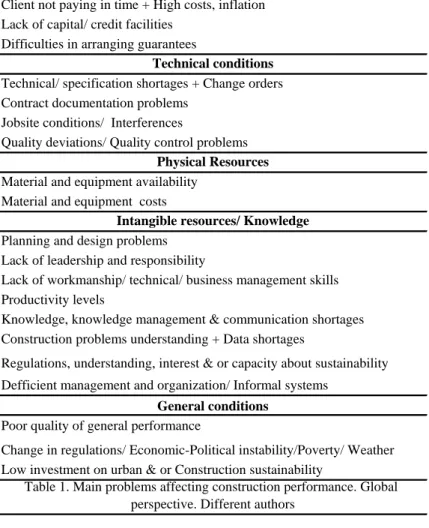
The following Table 1 (Pietrosemoli et al. 2011) based on documental review, present a summary of problems identified by diverse authors as affecting projects construction performance in diverse geographical realities of developed and developing countries. From a global perspective and recognizing diverse manifestations and severities in the different cases, all those factors are identified by authors as main causes of delays and other important changes on construction projects, as for example lost production, increased costs, quality problems and negative customer’s appreciation.
Financial Client not paying in time + High costs, inflation Lack of capital/ credit facilities
Difficulties in arranging guarantees
Technical conditions Technical/ specification shortages + Change orders Contract documentation problems
Jobsite conditions/ Interferences
Quality deviations/ Quality control problems Physical Resources Material and equipment availability
Material and equipment costs
Intangible resources/ Knowledge Planning and design problems
Lack of leadership and responsibility
Lack of workmanship/ technical/ business management skills Productivity levels
Knowledge, knowledge management & communication shortages Construction problems understanding + Data shortages
Regulations, understanding, interest & or capacity about sustainability Defficient management and organization/ Informal systems
General conditions Poor quality of general performance
Change in regulations/ Economic-Political instability/Poverty/ Weather Low investment on urban & or Construction sustainability
Table 1. Main problems affecting construction performance. Global perspective. Different authors
Sweis et al. (2008) sustain that those are common problem even with technological advances and management improvements because delays are present on construction jobsites in both developed and developing countries, with diverse origins that may include technical problems due to construction change orders, financial constraints, resource shortages, lack of organization or labor problems. Such situations create increasing financial and legal risks for the project owners and contractors that in some cases may arrive to legal disputes and severe losses for them.
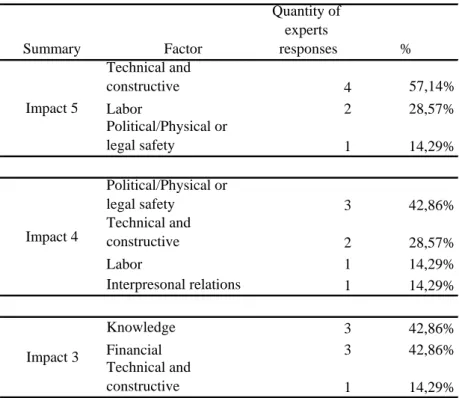
From the point of view of a regional context, similar problems are highlighted by the 7 construction experts consulted by authors in 2011. From their point of view the factors that are the biggest obstacles to construction performance are the ones described on Table 2 (Pietrosemoli et al. 2011).
Summary Factor
Quantity of experts
responses %
Technical and
constructive 4 57,14%
Labor 2 28,57%
Political/Physical or
legal safety 1 14,29%
Political/Physical or
legal safety 3 42,86%
Technical and
constructive 2 28,57%
Labor 1 14,29%
Interpresonal relations 1 14,29%
Knowledge 3 42,86%
Financial 3 42,86%
Technical and
constructive 1 14,29%
Impact 5
Impact 4
Impact 3
Table 2. Main factors affecting construction performance. Construction experts perspective
From a local perspective, similar conclusions are found as the directors and managers of one of the Venezuelan contractors working for the oil and petrochemical industry, consider that the problems that impact their performance more frequently are the ones described on Table N. 3 (Pietrosemoli et al. 2010).
Main problems
Very frequent & frecuent
Cases N. %
Resources availability 28 22,05%
Financial 25 19,69%
Labor 22 17,32%
Contractual/Relation with client 20 15,75%
Technical-Constructive 19 14,96%
Safety and public order 8 6,30%
Social claims 5 3,94%
Total responses 127 100,00%
Table N. 3. Main problems. Venezuelan oil and petrochemical construction perspective
Evidently all those problems, their frequency and severe impact should lead construction stakeholders to be aware of them creating a general recognition and awareness about lessons learned in order to reduce their recurrence and so the existing limitations to competitiveness. (Pietrosemoli 2009).
But in practical: Is this true? Are the companies going ahead in their attempt to avoid colliding twice with the same stone? This is not so evident.
In fact Koskela (2000:143) dramatically states “It has also been argued that in project control `firefighting´ ongoing or looming crisis consumes management resources and attention so totally that there is little room for planning let alone improvement activities…”.
The field work developed by authors confirms such appreciation. Table 4 (Pietrosemoli et al. 2011) summarizes the opinion of experts about the recurrence of repeating mistakes affecting construction companies in Central and Latin America mainly.
1 Almost always 2 Ocasionally 3 Ocasionally 4 Always 5 Almost always 6 Almost always 7 Ocasionally Table 4. Repeating mistakes
E
xpe
rt
s
How often in the new projects initiated by the organizations
they repeat earlier mistakes.
All the cross references from global to local perspectives that arise from documents and empirical evidence show that there is a lot of work to do to take advantage of the valuable learning from previous experiences. Such lessons learned from construction experiences - both from successes or failures - must be incorporated on the revision of the particular conditions of each project in order to transform them in valuable knowledge to be used by constructors and owners to develop strategies to reduce the impact of such situations (Love et al. 2005). This should become a priority for construction stakeholders.
4.
COMPETITIVE POLICIES
The competitiveness of an economy is related to the factors, policies and institutions that define its productivity levels and may add value, support development and create prosperity. In that context, competitivity gives the references needed to evaluate the factors that may add value to existing processes, develop potential and generate greater prosperity, wealth and employment (Singh 2002).
As a general framework sustaining the productive activities of all sectors the revision of policies affecting construction is proposed to all countries keeping in mind the existence of regional differences to promote conditions really valuable to uphold integral competitiveness improvements and sustainability.
5.
KNOWLEDGE MANAGEMENT AND 21
STCENTURY CONSTRUCTION
Knowledge is recognized as resulting from a combination of diverse expertise, values, personal approach, know-how, technical abilities and skills that a person acquires from personal, social and organizational interaction. As a valuable resource in the decision making processes, knowledge
management is considered a key element for network and capability development, to create cultural changes, foster education, and innovation and support the development of public policies (CEN 2004).
Because knowledge motivates creativity, promotes adaptation and better responses to change and enable decision making, experts consider that the relation between competitiveness advances and knowledge is very tight.
The acknowledgment of knowledge as a valuable resource is also connecting actors from the construction industry. Some of them recognize that in order to maintain competitiveness nowadays the construction industry relies heavily on knowledge because it allows fostering innovation and obtaining performance improvements of processes and customer satisfaction (Kamara et al. 2002).
In fact, Egbu et al. (2004) sustain that knowledge management improves construction because innovations expand more easily along the organizations, project indicators reach performance progresses, lessons learned from a project benefit others and the transfer of knowledge between the various stages of each project is easier.
Even if knowledge are embedded in all the individuals and organizational life and cannot be abstracted from the different activities any time, knowledge management processes are not simple. They depend upon a complex combination of factors starting with the cultural, organizational and technological framework needed to develop them.
The knowledge production and management has evolved from ancient history to our days and assume different particular and characteristic configuration depending on each company objectives and vision. By this reason there are no special recipes to guarantee the success of the knowledge management processes.
In fact, even with a growing realization of the value of knowledge management, especially found on developed countries, construction organizations frequently confront loss of knowledge that may be the result of personnel transfer to other projects, difficulties in capturing, organizing and retrieving acquired knowledge, deficient effectiveness of lessons learned, shortage of skilled workers, or a limited comprehension of the value of knowledge for construction (Kazi 2005, Egbu et al. 2005).
Additional problems may arise from the fragmentation of work or the need to combine diverse cultural habits and organizational structures that is a characteristic of construction and this means improvement opportunities in areas such as knowledge creation, dissemination and utilization of such intangible resources. This reality confirms the need of developing new knowledge management competences that require active participation of governments, universities and research centers, public and private organizations as well as the directors, managers and employees of construction organizations.
To solve such shortages, during knowledge management processes evolution, different models of knowledge management have been proposed by experts. Some of them applicable to different kind of organizations as for example SECI Model (Socialization, Externalization, Combination and Internalization) proposed by Nonaka, and Takeuchi, in 1995, the MAGIC model proposed by Rivero in 2006 (Modelo de Ayuda a la Gestión Integrada del Conocimiento, - Model to help the integrated knowledge management), the Successful knowledge management model proposed by Kulkarni, Ravindran and Freeze, in 2007, or the specialized construction oriented model CLEVER (Cross-sectoral learning in virtual enterprise) proposed by Kamara et al. in 2002.
Beyond them, there is a vast range of models available to the diverse organizations that offer valuable support to take best chance of intangible capital assets adaptable to the different needs of each one that may support construction competitiveness.
Another factor related to the competitiveness improvement in connection with knowledge management are the supply chain collaborative practices for construction. In fact, even if traditionally
referred to manufacturing industries, the supply chain collaborative practices are progressively being valued in construction projects since benefits the construction phases from design and planning up to management of final built premises (Akintoye 2000). This is especially important considering the complexities and challenges of construction projects due to the fact that permits the coordination of the different processes and enhances the flow of knowledge involving owners, clients, suppliers of goods and services, financial and insurance and other institutions related to any construction project.
In such way the supply chain management processes results of added value to reduce the construction costs and to increase companies competitive advantages (Akintoye 2000) and must be recognized as an additional resource to improve construction performance in coordination with knowledge management processes. The positive effect of all such practices together may be noticed in the reduction of project timeline, the improvement of the quality of services and the reduction of costs that support project success (Farooqui 2009).
Another important change in the knowledge management history was proposed by Gibbon et al. (1994) when they proposed the evolution from the traditional Mode 1 about production of knowledge - initially oriented to the theoretical knowledge production - , to the Mode 2 of knowledge production oriented to fulfill practical applications and extremely linked to the transdisciplinary integrated context of application (Kuutti, 2007).
The Gibbons et al. proposals present a fundamental support to the ideas discussed in this research especially because highlight the need to strengthen the link between the academic community knowledge production and the stakeholder’s needs and their own knowledge production. This attitude will permit take the full advantage of the existing and new knowledge related to construction in order to solve practical and repeated problems allowing to reduce the gap between theory and practice and sustaining the efforts to reach for construction sustainability and competitiveness.
6.
SOME PROPOSALS TO SUPPORT KNOWLEDGE MANAGEMENT FOR
CONSTRUCTION-CONCLUSIONS
The revision of the state of the art about construction, it challenges, the sustainability and knowledge management issues and it confrontation with results coming from field works, confirmed the authors hypothesis about the existence of a breach between the vast amount of available knowledge and the severe and unjustified recurrence of the construction problems that affect projects in diverse geographical and cultural environments.
These conduce authors to conclude that the valuable knowledge available are not reaching the final recipients in such a way to transform them in actions oriented to reduce the causes of construction problems, and because of that their expected benefit are partially lost.
As construction knowledge are resources that should generate positive attitudes toward sustainable construction and construction competitiveness and in this way promote problems and construction mistakes reduction and in general lead to construction performance improvements, there is an evident improvement opportunity about the utilization of such intangible resources.
To reduce the existing gap between available knowledge and problems, authors propose to make relevant knowledge easily available to end-users so to progressively promote in them changes of attitudes in front of these important untapped resources.
Even if no specific strategies are presented at this research stage, the main proposal is that combined academic and empirical knowledge must arrive to final users in simple, accessible and reflective ways with support of governments, universities, unions, guilds, citizens and media on a recurrent and innovative way that can conduce to profound changes of attitudes in mid-long term.
This implies the need to discuss and share valuable information in easy and practical ways making academic knowledge affordable for the common use. Easy models of knowledge management are needed to promote the popular understanding, production, dissemination and use of knowledge as strategic resources. Current research will continue in this path.
The permanent exchange of learning and experiences between different stakeholders may facilitate practical approaches to be followed by construction organizations working on developed and developing countries.
The current research is intended as a preliminary step to offer an overview of the construction competitiveness problem and the value of knowledge as a strategic asset for this sector, a goal that requires the development of knowledge management systems suitable for the diverse needs and cultures.
With this contribution all stakeholders - now aware of their duties - will act as change agents encouraging long-term and positive improvements that may help reduce the constraints that today limit competitiveness, sustainable construction and sustainable development.
REFERENCES
Akintoye, A. et al. (2000). “A survey of supply chains in the UK construction industry”. European Journal of purchasing and supply management. Volumen 6. Isssue 3-4. 2000. Pp. 159-168
Anumba, C. et al. (2005). “Knowledge Management in Construction”. Blackwell Publis. Ltd, India. CIB. (1999). “Agenda 21 for sustainable construction. Section two. Concepts of sustainable
development and sustainable construction”. CIB Report Publication N. 237. July 1999. 33-50. CIB& UNEP-IETC. (2002). “Agenda 21 for Sustainable Construction in Developing Countries. A
discussion document”. Boutek Report No Bou/ E0204. Pretoria, África. 83.
CEN. Comité Européen de Normalisation, (2004). “European guide to good Practice in Knowledge management. Part 1: Knowledge management framework”. CWA 14924-1. Brussels. 33.
Egbu, C. et al. (2003). “A systematic analysis of knowledge practices in other sectors: Lessons for construction. Knowledge management for sustainable construction competitiveness. 60.
Egbu, C. et al. (2004). “Knowledge management for sustainable construction competitiveness”. Final Report. July 2004. ISBN-1-9033661-63-3. BNE Report. 20.
Egbu, C. et al (2005). “Graphical conveyance of knowledge among construction SMES”. CIB-W102. Portugal. 12
Farooqui, R. et al. (2009). “Knowledge and information management in construction contracting firms. The US perspective”. CIB-W102. Rio de Janeiro, RJ. Brasil, 17-19 June 2009. 12.
Gomes, V. et al. (2005). “Exploring Sustainable Construction: Implications from Latin America”. Building Research and Information. Volume 33, number 5, September-October 2005. 428-440. Kazi, A., (2005). “Knowledge management in the construction Industry: A socio technical
perspective”. Idea Group Publishing. United States.
Koskela, L., (2000). “An exploration toward a production theory and its application to construction”. Technical Research Centre of Finland. Vtt publications 408.
Kuutti, Kari. “Design research, disciplines, and new production of knowledge. (2007). IaSDR07. International association of societies of design research. The Hong Kong Politecnic University. Nov 2007
Love, P. et al. (2005). “Management of Knowledge in project environments”. Elsevier Butterworth-Heinemann. Great Britain.
Pietrosemoli, L. (2009). “Knowledge management: Strategy to face construction challenges. Situation in Venezuela. CIB-W102 2009 Rio de Janeiro, Brasil 17-19 June, 2009.
Singh, A. (2002). “Competition and competition policy in emerging markets. International and developmental dimensions”. Sept 2002. United Nation conference in trade and development. Center for International Development Harvard University. 33.
Sweis, G. et al (2008). “Delays in construction projects: The case of Jordan”. International Journal of project management (26) 2008. 665-674.