Pattern Synthesis Using Real Coded Genetic Algorithm and Accelerated
Particle Swarm Optimization
P A Sunny Dayal
Research Scholar, Dept. of ECE, Centurion University of Technology and Management, Paralakhemundi, Odisha, India.
G S N Raju
Honorary Distinguished Professor, Dept. of ECE, AU College of Engineering (A), Andhra University, India.
S Mishra
Professor and Head of the Dept., Dept. of ECE, Centurion University of Tech. & Management, Paralakhemundi, Odisha, India.
Abstract
An antenna pattern synthesis is one of the most important problems to be addressed in all communication and radar applications. Real Coded Genetic Algorithm and Accelerated Particle Swarm Optimization are useful to solve such problems. In the present work, these algorithms are applied to optimize the sum patterns. They are optimized in terms of side lobe levels and main beamwidth. Amplitude distributions are numerically computed using Real Coded Genetic Algorithm and Accelerated Particle Swarm Optimization algorithms. The resultant distributions are introduced for the arrays of discrete radiators. Small and large arrays are designed. The patterns are presented in u domain and it has been possible to control side lobe level as per the specifications.
Keywords: Linear array, Real Coded Genetic Algorithm, Accelerated Particle Swarm Optimization, Pattern synthesis.
Introduction
The radiation pattern of a single element is fixed and it is constrained by gain. In many applications it is necessary to design antennas with very high gains to meet the demands of long distance communications, and modern radars. Enlarging the dimensions of single elements often leads to high gain characteristics. Another way is to use array antennas. In most of the cases, the elements are identical in the array. To provide very high gain patterns, it is necessary that the fields from the elements of the array are constructively added in the desired directions and destructively cancelled each other in the remaining space [1]. In this paper, to control the overall pattern, for linear geometrical configuration with half wavelength relative displacement between the elements, the excitation amplitudes of individual elements and with no additional phase are computed. It is often required that the pattern should exhibit a desired distribution, narrow beamwidth and low side lobes and decaying minor lobes. In this paper, the patterns are realized with narrow beamwidth and low side lobe levels with small null-to-null beamwidth.
Classical and numerical methods of array synthesis are well developed and reported in literature [1-9]. Some of the methods like Binomial, Dolph-Tschebyscheff, and Taylor line-source are traditional techniques. Optimizing antenna arrays to produce desired far field is topic of considerable interest in analogous. It often involves many parameters, and these parameters may be discrete. An example is optimizing the low side lobes of large array antennas [10].
The Genetic Algorithm is an optimization and search technique based on the principles of genetics and natural selection. It allows a population composed of many individuals to evolve under specified selection rules to a state that maximizes the cost function. The method was reported by John Holland in 1975 [11] and popularized by his student David Goldberg in 1989 [12]. Since then, many versions of evolutionary programming have been tried with varying degrees of success. Some of the advantages of a Genetic Algorithm includes that it optimizes with continuous or discrete variables, doesn’t require derivative information, simultaneously searches from a wide sampling of the cost surface, well suited for parallel computers, optimizes variables with extremely complex cost surfaces, provides a list of optimum variables, not just a single solution, may encode the variables so that the optimization is done with the encoded variables, and works with numerically generated data, experimental data or analytical functions. These advantages are many and produce useful results better than those of traditional methods.
The particle swarm optimization was formulated by Eberhart and Kennedy in 1995 [13]. The thought process behind the algorithm was inspired by the social behaviour of animals, such as bird flocking or fish schooling. Particle swarm optimization is similar to the continuous Genetic Algorithm in that it begins with a random population matrix. Unlike the Genetic Algorithm, particle swarm optimization has no evolution operators such as crossover and mutation. Particle swarm optimization is a recently invented high performance optimizer that possesses several highly desirable attributes, including the fact that the basic algorithm is very easy to
understand and implement. It is similar in some ways to Genetic Algorithms and evolutionary algorithms, but requires less computational time and generally fewer lines of code. In this paper, the linear arrays of isotropic elements with uniform spacing between them are considered. For achieving the desired level of side lobe level and minimum desired value of first null beamwidth, the individual element amplitude excitation has been computed using the RCGA and APSO algorithms, taking sidelobe level into account.
Design of Sum Patterns
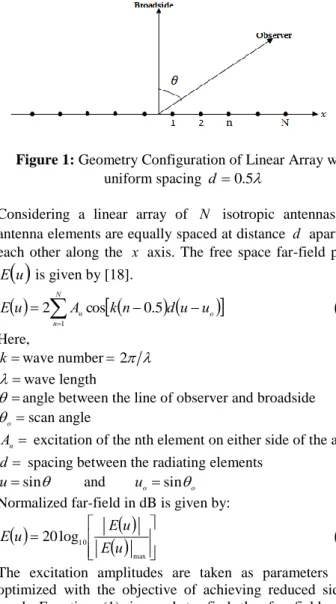
Synthesis of array antennas is very important to get the desired pattern and how to achieve low side lobe in the condition of a fixed main beamwidth has been considered since a long period of time [14-16]. The linear array is one of the commonly used arrays in many applications owing to its simplicity. The representation of such geometry is as shown in below Figure 1.
Figure 1: Geometry Configuration of Linear Array with uniform spacing d0.5
Considering a linear array of N isotropic antennas [17], antenna elements are equally spaced at distance d apart from each other along the x axis. The free space far-field pattern
u E is given by [18].
N n n o u u d n k A u E 1 5 . 0 cos 2 (1) Here, k wave number2 wave length angle between the line of observer and broadside
o
scan angle
n
A excitation of the nth element on either side of the array
d spacing between the radiating elements
sin
u
and uosino Normalized far-field in dB is given by:
max 10 log 20 u E u E u E (2)The excitation amplitudes are taken as parameters to be optimized with the objective of achieving reduced sidelobe level. Equation (1) is used to find the far field pattern information of current amplitude excitation An for all the elements, with element spacing d0.5 with zero additional phase.
The fitness function provides the interface between the physical problem and the optimization algorithm. In the optimization process, an attempt is made to reduce the sidelobe level of the radiation pattern while retaining the gain of the main beam. The problem of minimizing the maximum SLL in the pattern with prescribed beamwidth from a linear half wavelength spaced array is solved using the fitness function. The main objective of this work is to determine an appropriate set of required element amplitudes that achieve a reduced sidelobe level. Thus, the fitness function for achieving this objective is formulated as
0 , 1 1 u u u PSLL PSLL Fitness o d (3) Here ObtainedPeak SLL
max 10 log 20 max o o u E u E PSLL Desired Peak SLLPSLLd 40dB.Evolutionary Optimization Techniques
Real Coded Genetic Algorithm (RCGA)
Genetic Algorithm is a kind of heuristic search technique, which came into existence from Darwin’s theory of Natural Evolution. It uses certain methods based on the principle of natural genetics and natural selection to obtain the optimization procedures that best satisfies a pre-defined goal. At each generation, it maintains a population of individuals where each individual is a coded form of a possible solution of the problem at hand and is called chromosome. Each chromosome is evaluated by a function known as fitness function which is usually the fitness function or the objective function of the corresponding optimization problem. A new population is generated from the present one through selection, crossover and mutation operations. Purpose of selection is to select more fit individuals (parents) for crossover and mutation. Crossover causes the exchange of genetic materials between the parents to form offspring, whereas mutation incorporates new genetic materials in the offspring. Real Coded Genetic Algorithm (RCGA) uses floating-point number representation for the real variables. In floating-point representation, each chromosomes or individual vector is coded as a vector of floating-point numbers of the same length which is same as the solution vector. Since Real Coded Genetic Algorithm uses floating point numbers, there is no need of binary encoding and decoding. It takes less memory space and faster than Binary Genetic Algorithm. Introductory material on Real Coded Genetic Algorithm (RCGA) is reported by Michalewicz [19] and applications of genetic algorithms in the field of electromagnetic are discussed in [20-24]. Some of the advantages of Real Coded Genetic Algorithm over other traditional search techniques are by optimizing complex discrete parameters, doesn’t require derivative information, simultaneously searches from a wide sampling of cost surface, works with large number of variables, well suited for parallel computers, optimizes variables with extremely complex cost surfaces, and works with numerically generated data or experimental data.
Accelerated Particle Swarm Optimization (APSO)
The particle swarm optimization has been shown to be effective in optimizing difficult multidimensional discontinuous problems [25]. Recently, this technique has been successfully applied to antenna design [26]. Particle swarm optimization is based on the movement and intelligence of swarms, has been shown in certain instances to outperform like Genetic Algorithms [27 & 28]. Accelerated Particle Swarm Optimization (APSO) is one of the variants of standard PSO algorithm. APSO was developed by Xin She Yang in 2008 [29]. The standard PSO uses both the individual personal best and the current global best but APSO uses global best only. The pbest is used probably to increase the diversity in the quality solutions and this diversity can be simulated using some randomness. Hence, there is no compelling reason for using the individual personal best. A simplified version that could accelerate the convergence of the algorithm is to use only the global best. The other advantage of using this algorithm is to reduce the randomness as the numbers of iterations proceed. The APSO starts from initializing a swarm of particles with random positions and velocities. The fitness function of each particle in the swarm is evaluated and the gbest value is calculated. Later, actual position is updated for each and every particle. This process is repeated for each and every particle in the swarm until the optimum gbest value is obtained. Some of the advantages of APSO over other traditional optimization techniques and GA are to use objective function information to guide the search in the problem space, it has the flexibility to control the balance between the global and local exploration of the search space, and it has implicit parallelism. Accelerated Particle Swarm Optimization is well suited for a broad range of problems encountered in electromagnetic. APSO is considerably more efficient, and provides much faster convergence than random searches.
Results
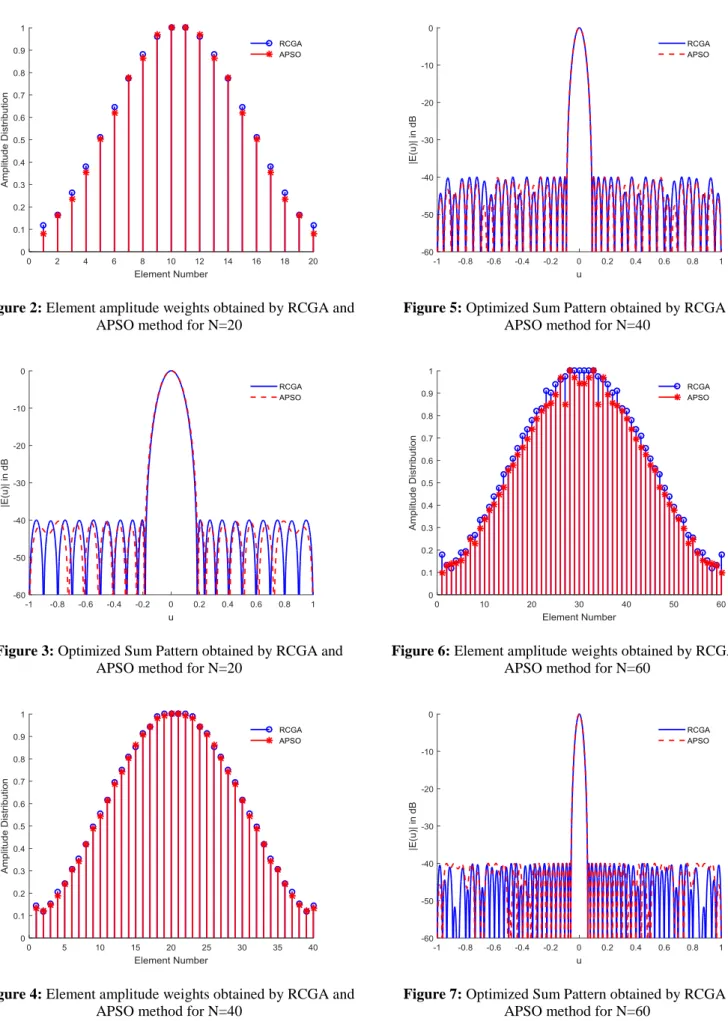
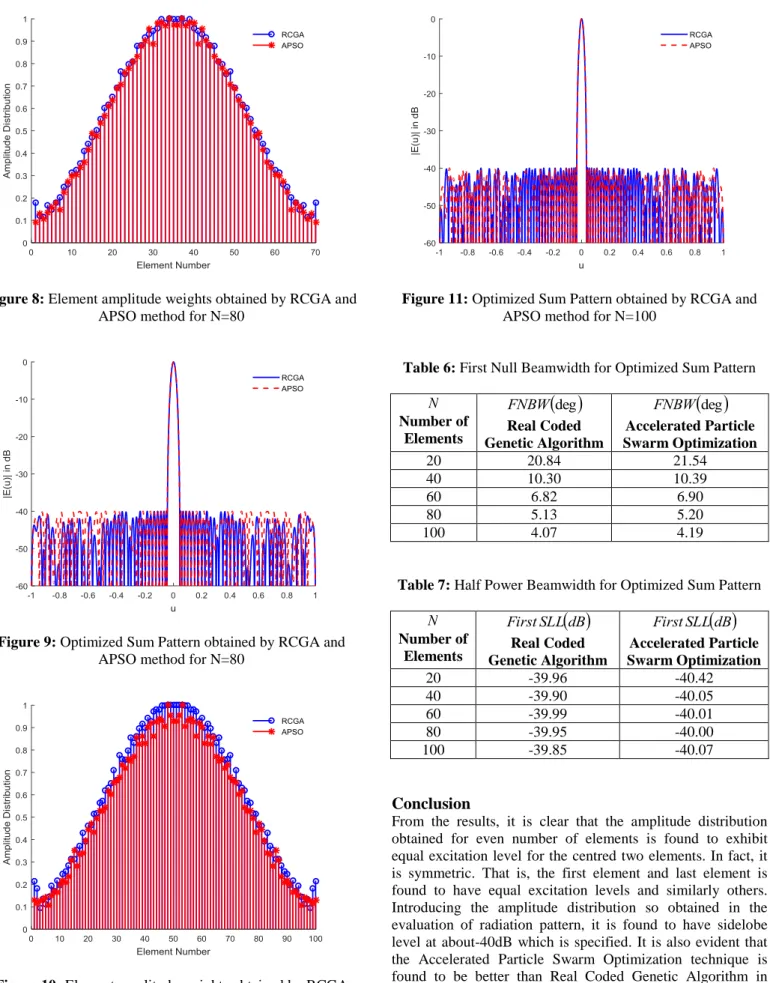
Real Coded Genetic Algorithm and Accelerated Particle Swarm Optimization are applied to evaluate amplitude distribution required to maintain sum patterns with sidelobe level at-40dB. The patterns are numerically computed for different arrays containing 20, 40, 60, 80, and upto 100 elements. The resultant amplitude distribution is found to be a taper on either side. As the number of elements increased in the array, the Null to Null Beamwidth is found to vary. The results are presented in Tables. 1-5 and Figs. 2-11. Null to Null Beamwidth, and First Sidelobe Level are presented in Tables. 6-7.
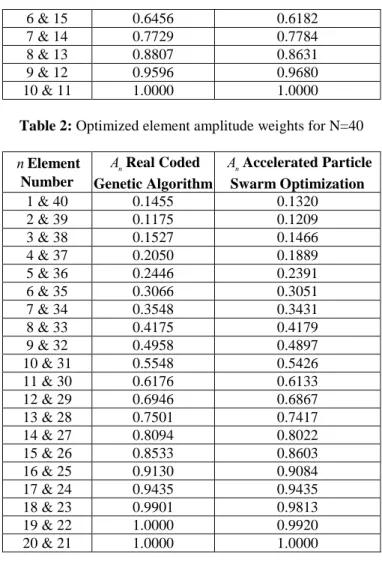
Table 1: Optimized element amplitude weights for N=20 nElement Number n A Real Coded Genetic Algorithm n A Accelerated Particle Swarm Optimization 1 & 20 0.1174 0.0793 2 & 19 0.1655 0.1619 3 & 18 0.2639 0.2346 4 & 17 0.3818 0.3546 5 & 16 0.5121 0.5028 6 & 15 0.6456 0.6182 7 & 14 0.7729 0.7784 8 & 13 0.8807 0.8631 9 & 12 0.9596 0.9680 10 & 11 1.0000 1.0000
Table 2: Optimized element amplitude weights for N=40 nElement Number n A Real Coded Genetic Algorithm n A Accelerated Particle Swarm Optimization 1 & 40 0.1455 0.1320 2 & 39 0.1175 0.1209 3 & 38 0.1527 0.1466 4 & 37 0.2050 0.1889 5 & 36 0.2446 0.2391 6 & 35 0.3066 0.3051 7 & 34 0.3548 0.3431 8 & 33 0.4175 0.4179 9 & 32 0.4958 0.4897 10 & 31 0.5548 0.5426 11 & 30 0.6176 0.6133 12 & 29 0.6946 0.6867 13 & 28 0.7501 0.7417 14 & 27 0.8094 0.8022 15 & 26 0.8533 0.8603 16 & 25 0.9130 0.9084 17 & 24 0.9435 0.9435 18 & 23 0.9901 0.9813 19 & 22 1.0000 0.9920 20 & 21 1.0000 1.0000
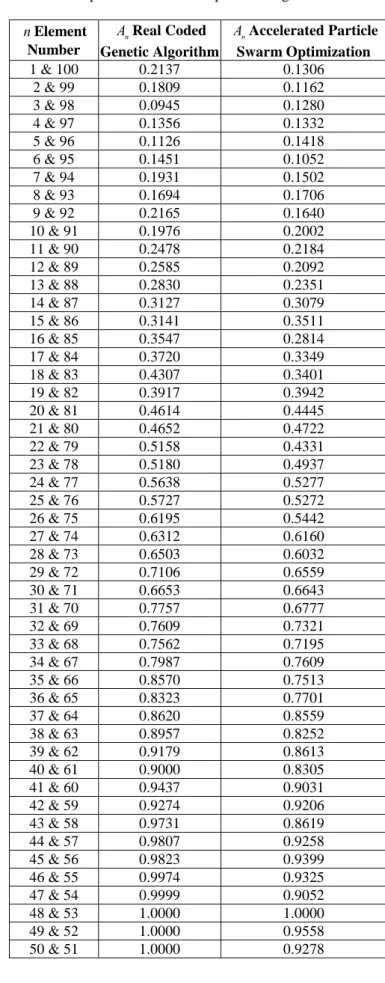
Table 3: Optimized element amplitude weights for N=60 nElement Number n A Real Coded Genetic Algorithm n A Accelerated Particle Swarm Optimization 1 & 60 0.1788 0.0974 2 & 59 0.1317 0.1308 3 & 58 0.1184 0.1382 4 & 57 0.1530 0.1407 5 & 56 0.1888 0.1517 6 & 55 0.1952 0.1855 7 & 54 0.2547 0.2461 8 & 53 0.2658 0.2282 9 & 52 0.3339 0.2947 10 & 51 0.3466 0.3370 11 & 50 0.3927 0.3762 12 & 49 0.4376 0.4038 13 & 48 0.4779 0.4465 14 & 47 0.5387 0.4784 15 & 46 0.5642 0.5551 16 & 45 0.6078 0.5791 17 & 44 0.6545 0.6244 18 & 43 0.7085 0.6560 19 & 42 0.7390 0.6941 20 & 41 0.7802 0.7396 21 & 40 0.8193 0.7851 22 & 39 0.8332 0.8204
23 & 38 0.9098 0.8437 24 & 37 0.9020 0.8559 25 & 36 0.9388 0.8938 26 & 35 0.9620 0.9687 27 & 34 0.9759 0.8508 28 & 33 1.0000 1.0000 nElement Number n A Real Coded Genetic Algorithm n A Accelerated Particle Swarm Optimization 29 & 32 1.0000 0.9699 30 & 31 1.0000 0.9422
Table 4: Optimized element amplitude weights for N=80 nElement Number n A Real Coded Genetic Algorithm n A Accelerated Particle Swarm Optimization 1 & 80 0.1425 0.1086 2 & 79 0.1566 0.0943 3 & 78 0.1299 0.0980 4 & 77 0.1260 0.1577 5 & 76 0.1403 0.1380 6 & 75 0.1498 0.2052 7 & 74 0.2247 0.1531 8 & 73 0.2071 0.1798 9 & 72 0.1995 0.2123 10 & 71 0.2856 0.2216 11 & 70 0.2735 0.2690 12 & 69 0.3449 0.3349 13 & 68 0.3310 0.3270 14 & 67 0.3677 0.3577 15 & 66 0.4245 0.3800 16 & 65 0.4207 0.3823 17 & 64 0.4747 0.5136 18 & 63 0.5065 0.4736 19 & 62 0.5660 0.4790 20 & 61 0.5523 0.5130 21 & 60 0.5959 0.6717 22 & 59 0.6392 0.5946 23 & 58 0.6806 0.6401 24 & 57 0.6840 0.6797 25 & 56 0.7490 0.6815 26 & 55 0.7711 0.7304 27 & 54 0.7865 0.7920 28 & 53 0.8064 0.8020 29 & 52 0.8622 0.8324 30 & 51 0.8541 0.8387 31 & 50 0.9107 0.8711 32 & 49 0.9038 0.8691 33 & 48 0.9483 0.9157 34 & 47 0.9224 0.9370 35 & 46 0.9941 0.9608 36 & 45 0.9714 0.9594 37 & 44 1.0000 0.9309 38 & 43 0.9997 0.9582 39 & 42 0.9990 1.0000 40 & 41 0.9963 0.9850
Table 5: Optimized element amplitude weights for N=100 nElement Number n A Real Coded Genetic Algorithm n A Accelerated Particle Swarm Optimization 1 & 100 0.2137 0.1306 2 & 99 0.1809 0.1162 3 & 98 0.0945 0.1280 4 & 97 0.1356 0.1332 5 & 96 0.1126 0.1418 6 & 95 0.1451 0.1052 7 & 94 0.1931 0.1502 8 & 93 0.1694 0.1706 9 & 92 0.2165 0.1640 10 & 91 0.1976 0.2002 11 & 90 0.2478 0.2184 12 & 89 0.2585 0.2092 13 & 88 0.2830 0.2351 14 & 87 0.3127 0.3079 15 & 86 0.3141 0.3511 16 & 85 0.3547 0.2814 17 & 84 0.3720 0.3349 18 & 83 0.4307 0.3401 19 & 82 0.3917 0.3942 20 & 81 0.4614 0.4445 21 & 80 0.4652 0.4722 22 & 79 0.5158 0.4331 23 & 78 0.5180 0.4937 24 & 77 0.5638 0.5277 25 & 76 0.5727 0.5272 26 & 75 0.6195 0.5442 27 & 74 0.6312 0.6160 28 & 73 0.6503 0.6032 29 & 72 0.7106 0.6559 30 & 71 0.6653 0.6643 31 & 70 0.7757 0.6777 32 & 69 0.7609 0.7321 33 & 68 0.7562 0.7195 34 & 67 0.7987 0.7609 35 & 66 0.8570 0.7513 36 & 65 0.8323 0.7701 37 & 64 0.8620 0.8559 38 & 63 0.8957 0.8252 39 & 62 0.9179 0.8613 40 & 61 0.9000 0.8305 41 & 60 0.9437 0.9031 42 & 59 0.9274 0.9206 43 & 58 0.9731 0.8619 44 & 57 0.9807 0.9258 45 & 56 0.9823 0.9399 46 & 55 0.9974 0.9325 47 & 54 0.9999 0.9052 48 & 53 1.0000 1.0000 49 & 52 1.0000 0.9558 50 & 51 1.0000 0.9278
Figure 2: Element amplitude weights obtained by RCGA and APSO method for N=20
Figure 3: Optimized Sum Pattern obtained by RCGA and APSO method for N=20
Figure 4: Element amplitude weights obtained by RCGA and APSO method for N=40
Figure 5: Optimized Sum Pattern obtained by RCGA and APSO method for N=40
Figure 6: Element amplitude weights obtained by RCGA and APSO method for N=60
Figure 7: Optimized Sum Pattern obtained by RCGA and APSO method for N=60
Figure 8: Element amplitude weights obtained by RCGA and APSO method for N=80
Figure 9: Optimized Sum Pattern obtained by RCGA and APSO method for N=80
Figure 10: Element amplitude weights obtained by RCGA and APSO method for N=100
Figure 11: Optimized Sum Pattern obtained by RCGA and APSO method for N=100
Table 6: First Null Beamwidth for Optimized Sum Pattern N Number of Elements
deg FNBW Real Coded Genetic Algorithm
deg FNBW Accelerated Particle Swarm Optimization 20 20.84 21.54 40 10.30 10.39 60 6.82 6.90 80 5.13 5.20 100 4.07 4.19Table 7: Half Power Beamwidth for Optimized Sum Pattern N Number of Elements
dB SLL First Real Coded Genetic Algorithm
dB SLL First Accelerated Particle Swarm Optimization 20 -39.96 -40.42 40 -39.90 -40.05 60 -39.99 -40.01 80 -39.95 -40.00 100 -39.85 -40.07Conclusion
From the results, it is clear that the amplitude distribution obtained for even number of elements is found to exhibit equal excitation level for the centred two elements. In fact, it is symmetric. That is, the first element and last element is found to have equal excitation levels and similarly others. Introducing the amplitude distribution so obtained in the evaluation of radiation pattern, it is found to have sidelobe level at about-40dB which is specified. It is also evident that the Accelerated Particle Swarm Optimization technique is found to be better than Real Coded Genetic Algorithm in terms of pattern characteristics.
References
[1] G. S. N. Raju, Antennas and wave propagation, 3rd ed.,
Pearson Education, 2005
[2] R. E. Collin and F.J. Zucker, Antenna theory, New York: McGraw-Hill, 1969.
[3] B. D. Stienberg, Principles of Aperture and Array System Design. New York: John Wiley and Sons, 1976.
[4] Robert S. Elliot, Antenna Theory and Design, Prentice-Hall of India, New Delhi, 1985.
[5] Y. T. Lo and S.W. Lee, Antenna Handbooks: Theory, Applications, and Design, New York, 1988.
[6] C. A. Balanis, Antenna Theory: Analysis and Design, 2nd ed. New York: Wiley, 1997.
[7] W. L. Stutzman and G.A. Thiele, Antenna Theory and Design, 2nd end. New York, Wiley, 1998.
[8] R. C. Hansen, Phased Array Antennas, New York: Wiley, 1998.
[9] R. J. Mailloux, Phased Array Antenna Handbook, Boston, Artech House,1994.
[10] R. Haupt, “Simultaneous nulling in the sum and difference patterns of a monopulse antenna,” IEEE Trans. Antennas Propag., Vol. 32, No.5, pp. 486-493, May 1984.
[11] J. H. Holland, Adaptation in Natural and Artificial Systems, The University of Michigan Press, 1975. [12] D. E. Goldberg, Genetic algorithms, New York:
Addison-Wesley, 1989.
[13] J. Kennedy and R. C. Eberhart, “Particle Swarm Optimization,” Proc., IEEE Int. Conf-Neural Networks, Vol. IV, pp. 1942-1948, Perth, Australia, Nov/ Dec. 1995.
[14] V. Rajya Lakshmi and G.S.N. Raju, “Synthesis of linear antenna arrays using array design and Real Coded Genetic Algorithm”. IJAEST, Vol. 18, pp 44-48, 2011.
[15] P. V. Florence, and G. S. N. Raju, “Synthesis of Linear Antenna Arrays Using Accelerated Particle Swarm Optimization,” International Journal of Computer Application, Vol. 103, No. 3, pp. 43-49, 2014.
[16] T. A. N. S. N. Varma and G. S. N.Raju, “Investigations on generation of ultra low sidelobe patterns,” International Journal of Engineering Science and Technology, Vol. 6, No. 6, June 2014.
[17] P. K. Murthy and A. Kumar, “Synthesis of Linear Antenna Arrays,” IEEE Trans. Antennas Propagat., Vol. AP-24, pp. 865-870, November 1976.
[18] M. T. Maa, Theory and Applications of Antenna Arrays, New York: John Wiley and Sons, 1974. [19] Z. Michalewicz, Genetic algorithms + Data Structures
= Evolution Programs, Springer-Verlag, Berlin, 1999. [20] R. L. Haupt, “An introduction to Genetic Algorithm in
electromagnetics,” IEEE AP-S Mag. Vol. 37, pp. 7-15, April 1995.
[21] J. M. Johnson, Y. Rahmat-Samii, “Genetic Algorithm Optimization and its application to antenna design,” Antennas and Propagation Society International Symposium, Vol. 1, pp. 326-239, June 1994.
[22] J. M. Johnson, Y. Rahmat-Samii, “Genetic Algorithms in engineering electromagnetic,” IEEE Transactions on Antennas and Propagation Magazine, Vol. 39, pp. 7-25, 1997.
[23] Y. Rahmat-Samii, and E. Michielssen Electromagnetic Optimization by Genetic Algorithms, Wiley, New York, 1999.
[24] R. L. Haupt, Real Coded Genetic Algorithm in electromagnetics, IEEE press, Wiley Inter Science, 2007.
[25] J. Robinson, S. Sinton, and Y. Rahmat-Samii, ”Particle swarm, Real Coded Genetic Algorithm, and their hybrids: optimization of profiled corrugated horn antenna,” in Proc. IEEE Int. Symp. Antenna Propoagation, Vol. 1, San Antonio, TX, 2002, pp. 314-317.
[26] J. Robinson and Y. Rahmat-Samii, “Particle Swarm Optimization in Electromagnetics”, in IEEE Transactions on Antennas and Propagation, Vol. 52, No. 2, pp. 397-407, February 2004.
[27] J. Kennedy and W. M. Spears, “Matching algorithms to problems: an experimental test of the particle swarm and some Genetic Algorithms on multi modal problem generator”, in Proc. IEEE Int. Conf. Evolutionary computation, 1998.
[28] P. A. Sunny Dayal, “Design of X Band Pyramidal Horn Antenna,” International Journal of Applied Control, Electrical and Electronics Engineering (IJACEEE), Vol. 3, No. 1/2, pp. 23-34, May 2015.
[29] X. S. Yang, Nature-Inspired Metaheuristics Algorithms, Luniver Press, 2008.
Authors:
P.A. Sunny Dayal received his M.Tech in
Radar & Microwave engineering from AU College of Engineering (A), Andhra University with Distinction First Class and obtained B.Tech in Electronics and Communication Engineering from Jawaharlal Nehru Technological University, Hyderabad. At present he is research scholar in department of ECE, Centurion University of Technology and Management. He worked as Associate Professor in Dept. of ECE, Viswanadha Institute of Technology and Management. He presented and published many papers in various national and international conferences and journals of repute. He is a Member of ACES and IEEE, Life Member of IETE, SEMCE and IAENG. His research interests are Antenna Arrays, EMI/EMC and Soft Computing.
Dr. G.S.N. Raju received his B.E., M.E.,
with distinction and first rank from Andhra University and Ph.D., from IIT, Kharagpur. At present, he is the Honorary Distinguished Professor in department of Electronics and Communication Engineering, AU College of Engineering (A), Andhra University. He was the former Vice – Chancellor of Andhra University. He is in teaching and research for the last 35 years in Andhra University. He guided 46 Ph.D.s in the fields of Antennas, Electromagnetics, EMI/EMC and Microwave, Radar Communications, Electronic circuits. Published about 390 technical papers in National/ International Journals/ Conference Journals and transactions. He is the recipient of The State Best Teacher Award’ from the Government of Andhra Pradesh in 1999, ‘The Best Researcher Award’ in 1994, ‘Prof. Aiya Memorial National IETE Award’ for his best Research guidance in 2005, ‘Dr. Sarvepalli Radhakrishnan Award for the Best Academician’ of the year 2007, ‘The National EMC Engineer of the Year Award’ in 2008, and ‘IEI Eminent Electronics and Telecommunication Engineer’ in 2012. He was a visiting Professor in the University of Paderborn and also in the University Karlsruhe, Germany in 1994. He held the positions of Principal, Andhra University College of Engineering (A), Visakhapatnam, Chief Editor of National Journal of Electromagnetic Compatibility. Prof. Raju has published 11 textbooks on Antennas and Wave Propagation, Electromagnetic Field Theory and Transmission Lines, Electronics Devices and Circuits, Microwave Engineering, Radar Engineering and Navigational Aids. Prof. Raju has been the best faculty performer in Andhra University with the performance index of 99.37%.
Dr. S. Mishra has completed his Ph.D in (Electronics and Communication Engineering) from Biju Patnaik University and Technology, Odisha and M.Tech (Electronics System and Communication) from NIT Rourkela, Odisha. He has published research papers in different national and international in journals. Presently he is Professor and Head of the Electronics and Communication Engineering department in Centurion University of Technology and Management, Bhubaneswar. His research areas are soft computing, signal processing and image processing.