Singular Value Decomposition based Image
Denoising
1
Sowmya M C,
2K V Suresh
1,2,3 Department of Electronics and Communication Engineering, Siddaganga Institute of Technology, Tumakuru, Karnataka, India
________________________________________________________________________________________________________ Abstract: Noise in image degrades the quality of the image. The aim of denoising is to reconstructing an original image from noisy image by securing important features. For visual quality and extraction of edges and texture information from the images, denoising is necessary. It is a necessary preprocessing step for many applications such as image compression, segmentation, identification, object recognition etc. In this paper, images are corrupted by Gaussian noise which is additive in nature. A recent development in this area of research is the use of Singular Value Decomposition (SVD).
Index Terms - Image denoising, additive Gaussian noise, K-means clustering, SVD
________________________________________________________________________________________________________
I. INTRODUCTION
The important research area in the field of image processing is image denoising and it is the base for many applications, one of them is feature extraction. Denoising is a critical step in enhancing the image quality. It is the process of reconstructing the original image by preserving image structures and details. Based on the image representation, denoising approaches can be classified as spatial domain, transform domain, and dictionary learning based methods.
Spatial domain filters exploit spatial correlations in images. Spatial filters are classified into two categories: local and non-local filters. Image denoising algorithm presented in [1] uses Principal Component Analysis (PCA). Using PCA first project image neighbourhood vectors onto a lower-dimensional subspace, using this subspace similarity weights are computed. For computing neighbourhood similarities lower-dimensional projections are used which increases accuracy and reduces the computational cost. A concept called Sequence-to-Sequence Similarity (SSS) is introduced in [2], efficient method to evaluate the content similarity for images, especially for edge information. SSS is a filtering window with two sequences, similarity between central sequence and surrounding sequence is called sequence-to-sequence similarity. SSS based filtering and a smoothing procedure is the two steps in SSS based image denoising algorithm. In this image denoising algorithm, edge information is preserved using SSS based filter and the noise present in flat area is removed by smoothing procedure.
Transform domain methods explored in the field of image denoising for decades. It is based on the manipulation of orthogonal transform of image rather than the image itself. Image denoising method proposed in [3] use Principal Component Analysis (PCA) and Local Pixel Grouping (LPG). Local features of the image can be transformed based on statistics calculation of PCA. Local image features are preserved by coefficient shrinkage. The traditional total variation (TV) based denoising models fails in removing heavy noise completely because gradients of images are affected by heavy noise, and thus the edge details are deteriorated. So, to preserve edges of images and to remove heavy noise in low light condition, a denoising model is proposed in [4]. It is the combination of nonlocal similarity and TV in wavelet domain. Heavy noise can be supressed using the bi-orthogonal wavelet function. The nonlocal similarity regularization improves the fine image details.
In dictionary based learning, training an over-complete dictionary for the patch representation of an image has been broadly analysed in many research areas. A denoising algorithm based on principal component analysis presented in [5] works directly on the Colour Filtering Array (CFA) images. The technique of PCA is employed on every CFA variable block containing color components from different channels to analyse the local structure. PCA denoising scheme can effectively exploit the spectral correlation and spatial correlation simultaneously as it works directly on the CFA image. This algorithm effectively retains color edges and details by supressing heavy noise. Three patch-based PCA algorithms proposed in [6] performs hard thresholding on the coefficients of image patches for the task of image denoising. Dictionary learning techniques are different for these three algorithms. The three different approaches are based Global PCA (PGPCA), based Local PCA (PLPCA) and Patch-based Hierarchical PCA (PHPCA). Orthonormal dictionaries are learned from the image by choosing at least three parameters: size of patches, threshold level, and searching zone width (PLPCA) or the number of recursions (PHPCA).
need training for each image separately resulting in less computational cost.
The rest of this paper is organized as follows. In Section II, the proposed algorithm is discussed briefly. In Section III, the experimental results are shown for different conditions. Finally, in Section IV, the paper is concluded with advantages.
II. IMAGE DENOISING
An efficient denoising method is proposed in [7] using SVD. Clean image is given as input to the system to which noise is added and the noisy image is generated and represented as
e
x
y
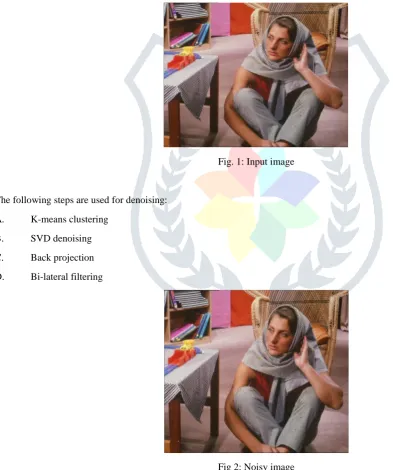
(1)Fig. 1 shows a clean image of size 512 x 512 which is given as input to the system and Fig. 2 shows noisy image with standard deviation 10.
Fig. 1: Input image
The following steps are used for denoising:
A. K-means clustering
B. SVD denoising
C. Back projection
D. Bi-lateral filtering
A. K-means clustering
K-means clustering [8] partition the image into clusters resulting clustered image. It classifies a given set of data into number of disjoint cluster. K-means algorithm consists of two separate phases. In the first phase it calculates the centroid and in the second phase it takes each point to the cluster which has nearest centroid from the respective data point. There are different methods to define the distance of the nearest centroid and one of the most used methods is Euclidean distance. Once the grouping is done it recalculates the new centroid of each cluster and based on that centroid, a new Euclidean distance is calculated between each centre and each data point and assigns the points in the cluster which have minimum Euclidean distance. Each cluster in the partition is defined by its member objects and by its centroid. The centroid for each cluster is the point to which the sum of distances from all the objects in that cluster is minimized. K-means is an iterative algorithm in which it minimizes the sum of distances from each object to its cluster centroid, over all clusters.
Euclidean distance d and centroid
c
k equations are given by equation (2) and equation (3)
m
n
c
ky
d
,
(2)where is input pixels to be clustered and
c
k is cluster center.
k k cm n c
k
y
m
n
k
c
1
,
(3)where is number of cluster.
B. SVD Denoising
SVD [9] is a factorization of a rectangular real or complex matrix analogous to the diagonalization of symmetric matrices using a basis of eigenvectors. SVD is a very suitable tool for estimating each group because good estimation of the group can be achieved by taking only a few largest singular values and corresponding singular vectors. SVD is a stable and an effective method to split the system into a set of linearly independent components, each of them bearing own energy contribution.
A digital image of size can be represented by its SVD as follows
T
V
U
A
(4)
u
u
u
m
U
1,
2,...,
(5)
v
v
v
n
V
1,
2,...,
(6)
n
0
0
0
0
0
0
0
0
0
0
0
0
0
0
0
0
0
0
0
0
2 1 (7)where U is an
mxm
orthogonal matrix, V is annxn
orthogonal matrix, and is anmxn
matrix with the diagonal elementsrepresenting the
i singular values, wherei
1
,
2
,..,
n
. The columns of the orthogonal matrix U are called the left singular vectors and the columns of the orthogonal matrix V are called the right singular vectors. The left singular vectors of A are eigenvectors of TAA and the right singular vectors of A are eigenvectors ofATA. Each singular value specifies the brightness
of decreasing singular values.
Fig. 3: Illustrating decomposing of A into
U
, and VTFig. 3 shows an example of an image A which is decomposed into
U
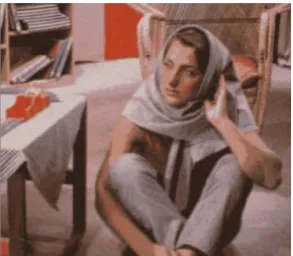
, and TV after applying SVD. By applying SVD to clustered image a denoised image is obtained by reducing the rank of singular value matrix and the corresponding singular vectors. Fig. 4 shows the denoised image.
Fig. 4: Reconstructed image after applying SVD
C. Back Projection
Even though SVD denoising method removes most of the noise, small amount of noise is present in the denoised image. By back projecting the denoised image a new image is generated and this procedure is repeated until the desired result is obtained.
D. Bi-lateral Filtering
Sharp edges in images can be preserved by using bi-lateral filter which is a non-linear filter. The intensity of each pixel is replaced by the weighted average of intensity values from neighbouring pixels, where weights are based on Gaussian distribution. Fig. 5 shows the smoothened image obtained using bi-lateral filter.
III. EXPERIMENTAL RESULTS
To test the efficiency of the proposed algorithm, several experiments are conducted on colour images and grey images with size 512 x 512 and 256 x 256. Additive Gaussian noise is added to clean images to generate noisy image. The quality of the image is calculated with the help of performance measure like peak signal-to-noise ratio (PSNR) as in [10].
MSE
MAX
PSNR
I2
10
log
10
(8)
10 1
0
2
,
,
1
mi n
j
j
i
X
j
i
Y
mn
MSE
(9)where MAXI is maximum possible pixel intensity value present in images.
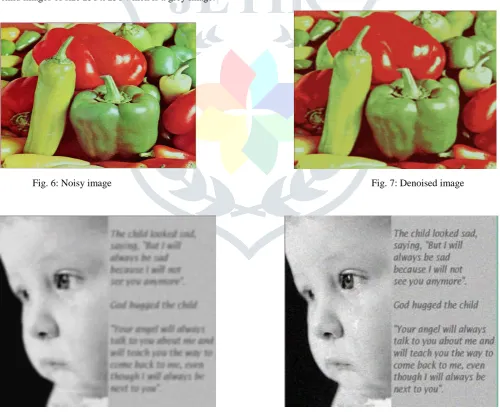
In the first experiment, a Pepper image of size 512 x 512 which is colour image is given as input. Fig. 6 shows the noisy image obtained by adding noise with standard deviation of 10 to the clean image. Clustered image is obtained by applying K-means clustering on noisy image. SVD is applied to this clustered image and reconstructed image is obtained with blurring effect, to smooth this image bi-lateral filter is applied and Fig. 7 shows the final denoised image. Fig. 8 and Fig. 9 shows the same results for child images of size 256 x 256 which is a grey image.
Fig. 6: Noisy image Fig. 7: Denoised image
IV. CONCLUSION
SVD method of denoising is proposed here for images corrupted with additive Gaussian noise. The proposed image denoising method is better than most of the existing methods because it takes the advantage of low-rank approximation to remove noise. This process can be applied for different types of noise in the image, since SVD is suitable for removing all types of noise. This process includes optimization method and hence the complexity of the process is reduced, which in turn reduces the computational cost. The performance of the method is measured based on the performance parameters like PSNR.
REFERENCES
[1] T. Tasdizen, “Principal components for non-local means image denoising,” 15th IEEE International Conference on Image Processing, San Diego, CA, pp. 1728-1731, 2008.
[2] K. Panetta, L. Bao and S. Agaian, “Sequence-to-Sequence Similarity-Based Filter for Image Denoising,” IEEE Sensors Journal, vol. 16, no. 11, pp. 4380-4388, June 2016.
[3] Zhang, Lei, Weisheng Dong, David Zhang and Guangming Shi, “Two-stage image denoising by principal component analysis with local pixel grouping,” Pattern Recognition, vol. 43, no. 4, pp. 1531-1549, 2010.
[4] Y. Shen, Q. Liu, S. Lou and Y. L. Hou, “Wavelet-Based Total Variation and Nonlocal Similarity Model for Image Denoising,” IEEE Signal Processing Letters, vol. 24, no. 6, pp. 877-881, June 2017.
[5] L. Zhang, R. Lukac, X. Wu and D. Zhang, “PCA-Based Spatially Adaptive Denoising of CFA Images for Single-Sensor Digital Cameras,” in IEEE Transactions on Image Processing, vol. 18, no. 4, pp. 797-812, April 2009.
[6] Deledalle, Charles-Alban, Joseph Salmon and Arnak S. Dalalyan, “Image denoising with patch based PCA: local versus global,” BMVC. Vol. 81, 2011.
[7] Q. Guo, C. Zhang, Y. Zhang, H. Liu, “An Efficient SVD-Based Method for Image Denoising,” IEEE Transactions on Circuits and Systems for Video Technology, vol. 26, no. 5, pp. 868-880, 2016.
[8] Nameirakpam Dhanachandra, Khumanthem Manglem, Yambem Jina Chanu, “Image Segmentation using K-means Clustering Algorithm and Subtractive Clustering Algorithm,” 11th International Multi-Conference on Information Processing, vol. 54, pp. 764-771, 2015.
[9] K. Mounika, D. Sri Navya Lakshmi, K. Alekya, “SVD Based Image Compression,” International Journal of Engineering Research and General Science, vol. 3, pp. 1271-1278, 2015.