DYNAMIC ANALYSIS AND OPTIMIZATION DESIGN OF
THE SFD- SLIDING BEARING FLEXIBLE ROTOR SYSTEM
JIYAN WANG
School of Science, Shandong Jiaotong University, Jinan 250023, Shan dong, China.
ABSTRACT
The paper proposes a mechanical model of SFD-sliding bearing flexible rotor system, employing Runge-Kutta method to tackle nonlinear differential equation, thus acquiring the dynamic response and the unbalanced response curve. Results obtained show the route of flexible rotor system from stable periodic motion to chaos state is: periodic motion—quasi-periodic motion—chaos —period doubling bifurcation— chaos. The paper analyzes the sensitivity of flexible rotor system, offering design variables to optimization analysis, improving the efficiency of optimization and shortening the design cycle. Based on sensitivity analysis, we conduct optimization analysis on critical speed by the application of genetic algorithm, which aims to further the enlargement of D-value between the first critical speed and the second critical speed. Additionally, the critical speed ameliorates after the optimization which supplies theoretical basis as well as theoretical analysis towards the dynamic stability of high-speed rotor system and provides reference for the design of such rotor system.
Keywords: SFD, Dynamic Analysis, Critical Speed, Sensitivity Theory, Optimization Design
1. INTRODUCTION
The SFD (Squeeze Film Damper), a typical one in the field of rotary mechanical design with the advantage of simple structure, small volume and convenient installation, can effectively afford viscous damping to depress rotor vibration amplitude and diminish external force of the rotor system[1]. Besides, the system dynamic stability improves if reasonable parameters are offered.
Researchers attach importance to SFD due to its excellent vibration reduction effect. Since 1970s, SFD is widely applied in reality and many achievements have been obtained. Nevertheless, certain stimulation about SFD has not been clear until now and still needs further research. So far, engineering design has adopted cut-and-try procedure with the combination of experience, theory and experiment.[2]
This paper establishes the motion equation of the SFD-sliding bearing flexible rotor system, analyzing the system dynamic response; gaining the critical speed of two systems to show the motion state in a visualized way through unbalanced response curve; making use of sensitivity analysis to offer design variables for optimization design; employing genetic algorithm in optimization design to rationalize system parameters and offer reference to the design of such rotor system.
2. MECHANICAL MODEL OF
SFD-SLIDING BEARING FLEXIBLE ROTOR SYSTEM
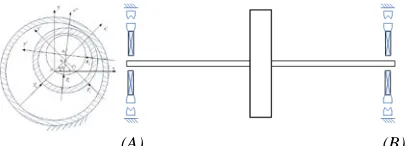
Fig.1(a) and Fig.1(b) represent the structure of SFD-sliding bearing flexible rotor system and its corresponding side view, respectively.[3] Here denotes the center of SFD fixed on rigid support and building coordinate system (inertial reference system), the center of bearing body, constructing integral coordinate system which shifts with the bearing body. The axis passes . is the center of shaft, establishing integral coordinate system which moves with the shaft, with axis passing . Suppose is the center of rotary table.
As shown in Fig. 1, and are film forces that SFD puts on bearing body along axis and axis respectively; while and , film forces which flexible bearing acts on shaft along axis and axis.
[image:1.612.331.534.628.701.2]
2.1 The Motion Equation of Bearing Center.
The bearing body is mainly affected by SFD-acting force, reSFD-acting force of axle journal, and gravity, so according to Newton second law, its
motion equation can be concluded as Equation (1):
1 1 1 1 1 1 2
2
1 1 1 1 1 2
2 1
cos sin sin
cos ,
sin cos cos
sin .
e t t
e
e t t
e
m x K x F F P
P
m y K y F F P
P m g
j j j
j
j j j
j + = - + -+ = + -- (1)
Here x1 and y1 are, respectively, the displacements of bearing body center in the X and Y-direction. m1is the quality of bearing body, K1 the rigidity of elastic support in SFD, j1 the polar angle that integral coordinate system of bearing bodyo x y1 , , revolves, and j 2 the polar angle that integral coordinate system of axle journal ,, ,,
2
o x y revolves.
2.2 The Motion Equation of Journal Center.
The shaft is influenced by acting force and gravity of bearing body and rotary table, besides, the flexibility of flexible rotor should be taken into consideration. Based on Newton second law, the motion equation is shown in Equation (2):
2 2 2 2 3 2 2
2 2 2 2 3 2 2 2
( ) sin cos ,
( ) cos sin .
t e
t e
m x K x x P P
m y K y y P P m g
j j
j j
+ - = - +
+ - = + - (2)
Here x2andy2are the separately displacements of shaft center on axisxand axisy.m2denotes the quality of shaft, K2 the rigidity of shaft.
2.3 The Motion Equation of Rotary Table Center.
The motion equation
can be represented
as Equation (3):
2
3 3 2 3 2 3
2
3 3 2 3 2 3 3
( ) cos
( ) sin
m x K x x m t
m y K y y m t m g
r w w
r w w
+ - =
+ - = - (3)
Where, x3, y3are displacements of rotary table center o3 on axis x and axis y , respectively.m3indicates the quality of rotary table,
r the mass deviation of rotary table andw the rotational angular speed of rotor.
Given that e1is the eccentricity between axle
journal center and bearing body center, e2 the eccentricity between bearing body center and SFD center, then the geometric relationship betweenx1,
2
x , y1, y2, j 1, j 2can be summarized as Equation (4):
2 2 2 2
1 2 1 2 1 2 1 1
1 2 1
1 2
2 1
( ) ( ) ,
arccos , arccos .
x x y y x y
x x x
e e j j e e = - + - = + -= = (4)
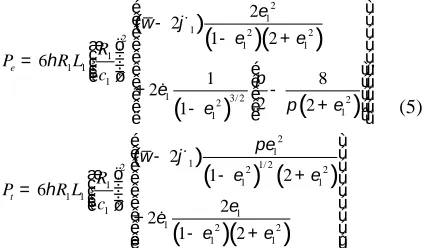
Adopting long bearing theory to sliding bearing, the expression of film force is[4-5]:
( )
(
)(
)
(
)
(
)
( )(
) (
)
(
)(
)
2 11 2 2
2
1 1
1 1 1
1
1 2 3/ 2 2
1 1
2 1
1 1/ 2
2 2 2
1 1
1 1 1
1 1
1 2 2
1 1 2 2 1 2 6 , 1 8 2 2 2 1 2 1 2 6 . 2 2 1 2 e t R
P R L
c
R
P R L
c e w j e e h p e p e e pe w j e e h e e e e é ù
ê - ú
ê - + ú
ê ú
æ ö÷
ç ÷ ê ú
= çç ÷ ê é ùú
÷ ç
è øê ê úú
+ ê - ú
ê ú
+
ê ú
ê - ë ûú
ë û
é ù
ê - ú
ê ú
æ ö÷ ê - + ú
ç ÷
= çç ÷ ê ú
÷
ç ê ú
è ø
ê+ ú
ê - + ú
ê ú
ë û
(5)
Employing short bearing approximation theory for SFD, the expression of film force can be displayed as:
(
)
(
)
(
)
(
)
3
2 2 2 2
2 2 2
2 2 2 2 5/ 2
2 2 2
3
2 2 2
2 2 2
2 2 3/ 2 2 2
2 2 2
2 (1 2 )
,
1 2 1
2 .
2 1 2 1
e t R L F c R L F c
h e p e
j e e
e e
h p e
j e e
e e
ì ü
ï ï
ï + ï
ï ï
= í + ý
ï - - ï
ï ï ï ï î þ ì ü ï ï ï ï ï ï
= í + ý
ï - - ï
ï ï
ï ï
î þ
(6)
[image:2.612.314.527.249.373.2]3. DYNAMIC RESPONSE OF THE FLEXIBLE ROTOR SYSTEM
Table 1: Parameter Values Of The System
quality of shaft 2m2(kg) 10
quality of bearingm1(m) 2.5
bearing radiusR1(m) 0.005
bearing widthL1(m) 0.01
bearing clearancec1(m) 0.5e-4
SFD radiusR2(m) 0.02
shaft rigidityK2(N/m) 2.45e7
SFD widthL2(m) 0.007
SFD clearancec2(m) 0.75e-4
SFD elastic bearing rigidityK1(N/m) 1.75e8
oil viscosityh(Pa.s) 0.01 gravity accelerationg(m2/s)
9.8
quality of rotary tablem3( kg) 0.4
(A) Locus Of Journal Center (B) Poincare Map Of Journal Center
Fig. 2. Dynamic Response While
w
=400rad/S(A) Locus Of Journal Center (B) Poincare Map Of JournalCenter Fig. 3. Dynamic Response While
w
=900rad/S [image:3.612.90.301.75.580.2](A) Locus Of Journal Center (B) Poincare Map Of Journal Center Fig. 4 Dynamic Response While
w
=950rad/S(A) Locus Of Journal Center (B) Poincare Map Of Journal Center Fig. 5. Dynamic Response While
w
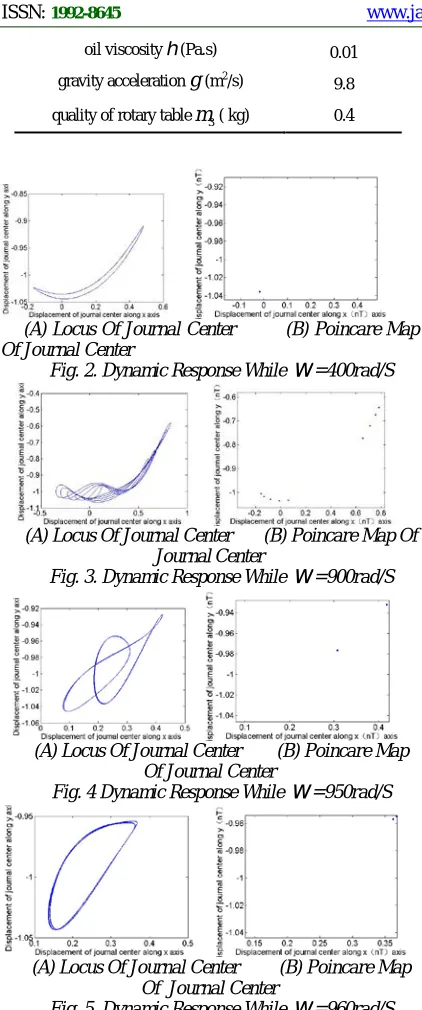
=960rad/SThe parameters of flexible rotor system can be seen in Table 1. According to calculation, the low rotating speed of rotor results in stable periodic response. Fig. 2 shows the dynamic response when the angular speed is 400rad/s. With the gradual increment of rotating speed, from 400 rad/s to 570 rad/s , the harmonious periodic motion comes to quasi-periodic motion. Fig. 3 reveals the dynamic response at the speed of 900rad/s, when the system is in chaos state. As rotating speed increases to 950 rad/s, the system enters period doubling bifurcation
in Fig. 4. Further, in Fig. 5 the system does single periodic motion if rotating speed arrives to 960 rad/s. When the rotating speed increases, the system comes to chaos again. [6-8]
4. SENSITIVITY ANALYSIS ON SFD-SLIDING BEARING FLEXIBLE ROTOR SYSTEM
During the process of rotational machinery design, the critical speed must be taken into account as a very important parameter. If the working speed is near to critical speed, the system appears large vibration, which causes damage of machine and even threatens people’s safety. The critical speed is one of the most significant factors in rotor system design. Most rotors’ working speeds are above first-order, second-first-order, even multiple-order critical speed. The first critical speed and the second critical speed are of great importance to research on the system stability. It is a remarkable job to change the parameter of rotor system effectively and minimize its variation [9].
In the optimization design of rotational machinery, the parameter sensitive to critical speed is usually chosen, such as structure or bearing. The selection of parameter is determined after sensitivity analysis.
The paper utilizes the ratio between relative variation of critical speed and that of design variable as the relative sensitivity of critical speed, this is:
0 /
( , ) lim .
/
j
j l l l
lj
j j l j
l j b
b a a a
h
b b a b
D ®
¶ D
= =
D ¶ (7)
where, j=1, 2,...,m,l=1, 2,...,n. The system sensitivity is critical speed variation caused by the variation of unit configuration parameter (for example, bearing clearance, bearing width, diameter)
Table2
Sensitivity Of The Flexible Rotor System
Design
variable Range of system variables
Sensitivit y of the first critical
speed
Sensitivity of the second critical speed
1
c (m) 2e- 5£ c1£12e- 5 -0.6714 -0.4752
1
L(m) 0.008£ L1£ 0.02 0.3642 0.1902
1
R (m) 2e- 3£ R1£ 7e- 3 -0.2668 -0.1298
2
2
L (m) 2e- 3£ L2£11e- 3 0.3128 0.0782
2
R (m) 0.01£ R2£ 0.03 -0.2666 -0.1602
1 K (N/m
)
1
1.55e+8£ K £ 4e+9
0.1325 0.0587
2 K (N/
m)
2
1.25e7£ K £ 4.3e8 0.0403 0.2390
h(Pa.s) 0.004£ h£ 0.016 0.4091 0.1805
In Table 2, the sensitivity figure is zero dimension and minus sign indicates that the critical speed decreases with design variable increasing. The above table has shown the first critical speed is sensitive to bearing clearance c1 , SFD clearance c2 and oil viscosity h while SFD clearance c2 , bearing clearance c1 and shaft rigidity K2 have great influences on the second critical speed and the system is more sensitive to these parameters.
5. OPTIMIZATION ANALYSIS OF ROTOR SYSTEM
5.1 The selection of Objective Function.
Optimization design needs to determine objective function at first. For rotational machinery, the selection of objective function should be set according to different requirements on the basis of stability. Taken into consideration that the working speed of rotor system should keep away from critical speed within a certain range to avoid resonance vibration which causes destabilization, the working speed should be far from critical speed as much as possible.
Some rotary machines have high working speed which varies in a certain scope between the first critical speed and the second critical speed. In order to avoid the working speed approaching the critical speed, the D-value between the first critical speed and the second critical speed should be enlarged to the utmost, so the objective function is:
2 2
1 2
1
( ) .
f x
w w
=
+ (8)
Here w1is the first critical speed of rotor system, 2
w the second critical speed, satisfyingw1£ w2 and the objective is to minimize the function f .
5.2 The Selection of Design Variable. The sensitivity analysis shows that the first critical speed is sensitive to bearing clearancec1, SFD clearance c2 and oil viscosity h while the second critical speed has high sensitivity towards SFD clearancec2, bearing clearancec1and shaft stiffnessK2. Therefore, the paper selects bearing clearancec1,SFD clearancec2,oil viscosityh
and shaft stiffnessK2as design variables whose constraint ranges are:
1min 1 1max 2 min 2 2 max
min max 2 min 2 2 max
, ,
, .
c c c c c c
K K K
h h h
£ £ £ £
£ £ £ £ (9)
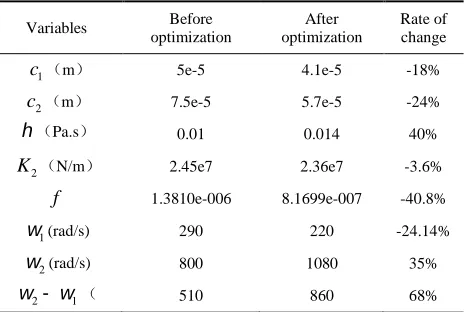
[image:4.612.304.536.385.541.2]5.3 Analysis of the Optimization Results. According to the above analysis, the paper employs genetic algorithm to optimize the system. Table 2 indicates the constraint ranges of the design variables.
Table 3 : Change Of Design Variables And Objective Function Before And After Optimization
Variables Before
optimization
After optimization
Rate of change
1
c (m) 5e-5 4.1e-5 -18%
2
c (m) 7.5e-5 5.7e-5 -24%
h(Pa.s) 0.01 0.014 40%
2
K (N/m) 2.45e7 2.36e7 -3.6%
f 1.3810e-006 8.1699e-007 -40.8%
1
w(rad/s) 290 220 -24.14%
2
w(rad/s) 800 1080 35%
2 1
w - w( 510 860 68%
Fig. 6. Amplitude Before And After Optimization
In Fig. 6, it is obvious that the distance between the first critical speed and the second critical speed on coordinate axis increases. When the rotating speed is within 410rad/s~880rad/s, the amplitude of rotary machines after optimization is lower than before. Therefore, after optimization, the working speed can be removed from the critical speed to a large extent and at the same time, the amplitude is reduced within the range.
For SFD-sliding bearing flexible rotor system which has variable high rotating speed (the working speed is between the first critical speed and the second critical speed), the distance between the first critical speed and the second critical speed should be enlarged as far as possible, in order to keep the working speed far away from the adjacent two critical speed, thus avoiding resonance vibration effectively.
6. CONCLUSION
The paper has established the mechanical model of SFD-sliding bearing flexible rotor system, analyzing the sensitivity of flexible rotor system on the first two critical speed. This paper has come to the conclusion that the first critical speed is sensitive to SFD clearance, bearing clearance and oil viscosity, which offers design variables to optimization analysis, improves the efficiency of optimization and shortens the design cycle.
Based on design variables offered by sensitivity analysis, this paper has employed genetic algorithm to give an optimization analysis on critical speed, which aims to enlarge the D-value between the first critical speed and the second critical speed to the utmost. The critical speed has ameliorated after the optimization which has remarkable results and provides reference for designers.
ACKNOWLEDGEMENTS
This work was financially supported by the Shandong Natural Science Foundation (ZR2011AL014), and Shandong Jiaotong University Natural Science Foundation (Z201201).
REFERENCES
[1] X. G. Lu, Y. C. Zhao, J. Lu,The dynamic analysis of the SFD-sliding bearing flexible rotor system, Chinese journal of applied mechanics, vol. 24, n.3, pp, 460-463, 2007.
[2] M. S. Li, Z. Chen, Y. Li, Analysis of dynamic characteristic for SFD, Journal of vibration and shock, vol. 28, n.5, pp, 44-48, 2009. [3] Information on http://www.paper.edu.cn [4] San Andres L A and Vance J M, Effects of
fluid inertia and turbulence on the force coefficients for squeeze film damper, ASME Transaction on Journal of Engineering for Gas Turbine and Power, vol. 108, pp.332, 1990. [5] X. Q. Yang and Q. C. Tan, An applied
calculation method of Pressure Distribution in Squeeze Film Damper, Journal of beihua university, vol.28, n.5, pp. 44-48, 2009.
[6] C.W, J. Chang, C.K. Chen, Chaos and bifurcation of a flexible rub-impact rotor supported by oil film bearings with non-linear suspension, Mech. Mach, vol, 42, n. 3, pp. 312–333, 2007.
[7] C.W. Chang-Jian, C.K. Chen, Bifurcation and chaos of a flexible rotor supported by turbulent journal bearings with non-linear suspension, Trans. IMechEJ-J. Engrg. Tribol. vol. 220, pp. 549–561, 2006.
[8] J. Y. Zhao, I. W. Linnett, L. J. Mclean, Stability and bifurcation of unbalanced response of a squeeze film damped flexible rotor, ASME Journal of Tribology, vol. 116, pp. 361-354, 1994.