End-to-End Neural Relation Extraction with Global Optimization
Meishan Zhang1 and Yue Zhang2 and Guohong Fu1
1. School of Computer Science and Technology, Heilongjiang University, China 2. Singapore University of Technology and Design
[email protected], yue [email protected],
Abstract
Neural networks have shown promising results for relation extraction. State-of-the-art models cast the task as an end-to-end problem, solved incrementally using a local classifier. Yet previous work us-ing statistical models have demonstrated that global optimization can achieve better performances compared to local classifica-tion. We build a globally optimized neural model for end-to-end relation extraction, proposing novel LSTM features in order to better learn context representations. In addition, we present a novel method to in-tegrate syntactic information to facilitate global learning, yet requiring little back-ground on syntactic grammars thus being easy to extend. Experimental results show that our proposed model is highly effec-tive, achieving the best performances on two standard benchmarks.
1 Introduction
Extracting entities (Florian et al.,2006,2010) and relations (Zhao and Grishman, 2005; Jiang and Zhai, 2007; Sun et al., 2011; Plank and Mos-chitti, 2013) from unstructured texts have been two central tasks in information extraction (Grish-man,1997;Doddington et al.,2004). Traditional approaches to relation extraction take entity recog-nition as a predecessor step in a pipeline (Zelenko et al.,2003;Chan and Roth,2011), predicting re-lations between given entities.
In recent years, there has been a surge of inter-est in performing end-to-end relation extraction, jointly recognizing entities and relations given free text inputs (Li and Ji, 2014; Miwa and Sasaki, 2014;Miwa and Bansal,2016;Gupta et al.,2016). End-to-end learning prevents error propagation in
the pipeline approach, and allows cross-task de-pendencies to be modeled explicitly for entity recognition. As a result, it gives better relation ex-traction accuracies compared to pipelines.
Miwa and Bansal(2016) were among the first to use neural networks for end-to-end relation extrac-tion, showing highly promising results. In partic-ular, they used bidirectional LSTM (Graves et al., 2013) to learn hidden word representations under a sentential context, and further leveraged tree-structured LSTM (Tai et al.,2015) to encode syn-tactic information, given the output of a parser. The resulting representations are then used for making local decisions for entity and relation ex-traction incrementally, leading to much improved results compared with the best statistical model (Li and Ji, 2014). This demonstrates the strength of neural representation learning for end-to-end rela-tion extracrela-tion.
On the other hand, Miwa and Bansal (2016)’s model is trained locally, without considering struc-tural correspondences between incremental deci-sions. This is unlike existing statistical methods, which utilize well-studied structured prediction methods to address the problem (Li and Ji,2014; Miwa and Sasaki,2014). As has been commonly understood, learning local decisions for structured prediction can lead to label bias (Lafferty et al., 2001), which prevents globally optimal structures from receiving optimal scores by the model. We address this potential issue by building a struc-tural neural model for end-to-end relation extrac-tion, following a recent line of efforts on globally optimized models for neural structured prediction (Zhou et al., 2015;Watanabe and Sumita, 2015; Andor et al.,2016;Wiseman and Rush,2016).
In particular, we follow Miwa and Sasaki (2014), casting the task as an end-to-end table-filling problem. This is different from the action-based method ofLi and Ji(2014), yet has shown to
be more flexible and accurate (Miwa and Sasaki, 2014). We take a different approach to representa-tion learning, addressing two potential limitarepresenta-tions ofMiwa and Bansal(2016).
First, Miwa and Bansal (2016) rely on exter-nal syntactic parsers for obtaining syntactic in-formation, which is crucial for relation extraction (Culotta and Sorensen, 2004; Zhou et al., 2005; Bunescu and Mooney, 2005; Qian et al., 2008). However, parsing errors can lead to encoding in-accuracies of tree-LSTMs, thereby hurting rela-tion extracrela-tion potentially. We take an alternative approach to integrating syntactic information, by taking the hidden LSTM layers of a bi-affine at-tention parser (Dozat and Manning,2016) to aug-ment input representations. Pretrained for parsing, such hidden layers contain rich syntactic informa-tion on each word, yet do not explicitly represent parsing decisions, thereby avoiding potential is-sues caused by incorrect parses.
Our method is also free from a particular syn-tactic formalism, such as dependency grammar, constituent grammar or combinatory categorial grammar, requiring only hidden representations on word that contain syntactic information. In con-trast, the method ofMiwa and Bansal(2016) must consider tree LSTM formulations that are specific to grammar formalisms, which can be structurally different (Tai et al.,2015).
Second, Miwa and Bansal (2016) did not ex-plicitly learn the representation of segments when predicting entity boundaries or making relation classification decisions, which can be intuitively highly useful, and has been investigated in sev-eral studies (Wang and Chang,2016;Zhang et al., 2016). We take the LSTM-Minus method ofWang and Chang(2016), modelling a segment as the dif-ference between its last and first LSTM hidden vectors. This method is highly efficient, yet gives as accurate results as compared to more complex neural network structures to model a span of words (Cross and Huang,2016).
Evaluation on two benchmark datasets shows that our method outperforms previous methods of Miwa and Bansal (2016), Li and Ji (2014) and Miwa and Sasaki(2014), giving the best reported results on both benchmarks. Detailed analysis shows that our integration of syntactic features is as effective as traditional approaches based on dis-crete parser outputs. We make our code publicly
Associated Press writer Patrick McDowell in Kuwait City
ORG PER PER GPE
[image:2.595.312.523.60.103.2]ORG-AFF PHYS
Figure 1: Relation extraction. The example is chosen from the ACE05 dataset, where ORG, PER and GPE denote organization, person and geo-political entities, respectively; ORG-AFF and PHYS denote organization affiliation and physical relations, respectively.
available under Apache License 2.0.1
2 Model
2.1 Task Definition
As shown in Figure1, the goal of relation extrac-tion is to mine relaextrac-tions from raw texts. It consists of two sub-tasks, namely entity detection, which recognizes valid entities, and relation classifica-tion, which determines the relation categories over entity pairs. We follow recent studies and recog-nize entities and relations as one single task. 2.2 Method
We follow Miwa and Sasaki (2014) and Gupta et al.(2016), treating relation extraction as a table-filling problem, performing entity detection and relation classification using a single incremental model, which is similar in spirit to Miwa and Bansal(2016) by performing the task end-to-end.
Formally, given a sentence w1w2· · ·wn, we
maintain a tableTn×n, whereT(i, j) denotes the
relation betweenwi andwj. Wheni= j,T(i, j)
denotes an entity boundary label. We map entity words into labels under the BILOU (Begin, In-side, Last, OutIn-side, Unit) scheme, assuming that there are no overlapping entities in one sentence (Li and Ji, 2014; Miwa and Sasaki, 2014;Miwa and Bansal,2016). Only the upper triangular table is necessary for indicating the relations.
We adopt the close-first left-to-right order (Miwa and Sasaki, 2014) to map the two-dimensional table into a sequence, in order to fill the table incrementally. As shown in Fig-ure2, first{T(i, i)} are filled by growing i, and then the sequence{T(i, i+ 1)}is filled, and then
{T(i, i+ 2)},· · ·,{T(i, i+n)} are filled incre-mentally, until the table is fully annotated.
During the table-filling process, we take two la-bel sets for entity detection (i = j) and relation
Associated Press writer Patrick McDowell in Kuwait City Associated
Press writer Patrick McDowell
in Kuwait
City
1 B-ORG 9⊥ 16⊥ 22⊥ 27⊥ 31⊥ 34⊥ 36⊥
2 L-ORG 10←−−−−−ORG-AFF 17⊥ 23⊥ 28⊥ 32⊥ 35⊥
3 U-PER 11⊥ 18⊥ 24⊥ 29⊥ 33⊥
4 B-PER 12⊥ 19⊥ 25⊥ 30⊥
5 L-PER 13⊥ 20⊥ 26−PHYS−−→
6 O 14⊥ 21⊥
7 B-GPE 15⊥
[image:3.595.131.469.61.160.2]8 L-GPE
Figure 2: Table-filling example, where numbers indicate the filling order.
classification (i < j), respectively. The labels for entity detection include{B-*, I-*, L-*, O, U-*}, where * denotes the entity type, and the labels for relation classification are{−→∗,←−∗,⊥}, where * de-notes the relation category and⊥denotes a NULL relation.2
At each step, given a partially-filled tableT, we determine the most suitable labellfor the next step using a scoring function:
score(T, l) =WlhT, (1)
whereWlis a model parameter andhT is the
vec-tor representation of T. Based on the function, we aim to find the best label sequence l1· · ·lm,
wherem = n(n2+1), and the resulting sequence of partially-filled tables is T0T1· · ·Tm, whereTi =
FILL(Ti−1, li), andT0 is an empty table.
Differ-ent from previous work, we investigate a structural model that is optimized for the label sequence l1· · ·lmglobally, rather than for eachlilocally.
2.3 Representation Learning
At the ith step, we determine the label li of the
next table slot based on the current hypothesis Ti−1. FollowingMiwa and Bansal(2016), we use
a neural network to learn the vector representation ofTi−1, and then use Equation1to rank candidate next labels. There are two types of input features, including the word sequencew1w2· · ·wn, and the
readily filled label sequencel1l2· · ·li−1. We build a neural network to representTi−1.
2.3.1 Word Representation
Shown in Figure 3, we represent each word wi
by a vectorhw
i using its word form, POS tag and
characters. Two different forms of embeddings are used based on the word form, one being obtained by using a randomly initialized look-up tableEw,
2We remove the illegal table-filling labels during
decod-ing for traindecod-ing and testdecod-ing. For example,T(i, j)must be⊥ ifT(i, i)orT(j, j)equals O.
hw
L ew
e0w et hchar
L L
CNN
character sequence
Figure 3: Word representations.
tuned during training and represented byew, and
the other being a pre-trained external word embed-ding fromE0
w, which is fixed and represented by
e0
w.3 For a POS tagt, its embeddingetis obtained
from a look-up tableEtsimilar toEw.
The above two components have also been used byMiwa and Bansal(2016). We further enhance the word representation by using its character se-quence (Ballesteros et al., 2015; Lample et al., 2016), taking a convolution neural network (CNN) to derive a character-based word representation hchar, which has been demonstrated effective for
several NLP tasks (dos Santos and Gatti, 2014). We obtain the finalhw
i based on a non-linear
feed-forward layer one0
w⊕ew⊕et⊕hchar, where⊕
denotes concatenation. 2.3.2 Label Representation
In addition to the word sequence, the history la-bel sequence l1l2· · ·li−1, and especially the
la-bels representing detected entities, are also use-ful disambiguation. For example, the previous en-tity boundary label can be helpful to deciding the boundary label of the current word. During re-lation classification, the types of the entities in-volved can indicate the relation category between them. We exploit the diagonal label sequence of partial table T, which denotes entity boundaries, to enhance the representation learning. A word’s entity boundary label embeddingelis obtained by
3We use the set of pre-trained glove word embeddings
[image:3.595.330.504.203.272.2]hi−1
... h
i ... hj ...
[image:4.595.324.513.63.416.2]hseg=hj−hi−1
Figure 4: Segment representation.
using a randomly initialized looking-up tableEl.
2.3.3 LSTM Features
We follow Miwa and Bansal (2016), learn-ing global context representations uslearn-ing LSTMs. Three basic LSTM structures are used: a left-to-right word LSTM (−−−−→LSTMw), a right-to-left
word LSTM (←−−−−LSTMw) and a left-to-right entity
boundary label LSTM (−−−−→LSTMe). Each LSTM
derives a sequence of hidden vectors for inputs. For example, for w1w2· · ·wn, −−−−→LSTMw gives
hw,→1 hw,→2 · · ·hw,→n .
Different from Miwa and Bansal (2016), who use the output hidden vectors{hi} of LSTMs to
represent words, we exploit segment representa-tions as well. In particular, for a segment of text[i, j], the representation is computed by using LSTM-Minus (Wang and Chang,2016), shown by Figure4, wherehj−hi−1in a left-to-right LSTM and hi −hj+1 in a right-to-left LSTM are used to represent the segment[i, j]. The segment rep-resentations can reflect entities in a sentence, and thus can be potentially useful for both entity de-tection and relation extraction.
2.3.4 Feature Representation
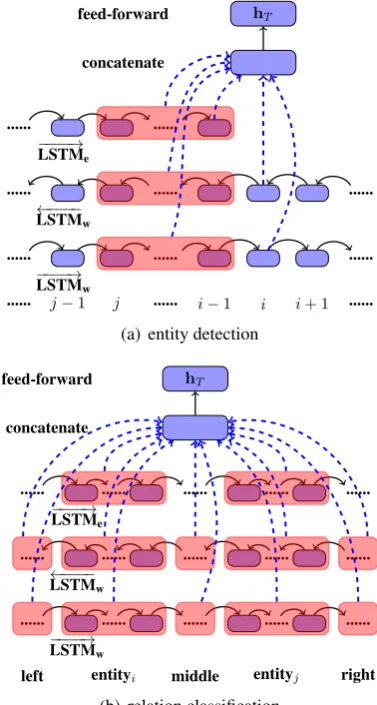
We use separate feature representations for entity detection and relation classification, both of which are extracted from the above three LSTM struc-tures. In particular, we first extract a set of base neural features, and then concatenate them and feed them into a non-linear neural layer for entity detection and relation classification, respectively. Figure5shows the overall representation.
[Entity Detection] Figure 5(a) shows the fea-ture representation for the entity detection. First, we extract six feature vectors from the three basic LSTMs, three of which are word features, namely hw,→i ,hw,←i andhe,→i−1, and the remaining are seg-ment features, namelyhw,→[j,i−1],h[w,←j,i−1]andhe,→[j,i−1], where j denotes the start position of the previ-ous entity.4 The segment features are computed dynamically from the partial outputs of entity de-tection, according to the boundaries of the
lastly-4The non-entity word is treated as a special unit entity to
extract segmental features.
... ... ...
... ... ...
... ...
hT
−−−−→ LSTMw ←−−−− LSTMw −−−−→ LSTMe
... j−1 j ... i−1 i i+ 1 ... concatenate
feed-forward
(a) entity detection
... ... ... ... ...
... ... ... ... ...
... ... ... ... ...
hT
−−−−→
LSTMw ←−−−−
LSTMw −−−−→
LSTMe
left entityi middle entityj right
concatenate feed-forward
(b) relation classification
Figure 5: Feature representation.
formed entity during the decoding. The six vectors are concatenated and then fed into a non-linear layer for entity detection.
[Relation Classification]Figure5(b)shows the feature representation for relation classification. Similar to entity detection, we extract a set of fea-tures from the basic LSTMs (−−−−→LSTMw, ←−−−−LSTMw
and −−−−→LSTMe), and then concatenate them for a
non-linear classification layer. The differences be-tween relation classification with entity detection lie in the range of hidden layers from LSTMs. For relation classification between i and j, we split each LSTM into five segments according to the two entities ended with i and j. Formally, let
[s(i), i]and[s(j), j]denote the two entities above, wheres(·)denotes the start position of an entity, the resulted segments are[0, s(i)−1](i.e.,left, in Figure5(b)),[s(i), i](i.e.,entityi),[i+1, s(j)−1]
(i.e.,middle),[s(j), j](i.e.,entityj) and[j+ 1, n]
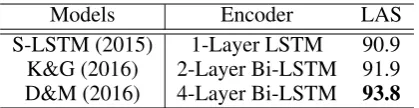
[image:4.595.87.278.63.100.2]en-Models Encoder LAS S-LSTM (2015) 1-Layer LSTM 90.9 K&G (2016) 2-Layer Bi-LSTM 91.9 D&M (2016) 4-Layer Bi-LSTM 93.8 Table 1: Encoder structures and performances of three state-of-the-art dependency parsers, where S-LSTM (2015) refers toDyer et al.(2015), K&G (2016) refers to the best parser ofKiperwasser and Goldberg (2016), D&M (2016) refers to Dozat and Manning (2016), and LAS (labeled attach-ment score) is the major evaluation metric.
tity label LSTM, we only use the segment features ofentityiandentityj.
2.3.5 Syntactic Features
Previous work has shown that syntactic features are useful for relation extraction (Zhou et al., 2005). For example, the shortest dependency path has been used by several relation extraction models (Bunescu and Mooney, 2005; Miwa and Bansal,2016). Here we propose a novel method to integrate syntax, without need for prior knowl-edge on concrete syntactic structures.
In particular, we take state-of-the-art syntactic parsers that use encoder-decoder neural models (Buys and Blunsom,2015;Kiperwasser and Gold-berg,2016), where the encoder represents the syn-tactic features of the input sentences. For exam-ple, LSTM hidden states over the input word/tag sequences has been used frequently as syntac-tic features (Kiperwasser and Goldberg, 2016). Such features represent input words with syntac-tic information. The parser decoder also leverages partially-parsed results, such as features from par-tial syntactic trees, although we do not use explicit output features. Table1shows the encoder struc-tures of three state-of-the-art dependency parsers.
Our method is to leverage trained syntactic parsers, dumping the encoder feature represen-tations given our inputs, using them directly as part of input embeddings in our proposed model. Denoting the dumped syntactic features on each word ashsyn1 hsyn2 · · ·hsynn , we feed them into a
non-linear neural layer, and then generate two LSTMs (bi-directional) based on the outputs, namely
−−−−→
LSTMsyn and ←−−−−LSTMsyn, respectively,
augment-ing the original three LSTMs into five LSTMs. Features are extracted from the two new LSTMs in the same way as from the basic bi-directional
word LSTMs.
In this paper, we exploit the parser ofDozat and Manning(2016), since it achieves the current best performance for dependency parsing. Our method can be easily generalized to other parsers, which are potentially useful for our task as well. For ex-ample, we can use a constituent parser in the same way by dumping the implicit encoder features.
Our exploration of syntactic features has two main advantages over the method of Miwa and Bansal(2016), where dependency path LSTMs are used for relation classification. On the one hand, incorrect dependency paths between entity pairs can propagate to relation classification in Miwa and Bansal(2016), because these paths rely on ex-plicit discrete outputs from a syntactic parser. Our method can avoid the problem since we do not compute parser outputs. On the other hand, the computation complexity is largely reduced by us-ing our method since sequential LSTMs are based on inputs only, while the dependency path LSTMs should be computed based on the dynamic en-tity detection outputs. When beam search is ex-ploited during decoding, increasing number of de-pendency paths can be used by a surge of entity pairs from beam outputs.
Our method can be extended into neural stack-ingWang et al.(2017), by doing back-propagation training of the parser parameters during model training, which are leave for future work.
2.4 Training and Search 2.4.1 Local Optimization
Previous work (Miwa and Bansal, 2016; Gupta et al., 2016) trains model parameters by model-ing each step for labelmodel-ing one input sentence sepa-rately. Given a partial tableT, its neural represen-tation hT is first obtained, and then compute the
next label scores{l1, l2,· · · , ls}using Equation1.
The output scores are regularized into a probabil-ity distribution{pl1, pl2,· · ·, pls}by using a
soft-max layer. The training objective is to minimize the cross-entropy loss between this output distri-bution with the gold-standard distridistri-bution:
loss(T, lgi,Θ) =−logplg
i, (2)
wherelgi is the gold-standard next label forT, and
Algorithm 1Beam-search.
agenda← {(empty table, score=0.0)}
fori in 1· · ·max-step
next scored tables← { }
forscored tableinagenda
labels←NEXTLABELS(scored table)
fornext labelinlabels
new←FILL(scored table,next label) ADDITEM(next scored tables,new)
agenda←TOP-B(next scored tables, B)
During the decoding phase, the greedy search strategy is applied in consistence with the train-ing. At each step, we find the highest-scored label based on the current partial table, before going on to the next step.
2.4.2 Global Optimization
We exploit the global optimization strategy of Zhou et al.(2015) andAndor et al. (2016), max-imizing the cumulative score of the gold-standard label sequence for one sentence as a unit. Global optimization has achieved success for several NLP tasks under the neural setting (Zhou et al.,2015; Watanabe and Sumita,2015). For relation extrac-tion, global learning gives the best performances under the discrete setting (Li and Ji,2014;Miwa and Sasaki,2014). We study such models here for neural network models.
Given a label sequence ofl1l2· · ·li, the score of
Tiis defined as follows:
score(Ti) = i
X
j=0
score(Tj−1, lj)
=score(Ti−1) +score(Ti−1, li),
(3)
where score(T0) = 0and score(Ti−1, li) is
com-puted by Equation1. By this definition, we maxi-mize the scores of all gold-standard partial tables. Again cross-entropy loss is used to perform model updates. At each stepi, the objective func-tion is defined by:
loss(x, Tig,Θ) =−logpTg i
=−logPscore(Tig) T0
i score(T
0 i),
(4)
where x denotes the input sentence, Tig denotes the gold-standard state at stepi, andT0
i are all
par-tial tables that can be reached at stepi. The major challenge is to compute pTg
i,
be-cause we cannot traverse all partial tables that are
valid at step i, since their count increases expo-nentially by the step number. We follow Andor et al.(2016), approximating the probability by us-ing beam search and early-update.
Shown in Algorithm 1, we use standard beam search, maintaining the B highest-scored partially-filled tables in an agenda at each step. When each action of table filling is taken, all hy-potheses in the agenda are expanded by enumer-ating the next labels, and theBhighest-scored re-sulting tables are used to replace the agenda for the next step. Search begins with the agenda contain-ing an empty table, and finishes when all cells of the tables in the agenda have been filled. When the beam size is 1, the algorithm is the same as greedy decoding. When the beam size is larger than 1, however, error propagation is alleviated. For train-ing, the same beam search algorithm is applied to training examples, and early-update (Collins and Roark,2004) is used to fix search errors.
3 Experiments
3.1 Data and Evaluation
We evaluate the proposed model on two datasets, namely the ACE05 data and the corpus of Roth and Yih (2004) (CONLL04), respectively. The ACE05 dataset defines seven coarse-grained entity types and six coarse-grained relation categories, while the CONLL04 dataset defines four entity types and five relation categories.
For the ACE05 dataset, we follow Li and Ji (2014) andMiwa and Bansal(2016), splitting and preprocessing the dataset into training, develop-ment and test sets.5 For the CONLL04 dataset, we followMiwa and Sasaki(2014) to split the data into training and test corpora, and then divide 10% of the training corpus for development.
We use the micro F1-measure as the major met-ric to evaluate model performances, treating an en-tity as correct when its head region and type are both correct,6and regard a relation as correct when the argument entities and the relation category are all correct. We exploit pairwise t-test for measur-ing significance values.
5https://github.com/tticoin/LSTM-ER/.
6For the ACE05 dataset, the head region is defined by the
Network Structure Size
Word Embedding 200
Tag Embedding 50
Char Embedding 50
[image:7.595.315.517.61.140.2]Entity Label Embedding 50 Input/Output of Word LSTMs 250 Input/Output of Entity Label LSTMs 100 Table Representation 300
Table 2: Dimension sizes.
Model Entity F1 Relation F1
baseline 81.5 50.9
-character 80.9 50.2
-segment 80.2 49.8
(entity detection)
Table 3: Feature ablation tests.
3.2 Parameter Tuning
We update all model parameters by back propa-gation using Adam (Kingma and Ba,2014) with a learning rate 10−3, using gradient clipping by a max norm 10 and l2-regularization by a pa-rameter 10−5. The dimension sizes of various vectors in neural network structure are shown in Table 2. All the hyper-parameters are tuned by development experiments. All experiments are conducted using gcc version 4.9.4 (Ubuntu 4.9.4-2ubuntu1 14.04.1), on an Intel(R) Xeon(R) CPU E5-2670 @ 2.60GHz.
Online training is used to learn parameters, traversing over the entire training examples by 300 iterations. We select the best iteration number ac-cording to the development results. In particu-lar, we exploit pre-training techniques (Wiseman and Rush,2016) to learn better model parameters. For the local model, we followMiwa and Bansal (2016), training parameters only for entity detec-tion during the first 20 iteradetec-tions. For the global model, we pretrain our model using local opti-mization for 40 iterations, before conducting beam global optimization.
3.3 Development Experiments
We conduct several development experiments on the ACE05 development dataset.
3.3.1 Feature Ablation Tests
We consider the baseline system with no syntac-tic features using local training. Compared with Miwa and Bansal(2016), we introduce character-level features, and in addition exploit segmental
Model Beam Relation F1 Speed
Local 1 50.9 95.6
Local(+SS) 1 51.2 95.1
Global 13 51.451.8 95.352.0
[image:7.595.76.284.62.178.2]5 52.6 36.9
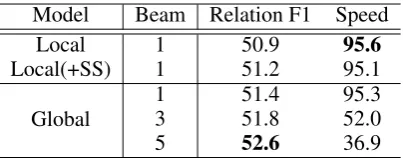
Table 4: Comparisons between local and global models, where SS denotes scheduled sampling, and speed is measured by the number of sentences per second.
features for entity detection. Feature ablation ex-periments are conducted for the two types of fea-tures. Table 3 shows the experimental results, which demonstrate that the character-level fea-tures and the segment feafea-tures we use are both use-ful for relation extraction.
3.3.2 Local v.s. Global Training
We study the influence of training strategies for re-lation extraction without using syntactic features. For the local model, we apply scheduled sampling (Bengio et al., 2015), which has been shown to improve the performance of relation extraction by Miwa and Bansal(2016).
Table4shows the results. Scheduled sampling achieves improved F-measure scores for the local model. With the same greedy search strategy, the globally normalized model gives slightly better re-sults than the local model with scheduled sam-pling. The performance of the global model in-creases with a larger beam size. When beam size 5 is exploited, we obtain a further gain of 1.2% on the relation F-measure, which is significantly better than our baseline local model with sched-uled sampling (p≈10−4). However, the decoding speed becomes intolerably slow when the beam size increases beyond 5. Thus we exploit a beam size of 5 for global training considering both per-formance and efficiency.
3.3.3 Syntactic Features
We examine the effectiveness of the proposed im-plicit syntactic features. Table5shows the devel-opment results using both local and global opti-mization. The proposed features improve the rela-tion performances significantly under both settings (p <10−4), demonstrating that our use of syntac-tic features is highly effective.
[image:7.595.79.282.196.262.2]Model Features Entity F1 Relation F1 Local -synall 81.681.5 53.050.9
[image:8.595.77.282.60.126.2]Global -synall 81.981.6 54.252.6
Table 5: The influence of syntactic features.
model Entity Relation Entity RelationACE05 CONLL04 Our Model 83.6 57.5 85.6 67.8 M&B (2016) 83.4 55.6 — —
[image:8.595.319.512.63.151.2]L&J (2014) 80.8 49.5 — — M&S (2014) — — 80.7 61.0
Table 6: Final results on the test datasets.
outputs which Miwa and Bansal (2016) and all previous methods use. We use the same parser of Dozat and Manning (2016), building features on its dependency outputs. We exploit the bi-directional tree LSTM ofTeng and Zhang(2016) to extract neural features, and then exploit a non-linear feed-forward neural network to combine the two features. Similarly, we extract segment fea-tures but by using max pooling instead over the sequential outputs of the feed-forward layer, since the vector minus is nonsense here. The final rela-tion results are 53.1% and 53.9% for the local and global models, respectively, which have no signif-icantly differences compared with our models. On the other hand, our method is relatively more effi-cient, and flexible to the grammar formalism. 3.4 Final Results
Table6shows the final results on the test datasets of ACE05 and CONLL04. We show several top-performing systems in the table as well, where M&B (2016) refers to Miwa and Bansal (2016), who exploit end-to-end LSTM neural networks with local optimization, and L&J (2014) and M&S (2014) refer to Li and Ji (2014) and Miwa and Sasaki(2014), respectively, which are both glob-ally optimized models using discrete features, giv-ing the top F-scores among statistical models.7
Overall, neural models give better performances
7Gupta et al.(2016) proposed a locally optimized model
but used a different test dataset from CONLL04 and a differ-ent evaluation method, reporting differ-entity and relation F-scores of 93.6% and 72.1%, respectively. Their results are not di-rectly comparable to the results in Table6. In particular, they regard an entity as correct if at least one token is tagged cor-rectly, which influences the results significantly since multi-word entities accounts for over 50% of all entities.
5 10 15 20 25 ≥30
20 40 60 80 100
Accuracy(%)
[image:8.595.73.289.164.242.2]global local
Figure 6: Sentence-level accuracies with respect to sentence length.
1 2 3 4 5 ≥6
30 40 50 60 70
F-scor
e(%)
+syn -syn
Figure 7: F-scores with respect to the distance be-tween entity pairs.
than statistical models, and global optimization can give improved performances as well. Our fi-nal model achieves the best performances on both datasets. Compared with the best reported re-sults, our model gives improvements of 1.9% on ACE05, and 6.8% on CONLL04.
3.5 Analysis
We conduct analysis on the ACE05 test dataset in order to better understand our models, on its two major contributions, first examining the influences of global optimization, and then studying the gains by using the proposed syntactic features.
Intuitively global optimization should give bet-ter accuracies at the sentence level. We verify this by examining the sentence-level accuracies, where one sentence is regarded as correct when all the labels in the resulted table are correct. Fig-ure 6 shows the result, which is consistent with our intuition. The sentence-level accuracies of the globally normalized model are consistently better than the local model. In addition, the accuracy de-creases sharply as the sentence length inde-creases, with the local model suffering more severely from larger sentences.
[image:8.595.319.511.200.290.2]dis-tance, thus facilitating relation extraction. We ver-ify whether the proposed syntactic features can benefit our model similarly. As shown in Fig-ure7, the F-scores of entity-pairs with large dis-tances see apparent improvements, demonstrating that our use of syntactic features has a similar ef-fect compared to the shortest dependency path.
4 Related Work
Entity recognition (Florian et al., 2004, 2006; Ratinov and Roth,2009;Florian et al.,2010;Kuru et al.,2016) and relation extraction (Zhao and Gr-ishman, 2005;Jiang and Zhai, 2007;Zhou et al., 2007;Qian and Zhou,2010;Chan and Roth,2010; Sun et al.,2011;Plank and Moschitti,2013;Verga et al., 2016) have received much attention in the NLP community. The dominant methods treat the two tasks separately, where relation extraction is performed assuming that entity boundaries have been given (Zelenko et al., 2003; Miwa et al., 2009;Chan and Roth,2011;Lin et al.,2016).
Several studies find that extracting entities and relations jointly can benefit both tasks. Early work conducts joint inference for separate models (Ji and Grishman,2005;Roth and Yih,2004,2007). Recent work shows that joint learning and decod-ing with a sdecod-ingle model brdecod-ings more benefits for the two tasks (Li and Ji,2014;Miwa and Sasaki, 2014;Miwa and Bansal,2016;Gupta et al.,2016), and we follow this line of work in the study.
LSTM features have been extensively exploited for NLP tasks, including tagging (Huang et al., 2015;Lample et al.,2016), parsing (Kiperwasser and Goldberg,2016;Dozat and Manning,2016), relation classification (Xu et al., 2015;Vu et al., 2016; Miwa and Bansal, 2016) and sentiment analysis (Li et al.,2015;Teng et al.,2016). Based on the output of LSTM structures, Wang and Chang(2016) introduce segment features, and ap-ply it to dependency parsing. The same method is applied to constituent parsing byCross and Huang (2016). We exploit this segmental representation for relation extraction.
Global optimization and normalization has been successfully applied on many NLP tasks that in-volve structural prediction (Lafferty et al., 2001; Collins,2002;McDonald et al.,2010;Zhang and Clark, 2011), using traditional discrete features. For neural models, it has recently received increas-ing interests (Zhou et al.,2015;Andor et al.,2016; Xu, 2016; Wiseman and Rush, 2016), and
im-proved performances can be achieved with global optimization accompanied by beam search. Our work is in line with these efforts. To our knowl-edge, we are the first to apply globally optimized neural models for end-to-end relation extraction, achieving the best results on standard benchmarks. 5 Conclusion
We investigated a globally normalized end-to-end relation extraction model using neural network, based on the table-filling framework proposed by Miwa and Sasaki(2014). Feature representations are learned from several LSTM structures over the inputs, and a novel simple method is used to in-tegrate syntactic information. Experiments show the effectiveness of both global normalization and syntactic features. Our final model achieved the best performances on two benchmark datasets. Acknowledgments
We thank the anonymous reviewers for their con-structive comments, which help to improve the paper, and Zhiyang Teng for dumping intermedi-ate outputs from the bi-affine parser. This work is supported by National Natural Science Foun-dation of China (NSFC) grants 61602160 and 61672211, Natural Science Foundation of Hei-longjiang Province (China) grant F2016036, Spe-cial business expenses in Heilongjiang Province (China) grant 2016-KYYWF-0183, the Singapore Ministry of Education (MOE) AcRF Tier 2 grant T2MOE201301 and SRG ISTD 2012 038 from Singapore University of Technology and Design. Yue Zhang is the corresponding author.
References
Daniel Andor, Chris Alberti, David Weiss, Aliaksei Severyn, Alessandro Presta, Kuzman Ganchev, Slav Petrov, and Michael Collins. 2016. Globally nor-malized transition-based neural networks. In ACL, pages 2442–2452.
Miguel Ballesteros, Chris Dyer, and Noah A. Smith. 2015. Improved transition-based parsing by model-ing characters instead of words with lstms. In Pro-ceedings of the EMNLP, pages 349–359.
Samy Bengio, Oriol Vinyals, Navdeep Jaitly, and Noam Shazeer. 2015. Scheduled sampling for se-quence prediction with recurrent neural networks.
InNIPS, pages 1171–1179.
extrac-tion. In EMNLP, pages 724–731. Association for Computational Linguistics.
Jan Buys and Phil Blunsom. 2015. Generative incre-mental dependency parsing with neural networks. In Proceedings of the 53rd ACL, pages 863–869. Yee Seng Chan and Dan Roth. 2010. Exploiting
back-ground knowledge for relation extraction. In COL-ING, pages 152–160.
Yee Seng Chan and Dan Roth. 2011. Exploiting syntactico-semantic structures for relation extrac-tion. InACL, pages 551–560.
Michael Collins. 2002. Discriminative training meth-ods for hidden markov models: Theory and ex-periments with perceptron algorithms. In EMNLP, pages 1–8.
Michael Collins and Brian Roark. 2004. Incremen-tal parsing with the perceptron algorithm. In ACL, pages 111–118.
James Cross and Liang Huang. 2016. Span-based constituency parsing with a structure-label system and provably optimal dynamic oracles. InEMNLP, pages 1–11.
Aron Culotta and Jeffrey Sorensen. 2004. Dependency tree kernels for relation extraction. InACL, pages 423–429.
George R Doddington, Alexis Mitchell, Mark A Przy-bocki, Lance A Ramshaw, Stephanie Strassel, and Ralph M Weischedel. 2004. The automatic content extraction (ace) program-tasks, data, and evaluation.
InLREC, volume 2, page 1.
Timothy Dozat and Christopher D Manning. 2016. Deep biaffine attention for neural dependency
pars-ing. arXiv preprint arXiv:1611.01734.
Chris Dyer, Miguel Ballesteros, Wang Ling, Austin Matthews, and Noah A. Smith. 2015. Transition-based dependency parsing with stack long short-term memory. InACL, pages 334–343.
R Florian, H Hassan, A Ittycheriah, H Jing, N Kamb-hatla, X Luo, N Nicolov, and S Roukos. 2004. A sta-tistical model for multilingual entity detection and tracking. InNAACL, pages 1–8.
Radu Florian, Hongyan Jing, Nanda Kambhatla, and Imed Zitouni. 2006. Factorizing complex models: A case study in mention detection. InCOLING/ACL, pages 473–480.
Radu Florian, John Pitrelli, Salim Roukos, and Imed Zitouni. 2010. Improving mention detection robust-ness to noisy input. InEMNLP, pages 335–345. Alex Graves, Abdel-rahman Mohamed, and Geoffrey
Hinton. 2013. Speech recognition with deep recur-rent neural networks. InICASSP, pages 6645–6649. IEEE.
Ralph Grishman. 1997. Information extraction: Tech-niques and challenges. InInformation extraction a multidisciplinary approach to an emerging informa-tion technology, pages 10–27. Springer.
Pankaj Gupta, Hinrich Sch¨utze, and Bernt Andrassy. 2016. Table filling multi-task recurrent neural net-work for joint entity and relation extraction. In Pro-ceedings of COLING 2016, pages 2537–2547. Zhiheng Huang, Wei Xu, and Kai Yu. 2015.
Bidirec-tional lstm-crf models for sequence tagging. arXiv preprint arXiv:1508.01991.
Heng Ji and Ralph Grishman. 2005. Improving name tagging by reference resolution and relation detec-tion. InACL, pages 411–418.
Jing Jiang and ChengXiang Zhai. 2007. A systematic exploration of the feature space for relation extrac-tion. InNAACL, pages 113–120.
Diederik Kingma and Jimmy Ba. 2014. Adam: A method for stochastic optimization. arXiv preprint arXiv:1412.6980.
Eliyahu Kiperwasser and Yoav Goldberg. 2016. Sim-ple and accurate dependency parsing using bidirec-tional lstm feature representations. TACL, 4:313– 327.
Onur Kuru, Ozan Arkan Can, and Deniz Yuret. 2016. Charner: Character-level named entity recognition.
InProceedings of COLING 2016, pages 911–921.
John Lafferty, Andrew McCallum, Fernando Pereira, et al. 2001. Conditional random fields: Probabilistic models for segmenting and labeling sequence data.
InICML, volume 1, pages 282–289.
Guillaume Lample, Miguel Ballesteros, Sandeep Sub-ramanian, Kazuya Kawakami, and Chris Dyer. 2016. Neural architectures for named entity recognition.
InNAACL, pages 260–270.
Jiwei Li, Thang Luong, Dan Jurafsky, and Eduard Hovy. 2015. When are tree structures necessary for deep learning of representations? InProceedings of the EMNLP, pages 2304–2314.
Qi Li and Heng Ji. 2014. Incremental joint extraction of entity mentions and relations. InProceedings of the Association for Computational Linguistics. Yankai Lin, Shiqi Shen, Zhiyuan Liu, Huanbo Luan,
and Maosong Sun. 2016. Neural relation extrac-tion with selective attenextrac-tion over instances. InACL, pages 2124–2133.
Ryan McDonald, Keith Hall, and Gideon Mann. 2010. Distributed training strategies for the structured per-ceptron. InNAACL, pages 456–464.
Makoto Miwa, Rune Sætre, Yusuke Miyao, and Jun’ichi Tsujii. 2009. A rich feature vector for protein-protein interaction extraction from multiple corpora. InEMNLP, pages 121–130.
Makoto Miwa and Yutaka Sasaki. 2014. Modeling joint entity and relation extraction with table repre-sentation. InEMNLP, pages 1858–1869.
Barbara Plank and Alessandro Moschitti. 2013. Em-bedding semantic similarity in tree kernels for do-main adaptation of relation extraction. In ACL, pages 1498–1507.
Longhua Qian and Guodong Zhou. 2010. Clustering-based stratified seed sampling for semi-supervised relation classification. InEMNLP, pages 346–355. Longhua Qian, Guodong Zhou, Fang Kong, Qiaoming
Zhu, and Peide Qian. 2008. Exploiting constituent dependencies for tree kernel-based semantic relation extraction. InColing 2008, pages 697–704.
Lev Ratinov and Dan Roth. 2009. Design chal-lenges and misconceptions in named entity recog-nition. In Proceedings of the Thirteenth Confer-ence on Computational Natural Language Learning (CoNLL-2009), pages 147–155.
Dan Roth and Wen-tau Yih. 2004. A linear program-ming formulation for global inference in natural lan-guage tasks. InCoNLL, pages 1–8.
Dan Roth and Wen-tau Yih. 2007. Global inference for entity and relation identification via a linear pro-gramming formulation. Introduction to statistical relational learning, pages 553–580.
Cicero dos Santos and Maira Gatti. 2014. Deep con-volutional neural networks for sentiment analysis of short texts. InProceedings of COLING 2014, pages 69–78.
Ang Sun, Ralph Grishman, and Satoshi Sekine. 2011. Semi-supervised relation extraction with large-scale word clustering. InACL, pages 521–529.
Kai Sheng Tai, Richard Socher, and Christopher D. Manning. 2015. Improved semantic representations from tree-structured long short-term memory net-works. InACL, pages 1556–1566.
Zhiyang Teng, Duy Tin Vo, and Yue Zhang. 2016. Context-sensitive lexicon features for neural senti-ment analysis. InProceedings of the EMNLP, pages 1629–1638.
Zhiyang Teng and Yue Zhang. 2016. Bidirectional tree-structured lstm with head lexicalization. arXiv preprint arXiv:1611.06788.
Patrick Verga, David Belanger, Emma Strubell, Ben-jamin Roth, and Andrew McCallum. 2016. Multi-lingual relation extraction using compositional uni-versal schema. InProceedings of the 2016 NAACL, pages 886–896.
Ngoc Thang Vu, Heike Adel, Pankaj Gupta, and Hin-rich Sch¨utze. 2016. Combining recurrent and convo-lutional neural networks for relation classification.
InProceedings of the NAACL, pages 534–539.
Hongmin Wang, Yue Zhang, GuangYong Leonard Chan, Jie Yang, and Hai Leong Chieu. 2017. Uni-versal dependencies parsing for colloquial singa-porean english. CoRR, abs/1705.06463.
Wenhui Wang and Baobao Chang. 2016. Graph-based dependency parsing with bidirectional lstm. InACL, pages 2306–2315.
Taro Watanabe and Eiichiro Sumita. 2015. Transition-based neural constituent parsing. In ACL, pages 1169–1179.
Sam Wiseman and Alexander M. Rush. 2016. Sequence-to-sequence learning as beam-search op-timization. InEMNLP, pages 1296–1306.
Wenduan Xu. 2016. Lstm shift-reduce ccg parsing. In EMNLP, pages 1754–1764.
Yan Xu, Lili Mou, Ge Li, Yunchuan Chen, Hao Peng, and Zhi Jin. 2015. Classifying relations via long short term memory networks along shortest depen-dency paths. In Proceedings of the 2015 EMNLP, pages 1785–1794.
Dmitry Zelenko, Chinatsu Aone, and Anthony Richardella. 2003. Kernel methods for relation ex-traction. Journal of machine learning research, 3(Feb):1083–1106.
Meishan Zhang, Yue Zhang, and Guohong Fu. 2016. Transition-based neural word segmentation. In Pro-ceedings of ACL, pages 421–431, Berlin, Germany. Yue Zhang and Stephen Clark. 2011. Syntactic
pro-cessing using the generalized perceptron and beam search. Computational Linguistics, 37(1):105–151. Shubin Zhao and Ralph Grishman. 2005. Extracting
relations with integrated information using kernel methods. InACL, pages 419–426.
GuoDong Zhou, Jian Su, Jie Zhang, and Min Zhang. 2005. Exploring various knowledge in relation ex-traction. InACL, pages 427–434.
GuoDong Zhou, Min Zhang, DongHong Ji, and QiaoMing Zhu. 2007. Tree kernel-based relation ex-traction with context-sensitive structured parse tree information. InEMNLP-CoNLL, pages 728–736. Hao Zhou, Yue Zhang, Shujian Huang, and Jiajun