2744
Shrinking Japanese Morphological Analyzers
With Neural Networks and Semi-supervised Learning
Arseny Tolmachev
Daisuke Kawahara
Kyoto University, Graduate School of Informatics Yoshida Honmachi, Sakyo-ku, Kyoto 606-8501, Japan
Sadao Kurohashi
Abstract
For languages without natural word bound-aries, like Japanese and Chinese, word seg-mentation is a prerequisite for downstream analysis. For Japanese, segmentation is often done jointly with part of speech tagging, and this process is usually referred to as morpho-logical analysis. Morphomorpho-logical analyzers are trained on data hand-annotated with segmenta-tion boundaries and part of speech tags. A seg-mentation dictionary or character n-gram infor-mation is also provided as additional inputs to the model. Incorporating this extra informa-tion makes models large. Modern neural mor-phological analyzers can consume gigabytes of memory. We propose a compact alternative to these cumbersome approaches which do not rely on any externally provided n-gram or word representations. The model uses only unigram character embeddings, encodes them using ei-ther stacked bi-LSTM or a self-attention net-work, and independently infers both segmen-tation and part of speech information. The model is trained in an end-to-end and semi-supervised fashion, on labels produced by a state-of-the-art analyzer. We demonstrate that the proposed technique rivals performance of a previous dictionary-based state-of-the-art ap-proach and can even surpass it when training with the combination of human-annotated and automatically-annotated data. Our model it-self is significantly smaller than the dictionary-based one: it uses less than 15 megabytes of space.
1 Introduction
Languages with a continuous script, like Japanese and Chinese, do not have natural word boundaries in most cases. Natural language processing for such languages requires to perform some variation of word segmentation.
Although some NLP applications, like neu-ral machine translation, started to use
unsuper-あ
...
る か な い か
Encoder
...
...
[image:1.595.325.505.224.435.2]...
... ...
...
...
Dense Softmax
Seg
B I E
t1
t2
tN
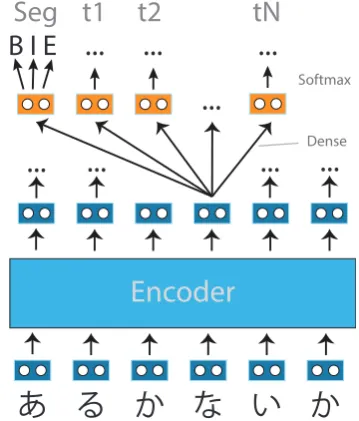
Figure 1: Proposed model. We encode character uni-gram embeddings into shared representations for each character. The shared representation is projected into a tag-specific representations from which we indepen-dently infer segmentation and per-character tags.
vised segmentation methods (Kudo and Richard-son,2018), resulting segmentation often has deci-sions which are not natural to humans. Supervised segmentation based on a human-defined standard is essential for applications which are designed for interaction on a word-level granularity, for exam-ple, full-text search. Segmentation is commonly done jointly with part of speech (POS) tagging and usually referred to as Morphological Analysis.
n-gram embeddings are even larger, easily reaching gigabytes. This makes it difficult to deploy MA in space-constrained environments such as mobile applications and browsers.
It has been shown that simple or straightforward models can match or outperform complex models when using a large number of training data. For ex-ample, a straightforward backoff technique rivals a complicated smoothing technique for language models (Brants et al.,2007). Pretraining a bidirec-tional language model on a large dataset helps to solve a variety of NLP tasks (Devlin et al.,2018). Our approach is inspired by this line of work.
Contributions We propose a very straightfor-ward fully-neural morphological analyzer which usesonly character unigramsas its input1. Such an analyzer, when trained only on human-annotated gold data has low accuracy. However, when trained on a large amount of automatically tagged silver data, the analyzer rivals and even outper-forms, albeit slightly, the bootstrapping analyzer. We conclude that there is no need for rich input representation. Neural networks learn the infor-mation to combine characters into words by them-selves when given enough data.
Ignoring explicit dictionary information and rich input representations makes it possible to make analyzers that are highly accurate and very compact at the same time. We also perform ab-lation experiments which show that the encoder component of such an analyzer is more important than character embeddings.
2 Morphological Analysis Overview
Segmentation is a cornerstone requirement for pro-cessing languages with a continuous script, and thus it has been studied for a long time. Most cur-rent approaches use either rich feature representa-tion, e.g. character n-grams or their embeddings, or a segmentation dictionary. There exist two main lines of approaches: pointwise and search-based. Pointwise approaches make a segmentation deci-sion for each character, usually based on the in-formation from its surroundings. Search-based ap-proaches look for a maximum scored interpretation in some structure over the input sentence.
Most Japanese analyzers use segmentation dic-tionaries which define corpus segmentation stan-dards. They usually have rich POS information at-1The source code is avaliable athttps://github.com/
eiennohito/rakkyo
tached and are human-curated. One focus of seg-mentation dictionaries is to be consistent: it should be possible to segment a sentence using the dictio-nary entries only in a single correct way. Such dic-tionaries are often maintained together with anno-tated corpora. On the other hand, Chinese-focused systems do not put much focus on dictionaries. Still, almost all aproaches use rich feature tem-plates or additional resources such as pretrained character n-gram or word embeddings, which in-crease the model size.
Pointwiseapproaches make a segmentation de-cision independently for each position. They can be seen as a sequence tagging task. Such ap-proaches are more popular for Chinese.
KyTea (Neubig et al.,2011) is an example of this approach in Japanese. It makes a binary decision for each character: whether to insert a boundary before it or not. It can be seen as sequence tagging with {B, I} tagset. POS tagging is done after in-ferring segmentation. The decisions are made by feature-based approaches, using characters, char-acter n-grams, charchar-acter type information, and dic-tionary information as features. KyTea can use word features obtained from a dictionary. It checks whether the character sequence before and after the current character forms a word from the dictionary. It also checks whether the current word is inside a word.
Neural networks were shown to be useful for Japanese in this paradigm as well (Kitagawa and
Komachi,2017). They use character embeddings,
character type embeddings, character n-gram em-beddings, and tricks to incorporate dictionary in-formation into the model.
Many studies on Chinese adopt the pointwise approach. Often, the segmentation task is refor-mulated as sequence tagging (Xue,2003) with {B, I, E, S} tagset. Peng et al. (2004) showed that CRFs help further in this task. This tactic was followed by many subsequent feature-based ap-proaches (Tseng et al., 2005; Zhao et al., 2006;
Zhang et al.,2013), using character n-gram,
char-acter type and word features.
named entity recognition as well. The character representation was pretrained on a language mod-eling task. Shao et al.(2017) used a bidirectional recurrent network with GRU cells followed by a CRF layer for joint segmentation and POS tag-ging. They used pretrained character n-gram em-beddings together with sub-character level infor-mation extracted by CNNs as features. Using a dictionary with NN is also popular (Zhang et al.,
2018b;Liu et al.,2018).
Search-based approaches induce a structure over a sentence and perform a search over it. A most frequently used structure is a lattice which contains all possible segmentation tokens. The search then finds the highest scoring path through the lattice. Another branch of search-based ap-proaches splits decisions into transitions (starting a new token and appending a character to the to-ken) and searches for the highest scoring chain of transitions. This also can be seen as dynamically constructing a lattice while performing the search in it at the same time.
Lattice-based approaches are popular for the Japanese language. Most of the time, the lattice is based on words which are present in a segmen-tation dictionary and a rule-based component for handling out-of-dictionary words. Usually, there are no machine-learning components in lattice cre-ation, but the scoring can be machine-learning based. We believe that the availability of high quality consistent morphological analysis dictio-naries is the reason for that. Still, the work ofKaji
and Kitsuregawa(2013) is a counterexample of a
lattice-based approach for Japanese which uses a machine-learning component for creating the lat-tice.
Traditional lattice-based approaches for Japanese use mostly POS tags or other hidden information accessible from the dictionary to score paths through the lattice. JUMAN (
Kuro-hashi, 1994) is one of the first analyzers, which
uses a hidden Markov model with manually-tuned weights for scoring. Lattice path scores are computed using connection weights for each pair of part of speech tags.
Probably the most known and used morpholog-ical analyzer for Japanese is MeCab (Kudo et al.,
2004), where CRFs were used for learning the scor-ing. MeCab is very fast: it can analyze almost 50k sentences per second. It also achieves accept-able accuracy, and so the tool is very popular. The
speed is realized by precomputing feature weights, but it takes a lot of space when the total number of features gets large. For example, the UniDic model for modern Japanese v2.3.02takes 5.5GB because it uses many feature templates.
There were studies which tried to integrate NN into lattice-based approaches as well. Juman++
(Morita et al.,2015) uses dictionary-based lattice
construction with the combination of two models for path scoring: the feature-based linear model us-ing soft-confidence weighted learnus-ing (Wang et al.,
2016) and a recurrent neural network (Mikolov,
2012). It significantly reduced the number of both segmentation and POS tagging errors. However, it was very slow, being able to analyze only about 15 sentences per second, hence the original ver-sion was impractical. The following improvement
(Tolmachev et al.,2018) greatly increased
analy-sis speed by doing aggressive beam trimming and performing heavyweight NN evaluation only after lightweight scoring by the linear model.
Direct lattice-based approaches are not very popular for Chinese, but some are lattice-based in spirit. A line of work byZhang and Clark(2008,
2010) builds the lattice dynamically from partial words, searching paths with a perceptron-based scorer and customized beam search. The dictio-nary is built dynamically from the training data as frequent word-tag pairs which help the system to prune unlikely POS tags for word candidates.
One more variation on lattice-based approaches for Chinese is the work byCai and Zhao (2016). In this work, a segmentation dictionary is used to construct a subnetwork, which combines charac-ter representations into word representations used for computing sentence-wise segmentation scores. This can be seen as explicitly learning dictionary information by a model. Resulting segmentation is still created from the start to the end by growing words one by one while performing beam search. The follow up (Cai et al., 2017) simplifies that model and shows that greedy search can be enough for estimating segmentation when using neural net-works. Still, this line of work does not consider POS tagging.
Transition-based approaches treat input data (most frequently – characters) as input queue and store a current, possibly incomplete, token in a buffer. Models usually infer whether they should create a new token from a character in the input
queue or append an input character to the already existing token. Neural models are often used in this paradigm (Ma and Hinrichs, 2015;Zhang et al.,
2016;Yang et al., 2017;Ma et al., 2018; Zhang
et al.,2018a). Almost all of them use both word
and charcter n-gram embeddings. This paradigm was extended to do parsing jointly with MA ( Ha-tori et al.,2012;Kurita et al.,2017).
Semi-supervised approaches to segmentation and POS tagging fall into several categories. The first one uses raw or automatically-annotated data to precompute feature representations and then uses these feature representations for supervised learning. For example, Sun and Xu (2011) and
Wang et al. (2011) use data from automatically
segmented texts as features. They precomute the features beforehand and train an analyzer after-wards. In addition to that,Zhang et al.(2013) use a variation of smoothing for handling automatic annotation errors. A lot of neural-based methods pretrain word and character n-gram embeddings.
Yang et al.(2017) pretrain a part of the model on
different data sources, including automatically seg-mented text, but the model itself is trained only on the gold data.
Another approach is to use heterogeneous data (annotated in incompatible annotation standards). In addition to corpus statistics from a raw corpus,
Zhao and Kit(2008) exploit heterogeneous
annota-tions.Li et al.(2015) use corpora with different an-notation standards. They combine tags into “bun-dles” (e.g. [NN, n]) and infer them at the same time while paying attention to ambiguity. Chen et al.
(2016) train a classifier that can annotate several standards jointly.
Finally, it is possible to use raw or automatically-annotated data directly. A study (Suzuki and
Isozaki,2008) is an example of a feature-based
al-gorithm which uses raw data. Tri-training (Zhou
and Li, 2005) is a generic way to use raw data.
They propose to train on automatically analyzed examples where two of three diverse analyzers agree.Søgaard(2010) show that tri-training helps English POS-tagging with SVM and MaxEnt-based approaches. Zhou et al. (2017) use self-training and tri-self-training for Chinese word segmen-tation. They, however, also pretrain other features like word-context character embeddings, chrarac-ter unigrams and bigrams.
3 Proposed Approach
In order for MA to be practical, it should be not only accurate, but also fast and have relatively compact models. The speed of search-based ap-proaches is dependent on how computationally heavy a weighting function is. Heavyweight mod-els, like neural networks, require a large number of computations, and we think that it will be very difficult to create a practical search-based fully NN morphological analyzer with analysis speed com-parable to traditional analyzers.
We do not want to use any explicit information about how to combine characters to form a word, like dictionaries, which takes space and is not triv-ial to incorporate into a character-based model. We also want our model to be fast, at least compara-ble with the speed of traditional analyzers. To this end, we follow a pointwise approach and force the neural network to learn the dictionary information from a corpus.
We use a straightforward architecture shown in Figure1. We embed each character, and then ap-ply an encoder, which produces an encoded rep-resentation for each character. Encoded charac-ter representations are independently transformed into tag representations. For each tag, the encoded representation is projected with a fully-connected layer with SeLU non-linearity (Klambauer et al.,
2017). Finally, we multiply the tag representa-tion by tag-specific embeddings and apply softmax non-linearity to get normalized tag probabilities.
Encoder Architectures We use two architec-tures for the encoder: a stacked bidirectional re-current architecture with LSTM cells (
Hochre-iter and Schmidhuber (1997), bi-LSTM) and a
Transofrmer-inspired mutihead self-attention net-work (Vaswani et al. (2017),SAN). We concate-nate both directions of bi-LSTM outputs before passing them to the next layer without residual con-nections. We also apply layer normalization (Ba
et al., 2016) to the concatenated outputs. We do
not use dropout in encoders when using silver data for training.
Data Encoding Our model infers a tag for every input character. While this decision is natural for segmentation, POS tags are not usually tagged in this way.
cor-あ B 動 * 子ラ 基本
る E 動 * 子ラ 基本
か B 助 接助 * *
な B 形 * イ形 基本
い E 形 * イ形 基本
か B 助 終助 * *
EOS
[image:5.595.77.276.61.172.2]Seg 4-layered POS
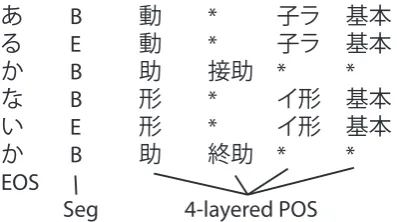
Figure 2: An example of full sentence annotation
あ B 動 * ? ? る ? 動 * ? ? か ? ? ? ? ? な B ? ? イ形 基本 い E ? ? イ形 基本 か B 助 終助 * * EOS
Figure 3: An example of partial sentence annotation
pora with the JUMAN-based segmentation stan-dard (Jumandic), which has 4-layered POS tags: rough POS, fine POS, conjugation type and conju-gation form. We treat each tag layer independently in our model, as shown in Figure2.
We also consider apartial annotation scheme, where some tags are unknown. An example of partial sentence annotation is shown in Figure3. Unknown tags are displayed by “?” symbols. We create partially annotated silver data by marking as unknown all tags which are ambiguous in a top-k analysis result. When computing the training loss, we treat unknown tags as padding: corresponding values are masked out of loss computation.
Loss Following Vaswani et al. (2017), we smooth softmax labels. They use the technique de-scribed bySzegedy et al.(2016), which uniformly distributes some small factor like 0.1 to
incor-rect labels. However, we do not induce a uniform smoothing. Instead, we want to prevent the model from being overconfident in its decisions without inducing uniformity. We slightly modify the cross-entropy loss as follows.
Remember that softmax probabilities are com-puted from unnormalized log-probabilities li as qi = eli/Z, where Z = Pjelj. The cross-entropy loss will be L = −P
ipilogqi,where pi are gold probabilities. In our case the vector pis one-hot, meaning thatpc = 1and other val-ues are zero. This gives a sparse cross-entropy L = −logqc = logZ −lc,which is often
im-Train Test
Corpus Sents Tokens Sents Tokens
KU 37k 930k 1783 46k
[image:5.595.316.519.63.134.2]Leads 14k 217k 2195 36k
Table 1: Benchmark corpora sizes
plemented in deep learning frameworks. It has a minimum when logZ is equal to lc, but it makes the model overconfident. Instead, we want to stop whenqc= 1−, or in other wordselc/Z = 1−. This gives us our modified loss:
L=max(logZ−lc+log(1−),0).
It can be efficiently implemented using the sparse cross-entropy operation. In our experiments we use= 0.2.
Our final loss is a weighted sum of individual tag softmax losses. We use a weight coefficient of 10 for segmentation and 2 for the first POS tag layer.
4 Experiments
We conduct experiments on Japanese morphologi-cal analysis. For training we use two data sources. The first is usual human-annotated gold training data. The second issilverdata from the results of automatic analysis. We use Juman++ V2 – the cur-rent state-of-the-art analyzer for the JUMAN seg-mentation standard as the bootstrap analyzer.
We use two gold corpora. The first is the Ky-oto University Text Corpus (Kurohashi and Nagao
(2003), referred to asKU), containing newspaper data. The second is the Kyoto University Web Doc-ument Leads Corpus (Hangyo et al. (2012), re-ferred to asLeads) which consists of web docu-ments. Corpus statistics are shown in Table1. We denote models which use gold training data byG. We take raw data to generate our silver annotated data from a crawled web corpus of 9.8B unique sentences. We sample 3B sentences randomly from it and analyze them using the Juman++ base-line model. From it we sample 500M sentences, which become our training silver data, prioritizing sentences which contain at least one not very fre-quent word. We prepare both top-scored (denoted asT) and non-ambigous in beam (denoted as B) variants of the silver data. Our silver data is in-domain for Leads and out-of-in-domain for KU.
Baselines We use four baselines: JUMAN,
[image:5.595.76.278.206.302.2]Parameter bi-LSTM SAN
Char embedding size 128 128
Tag embedding size 32 32
# Layers 4 6
Hidden Size 128×2 32
# Heads - 4
Projection Inner Dim - 512
[image:6.595.77.286.63.202.2]# Emedding Parameters 2.38M 2.38M # Total Parameters 3.88M 3.59M
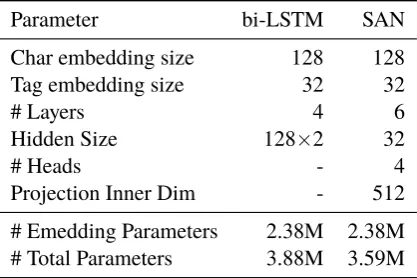
Table 2: Hyperparameters for neural models
KyTea and Juman++ we train a model using the same dictionary and merged training sections of KU and Leads, which is evaluated on each corpus independently.
Neural Models The hyper-parameters of the bi-LSTM-based model are displayed in Table2. We use all unique characters present in our huge web corpus (18,581) as input. We select sizes of both neural models restricting the total number of pa-rameters to be less than 4M. For optimization we use the Adam optimizer (Kingma and Ba, 2016) with hyperparameters and learning rate schedul-ing described byVaswani et al. (2017). We train all models on Nvidia GPUs. On a single GeForce 1080Ti the bi-LSTM model can consume about 4,500 sentences per second and the SAN-based model about 6,500 sentences per second for train-ing. We denote bi-LSTM-based models byLand SAN-based models bySin experimental results.
Treatment of Gold Data Existing methods are already highly accurate on this task, and it is dif-ficult to perform hyperparameter and architecture selection reliably with a small development set. Because of that, we split our data in an unusual way. Generally, we use the silver data (B or T) as a train set, the human-annotated original training data (G) as a dev set and the original test set as a test set. Our hyperparameter selection decisions were based entirely on this setting. We do not per-form additional hyperparameter search for a com-bination of silver and gold data for training.
The exception is cases when we use only gold datafor training. For that, we cheat and optimize our hyperparameters, including dropout, which we use only for this setting, on test scores. Nonthe-less, the best scores on this setting are significantly lower than the worst baseline.
KU, News Leads, Web Analyzer Seg +P1 +P2 Seg +P1 +P2
Baselines
JUMAN 98.41 97.18 95.45 98.09 96.96 95.71 MeCab 99.10 98.56 97.59 98.25 97.60 96.22 KyTea 99.13 98.25 97.01 97.98 96.85 95.11 Juman++ 99.52 99.10 97.86 98.61 98.07 96.70
bi-LSTM
L:G 97.46 96.56 94.78 96.33 95.43 93.46 L:B 99.22 98.82 97.50 98.57 98.01 96.61 L:T 99.33 98.90 97.59 98.68 98.16 96.71 L:BG 99.43 99.05 98.06 98.59 98.04 96.76 L:TG 99.43 99.05 98.01 98.71 98.19 96.80
Self-attention
S:G 98.28 97.67 95.66 97.23 96.36 93.91 S:B 99.19 98.75 97.34 98.56 97.99 96.59 S:T 99.23 98.78 97.36 98.66 98.15 96.75 S:BG 99.30 98.90 97.83 98.60 98.03 96.70 S:TG 99.37 98.97 97.93 98.70 98.15 96.83
Pre-training scenario
[image:6.595.309.522.64.289.2]S:B→G(a) 99.24 98.85 97.75 98.58 98.03 96.64 S:B→G(b) 99.15 98.65 97.55 98.39 97.78 96.36 S:B→G(c) 99.27 98.82 97.75 98.50 97.91 96.43 S:B→G(d) 99.26 98.82 97.76 98.52 97.94 96.48
Table 3: Test F1 score comparison on benchmark cor-pora. Legend: bi-[L]STM, [S]AN, [G]old data, [T]op-only and [B]eam-non-ambigous silver data.
Experimental Results Results of our experi-ments are shown in Table 3. For each analyzer, we show six values. Segis a tokenwise F1 mea-sure on segmentation.+P1requires the 1st layer of POS tags (coarse-grained POS tags) also to match gold data. For the sake of simplicity, we use only POS tags co-located with “B” Seg tags for the eval-uation. +P2is analogous for the 2nd layer of POS tags. For all results in this table, we train NN-based models for a single epoch, which meansthe train-ing procedure sees each silver sentence only once. We use one gold example for ten silver examples for mixed-data settings, looping over the gold data until the silver data is extinguished.
Training neural models only on gold data quickly results in overfitting which can be seen in L:G and S:G results. These scores are significantly lower than that of our worst baseline: JUMAN.
Size, MB
Analyzer Dictionary Model Total
JUMAN 288 1 289
MeCab 312 8 320
KyTea:G - 569 569
KyTea:TG - 3218 3218
Juman++ 157 288 434
bi-LSTM 1 14 15
[image:7.595.344.489.63.156.2]SAN 1 13 14
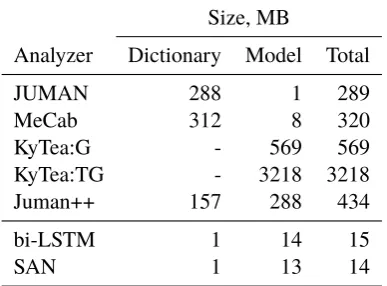
Table 4: MA model sizes for Jumandic
away difficult cases for beam-based data, denois-ing it in a sense, but NN seem to handle that kind of noise relatively well.
Adding the gold data to the silver data (*:BG, *:TG) allows both models to improve their accu-racy further. Results on Leads are comparable for both L:TG and S:TG and higher than the previous SOTA, giving segmentation error reduction of 8% in comparison to Juman++. On KU, the LSTM-based models seem to perform better without a significant difference on the TG and BG settings, while still underperforming the Juman++ baseline except +P2 case, where both models are stronger than Juman++.
Pre-training Scenario We also check the fine-tuning approach when we first learn the represen-tations on a large corpus and then refine the model on a gold corpus. S:B→G(a-d) are four such runs of a SAN-based model with different hyperparam-eters. All four runs are initialized with the same S:B model and trained on the gold data only. We found it difficult to find good hyperparameters for fine-tuning. The models were prone to overfit very fast. Mixing gold and silver data resulted in stable training without hyperparameter search.
Model Sizes We compare the model sizes of an-alyzers in Table4. In case of dictionary-based an-alyzers the dictionary takes most of the space. We count sizes of compiled models for all analyzers. KyTea, as another example of pointwise MA, uses string-based features and treats its features uni-formly, hence dictionary size is not applicable to it. AKyTea:TG variant that uses additional 2M silver sentences takes almost 6x the space of the original model, reaching 3GB. When using neural networks, on the other hand, it is possible to control model sizes more easily. Moreover, our proposed
Analyzer KU Leads
[image:7.595.85.279.64.207.2]KyTea-D:G 98.45 97.04 KyTea-D:T 98.51 98.10 KyTea-D:TG 99.18 98.31 KyTea:G 99.13 97.98 KyTea:TG 99.33 98.42
Table 5: KyTea test Seg F1 comparison. -D models do not use the dictionary. T models use silver data (2M sentences, created like in the main experiment)
models take significantly less space while having comparable accuracy.
Dictionary-based analyzers store other informa-tion, like readings and lemma forms, in addition to token surface forms and POS, but removing that information would not make model sizes compara-ble with NN-based ones. For NN-based analyzers, we count a dictionary as 1 MB because they need a character-to-id mapping to work. However, the list of characters contains non-frequently used charac-ters, some of which could be treated as UNKs with-out any accuracy loss. We also treat weights as 4-byte floating points, and so it would be possible to further decrease the NN model size, for example by using less precise storage formats.
5 Discussion
Dictionaries Dictionary information is usually added to character-based models either using a bi-nary feature vector (e.g. a dictiobi-nary contains a tri-gram to the left of the decision point) or word em-beddings. We believe that a dictionary can be re-placed with a large training corpus which includes most of the entries from that dictionary. A neural model with only the unigram character input can solve word segmentation and POS tagging only if it builds some knowledge about the dictionary in-ternally. Our main experimental results (Table4) show that it seems to be the case and there is no need to model the dictionary explicitly.
500M 1B # Training Sentences 99.30
99.35 99.40 99.45 99.50 99.55 99.60
L:B
[image:8.595.311.521.59.218.2]S:B
Figure 4: Dev Seg F1 curves for L:B and S:B
How much data do we need? For our main ex-periments, we train all models for a single epoch on our silver dataset. Figure4shows KU train (our dev set) Seg F1 curves for L:B and S:B for three epochs. We ran each experiment four times with different random seeds. The learning curves be-come less sloppy when reaching 500M sentences but do not become flat there. The training does not seem to completely converge even after 3 epochs. We still use one full epoch (500M) for our main experiments. The curves are pretty noisy, but it seems that the model is robust with respect to ini-tialization.
SAN Ablation Experiments The proposed MA
achieves high accuracy while having very compact models. The inputs do not contain any information on how to combine characters into words and we assume that the model learns it from the data. To get the model size even smaller, we check which model parts contribute more to the resulting analy-sis accuracy, meaning that they contain the dictio-nary knowledge.
We perform ablation experiments on the SAN model by varying its hyperparameters and check-ing how it affects the accuracy of the resultcheck-ing ana-lyzer. The LSTM model could not converge in this setting. We used 2.5M of silver training data for these experiments.
Figure5shows the segmentation F1 score when varying input embedding, shared representation and SAN hidden dimension sizes. JUMAN score, as a lowest acceptable baseline, is shown in red. The embedding size seems to have a lower impact on accuracy than the shared representation and the SAN hidden dimension size. Namely, the (128-16) model with the embedding size of 16 has higher accuracy than the (128-4) model with the
embed-16 32 64 128
Embedding dimension 97.0
97.5 98.0 98.5 99.0 99.5 Seg F1
Shr.dim - hid.dim 64-4 64-16 128-4 128-16 256-4 256-16
Figure 5: Effect of embedding size on Seg F1
0 2 4 6 8 10 12 14 16
60 70 80 90 100
SAN projection dimension 0 32 64
0 2 4 6 8 10 12 14 16
SAN hidden dimension 97.0
[image:8.595.87.269.77.215.2]97.5 98.0 98.5 99.0 99.5
Figure 6: Effect of SAN hidden dimension on Seg F1
ding size of 128. Accordingly, we believe that the encoder contributes much stronger to learning the dictionary than character embeddings.
One more interesting observation is that the models are still better than JUMAN, while hav-ing much less parameters than our base model. We explore more extreme settings of the SAN hidden state, shown in Figure 6. We fix embedding and shared representation dimensions to 128 and vary the SAN hidden and projection dimensions. The lower subgraph is a scale-up version of top graph. The point at SAN hidden size equal to 0 means that we directly use unigram embeddings to pre-dict segmentation without any encoder.
[image:8.595.314.519.252.412.2]System Segmentation Correct Segmentation Transliteration Meaning
こう|ゆう|曲って こうゆう|曲|って ko:yu: kyoku tte this song is
なんて|すん|ごい なんて|すんごい nante sungoi how awesome
んな|わけな|いって んな|わけ|ない|って nna wake nai tte no way! あっ|ちゃんと|遊び|たい あっ|ちゃん|と|遊び|たい see main text
Table 6: n-grams with inconsistent POS tags which are also Juman++ errors
Label Uncertainty and Error Analysis
Be-cause our neural models infer all tags indepen-dently, they can be inconsistent, for example, a word can have different POS tags on different char-acters. We looked into frequent 3-grams where the central word has inconsistent tags (POS tags are not the same for all characters, or they do not form a correct 4-layered tag). Most of these trigrams oc-cur in ambiguous situations.
We have picked several examples which are ac-tually errors in Juman++ segmentation as well. They are shown in Table 6. In Japanese, words often have several orthographic forms. The most common variant is usage of hiragana (phonetic script) instead of kanji (ideographic characters). Verbs can have different possible endings, e.g. 曲 がるand曲る(magaru – to turn or bend) are two
orthographic variants of a single verb. There are also colloquial variants; namely the verb 言うis
usually read asいう(iu – to say), but can also be
written asゆうbecause the pronunciation is close.
These phenomena are relatively common in web and user-generated texts, but corpus and segmen-tation dictionary coverage of them is not very good. The first two examples contain alternative col-loquial spellings of wordsこういう(ko:iu – such)
andすごい(sugoi – awesome). In the first example
the system incorrectly recognizes曲|って(kyoku
tte) as曲って(magatte) – a conjugation of 曲る.
The fourth example (a chanto asobitai/ac-chan to asobitai - ah! [I] want to play properly/[I] want to play with ac-chan <person name>) is actually am-biguous and can have two meanings. The second one is more probable though. The fact that fre-quent words with uncertain POS tags are Juman++ errors as well implies that insufficient gold data causes the uncertainty.
We also compare differences between Juman++ and our models to get an insight on general prob-lems with proposed methods. Neural models make many errors in hiragana words. For example, both neural models make errors in the sentence弱者|が
|とうた|さ|れて(jyakusya ga to:ta sarete -
weak-lings lose to natural selection). LSTM makes a segmentation mistake (と|うたさ) and SAN does
a POS tagging mistake, while Juman++ produces the correct answer. It knows thatとうたis a
spe-cial type of noun that is often followed byされて
from POS tags. Hiragana-based spellings of most content words are somewhat rare in Japanese, and NN models do not have enough training data for these spellings. It could be possible to improve the situation by using data augmentation techniques. Another frequent problem is segmentation and tag-ging of proper nouns. We believe that this problem could be solved by data augmentation, but we leave this as future work.
6 Conclusion and Future Work
We presented a novel way to train small neural models for Japanese Morphological analysis by di-rectly feeding the network a large number of silver training data. Our method achieves new SOTA on web domain when combining the silver data with gold one. This is an empirical evidence that there is no need for feature engineering for neural mor-phological analysis at all. A neural network can learn implicit dictionary information itself and it does not need to be large. We also show that train-ing by mixtrain-ing the data together works better than fine-tuning and is more stable.
References
Jimmy Lei Ba, Jamie Ryan Kiros, and Geoffrey E. Hin-ton. 2016. Layer Normalization. arXiv:1607.06450 [cs].
Thorsten Brants, Ashok C. Popat, Peng Xu, Franz J. Och, and Jeffrey Dean. 2007.Large Language Mod-els in Machine Translation. In Proceedings of the 2007 Joint Conference on Empirical Methods in ural Language Processing and Computational Nat-ural Language Learning (EMNLP-CoNLL), pages 858–867, Prague, Czech Republic. Association for Computational Linguistics.
Deng Cai and Hai Zhao. 2016. Neural Word Segmen-tation Learning for Chinese. InProceedings of the 54th Annual Meeting of the Association for Compu-tational Linguistics (Volume 1: Long Papers), pages 409–420, Berlin, Germany. Association for Compu-tational Linguistics.
Deng Cai, Hai Zhao, Zhisong Zhang, Yuan Xin, Yongjian Wu, and Feiyue Huang. 2017. Fast and Accurate Neural Word Segmentation for Chinese. In Proceedings of the 55th Annual Meeting of the As-sociation for Computational Linguistics (Volume 2: Short Papers), pages 608–615, Vancouver, Canada. Association for Computational Linguistics.
Hongshen Chen, Yue Zhang, and Qun Liu. 2016. Neu-ral Network for Heterogeneous Annotations. In Proceedings of the 2016 Conference on Empirical Methods in Natural Language Processing, pages 731–741, Austin, Texas. Association for Computa-tional Linguistics.
Jacob Devlin, Ming-Wei Chang, Kenton Lee, and Kristina Toutanova. 2018. BERT: Pre-training of Deep Bidirectional Transformers for Language Understanding. arXiv:1810.04805 [cs]. ArXiv: 1810.04805.
Masatsugu Hangyo, Daisuke Kawahara, and Sadao Kurohashi. 2012. Building a Diverse Document Leads Corpus Annotated with Semantic Relations. In Proceedings of the 26th Pacific Asia Conference on Language, Information, and Computation, pages 535–544, Bali, Indonesia. Faculty of Computer Sci-ence, Universitas Indonesia.
Jun Hatori, Takuya Matsuzaki, Yusuke Miyao, and Jun’ichi Tsujii. 2012. Incremental Joint Approach to Word Segmentation, POS Tagging, and Depen-dency Parsing in Chinese. In Proceedings of the 50th Annual Meeting of the Association for Com-putational Linguistics (Volume 1: Long Papers), pages 1045–1053, Jeju Island, Korea. Association for Computational Linguistics.
Sepp Hochreiter and Jürgen Schmidhuber. 1997.
Long Short-Term Memory. Neural Comput., 9(8):1735–1780.
Nobuhiro Kaji and Masaru Kitsuregawa. 2013. Effi-cient Word Lattice Generation for Joint Word Seg-mentation and POS Tagging in Japanese. In Pro-ceedings of the Sixth International Joint Conference on Natural Language Processing, pages 153–161, Nagoya, Japan. Asian Federation of Natural Lan-guage Processing.
Diederik P. Kingma and Jimmy Ba. 2016.
Adam: A method for stochastic optimization. arXiv:1412.6980 [cs.LG].
Yoshiaki Kitagawa and Mamoru Komachi. 2017.Long Short-Term Memory for Japanese Word Segmenta-tion.arXiv:1709.08011 [cs]. ArXiv: 1709.08011. Günter Klambauer, Thomas Unterthiner, Andreas
Mayr, and Sepp Hochreiter. 2017. Self-Normalizing Neural Networks. InAdvances in Neural Informa-tion Processing Systems 30, pages 971–980. Curran Associates, Inc.
Taku Kudo and John Richardson. 2018.SentencePiece: A simple and language independent subword tok-enizer and detoktok-enizer for Neural Text Processing.
InProceedings of the 2018 Conference on Empirical Methods in Natural Language Processing: System Demonstrations, pages 66–71, Brussels, Belgium. Association for Computational Linguistics.
Taku Kudo, Kaoru Yamamoto, and Yuji Matsumoto. 2004. Applying Conditional Random Fields to Japanese Morphological Analysis. InProceedings of the 2004 Conference on Empirical Methods in Natural Language Processing.
Shuhei Kurita, Daisuke Kawahara, and Sadao Kuro-hashi. 2017. Neural Joint Model for Transition-based Chinese Syntactic Analysis. InProceedings of the 55th Annual Meeting of the Association for Com-putational Linguistics (Volume 1: Long Papers), pages 1204–1214, Vancouver, Canada. Association for Computational Linguistics.
Sadao Kurohashi. 1994. Improvements of Japanese morphological analyzer JUMAN. In Proceedings of The International Workshop on Sharable Natural Language, 1994.
Sadao Kurohashi and Makoto Nagao. 2003. Building A Japanese Parsed Corpus. InTreebanks: Building and Using Parsed Corpora, Text, Speech and Lan-guage Technology, pages 249–260. Springer Nether-lands, Dordrecht.
Junxin Liu, Fangzhao Wu, Chuhan Wu, Yongfeng Huang, and Xing Xie. 2018. Neural Chinese Word Segmentation with Dictionary Knowledge. In Nat-ural Language Processing and Chinese Computing, Lecture Notes in Computer Science, pages 80–91. Springer International Publishing.
Ji Ma, Kuzman Ganchev, and David Weiss. 2018.
State-of-the-art Chinese Word Segmentation with Bi-LSTMs. InProceedings of the 2018 Conference on Empirical Methods in Natural Language Process-ing, pages 4902–4908, Brussels, Belgium. Associa-tion for ComputaAssocia-tional Linguistics.
Jianqiang Ma and Erhard Hinrichs. 2015. Accurate Linear-Time Chinese Word Segmentation via Em-bedding Matching. InProceedings of the 53rd An-nual Meeting of the Association for Computational Linguistics and the 7th International Joint Confer-ence on Natural Language Processing (Volume 1: Long Papers), pages 1733–1743, Beijing, China. As-sociation for Computational Linguistics.
Tomas Mikolov. 2012. Statistical Language Models Based on Neural Networks. Ph. D. Thesis, Brno Uni-versity of Technology, Brno.
Hajime Morita, Daisuke Kawahara, and Sadao Kuro-hashi. 2015. Morphological Analysis for Unseg-mented Languages using Recurrent Neural Network Language Model. InProceedings of the 2015 Con-ference on Empirical Methods in Natural Language Processing, pages 2292–2297, Lisbon, Portugal. As-sociation for Computational Linguistics.
Graham Neubig, Yosuke Nakata, and Shinsuke Mori. 2011. Pointwise Prediction for Robust, Adaptable Japanese Morphological Analysis. InProceedings of the 49th Annual Meeting of the Association for Computational Linguistics: Human Language Tech-nologies, pages 529–533, Portland, Oregon, USA. Association for Computational Linguistics.
Fuchun Peng, Fangfang Feng, and Andrew McCallum. 2004. Chinese Segmentation and New Word Detec-tion Using CondiDetec-tional Random Fields. In Proceed-ings of the 20th International Conference on Compu-tational Linguistics, COLING ’04, Stroudsburg, PA, USA. Association for Computational Linguistics. Yanjun Qi, Sujatha G. Das, Ronan Collobert, and Jason
Weston. 2014. Deep Learning for Character-Based Information Extraction. InAdvances in Information Retrieval, Lecture Notes in Computer Science, pages 668–674. Springer International Publishing.
Yan Shao, Christian Hardmeier, Jörg Tiedemann, and Joakim Nivre. 2017. Character-based Joint Seg-mentation and POS Tagging for Chinese using Bidi-rectional RNN-CRF. InProceedings of the Eighth International Joint Conference on Natural Lan-guage Processing (Volume 1: Long Papers), pages 173–183, Taipei, Taiwan. Asian Federation of Natu-ral Language Processing.
Weiwei Sun and Jia Xu. 2011. Enhancing Chinese Word Segmentation Using Unlabeled Data. In Proceedings of the 2011 Conference on Empirical Methods in Natural Language Processing, pages 970–979, Edinburgh, Scotland, UK. Association for Computational Linguistics.
Jun Suzuki and Hideki Isozaki. 2008.Semi-Supervised Sequential Labeling and Segmentation Using Giga-Word Scale Unlabeled Data. InProceedings of ACL-08: HLT, pages 665–673, Columbus, Ohio. Associ-ation for ComputAssoci-ational Linguistics.
Christian Szegedy, Vincent Vanhoucke, Sergey Ioffe, Jon Shlens, and Zbigniew Wojna. 2016. Rethink-ing the inception architecture for computer vision. In The IEEE Conference on Computer Vision and Pat-tern Recognition (CVPR).
Anders Søgaard. 2010.Simple Semi-Supervised Train-ing of Part-Of-Speech Taggers. In Proceedings of the ACL 2010 Conference Short Papers, pages 205–208, Uppsala, Sweden. Association for Compu-tational Linguistics.
Arseny Tolmachev, Daisuke Kawahara, and Sadao Kurohashi. 2018.Juman++: A Morphological Anal-ysis Toolkit for Scriptio Continua. In Proceedings of the 2018 Conference on Empirical Methods in Natural Language Processing: System Demonstra-tions, pages 54–59. Association for Computational Linguistics.
Huihsin Tseng, Pichuan Chang, Galen Andrew, Daniel Jurafsky, and Christopher Manning. 2005. A Con-ditional Random Field Word Segmenter for Sighan Bakeoff 2005. InProceedings of the Fourth SIGHAN Workshop on Chinese Language Processing. Associ-ation for ComputAssoci-ational Linguistics.
Ashish Vaswani, Noam Shazeer, Niki Parmar, Jakob Uszkoreit, Llion Jones, Aidan N Gomez, Łukasz Kaiser, and Illia Polosukhin. 2017. Attention is All you Need. In I. Guyon, U. V. Luxburg, S. Bengio, H. Wallach, R. Fergus, S. Vishwanathan, and R. Gar-nett, editors, Advances in Neural Information Pro-cessing Systems 30, pages 5998–6008. Curran Asso-ciates, Inc.
Jialei Wang, Peilin Zhao, and Steven C. H. Hoi. 2016.
Soft Confidence-Weighted Learning. ACM Trans. Intell. Syst. Technol., 8(1):15:1–15:32.
Yiou Wang, Jun’ichi Kazama, Yoshimasa Tsuruoka, Wenliang Chen, Yujie Zhang, and Kentaro Torisawa. 2011. Improving Chinese Word Segmentation and POS Tagging with Semi-supervised Methods Using Large Auto-Analyzed Data. InProceedings of 5th International Joint Conference on Natural Language Processing, pages 309–317, Chiang Mai, Thailand. Asian Federation of Natural Language Processing. Nianwen Xue. 2003. Chinese Word Segmentation as
Process-ing, Volume 8, Number 1, February 2003: Special Is-sue on Word Formation and Chinese Language Pro-cessing, pages 29–48.
Jie Yang, Yue Zhang, and Fei Dong. 2017.Neural Word Segmentation with Rich Pretraining. In Proceed-ings of the 55th Annual Meeting of the Association for Computational Linguistics (Volume 1: Long Pa-pers), pages 839–849, Vancouver, Canada. Associa-tion for ComputaAssocia-tional Linguistics.
Longkai Zhang, Houfeng Wang, Xu Sun, and Mairgup Mansur. 2013. Exploring Representations from Un-labeled Data with Co-training for Chinese Word Seg-mentation. InProceedings of the 2013 Conference on Empirical Methods in Natural Language Process-ing, pages 311–321, Seattle, Washington, USA. As-sociation for Computational Linguistics.
Meishan Zhang, Nan Yu, and Guohong Fu. 2018a. A Simple and Effective Neural Model for Joint Word Segmentation and POS Tagging. IEEE/ACM Trans-actions on Audio, Speech, and Language Processing, 26(9):1528–1538.
Meishan Zhang, Yue Zhang, and Guohong Fu. 2016.
Transition-Based Neural Word Segmentation. In Proceedings of the 54th Annual Meeting of the As-sociation for Computational Linguistics (Volume 1: Long Papers), pages 421–431, Berlin, Germany. As-sociation for Computational Linguistics.
Qi Zhang, Xiaoyu Liu, and Jinlan Fu. 2018b. Neu-ral Networks Incorporating Dictionaries for Chinese Word Segmentation. InProceedings of the Thirty-Second AAAI Conference on Artificial Intelligence, (AAAI-18), the 30th innovative Applications of Arti-ficial Intelligence (IAAI-18), and the 8th AAAI Sym-posium on Educational Advances in Artificial Intel-ligence (EAAI-18), New Orleans, Louisiana, USA, February 2-7, 2018, pages 5682–5689.
Yue Zhang and Stephen Clark. 2008. Joint Word Seg-mentation and POS Tagging Using a Single Per-ceptron. In Proceedings of ACL-08: HLT, pages 888–896, Columbus, Ohio. Association for Compu-tational Linguistics.
Yue Zhang and Stephen Clark. 2010. A Fast Decoder for Joint Word Segmentation and POS-Tagging Us-ing a SUs-ingle Discriminative Model. InProceedings of the 2010 Conference on Empirical Methods in Natural Language Processing, pages 843–852, Cam-bridge, MA. Association for Computational Linguis-tics.
Hai Zhao, Chang-Ning Huang, Mu Li, and Bao-Liang Lu. 2006. Effective Tag Set Selection in Chinese Word Segmentation via Conditional Random Field Modeling. InProceedings of the 20th Pacific Asia Conference on Language, Information and Compu-tation. Association for Computational Linguistics. Hai Zhao and Chunyu Kit. 2008. Exploiting unlabeled
text with different unsupervised segmentation crite-ria for chinese word segmentation. Research in Com-puting Science, 33:93–104.
Xiaoqing Zheng, Hanyang Chen, and Tianyu Xu. 2013.
Deep Learning for Chinese Word Segmentation and POS Tagging. In Proceedings of the 2013 Con-ference on Empirical Methods in Natural Language Processing, pages 647–657, Seattle, Washington, USA. Association for Computational Linguistics. Hao Zhou, Zhenting Yu, Yue Zhang, Shujian Huang,
XIN-YU DAI, and Jiajun Chen. 2017. Word-Context Character Embeddings for Chinese Word Segmen-tation. InProceedings of the 2017 Conference on Empirical Methods in Natural Language Processing, pages 760–766, Copenhagen, Denmark. Association for Computational Linguistics.