4046
Rethinking Complex Neural Network Architectures for
Document Classification
Ashutosh Adhikari,∗ Achyudh Ram,∗ Raphael Tang, and Jimmy Lin
David R. Cheriton School of Computer Science University of Waterloo
{adadhika, arkeshav, r33tang, jimmylin}@uwaterloo.ca
Abstract
Neural network models for many NLP tasks have grown increasingly complex in recent years, making training and deployment more difficult. A number of recent papers have questioned the necessity of such architectures and found that well-executed, simpler mod-els are quite effective. We show that this is also the case for document classification: in a large-scale reproducibility study of several recent neural models, we find that a simple BiLSTM architecture with appropriate regu-larization yields accuracy and F1 that are ei-ther competitive or exceed the state of the art on four standard benchmark datasets. Sur-prisingly, our simple model is able to achieve these results without attention mechanisms. While these regularization techniques, bor-rowed from language modeling, are not novel, to our knowledge we are the first to apply them in this context. Our work provides an open-source platform and the foundation for future work in document classification.
1 Introduction
Recent developments in neural architectures for a wide range of NLP tasks can be character-ized as a drive towards increasingly complex net-work components and modeling techniques. Wor-ryingly, these new models are accompanied by smaller and smaller improvements in effectiveness on standard benchmark datasets, which leads us to wonder if observed improvements are “real”. There is, however, ample evidence to the contrary. To provide a few examples: Melis et al. (2018) report that standard LSTM architectures outper-form more recent models when properly tuned. Vaswani et al. (2017) show that sequence trans-duction using encoder–decoder networks with tention mechanisms work just as well with the at-tention module only, making most of the complex ∗
Equal contribution.
neural machinery unnecessary. Mohammed et al. (2018) show that simple RNN- and CNN-based models yield accuracies rivaling far more complex architectures in simple question answering over knowledge graphs.
Perhaps most damning are the indictments of Sculley et al. (2018), who lament the lack of empirical rigor in our field and cite even more ex-amples where improvements can be attributed to far more mundane reasons (e.g., hyperparameter tuning) or are simply noise. Lipton and Stein-hardt(2018) concur with these sentiments, adding that authors often use fancy mathematics to ob-fuscate or to impress (reviewers) rather than to clarify. Complex architectures are more difficult to train, more sensitive to hyperparameters, and brittle with respect to domains with different data characteristics—thus both exacerbating the “crisis of reproducibility” and making it difficult for prac-titioners to deploy networks that tackle real-world problems in production environments.
Like the papers cited above, we question the need for overly complex neural architectures, fo-cusing on the problem of document classification. Starting with a large-scale reproducibility study of several recent neural models, we find that a simple bi-directional LSTM (BiLSTM) architec-ture with appropriate regularization yields accu-racy and F1 that are either competitive or exceed
2 Background and Related Work
2.1 Document Classification
Over the last few years, deep neural networks have achieved the state of the art in document classifi-cation. One popular model, hierarchical attention network (HAN), uses word- and sentence-level attention in classifying documents (Yang et al., 2016). Although this model nicely captures the in-tuition that modeling word sequences in sentences should be handled separately from sentence-level discourse modeling, one wonders if such complex architectures are really necessary, especially given the size of training data available today.
An important variant of document classifica-tion is the multi-label, multi-class case. Liu et al. (2017) develop XML-CNNs for multi-label text classification, basing the architecture on Kim-CNN (Kim,2014) with increased filter sizes and an additional fully-connected layer. They also in-corporate dynamic adaptive max-pooling (Chen et al., 2015) instead of the vanilla max-pooling over time in KimCNN. The paper compares with CNN-based approaches for the multi-label task, but only reports precision and disregards recall. Yang et al.(2018) instead adopts encoder–decoder sequence generation models (SGMs) for generat-ing multiple labels for each document. Similar to our critique of HAN, we opine against the high complexity of these multi-label approaches.
2.2 Regularizing RNNs
There have been attempts to extend dropout (Sri-vastava et al.,2014) from feedforward neural net-works to recurrent ones. Unfortunately, direct application of dropout on the hidden units of an RNN empirically harms its ability to retain long-term information (Zaremba et al., 2014). Re-cently, however, Merity et al. (2018) success-fully apply dropout-like techniques to regularize RNNs for language modeling, achieving competi-tive word-level perplexity on multiple datasets. In-spired by this development, we adopt two of their regularization techniques, embedding dropout and weight-dropped LSTMs, to our task of document classification.
Weight-dropped LSTM.LSTMs comprise eight
total input–hidden and hidden–hidden weight ma-trices; in weight dropping, Merity et al. (2018) regularize the four hidden–hidden matrices with DropConnect (Wan et al., 2013). The operation is applied only once per sequence, using the same
max-pool
b
a c d f
e g
1
2
[image:2.595.307.527.65.165.2]n
Figure 1: Illustration of the model architecture, where the labels are the following: (a) input word embed-dings (b) BiLSTM (c, d) concatenated forwardhf1:nand backward hb
1:n hidden features (e) max-pooling over
time (f) document feature vector (g) softmax or sig-moid output.
dropout mask across multiple timesteps. Conve-niently, this allows practitioners to use fast, out-of-the-box LSTM implementations without affecting the RNN formulation or training performance.
Embedding Dropout. Introduced in Gal and
Ghahramani(2016) and successfully employed for neural language modeling (Merity et al., 2018), embedding dropout performs dropout on entire word embeddings, effectively removing some of the words at each training iteration. As a result, the technique conditions the model to be robust against missing input; for document classification, this discourages the model from relying on a small set of input words for prediction.
3 BiLSTM Model
We design our model to be minimalistic: First, we feed the word embeddingsw1:nof a document
to a single-layer BiLSTM, extracting concatenated forward and backward word-level context vectors h1:n = hf1:n⊕hb1:n. Subsequently, we max-pool
h1:nacross time to yield document vectord—see
Figure1, labels a–f. Finally, we feedd to a sig-moid or a softmax layer over the labels, depend-ing on if the task type is multi-label or sdepend-ingle-label classification (label g).
concatena-tion operaconcatena-tions, which makes for both simple im-plementation and resource-efficient inference.
4 Experimental Setup
We conduct a large-scale reproducibility study in-volving HAN, XML-CNN, KimCNN, and SGM. These are compared to our proposed model, re-ferred to as LSTMreg, as well as an ablated variant
without regularization, denoted LSTMbase. The
implementation of our model as well as from-scratch reimplementations of all the comparison models (except for SGM) are provided in our toolkit called Hedwig, which we make publicly available to serve as the foundation for future work.1 In addition, we compare the neural ap-proaches to logistic regression (LR) and support vector machines (SVMs). The LR model is trained using a one-vs-rest multi-label objective, while the SVM is trained with a linear kernel. Both of these methods use word-level tf–idf vectors of the doc-uments as features.
All of our experiments are performed on Nvidia GTX 1080 and RTX 2080 Ti GPUs, with PyTorch 0.4.1 as the backend framework. We use Scikit-learn 0.19.2 for computing the tf–idf vectors and implementing LR and SVMs.
4.1 Datasets
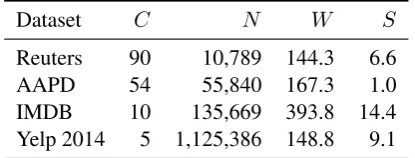
We evaluate our models on the following four datasets: Reuters-21578, arXiv Abstract Paper dataset (AAPD), IMDB, and Yelp 2014. Reuters and AAPD are multi-label datasets, whereas IMDB and Yelp are single-label ones. For IMDB and Yelp, we use random sampling to split the dataset such that 80% is used for training, 10% for validation, and 10% for test. We use the standard ModApte splits (Apt´e et al.,1994) for the Reuters dataset, and author-defined splits for AAPD (Yang et al.,2018). We summarize the statistics of these datasets in Table1.
Unfortunately, there is little consensus within the natural language processing community for choosing the splits of IMDB and Yelp 2014. Fur-thermore, they are often unreported in modeling papers, hence preventing direct comparison with past results. We are not able to find the exact splitsYang et al. (2016) use; for consistency, we use the same proportion the authors report, but of course this yields different samples in each split.
1 http://hedwig.ca
Dataset C N W S
Reuters 90 10,789 144.3 6.6
AAPD 54 55,840 167.3 1.0
IMDB 10 135,669 393.8 14.4
[image:3.595.313.521.63.142.2]Yelp 2014 5 1,125,386 148.8 9.1
Table 1: Summary of the datasets.Cdenotes the num-ber of classes in the dataset,N the number of samples, andW andS the average number of words and sen-tences per document, respectively.
For the multi-label datasets, we report the well-known micro-averaged F1 score, which is the
class-weighted harmonic mean between recall and precision. For the single-label datasets, we com-pare the models using accuracy.
4.2 Training and Hyperparameters
To ensure a fair comparison, we tune the hyper-parameters for all baseline models. For HAN, we use a batch size of 32 across all the datasets, with a learning rate of 0.01 for Reuters and 0.001 for the rest. To train XML-CNN, we select a dy-namic pooling window length of eight, a learn-ing rate of 0.001, and 128 output channels, with batch sizes of 32 and 64 for single-label and multi-label datasets, respectively. For KimCNN, we use a batch size of 64 with a learning rate of 0.01. For training SGM on Reuters, we use the source code provided by the authors2 and follow the same hy-perparameters in their paper (Yang et al., 2018). For the LR and SVM models, we use the default set of hyperparameters in Scikit-learn.
For LSTMregand LSTMbase, we use the Adam
optimizer with a learning rate of 0.01 on Reuters and 0.001 on the rest of the datasets, using batch sizes of 32 and 64 for multi-label and single-label tasks, respectively. For LSTMreg, we also apply
temporal averaging (TA): as shown inKingma and Ba (2014), TA reduces both generalization error and stochastic noise in recent parameter estimates from stochastic approximation. We set the default TA exponential smoothing coefficient ofβEMA to 0.99. We choose 512 hidden units for the Bi-LSTM models, whose max-pooled output is regu-larized using a dropout rate of 0.5. We also reg-ularize the input–hidden and hidden–hidden Bi-LSTM connections using embedding dropout and weight dropping, respectively, with dropout rates of 0.1 and 0.2.
# Model Reuters AAPD IMDB Yelp ’14
Val. F1 Test F1 Val. F1 Test F1 Val. Acc. Test Acc. Val. Acc. Test Acc.
1 LR 77.0 74.8 67.1 64.9 43.1 43.4 61.1 60.9
2 SVM 89.1 86.1 71.1 69.1 42.5 42.4 59.7 59.6
3 KimCNN Repl. 83.5 ±0.4 80.8 ±0.3 54.5 ±1.4 51.4 ±1.3 42.9 ±0.3 42.7 ±0.4 66.5 ±0.1 66.1 ±0.6
4 KimCNN Orig. – – – – – 37.6†† – 61.0††
5 XML-CNN Repl. 88.8 ±0.5 86.2 ±0.3 70.2 ±0.7 68.7 ±0.4 – – – – 6 HAN Repl. 87.6 ±0.5 85.2 ±0.6 70.2 ±0.2 68.0 ±0.6 51.8 ±0.3 51.2 ±0.3 68.2 ±0.1 67.9 ±0.1
7 HAN Orig. – – – – – 49.4‡ – 70.5‡
8 SGM Orig. 82.5 ±0.4 78.8 ±0.9 – 71.0† – – – –
9 LSTMbase 87.6 ±0.2 84.9 ±0.3 72.1 ±0.4 69.6 ±0.4 52.5 ±0.2 52.1 ±0.3 68.6 ±0.1 68.4 ±0.1
[image:4.595.79.525.63.227.2]10 LSTMreg 89.1±0.8 87.0±0.5 73.1±0.4 70.5 ±0.5 53.4±0.2 52.8±0.3 69.0±0.1 68.7 ±0.1
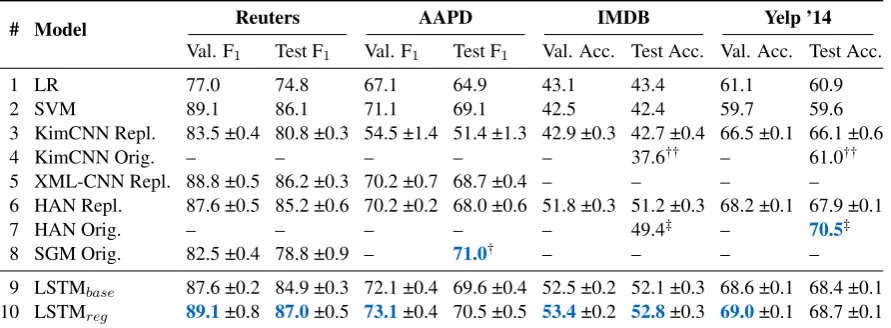
Table 2: Results for each model on the validation and test sets; best values are bolded in blue.Repl. reports mean
±SD of five runs from our reimplementations;Orig.refers to point estimates from†Yang et al.(2018),‡Yang
et al.(2016), and††Tang et al.(2015).
For our optimization objective, we use cross-entropy and binary cross-cross-entropy loss for single-label and multi-single-label tasks, respectively. On all datasets and models, we use 300-dimensional word vectors (Mikolov et al.,2013) pre-trained on Google News. We train all neural models for 30 epochs with five random seeds, reporting the mean validation set scores and their corresponding test set results.
Toward Robust Baselines. Recently,
repro-ducibility is becoming a growing concern for the NLP community (Crane,2018). Indeed, very few of the papers that we consider in this study re-port validation set results, let alone run on mul-tiple seeds. In order to address these issues, we report scores on both validation and test sets for our reimplementations; doing so is good practice, since it reinforces the validity of the experimen-tal results and claims. We also provide the stan-dard deviation of the scores across different seeds to demonstrate the stability of our results. This is in line with previous papers (Zhang and Wallace, 2017;Reimers and Gurevych,2017;Crane,2018) that emphasize reporting variance for robustness against potentially spurious conclusions.
5 Results and Discussion
We report the mean and standard deviation (SD) of the F1 scores and accuracy for all five runs in
Ta-ble2. For HAN and KimCNN, we include results from the original papers to validate our reimple-mentation. We fail to replicate the reported results of SGM on AAPD using the authors’ codebase
and data splits.3 As a result, we simply copy the value reported inYang et al.(2018) in Table2, row 8, which represents their maximum F1 score. To
verify the correctness of our HAN and KimCNN reimplementations, we compare the differences in F1 and accuracy on the appropriate datasets. We
attribute the small differences to using different dataset splits (see Section4.1) and reporting mean values.
Baseline Comparison. We see that our
sim-ple LSTMreg model achieves state of the art on
Reuters and IMDB (see Table2, rows 9 and 10), establishing mean scores of 87.0 and 52.8 for F1
score and accuracy on the test sets of Reuters and IMDB, respectively. This highlights the ef-ficacy of proper regularization and optimization techniques for the task. We observe that LSTMreg
consistently improves upon the performance of LSTMbaseacross all of the tasks—see rows 9 and
10, where, on average, regularization yields in-creases of 1.5 and 0.5 points for F1score and
ac-curacy, respectively.
A few of our LSTMreg runs attain
state-of-the-art test F1 scores on AAPD. However, in the
in-terest of robustness, we report the mean value, as mentioned in Section4.2. We also find the accu-racy of LSTMreg and our reimplemented version
of HAN on Yelp 2014 to be almost two points lower than the copied result of HAN (rows 6, 7, and 10) from Yang et al. (2016). On the other hand, both of the models surpass the original re-sult by nearly two points for the IMDB dataset. We cannot rule out that these disparities are caused
by the absence of any widely-accepted splits for evaluation on Yelp 2014 and IMDB (as opposed to model or implementation differences).
Interestingly, the non-neural LR and SVM base-lines perform remarkably well. On Reuters, for example, the SVM beats many neural baselines, including our non-regularized LSTMbase(rows 2–
9). On AAPD, the SVM either ties or beats the other models, losing only to SGM (rows 2–8). Compared to the SVM, the LR baseline appears better suited for the single-label datasets IMDB and Yelp 2014, where it achieves better accuracy than the SVM does.
6 Conclusions and Future Work
In this paper, we question the complexity of ex-isting neural network architectures for document classification. To demonstrate the effectiveness of proper regularization and optimization, we apply embedding dropout, weight dropping, and tem-poral averaging when training a simple BiLSTM model, establishing either competitive or state-of-the-art results on multiple datasets.
One potential extension of this work is to con-duct a comprehensive ablation study to determine the relative contribution of each of the regulariza-tion and optimizaregulariza-tion techniques. Furthermore, it would be interesting to compare these techniques to the recent line of research in deep language representation models, such as Embeddings from Language Models (ELMo;Peters et al.,2018) and pre-trained transformers (Devlin et al.,2018; Rad-ford, 2018). Finally, the examined regularization and optimization methods deserve exploration in other NLP tasks as well.
Acknowledgments
This research was supported by the Natu-ral Sciences and Engineering Research Council (NSERC) of Canada. We thank Nabiha Asghar for providing us with the Yelp 2014 dataset. We also thank the anonymous reviewers for their valuable comments.
References
Chidanand Apt´e, Fred Damerau, and Sholom M Weiss. 1994. Automated learning of decision rules for text categorization. ACM Transactions on Information Systems, 12(3):233–251.
Yubo Chen, Liheng Xu, Kang Liu, Daojian Zeng, and Jun Zhao. 2015. Event extraction via
dy-namic multi-pooling convolutional neural networks. In Proceedings of the 53rd Annual Meeting of the Association for Computational Linguistics and the 7th International Joint Conference on Natural Lan-guage Processing (Volume 1: Long Papers), vol-ume 1, pages 167–176.
Matt Crane. 2018. Questionable answers in question answering research: reproducibility and variability of published results.Transactions of the Association for Computational Linguistics, 6:241–252.
Jacob Devlin, Ming-Wei Chang, Kenton Lee, and Kristina Toutanova. 2018. BERT: Pre-training of deep bidirectional transformers for language under-standing. CoRR, abs/1810.04805.
Yarin Gal and Zoubin Ghahramani. 2016. A theoret-ically grounded application of dropout in recurrent neural networks. InAdvances in neural information processing systems, pages 1019–1027.
Yoon Kim. 2014. Convolutional neural networks for sentence classification. InProceedings of the 2014 Conference on Empirical Methods in Natural Lan-guage Processing (EMNLP), pages 1746–1751.
Diederik P. Kingma and Jimmy Ba. 2014. Adam: A method for stochastic optimization. InInternational Conference on Learning Representations.
Zachary C. Lipton and Jacob Steinhardt. 2018. Troubling trends in machine learning scholarship. arXiv:1807.03341v2.
Jingzhou Liu, Wei-Cheng Chang, Yuexin Wu, and Yiming Yang. 2017. Deep learning for extreme multi-label text classification. InProceedings of the 40th International ACM SIGIR Conference on Re-search and Development in Information Retrieval, pages 115–124.
Gbor Melis, Chris Dyer, and Phil Blunsom. 2018. On the state of the art of evaluation in neural language models. In International Conference on Learning Representations.
Stephen Merity, Nitish Shirish Keskar, and Richard Socher. 2018. Regularizing and optimizing LSTM language models. In International Conference on Learning Representations.
Tomas Mikolov, Ilya Sutskever, Kai Chen, Greg S Cor-rado, and Jeff Dean. 2013. Distributed representa-tions of words and phrases and their compositional-ity. InAdvances in neural information processing systems, pages 3111–3119.
Matthew Peters, Mark Neumann, Mohit Iyyer, Matt Gardner, Christopher Clark, Kenton Lee, and Luke Zettlemoyer. 2018. Deep contextualized word rep-resentations. In Proceedings of the 2018 Confer-ence of the North American Chapter of the Asso-ciation for Computational Linguistics: Human Lan-guage Technologies, Volume 1 (Long Papers), pages 2227–2237.
Alec Radford. 2018. Improving language understand-ing by generative pre-trainunderstand-ing.
Nils Reimers and Iryna Gurevych. 2017. Reporting score distributions makes a difference: performance study of LSTM-networks for sequence tagging. In Proceedings of the 2017 Conference on Empirical Methods in Natural Language Processing, pages 338–348.
D. Sculley, Jasper Snoek, Alex Wiltschko, and Ali Rahimi. 2018. Winner’s curse? On pace, progress, and empirical rigor. InProceedings of the 6th Inter-national Conference on Learning Representations, Workshop Track (ICLR 2018).
Nitish Srivastava, Geoffrey Hinton, Alex Krizhevsky, Ilya Sutskever, and Ruslan Salakhutdinov. 2014. Dropout: a simple way to prevent neural networks from overfitting. Journal of Machine Learning Re-search, 15(1):1929–1958.
Duyu Tang, Bing Qin, and Ting Liu. 2015. Document modeling with gated recurrent neural network for sentiment classification. InProceedings of the 2015 Conference on Empirical Methods in Natural Lan-guage Processing, pages 1422–1432.
Ashish Vaswani, Noam Shazeer, Niki Parmar, Jakob Uszkoreit, Llion Jones, Aidan N Gomez, Łukasz Kaiser, and Illia Polosukhin. 2017. Attention is all you need. InAdvances in Neural Information Pro-cessing Systems, pages 5998–6008.
Li Wan, Matthew Zeiler, Sixin Zhang, Yann Le Cun, and Rob Fergus. 2013. Regularization of neural net-works using dropconnect. InInternational Confer-ence on Machine Learning, pages 1058–1066.
Pengcheng Yang, Xu Sun, Wei Li, Shuming Ma, Wei Wu, and Houfeng Wang. 2018. SGM: Sequence generation model for multi-label classification. In Proceedings of the 27th International Conference on Computational Linguistics, pages 3915–3926.
Zichao Yang, Diyi Yang, Chris Dyer, Xiaodong He, Alex Smola, and Eduard Hovy. 2016. Hierarchi-cal attention networks for document classification. InProceedings of the 2016 Conference of the North American Chapter of the Association for Computa-tional Linguistics: Human Language Technologies, pages 1480–1489.
Wojciech Zaremba, Ilya Sutskever, and Oriol Vinyals. 2014. Recurrent neural network regularization. arXiv:1409.2329.