A Consolidated Open Knowledge Representation for Multiple Texts
Rachel Wities∗1, Vered Shwartz1, Gabriel Stanovsky1, Meni Adler1, Ori Shapira1,
Shyam Upadhyay2, Dan Roth2, Eugenio Martinez Camara3, Iryna Gurevych3,4and
Ido Dagan1
1Bar-Ilan University, Ramat-Gan, Israel
2University of Illinois at Urbana-Champaign, IL, USA
3Ubiquitous Knowledge Processing Lab (UKP), Technische Universitat Darmstadt 4Ubiquitous Knowledge Processing Lab (UKP-DIPF),
German Institute for Educational Research
{rachelvov,vered1986,gabriel.satanovsky,meni.adler,obspp18}@gmail.com
{upadhya3,danr}@illinois.edu, {camara,gurevych}@ukp.informatik.tu-darmstadt.de [email protected]
Abstract
We propose to move from Open Infor-mation Extraction (OIE) ahead to Open Knowledge Representation (OKR), aim-ing to represent information conveyed jointly in a set of texts in an open text-based manner. We do so by consolidating OIE extractions using entity and predicate coreference, while modeling information containment between coreferring elements via lexical entailment. We suggest that generating OKR structures can be a useful step in the NLP pipeline, to give seman-tic applications an easy handle on consoli-dated information across multiple texts.
1 Introduction
Natural language understanding involves identify-ing, classifyidentify-ing, and integrating information about events and other propositions mentioned in text. While much effort has been invested in generic methods for analyzing single sentences and de-tecting the propositions they contain, little thought and effort has been put into the integration step: how to systematically consolidate and represent information contributed by propositions originat-ing from multiple texts. Consolidatoriginat-ing such in-formation, which is typically both complemen-tary and partly overlapping, is needed to con-struct multi-document summaries, to combine ev-idence when answering questions that cannot be answered based on a single sentence, and to pop-ulate a knowledge base while relying on multiple pieces of evidence (see Figure 1 for a motivating
∗Corresponding author
example). Yet, the burden of integrating informa-tion across multiple texts is currently delegated to downstream applications, leading to various par-tial solutions in different application domains.
This paper suggests that a common consolida-tion step and a corresponding knowledge represen-tation should be part of the “standard” semantic processing pipeline, to be shared by downstream applications. Specifically, we pursue an Open Knowledge Representation (OKR) framework that captures the information expressed jointly in mul-tiple texts while relying solely on the termi-nology appearing in those texts, without requir-ing pre-defined external knowledge resources or schemata.
As we focus in this work on investigating an
open representation paradigm, our proposal fol-lows and extends the Open Information Extrac-tion (OIE) approach. We do that by first extract-ing textual predicate-argument tuples, each cor-responding to an individual proposition mention. We then merge these mentions by accounting for proposition coreference, an extended notion of event coreference. This process yields consoli-dated propositions, each corresponding to a single fact, or assertion, in the described scenario. Simi-larly, entity coreference links are used to establish reference to real-world entities. Taken together, our proposed representation encodes information about events and entities in the real world, simi-larly to what is expected from structured knowl-edge representations. Yet, being an open text-based representation, we record the various lexical terms used to describe the scenario. Further, we model information redundancy and containment among these terms through lexical entailment.
In this paper we specify our proposed
1. Turkeyforces downSyrian plane. 4. Turkish PM says plane was carrying ammunition for Syria government. 2. Damascus sends note to Ankara over Syrian plane. 5. Last night Turkish F16sgroundeda Syrian passenger jet.
3. Turkey Escalates Confrontation with Syria. 6. Russia angry at Turkey about Russian passengers.
Figure 1: A sample of news headlines, illustrating the need for information consolidation. Two mentions of the same proposition, for which event coreference holds, are highlighted, with the predicate in bold and the arguments underlined. Some information is redundant, but may be described at different granularity levels; for example, different mentions describe the interception target as aplaneand as ajet, wherejet
entailsplaneand is accordingly more informative.
tation, while specifying the involved annotation sub-tasks from which our structures are composed. We then describe our annotated dataset, of news headline tweets about 27 news stories, which is the first to be jointly annotated for all our required sub-tasks. We also provide initial predicted base-line results for each of the sub-tasks, pointing at the limitations of current state of the art.1
Overall, our main contribution is in proposing to create a consolidated representation for the infor-mation contained in multiple texts, and in specify-ing how such representation can be created based on entity and event coreference and lexical entail-ment. An accompanying contribution is our an-notated dataset, which can be used to analyze the involved phenomena and their interactions, and as a development and test set for automated gener-ation of OKR structures. We further note that while this paper focuses on creating anopen repre-sentation, by consolidating Open IE propositions, future work may investigate the consolidation of other semantic sentence representations, for exam-ple AMR (Abstract Meaning Representation) (Ba-narescu et al., 2013), while exploiting similar prin-ciples to those proposed here.
2 Background: Relevant Component Tasks
In this section we describe the prior annotation tasks on which we rely in our representation, as described later in Section 3.
2.1 Open Information Extraction
Open IE(Open Information Extraction) (Etzioni et al., 2008) is the task of extracting coherent propositions from a sentence, each comprising a relation phrase and two or more argument phrases. For example,(plane,landed in, Ankara).
Open IE has gained substantial and consistent attention, and many automatic extractors were
cre-1Our dataset, detailed annotation guidelines, the
annota-tion tool and the baseline implementaannota-tions are available at
https://github.com/vered1986/OKR.
ated (e.g., Fader et al. (2011); Del Corro and Gemulla (2013)). Open IE’s extractions were also shown to be effective as intermediate sentence-level representation in various downstream appli-cations (Stanovsky et al., 2015; Angeli et al., 2015). Analogously, we conjecture a similar util-ity of our OKR structures at the multi-text level.
Open IE does not assign roles to the arguments associated with each predicate, as in other single-sentence representations like SRL (Semantic Role Labeling) (Carreras and M`arquez, 2005; Palmer et al., 2010). While the former is not consis-tent in assigning argument slots to the same ar-guments across different propositions, the latter requires predefined thematic role ontologies. A middle ground was introduced by QA-SRL (He et al., 2015), where predicate-argument structures are represented using question-answer pairs, e.g. (what landed somewhere?, plane), (where did something land?,Ankara).
2.2 Coreference Resolution Tasks
In our representation, we use coreference resolu-tion to consolidate menresolu-tions of the same entity or the same event across multiple texts.
Entity Coreference Entity coreference resolu-tion identifies menresolu-tions in a text that refer to the same real-world entity (Soon et al., 2001; Ng and Cardie, 2002; Bengtson and Roth, 2008; Clark and Manning, 2015; Peng et al., 2015). In the cross-document variant, Cross Document Coreference Resolution (CDCR), mentions of the same entity can also appear in multiple documents in a cor-pus (Singh et al., 2011).
Event Coreference Event coreference
deter-mines whether two event descriptions (mentions) refer to the same event (Humphreys et al., 1997). Cross document event coreference (CDEC) is a variant of the task in which mentions may occur in different documents (Bagga and Baldwin, 1999).
al., 2014; Peng et al., 2016), the problem of cross document event coreference has been relatively under-explored (Bagga and Baldwin, 1999; Bejan and Harabagiu, 2014). Standard benchmarks for this task are the Event Coreference Bank (ECB) (Bejan and Harabagiu, 2008) and its extensions, that also annotate entity coreference: EECB (Lee et al., 2012) and ECB+ (Cybulska and Vossen, 2014). See (Upadhyay et al., 2016) for more de-tails on cross document event coreference.
Differently from our dataset described in Sec-tion 4, ECB and its extensions do not establish predicate-argument annotations. A secondary line of work deals with aligning predicates across doc-ument pairs, as done in Roth and Frank (2012). PARMA (Wolfe et al., 2013) treated the task as a token-alignment problem, aligning also argu-ments, while Wolfe et al. (2015) added joint con-straints to align predicates and their arguments.
Using Coreference for Consolidation
Recog-nizing that two elements are corefering can help in consolidating textual information. In discourse representation theory (DRT), a proposition ap-plies to all co-referring entities (Kamp et al., 2011). In recognizing textual entailment (Dagan et al., 2013), lexical substitution of co-referring el-ements is useful (Stern and Dagan, 2012). For ex-ample, in Figure 1, sentence (1) together with the coreference relation between plane andjet entail that “Turkey forces down Syrian jet.”
2.3 Lexical Inference
Recognizing lexical inferences is an important component in semantic tasks, in order to bridge lexical variability in texts. For instance, in text summarization, lexical inference can help identi-fying redundancy, when two candidate sentences for the summary differ only in terms that hold a lexical inference relation (e.g. “the plane landed in
Ankara” and “the plane landed inTurkey”). Rec-ognizing the inference direction, e.g. thatAnkara
is more specific thanTurkey, can help in selecting the desired granularity level of the description.
There has been consistent attention to recogniz-ing lexical inference between terms. Some meth-ods aim to recognize a general lexical inference relation (e.g. (Kotlerman et al., 2010; Turney and Mohammad, 2015)), others focus on a specific se-mantic relation, mostly hypernymy (Hearst, 1992; Snow et al., 2005; Santus et al., 2014; Shwartz et al., 2016), while recent methods classify a pair of
terms to a specific semantic relation out of several (Baroni et al., 2012; Weeds et al., 2014; Pavlick et al., 2015; Shwartz and Dagan, 2016). It is worth noting that most existing methods are indifferent to the context in which the target terms occur, with the exception of few works, which were mostly fo-cused on a narrow aspect of lexical inference, e.g. lexical substitution (Melamud et al., 2015).
Determining entailment between predicates is a different sub-task, which has also been broadly explored (Lin and Pantel, 2001; Duclaye et al., 2002; Szpektor et al., 2004; Schoenmackers et al., 2010; Roth and Frank, 2012). Berant et al. (2010) achieved state-of-the-art results on the task by constructing a predicate entailment graph opti-mizing a global objective function. However, per-formance should be further improved in order to be used accurately within semantic applications.
3 Proposed Representation
Our Open Knowledge Representation (OKR) aims to capture the consolidated information expressed jointly in a set of texts. In some analogy to struc-tured knowledge bases, we would like the ele-ments of our representation to correspond to en-tities in the described scenario and to statements (propositions) that relate them. Still, in the spirit of Open IE, we would like the representation to be open, while relying only on the natural language terminology in the given texts without referring to predefined external knowledge.
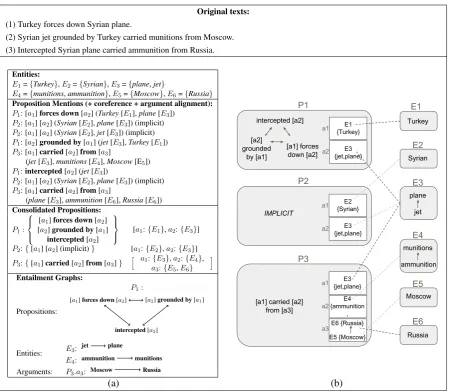
This section specifies our proposed structure, with a running example in Figure 2. The specifica-tion involves two aspects: the first is defining the component annotation sub-tasks involved in cre-ating our representation, following those reviewed in Section 2; the second is specifying how we de-rive from these component annotations a consoli-dated representation. These two aspects are inter-leaved along the presentation, where for each step we first describe the relevant annotations and then how we use them to create the corresponding com-ponent of the representation.
3.1 Entities
To represent entities, we first annotate the text by entity mentions and coreference. Following the typical notion for these tasks, an entity mention
Ac-Original texts: (1) Turkey forces down Syrian plane.
(2) Syrian jet grounded by Turkey carried munitions from Moscow. (3) Intercepted Syrian plane carried ammunition from Russia.
Entities:
E1={Turkey},E2={Syrian},E3={plane,jet}
E4={munitions,ammunition},E5={Moscow},E6={Russia} Proposition Mentions (+ coreference + argument alignment):
P1: [a1]forces down[a2] (Turkey[E1],plane[E3]) P2: [a1] [a2] (Syrian[E2],plane[E3]) (implicit) P2: [a1] [a2] (Syrian[E2],jet[E3]) (implicit) P1: [a2]grounded by[a1] (jet[E3],Turkey[E1]) P3: [a1]carried[a2]from[a3]
(jet[E3],munitions[E4],Moscow[E5]) P1:intercepted[a2] (jet[E3])
P2: [a1] [a2] (Syrian[E2],plane[E3]) (implicit) P3: [a1]carried[a2]from[a3]
(plane[E3],ammunition[E6],Russia[E6]) Consolidated Propositions:
P1:
[a1]forces down[a2] [a2]grounded by[a1]
intercepted[a2]
[a1:{E1},a2:{E3}]
P2:{[a1] [a2] (implicit)} [a1:{E2},a2:{E3}] P3:{[a1]carried[a2]from[a3]}
h a1:{E3},a2:{E4},
a3:{E5,E6}
i
Entailment Graphs:
Propositions:
P1:
[a1]forces down[a2] [a2]grounded by[a1]
intercepted[a2]
Entities: E3: jet plane
E4: ammunition munitions Arguments: P3.a3: Moscow Russia
[a1] forces down [a2]
E1 P1
[a1] carried [a2] from [a3] intercepted [a2]
[a2] grounded
by [a1]
E3 {jet,plane}
E4 {ammunition
, munitions} E6 {Russia}
E5 {Moscow} IMPLICIT
E1 {Turkey}
E3 {jet,plane}
a2 a1
a2 a1
a3
E2 {Syrian}
E3 {jet,plane}
a2 a1 P2
P3
Turkey
E2
Syrian
E5
Moscow
E6
Russia
E4
munitions
ammunition
E3
plane
jet
[image:4.595.75.526.58.450.2](a) (b)
Figure 2: An illustration of our OKR formalism(a), with a corresponding graphical view of the consol-idated structure(b). In (b), dashed lines connect entities to their instantiation within arguments, while allowing graph-traversal inferences such as: what is the relation between Turkey andRussia? Turkey
intercepted a plane that carried ammunition fromRussia(the path fromE1 toE6 via the darker dashed
lines).
cordingly, we represent anentityin the described scenario by the coreference cluster of all its tions. We represent the coreferring cluster of men-tions by the multiset of its terms, keeping pointers to each term’s mentions (see Entities in Figure 2; to avoid clutter, pointers are not presented in the figure). We note that we take an inclusive view which regards concepts as entities, for example the adjective Syrian is considered an entity mention that may corefer withSyria.
3.2 Proposition Mentions and Consolidated Propositions
To represent propositions, we first annotate Open IE style extractions, which we term proposition mentions. Each mention consists of a predicate expression, e.g. around verbs or nominalizations,
in the figure). Nested propositions are represented by having one proposition mention as an argument of the other (e.g. “the [plane]was forced to[land in Ankara]”).
To link different mentions of the same real world fact, we annotate proposition coreference, which generalizes the notion of event corefer-ence to cover all types of predications (e.g.,John is Mary’s brother would co-refer with Mary is John’s sister). This annotation specifies the coref-erence relation for a cluster of proposition men-tions (denoted by the same proposition indexPiin
Figure 2), as well as an alignment of their argu-ments, (denoted by matching argument indexes within the same proposition cluster). We then con-sider apropositionto correspond to a coreference cluster of proposition mentions, which jointly de-scribe the referred real-world fact.
Yet, a cluster of co-referring proposition men-tions does not provide a succinct representation for the aggregated textual description of a proposition. To that end, we aggregate the information in the cluster into aConsolidated Proposition, composed of aconsolidated predicate andconsolidated ar-guments. Similar to entity representation, a con-solidated predicate is represented by the set of all predicate expressions appearing in the cluster. A consolidated argument is specified by the set of all entities (or propositions, in case of having one proposition being an argument of another one) that occupy this argument’s slot in the different men-tions. As with entities, each element in this rep-resentation is accompanied by a set of pointers to all its original mentions (omitted from the figure). A graphical illustration of this structure is given in Figure 2(b) (for now, ignore the arrows within some of the nodes).
A consolidated proposition encodes compactly all possible textual descriptions for the referred proposition, which can be generated from its men-tions taken jointly. Each description can be gener-ated by picking one possible predicate expression and then picking one possible lexical choice for each argument. For example,P1may be described
asTurkey intercepted a plane,Turkey forces down a jetetc. Some of these descriptions correspond to original mentions in the text, while others can be induced through coreference (as reviewed at the end of Section 2.2). The representation of a con-solidated proposition thus does not depend on the particular way in which lexical choices were split
across the different proposition mentions.
3.3 Lexical Entailment Graphs
The set of descriptions encoded in a consolidated proposition is highly redundant. To make it more useful, we would like to model the information overlap between different lexical choices. For ex-ample, we want to know thatTurkey intercepted a planeis more general than, or equivalently, is en-tailed by,Turkey intercepted a jet. To that end, we annotate the lexical entailment relations between the elements in each component of our represen-tation, that is, within each consolidated predicate, consolidated argument and entity. This yields a
lexical entailment graph within each component (see figure 2), which models the information con-tainment relationships between different descrip-tions.
Notice that in our setting the lexical entailment relation is considered within the given context (see Section 2.3). For example, grounded andforced down may not be generically synonymous, but they do convey equivalent information in a given context of forcing a flying plane to land. Contra-dictions are modeled to a limited extent, by anno-tating contradiction relations (in context) between elements of our entailment graphs, for example when different figures are reported for the number of casualties in a disaster. This is a natural rep-resentation, since contradiction is often modeled within a three-way entailment classification task. Modeling of broader cases of contradiction is left for future work.
The entailment graphs yield better modeling of the supporting text mentions (and their total count) for each possible description. For exam-ple, knowing thatMoscowentailsRussia, we can assume inP3 two supporting mentions for
# Entities 1262
# Entity mentions 5074
# Entity singeltons 777
# Propositions 1406
# Proposition mentions 4311 # Proposition Singletons 949 Avg. mentions per entity chain 8.86 Avg. distinct lemmas per entity chain 2.00 Avg. mentions per proposition chain 7.35 Avg. distinct lemmas per prop. chain 2.24 Avg. number of elements per arg. chain 1.08
Table 2: Twitter dataset statistics. Distinct lemma terms per proposition chain were calculated only on explicit propositions. Average number of el-ements per argument chain measures how many distinct entities or propositions were part of the same argument.
In summary, our open knowledge representa-tion consists of the following: entities, generated by detecting entity mentions and coreference; con-solidated propositions, composed of consolidated predicates and arguments, which are generated by detecting proposition mentions and coreference relations between them;lexical entailment graphs
for entities, consolidated predicates and consoli-dated arguments, which specify the inference rela-tions between the elements within each of these components. This yields a compact representa-tion of all possible descriprepresenta-tions of the statements jointly asserted by the set of texts, as induced via coreference-based inference, while tracking in-formation containment between different descrip-tions as well as tracking their (induced) supporting mentions.
4 News-Related Tweets Dataset
Following the formal definition of our OKR struc-tures, we compiled a corpus with gold annotations of our 5 subtasks (listed in Table 1). As outlined in the previous section, our structures follow deter-ministically from these annotations. Specifically, we make use of the news-related tweets collected in the Twitter Event Detection Dataset (McMinn et al., 2013), which clusters tweets from major news networks and other sources discussing the same event (for example, the grounding of a Syr-ian plane by the Turkish government). We chose to annotate news related tweets in this first dataset for several reasons: (1) they represent self contained assertions, (2) they tend to be relatively factual and succinct, and (3) by looking at several news sources we can obtain a corpus with high redun-dancy, which our representation aims to address.
We note that while this dataset exhibits a limited amount of linguistic complexity, making it suit-able for a first investigation, it still represents a very practical use case of consolidating informa-tion in a large stream of tweets about a news story. This annotation serves two main purposes. First, it validates the feasibility of our annotation scheme in terms of annotator requirements, train-ing and agreement. Second, to the best of our knowledge, this is the first time these core NLP annotations are annotatedin parallelover the same texts. Following, this annotation has the potential of becoming a useful resource spurring future re-search into joint prediction of these annotations. For instance, predicate argument structures may benefit from co-reference signals, and entity ex-traction systems may exploit signals from lexical entailment.
Overall, we annotated 1257 tweets from 27 clusters. We release the dataset both in full OKR format, as well as ECB-like “light” format, con-taining only the annotated co-reference chains. Overall corpus statistics are depicted in Table 2.
4.1 Dataset Characteristics
An analysis of the annotations reveals interesting and unique characteristics of our annotated corpus. First, the part of speech distribution of enti-ties and predicates (Table 3) shows that our cor-pus captures information beyond the current focus on verb-centric applications and corpora in NLP. Namely, our corpus contains a vast number of non-verbal predications (67%), and a relatively large number of adjectival entities, owing to the fact that our structure annotates concepts such as “north-ern” or “Syrian” as entities in an implicit relation. Second, the average number of unique lemmas per entity and proposition chains (2.00 and 2.24, respectively) shows that our corpus exhibits a fair amount of non-trivial lexical variability.
Finally, roughly 96% of our entailment graphs (entity and proposition) form a connected compo-nent. This data provides an interesting potential for investigating and modeling lexical inference relations within coreference chains.
4.2 Annotation Procedure and Agreement
Task EntityMent. Entity Co-reference Pred.Prop. MentionsArg. PredicateProposition Co-ReferenceArgument Entity PropEntailment avg. acc MUC B3 CEAF CoNLLF1 avg. acc avg. acc MUC B3 CEAF CoNLLF1 MUC B3 CEAF CoNLLF1 F1 F1
IAA .85 .87 .92 .92 .90 .74(.93, .72)† .85 .86 .88 .76 .83 .99 .99 .98 .99 .70 .82
[image:7.595.75.525.62.114.2]Pred .58 .84 .89 .81 .85 .41(.73, .25)† .37 .47 .67 .56 .56 .93 .97 .94 .95 .44 .56
Table 1: Inter-Annotator Agreement (top) and off-the-shelf state-of-the-art predicted performance (bot-tom, see Section 5) for the OKR subtasks: (1) Entity mention extraction (for prediction we use F1 score) (2) Entity co-reference (3) Proposition Extraction (predicate identification and argument detection) (4) Proposition Co-reference (predicate coreference and argument alignment), and (5) Entailment graphs (entity and proposition entailment; argument entailment figures are not presented due to very low statis-tics).†Numbers in parenthesis denote verbal vs. non-verbal predicates, respectively.
to facilitate the incremental annotation for all subtasks . We employ the QA-SRL annotation methodology to help determining Open IE pred-icate and argument spans in the gold standard, for its intuitiveness for non-expert annotators (He et al., 2015). Five clusters were annotated indepen-dently by both annotators and were used to mea-sure their agreement on the task. The other clus-ters were annotated by one annotator and reviewed by an expert.
We measure agreement separately on each an-notation subtask. After each task in our pipeline we keep only the consensual annotations. For ex-ample, we measure entity coreference agreement only for entity mentions that were annotated by both annotators. For entity, predicate and argu-ment argu-mention agreeargu-ment, we average the accuracy of the two annotators, each computed while taking the other as a gold reference.
For entity, predicate, and argument co-reference we calculated coreference resolution metrics: the link-based MUC (Vilain et al., 1995), the mention-basedB3 (Bagga and Baldwin, 1998), the
entity-based CEAF, and the widely adopted CoNLL F1
measure which is an average of the three. For en-tity and proposition entailment we compute theF1
score over the annotated directed edges in each entailment graph, as is common for entailment agreement metrics (Berant et al., 2010).
We macro-averaged these scores to obtain an overall agreement on the 5 events annotated by both annotators. The agreement scores for the two annotators are shown in Table 1, and overall show high levels of agreement. A qualitative analysis of the more common disagreements between annota-tors is shown in Table 4.
Overall, this shows that our parallel annotation is indeed feasible; agreement on each of the sub-tasks is relatively high and on par with reported inter-annotator agreement on similar tasks.
POS Nouns Verbs Adj’s Impl. Others
Ent. Dist. .85 .01 .09 – .05
Pred. Dist. .40 .33 .04 .18 .04
Table 3: Entity and Predicate distribution across part of speech tags: nouns, verbs, adjectives, non-lexicalized (implicit) and all others.
Disagreement Type Examples
Phrasal verbs [placed to leave]pred.vs.[placed to]pred.[leave]pred.
[faces charges]pred.vs.[faces]pred.[charges]arg.
Nominalizations [[suspectterror]ent.]ent.attackplanevs.vs.[terror[suspect]pred.]pred.attackplane
U.S.[elections]ent.vs.U.S.[elections]pred.
Entailment fuelscandal→gas→vs.casegasvs.→casefuel→scandal
Table 4: Typical cases of annotator disagreements. Annotated spans are denoted by square brackets, subscript denotes label for the mention (predicate, argument or entity).
5 Baselines
As we have shown in previous sections, our struc-ture is derived from known “core” NLP tasks, ex-tended where needed to fit our consolidated repre-sentation. Subsequently, a readily available means of automatically recovering OKR is through a pipeline which uses off-the-shelf models for each of the subtasks.
To that end, we employ publicly available tools and simple baselines which approximate the cur-rent state-of-the-art in each of these subtasks. For brevity sake, in the rest of the section we briefly describe each of these baselines. For a more de-tailed technical description see the OKR repos-itory (https://github.com/vered1986/ OKR).
ForEntity Mentionextraction we use the spaCy NER model2 in addition to annotating all of the
nouns and adjectives as entities. For Proposition Mention detection we use Open IE propositions extracted from PropS (Stanovsky et al., 2016), where non-restrictive arguments were reduced fol-lowing Stanovsky and Dagan (2016). For
tionandEntity coreference, we clustered the entity mentions based on simple lexical similarity met-rics (e.g., lemma matching and Levenshtein dis-tance), shown to be effective on our news tweets.
3
For Argument Mentiondetection we attach the components (entities and propositions) as argu-ments of predicates when the components are syntactically dependent on them. Argument Co-reference is simply predicted by marking co-reference if and only if the arguments are both mentions of the same entity co-reference chain. For Entity Entailment purposes we used knowl-edge resources (Shwartz et al., 2015) and a pre-trained model for HypeNET (Shwartz et al., 2016) to obtain a score for all pairs of Wikipedia com-mon words (unigrams, bigrams, and trigrams). A threshold for the binary entailment decision was then calibrated on a held out development set. Fi-nally, forPredicate Entailmentwe used the entail-ment rules extracted by Berant et al. (2012).
5.1 Results and Error Analysis
Using the same metrics used for measuring inter-annotator agreement, we evaluated how well the presented models were able to recover the differ-ent facets of the OKR gold annotations. The per-formance on the different subtasks is presented in Table 1 (bottom).
We measure the performance of each compo-nent separately, while taking the annotations for all previous steps from the gold human annota-tions. This allows us to examine the performance of the current component, alleviating any incurred errors from previous steps. Thus, we can iden-tify technological “bottle-necks” – the steps which most significantly lower predicted OKR accuracy using current off-the-shelf tools.
First, we noticed that non-verbal predicates pose a challenge for current verb-centric systems. This primarily manifests in low scores for iden-tifying entities, predicates and arguments. Many entity mention errors are due to nominalizations mistakenly annotated as entities. When excluding gold nominalizations, the entity mention baseline F1 score rises from 0.58 to 0.63. As mentioned
3We chose simple metrics over complex state-of-the-art
entity coreference models since they target different scenarios from ours: first, they focus on named entities, and are likely to overlook common nouns likeplaneandjet. Second, since we work in the context of the same news story, it is reasonable to assume that, for example, two mentions of a person with the same last name belong to the same entity.
earlier (Section 4.2) nominalizations were also one of the main challenges for the annotators. Further-more, recognizing nominalizations and other non-verbal predicates, which are very common in our dataset (see Table 3), proves to be a difficult task. Indeed, we see a significant improvement in per-formance when comparing verbal predicate men-tion performance to non-verbal performance (ac-curacy of 0.73 vs. 0.25). Finally, argument iden-tification was hard mainly because of inconsisten-cies in verbal versus nominal predicate-argument structure in dependency trees.4
The low performance in predicate coreference compared to entity coreference can be explained by the higher variability of predicate terms. The argument co-reference task becomes easy given gold predicate-argument structures, as most argu-ments are singletons (i.e. composed of a single element).
Finally, while the performance of the predicate entailment component reflects the current state-of-the-art (Berant et al., 2012; Han and Sun, 2016), the performance on entity entailment is much worse than the current state-of-the-art in this task as measured on common lexical inference test sets. We conjecture that this stems from the nature of the entities in our dataset, consisting of both named entities and common nouns, many of which are multi-word expressions, whereas most work in entity entailment is focused on single word com-mon nouns. Furthermore, it is worth noting that our annotations are of naturally occurring texts, and represent lexical entailment in real world co-reference chains, as opposed to synthetically com-piled test sets which are often used for this task.
While several tasks achieve reasonable perfor-mance on our datasets, most tasks leave room for improvement. These bottle-necks are bound to hinder the performance of a pipeline end-to-end system. Future research into OKR should first tar-get these areas; either as a pipeline or in a joint learning framework.
6 Applications and Related Work
The need to consolidate information originating from multiple texts is common in applications that summarize multiple text into some struc-ture, such as multi-document summarization and knowledge-base population. Currently, there is no
4E.g., “Facebook’s acquisition of Instagram” is
systematic solution, and the burden of integrating information across multiple texts is delegated to downstream applications, leading to partial solu-tions which are geared to specific applicasolu-tions.
Multi-Document Summarization (MDS)
(Barzilay et al., 1999) is a task whose goal is to produce a concise summary from a set of related text documents, such that it includes the most important information in a non-redundant manner. While extractive summarization selects salient sentences from the document collection, abstrac-tive summarization generates new sentences, and is considered a more promising yet more difficult task.
A recent approach for abstractive summa-rization generates a graphical representation of the input documents by: (1) parsing each sen-tence/document into a meaning representation structure; and (2) merging the structures into a sin-gle structure that represents the entire summary, e.g. by identifying coreferring items.
In that sense, this approach is similar to OKR. However, current methods applying this approach are still limited. Gerani et al. (2014) parse each document to discourse tree representation (Joty et al., 2013), aggregating them based on entity coref-erence. Yet, they work with a limited set of (dis-course) relations, and rely on coreference only be-tween entities, which was detected manually.
Similarly, Liu et al. (2015) parse each input sen-tence into an individual AMR graph (Banarescu et al., 2013), and merge those into a single graph through identical concepts. This work extends the AMR formalism of canonicalized representation per entity or event to multiple sentences. How-ever, they only focus on certain types of named entities, and collapse two entities based on their names rather than on coreference.
Event-Centric Knowledge Graphs (ECKG)
(Vossen et al., 2016; Rospocher et al., 2016) is another related work which represent news arti-cles as graphs. Event nodes are linked to DBPedia (Auer et al., 2007), with the goal of enriching en-tities and events with dynamic knowledge. For ex-ample, an event describing the interception of the Syrian plane by Turkey will be linked in DBPedia toSyriaandTurkey.
We propose that OKR can help the described applications by providing a general underlying representation for multiple texts, obviating the
need to develop specialized consolidation meth-ods for each application. We can expect the use of OKR structures in MDS to shift the research ef-forts in this task to other components, e.g. gener-ation, and eventually contribute to improving state of the art on this task. Similarly, an algorithm cre-ating the ECKG structure can benefit from build-ing upon a consolidated structure such as OKR, rather than working directly on free text.
7 Conclusions
In this paper we advocate the development of rep-resentation frameworks for the consolidated infor-mation expressed in a set of texts. The key ingre-dients of our approach are the extraction of propo-sition structures which capture individual state-ments and their merging based on entity and event coreference. Coreference clusters are proposed as a handle on real world entities and facts, while still being self-contained within the textual realm. Lexical entailment is proposed to model infor-mation containment between different textual de-scriptions of the same real world components.
While we developed an “open” KR framework, future work may investigate the creation of similar models based on structures that do refer to exter-nal resources (such as PropBank, as in Abstract Meaning Representation – AMR). Gradually, fine grained semantic phenomena may be addressed, such as factuality, attribution and modeling sub-events and cross-event relationships. Finally, we plan to investigate performing the core annotation sub-tasks via crowdsourcing, for scalability.
Acknowledgments
This work was supported in part by grants from the MAGNET program of the Israeli Office of the Chief Scientist (OCS) and the German Research Foundation through the German-Israeli Project Cooperation (DIP, grant DA 1600/1-1), and by Contract HR0011-15-2-0025 with the US Defense Advanced Research Projects Agency (DARPA).
References
344–354, Beijing, China, July. Association for Com-putational Linguistics.
Jun Araki, Zhengzhong Liu, Eduard Hovy, and Teruko Mitamura. 2014. Detecting subevent structure for event coreference resolution. InProceedings of the Ninth International Conference on Language Re-sources and Evaluation (LREC-2014), pages 4553– 4558, Reykjavik, Iceland. European Language Re-sources Association (ELRA).
S¨oren Auer, Christian Bizer, Georgi Kobilarov, Jens Lehmann, Richard Cyganiak, and Zachary Ives. 2007. The semantic web. InLecture Notes in Com-puter Science, volume 4825, chapter Dbpedia: A nucleus for a web of open data, pages 722–735. Springer Berlin Heidelberg.
Amit Bagga and Breck Baldwin. 1998. Algorithms for scoring coreference chains. In Proceedings of the First International Conference on Language Re-sources and Evaluation (LREC’98), volume 1, pages 563–566, Granada, Spain. European Language Re-sources Association (ELRA).
Amit Bagga and Breck Baldwin. 1999. Cross-document event coreference: Annotations, exper-iments, and observations. In Proceedings of the Workshop on Coreference and its Applications, pages 1–8, College Park, Maryland,US. Association for Computational Linguistics.
Laura Banarescu, Claire Bonial, Shu Cai, Madalina Georgescu, Kira Griffitt, Ulf Hermjakob, Kevin Knight, Philipp Koehn, Martha Palmer, and Nathan Schneider. 2013. Abstract meaning representation for sembanking. InProceedings of the 7th Linguis-tic Annotation Workshop and Interoperability with Discourse, pages 178–186, Sofia, Bulgaria, August. Association for Computational Linguistics.
Marco Baroni, Raffaella Bernardi, Ngoc-Quynh Do, and Chung-chieh Shan. 2012. Entailment above the word level in distributional semantics. In Proceed-ings of the 13th Conference of the European Chap-ter of the Association for Computational Linguistics, pages 23–32, Avignon, France, April. Association for Computational Linguistics.
Regina Barzilay, Kathleen R. McKeown, and Michael Elhadad. 1999. Information fusion in the context of multi-document summarization. InProceedings of the 37th Annual Meeting of the Association for Computational Linguistics, pages 550–557, College Park, Maryland, USA, June. Association for Com-putational Linguistics.
Cosmin Bejan and Sanda Harabagiu. 2008. A lin-guistic resource for discovering event structures and resolving event coreference. In Proceedings of the Sixth International Conference on Language Re-sources and Evaluation (LREC’08), pages 2881– 2887, Marrakech, Morocco, May. European Lan-guage Resources Association (ELRA).
Cosmin A. Bejan and Sanda Harabagiu. 2014. Un-supervised event coreference resolution. Computa-tional Linguistics, 40(2):311–347.
Eric Bengtson and Dan Roth. 2008. Understanding the value of features for coreference resolution. In Pro-ceedings of the 2008 Conference on Empirical Meth-ods in Natural Language Processing, pages 294– 303, Honolulu, Hawaii. Association for Computa-tional Linguistics.
Jonathan Berant, Ido Dagan, and Jacob Goldberger. 2010. Global learning of focused entailment graphs. In Proceedings of the 48th Annual Meeting of the Association for Computational Linguistics, pages 1220–1229, Uppsala, Sweden, July. Association for Computational Linguistics.
Jonathan Berant, Ido Dagan, and Jacob Goldberger. 2012. Learning entailment relations by global graph structure optimization. Computational Linguistics, 38(1):73–111.
Xavier Carreras and Llu´ıs M`arquez. 2005. Intro-duction to the CoNLL-2005 shared task: Semantic role labeling. In Proceedings of the Ninth Confer-ence on Computational Natural Language Learning (CoNLL-2005), pages 152–164, Ann Arbor, Michi-gan, June. Association for Computational Linguis-tics.
Zheng Chen, Heng Ji, and Robert Haralick. 2009. A pairwise event coreference model, feature impact and evaluation for event coreference resolution. In
Proceedings of the Workshop on Events in Emerg-ing Text Types, pages 17–22, Borovets, Bulgaria, September. Association for Computational Linguis-tics.
Kevin Clark and Christopher D. Manning. 2015. Entity-centric coreference resolution with model stacking. InProceedings of the 53rd Annual Meet-ing of the Association for Computational LMeet-inguistics and the 7th International Joint Conference on Natu-ral Language Processing (Volume 1: Long Papers), pages 1405–1415, Beijing, China, July. Association for Computational Linguistics.
Agata Cybulska and Piek Vossen. 2014. Using a sledgehammer to crack a nut? lexical diversity and event coreference resolution. InProceedings of the Ninth International Conference on Language Re-sources and Evaluation (LREC-2014), pages 4545– 4552, Reykjavik, Iceland. European Language Re-sources Association (ELRA).
Ido Dagan, Dan Roth, and Mark Sammons. 2013. Rec-ognizing textual entailment. Morgan & Claypool Publishers, San Rafael, CA.
Florence Duclaye, Franc¸ois Yvon, and Olivier Collin. 2002. Using the web as a linguistic resource for learning reformulations automatically. In Proceed-ings of the Third International Conference on Lan-guage Resources and Evaluation (LREC’02), vol-ume 2, pages 390–396, Las Palmas, Canary Islands - Spain. European Language Resources Association (ELRA).
Oren Etzioni, Michele Banko, Stephen Soderland, and Daniel S. Weld. 2008. Open information extrac-tion from the web. Communications of the ACM, 51(12):68–74, December.
Anthony Fader, Stephen Soderland, and Oren Etzioni. 2011. Identifying relations for open information ex-traction. InProceedings of the 2011 Conference on Empirical Methods in Natural Language Process-ing, pages 1535–1545, Edinburgh, Scotland, UK., July. Association for Computational Linguistics. Shima Gerani, Yashar Mehdad, Giuseppe Carenini,
Raymond T. Ng, and Bita Nejat. 2014. Abstractive summarization of product reviews using discourse structure. InProceedings of the 2014 Conference on Empirical Methods in Natural Language Processing (EMNLP), pages 1602–1613, Doha, Qatar, October. Association for Computational Linguistics.
Xianpei Han and Le Sun. 2016. Context-sensitive inference rule discovery: A graph-based method. In Proceedings of COLING 2016, the 26th Inter-national Conference on Computational Linguistics: Technical Papers, pages 2902–2911, Osaka, Japan, December. The COLING 2016 Organizing Commit-tee.
Luheng He, Mike Lewis, and Luke Zettlemoyer. 2015. Question-answer driven semantic role labeling: Us-ing natural language to annotate natural language. In Proceedings of the 2015 Conference on Empiri-cal Methods in Natural Language Processing, pages 643–653, Lisbon, Portugal, September. Association for Computational Linguistics.
Marti A. Hearst. 1992. Automatic acquisition of hyponyms from large text corpora. In COLING 1992 Volume 2: Proceedings of the 15th Inter-national Conference on Computational Linguistics, volume 2, pages 539–545. Association for Compu-tational Linguistics.
Kevin Humphreys, Robert Gaizauskas, and Saliha Az-zam. 1997. Event coreference for information ex-traction. InProceedings of a Workshop on Opera-tional Factors in Practical, Robust Anaphora Reso-lution for Unrestricted Texts, pages 75–81, Madrid, Spain, July. Association for Computational Linguis-tics.
Shafiq Joty, Giuseppe Carenini, Raymond Ng, and Yashar Mehdad. 2013. Combining intra- and multi-sentential rhetorical parsing for document-level dis-course analysis. InProceedings of the 51st Annual Meeting of the Association for Computational Lin-guistics (Volume 1: Long Papers), pages 486–496,
Sofia, Bulgaria, August. Association for Computa-tional Linguistics.
Hans Kamp, Josef Van Genabith, and Uwe Reyle. 2011. Discourse representation theory. In Hand-book of philosophical logic, volume 15, pages 125– 394. Springer Netherlands.
Lili Kotlerman, Ido Dagan, Idan Szpektor, and Maayan Zhitomirsky-Geffet. 2010. Directional distribu-tional similarity for lexical inference. Natural Lan-guage Engineering, 16(04):359–389.
Heeyoung Lee, Marta Recasens, Angel Chang, Mihai Surdeanu, and Dan Jurafsky. 2012. Joint entity and event coreference resolution across documents. In
Proceedings of the 2012 Joint Conference on Empir-ical Methods in Natural Language Processing and Computational Natural Language Learning, pages 489–500, Jeju Island, Korea, July. Association for Computational Linguistics.
Dekang Lin and Patrick Pantel. 2001. Dirt - discovery of inference rules from text. InProceedings of the Seventh ACM SIGKDD International Conference on Knowledge Discovery and Data Mining, KDD ’01, pages 323–328, San Francisco, California. Associa-tion for Computing Machinery.
Zhengzhong Liu, Jun Araki, Eduard Hovy, and Teruko Mitamura. 2014. Supervised within-document event coreference using information propagation. In
Proceedings of the Ninth International Conference on Language Resources and Evaluation (LREC-2014), pages 4539–4544, Reykjavik, Iceland. Euro-pean Language Resources Association (ELRA). Fei Liu, Jeffrey Flanigan, Sam Thomson, Norman
Sadeh, and Noah A. Smith. 2015. Toward abstrac-tive summarization using semantic representations. InProceedings of the 2015 Conference of the North American Chapter of the Association for Compu-tational Linguistics: Human Language Technolo-gies, pages 1077–1086, Denver, Colorado, May– June. Association for Computational Linguistics. Andrew J. McMinn, Yashar Moshfeghi, and
Joe-mon M. Jose. 2013. Building a large-scale cor-pus for evaluating event detection on twitter. In
Proceedings of the 22Nd ACM International Con-ference on Information & Knowledge Management, CIKM ’13, pages 409–418, San Francisco, Califor-nia, USA. Association for Computing Machinery. Oren Melamud, Ido Dagan, and Jacob Goldberger.
2015. Modeling word meaning in context with sub-stitute vectors. InProceedings of the 2015 Confer-ence of the North American Chapter of the Associ-ation for ComputAssoci-ational Linguistics: Human Lan-guage Technologies, pages 472–482, Denver, Col-orado, May–June. Association for Computational Linguistics.
InProceedings of 40th Annual Meeting of the Asso-ciation for Computational Linguistics, pages 104– 111, Philadelphia, Pennsylvania, USA, July. Asso-ciation for Computational Linguistics.
Martha Palmer, Daniel Gildea, and Nianwen Xue. 2010. Semantic role labeling. Synthesis Lectures on Human Language Technologies, 3(1):1–103. Ellie Pavlick, Johan Bos, Malvina Nissim, Charley
Beller, Benjamin Van Durme, and Chris Callison-Burch. 2015. Adding semantics to data-driven para-phrasing. InProceedings of the 53rd Annual Meet-ing of the Association for Computational LMeet-inguistics and the 7th International Joint Conference on Natu-ral Language Processing (Volume 1: Long Papers), pages 1512–1522, Beijing, China, July. Association for Computational Linguistics.
Haoruo Peng, Kai-Wei Chang, and Dan Roth. 2015. A joint framework for coreference resolution and men-tion head detecmen-tion. In Proceedings of the Nine-teenth Conference on Computational Natural Lan-guage Learning, pages 12–21, Beijing, China, July. Association for Computational Linguistics.
Haoruo Peng, Yangqiu Song, and Dan Roth. 2016. Event detection and co-reference with minimal su-pervision. In Proceedings of the 2016 Conference on Empirical Methods in Natural Language Pro-cessing, pages 392–402, Austin, Texas, November. Association for Computational Linguistics.
Marco Rospocher, Marieke van Erp, Piek Vossen, Antske Fokkens, Itziar Aldabe, German Rigau, Aitor Soroa, Thomas Ploeger, and Tessel Bogaard. 2016. Building event-centric knowledge graphs from news. Web Semantics: Science, Services and Agents on the World Wide Web, 37:132–151. Michael Roth and Anette Frank. 2012. Aligning
predi-cate argument structures in monolingual comparable texts: A new corpus for a new task. In*SEM 2012: The First Joint Conference on Lexical and Compu-tational Semantics – Volume 1: Proceedings of the main conference and the shared task, and Volume 2: Proceedings of the Sixth International Workshop on Semantic Evaluation (SemEval 2012), pages 218– 227, Montr´eal, Canada, 7-8 June. Association for Computational Linguistics.
Enrico Santus, Alessandro Lenci, Qin Lu, and Sabine Schulte im Walde. 2014. Chasing hypernyms in vector spaces with entropy. In Proceedings of the 14th Conference of the European Chapter of the As-sociation for Computational Linguistics, volume 2: Short Papers, pages 38–42, Gothenburg, Sweden, April. Association for Computational Linguistics. Stefan Schoenmackers, Jesse Davis, Oren Etzioni, and
Daniel Weld. 2010. Learning first-order horn clauses from web text. InProceedings of the 2010 Conference on Empirical Methods in Natural Lan-guage Processing, pages 1088–1098, Cambridge, MA, October. Association for Computational Lin-guistics.
Vered Shwartz and Ido Dagan. 2016. Path-based vs. distributional information in recognizing lexical se-mantic relations. InProceedings of the 5th Work-shop on Cognitive Aspects of the Lexicon (CogALex - V), pages 24–29, Osaka, Japan, December. The COLING 2016 Organizing Committee.
Vered Shwartz, Omer Levy, Ido Dagan, and Jacob Goldberger. 2015. Learning to exploit structured resources for lexical inference. In Proceedings of the Nineteenth Conference on Computational Nat-ural Language Learning, pages 175–184, Beijing, China, July. Association for Computational Linguis-tics.
Vered Shwartz, Yoav Goldberg, and Ido Dagan. 2016. Improving hypernymy detection with an integrated path-based and distributional method. In Proceed-ings of the 54th Annual Meeting of the Association for Computational Linguistics (Volume 1: Long Pa-pers), pages 2389–2398, Berlin, Germany, August. Association for Computational Linguistics.
Sameer Singh, Amarnag Subramanya, Fernando Pereira, and Andrew McCallum. 2011. Large-scale cross-document coreference using distributed infer-ence and hierarchical models. InProceedings of the 49th Annual Meeting of the Association for Com-putational Linguistics: Human Language Technolo-gies, pages 793–803, Portland, Oregon, USA, June. Association for Computational Linguistics.
Rion Snow, Daniel Jurafsky, and Andrew Y. Ng. 2005. Learning syntactic patterns for automatic hypernym discovery. InAdvances in Neural Information Pro-cessing Systems, volume 17, pages 1297–1304. MIT Press.
Wee M. Soon, Hwee T. Ng, and Daniel C. Y. Lim. 2001. A machine learning approach to coreference resolution of noun phrases. Computational linguis-tics, 27(4):521–544.
Gabriel Stanovsky and Ido Dagan. 2016. Annotating and predicting non-restrictive noun phrase modifi-cations. InProceedings of the 54th Annual Meet-ing of the Association for Computational LMeet-inguis- Linguis-tics (Volume 1: Long Papers), pages 1256–1265, Berlin, Germany, August. Association for Compu-tational Linguistics.
Gabriel Stanovsky, Ido Dagan, and Mausam. 2015. Open IE as an intermediate structure for semantic tasks. In Proceedings of the 53rd Annual Meet-ing of the Association for Computational LMeet-inguistics and the 7th International Joint Conference on Natu-ral Language Processing (Volume 2: Short Papers), pages 303–308, Beijing, China, July. Association for Computational Linguistics.
Asher Stern and Ido Dagan. 2012. Biutee: A mod-ular opsource system for recognizing textual en-tailment. In Proceedings of the ACL 2012 System Demonstrations, pages 73–78, Jeju Island, Korea, July. Association for Computational Linguistics. Idan Szpektor, Hristo Tanev, Ido Dagan, and
Bonaven-tura Coppola. 2004. Scaling web-based acquisition of entailment relations. In Dekang Lin and Dekai Wu, editors, Proceedings of EMNLP 2004, pages 41–48, Barcelona, Spain, July. Association for Com-putational Linguistics.
Peter D. Turney and Saif M. Mohammad. 2015. Ex-periments with three approaches to recognizing lex-ical entailment. Natural Language Engineering, 21(03):437–476.
Shyam Upadhyay, Nitish Gupta, Christos Christodoulopoulos, and Dan Roth. 2016. Re-visiting the evaluation for cross document event coreference. InProceedings of COLING 2016, the 26th International Conference on Computational Linguistics.
Marc Vilain, John Burger, John Aberdeen, Dennis Con-nolly, and Lynette Hirschman. 1995. A model-theoretic coreference scoring scheme. In Proceed-ings of the 6th conference on Message understand-ing, pages 45–52, Columbia, Maryland. Association for Computational Linguistics.
Piek Vossen, Rodrigo Agerri, Itziar Aldabe, Agata Cy-bulska, Marieke van Erp, Antske Fokkens, Egoitz Laparra, Anne-Lyse Minard, Alessio Palmero Apro-sio, German Rigau, et al. 2016. Newsreader: Us-ing knowledge resources in a cross-lUs-ingual readUs-ing machine to generate more knowledge from mas-sive streams of news. Knowledge-Based Systems, 110:60–85.
Julie Weeds, Daoud Clarke, Jeremy Reffin, David Weir, and Bill Keller. 2014. Learning to distinguish hy-pernyms and co-hyponyms. InProceedings of COL-ING 2014, the 25th International Conference on Computational Linguistics: Technical Papers, pages 2249–2259, Dublin, Ireland, August. Dublin City University and Association for Computational Lin-guistics.
Travis Wolfe, Benjamin Van Durme, Mark Dredze, Nicholas Andrews, Charley Beller, Chris Callison-Burch, Jay DeYoung, Justin Snyder, Jonathan Weese, Tan Xu, and Xuchen Yao. 2013. Parma: A predicate argument aligner. In Proceedings of the 51st Annual Meeting of the Association for Com-putational Linguistics (Volume 2: Short Papers), pages 63–68, Sofia, Bulgaria, August. Association for Computational Linguistics.
Travis Wolfe, Mark Dredze, and Benjamin Van Durme. 2015. Predicate argument alignment using a global coherence model. InProceedings of the 2015 Con-ference of the North American Chapter of the As-sociation for Computational Linguistics: Human