Practical Evaluation of Speech Recognizers
for Virtual Human Dialogue Systems
Xuchen Yao
∗, Pravin Bhutada
†, Kallirroi Georgila
‡, Kenji Sagae
‡,
Ron Artstein
‡, David Traum
‡∗Faculty of Arts, University of Groningen
†Department of Computer Science and Center for Computational Learning Systems, Columbia University
‡Institute for Creative Technologies, University of Southern California
{yaoxuchen,pravin.bhutada}@gmail.com,{kgeorgila,sagae,artstein,traum}@ict.usc.edu
Abstract
We perform a large-scale evaluation of multiple off-the-shelf speech recognizers across diverse domains for virtual human dialogue systems. Our evaluation is aimed at speech recognition consumers and potential consumers with limited experience with readily available recognizers. We focus on practical factors to determine what levels of performance can be expected from different available recognizers in various projects featuring different types of conversational utterances. Our results show that there is no single recognizer that outperforms all other recognizers in all domains. The performance of each recognizer may vary significantly depending on the domain, the size and perplexity of the corpus, the out-of-vocabulary rate, and whether acoustic and language model adaptation has been used or not. We expect that our evaluation will prove useful to other speech recognition consumers, especially in the dialogue community, and will shed some light on the key problem in spoken dialogue systems of selecting the most suitable available speech recognition system for a particular application, and what impact training will have.
1.
Introduction
This paper evaluates several publicly available Automatic Speech Recognition (ASR) systems, using data collected from deployed spoken dialogue systems. Since ASR sys-tems are typically tuned to specific applications and the environments they operate in, performance is affected by many factors, among them:
• The domain and vocabulary that the recognizer is ex-pected to handle.
• The acoustic environment in which the recognizer op-erates.
• The speech recognition engine.
• The procedure for adapting the recognizer to a partic-ular domain.
• The possibility for training on individual speakers, and the amount of available user-specific training data.
Additionally, there is often a trade-off between the quality of the speech recognition output and the time it takes to reach that output; real-time conversational systems may be willing to accept a somewhat degraded output in return for lower latencies.
The evaluation described in this paper was performed by consumers of speech recognition systems, not ASR re-searchers, and is targeted to other ASR consumers and potential consumers with limited experience with readily available recognizers. We focused on practical factors to determine what levels of performance can be expected from different available recognizers in various projects featuring different types of conversational utterances. While compar-ative evaluations of speech recognizers are available, e.g. (Dybkjaer et al., 1998; Young and Chase, 1998; Devine et
al., 2000; Lamel et al., 2000; Broughton, 2002; Berger et al., 2006), we do not know of any other large-scale evalu-ations of multiple recognizers across diverse domains in a conversational setting, in particular, for virtual human dia-logue systems.
The remainder of the paper describes the data used, the ASR engines, the adaptation procedures, and the results of the comparison.
2.
Data
We evaluated the speech recognizers on six data sets rep-resenting different dialogue domains and types of speaker. All of the data sets consist of spontaneous speech spoken in actual conversations from the target user populations for virtual reality interactions.
2.1. Dialogue Systems and Domains
Each of our six domains involves conversation between a human participant and one or more virtual characters, ex-cept for the domain of the IOTA system (see Section 2.1.6.), which has conversations between two human participants. The data sets derived from collected interactions of humans and virtual characters include only utterances spoken by hu-man participants, and not by the virtual characters. In the remainder of this subsection, we describe each of the do-mains used in our evaluation, including brief descriptions of the dialogue systems with which the utterances were col-lected.
2.1.1. SGT Star
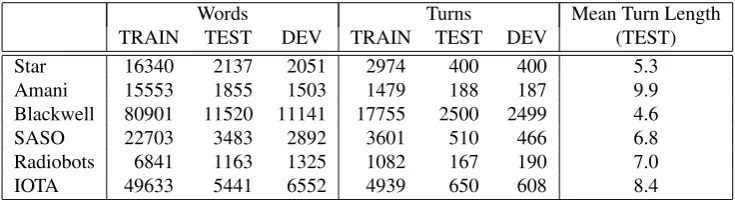
inde-Words Turns Mean Turn Length TRAIN TEST DEV TRAIN TEST DEV (TEST)
Star 16340 2137 2051 2974 400 400 5.3
Amani 15553 1855 1503 1479 188 187 9.9
Blackwell 80901 11520 11141 17755 2500 2499 4.6
SASO 22703 3483 2892 3601 510 466 6.8
Radiobots 6841 1163 1325 1082 167 190 7.0
IOTA 49633 5441 6552 4939 650 608 8.4
Table 1: Data used in the evaluation. Mean turn length is measured in words.
Trainee Roger where do you want hog to look from now that I’m looking at that building, where do you want me to go?
Instructor Follow the y to the south.
Trainee Okay you mean the y that follows to the south-west?
Instructor Affirmative.
Trainee Roger contact on that east west road.
Instructor From that unit from that intersection go west three units of measure.
2.2. Creating Data Sets from Collected Utterances
The utterances collected from user sessions in the domains described above were transcribed manually to create a sepa-rate corpus for each of the domains. We selected utterances from each corpus randomly to create training, development and test sets: development and test sets were each slightly over 10% of the total utterances (dialogue turns) in each corpus, and the remaining utterances were assigned to the training set. The sizes of the training, development and test sets for each domain are shown in Table 1. We show set sizes in terms of word (token) count and the number of dia-logue turns. In addition, we also show the mean turn length for each domain.
The SGT Blackwell corpus is the largest of our six cor-pora, with a training set containing over 80,000 words, in almost 18,000 dialogue turns. This is also the corpus with the shortest turns on average, with a mean turn length of 4.6. In comparison, the mean turn length in the Amani cor-pus is more than twice as long, at 9.9. The smallest of the six corpora is the Radiobots corpus, with a training set un-der 7,000 words and about 1,000 utterances.
Table 2 shows the vocabulary size and density for the train-ing set in each domain. Size is the number of unique words, or types, in each of the training sets, and density is the to-tal number of tokens divided by the vocabulary size.1 The table also shows the number of words in the development set that are not in the training set vocabulary, or out-of-vocabulary (OOV) words. Counts are included for OOV types and tokens in the development set. Finally, the ta-ble also includes the OOV rate, defined as the OOV token count divided by the total number of tokens in the devel-opment set. Vocabulary size and OOV rate are indicative
1
The density figure is not normalized to the size of the corpus; generally, a higher number (indicating lower density) is expected for larger corpora
Vocabulary OOV OOV tokens size density types N %
Star 516 31.7 35 37 1.80
Amani 1194 13.0 58 67 4.46 Blackwell 2568 31.5 128 147 1.32
SASO 808 28.1 38 43 1.49
Radiobots 198 34.6 16 18 1.36 IOTA 1878 26.4 114 143 2.18
Table 2: The vocabulary size and density of the training set for each corpus, the number of unique out-of-vocabulary (OOV) words in each development set, and the total number and rate of out-of-vocabulary words in each development set.
of the difficulty of the recognition task in these specific do-mains. Tables 1 and 2 suggest, for example, that the amount of data collected in the Amani domain may be inadequate, given the small training set size and high OOV rate. Al-though the Radiobots corpus is even smaller, its vocabulary size is very small, and its OOV rate low.
3.
Methodology
3.1. General Steps
The following open source recognizers were used in the evaluation:
Cambridge HTK family: HVite (v3.4.1), HDecode and Julius (v4.1.2).2
CMU Sphinx family: Sphinx 4 and Pocket Sphinx (v0.5).3
For these recognizers, acoustic models and language mod-els were first trained on the training set (TRAIN). Then the recognizers were tuned on the development set (DEV) and the final result was calculated on the test set (TEST).
3.2. Acoustic and Language Models
Acoustic models and language models were trained as fol-lows.
2
HTK is available fromhttp://htk.eng.cam.ac.uk; Julius http://julius.sourceforge.jp is compatible with acoustic and language models trained using HTK so we in-clude it with the HTK family
3Both are available from http://cmusphinx.
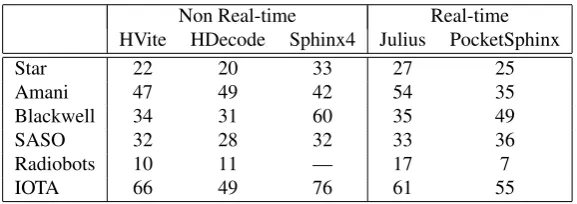
Non Real-time Real-time HVite HDecode Sphinx4 Julius PocketSphinx
Star 22 20 33 27 25
Amani 47 49 42 54 35
Blackwell 34 31 60 35 49
SASO 32 28 32 33 36
Radiobots 10 11 — 17 7
IOTA 66 49 76 61 55
Table 3: Word error rates on the various DEV sets (best results achieved after tuning the parameters).
Non Real-time Real-time HVite HDecode Julius PocketSphinx
Star 33 32 36 33
Amani 56 65 50 38
Blackwell 32* 42 32 53
SASO 33 29 33 30
Radiobots 15 12 14 10
IOTA 57 39 42 47
Table 4: Word error rates on the various TEST sets. Note that the result of HVite on Blackwell is based on only 10% of the data set. To facilitate comparisons the WER of HDecode and Julius on the same portion of Blackwell was 46% and 36% respectively.
HTK family: The three decoders used the same acous-tic and language models. We used two sets of these models: in one set both models were trained only on TRAIN so they highly fit a specific data set; in the other set both models were adapted with the Wall Street Journal (WSJ) training corpus (Vertanen, 2006)4. The training procedure follows Young et al. (2006).
Sphinx family: A language model was built from TRAIN of each data set with the CMU SLM toolkit (Clark-son and Rosenfeld, 1997)5, while the acoustic mod-els were adapted with the WSJ corpus using CMU’s SphinxTrain tool6. We used the WSJ acoustic models distributed by CMU.
The CMU pronouncing dictionary v0.7a (Weide, 2008) was used as the main dictionary for both of the HTK and Sphinx family. We used trigrams throughout our experiments with the Sphinx family of recognizers. On the other hand, both bigrams and trigrams were used with the HTK family of recognizers (except for HVite, which supports only bi-grams).
3.3. Evaluation Method
Our main evaluation metric was word error rate (WER). WER was calculated by theHResultsprogram of HTK. It can be formulated as:
WER= Substitutions+Deletions+Insertions Length of target string
4Available fromhttp://www.keithv.com/software 5
Available from http://www.speech.cs.cmu.edu/ SLM info.html
6Available from http://cmusphinx.sourceforge.
net/html/download.php#SphinxTrain
Additionally, we note whether the recognition was real-time or not. A real-real-time recognizer can finish recognizing a segment of speech in a time interval no greater than the length of the speech.
We also measure perplexity as an indication of the com-plexity of each corpus. Percom-plexity is a common way of eval-uating language models with respect to some text. Perplex-ity (equation 1) is derived from cross-entropy (equation 2):
P P= 2H(T) (1)
H(T) =− 1
WTlog2P(T) (2)
whereP(T)is the probability that the language model as-signs to textT andWT is the number of tokens (words) in
textT. A perplexity of valueNmeans that at each point in the recognition path the recognizer has to choose amongN
words on average. Thus the lower the perplexity the easier the speech recognition task.
4.
Results and Discussion
4.1. Results Overview
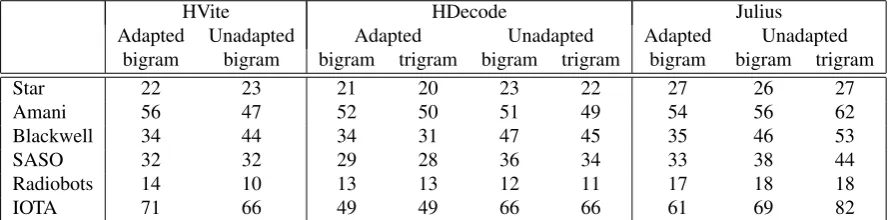
HVite HDecode Julius Adapted Unadapted Adapted Unadapted Adapted Unadapted
bigram bigram bigram trigram bigram trigram bigram bigram trigram
Star 22 23 21 20 23 22 27 26 27
Amani 56 47 52 50 51 49 54 56 62
Blackwell 34 44 34 31 47 45 35 46 53
SASO 32 32 29 28 36 34 33 38 44
Radiobots 14 10 13 13 12 11 17 18 18
IOTA 71 66 49 49 66 66 61 69 82
Table 5: Comparison of WER for the HTK family considering adaptation on DEV (using both bigrams and trigrams).
and further work is needed on ASR performance and NLU and dialogue techniques to cope with high error rates, e.g. (Leuski et al., 2006a). Second, there are large differences in the recognition rates for the different domains. This un-derscores the need for further domain typology for virtual humans. Some of these differences may be an artifact of the size of the collected data set, but other aspects concern the domain itself, e.g. size of turns, size of vocabulary, how specialized the vocabulary is, density, perplexity and OOV rate. Virtual human designers may need to pay attention to how people will want to talk in a given domain and the implications for ASR performance. Third, no one recog-nizer dominates on all data sets, e.g. Julius works best on Blackwell, but is significantly worse than Pocket Sphinx on Radiobots and Amani. The upshot is that training for spe-cific domains is important, and choice of recognizer may again depend on aspects of the domain.
4.2. Adaptation Affects Performance
For the HTK family, we did experiments to evaluate bi-gram vs. tribi-gram language models and whether adapting with both WSJ acoustic and language models helps im-prove WER.
Table 5 shows the comparison. Again, no one technique dominates. HVite is better with adaptation for Blackwell, but worse for IOTA and Amani. HDecode does best with adapted trigrams for most domains, but unadapted trigrams are best for Radiobots, while trigrams perform at least as well as bigrams for all domains. Adaptation also is optimal for Julius, while bigrams perform better than trigrams for most domains.
Due to the fact that the WSJ corpus is much larger than our data sets, the final adapted models are also much en-larged. This brings a decrease in decoding speed because the search space is widened. The consequences of bigger search space could be two-fold. On one hand, enriched models could compensate for data sparsity and thus lower WER. This appears to be the case for the Blackwell do-main, where enriched models cause a drop of more than 10 percentage points in WER for all three decoders, and may also be the cause for the lower drop in WER for the SASO domain. On the other hand, if a data set covers only a closed domain and uses small-size vocabulary, then the additional hypotheses of the enriched models make it more difficult to find the correct interpretation. This may explain the increase in WER with adapted models for the Radiobots domain (for HVite and HDecode).
4.3. Perplexity Affects Performance
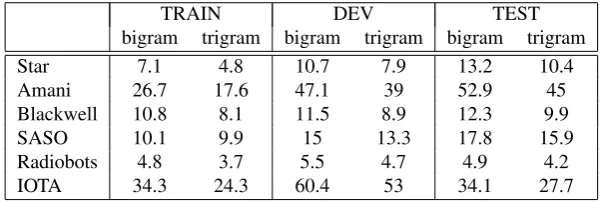
Table 6 presents perplexity results using both unadapted bi-grams and unadapted tribi-grams on the TRAIN, DEV and TEST data sets of each domain. As expected perplexity is lower on TRAIN since this data set was used for training the language models. Also, trigrams lead to lower perplexities than bigrams. The perplexity on IOTA is very high, espe-cially on DEV, which explains the high WER. On the other hand, the perplexity is low for Radiobots, which explains the low WER for this domain. To calculate perplexity we used the SRI SLM toolkit (Stolcke, 2002)7.
5.
Conclusion
We performed an evaluation of multiple off-the-shelf speech recognizers across diverse domains for virtual hu-man dialogue systems. Our evaluation is targeted to ASR consumers and potential consumers with limited experience with readily available recognizers. Our results show that there is no single recognizer that outperforms all other rec-ognizers in all domains.
We expect that our evaluation will prove useful to other ASR consumers, especially in the dialogue community, and will shed some light on the key problem in spoken dialogue systems of selecting the most suitable available ASR sys-tem for a particular application, and what impact training will have.
In future work we intend to incorporate these recognizers into our system architectures, so that we can test the effect of each ASR engine on the overall user experience while he/she interacts with the dialogue system. We also intend to work towards developing a regression model that will help us predict which ASR system will perform best based on the characteristics of the domain.
6.
Acknowledgments
The work described here has been sponsored by the U.S. Army Research, Development, and Engineering Command (RDECOM). Statements and opinions expressed do not necessarily reflect the position of the United States Gov-ernment, and no official endorsement should be inferred. The first author acknowledges financial support from the Erasmus Mundus Program through scholarships for the Eu-ropean Masters Program in Language and Communication Technologies (LCT).
7Available from http://www.speech.sri.com/
TRAIN DEV TEST bigram trigram bigram trigram bigram trigram
Star 7.1 4.8 10.7 7.9 13.2 10.4
Amani 26.7 17.6 47.1 39 52.9 45
Blackwell 10.8 8.1 11.5 8.9 12.3 9.9
SASO 10.1 9.9 15 13.3 17.8 15.9
Radiobots 4.8 3.7 5.5 4.7 4.9 4.2
IOTA 34.3 24.3 60.4 53 34.1 27.7
Table 6: Perplexity for the HTK family on TRAIN, DEV and TEST data sets (using both unadapted bigrams and unadapted trigrams).
7.
References
R. Artstein, S. Gandhe, J. Gerten, A. Leuski, and D. Traum. 2009a. Semi-formal evaluation of conversational char-acters. In Orna Grumberg, Michael Kaminski, Shmuel Katz, and Shuly Wintner, editors,Languages: From For-mal to Natural. Essays Dedicated to Nissim Francez on the Occasion of His 65th Birthday, volume 5533 of Lec-ture Notes in Computer Science, pages 22–35. Springer, Berlin.
R. Artstein, S. Gandhe, M. Rushforth, and D. Traum. 2009b. Viability of a simple dialogue act scheme for a tactical questioning dialogue system. In DiaHolmia 2009: Proc. of 13th Workshop on the Semantics and
Pragmatics of Dialogue, Stockholm, Sweden.
S. Berger, Z.A. Sloane, and J. Yang. 2006. Competitive evaluation of commercially available speech recogniz-ers in multiple languages. In Proc. of Fifth Interna-tional Conference on Language Resources and Evalua-tion (LREC), Genoa, Italy.
M. Broughton. 2002. Measuring the accuracy of commer-cial automated speech recognition systems during con-versational speech. In Workshop on Virtual Conversa-tional Characters: Applications, Methods, and Research Challenges, Melbourne, Australia.
P. Clarkson and R. Rosenfeld. 1997. Statistical language modeling using the CMU-Cambridge toolkit. InProc. of
Eurospeech, Rhodes, Greece.
E.G. Devine, S.A. Gaehde, and A.C. Curtis. 2000. Com-parative evaluation of three continuous speech recogni-tion software packages in the generarecogni-tion of medical re-ports.The Journal of American Medical Informatics As-sociation, 7(5):462–468.
L. Dybkjaer, N.O. Bernsen, R. Carlson, L. Chase, N. Dahlbaeck, K. Failenschmid, U. Heid, P. Heis-terkamp, A. Joenson, H. Kamp, I. Karlsson, J. v. Kup-pevelt, L. Lamel, P. Paroubek, and D. Williams. 1998. The DISC approach to spoken language dialog systems development and evaluation. InProc. of First Interna-tional Conference on Language Resources and
Evalua-tion (LREC), pages 185–189, Granada, Spain.
L. Lamel, W. Minker, and P. Paroubek. 2000. Towards best practice in the development and evaluation of speech recognition components of a spoken language dialog
sys-tem. Natural Language Engineering, 6(3–4):305–322.
A. Leuski, B. Kennedy, R. Patel, and D. Traum. 2006a. Asking questions to limited domain virtual characters:
How good does speech recognition have to be? In25th
Army Science Conference, Orlando, Florida, USA.
A. Leuski, R. Patel, D. Traum, and B. Kennedy. 2006b. Building effective question answering characters. In
Proc. of 7th SIGdial Workshop on Discourse and Dia-logue, pages 18–27, Sydney, Australia.
S.M. Robinson, A. Roque, A. Vaswani, D. Traum, C. Her-nandez, and B. Millspaugh. 2006. Evaluation of a spo-ken dialogue system for virtual reality call for fire train-ing. In25th Army Science Conference, Orlando, Florida, USA.
S. Robinson, D. Traum, M. Ittycheriah, and J. Henderer. 2008. What would you ask a conversational agent? Ob-servations of human-agent dialogues in a museum set-ting. InProc. of Sixth International Conference on
Lan-guage Resources and Evaluation (LREC), Marrakech,
Morocco.
A. Roque, A. Leuski, V. Rangarajan, S. Robinson, A. Vaswani, S. Narayanan, and D. Traum. 2006. Radiobot-CFF: A spoken dialogue system for military training. InProc. of Interspeech, Pittsburgh, Pennsylva-nia, USA.
A. Stolcke. 2002. SRILM – an extensible language model-ing toolkit. InProc. of ICSLP, Denver, Colorado, USA. D.R. Traum, S. Marsella, J.Gratch, J.Lee, and A. Hartholt.
2008. Multi-party, multi-issue, multi-strategy negotia-tion for multi-modal virtual agents. InProc. of 8th Inter-national Conference on Intelligent Virtual Agents (IVA), Tokyo, Japan.
K. Vertanen. 2006. Baseline WSJ acoustic models for HTK and Sphinx: Training recipes and recognition ex-periments. Technical report, Cavendish Laboratory, Uni-versity of Cambridge.
R.L. Weide. 2008. The CMU pronouncing dictionary. S.J. Young and L.L. Chase. 1998. Speech recognition
evaluation: a review of the U.S. CSR and LVCSR pro-grammes. Computer Speech and Language, 12(4):263– 279.
S.J. Young, G. Evermann, M.J.F. Gales, T. Hain, D. Ker-shaw, G. Moore, J. Odell, D. Ollason, D. Povey, V. Valtchev, and P.C. Woodland. 2006. The HTK Book,
version 3.4. Cambridge University Engineering