DESIGN OF PID CONTROLLER WITH INTEGRATION OF
ARTIFICIAL INTELLIGENCE FOR MACHINE TOOLS
APPLICATION
Submitted in accordance with requirement of the Universiti Teknikal Malaysia Melaka (UTeM) for the Bachelor Degree of Manufacturing Engineering (Hons.)
by
NURUL QAMARIYAH BINTI MISBAHUL MUNIR B051410114
940329-01-6658
FACULTY OF MANUFACTURING ENGINEERING
Disahkan oleh:
_____________________________ ______________________________ Alamat Tetap: Cop Rasmi:
_____________________________ _____________________________ _____________________________
Tarikh: _______________________ Tarikh: _______________________
UNIVERSITI TEKNIKAL MALAYSIA MELAKA
BORANG PENGESAHAN STATUS LAPORAN PROJEK SARJANA MUDA
Tajuk: DESIGN OF PID CONTROLLER WITH INTEGRATION OF ARTIFICIAL INTELLIGENCE FOR MACHINE TOOLS APPLICATION
Sesi Pengajian: 2017/2018 Semester 2
Saya Nurul Qamariyah Binti Misbahul Munir (940329-01-6658)
mengaku membenarkan Laporan Projek Sarjana Muda (PSM) ini disimpan di Perpustakaan Universiti Teknikal Malaysia Melaka (UTeM) dengan syarat-syarat kegunaan seperti berikut:
1. Laporan PSM adalah hak milik Universiti Teknikal Malaysia Melaka dan penulis. 2. Perpustakaan Universiti Teknikal Malaysia Melaka dibenarkan membuat salinan
untuk tujuan pengajian sahaja dengan izin penulis.
3. Perpustakaan dibenarkan membuat salinan laporan PSM ini sebagai bahan pertukaran antara institusi pengajian tinggi.
4. *Sila tandakan (√)
(Mengandungi maklumat yang berdarjah keselamatan atau kepentingan Malaysiasebagaimana yang termaktub dalam AKTA RAHSIA RASMI 1972)
(Mengandungi maklumat TERHAD yang telah ditentukan oleh organisasi/ badan di mana penyelidikan dijalankan)
√
SULIT
TERHAD
DECLARATION
I hereby, declared this report entitled “Design of PID Controller with Integration of Artificial Intelligence for Machine Tools Application” is the result of my own research
except as cited in references.
Signature : ………
APPROVAL
This report is submitted to the Faculty of Manufacturing Engineering of Universiti Teknikal Malaysia Melaka as a partial fulfilment of the requirement for degree of Bachelor
of Manufacturing Engineering (Hons.). The member of the supervisory committee is as follows:
i
ABSTRAK
ii
ABSTRACT
iii
DEDICATION
Alhamdulillah, all praises and grateful to the Almighty God, this project has been completed with the blessings from Allah.
Specially to my beloved family,
my dearest mother, Sulastri
my appreciated father, Misbahul Munir
my adored little sisters Nor Fatimah, Nur Hidayah, and Rabiatul Adawiyah
for the love, prayers, moral support, encouragement, sincere advices, and sacrifices.
iv
ACKNOWLEDGEMENT
I would like to firstly express my highest appreciation and gratitude to my respected supervisor, Ir. Dr. Lokman Bin Abdullah. It is a great honour as to be able to complete this project supervised by him. Thank you for lending the time during the hours of need. Every sacrifice that you did in order to give me the teaching and explanation during the hours of need, and every other recommendation for this project, along with the support and patience you provided for me to complete this project may be given the best reward from Allah the Almighty God. Millions of thanks I would like to deliver for everything during this one year.
I would also deliver this appreciation to the staffs and academicians of UTeM especially FKP UTeM in terms of facility and moral support. Thank you for the extra knowledge gained for this project through the learning of the subjects.
v
TABLE OF CONTENTS
Abstrak i
Abstract ii
Dedication iii
Acknowledgement iv
Table of Contents v
List of Tables viii
List of Figures ix
List of Abbreviations xi
CHAPTER 1: INTRODUCTION
1.1 Background 1
1.2 Problem Statement 2
1.3 Objectives of Research 3
1.4 Scope of Research 4
1.5 Significance of Study 5
1.6 Thesis Outlines 6
CHAPTER 2: LITERATURE REVIEW
2.1 Introduction 7
2.2 Controllers for Machine Tool Application 8
2.3 Various Controller Designs 9
2.3.1 PID Controller 9
2.3.2 Nonlinear PID (NPID) Controller 10
2.4 Artificial Intelligence Approach 11
vi
2.5 Summary 16
CHAPTER 3: METHODOLOGY
3.1 Introduction 18
3.2 Overview 18
3.2.1 Literature Review 20
3.2.2 System Identification 20
3.2.3 Cutting Forces Identification 21
3.2.4 Controller Design and Numerical Analysis 21 3.2.5 Simulation and Experimental Analysis 22 3.2.5.1 Simulation Analysis 22 3.2.5.2 Experimental Setup and Analysis 23 3.2.6 Comparison and Discussion on Results 24
3.2.7 Report Writing 25
3.3 Summary 25
CHAPTER 4: CONTROLLER DESIGN
4.1 Types of Controller Design 26
4.1.1 Basic PID Controller 26
4.1.2 PID with PSO Controller 29
4.1.3 PID with FFA Controller 34
4.2 Stability Analysis 40
4.2.1 Stability Analysis for Basic PID controller 41 4.2.2 Stability Analysis for PID controller with PSO Integration 44 4.2.3 Stability Analysis for PID controller with FFA Integration 47
4.2.4 Summary 49
CHAPTER 5: RESULTS AND DISCUSSION
5.1 Introduction 51
5.2 Maximum Tracking Error 52
5.2.1 Basic PID controller 52
5.2.1.1 Simulation results 52
vii
5.2.2 PID controller with integration of PSO 57
5.2.2.1 Simulation results 57
5.2.2.2 Experimental result 59 5.2.3 PID controller with integration of FFA 61
5.2.3.1 Simulation result 61
5.2.3.2 Experimental result 62
5.3 Root Mean Square Error (RMSE) 64
5.3.1 Simulation results 65
5.3.2 Experimental results 67
5.4 Discussion 70
CHAPTER 6: CONCLUSION AND RECOMMENDATIONS
6.1 Conclusion 72
6.2 Future Recommendations 73
viii
LIST OF TABLES
2.1 FFT error comparison between PID and NPID controllers (Abdullah et al., 2013)
11
4.1 PID parameters for Basic PID controller 28
4.2 Parameters of PSO method and PID controller through PSO 34 4.3 Parameters of PSO method and PID controller through PSO 40
5.1 Research arrangement 51
5.2 Simulated maximum tracking error for system of Basic PID controller 54 5.3 Experimental maximum tracking error for system of Basic PID controller 57 5.4 Simulated maximum tracking error for system of PID with PSO controller 59 5.5 Experimental maximum tracking error for system of PID with PSO
controller
60
5.6 Simulated maximum tracking error for system of PID with FFA controller 62 5.7 Experimental maximum tracking error for system of PID with FFA basic
controller
64
5.8 Simulation RMSE result at f = 0.2 Hz 65
5.9 Simulation RMSE result at f = 0.4 Hz 66
5.10 Experimental RMSE result at f = 0.2 Hz 67
ix
LIST OF FIGURES
1.1 Machine tool used in CNC machine 1
1.2 XY table system 5
2.1 Genetic Algorithm Flowchart (Nagaraj and Vijayakumar, 2011) 15
3.1 Flowchart of research methodology 19
3.2 Flow of research experiment setup (Abdullah, 2014) 24
4.1 Block diagram of Basic PID controller in MATLAB / Simulink 27 4.2 Block diagram of PID controller in MATLAB / Simulink 29
4.3 Flowchart of PSO 32
4.4 Block diagram of PID with PSO controller in MATLAB / Simulink 33
4.5 Flowchart of FFA 38
4.6 Block diagram of PID with FFA controller in MATLAB / Simulink 39 4.7 Gain Margin (Gm) and Phase Margin (Pm) analysis of Basic PID
controller
42
4.8 Nyquist Plot analysis of Basic PID controller 42
4.9 Sensitivity Function analysis for Basic PID controller 43 4.10 Complementary Sensitivity Function analysis for Basic PID controller 44 4.11 Gain Margin (Gm) and Phase Margin (Pm) analysis of PID with PSO
controller
45
4.12 Nyquist Plot analysis of PID with PSO controller 45 4.13 Sensitivity Function analysis of PID with PSO controller 46 4.14 Complementary Sensitivity Function analysis for PID with PSO controller 46 4.15 Gain Margin (Gm) and Phase Margin (Pm) analysis of PID with FFA
controller
47
x
4.17 Sensitivity Function analysis of PID with FFA controller 48 4.18 Complementary Sensitivity Function analysis of PID with FFA controller 49
5.1 Simulated tracking error of Basic PID controller at f = 0.2 Hz 53 5.2 Simulated tracking error of Basic PID controller at f = 0.4 Hz 53 5.3 The block diagram of PID controller for experimental work 55 5.4 Experimental tracking error of Basic PID controller at f = 0.2 Hz 56 5.5 Experimental tracking error of Basic PID controller at f = 0.4 Hz 56 5.6 Simulated tracking error of PID with PSO controller at f = 0.2 Hz 58 5.7 Simulated tracking error of PID with PSO controller at f = 0.4 Hz 58 5.8 Experimental tracking error of PID with PSO controller at f = 0.2 Hz 59 5.9 Experimental tracking error of PID with PSO controller at f = 0.4 Hz 60 5.10 Simulated tracking error of PID with FFA controller at f = 0.2 Hz 61 5.11 Simulated tracking error of PID with FFA controller at f = 0.4 Hz 62 5.12 Experimental tracking error of PID with FFA controller at f = 0.2 Hz 63 5.13 Experimental tracking error of PID with FFA controller at f = 0.4 Hz 63
5.14 Simulation RMSE values at f = 0.2 Hz 65
5.15 Simulation RMSE values at f = 0.4 Hz 66
5.16 Experimental RMSE values at f = 0.2 Hz 68
xi
LIST OF ABBREVIATIONS
PID - Proportional integral derivative
AI - Artificial intelligence
PSO - Particle Swarm Optimisation
CHAPTER 1
INTRODUCTION
1.1 Background
[image:16.595.197.433.522.693.2]Nowadays, machine tool manufacturers are required to manufacture high precision machines but maintaining affordable prices in order to compete in the market. The role of controller in machine tools application is crucial for precise tools positioning. For instance, Figure 1.1 represents the machine tool used in CNC milling machine.
In manufacturing field, high precision positioning machines should be produced by the machine tools manufacturers but still maintaining affordable prices in order to compete in the market. According to Lopez et al. (2009), high precision in machine tools significantly enhanced the production of machined parts, in terms of escalating the added value of the parts, as well as to bring advantage in the machining process by reducing finishing process. Besides, high precision machining is directly related with other manufacturing requirements, for instance, the necessity in increasing productivity. The machining cost for the machined parts can be lowered when using a high precision machine compared to conventional machining. This situation brings goodness technically and economically which results in higher reliability of the system by decreasing the tolerances during machining process and reducing the operations for manual adjusting in finishing process.
1.2 Problem Statement
The performance of a machine depends on the efficiency of the machine tools handling disturbance forces such as cutting force and frictional force. The main indicators for machine tools performance are precise positioning, accuracy, robustness, flexibility and highly automated. Through an online article published by Olexa (2005), the issue related to precise positioning is when a machine tool moves from the datum of (0,0,0) to the targeted point, the tracking error of the machine actuators caused by the failure in moving to the exact position results in the position deviation of the tool from the true position. This is caused by the inaccuracies of the machine geometry which acts to move the work piece along the axes of the machine. This deficiency is also related to the volumetric accuracy of the machine tool which is the ability of the tool to reach to the true position from the previous point inside the reachable limit of the working envelope in the machining area.
(Yadav et al., 2016). However, there is a problem presents when implementing PID controller. Through the past research of Gaing (2004), it is quoted that the gains of PID controller namely Kp, Ki, and Kd are difficult to be tuned properly since some of the industrial plants face problem such as the implementation of nonlinear system, time delays, and high order system. During the past years, the world of control system has discovered methods to tune the PID controller gains through heuristic methods such as Ziegler-Nichols method. However, the implementation of Ziegler-Ziegler-Nichols formula had caused the optimal PID gains difficult to be determined. Hence, many artificial intelligence (AI) approaches have been implemented to enhance the performance of the controllers while keeping their basic characteristics consistent.
Due to these reasons, this project is proposed to solve the issue of precision and accuracy performance of the machine tools by integrating AI approaches namely Particle Swarm Optimisation (PSO) and Firefly Algorithm (FFA) into the PID controller.
1.3 Objectives of Research
The objectives of this research are as follows:
(a) To design proportional integral derivative (PID) controller with integration of artificial intelligence techniques namely Particle Swarm Optimisation (PSO) and Firefly Algorithm (FFA) for optimisation of precise positioning in machine tools application.
(c) To compare the result data between basic PID controller, PID with PSO controller, and PID with FFA controller.
1.4 Scope of Research
The scope of this research is stated in the following:
(a) The basic controller used only involves proportional integral derivative (PID).
(b) The optimisation approach by using artificial intelligence for precise positioning of machine tool application only includes:
(I) Particle Swarm Optimisation (PSO), and (II) Firefly Algorithm (FFA).
(c) The disturbance force to be implemented into the system during simulation and experimental analysis only involves the cutting forces of
(I) 1500 revolutions per minute (rpm), (II) 2500 rpm, and
(III) 3500 rpm
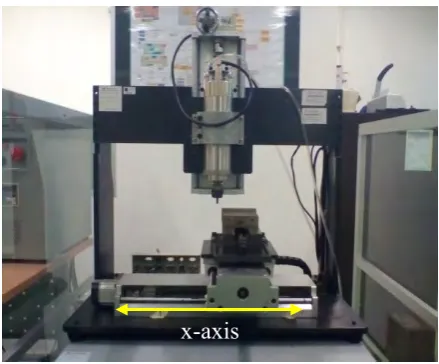
(d) For the experimental analysis using the XY table ball screw drives system as displayed in Figure 1.2, only the x-axis motion is taken into account.
(e) The parameters used to measure and compare the performance on precise positioning of each controllers only includes:
(I) Tracking error
Figure 1.2: XY table system
1.5 Significance of Study
This research contributes in providing the knowledge by investigating the integration of artificial intelligence into PID controller for machine tools application.
(a) Design of PID controller by integrating Particle Swarm Optimisation (PSO) and Firefly Algorithm (FFA) which are the approaches in artificial intelligence.
(b) Integration of artificial intelligence through PSO and FFA approaches into PID controller for the optimisation in term of precise positioning in machine tools application.
(c) Comparison of the outcomes by evaluating the errors through different types of controllers by implementing various cutting forces as disturbance force into the system.
(d) Providing solutions to optimise the machine tools for manufacturers to ensure the productivity fulfils the need to have high precision machine.
1.6 Thesis Outlines
CHAPTER 2
LITERATURE REVIEW
2.1 Introduction
The issue of high precision in machine tools had been raised not only recently, but starting decades back a long time ago. Through Evans (1977), the development of controlling the precision of machine tools through control system embedded in the machine just started to be explored. During those days, the machine manufacturer only focused to overcome the problem related with machine tools precision through mechanical precision which results in expensive machine price. To be exact, the computer is not used to sense and control the actual position of the cutting tool, but instead the positioning accuracy is achieved through highly precise ways and lead screws of the machine.
In this chapter, the information regarding this research is being referred from the previous studies. Section 2.2 elaborates the application of controllers in machine tools application, Section 2.3 on various controller designs, Section 2.4 on artificial intelligence approach and Section 2.4 for the summary part.
2.2 Controllers for Machine Tool Application
The current researches on the machine tool application portray various implementations of controllers done through previous studies. There are several controllers highlighted, as mentioned in a review of past researches done by Anang et al. (2016). Throughout the review which focused on the control strategy for machine tools, the list consisted of linear control strategies and adaptive nonlinear control strategies. As for the linear control strategies, there were several controllers discussed, namely Proportional Integral Derivative (PID) controller and Cascade P/PI controller. In addition, the nonlinear control strategies comprised of Nonlinear PID (NPID), Feedforward NPID (FNPID), Adaptive NPID (ANPID), Adaptive Robust Controller (ARC), Nominal Characteristics Trajectory Following (NCTF) controller, as well as neural network control and fuzzy logic control. The review made a few summarisations; firstly, the nonlinear function should be considered to enhance the overall performance, precision, and robustness of machine tools; secondly, to improve the precision of machine tools, the combination of controllers showed better performance compared to stand-alone control strategies; and lastly, the integration of neural network and fuzzy logic highlights the recent enhancement of precise positioning for nonlinearity function of machine tools.
performance. This occurrence displayed NPID controller which is an adaptive type controller offered flexibility and thus, showed advantage for machining application.
Hence, it is summarised from the previous researches that the nonlinear control strategies portrayed better performance in precise positioning compared to the linear controllers for the application of machine tools. The integration of computational intelligence such as fuzzy logic and neural network into the nonlinear controllers further improved the precision performance for machine tools application.
2.3 Various Controller Designs
2.3.1 PID Controller