ISSN: 2319-8753
I
nternational
J
ournal of
I
nnovative
R
esearch in
S
cience,
E
ngineering and
T
echnology
(An ISO 3297: 2007 Certified Organization)
Vol. 3, Issue 7, July 2014
Copyright to IJIRSET www.ijirset.com 14815
Optimizing the Process Parameters of WEDM
using Taguchi Technique on P-21 die steel
Saurabh Chhabra
1, Deepak Gupta
2, Parveen Yadav
31
Research scholor, GGGI Shahabad, Haryana, India 2
Assistant Professor, Department of Mechanical Engineering,Galaxy global group of institution, shahabad, Haryana,
India 3
Assistant Professor, Chandigarh University, Punjab¸ India
ABSTRACT: Wire electric discharge machine (WEDM) plays a life sustaining performance in the fabricating industry in order to separate the laborious and unmanageable tool and die material. WEDM has the ability to generate complicated shapes with high preciseness and accuracy. Using the material P-21 in the existing work study finds out the application in making die tool. Present main objective of this investigation is to get parameters of the process for characteristics of single response. Taguchi method of orthogonal array L18 is used to find out desired value of performance characteristics. Investigation are done out on P-21 mould steel as work piece and tool electrode as brass wire coated with zinc. Parameter of response in material removal rate. A continuous investigation on a set of three trials is conducted and average of three continuous experiment is chosen with best condition. Using different input variable such as Input current, pulse on, pulse off, wire feed and wire tension are conducted in the investigation. After all that a confirmation experiment has to be carried out to formalize effectivity of proposed optimal condition.
KEYWORDS: P-21mould steel, WEDM, L18 orthogonal array, S/N ratio, ANOVA
I. INTRODUCTION
Wire electric discharge machine (WEDM) is machine which is used for metal removal. By this machine material is eroded from a conductive work piece through an electrical erosion, as it uses copper wire coated with zinc of 0.25mm dia. Conductive work piece never comes in contact with the wire of WEDM machine. Distinct spark between wire separated by thin di-electric fluid film and the work-piece makes the material to erode 0.025-0.075 mm gap is constantly maintained between work-piece and the wire. All this is done by computer managed WEDM. Optimization of process parameters is vital step. Problem could occur if the process parameter is in-appropriately selected. Parameter like material removal rate depends upon machining parameters such as pulse on, pulse off, discharge current, wire feed, wire tension and much more. So in this existing experiment, we are doing investigation through taguchi method most broadly used method in manufacturing t amend the process with single performance characteristics thus selecting optimal parameters of process.
ISSN: 2319-8753
I
nternational
J
ournal of
I
nnovative
R
esearch in
S
cience,
E
ngineering and
T
echnology
(An ISO 3297: 2007 Certified Organization)
Vol. 3, Issue 7, July 2014
Copyright to IJIRSET www.ijirset.com 14816
Figure. 1
II.
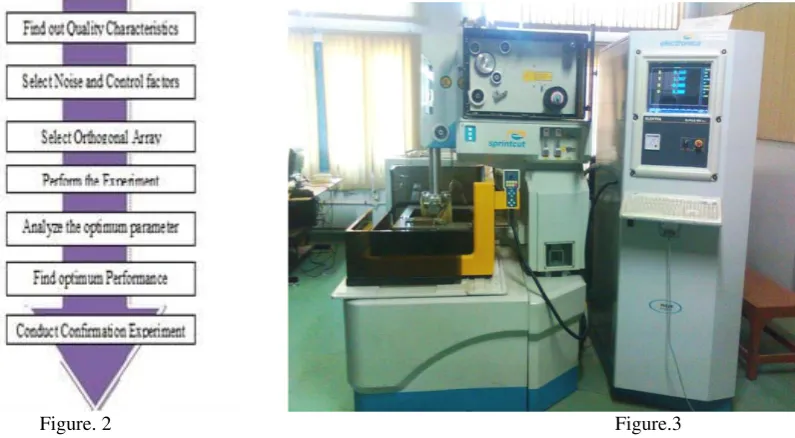
EXPERIMENTAL SET-UP AND SELECTION OF PROCESS PARAMETERSThe pulse generator capacity of the machine is 40A. The pulse generator supplies the electrical energy to the spark gap in the form of pulses. The machine tool unit comprises of a main worktable (called X-Y table) by which the work piece is clamped on auxiliary table (called U-V table) and wire drive mechanism. Figure 2. shows the stepwise procedure for Taguchi experimental design and analysis. Figure 3. shows the experiments are carried out in CNC sprint cut wire EDM of Electronic a Machine tool ltd. .
Figure. 2 Figure.3
Work piece Electrode: - The work piece material used in this investigation was steel P-21 Mould steel. Composition of P-21 Mould steel is C= 0.18-0.22% , Mn= 0.20-0.40% , Si ≤0.030% ,Cr= 0.50-0.30%, Ni=3.90-4.25%, Si= 0.20-0.40%, P≤ 0.030, V= 0.15-0.25, Al = 1.05-1.25. A P-21 die Mould steel plate of size 200x50x20 (l x b x w) is used.
Tool Electrode: Zinc coated copper wire having dia of 0.25mm is used in the present investigation as the electrode. Zinc coated Copper wire electrode can conduct high current as compare to simple copper wire.
Selection of Process Parameters and their Ranges:
ISSN: 2319-8753
I
nternational
J
ournal of
I
nnovative
R
esearch in
S
cience,
E
ngineering and
T
echnology
(An ISO 3297: 2007 Certified Organization)
Vol. 3, Issue 7, July 2014
Copyright to IJIRSET www.ijirset.com 14817
The process parameters selected for this study are as following: a. Current.
b. Pulse- ON time. c. Pulse-OFF time. d. Wire Speed e. Wire Tension
In Sprint-cut WEDM, the value of current ranges b/w 10 to 230A, Pulse-ON time b/w 110 to 131, Pulse-OFF varies b/w 0-63, Wire speed 1-15m/min and Wire tension ranges between1 to 15N.
III. SELECTION OF ORTHOGONAL ARRAY (OA) AND PARAMETER ASSIGNMENT
Before selecting a particular OA to be used as a matrix for conducting the experiments, the following two points are first considered:
1. The number of parameters and interactions of interest. 2. The number of levels for the parameters of interest.
Degree of freedom (DOF) associated with each factor is equal to no. of level -1. Therefore, total degree of freedom for the five factors is (5+2+2+2+2) 11. As per Taguchi’s method, the total DOF of selected OA must be greater than or equal to the total DOF required for the experiment. So, L18 OA having 17 (=18-1) degree of freedom is selected for the present analysis. The experiments are conducted at each trial conditions as given in table 2. For each trial, the experiments is repeated by three times.
Table 1. Levels for various control factors
Sr.NO
Level
Control Factors
A
B
C
D
E
1
1
170
120
48
4
6
2
2
180
124
52
5
7
3
3
190
128
56
6
8
4
4
200
5
5
210
6
6
220
Table2. L18 orthogonal array
Sr. No Parametric Trial conditions
A B C D E
1 1 1 1 1 1
2 1 2 2 2 2
3 1 3 3 3 3
4 2 1 1 2 2
5 2 2 2 3 3
6 2 3 3 1 1
7 3 1 2 1 3
8 3 2 3 2 1
ISSN: 2319-8753
I
nternational
J
ournal of
I
nnovative
R
esearch in
S
cience,
E
ngineering and
T
echnology
(An ISO 3297: 2007 Certified Organization)
Vol. 3, Issue 7, July 2014
Copyright to IJIRSET www.ijirset.com 14818
10 4 1 3 3 2
11 4 2 1 1 3
12 4 3 2 2 1
13 5 1 2 3 1
14 5 2 3 1 2
15 5 3 1 2 3
16 6 1 3 2 3
17 6 2 1 3 1
18 6 3 2 1 2
IV. RESULT AND DISCUSSION
In this section, we are discussing the effect of WEDM process parameters( peak current, pulse on time, pulse off time, current, wire speed and wire tension) on the basis of response characteristics(cutting speed and surface roughness). The average value of response characteristics, mean data and S/N ratio for each parameter, at all levels, is calculated from
table 3. These effects are plotted by using MINITAB 15 SOFTWARE.
Effect of Parameters On Material Removal Rate:-
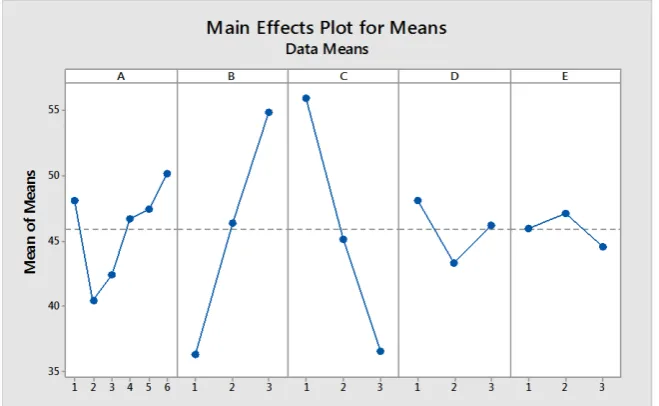
Wherever cutting is required, we need high Material removal rate. MRR is a “Larger is better” type characteristics which denotes the optimum value of MRR should be high so that production can be increased and we can save the time. Average value of MRR is Main effects of each parameter are calculated from response table 7 and 8 as shown in fig 8. These effects are plotted by using MINITAB 15. It is clear from the S/N plots that the maximum S/N ratio occurs corresponding to A1, B3, C1, D1 and E2.
Table 1. Response Table for S/N Ratios (Larger is better)
Level A B C D E
1 33.64 31.03 34.84 33.45 33.05
2 32.12 33.07 32.9 32.4 33.15
3 32.11 34.7 31.06 32.95 32.59
4 32.96
5 33.34
6 33.43
Delta 1.54
ISSN: 2319-8753
I
nternational
J
ournal of
I
nnovative
R
esearch in
S
cience,
E
ngineering and
T
echnology
(An ISO 3297: 2007 Certified Organization)
Vol. 3, Issue 7, July 2014
Copyright to IJIRSET www.ijirset.com 14819
Table2. Response Table for Means
Level A B C D E
1 48.11 36.35 55.88 48.11 45.96
2 40.45 46.41 45.15 43.36 47.1
3 42.41 54.88 36.61 46.18 44.58
4 46.69
5 47.43
6 50.19
Delta 9.74
ISSN: 2319-8753
I
nternational
J
ournal of
I
nnovative
R
esearch in
S
cience,
E
ngineering and
T
echnology
(An ISO 3297: 2007 Certified Organization)
Vol. 3, Issue 7, July 2014
Copyright to IJIRSET www.ijirset.com 14820
Figure1. Main Effect Plot for S/N ratio and MEAN for material removal rate
Figure 2. Residual plot for Material removal rate.
Confirmation Experiment:
ISSN: 2319-8753
I
nternational
J
ournal of
I
nnovative
R
esearch in
S
cience,
E
ngineering and
T
echnology
(An ISO 3297: 2007 Certified Organization)
Vol. 3, Issue 7, July 2014
Copyright to IJIRSET www.ijirset.com 14821
V. CONCLUSION
On the basis of above studied experiments, it can be safely concluding that:- . Material removal rate I mainly affected by pulse-on and pulse-off time.
REFERENCES
1. Pichai janmance, Apiwat Muttamara “ Optimization of electrical discharge machining of composite 900WC-10Co base on Taguchi approach” European journal of scientific research Vol. 64 No. 3 (2011), pp 426-436
2. Pujari srinivasa, Kooma Ramji, Beela Satyanarayana. Effect of WEDM conditions on surface roughness:A Parametric optimisation using Taguchi Method: international journal of advanced engineering sciences amd technologies Vol No-6, PP-41-48 (2011).
3. V.Muthuraman, R.Ramakrishnan, L.Kartikeyan, C.Parveen. Influences of process variables during wire electric discharge machining of O1 Steel: European journal of scientific research. Vol79 no 3 pp 449-456 (2012).
4. Anish kumar, Vinod Kumar, Jatinder Kumar. Prediction of surface roughness in wire electric discharge machining(WEDM) process based on response surface methodology: international journal of engineering and technology. Vol 2 No. 4 pp-708-719 (2012).
5. Aniza Alias, Bulan Abdullah, Nonliana Mohd. Abbas. Influence Of machine feed rate in WEDM of titanium Ti-6AL-4V with constant current (6A) using brass wire: International Symposium on Robotics and intelligent sensors(2012) procedia engineering 41 pp-1806-1811.
6. Aniza Alias, Bulan Abdullah, Nonliana Mohd. Abbas. WEDM: International Symposium on Robotics and intelligent sensors(2012) procedia engineering 41pp-1812-1817.