R E S E A R C H
Open Access
Synchronization for complex dynamical
networks with mixed mode-dependent time
delays
Yuechao Ma and Nannan Ma
**Correspondence:
[email protected] College of Science, Yanshan University, 438 Hebeidajie Road, Haigang District, Qinhuangdao, Hebei 066004, P.R. China
Abstract
In this paper, the problem of synchronization control is investigated for complex dynamical networks with discrete intervals and distributed time-varying delays. The main thing is to design a properly pinning controller, for which the error system of complex dynamical networks is asymptotically stable. Based on the theory of Lyapunov stability and linear matrix inequality, the suitable Lyapunov-Krasovskii functional is constructed in terms of the Kronecker product, and then we obtain a novel synchronization criterion. Finally, a numerical example is given to illustrate the effectiveness of the proposed methods.
Keywords: complex dynamical networks; synchronization; mixed mode-dependent time delays; linear matrix inequality
1 Introduction
Over the past two decades, extensive efforts have been devoted to the research on com-plex dynamical networks due to their theoretical importance, and practical applications in various fields, such as the Internet and World Wide Web, food web, genetic networks, and neural networks [–]. Many of these networks exhibit complexity in the overall topo-logical properties and dynamical properties of the networks nodes and the coupled units. It is not surprising that one witnesses a surge of research interest in the analysis of the dynamical behavior of complex dynamical networks.
An important concern in the research of complex dynamical networks is the synchro-nization problem, of which the purpose is to design the proper controller to achieve syn-chronization of the considered complex dynamical networks. Many significant advances on this issue have been reported in the literature; see [–] and the references therein. In this paper, we study a non-fragile approach [–], the authors of [] investigated the controlled synchronization for complex dynamical networks with random delayed infor-mation exchanges, for which stochastic variables are utilized to model randomly occurring phenomena. Reference [] investigates the non-fragile synchronization for bidirectional associative memory neural networks with time-varying delays. The sufficient conditions are derived to guarantee its synchronization based on a master-slave system approach. The discrete-time complex dynamical networks with interval time-varying delays is studied in []. In this paper, the randomly occurring perturbations will be considered, which are
sumed to belong to the binomial sequence. According to the author in [], the complex dynamical networks are synchronized, by using the sampled-data control method. Pin-ning sample-data control in [] for synchronization of complex networks has been stud-ied with probabilistic time-varying delays, by applying quadratic convex approach. The impulsive control [–] for synchronization of complex networks also is investigated. Impulsive control [] is applied to the synchronization for complex dynamical networks with coupling delays. Two types of time-varying coupling delays are considered: the de-lays without any restriction on the delay derivatives, and the dede-lays whose derivatives are strictly less than the former. The pinning control [–] is one of the most commonly used to achieve the synchronization between the nodes. In [], pinning synchronization of nonlinearly coupled complex networks with time-varying delays is investigated, by us-ingM-matrix strategies. Through to pinning control all reached the purpose of synchro-nization, by using different methods. For instance, in [], one investigated the pinning adaptive hybrid synchronization of two general complex dynamical networks with mixed coupling. Also the authors of [] studied the intermittent pinning control for cluster syn-chronization of delayed heterogeneous dynamical networks. In this paper, the complex networks system is a system with non-identical delayed dynamical nodes. By these men-tioned control methods, pinning control can effectively decrease the number of nodes causing the system to achieve synchronization. Since pinning control can reduce the con-trol of nodes, it is very valuable to study the synchronization of a complex dynamical net-works system via pinning control.
Inspired by the above discussion, in this paper we deal with the synchronization for complex dynamical networks with mixed mode-dependent time delays. The main contri-bution of this paper is summarized as follows: () A more general system was introduced to solve practical problems. () Sufficient conditions were obtained to ensure the complex dynamical networks synchronization. () The pinning controller is designed to ensure the complex dynamical networks synchronization. () The design of the control results can be seen from Figures -. () The simulation results demonstrate the feasibility of the method. The rest of the paper is organized as follows. In Section , the complex dynamical net-works model is introduced, several assumptions, lemmas, and definitions are also pro-posed. The main results of the synchronization on complex dynamical networks are given in Section . In Section , we provide a numerical example to illustrate the effectiveness of the obtained results. Conclusions are finally drawn in Section .
Notation: The notation in this paper is standard. Rndenotes the ndimensional Eu-clidean space,Rm×nrepresents the set of allm×nreal matrices. For a real asymmetric ma-trixXandY, the notationX>Y(respectively,X≥Y) meansX–Yis semi-positive definite (respectively, positive definite). The superscript ‘T’ denotes matrix transposition. More-over, in symmetric block matrices, ‘∗’ is used as an ellipsis for the terms that are introduced by asymmetry anddiag{· · · }denotes a block-diagonal matrix. Letτ> andC([–τ, ],Rn) denote the family of continuous functionsφ, from [–τ, ] toRn. (,F,{F
t},P) is a complete probability space with a filtration,{Ft}t≥satisfying the usual conditions.E{·}represents the mathematical expectation.λmax(·) means the largest eigenvalue of a matrix. If not ex-plicitly stated the matrices are assumed to have compatible dimensions.
2 System description and preliminary lemma
Let{r(t)(t≥)} be a right-continuous Markovian chain on the probability space (,F,
{Ft}t≥,P) taking values in the finite spaceS={, , . . . ,m}with generator={πij}m×m (i,j∈S) given by
Pr(rt+t=j|rt=i) =
πijt+o(t), i=j, +πijt+o(t), i=j,
()
wheret> ,limt→(ot/t) = , andπijis the transition rate from modeito modej satisfyingπij≥ fori=jwithπij= –
m
j=j=iπij(i,j∈S).
Considering the following Markovian jumping complex networks with mixed mode-dependent time-varying delays consisting of N nodes, in which each node is an n -dimensional dynamical subsystem:
˙
xk(t) = –Dr(t)xk(t) +Ar(t)fxk(t)+Br(t)gxk
t–τ(t)
+Cr(t) t
t–τ(t) hxk(s)
ds+c
N
j=
Gkj
r(t)xj
t–τ(t)
+uk(t), ()
where xk(t) = (xk(t),xk(t), . . . ,xkn(t))T ∈Rn denotes the state vector of the ith node,
D(r(t)) =diag{d,r(t),d,r(t), . . . ,dn,r(t)}> ;A(r(t)),B(r(t)), andC(r(t))∈Rn×n, are, respec-tively, the connection weight matrix, the discretely delayed connection weight matrix, and the distributively delayed connection weight matrix; (r(t)) is an inner-coupling matrix;
the unknown discrete-time delay and the distributed delay of system with ≤τ(t)≤τ, ≤τ(t)≤τ, ≤ ˙τ(t)≤d, and ≤ ˙τ(t)≤d.τ,τ,danddare positive constants.
G= (Gij)N×N denotes the coupling configuration matrix, if there is a connection between nodeiand nodej, thenGkj=Gjk== (i= j), otherwiseGkj=Gjk= (k=j). The row sums ofGare zero,i.e.Nk=jGkj= –Gkk,k= , , . . . ,N.
Correspondingly, the response complex networks with the control inputs uk(t)∈Rn (k= , , . . . ,N) can be written as
˙
yk(t) = –Dr(t)yk(t) +Ar(t)fyk(t)+Br(t)gyk
t–τ(t)
+Cr(t) t
t–τ(t) hyk(s)
ds+c
N
j=
Gij
r(t)yj
t–τ(t)
+uk(t), ()
whereuk(t) is given as
uk=
–cσk (yk–xk), k= , , . . . ,l,
, k=l+ ,l+ , . . . ,N. ()
For simplicity, we denoteD(r(t)) =Di,A(r(t)) =Ai,B(r(t)) =Bi,C(r(t)) =Ci, (r(t)) = i. Let the error beek(t) =yk(t) –xk(t), we can arrive the error dynamical networks:
˙
ek(t) = –Diek(t) +Aif
ek(t)+Big
ek
t–τ(t)
+Ci t
t–τ(t)
hek(s)ds
+c
N
j=
Gkj iek
t–τ(t)
–cσk ek(t), ()
where
fek(t)
=fyk(t)
–fxk(t)
,
gek
t–τ(t)
=gyk
t–τ(t)
–gxk
t–τ(t)
,
hek(t)=hyk(t)–hxk(t).
With the matrix Kronecker product, we can rewrite the error networks system () in the following compact form:
˙
e(t) = –IN⊗(Di+cσk )
e(t) + (IN⊗Ai)f
e(t)+ (IN⊗Bi)g
et–τ(t)
+ (IN⊗Ci) t
t–τ(t)
he(s)ds+c(G⊗ i)et–τ(t)
, ()
where
e(t) =eT(t),eT(t), . . . ,eTN(t)T,
et–τ(t)
=e
t–τ(t)
,e
t–τ(t)
, . . . ,eN
t–τ(t) T
,
fe(t)=fe(t)
,fe(t)
, . . . ,feN(t) T
he(t)=he(t)
,he(t)
, . . . ,heN(t) T
,
get–τ(t)
=ge
t–τ(t)
,ge
t–τ(t)
, . . . ,geN
t–τ(t) T.
The purpose of this paper is to design a series of pinning controllers () to ensure the asymptotical synchronization of complex dynamical networks (). Before proceeding with the main results, we present the following definitions, lemmas, and assumptions.
Definition .[] Complex dynamical networks () are said to be asymptotically syn-chronized by pinning control, iflimt→ xk(t) –yk(t) = ,k= , , . . . ,N.
Lemma .(Jensen’s inequality) For a positive matrix M,scalar hU>hL> such that the
following integrations are well defined,we have:
(i) –(hU–hL) t–hL
t–hUx
T(s)Mx(s)ds≤–(t–hL t–hUx
T(s)ds)M(t–hL t–hUx
T(s)ds),
(ii) –(hU–hL
) t–hL
t–hU
t
sxT(u)Mx(u)du ds≤–( t–hL
t–hU
t
s xT(u)du ds)M( t–hL
t–hU
t
sx(u)du ds).
Lemma .[] If for any constant matrix R∈Rn×n,R=RT> ,scalarγ> ,and vector
functionφ: [,γ]→Rmthe integrations concerned are well defined,the following inequal-ity holds:
–γ t
t–γ
˙
φT(s)Rφ˙(s)ds≤
φ(t)
φ(t–γ) T
–R R
∗ –R
φ(t)
φ(t–γ)
.
Lemma .[] Let f(·)be a non-negative function defined on[, +∞],if f(·)is Lebesgue integrable and uniformly continuous on[, +∞],thenlimt→∞f(t) = .
Lemma .[] For a given symmetric positive definite matrix R> any function and differentiable signalωin[a,b]→Rnand any twice differential function[a,b]→R,then
the following inequality holds:
b
a
˙
ω(u)Rω˙(u)du≥η
T(a,b)Rη(a,b)
b–a +
νT(a,b)Rν(a,b)
b–a ,
whereη(a,b) =ω(b) –ω(a),ν(a,b) =ω(b)+ω(a)–b–a b
a ω(u)du.
Assumption . The nonlinear functionf :Rn→Rnsatisfies
f(x) –f(y) –U(x–y) Tf(x) –f(y) –V(x–y) ≤, ∀x,y∈Rn,
whereUandV∈Rnare constant matrices withV–U> . For presentation simplicity and without loss of generality, it is assumed thatf() = .
3 Main results
Theorem . The error dynamical network()is asymptotically stable with mixed
Proof Define the Lyapunov functional candidate as follows:
LetLbe the weak infinitesimal generator of the random process:
LVe(t),i,t= lim
LV
Then it follows from Lemma ., Lemma ., and Lemma . that
We can get from Assumption . that for anyλ> ,λ> :
Substituting ()-() into () yields
×Nk
e(t) –e(t–τ)
–
τ
t
t–τ e(s)ds
+
e(t) –e(t–τ)
–
τ
t
t–τ e(s)ds
T
×Nk
e(t) –e(t–τ)
–
τ
t
t–τ e(s)ds
–τ ˙e
T(t)K ke˙(t) –
τ e˙
T(t)K ke˙(t) –
τ
–τ
t
t+θ
˙
eT(s)ds dθKk
–τ
t
t+θ
˙
e(s)ds dθ
– τ
–τ
t
t+θ
˙
eT(s)ds dθKk
–τ
t
t+θ
˙
e(s)ds dθ–y(t) –y(t). ()
Then from () we can obtain
LVe(t),i,t≤ζT(t)(t)ζ(t), ()
where
ζ(t) =
e(t)e(t–τ)e(t–τ)e
t–τ(t)
et–τ(t)
fe(t)fe(t–τ)
fe(t–τ)
fet–τ(t)
fet–τ(t)
ge(t)ge(t–τ)
ge(t–τ)
get–τ(t)
get–τ(t) t
t–τ(t)
he(s)ds
t
t–τ e(s)ds
t
t–τ
e(s)ds˙e(t)˙e(t–τ)˙e(t–τ) T
.
Definingλ∗=max(λ((t))), it follows from () and combining with () that
LVe(t),i,t≤λ∗ζ(t)≤λ∗e(t). ()
By integrating the inequality in () between andtand taking the expectation, one can readily obtain
EVe(t),i,t=EV() +E t
LVe(t),i,tds≤EV() +λ∗E t
e(t)ds. ()
Notice thatλ∗< andV(e(t),i,t) > , we can infer thatt e(s) dsis convergent when
t→ ∞. Then we haveE+∞ e(s) ds≤–EλV∗().
It can be shown from Lemma . that
lim
t→∞Ee(t)
= .
Basing on Definition ., the complex networks dynamical networks () are asymptoti-cally synchronized via the pinning controller. The proof is completed.
and the identification speed. And we can ensure that the inequalities () are just only the sufficient conditions but not the necessary ones.
4 Example
In this section, a numerical example is provided to demonstrate that the proposed method in this paper is effective.
Example For the sake of simplification, we consider the following -nodes error com-plex dynamical networks () with matrix parameters. We have
D=
Suppose the transition probability matrix
π=
By using Matlab, the LMI () can be solved and a feasible solution is obtained. In order to save space we list only part of the results:
M= ⎡ ⎢ ⎢ ⎢ ⎢ ⎢ ⎢ ⎢ ⎢ ⎣
. . . . . . . . . . . .
. . . . . . . . . . . . . . . . . . . . . . . .
⎤ ⎥ ⎥ ⎥ ⎥ ⎥ ⎥ ⎥ ⎥ ⎦ .
By Theorem ., the Markovian jumping complex networks with varying delays achieve synchronization through the pinning controlleru(t), with the above mentioned
parame-Figure 1 The error state response ofe1i(t)
(i= 1, 2) with out controlu(t).
Figure 2 The error state response ofe2i(t)
(i= 1, 2) with out controlu(t).
Figure 3 The error state response ofe3i(t)
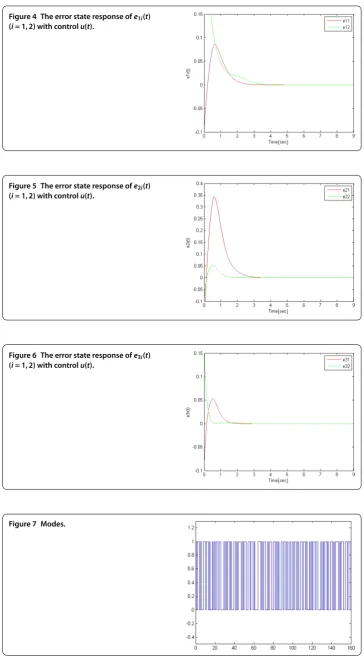
Figure 4 The error state response ofe1i(t)
(i= 1, 2) with controlu(t).
Figure 5 The error state response ofe2i(t)
(i= 1, 2) with controlu(t).
Figure 6 The error state response ofe3i(t)
(i= 1, 2) with controlu(t).
ters. The numerical simulations are presented in Figures -. We pay attention in Figure to Figure to see that the error dynamical system () is non-synchronous without the pinning controlleru(t). As a comparison, it can been seen in Figures - that the synchro-nization errors can first converge asymptotically to zero with the pinning controlu(t). In accordance with the transition probability matrix in (), a possible time sequence of the mode jumps is illustrated in Figure .
5 Conclusion
In this paper, we have developed an approach to solve the problem of synchronization for a class of complex dynamical networks with mixed mode-dependent delays. By building properly Lyapunov-Krasovskii functions involving triple integral terms and using integral inequalities, new synchronization criteria have been obtained, which guaranteed the syn-chronization of complex dynamical networks. The result is expressed in terms of LMIs. Finally, a numerical example is provided to illustrate the effectiveness of the proposed methods.
Competing interests
The authors declare that they have no competing interests.
Authors’ contributions
NM carried out the main part of this paper, YM participated in the discussion and revision of the paper. All authors read and approved the final manuscript.
Acknowledgements
This paper is supported by the National Natural Science Foundation of China (No. 61273004) and the Natural Science Foundation of Hebei province (No. F2014203085). The authors would like to thank the editor and anonymous reviewers for their many helpful comments and suggestions, improving the quality of this paper.
Received: 11 March 2016 Accepted: 15 August 2016
References
1. Boccaletti, S, Latora, V, Moreno, Y, Chavez, M, Huang, D: Complex networks: structure and dynamics. Phys. Rep.424, 175-308 (2006)
2. Albert, R, Barabasi, A: Statistical mechanics of complex networks. Rev. Mod. Phys.74, 47-97 (2002)
3. Li, X, Chen, GR: Synchronization and desynchronization of complex dynamical networks: an engineering viewpoint. IEEE Trans. Circuits Syst. I, Fundam. Theory Appl.50(11), 1381-1390 (2003)
4. Liu, Y, Wang, ZD, Liang, JL, Liu, XH: Synchronization and state estimation for discrete-time complex networks with distributed delays. IEEE Trans. Syst. Man Cybern., Part B, Cybern.38(5), 1314-1325 (2008)
5. Hoppensteadt, FC, Izhikevich, EM: Pattern recognition via synchronization in phase-locked loop neural networks. IEEE Trans. Neural Netw.11(3), 734-738 (2000)
6. Wei, GW, Jia, YQ: Synchronization-based image edge detection. Europhys. Lett.59(6), 814-819 (2002)
7. Li, D, Wang, Z, Ma, G: Controlled synchronization for complex dynamical networks with random delayed information exchanges: a non-fragile approach. Neurocomputing171, 1047-1052 (2016)
8. Mathiyalagan, K, Anbuvithya, R, Sakthivel, R, Park, JH, Prakash, P: Non-fragileH∞synchronization of memristor-based neural networks using passivity theory. Neural Netw.74, 85-100 (2016)
9. Anbuvithya, R, Mathiyalagan, K, Sakthivel, R, Prakash, P: Non-fragile synchronization of memrisitive BAM networks with random feedback gain fluctuations. Commun. Nonlinear Sci. Numer. Simul.29, 427-440 (2015)
10. Mathiyalagan, K, Park, JH, Sakthivel, R: Exponential synchronization for fractional-order chaotic systems with mixed uncertainties. Complexity21, 114-125 (2015)
11. Park, MJ, Kwon, OM, Ju, HP, Lee, SM, Cha, EJ: Synchronization of discrete-time complex dynamical networks with interval time-varying delays via non-fragile controller with randomly occurring perturbation. J. Franklin Inst.351, 4850-4871 (2014)
12. Su, L, Shen, H: Mixed/passive synchronization for complex dynamical networks with sampled-data control. Appl. Math. Comput.259(15), 931-942 (2015)
13. Hua, CC, Ge, C, Guan, XP: Synchronization of chaotic Lur’e systems with time delays using sampled-data control. IEEE Trans. Neural Netw. Learn. Syst.26, 1214-1221 (2015)
14. Rakkiyappan, R, Sakthivel, N: Pinning sampled-data control for synchronization of complex networks with probabilistic time-varying delays using quadratic convex approach. Neurocomputing162(25), 26-40 (2015) 15. Chen, WH, Jiang, ZY, Lu, XM, Luo, SX:H∞synchronization for complex dynamical networks with coupling delays
using distributed impulsive control. Nonlinear Anal. Hybrid Syst.17, 111-127 (2015)
17. Li, Z, Fang, JA, Miao, Q, He, G: Exponential synchronization of impulsive discrete-time complex networks with time-varying delay. Neurocomputing157, 335-343 (2015)
18. Wang, JY, Feng, JW, Xu, C, Zhao, Y, Feng, JQ: Pinning synchronization of nonlinearly coupled complex networks with time-varying delays usingM-matrix strategies. Neurocomputing177, 89-97 (2016)
19. Li, B: Pinning adaptive hybrid synchronization of two general complex dynamical networks with mixed coupling. Appl. Math. Model.40(4), 2983-2998 (2016)
20. Liu, XW, Xu, Y: Cluster synchronization in complex networks of nonidentical dynamical systems via pinning control. Neurocomputing168, 260-268 (2015)
21. Guo, L, Pan, H, Nian, XH: Adaptive pinning control of cluster synchronization in complex networks with Lurie-type nonlinear dynamics. Neurocomputing182, 294-303 (2016)
22. Cai, SM, Zhou, PP, Liu, ZR: Intermittent pinning control for cluster synchronization of delayed heterogeneous dynamical networks. Nonlinear Anal. Hybrid Syst.18, 134-155 (2015)
23. Jing, TY, Chen, FQ, Li, QH: Finite-time mixed outer synchronization of complex networks with time-varying delay and unknown parameters. Appl. Math. Model.39(23-24), 7734-7743 (2015)
24. Ma, YC, Zheng, YQ: Synchronization of continuous-time Markovian jumping singular complex networks with mixed mode-dependent time delays. Neurocomputing156, 52-59 (2015)
25. Shi, KB, Zhong, SM, Zhu, H, Liu, XZ, Zeng, Y: New delay-dependent stability criteria for neutral-type neural networks with mixed random time-varying delays. Neurocomputing168, 896-907 (2015)
26. Dai, Y, Cai, YZ, Xu, XM: Synchronization and exponential estimates of complex networks with mixed time-varying coupling delays. Int. J. Autom. Comput.6(3), 301-307 (2009)
27. Li, HJ: Delay-distribution-dependent synchronization of T-S fuzzy stochastic complex networks with mixed time delays. In: Chinese Control and Decision Conference, pp. 23-25 (2011)
28. Song, Q, Cao, JD, Liu, F: Pinning-controlled synchronization of hybrid-coupled complex dynamical networks with mixed time-delays. Int. J. Robust Nonlinear Control22(6), 690-706 (2012)
29. Sakthivel, R, Anbuvithya, R, Mathiyalagan, K, Ma, Y, Prakash, P: Reliable anti-synchronization conditions for BAM memristive neural networks with different memductance functions. Appl. Math. Comput.275, 213-228 (2016) 30. Hua, CC, Zhang, LL, Guan, XP: Decentralized output feedback adaptive NN tracking control for time-delay stochastic
nonlinear systems with prescribed performance. IEEE Trans. Neural Netw. Learn. Syst.26, 2749-2759 (2015) 31. Ali, MS, Saravanakumar, R, Zhu, QX: Less conservation delay-dependent control of uncertain neural networks with
discrete interval and distributed time-varying delays. Neurocomputing166, 84-95 (2015)
32. Hua, CC, Guan, XP: Smooth dynamic output feedback control for multiple time-delay systems with nonlinear uncertainties. Automatica68, 1-8 (2016)
33. Yang, XS, Yang, ZC: Synchronization of T-S fuzzy complex dynamical networks with time-varying impulsive delays and stochastic effects. Fuzzy Sets Syst.235(16), 25-43 (2014)
34. Saaban, AB, Ibrahim, AB, Shehzad, M, Ahmad, I: Global chaos synchronization of identical and nonidentical chaotic systems using only two nonlinear controllers. Int. J. Math. Comput. Phys. Electr. Comput. Eng.7(12), 338-344 (2013) 35. Duan, WY, Cai, CX, Zou, Y, You, J: Synchronization criteria for singular complex dynamical networks with delayed
coupling and non-delayed coupling. Control Theory Appl.30(8), 947-955 (2013)
36. Wang, Y, Wang, ZD, Liang, JL: Global synchronization stability for delayed complex networks switch randomly occurring nonlinearities and multiple stochastic disturbances. J. Phys. A, Math. Theor.42(13), 1243-1247 (2009) 37. Seuret, A, Gouaisbaut, F: Jensen’s and Wirtinger’s inequalities for time-delay systems. IFAC Proc. Ser.46(3), 343-348
(2013)