IJSRSET16254 | Received : 03 Sep 2016 | Accepted : 12 Sep 2016 | September-October-2016 [(2)5: 53-62]
© 2016 IJSRSET | Volume 2 | Issue 5 | Print ISSN: 2395-1990 | Online ISSN : 2394-4099 Themed Section: Engineering and Technology
53
Efficiency and Performance Optimization of Induction Motor Drive
B. Tiwari
1, P. K. Choudhary
2 1M.E. Student, RCET Bhilai, Chhattisgarh, India
2
Research Scholar, CSVTU Bhilai, Chhattisgarh, India
ABSTRACT
Induction Motor(IM) are known for its power/mass ratio, its efficiency, low cost and maintenance free performance during its life cycle therefore known as workhorses of industries. But huge amount of energy is wasted by IM due to their poor efficiency, also the operating cost is high. Therefore a small increment in efficiency may lead to contribute huge significant effect on the entire energy saving. The main key features in which estimation and re-production of optimal flux component of current (Ids) depends, are loss model control (LMC) and search control (SC). To drive loss-minimization expression, core saturation is considered with d-q loss model of IM. Ids value expression for various load profiles, this loss expression is used to derive optimal Ids expression and tabulation is done. According to the table, a model is designed. The optimal Ids* value can be calculated, which depends upon run-time profile, followed by feed-forward manner and thus eliminates complex computation of run time loss model. Comparison is done between proposed operation that is optimal Ids and constant Ids obtained by conventional method. Increment of 1-12% efficiency is observed.
Keywords - Variable speed Drive, Induction Motor, HVDC, Efficiency Optimization
I.
INTRODUCTION
Electricity generation, now-a-days, is done from non-renewable sources or resources of fuel like natural gases, coal and oil. Some of the key factors efforts the energy saving by limiting the resources, reducing greenhouse effects, increment in price and increment in load demand. It has been observed that about 65-70% of electricity which is generated totally is consumed by these generating motors it-self and about 85-90% of same electricity is utilized by three phase ac IM of wide capacity up to 100 Hp, which also include annual expansion rate to 1.5% and 2.2% of industrial and tertiary sector respectively. Since, number of motors in operation is increasing every year with already installed huge motors, a small increment in efficiency will leads to-wards significant revenue saving, consumption of fuel and other including factors. According to available report, every single increment in efficiency of motor may leads to revenue saving of around 1$ billion per annum with reduction in combustion of coal around 5.4-9.1 million tons. This single percent increment will also leads to reduction in emission of greenhouse gasses of around 5.4-9.1 million tons. For considerable saving in
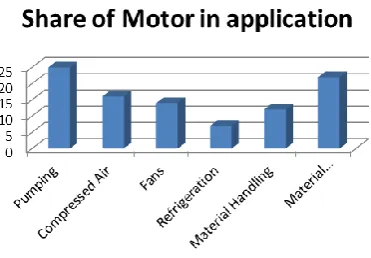
are fan system and compressed gas, pumping, material processing and handling, HVAC system, refrigeration etc. According to the report produced by the EIA (Energy Information Administration), Air conditioning (HVAC), ventilation, heating, and such application it i observed that about 50% of total consumption of electricity has been consumed by buildings of Malaysia due to installation of induction motor in such application. All these motors are normally operated in light load or partial load according to their demand and also waste lots of revenue due to light loading. Saving of energy for having energy efficient control of VFD (Variable Frequency Drives) has been achieving in a wide range. In spite this, the application like vehicles used for marine area that is marine vehicle, traction or electrical vehicle require optimized control in energy strategy since they are such application which are mainly operates in partial loads, so that consumption of energy will be in best manner. The work on these thesis mentioned by the application of IDM that is induction motor drives which is used as pumping application. This application is also such application in which induction motor operated below 60% of its rated vales that is they operates in light loads. Since, induction motor operates in light loads, especially in steady state condition by directly adapting optimal flux operation rather at rated flux strategy. The sharing of induction motors has also been estimated, that in most of the application, motor will operate in partial loads. Among these application, Pumping system and material processing will use around 50% of installed motors. The highest percentage of motor is shared by pumping system. These pumps are normally used in water treatment plant in which motor of 100 Hp and above rating motor has been used. Secondly, the share of motor about 22% has been done by material processing plant. Rest of the application share further 50% motor total installed they are mainly, Compressed air, fans, Refrigeration Material Handling and other application of 16%, 14%, 7%, 12% and 4% shares respectively.
Figure a. Share of Different Motor System
Indian Pumping Scenario
In Indian pumping context, there are pumping systems account for nearly 20% of the world’s energy used by electric motors and 25% to 50% of the total electrical energy usage in certain industrial facilities. Significant opportunities exist to reduce pumping system energy consumption through smart design, retrofitting, and operating practices. In particular, the many pumping applications with variable-duty requirements offer great potential for savings. The savings often go well beyond energy, and may include improved performance, improved reliability, and reduced life cycle costs. In pumping life cycle of motor there is 10-15% is its initial cost, 5-10% is maintenances cost, 10% is other cost and 60-75% is there electrical energy cost of its whole life cycle expansion, so there is wide area of energy saving is possible. Normally the efficiency of diesels pump is 20-30% and in place of diesel if use electrical energy the efficiency is increase and its range is 30-40%. In electrical pumping there is efficiency is also improve by adopting optimal flux operation in place of constant or convectional flux control. According to Ministry of Agriculture it accounts for 14% of India’s GDP Project Details in India. India`s Agriculture sector consumes about 140 billion units a year which is equivalent to around 18% of total National electricity consumption of India. The average efficiency level of in-efficient non-star rated pump sets are in the range of 25%-30%. Efficiency level of star rated energy efficient pump sets is 40%-45%. Potential of 20% savings is estimated by mere replacement of in-efficient pump sets with star rated pump sets.
Water Treatment Plant
II.
METHODS AND MATERIAL
A. Methods of Optimal Flux Operation
The productivity in various industries and home appliances will be of better quality by facilitating the revolution of automation to variable speed electrical drive. Recent advancements in power electronic, microelectronic and micro computing technologies have made it possible to implement variable speed induction motor in many applications. The system efficiency can be increased from 15 to 27% by the introduction of variable – speed drive operation in place of constant – speed operation, can lead to annual energy savings of up to 50%, when compared with fixed speed systems. To maintain the condition of operation within the limits of rated voltage and frequency, the combination of voltage and frequency can be used to supply the motor with variable voltage variable frequency operation. Many methods are there. The scalar control is based on the steady–state model of motor is due to magnitude variation of the control variable only. The stator voltage can be used to control the flux, and frequency or slip can be adjusted to control the torque. Different schemes for scalar control are used, such as: constant V/f ratio, constant slip, and constant air-gap flux control. One of the most popular control techniques is by varying frequency and voltage by maintaining their ratio constant, popularly known as V/f control. The developed torque by an induction motor is directly proportional to the ratio of the applied voltage and supply frequency. By changing the voltage and the frequency and by keeping constant ratio between them the torque developed can be made constant in entire speed range. This allows us to keep the torque of the motor nearly independent on the motor velocity. It is simple to implement and cost effective and used when the motor load is approximately independent on motor speed or if load dependence on speed is known in advance. In addition, this method has advantage like low starting current, but suffer a drawback due the inherent coupling effect (both torque and flux are function of stator voltage or current and frequency) give sluggish response and system is easily prone to instability. To improve the performance a close loop mode can be implemented. However, it is expensive and destroys the mechanical robustness of the drive system. Simple State Control, Loss Model Control and Search Control are the three main control techniques which are used to optimize the system. Many authors recognize
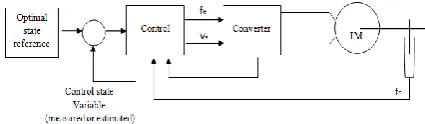
only two types (SC and LMC) since SSC can be viewed as a simpler form of LMC. Simple State Control is the first strategy which is based on the control of one specific variables or predefined relation in the drive. This variable must be measured or estimated and its value is used in the feedback control of the drive, with the aim of running the motor by predefined reference value. Slip frequency or power factor displacement are the most often used variables in this control strategy, which one to choose depends on which measurement signals are available. Power factor control is simple, i.e., it does not require speed or load information, and it has a relatively fast adaptation, it is a good choice for industrial drives. But the generation of optimal power factor commands remains restrictive and tedious. So trial and error methods are often used. On the other hand, the rotor slip frequency control requires both speed and load information. This strategy is simple, but gives good results only for a narrow set of operation conditions. Also, it is sensitive to parameter changes in the drive due to temperature changes and magnetic circuit saturation. In overall, these methods only yield suboptimal operation since parameter variations due to temperature changes and saturation effects are not taken into consideration.
Figure b. Block Diagram of Simple State Control
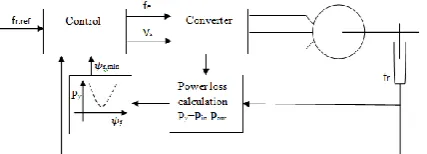
strategy is also sensitive to parameter variations in the drive.
Figure c. Block Diagram of Model Based Control
The third technique which based on the on-line procedure for the efficiency optimization is carried which termed as Search Control Method. The on-line efficiency optimization control on the basis of search, where the stator or rotor flux is decremented in steps until the measured input power settles down to the lowest value is very attractive. Search strategy methods have an important advantage compared to other strategies. It is completely insensitive to parameter changes while effects of the parameter variations caused by temperature and saturation are very expressed in two other strategies. Besides all good characteristics of search strategy methods, there is an outstanding problem in its use. When the load is low and optimal operating point is found, flux is so low that the motor is very sensitive to load perturbations. At minimum loss point the relation between flux and input power is almost flat. So to avoid oscillatory behaviour the input power must be accurately measured in the control. Also, flux convergence to its optimal value sometimes can be to slow, and flux never reaches the value of minimal losses then in small steps oscillates around it. Difficulties in tuning the algorithm for a given application and the need for precise load information are also there. For these reasons, this is not a good method in industrial drives.
Figure d. Block Diagram of Search Control Method
To achieve the good characteristics of two optimization strategies SC and LMC and it was enhanced attention as interesting solution for efficiency optimization of controlled electrical drives by combining the two method to obtain hybrid methods. The use of Artificial Intelligence (AI) techniques such as artificial neural
network (ANN), fuzzy logic, expert systems and nature inspired algorithms (NIA), Genetic algorithm and differential evolution in optimization have significant utility in flux optimization. There are many types of AI controllers applied to IM optimization through control as well as design and are available in the various literatures. Some controllers use Fuzzy ANN. Fast convergence can be achieved by these controllers. Nature Inspired Algorithms (NIA) are relatively a newer addition to class of population based stochastic search techniques based on the self-organizing collective processes in nature and human artefacts. Some popular NIA are Genetic Algorithms (GA), Particle Swarm
Optimization (PSO), Evolutionary Algorithm,
Simulated Annealing (SA), and Evolution Strategy, etc. NIA seem promising because of their social – cooperative approach and because of their ability to adapt themselves in the continuously changing environment. Various work done in the field of efficiency improvement are now explained in brief.
Simple State Control
Maximum Torque per Ampere (MTA) algorithm, ensuring a constant-optimal slip which is proposed for increasing the efficiency at light loads, based on an intuitive adaptation. MTA strategy imposes a constant optimal slip control equal to the inverse of rotor time constant. M. Cacciato, A. Consoli, G. Scarcella, G. Scelba and A. Testa et al. [3] proposed an experimental evaluation has been accomplished on a 1.5 Hp induction motor drive to measure the losses minimization and verify the dynamic performance of the proposed method. M.E.H. Benbouzid, and N.S. Nait et al. [4] deal with power factor tracking in a field-oriented scheme for induction motor drive leading to efficiency optimization. Simulation results illustrated that the efficiency is optimized in the light load region. They also noticed that efficiencies, with and without the optimization algorithm, are identical for rated loads.
Loss Model Control
loss model. Under specific speed and torque, without harmonic frequency effect consideration, the optimum voltage and slip frequency to achieve the minimum power losses are obtained,
√
( )
.
Search Control
Input power is a parabolic function of the flux that has strictly positive second derivative with the regime-dependent minimum that can be found by various search procedures. The loss function is concave and it means that there is a value of flux that will generate minimum power losses. The losses minimization condition with respect to air-gap flux of the induction motor can be determined by the sensitivity power losses equation equal to zero. This is given by:
( ) ( )
Solving for optimum air gap flux yields:
√
I. Kioskeridis and N. Margariset al. [14] and S. Kaboli, M. R. Zolghadri and E. Vahdati-Khajehet al. [15] suggested choosing stator current as the controlled variable in spite of input power. It is proved that better results are achieved if the stator current is used as the controlled variable. In addition, the stator current has more sensitivity to the flux variation than input power. They also concluded that the air gap flux should be always kept greater than 0.3 pu independent of control algorithm. It revealed that power input to the drive is smaller in stator current minimization than the power
input minimization. These properties allow
implementing an adaptive algorithm to determine the proper flux step without waste of time. This adaptive algorithm set a large flux step for transient state to speed up the convergence process and a small flux step for steady state to minimize the flux ripple.
Hybrid Methods
A perturb and observe technique is presented by P. K. Choudhary et al. [30], where the input variable is the magnetizing flux. The basic P&O algorithm is proposed
by P. K. Choudhary et al. [30]where the LMT perturbs the dc link voltage and the motor frequency to control the voltage and speed, respectively. The result is a variable V/f ratio that achieves optimum input power to the drive. Three LMTs were discussed by P. K. Choudhary et al. [30]. One is physics – based while two are hybrid. The physics-based techniques vary the frequency of the motor until the reference rotor speed is achieved. The voltage is then varied to reduce the input power. This procedure is repeated when the speed changes. It is suggested that in order to maintain maximum efficiency, the induction motor should operate at a constant slip given by P. K. Choudhary et al. [30]. The function of the efficiency in terms of slip frequency is derived after considerable algebraic expression is given by:
√ ( )
The slip frequency that result the maximum efficiency is determined by,
√ √
√
Another approach [68], the optimum torque current (Id)
for maximizing the efficiency is determined by differentiating the power losses function with respect to the torque current (Id) and equalling it to zero. The
optimal torque current (Id) for maximum efficiency is
given by,
√
( ) ( )
P. K. Choudhary et al. [30],also proposed loss minimizing control scheme for induction motors in vector control. With neglecting saturation and Ldis
d-axis inductance, the optimal torque current (Id) to
achieve the minimum losses is given by:
√
( )
B. Optimal Flux Estimation Methods
In this the various methods of induction motor loss
modelling for deriving optimal Ids expression in terms of
motor parameters and load parameters, which runs the
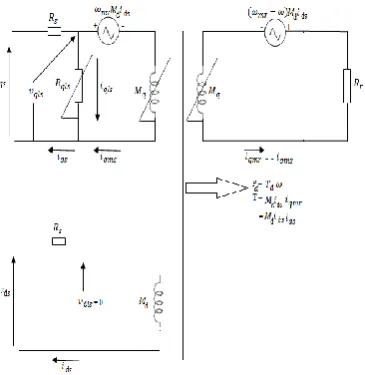
Figure e. IM Equivalent Circuit Generalized in d-q coordinates
After applying maxima, minima principle, optimal efficiency condition is achieved when
√
( ) ( )| |
This is called loss minimization factor (LMF).
The reference value ( ) can be determined by torque
control loop.
Problem Statement
The water treatment plant is generally posses the discontinous load, that is the load is not continous for 24 hours a day. It changes according to their requirement. So, the induction motor doesnot operate for rated torque or full load continously but runs partially for a day. So, the induction motor runs more in partial load than full load.Since, the efficiency of the system is maximum for the full load torque and it gradually decreases as we move to the load below full load. The range of the efficiency become very low for the partial load, that is load torque below 60% rated torque gives poor efficiency. The vector control is based on the PI controller which gives different Ids* value for different
combinations of speed and torque of the system. This
Ids* value is responsible for the efficiency of the system.
Since, for a particular load torque Ids* gets saturation at
a particular speed and do not increase even in the further incremet in speed. If there is increment in the value of Ids* for a particular load will lead to increment in the
efficiency of the system. To optimise the system, the
system will be mainly control by either LMC technique or SC technique. LMC is quick approach, involves computing the losses by using the machine model and choosing the flux level that minimizes these losses, but suffers a drawback due to parameter variation. On the other hand SC, which is fully insensitive to motor parameter variations, flux is decremented in steps till the measured input power settles to the lowest value, but suffers slow convergence and torque ripples. So, the hybrid combination of LMC and SC will be used as optimal control where both will compensate each other’s disadvantageous factor on a result an optimised system will be achieved.But, the main criteria is to increase this efficiency. According to the literature review, it is clear that the efficiency of overall system by using optimal control is superior than vector control strategy in the staeady state condition. But when we judge for the transient state, the vector control become superior than optimal control and gives higher efficiency. So, the requiremment of this project is to increase the efficiency for both transient and steady state, whether it runs for full load or partial load.
Figure f. Relationship Between and
C. Proposed Layout
In this paper, good features of both LMC and SC are
used. LMC is used for development of optimal Ids
values for efficiency optimization which basically
reproduces the value of Ids as command signal by using
the lookup table, in conventional vector control algorithm instead of its constant value.
√ ( )
( )| | ( )
√ ( ) ( )
is called Loss Minimization Factor (LMF).
efficiency. The response and efficiency of the Induction Motor in vector control is better in transient state than that of steady state if compared to optimal control. So, the sensor is designed such that it will operate the machine under vector control in transient and under optimal condition in steady state condition. In the above system, the induction motor has been selected for the rating of 100 Hp, 575 volt and 60 Hz with all the parameters shown in the induction motor block parameters toolbox with universal bridge connected with this induction motor which is shown by universal bridge block parameter toolbox. This possess the GTO/Diode device as inverter.
Look-Up Table Controller Optimal Operation
Conventional Vector Control
Inverter
Pulse Generator
IM
Load Pulse
Speed and Torque Signal
Feedback
I* d , I*q Id optimal , I*q
Sensor
Figure g. Efficiency Optimization Block Diagram
Indirect Vector or Field-Oriented Control Induction Motor Drive
The simulation has been done using this controller in MATLAB Simulink. A DC machine, traditionally, has been a superior choice for torque control. The commutator of the Dc machine holds a fixed, orthogonal spatial angel between field flux and armature magneto-motive force (MMF), allowing the torque and flux to be controlled in a doubled manner. Induction machine can emulate this control method. FOC control is a software that utilizes the position of the rotor combined with two-phase currents of generate a means of instantaneously controlling the torque and flux. Field-oriented controllers require control of both magnitude and phase of the AC quantities and are, therefore, also referred as vector controllers.
Optimal Control Induction Motor Drive
The optimal controller induction motor plays an important role in steel, paper and cement factories if designed properly specially for partial load. Since, indirect vector control is such a drive technique which is widely being employed in all industry to improve the efficiency of process but it normally does not work for partial load or give lower efficiency. So, a new hybrid combination of LMC and SC has been designed to optimise the efficiency of the system. According to the principle of optimal control, mathematical model of optimal control induction motor drive is described in detail. A PI controller is employed in combination of LMC and SC which has been so designed that it will search the perfect value of flux for selected torque and speed combination. since, the better efficiency under transient state in the indirect vector control induction motor drive but under steady state condition the optimal control much better efficiency. The simulation has been done using this controller in MATLAB Simulink.
III.
RESULTS AND DISCUSSION
The proposed scheme uses load torque information at a known speed in feed-forward way, and generates proper
value of flux component of current (Ids), that maximize
the motor efficiency at that given load profile, with the help of LMC and SC combination. The lookup table has been designed by calculating the reference value (Ids*)
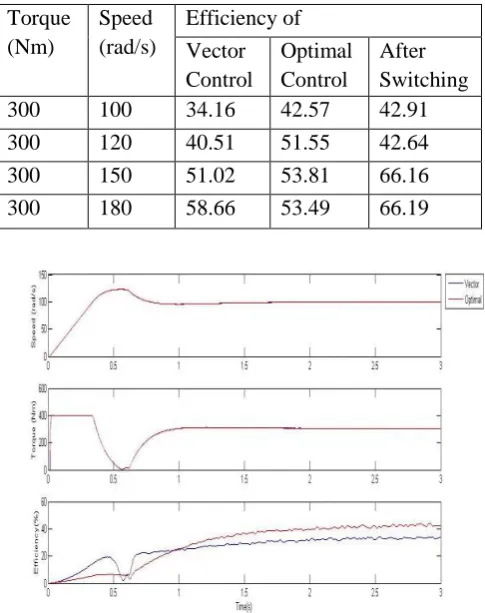
Table a : Efficiency Rise and Saving Percentage by Flux Optimization for 50 HP Motor
Torque (Nm)
Speed (rad/s)
Efficiency of Vector Control
Optimal Control
After Switching
300 100 34.16 42.57 42.91
300 120 40.51 51.55 42.64
300 150 51.02 53.81 66.16
300 180 58.66 53.49 66.19
Figure h. Speed, Torque and Efficiency performance at rated load torque (300N-m) at 100 rad/sec speed
Figure i. Speed, Torque and Efficiency performance at rated load torque (300N-m) at 100 rad/sec speed after
applying switch
IV.
CONCLUSION
In this work, the vector control method under steady state condition is not superior to optimal control both in terms of enhancement and in terms of energy saving. While observing the result, around 1-12% increment in efficiency has been observed that is improvement up to 12% is possible for 100 Hp, 50 Hz motor for all the different combination of speed and torque, or different load torque especially above 55-60 % of rated torque, in SIMULINK environment. While moving towards the value below 55 % of its rated load torque, increment in efficiency is reducing gradually. Here, the conventional method shows better performance than applied one.
Also the dynamic performance seems satisfactory and almost similar to the vector control. Even better performance is obtained for the torque value above 0.6 per unit but torque tracking accuracy is reduced by small value, but still capable of maintaining the combination of torque and speed. The explained methodology leads towards the huge amount of energy saving with a great contribution towards the environmental and social aspects. Although the vector control method under the condition of steady state is not superior to optimal operation both in terms of enhancement and energy saving but it shows better performance under transient condition. So, a switch has been connected which senses the running combination of speed and torque and changes its mode accordingly. If the running mode is transient, then the vector
controller controls the Ids of induction motor and when it
reaches to steady state; the change in mode will lead towards running the induction motor in optimal control. Also, the proposed hybrid approach eliminates the need of run-time computation complexity in traditional loss model controller (LMC) hence less hardware will be required and the applied method will be cost-effective. Even no run-time perturbations are present as it usually happens in the conventional search control (SC), therefore no torque ripples and hence less wear and tear of induction motor drive.
V.
APPENDIX
Induction machine rating: 575 V three-phase, 60 Hz, 100 Hp, four-pole, 1800 r/min.
Motor parameters: Rs=0.05963 Ω, Ls=0.633mH, Rr
=
0.03281 Ω, Lr
=
0.633mH, L0=27.42mH, J=1.3 kg.m
2
[1] A. M. Bazzi and P. T. Krein, "Review of methods for real-time loss minimization in induction machines," IEEE transactions on Industry application, vol. 46, no. 6, pp. 2319-2328, November/december 2010.
[2] J. F. Fuchsloch, W. R. Finley and R. W. Walter,
"The next generation motor: designing a new approach to improve the energy efficiency of NEMA premium motors”, IEEE Conf. 2008.
[3] M. Cacciato, A. Consoli, G. Scarcella, G. Scelba
and A. Testa, "Efficiency optimization techniques via constant optimal slip control of induction motor drives”, IEEE Conf. SPEEDAM 2006.
[4] M.E.H. Benbouzid, and N.S. Nait Said, "An
efficiency-optimization controller for induction motor drives”, IEEE Conf. Power Engineering Review, 1998.
[5] S. Chen and S. N. Yeh, "Optimal efficiency
analysis of induction motors fed by variable-voltage and variable-frequency source”, IEEE Trans. Energy Conversion, Vol. 7, No. 3, 1992.
[6] G. O. Garcia, J. C. Mendes Luis, R. M. Stephan
and E. H. Watanabe, "Fast efficiency maximizer for adjustable speed induction motor drive," in
International Conference on Industrial
Electronics, Control, Instrumentation, and
Automation, San Diego, CA, 1992.
[7] F. FemBndez-Bernal, A. Garcia-Cerrada and R.
Faure, "Model-based loss minimization for DC and AC vector controlled motors including core saturation," in Thirty-Fourth IAS annual meeting on Industry Applications, Phoenix, AZ, 1999. [8] M. N. Uddin and S. W. Nam, "New online
loss-minimization-based control," IEEE Transactions on Power Electronics, vol. 23, no. 2, pp. 926 - 933, March 2008.
[9] G. Dong and O. Ojo, "Efficiency optimizing
control of induction motor using natural
variables," IEEE transaction on industrial
electronics, vol. 53, no. 6, pp. 1791-1798, December 2006.
[10] Z. Qu, M. Ratna, M. Hinkkanen and J. Luomi,
"Loss-minimizing flux level control of induction motor drives," vol. 48, no. 3, May/June 2012.
[11] J.-F. Stumper, A. Dotlinger and R. Kennel, "Loss
minimization of induction machines in dynamic
operation," IEEE transactions on energy
conversion, vol. 28, no. 3, pp. 726-735, September 2013.
[12] F. Abrahamsen, F. Blaabjerg, J. K. Pedersen and
P. B. Thoegerse, "Efficiency-optimized control of medium-size induction motor drives," IEEE transaction on Industry Application, vol. 37, no. 6, pp. 1761-1767, November/December 2001.
[13] A. E. Fadili, F. Giri, A. E. Margi, R. Lajouad and
F. Z. Chaoui, "Towards a global control stratedy for indution motor: speed regulation, flux optimization and power factor correction," international journal of electrical power and energy system, vol. 43, pp. 230-244, December 2012.
[14] I. Kioskeridis and N. Margaris, "Loss
minimization in scalar-controlled induction motor drives with search controllers," IEEE transaction on power electronics, vol. 11, no. 2, pp. 213-220, march 1996.
[15] S. Kaboli, M. R. Zolghadri and E.
Vahdati-Khajeh, "A fast flux search controller for dtc-based induction motor drives," IEEE trans. Industrial electronics, vol. 54, no. 5, pp. 2407-2416, october 2007.
[16] M. C. Ta, C. Chakravorty and Y. Hori,
"Efficiency maximization of induction motor drives for electric vehicles based on actual measurement of input power," in IEEE conference IECON'O, 2001.
[17] D. S. Kirschen, D. W. Novotny and T. A. Lipo,
"On-line efficiency optimization of a variable
frequency induction motor drive," IEEE
transaction on industry application, vol. 21, no. 4, pp. 610-616, 1985.
[18] J. G. Cleland, V. E. Mccormick and M. W.
Turner, "Design of an efficinecy optimization controller for inverter-fed ac induction motors," in Industry application conference, orlando,FL, 1995.
[19] H. Rehman and X. Longya, "Alternative energy
vehicles drive system: control, flux, torque estimation, and efficinecy optimization," IEEE trans. vehicular technology, vol. 60, no. 8, pp. 3625-3634, October 2011.
[20] S. N. Vukosavic and E. Levi, "Robust dsp-based efficiency optimization of a variable speed induction motor drive," IEEE transaction on Industrial Electrinocs, vol. 50, no. 3, pp. 560-570, June 2003.
[21] C. Chakroborty and Y. Hori, "Fast efficiency
optimization techniques for the indirect
transaction on industry application, vol. 39, no. 4, pp. 1070-1076, July/August 2003.
[22] C. Chakraborty, C. T. Minh, T. Uchida and Y.
Hori, "Fast search controllers for efficinecy maximization of induction motor drives based on dc link power measurement," in Power conversion conference, Osaka, 2002.
[23] Z. Qu, M. Ranta, M. Hinkkanen and J. Luomi,
"Loss-minimizing flux level control of induction motor drives”, IEEE Trans. Industry Applications, Vol. 48, No. 3, May/June 2012.
[24] B. Pryymak, J. M. Moreno-Eguilaz and J.
Peracaula, "Neural network flux optimization using a model of losses in induction motor drives," in 8th international conference on modeling and simulation f electric machines, converters and systems, 2006.
[25] O. E. Ebrahim, M. A. Badr, A. S. Elgendy and P.
K. Jain, "ANN-based optimal energy control of induction motor drives in pumping applications," IEEE transaction on energy conversion, vol. 25, no. 3, pp. 652-660, September 2010.
[26] J. Li and Y.-R. Zhong, "Efficiency optimization of induction machines based on fuzzy search controller," in machine learning cybernetics, 2005.
[27] G. C. D. s. B. K. B. and J. G. c. , "fuzzy logic based on-line efficiency optimization control of an indirect vector controlled induction motor drive," in International Conference on Industrial Electronics, Control, and Instrumentation, Maui, HI, 1993.
[28] K. Sundareswaran and S. Palani, "fuzzy logic
approach for energy efficient voltage controlled induction motor drive," in IEEE International Conference on Power Electronics and Drive Systems, 1999.
[29] A. H. M. Yatim and W. M. Utomo, "Efficiency
optimization of variables speed induction motor drives using online back propogation," in Power and energy conference, 2006.
[30] P. K. Choudhary, S. P. Dubey and V. K. Gupta,