3629
Design Of Rme-Based Mathematical Module
Development In Improving Problem Solving
Ability
Dina Meika Putri, Suparman
Abstract: The aim of this study was to develop a RME-based mathematical module in improving problem solving ability. Data collection techniques used test and non-test instruments in form of collecting observations and interview guidelines. Module development used a four-D model. The stages of module development include: defining, designing, developing and disseminating. The subjects of this study were class IV of Muhammadiyah Kleco elementary school Yogyakarta, Indonesia. The object of this study consists of curriculum, student characteristics, evaluation, and teaching materials. This study produced a RME-based mathematical module designed that is suitable with the analysis of student needs to improve problem-solving ability in accordance with the curriculum, student characteristics, learning material, and also learning objectives. The design results of this module consist of a cover, preface, table of contents, module usage instructions, basic competencies, supporting information, and training. This study can be continued to be developed and disseminated for further purposes.
Index Terms: Mathematical module, problem solving, RME.
—————————— ——————————
1. INTRODUCTION
athematics is a branch of science that is very important to be taught[1]. Mathematics is also one of the branches of knowledge that refers to the experience in everyday life. Therefore, mathematics is one of the subjects that must be followed by students at every level of Education. In this modern era, mathematics experiences many developments in terms of its modeling in understanding the real events that occur around the environment [2]. Besides being a subject that is very much needed, mathematics is also used as a basic reference in solving problems. The most important aspect of mathematics learning is a problem-solving ability that is faced with real contexts in life [3], [4], [5]. Problem-solving skills can help develop mathematical understanding to train students' skills in learning mathematics [6]. Thus, the problem-solving ability has a major role in mathematics learning.
Even though problem-solving abilities are important, the fact that problem-solving skills up to now are still an urgent problem and need to be considered in mathematics learning [7]. Based on observations, the researchers found that students' problem-solving abilities, especially in flat-building material at Muhammadiyah Kleco elementary school, still needed to be improved. Students' difficulties in solving mathematical problems usually occur in the process of exposure and interpretation of problems presented [8], [9]. Another problem is that sudents still have difficulty in modeling and determining the initial steps to be taken when answering questions. The suitability of the use of teaching materials is able to help students in completing various forms of mathematical questions. One of the teaching materials is module [10]. The mathematical module is a guide to student learning independently in learning activities [11]. The math module consists of a set of learning activities that must be followed by the students to maximize their understanding as an
effort to develop important skills in achieving indicators of learning outcomes in teaching and learning process. The development of this module aims to help the learning process of students so that students can learn independently [12]. Modul can be used to describe the purpose and benefits of the learning process [13]. The use of modules can help teachers measure aspects of students' knowledge and skills [14]. Module development is tailored to the characteristics of students so that an interesting learning space is created [15]. In order for students' problem-solving skills to be trained and increased, the development of modules must also be in accordance with the characteristics of problem-solving. One of the learning strategies that can help students to improve their mathematical problem-solving abilities is the Realistic Mathematics Education (RME) approach [16] [17]. The RME approach aims to make the learning process more meaningful [18]. RME always presents and connects all mathematical problems in a real context, so that the learning process of students is related to their experiences in everyday life [19]. The use of concrete objects helps students construct their knowledge in dealing with various mathematical problems. Based on observations conducted at Muhammadiyah Kleco Elementary School in Yogyakarta, various problems related to students' problem-solving abilities, especially in flat-waking material, were found. Firstly, a lack of student understanding in understanding the characteristics of flat wake and the purpose of the questions presented. Secondly, there are conceptual errors in the process of working on the questions. Thirdly, most students have not mastered the preconditions of flat quadratic conditions. For example, lines are parallel, aligned and intersect Then, the use of teaching materials that do not support students in learning students' problem-solving skills. Several studies on the effectiveness of learning developed with realistic mathematical approaches have good results [20]. To implement RME-based learning, learning resources are needed to support the learning process such as math modules. The aim of this study was to develop the RME-based mathematical module design in improving the problem-solving ability of fourth-grade students in an elementary school. M
————————————————
Dina Meika Putri is currently pursuing masters degree program in mathematics education in University of Ahmad Dahlan, Indonesia, PH-087723631947. E-mail: [email protected]
Suparman is an associate professor in mathematics education at
University of Ahmad Dahlan, Indonesia, E-mail:
3630
2
METHOD
This study is a development research. The subjects of the research were the fourth-grade students of SD Muhammadiyah Kleco Yogyakarta, Indonesia. The objects of this study are curriculum, the characteristics of students and evaluation of teaching and learning materials. The instruments of data collection use documentation consisting of observation guidelines, interview guidelines, and also giving tests. The observation model is used to observe the learning model used during the learning process. Interview guidelines are given to teachers and students to analyze teaching materials that match the characteristics of students. Tests are given to students to measure and evaluate the students' problem-solving abilities during the teaching and learning process. The research model is the Four-D. The stages of the 4D model are the defining stage, the stage of designing the developing phase and the disseminating stage of Thiagarajan, Semmel, & Semmel [20]. The research and development procedures are as shown in fig. 1.
Figure 1 General steps in Research and Development.
In the define phase, researchers conduct material analysis, curriculum analysis, student analysis, and analysis of learning objectives. Then in the design phase, the researcher used the learning material developed. The instruments used were interviews and questionnaire guidelines. Data analysis techniques used were analyzing each questionnaire item, both questionnaires of material experts, media experts, and quantified student responses.
3
RESULT
AND
DISCUSSION
The study was conducted by designing a RME-based mathematical module in improving the problem-solving abilities in fourth-grade students in elementary school. The design of teaching materials is suitable with the students’ needs. The design phases include media selection, format selection, and also initial design. There are some stages in designing teaching materials including making cover modules, identifying basic competencies, identifying learning objectives, making concept maps of teaching materials, designing teaching materials and evaluating learning. Basic competence is used as a reference for designing teaching materials. Learning objectives are used as the targets for learning development, concept maps illustrate teaching sub-materials.
Teaching material development and learning evaluation are developed according to the ability to be measured. The basic competence to be achieved is shown in table 1.
Table 1 Basic Competence
Based on Table 1, there are two basic competencies that are used in learning quadrilateral flat building material. This basic competency is needed to train students in the learning process. And then the learning objective is shown in table 2.
Table 2 Learning Objective
The learning objectives to be achieved in this development module are students who can explain the characteristics of various types of flat, both flat and high shapes of triangles. Besides, students are also expected to have skills in resolving flat difficulties. Just an example: students can calculate the area and circumference of a flat shape. The success of the learning process depends on the achievement of learning objectives. In addition to the learning objectives, the thing to do is to design the module cover. Here is the cover of the module listed in Fig. 2.
Define
Design
Development
3631 Figure 2 is the module cover. The module cover is designed
based on the theme of the teaching material contained in it. The teaching material contained in the module is a quadrilateral designed to suit the characteristics of the RME.
The picture on the cover shows various forms of flat shape summarized into the form of a joglo house. The cover is designed as attractive as possible so that students are more ambitious in learning mathematics. The cover design also features the researcher's identity. In the cover attache various types of shapes to be discussed. The module cover also attaches the characteristics of the module. The problems presented are very closely related to everyday life. The combination of colors on the cover becomes very important to attract the attention of the reader. After designing the cover is the author's data. The data is intended so that the reader of the mathematics module can recognize the module writer. Also, with the existence of personal data, the author of the book can be identified. Inside the personal data contained the name, hobbies, aspirations of the writer and the activities being undertaken by the author. Personal data is also evidence of ownership of the work and performance in the preparation of the module. So that the work made is protected from recognition by other people. Usually, personal data also has a special attraction for the reader. So it is very important to attach the personal data in the module design. Therefore, personal data becomes very important to be attached to work, it shown in fig.3.
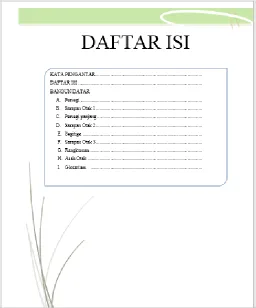
As shown figure 3,The author is active in disseminating the charitable learning movement aimed at the local community. After the data themselves, the next design is a table of contents, as in fig.4..
In figure 4, Table of Contents is the page that guides the main contents of the book along with the page numbers. Table of contents can make it easier to search for vocabulary or sub material contained in the module. The next design is a concept maps, as shown fig.5.
3632
relationship between the components of rectangular flat building material. The use of Concept maps affects Teaching material, as in the fig. 6.
Figure 6 is supporting information that can complement
mathematical modules relating to quadrilateral and everyday problems. Students are presented with a variety of real information. So, they will be easier to understand it, able to solve the problems provided make students easier to understand the material. After the supporting information, the next design is learning evaluation, as shown fig. 7.
The Learning Evaluation is given based on the level of the students’ ability in understanding and solving problems. The third stage of development is the stage of developing learning materials and design instruments used to measure the performance of products that have been developed. At the expert validation stage, the learning material is validated by a validator lecturer, material expert, media expert lecturer, and teacher at the school. The validation of learning materials uses assessment instruments that have been reviewed by several material the expert teachers at SD Muhammadiyah Kleco. Furthermore, the instruments in the form of questionnaires were reviewed. After the instrument is valid, the instrument can be used by material experts and media experts to assess the learning material being developed. The table below shows the result of the questionnaire’s calculation regarding the feasibility of instructional media by material experts. The table below of the shows the results of questionnaire calculations about the feasibility of instructional media by material experts. The results of these calculations can determine the level feasibility of learning media that has been designed. The feasibility of learning media can have an influence on the implementation of mathematics learning during the learning process at school. One of the factors causing the success of learning objectives is the feasibility of learning media, that is applied during learning. Besides, the use of media can be developed for educational applications [21]. It is shown in table 3.
Table 3
The result
of the
3633
Based on Table 3 above, it can be seen that the average score of the material expert assessment is 82. So, it can be concluded that the learning media developed in terms of media are included in the very good category. These results indicate that the development of mathematics learning media in the form of modules are declared feasible and can be used or applied during the learning process. Also, learning media are considered capable of measuring students' problem-solving abilities.
CONCLUSION
The learning material developed has the advantages of improving mathematical problem-solving abilities of quadrilateral course in fourth grade students. The material presented includes indicators of problem-solving skills that are integrated into questions and integrate learning approaches in accordance with Realistic Mathematics Education (RME). After this research design was carried out, the next research was the development of learning materials based on Realistic Mathematics Education until the development and deployment stage could be implemented.
ACKNOWLEDGMENT
The author thanked the Ahmad Dahlan University for facilitating the author to complete this research. Thanks also to the head of our master program department, Mr. Suparman, who taught and motivated researchers to complete the research in mathematics education. Finally, the researcher also thanked the school and the teacher for help in facilitating the researcher with the students who were used as the research subjects in this research.
REFERENCES
[1] Rittle‐Johnson, B, Developing mathematics knowledge, vol. 11, no. 3, pp. 184-190, 2017. Child Development Perspectives.
[2] Huber, D., Jones, L., & Helminski, C, The Importance of Mathematical Models to Scientific Discovery, vol. 71, no. 3, pp. 24-29, 2015. A Case Study on the Feeding Mechanism of the Goliath Grouper" Epinephelus itajara". Australian Mathematics Teacher.
[3] Grønmo, L. S., Lindquist, M., Arora, A., & Mullis, mathematics framework, vol. 1, no. 5, pp. 11-27, 2015, TIMSS.
[4] Liljedahl, P., Santos-Trigo, M., Malaspina, U., & Bruder, R, Problem solving in mathematics education. In Problem Solving in Mathematics Education , pp. 1-39, 2016, Springer, Cham.
[5] Kartono, H.U., dan Retnoningsih, A, Analysis of mathematics problem solving ability of junior high school student viewed from student’s cognitive style, vol. 2, no. 10, pp. 578, 2014, International journal of education and research.
[6] Siska Apulina Peranginangin, Edy Surya, An Analysis of Students’ Mathematics Problem Solving Ability in VII
Grade at SMP Negeri 4 Pancurbatu, vol. 33, no 2, pp. 57-58, 2017, International Journal of Sciences: Basic and Applied Research (IJSBAR).
[7] Liljedahl, P, On the Edges of Flow: Student Problem-Solving Behavior, pp. 505-524, 2018, In Broadening the Scope of Research on Mathematical Problem Solving, Springer, Cham.
[8] Jupri, A., & Drijvers, P. H. M, Student difficulties in mathematizing word problems in algebra. Vol.13, no 9, pp. 2481-2502, 2016, Eurasia Journal of Mathematics, Science and Technology Education.
[9] Banyuningsih, A.S., Usodo, B., dan Subanti, Analysis of Junior High School Students’ Problem-solving Ability Reviewed from Self-regulated Learning, vol.2, no.1, pp.52, 2017, International Journal of Science and Applied Science.
[10]Madlung, A, Assessing an effective undergraduate module teaching applied bioinformatics to biology students, vol.14, no.1, 2018, PLoS computational biology. [11] Kane, J, A Case Study Documenting the Effects of Response to Intervention Practices on Mathematics Success in Elementary Education,vol.18, no.2, pp. 40, 2018, Culminating Experience Action Research Projects, Spring 2016, 40.
[12]Takahashi, A, Recent Trends in Japanese Mathematics Textbooks for Elementary Grades: Supporting Teachers to Teach Mathematics through Problem Solving, vol.4, no.2, pp. 313-319, 2016, Universal Journal of Educational Research.
[13]Hohenwarter, J., Kocadere, S. A., & Hohenwarter, M. (2017, February). Maths teachers’ adventure of ICT integration: From an open online course towards an online teacher community. In CERME 10.
[14]Singh, C. K. S., Singh, R. K. A., Singh, T. S. M., Mostafa, N. A., & Mohtar, T. M. T, Developing a Higher Order Thinking Skills Module for Weak ESL Learners, vol.11, no.7, pp. 86-100, 2018, English Language Teaching. [15]Limongelli, C., Lombardi, M., Marani, A., Sciarrone, F., &
Temperini, M, A recommendation module to help teachers build courses through the Moodle Learning Management System, vol.22, no.1-2, pp. 58-82, 2016, New Review of Hypermedia and Multimedia.
[16]Septriyana, Y., Fauzan, A., & Ahmad, R. (2019, January). The Influence of Realistic Mathematics Education (RME) Approach on Students’ Mathematical Problem Solving Ability. In International Conference on Islamic Education (ICoIE 2018). Atlantis Press.
[17]Hasibuan, A. M., Saragih, S., & Amry, Z, Development of Learning Materials Based on Realistic Mathematics Education to Improve Problem Solving Ability and Student Learning Independence. Vo.14, no.1, pp. 243-252, 2018, International Electronic Journal of Mathematics Education. [18]Nickerson, S. D., Lamb, L., & LaRochelle, R, Challenges
in measuring secondary mathematics teachers’ professional noticing of students’ mathematical thinking, pp.381-398, 2017, In Teacher noticing: bridging and broadening perspectives, contexts, and frameworks, Springer, Cham.
3634
[20]Houghton, C., Murphy, K., Shaw, D., & Casey, D. (2015). Qualitative case study data analysis, vol.22, no. 5, 2015, An example from practice. Nurse Researcher (2014+) 8. [21]Phillips, R. (2014). The Developer's Handbook of