Luis Bautista1,2, Alain Abran2, Alain April2
1
Department of Electronic Systems, Autonomous University of Aguascalientes, Aguascalientes, Mexico; 2Department of Software Engineering and Information Technology, ETS University of Quebec, Montreal, Canada.
Email: [email protected], {alain.abran, alain.april}@etsmtl.ca
Received December 20th, 2011; revised January 21st, 2012; accepted February 5th, 2012
ABSTRACT
Cloud Computing is an emerging technology for processing and storing very large amounts of data. Sometimes anoma-lies and defects affect part of the cloud infrastructure, resulting in a performance degradation of the cloud. This paper proposes a performance measurement framework for Cloud Computing systems, which integrates software quality concepts from ISO 25010.
Keywords: Cloud Computing; Measurement; Performance; ISO 25010; COSMIC; Maintenance
1. Introduction
Cloud Computing (CC) is an emerging technology aimed at processing and storing very large amounts of data. It is an internet-based technology in which several distributed computers work together to efficiently process large amounts of information, while ensuring the rapid processing of query results to users. Some CC users prefer not to own the physical infrastructure they are using: instead, they rent cloud infrastructure, or a cloud platform or software, from a third-party provider. These infrastructure application op-tions delivered as a service are known as Cloud Services [1].
One of the most important challenges in delivering Cloud Services is to ensure that they are fault tolerant. Fail-ures and anomalies can degrade these services, and im-pact their quality, and even the availability. According to Coulouris [2], a failure occurs in distributed systems (DS), like CC systems (CCS), when a process or a communica-tion channel departs from what is considered to be its normal or desired behavior. CCS include all the technical resources clouds have in order to process information, like software, hardware, and network elements, for example. An anomaly is different, in that it slows down part of a CCS without making it fail completely, impacting the performance of tasks within nodes and, consequently, of the system itself.
A performance measurement framework (PMF) for CCS should propose a means to identify and quantify “normal cluster behavior”, which can serve as a baseline for de-tecting possible anomalies in the computers (i.e. nodes in a cluster) that may impact cloud performance. To achieve
this goal, methods are needed to collect the necessary base measures specific to CCS performance, and analysis models must be designed to determine the relationships that exist among these measures.
The ISO International Vocabulary of Metrology (VIM) [3] defines a measurement method as a generic descrip-tion of a logical organizadescrip-tion of operadescrip-tions used in meas-urement, and an analysis model as an algorithm or calcu-lation combining one or more measures obtained from a measurement method to produce evaluations or estimates relevant to the information needed for decision making.
The purpose of a measurement process, as described in ISO 15939 [4], is to collect, analyze, and report data re-lating to the products developed and processes implemented within the organizational unit, to support effective man-agement of the process, and to objectively demonstrate the quality of the products.
ISO 15939 [4] defines four sequential activities: estab-lish and sustain measurement commitment, plan the meas-urement process, perform the measmeas-urement process, and evaluate the measurement. These activities are performed in an iterative cycle that allows for continuous feedback and improvement of the measurement process, as shown in Figure 1.
Figure 1. Sequence of activities in a measurement process (Adapted from the ISO 5939 measurement process model [4]).
the design of a measurement method and a performance measurement model for CCS will be developed.
This paper is structured as follows. Section 2 presents related work on performance measurement for computer based systems. Section 3 establishes the performance con-text for CC by defining the basic concepts of performance and developing an overview of the elements involved in the measurement process. Section 4 presents the design of the proposed PMF for CCS using COSMIC concepts. In addition, this section introduces a number of key interna-tional standards terms, related to performance, with which we further detail the PMF described in this section. Fi-nally, Section 5 summarizes the contributions of this re-search and suggests future work.
2. Related Work
2.1. Performance Measurement Approaches for Computer Systems
Currently, the measurement of computer-based system (CBS) performance has been investigated in the computer sci-ence literature from the following viewpoints: load bal-ancing, network intrusion detection, and host state main-tenance. For example, Burges [5] defines system per-formance as “normal behavior”, and proposes that this behavior can only be determined by learning about past events and by modeling future behavior using statistics from the past and observing present behavior. According to Burges, modern computing systems are complex: they are composed of many interacting subsystems, which makes their collective behavior intricate and, at the same time, influences the performance of the whole system.
Other authors have tried to predict the performance of complex systems (computer clusters, for example) by simulating cluster behavior using a virtual environment. For instance, Rao [6] estimates the variation of cluster performance through changes in task size, as well as the time taken to solve a particular problem. He has also built a predictive model using regression analysis to in-vestigate the behavior of the system and predict the
per-formance of the cluster.
Other published approaches have focused on the reli-ability aspects of large, high-performance computer sys-tems in order to measure system performance. Smith [7] observes that failure occurrence has an impact on both sys-tem performance and operational costs. He proposes an automatic mechanism for anomaly detection that aims to identify the root causes of anomalies and faults. Smith [7] has also developed an automatic anomaly detection frame-work that is aimed at processing massive volumes of data using a technique based on pattern recognition. In a case study, Smith identifies health-related variables, which are then used for anomaly detection. Each of these variables is related to a system characteristic (such as user utiliza-tion, CPU idle time, memory utilizautiliza-tion, I/O volume op-erations). Once the measurement data have been collected, he proposes clustering categories, where an outlier de-tector identifies the nodes that potentially have anomalies. Finally, a list of those possible anomalies is sent to a system administrator who has the expertise to quickly confirm whether or not an anomaly exists.
Smith’s research presents interesting avenues for the measurement of system performance from various perspec-tives. Further work is needed to define an integrated model of performance measurement, which would include the perspectives of users, developers, and maintainers.
2.2. Jain’s System Performance Concepts and Sub Concepts
Figure 2 presents the possible outcomes of a service re-quest to a system and the sub concepts associated with them.
2.3. ISO 25010 Performance Concepts and Sub Concepts
There are several software engineering standards on sys-tem and software quality models, such as ISO 25010 [9], which is a revision of the ISO 9126-1 [10] software qual-ity model. The ISO 25010 standard defines software pro- duct and computer system quality from two distinct per-spectives: 1) a quality in use model, and 2) a product quality model:
1) The quality in use model is composed of five char-acteristics that relate to the outcome of an interaction when a product is used in a particular context of use. This qual-ity model is applicable to the entire range of use of the human-computer system, including both systems and soft-ware.
2) The product quality model is composed of eight char-acteristics that relate to the static properties of software and the dynamic properties of the computer system.
This product quality model is applicable to both sys-tems and software. According to ISO 25010, the proper-ties of both determine the quality of the product in a par-ticular context, based on user requirements. For example, performance efficiency and reliability can be specific con-cerns of users who specialize in areas of content delivery, management, or maintenance. The performance efficiency concept proposed in ISO 25010 has three sub concepts: 1) time behavior, 2) resource utilization, and 3) capacity, while the reliability concept has four sub concepts: 1) maturity, 2) availability, 3) fault tolerance, and 4) recov-erability. In this research, we have selected performance efficiency and reliability as concepts for determining the performance of CCS. Both Jain’s proposal and the ISO 25010 concepts and sub concepts form the basis of our definition of the performance concept in CC.
3. Definition and Decomposition of the
Performance Concept for
Cloud Computing
3.1. Definition of the Performance Concept for Cloud Computing
[image:3.595.309.541.85.238.2]Based on the performance perspectives presented by Jain and the product quality characteristics defined by ISO 25010, we propose the following definition of CCS per-formance measurement:
Figure 2. Possible outcomes of a service request to a system, according to Jain [10].
“The performance of a Cloud Computing system is de-termined by analysis of the characteristics involved in performing an efficient and reliable service that meets requirements under stated conditions and within the maximum limits of the system parameters.”
Although at first sight this definition may seem com-plex, it only includes the sub concepts necessary to carry out CCS performance measurement from three perspec-tives: 1) users, 2) developers, and 3) maintainers.
Furthermore, from the literature review, a number of sub concepts have been identified that could be directly related to the concept of performance, such as:
Performance efficiency: The amount of resources used under stated conditions. Resources can include soft-ware products, the softsoft-ware and hardsoft-ware configura-tion of the system, and materials.
Time behavior: The degree to which the response and processing times and throughput rates of a product or system, when performing its functions, meet require-ments.
Capacity: The degree to which the maximum limits of a product or system parameter meet requirements. Resource utilization: The degree to which the amounts
and types of resources used by a product or system when performing its functions meet requirements. Reliability: The degree to which a system, product or
component performs specified functions under speci-fied conditions for a specispeci-fied period of time.
Maturity: The degree to which a system meets needs for reliability under normal operation.
Availability: The degree to which a system, product or component is operational and accessible when required for use.
Fault tolerance: The degree to which a system, prod-uct, or component operates as intended, in spite of the presence of hardware or software faults, and,
3.2. Definition of a Performance Context Diagram for Cloud Computing
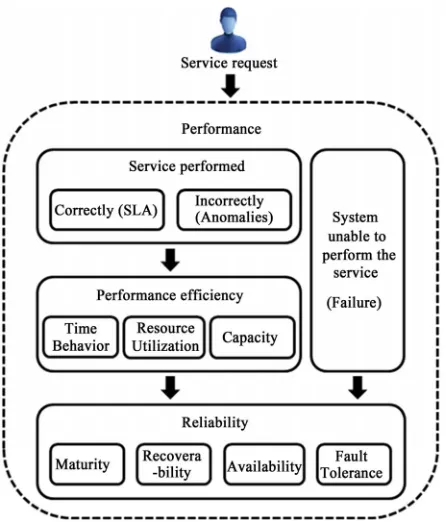
Now that the CCS performance measurement concepts and sub concepts have been identified, a context diagram will be helpful that shows the relationships between the performance sub concepts proposed by ISO 25010 and the performance measurement perspective presented by Jain, as well as the logical sequence in which the sub con-cepts appear when a performance issue arises in a CCS (see Figure 3).
In this figure, system performance is determined by two main sub concepts: 1) performance efficiency, and 2) reliability. As explained previously, when a CCS receives a service request, there are three possible outcomes (the service is performed correctly, the service is performed incorrectly, or the service cannot be performed). The out-come will determine the sub concepts that will be applied for performance measurement. For example, suppose that the CCS performs a service correctly, but, during its execu-tion, the service failed and was later reinstated. Although the service was ultimately performed successfully, it is clear that the system availability (part of the reliability sub concept) was compromised, and this affected CCS performance.
As illustrated above, CCS performance can be based on two main concepts: 1) performance efficiency, and 2) reliability. Performance efficiency will determine the amount of resources used for a period of time, while reliability will determine the degree to which a system successfully performs specified functions during the same period. Re- sources include all CCS elements, such as: software ap-plications, hardware system, and network system.
4. Design of Performance Measurement
Framework for Cloud Computing
4.1. The COSMIC Measurement Method Model
The ISO 19761 COSMIC v 3.0 Functional Size Meas-urement Method (FSM) [11] defines an explicit model of software functionality derived from the functional user requirements (FUR). FUR describe the functionality that the software or system is to execute (sometimes also known as system capabilities). According to this method, each FUR is represented by one or more functional processes within the piece of software to which it has been allo-cated. In turn, each functional process is represented by sub processes, which can be of the data movement type or the data transform type.
Based on this explicit model of functionality, four data movement types are recognized (Entry, Exit, Read, and Write). Figure 4 shows the COSMIC model of generic software adapted from Figure 12.4, p. 256 of [12]).
[image:4.595.312.535.82.343.2]According to the COSMIC model [12], software is de-limited by hardware, as shown on the left-hand side of
[image:4.595.310.537.379.551.2]Figure 3. Context diagram for Cloud Computing perform-ance measurement.
Figure 4. COSMIC model of generic software-adapted from Figure 12.4 of [12].
ample, in real-time software, users are typically replaced by engineered devices that interact directly with the soft-ware; that is, the users are I/O hardware. In other domains, like business application software, for example, the ab-straction commonly assumes that the users are one or more humans who interact directly with the software, ignoring the I/O hardware/software boundary.
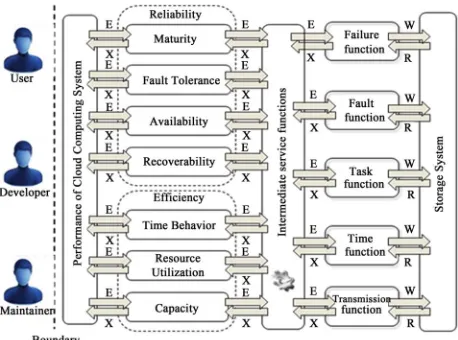
Based on the COSMIC model of generic software and the abstractions mentioned above, our proposed design for the generic PMF for CC is presented in Figure 5.
The left-hand side of Figure 5 presents the CCS. En-tries are the detailed attributes that determine CCS per-formance: for example, system attributes such as mem-ory use, CPU loads, network information, etc., as well as user application attributes, such as successfully performed tasks, error tasks, etc. These attributes are used to quan-tify the efficiency and reliability concepts through vari-ous measurement functions to be able to satisfy func-tional requirements.
These measurement functions provide an interpretation of the system attributes, i.e. they assign values to the properties. A target value of the attribute measure repre-sents a system requirement, i.e. the required value of the availability property. Similarly, the actual value of the measurement represents the observed level of satisfaction of the requirement.
[image:5.595.305.537.349.727.2]So, the above measurement functions share common base measures between the concepts using intermediate Entries and Exits as communication channels. A base measure is the result of the measurement of an attribute obtained through a measurement method. The right-hand side of the figure shows the system that stores the func-tion results to be used to determine CCS performance through, for example, an analysis model.
Figure 5. Generic performance measurement framework for CC.
formance concepts (refer to Figure 3) that represent the system attributes, and which can be measured to assess whether or not the CCS satisfies the system requirements. We chose the ECSS [14] and ISO 25010 [9] standards to carry out an inventory of requirement terms (both stan-dards are recognized guidelines used in academia and by practitioners to define both hardware and software sys-tems). A number of terms have been identified that rep-resent key aspects of measurement, and these have been included in the proposed performance framework.
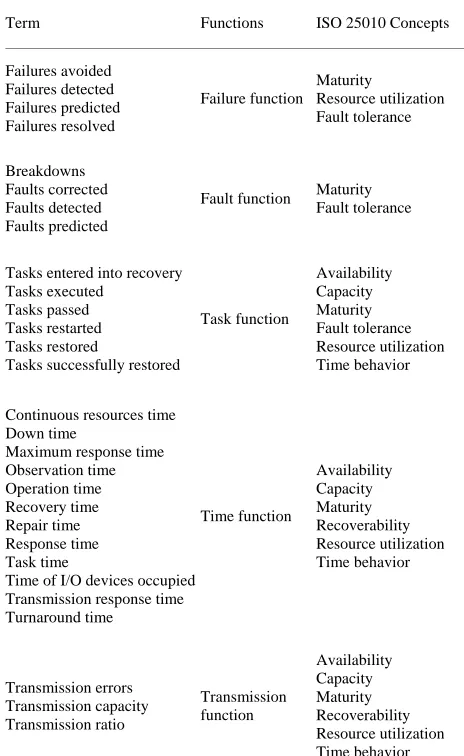
[image:5.595.56.294.575.708.2]These terms are grouped into functions, which are re-sponsible for conducting the measurement process using a combination of base measures. They are associated with the corresponding ISO 25010 quality concepts, as pre-sented in Table 1.
Table 1. Terms associated with performance sub concepts.
Term Functions ISO 25010 Concepts
Failures avoided Failures detected Failures predicted Failures resolved
Failure function
Maturity
Resource utilization Fault tolerance
Breakdowns Faults corrected Faults detected Faults predicted
Fault function Maturity Fault tolerance
Tasks entered into recovery Tasks executed
Tasks passed Tasks restarted Tasks restored
Tasks successfully restored
Task function
Availability Capacity Maturity Fault tolerance Resource utilization Time behavior
Continuous resources time Down time
Maximum response time Observation time Operation time Recovery time Repair time Response time Task time
Time of I/O devices occupied Transmission response time Turnaround time
Time function
Availability Capacity Maturity Recoverability Resource utilization Time behavior
Transmission errors Transmission capacity Transmission ratio
Transmission function
4.4. Detailed Performance Measurement Framework
Now that the terms related to the performance concepts have been identified and categorized, we position the resulting functions (on the right-hand side of Figure 6) in a more detailed view of the PMF for CC. These functions would be interconnected through an intermediate service that shares common base measures, reducing the number of operations in the measurement process at the time of calculation.
The resulting PMF is composed of seven quality con-cepts which are presented on the left-hand side of Figure 6. Each concept is measured using the five basic func-tions that will share base measures through an intermedi-ate service (IS). This means that the IS will share results from the measurement processes of each function.
It is important to mention that this PMF proposal ad-dresses the generic requirements for capturing the data needed for the context diagram presented earlier, in Fig-ure 3. These data can be collected using automated data collection software.
4.5. Example of Measurement of the Availability Concept
Using the proposed PMF for CC, we can demonstrate how to measure the Cloud availability concept. This concept (shown in Table 1) is determined by using three functions: 1) the time function, 2) the task function, and 3) the transmission function. For example, a time func-tion can use several different measurements, such as CPU user utilization, job duration, and response time. These measurements are obtained through a measure-ment method that uses a data collector to obtain the base measures needed. In turn, these base measures are input-ted to a time function that calculates a derived measure of the time concept. The intermediate service (IS) com-bines the derived measures of each function to determine a measurement of the availability concept that contrib-utes to CCS performance, along with the other concept measures defined in the framework.
It is important to mention that this measurement pro-cedure is similar for all the concepts. The measures are then grouped together, depending on the desired perspec-tive: user, developer, or maintainer.
Finally, the performance analysis of the CCS is sup-ported by an analysis model to help interpret the results by relating them to the initial performance requirements.
5. Summary, Contributions, and
Future Work
[image:6.595.308.537.90.260.2]Cloud Computing is an Internet-based technology aimed at processing very large amounts of data in a more effi-cient way, and one of its most important challenges is to
Figure 6. Detailed performance measurement model for CC.
deliver a high level of tolerance to faults and anomalies. This paper proposes a performance measurement frame-work for Cloud Computing systems. Such frameframe-work should define the elements necessary to measure “cluster behavior” using software quality concepts. The design of our framework is based on the concepts of metrology, along with aspects of software quality directly related to the performance concept, which are addressed in the ISO 25010 international standard. We found through our lit-erature search that the performance efficiency and reli-ability concepts are closely associated with the meas-urement perspective of Jain. As a result, this research proposal integrates ISO 25010 concepts into Jain’s per-spective for the performance measurement of informa-tion systems. The terminology and vocabulary associated with performance are aligned with many different inter-national standards, such as ECSS. This first performance measurement framework for Cloud Computing systems (see Figure 5) was designed based on the COSMIC pro-posal that models generic software, and includes the fun- ctions required to measure performance.
This research work proposes a novel performance meas-urement framework for Cloud Computing systems. It de- fines the basis for the design of a measurement method and will make it possible to measure the Cloud Comput-ing concepts that are directly related to performance.
Shi, “Tools and Technologies for Building Clouds,”
Cloud Computing: Principles, Systems and Applications,
Computer Communications and Networks, Springer-Verlag,
Berlin, 2010. doi:10.1007/978-1-84996-241-4_1
[2] G. Coulouris, J. Dollimore and T. Kindberg, “Distributed Systems Concepts and Design,” Addison-Wesley, 4th Edition, Pearson Education, Edinburgh, 2005.
[3] ISO/IEC Guide 99-12, “International Vocabulary of Me-trology—Basic and General Concepts and Associated Terms, VIM,” International Organization for Standardiza-tion ISO/IEC, Geneva, 2007.
[4] ISO/IEC 15939, “Systems and Software Engineering— Measure,” International Organization for Standardization ement Process, Geneva, 2007.
[5] M. Burgess, H. Haugerud and S. Straumsnes, “Measuring System Normality,” ACM Transactions on Computer
Systems, Vol. 20, No. 2, 2002, pp. 125-160.
doi:10.1145/507052.507054
[6] A. Rao, R. Upadhyay, N. Shah, S. Arlekar, J. Ragho- thamma and S. Rao, “Cluster Performance Forecasting Using Predictive Modeling for Virtual Beowulf Clusters,” In: V. Garg, R. Wattenhofer and K. Kothapalli, Eds.,
ICDCN 2009, LNCS 5408, Springer-Verlag, Berlin, 2009,
pp. 456-461.
[7] D. Smith, Q. Guan and S. Fu, “An Anomaly Detection Framework for Autonomic Management of Compute
urement, Simulation, and Modeling,” Wiley-Interscience, New York, 1991.
[9] ISO/IEC 25010:2010(E), “Systems and Software Engi-neering—Systems and Software Product Quality Re-quirements and Evaluation (SQuaRE)—System and Soft-ware Quality Models,” International Organization for Stan- dardization, Geneva, 2010.
[10] ISO/IEC 9126-1:2001(E), “Software Engineering—Pro- duct Quality—Part 1: Quality Model,” International Or-ganization for Standardization, Geneva, 2001.
[11] ISO/IEC-19761, “Software Engineering—COSMIC v 3.0— A Functional Size Measurement Method,” International Organization for Standardization, Geneva, 2003.
[12] A. Abran, “Software Metrics and Software Metrology,” John Wiley & Sons Interscience and IEEE-CS Press, New York, 2010. doi:10.1002/9780470606834
[13] K. Sarayreh, A. Abran and L. Santillo, “Measurement of Software Requirements Derived from System Reliability Requirements,” Workshop on Advances on Functional
Size Measurement and Effort Estimation, 24th European
Conference on Object Oriented Programming, Maribor,
20-22 June 2010.
![Figure 1. Sequence of activities in a measurement process (Adapted from the ISO 5939 measurement process model [4])](https://thumb-us.123doks.com/thumbv2/123dok_us/9258784.415185/2.595.110.481.83.227/figure-sequence-activities-measurement-process-adapted-measurement-process.webp)
![Figure 2. Possible outcomes of a service request to a system, according to Jain [10].](https://thumb-us.123doks.com/thumbv2/123dok_us/9258784.415185/3.595.309.541.85.238/figure-possible-outcomes-service-request-according-jain.webp)