A System for Multilingual Dependency Parsing based on Bidirectional
LSTM Feature Representations
KyungTae Lim LATTICE Laboratory
´Ecole Normale Sup´erieure & PSL Univ. Univ. Sorbonne nouvelle & USPC
Paris, France KISTI / DaeJeon, Korea
Thierry Poibeau LATTICE Laboratory
´Ecole Normale Sup´erieure & PSL Univ. Univ. Sorbonne nouvelle & USPC
Paris, France
Abstract
In this paper, we present our multilin-gual dependency parser developed for the CoNLL 2017 UD Shared Taskdealing with “Multilingual Parsing from Raw Text to Universal Dependencies”1. Our parser ex-tends the monolingual BIST-parser as a multi-source multilingual trainable parser. Thanks to multilingual word embeddings and one hot encodings for languages, our system can use both monolingual and multi-source training. We trained 69 monolingual language models and 13 multilingual models for the shared task. Our multilingual approach making use of different resources yield better results than the monolingual approach for 11 languages. Our system ranked 5th and
achieved 70.93 overall LAS score over the 81 test corpora (macro-averaged LAS F1 score).
1 Introduction
Many existing parsers are trainable on gual data. Normally such systems take a monolin-gual corpus in input, along with monolinmonolin-gual word embeddings and possibly monolingual dictionar-ies as well as other knowledge sources. However for resource-poor languages such as Kurmanji and Buryat2, there are generally not enough resources to train an efficient parser. One reasonable ap-proach is then to infer knowledge from similar lan-guages (Tiedemann, 2015). Developing tools to process several languages including resource-poor languages has been conducted in many different ways in the past (Heid and Raab,1989). Thanks
1http://universaldependencies.org/conll17/
2http://universaldependencies.org/conll17/surprise.html
to Universal Dependency (Nivre et al., 2016), it is now possible to train a system for several lan-guages from the same set of POS tags. It has also been demonstrated that, with current machine learning approaches, parsing accuracy improves when using multilingual word embeddings (i.e. word embeddings inferred from corpora in differ-ent languages) even for resource-rich languages (Ammar et al.,2016a;Guo et al.,2015).
In this paper, we describe the development of a system using either a monolingual or multilin-gual strategy (depending on the kind of resources available for each language considered) for the CoNLL 2017 shared task (Zeman et al., 2017). For the multilingual model, we assume that learn-ing over words and POS sequences is a first step from which better parsers can then be derived. For this reason, we re-used most of the training al-gorithms implemented for the BIST-parser since these have proven to be effective when dealing with sequential information even for long sen-tences, thanks to bidirectional LSTM feature rep-resentations (Kiperwasser and Goldberg,2016).
In addition, our parser can also have recourse to multilingual word embeddings that merge differ-ent word vectors in a single vector space in order to get multi-source models. As for multilingual word embeddings, we extend the bilingual word mapping approach (Artetxe et al.,2016) to be able to deal with multilingual data. We have only used this approach based on multilingual word embed-dings for two different language groups in this experiment: (i) for resource-poor languages for which less than 30 sentences were provided for training such as surprise languages and Kazakh, and (ii) for another group of 7 resource-rich lan-guages that are all Indo-European lanlan-guages. This is to show that even the analysis of resource-rich languages can be improved thanks to a multilin-gual approach.
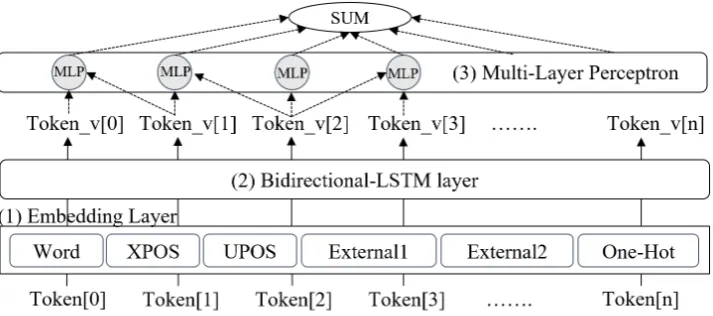
Figure 1: Overall system structure for training language models. (1) Embedding Layer: vectorized features that are feeding into Bidirectional LSTM.(2) Bidirectional-LSTM: train representation of each token as vector values based on bidirectional LSTM neural network. (3) Multi-Layer Perceptron: build candidate of parse trees based on trained(changed) features by bidirectional LSTM layer, and then calculate probabilistic scores for each of candidates. Finally, if it has multiple roots, revise it (section 3) or select the best parse tree.
Although we could theoretically train a single model for all the languages considered in the eval-uation based on our multilingual approach, rele-vant results can only be obtained if one takes into account language similarities and typological in-formation. Moreover, given the limited time and the specific resource environment designed for the shared task, it was hard to get better results using a multilingual approach than using a monolingual approach for resource-rich languages since train-ing new word embeddtrain-ings requires time. Thus, we processed 69 corpora with monolingual mod-els, and only 13 corpora with our multilingual ap-proach.
In what follows we describe the architecture of our system (section 2), our monolingual tion 3) as well as our multilingual approach (sec-tion 4). Finally, we compare the results with the baseline provided by UDPipe1.1 and with the re-sults of other teams (section 5).
2 System Overview
Our system extends the Graph-based parser (Taskar et al.,2005) especially in BIST-parser that works by default with monolingual data. Basi-cally the Graph-based BIST-parser uses bidirec-tional Long Short Term Memory (LSTM) feature representations thanks to two neural network lay-ers (Kiperwasser and Goldberg, 2016). In or-der to select the best relation and head for each tokens in a sentence, Kiperwasser and Goldberg
link the output of the bidirectional LSTM with the Multi-Layer Perceptron (MLP) thanks to one neu-ral layer. Here we adopt the same feature repre-sentation and MLP but different training features and decision models.
In order to adapt the parser to a multilingual approach, we add new parameters and new fea-tures to the training algorithm, notably the pos-sibility to use multilingual word embeddings and one hot encoding to encode languages. Finally, the parser can be trained on monolingual and multilin-gual data depending on the parameters chosen for training. An overview of the overall architecture is given in Figure1. Details on word embeddings along with the number of dimensions considered are given below.
• Word: randomly generated word embedding (100)
• XPOS:language-specific POS (25)
• UPOS:universal POS (25)
• External embedding1:pretrained word em-bedding (100)
• External embedding2:pretrained word em-bedding that is replaced withWord(100)
Corpus Embedding model Bilingual Dic Training corpora
Buryat Buryat-Russian wiki dump brx(20), ru
Kurmanji Kurmanji-English wiki dump kmr(20), en
North S´ami North S´ami-Finnish wiki dump sme(20), fi, fi-fbt Upper Sorbian Upper Sorbian-Polish OPUS hsb(20), pl
Kazakh Kazakh-Turkish OPUS kk(20), tr
Portuguese 7 languages* Europarl7,WMT11 en, it, fr, es, pt, de, sv Italian 7 languages* Europarl7,WMT11 en, it, fr, es, pt, de, sv Italian ParTUT 7 languages* Europarl7,WMT11 en, en partut, fr partut, it, it partut English ParTUT 7 languages* Europarl7,WMT11 en, en partut, fr partut, it partut French ParTUT 7 languages* Europarl7,WMT11 en partut, fr(2), fr partut, it partut
Czech-CLTT Czech - cs, cs cac, cs cltt
Galician-TreeGal Galician - ga, ga treegal
Slovenian-SST Slovenian - sl, sl sst
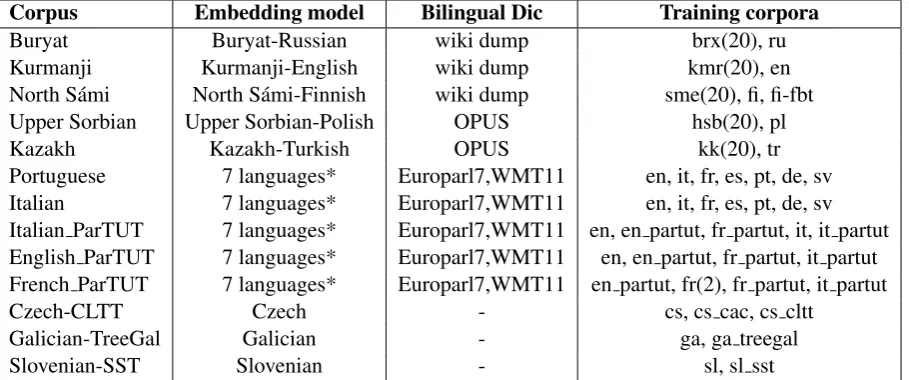
Table 1: Languages trained by a multilingual model. Embedding model: applied languages that were used for making multilingual word embeddings. Bilingual Dic: resources to generate bilingual dictionariesTraining corpora:Training corpora that were used. 7 languages:English, Italian, French, Spanish, Portuguese, German, Swedish. (number): the number of multiplication to expand the total amount of corpus.
Word refers to words taken from the training corpora and used as lexical features with vector-ized embeddings in our parser. Both XPOS and UPOS3 are used as delexicalized features. The content of Word and POS is set randomly when the training phase starts. In addition, two external word embeddings are added to the representations of words, one is concatenated with theWord vec-tor additionally, and the other is used to replace the Word vector. For example, let Word be gen-erated randomly with 100 dimensional vector val-ues andExternal1and letExternal2be pretrained word embeddings made from different resources with 100 dimensional vector values. If we just add External1to an additional word embedding, then final word embedding could be Word+External1 (200 dimensions) based on concatenation. How-ever, if we add just External2 as an additional word embedding,Wordis deleted because it is re-placed withExternal2 so that final word embed-ding could beExternal2(100 dimensions). If both are used, final word embedding could be Exter-nal1 + External2(Wordis deleted because of Ex-ternal2). Since we have found if we can use two external word embeddings, replacing one word embedding as the Word made better results than concatenating two word embeddings based on ex-periments.
Since our goal is to develop a multilingual pars-3http://universaldependencies.org/format.html
ing model, we took the idea of one-hot encodings from (Ammar et al., 2016a). The idea is to add language one-hot encoding as an additional fea-ture while training multilingual models. It allows the model to directly focus on language specifici-ties. There are 65 hot-encoding dimensions be-cause there are 64 languages in UD 2.0 (Nivre et al.,2017) plusunknownlanguages.
3 Monolingual Model
There were 81 different corpora to be parsed within the CoNLL 2017 shared task. We used a monolingual approach for 69 corpora, and our results are detailed in section 5. As mentioned above, training a monolingual model in our system is very similar to training a BIST-parser model. However, we made two modifications to the origi-nal approach.
[image:3.595.74.529.63.253.2]empirical process depending on the language con-sidered (i.e. taking into account language-specific word order). For example, the primary root is the first head node in the case of an English sentence and the last one in the case of a Korean sentence. This very simple trick improved the LAS scores by 0.43 overall F1-measure on the development set.
Customizing for UD: Basically, the BIST-parser is not adapted to the Universal Dependency format. Thus several changes had to be made. First, we added bothXPOSandUPOScategories to the parser. Second, if a word in a training sen-tence did not exist in external word embeddings, we replaced the word as a lemma of the word. Third, we used the external word embeddings pro-vided by the shared task organizers4 and concate-nated them with the originalWordembedding.
4 Multilingual Model
We processed 13 test corpora with our multilin-gual model. The F1-measure of our system for these corpora are better than with our monolingual system for resource-poor languages and even for most of the resource-rich languages.
4.1 Surprise Languages and Kazakh
There were four surprise languages provided for evaluation within the CONLL 2017 shared task: Buryat, Kurmanji, North S´ami and Upper Sorbian (all in the Universal Dependency format). Less than 30 sentences were provided for training, and Kazakh also had 30 sentences for training. We di-vided the training corpus in half: half od the data were set apart for development and never used for training.
Word embeddings. The first step for training multilingual model is finding topologically simi-lar languages. Thus, we selected three languages for each surprise language in order to be able to derive multilingual word embeddings. The choice of languages was based on theWord Atlas of Lan-guage Structures5and on advices from linguists.
Bilingual Dictionary. There has been many attempts to build multilingual embeddings ( Am-mar et al.,2016b;Smith et al.,2017). One sim-ple but powerful method is finding a linear trans-formation matrix from two monolingual
embed-4
https://lindat.mff.cuni.cz/repository/xmlui/handle/11234/1-1989
5The Word Atlas of Language Structures provides
infor-mation about different languages in the world (family, lati-tude and longilati-tude, see http://wals.info).
dings. (Artetxe et al.,2016) propose to do this with pretrained word embeddings and bilingual dictio-naries. We tried to follow their approach using monolingual embeddings provided by Facebook research6 and building bilingual dictionaries. Un-fortunately there were not many resources (even with a limited coverage) for building a bilingual dictionary in the case of surprise languages.
For some languages we were able to find bilin-gual dictionaries from OPUS7. When no cor-pus was available, we used Swadesh lists from Wikipedia dumps. Swadesh lists are composed of 207 bilingual words that are supposed to be ”basic concepts for the purposes of historical-comparative linguistics”8. Finally, we trans-formed both embeddings in a single vector space.
Table1shows details about the selected pairs of languages and the different sources used for our dictionaries. From these resources, we trained a multilingual model and after testing with the de-velopment set set apart for each pair of candidate languages, we picked up the best candidate for the different surprise languages and for Kazakh.
4.2 Italian and Portuguese
There have been several attempts aiming at train-ing multiltrain-ingual models for resource-rich lan-guages (Guo et al., 2016; Ammar et al., 2016a). We have tested our multilingual system in a sim-ilar way as explained in the previous section for resource-rich languages, except that we of course changed the resources used. We used the mul-tilingual word embeddings for 7 languages pre-sented inAmmar et al.’s paper (average and brown cluster model), and then trained a multilingual model with the training set provided for the 7 lan-guages considered. Although the size of word vectors for multilingual embeddings is almost 10 times smaller than with the monolingual embed-dings made by Facebook research, the result (F1-measure) is slightly better than with the monolin-gual model for Italian and Portuguese, with 0.39 and 0.41 within development sets.
4.3 ParTUT corpora
We assumed that all ParTUT corpora are related with each other. Thus, we used a similar mul-tilingual approach to parse the ParTUT corpora but we used different compositions of corpora for
6https://github.com/facebookresearch/fastText/ 7http://opus.lingfil.uu.se/
Corpus LAS UAS Rank(LAS) Rank(UAS) Baseline(LAS)
Overall (81) 70.93 76.75 5 5 68.35
Big treebanks only (55) 75.79 80.55 5 5 73.04
PUD treebanks only (14) 70.77 77.64 4 4 68.33
Small treebanks only (8) 54.78 64.99 4 5 51.80
Surprise language only (4) 36.93 48.66 12 15 37.07
English PUD 82.38 85.77 2 2 78.95
Russian PUD 72.03 79.31 2 2 68.31
Spanish 85.22 88.40 2 3 81.47
Table 2: Official experiment results with rank. (number): number of corpora
Corpus LATTICE Baseline
Arabic PUD 47.13 43.14
Arabic 68.54 65.3
Bulgarian 85.6 83.64
Catalan 86.83 85.39
Czech-CAC 84.77 82.46
Czech PUD 80.86 79.8
Czech 83.68 82.87
Old Church Slavonic 60.81 62.76
Danish 76.47 73.38
Danish PUD 71.45 66.53
German 75.09 69.11
Greek 81.13 79.26
English-LinES 76.17 72.94
English PUD 82.38 78.95
English 78.91 75.84
Spanish-AnCora 86.87 83.78
Spanish PUD 79.87 77.65
Spanish 85.22 81.47
Estonian 62.93 58.79
Basque 72.13 69.15
Persian 82.63 79.24
Finnish-FTB 79.44 74.03
Finnish PUD 80.82 78.65
Finnish 77.11 73.75
French PUD 76.55 73.63
French-Sequoia 83.7 79.98
French 82.83 80.75
Irish 64.39 61.52
Galician 80.68 77.31
Gothic 60.55 59.81
Ancient Greek-PROIEL 60.58 65.22
Ancient Greek 51.5 56.04
Hebrew 61.24 57.23
Hindi PUD 50.94 50.85
Hindi 86.99 86.77
Corpus LATTICE Baseline
Croatian 80.96 77.18
Hungarian 68.49 64.3
Indonesian 76.6 74.61
Italian PUD 86.49 83.7
Japanese PUD 77.41 76.28
Japanese 73.98 72.21
Korean 72.35 59.09
Latin-ITTB 74.33 76.98
Latin-PROIEL 55.04 57.54
Latin 51.95 43.77
Latvian 64.49 59.95
Dutch-LassySmall 75.67 78.15
Dutch 70.6 68.9
Norwegian-Bokmaal 85.55 83.27 Norwegian-Nynorsk 84.57 81.56
Polish 85.94 78.78
Portuguese-BR 88.56 85.36 Portuguese PUD 76.56 73.96
Romanian 81.93 79.88
Russian PUD 72.03 68.31
Russian-SynTagRus 87.9 86.76
Russian 78.42 74.03
Slovak 79.23 72.75
Slovenian 84.52 81.15
Swedish-LinES 78.15 74.29
Swedish PUD 73.4 70.62
Swedish 81.07 76.73
Turkish PUD 34.82 34.53
Turkish 58.89 53.19
Uyghur 34.94 34.18
Ukrainian 63.63 60.76
Urdu 79.26 76.69
Vietnamese 39.87 37.47
Chinese 61.94 57.4
Average 73.13 70.45
[image:5.595.94.506.62.187.2] [image:5.595.81.533.250.748.2]Corpus LATTICE-Multi LATTICE-Mono Baseline
Buryat 27.08 19.7 31.5
Kurmanji 41.71 37.59 32.35
North S´ami 28.39 25.89 30.6
Upper Sorbian 50.54 41.23 53.83
Kazakh 22.11 19.98 24.51
Italian 87.75 87.98 85.28
Portuguese 84.08 84.08 82.11
English-ParTUT 80.45 77.62 73.64
French-ParTUT 83.26 80.66 77.38
Italian-ParTUT 84.09 80.36
-Czech-CLTT 75.45 74.85 71.64
Galician-TreeGal 68.01 67.75 65.82
Slovenian-SST 49.94 48.06 46.45
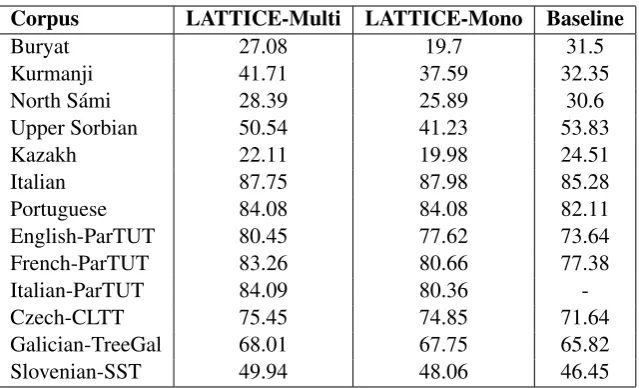
Table 4: Official experiment results processed by multilingual models.
training, such as French ParTUT with en partut, fr partut, it partut and doubled-fr corpus. Finally, the best training compositions are listed in Table1.
4.4 Czech-CLTT, Galician-TreeGal, Slovenian-SST
These three corpora have a small number of train-ing sentences. We thus chose to train them to-gether but with different language hot-encoding values.
5 Experimental Results
Because we wanted to focus on the dependency parsing task, we used automatically annotated cor-pora for testing and also trained all models with the annotated corpora provided by UDPipe (Straka et al.,2016).
As described in section 4, we used different word embeddings and training corpora for multi-lingual models. As for monomulti-lingual models, we simply trained the system with monolingual em-beddings (see details in section 3).
Overall results. Table2,3and4show the of-ficial results (except for it ParTUT), using the F1-measure computed by the TIRA platform (Potthast et al., 2014) for the CoNLL 2017 Shared task9. Our system achieved 70.93 F1 (LAS) on the over-all 81 test sets and ranked 5thout of 33 teams. The
average gap between the baseline obtained with UDPipe1.1 (Straka et al., 2016) and our system is 2.58 LAS in our favor. Our system shows bet-ter results in avoiding over-fitting issues. Perfor-mance gaps are narrowed when considering only
9http://universaldependencies.org/conll17/results.html
PUD test sets (for example, our system ranked second best for processing English PUD and Rus-sian PUD), which is encouraging for practical ap-plications.
Multilingual model. Table 4 shows the re-sults obtained when using the multilingual mod-els on the small treebank dataset (fr partut, ga, gl treegal, kk, la, sl sst, ug, uk). We ranked 4th,
with 54.78 LAS score on this group of languages. However, in terms of extremely resource-poor lan-guages (surprise lanlan-guages), we have ranked only 12th, with 36.93 LAS score. This is slightly lower
than the UDPipe1.1 baseline model: we assume this is the result of using half of the corpus for training surprise languages (section 4). If we com-pare monolingual models of surprise languages with multilingual ones, we see an improvement between 2.5 and 9.31 percent. The same kind of improvement can be observed for the ParTUT group. In this case, the multilingual approach im-proves performance by almost 3 points.
6 Conclusion
[image:6.595.140.460.60.254.2]effective way to solve the multiple roots problem of the original BIST parser and (3) an original ap-proach for the elaboration of multilingual dictio-naries for resource-poor languages and the projec-tion of monolingual word embeddings in a single vector space. Our system ranked5thand achieved
70.93 overall F1-measure over the 81 test corpora provided for evaluation. We are confident there is room for improvement since this system is only preliminary and lots of components could be op-timized. A better account of language typology could also help the process and show the benefit of linguistic knowledge in this kind of environment.
7 Acknowledgements
Kyung Tae Lim is supported by the ANR ERA-NET ATLANTIS project. This work is also sup-ported by the LAKME project through a grant from Paris Sciences et Lettres within the frame-work of the IDEX (Initiatives d’Excellence) PSL reference ANR-10-IDEX-0001-02.
References
Waleed Ammar, George Mulcaire, Miguel Ballesteros, Chris Dyer, and Noah A. Smith. 2016a. One parser, many languages. CoRR abs/1602.01595. http://arxiv.org/abs/1602.01595.
Waleed Ammar, George Mulcaire, Yulia Tsvetkov, Guillaume Lample, Chris Dyer, and Noah A Smith. 2016b. Massively multilingual word embeddings. arXiv preprint arXiv:1602.01925.
Mikel Artetxe, Gorka Labaka, and Eneko Agirre. 2016. Learning principled bilingual mappings of word em-beddings while preserving monolingual invariance. In Proceedings of the 2016 Conference on Empiri-cal Methods in Natural Language Processing.
Jiang Guo, Wanxiang Che, David Yarowsky, Haifeng Wang, and Ting Liu. 2015. Cross-lingual depen-dency parsing based on distributed representations. InProceedings of ACL.
Jiang Guo, Wanxiang Che, David Yarowsky, Haifeng Wang, and Ting Liu. 2016. A representation learn-ing framework for multi-source transfer parslearn-ing. In AAAI. pages 2734–2740.
Ulrich Heid and Sybille Raab. 1989. Collocations in multilingual generation. In Proceedings of the fourth conference on European chapter of the Asso-ciation for Computational Linguistics. AssoAsso-ciation for Computational Linguistics, pages 130–136.
Eliyahu Kiperwasser and Yoav Goldberg. 2016. Simple and accurate dependency
parsing using bidirectional LSTM fea-ture representations. TACL 4:313–327. https://transacl.org/ojs/index.php/tacl/article/view/885. Joakim Nivre, Marie-Catherine de Marneffe, Filip
Gin-ter, Yoav Goldberg, Jan Hajiˇc, Christopher Man-ning, Ryan McDonald, Slav Petrov, Sampo Pyysalo, Natalia Silveira, Reut Tsarfaty, and Daniel Zeman. 2016. Universal Dependencies v1: A multilingual treebank collection. In Proceedings of the 10th International Conference on Language Resources and Evaluation (LREC 2016). European Language Resources Association, Portoroˇz, Slovenia, pages 1659–1666.
Joakim Nivre et al. 2017. Universal Dependencies 2.0. LINDAT/CLARIN digital library at the Insti-tute of Formal and Applied Linguistics, Charles Uni-versity, Prague, http://hdl.handle.net/ 11234/1-1983. http://hdl.handle.net/11234/1-1983.
Martin Potthast, Tim Gollub, Francisco Rangel, Paolo Rosso, Efstathios Stamatatos, and Benno Stein. 2014. Improving the reproducibility of PAN’s shared tasks: Plagiarism detection, author iden-tification, and author profiling. In Evangelos Kanoulas, Mihai Lupu, Paul Clough, Mark Sander-son, Mark Hall, Allan Hanbury, and Elaine Toms, editors, Information Access Evaluation meets Mul-tilinguality, Multimodality, and Visualization. 5th International Conference of the CLEF Initiative (CLEF 14). Springer, Berlin Heidelberg New York, pages 268–299. https://doi.org/10.1007/978-3-319-11382-1 22.
Samuel L. Smith, David H. P. Turban, Steven Ham-blin, and Nils Y. Hammerla. 2017. Offline bilin-gual word vectors, orthogonal transformations and the inverted softmax. CoRR abs/1702.03859. http://arxiv.org/abs/1702.03859.
Milan Straka, Jan Hajiˇc, and Jana Strakov´a. 2016. UD-Pipe: trainable pipeline for processing CoNLL-U files performing tokenization, morphological anal-ysis, POS tagging and parsing. In Proceedings of the 10th International Conference on Language Resources and Evaluation (LREC 2016). European Language Resources Association, Portoroˇz, Slove-nia.
Ben Taskar, Vassil Chatalbashev, Daphne Koller, and Carlos Guestrin. 2005. Learning structured predic-tion models: A large margin approach. In Proceed-ings of the 22nd international conference on Ma-chine learning. ACM, pages 896–903.
J¨org Tiedemann. 2015. Cross-lingual dependency parsing with universal dependencies and predicted pos labels. Depling 2015page 340.