Global Normalization of Convolutional Neural Networks
for Joint Entity and Relation Classification
Heike Adel and Hinrich Sch¨utze
Center for Information and Language Processing (CIS) LMU Munich, Germany
Abstract
We introduce globally normalized convo-lutional neural networks for joint entity classification and relation extraction. In particular, we propose a way to utilize a linear-chain conditional random field out-put layer for predicting entity types and re-lations between entities at the same time. Our experiments show that global normal-ization outperforms a locally normalized softmax layer on a benchmark dataset.
1 Introduction
Named entity classification (EC) and relation ex-traction (RE) are important topics in natural lan-guage processing. They are relevant, e.g., for pop-ulating knowledge bases or answering questions from text, such as “Where does X live?”
Most approaches consider the two tasks inde-pendent from each other or treat them as a se-quential pipeline by first applying a named entity recognition tool and then classifying relations be-tween entity pairs. However, named entity types and relations are often mutually dependent. If the types of entities are known, the search space of possible relations between them can be reduced and vice versa. This can help, for example, to resolve ambiguities, such as in the case of “Mer-cedes”, which can be a person, organization and location. However, knowing that in the given context, it is the second argument for the rela-tion “live in” helps concluding that it is a loca-tion. Therefore, we propose a single neural net-work (NN) for both tasks. In contrast to joint train-ing and multitask learntrain-ing, which calculate
task-wise costs, we propose to learn a joint
classifi-cation layer which isglobally normalized on the outputs of both tasks. In particular, we train the NN parameters based on the loss of a linear-chain
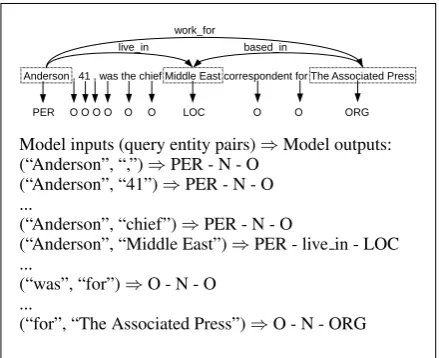
Anderson , 41 , was the chief Middle East correspondent for The Associated Press
PER O O O O O O LOC O O ORG work_for
live_in based_in
Model inputs (query entity pairs)⇒Model outputs: (“Anderson”, “,”)⇒PER - N - O
(“Anderson”, “41”)⇒PER - N - O ...
(“Anderson”, “chief”)⇒PER - N - O
(“Anderson”, “Middle East”)⇒PER - live in - LOC ...
(“was”, “for”)⇒O - N - O ...
[image:1.595.307.527.221.400.2](“for”, “The Associated Press”)⇒O - N - ORG
Figure 1: Examples of our task
conditional random field (CRF) (Lafferty et al.,
2001). CRF layers for NNs have been introduced
for token-labeling tasks like named entity
recog-nition (NER) or part-of-speech tagging (Collobert
et al., 2011; Lample et al., 2016; Andor et al.,
2016). Instead of labeling each input token as in
previous work, we model the joint entity and rela-tion classificarela-tion problem as a sequence of length three for the CRF layer. In particular, we identify the types of two candidate entities (words or short phrases) given a sentence (we call this entity clas-sification to distinguish it from the token-labeling task NER) as well as the relation between them. To the best of our knowledge, this architecture for combining entity and relation classification in a
single neural network is novel. Figure1shows an
example of how we model the task: For each sen-tence, candidate entities are identified. Every pos-sible combination of candidate entities (query en-tity pair) then forms the input to our model which predicts the classes for the two query entities as well as for the relation between them.
To sum up, our contributions are as follows: We introduce globally normalized convolutional neu-ral networks for a sentence classification task. In particular, we present an architecture which al-lows us to model joint entity and relation sification with a single neural network and clas-sify entities and relations at the same time, nor-malizing their scores globally. Our experiments confirm that a CNN with a CRF output layer out-performs a CNN with locally normalized softmax
layers. Our source code is available at http:
//cistern.cis.lmu.de.
2 Related Work
Some work on joint entity and relation classifica-tion uses distant supervision for building their own
datasets, e.g., (Yao et al., 2010; Yaghoobzadeh
et al.,2016). Other studies, which are described in more detail in the following, use the “entity and
re-lation recognition” (ERR) dataset from (Roth and
Yih,2004,2007) as we do in this paper. Roth and
Yih(2004) develop constraints and use linear
pro-gramming to globally normalize entity types and
relations.Giuliano et al.(2007) use entity type
in-formation for relation extraction but do not train
both tasks jointly. Kate and Mooney(2010) train
task-specific support vector machines and develop a card-pyramid parsing algorithm to jointly model
both tasks. Miwa and Sasaki(2014) use the same
dataset but model the tasks as a table filling
prob-lem (see Section4.2). Their model uses both a
lo-cal and a global scoring function. Recently,Gupta
et al.(2016) apply recurrent neural networks to fill the table. They train them in a multitask fashion. Previous work also uses a variety of linguistic fea-tures, such as part-of-speech tags. In contrast, we use convolutional neural networks and only word embeddings as input. Furthermore, we are the first to adopt global normalization of neural networks for this task.
Several studies propose different variants of non-neural CRF models for information extraction tasks but model them as token-labeling problems (Sutton and McCallum, 2006; Sarawagi et al.,
2004;Culotta et al.,2006;Zhu et al.,2005;Peng and McCallum, 2006). In contrast, we propose a simpler linear-chain CRF model which directly connects entity and relation classes instead of as-signing a label to each token of the input sequence.
This is more similar to the factor graph by Yao
et al.(2010) but computationally simpler. Xu and
Sarikaya (2013) also apply a CRF layer on top of continuous representations obtained by a CNN. However, they use it for a token labeling task (se-mantic slot filling) while we apply the model to a sentence classification task, motivated by the fact that a CNN creates single representations for whole phrases or sentences.
3 Model
3.1 Modeling Context and Entities
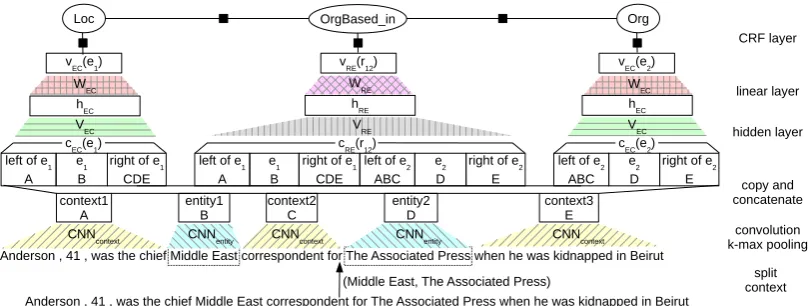
Figure2illustrates our model.
Input. Given an input sentence and two query
entities, our model identifies the types of the
en-tities and the relation between them; see
Fig-ure1. The input tokens are represented by word
embeddings trained on Wikipedia with word2vec (Mikolov et al., 2013). For identifying the class
of an entityek, the model uses the context to its
left, the words constitutingekand the context to its
right. For classifying the relation between two
en-titieseiandej, the sentence is split into six parts:
left of ei, ei, right of ei, left of ej, ej, right of
ej.1 For the example sentence in Figure1and the
entity pair (“Anderson”, “chief”), the context split
is: [] [Anderson] [, 41 , was the chief Middle ...]
[Anderson , 41 , was the] [chief] [Middle East
cor-respondent for ...]
Sentence Representation.For representing the different parts of the input sentence, we use convo-lutional neural networks (CNNs). CNNs are suit-able for RE since a relation is usually expressed by the semantics of a whole phrase or sentence. Moreover, they have proven effective for RE in
previous work (Vu et al.,2016). We train one CNN
layer for convolving the entities and one for the contexts. Using two CNN layers instead of one gives our model more flexibility. Since entities are usually shorter than contexts, the filter width for entities can be smaller than for contexts. Fur-thermore, this architecture simplifies changing the entity representation from words to characters in future work.
After convolution, we applyk-max pooling for
both the entities and the contexts and concatenate
the results. The concatenated vector cz ∈ RCz,
z∈ {EC, RE}is forwarded to a task-specific
hid-den layer of sizeHz which learns patterns across
the different input parts:
hz = tanh(VzTcz+bz) (1)
Anderson , 41 , was the chief Middle East correspondent for The Associated Press when he was kidnapped in Beirut context1
A entity1B context2C entity2D context3E
Anderson , 41 , was the chief Middle East correspondent for The Associated Press when he was kidnapped in Beirut (Middle East, The Associated Press)
hEC
left of e1
A
e1
B
right of e1
CDE
e2
D
right of e2
E
left of e1
A
e1
B
right of e1
CDE
left of e2
ABC
left of e2
ABC
e2
D
right of e2
E
vEC(e1)
Loc OrgBased_in Org
vRE(r12) vEC(e2)
cEC(e1) cRE(r12) cEC(e2)
CNNcontext CNNentity CNNcontext CNNentity CNNcontext
split context convolution k-max pooling
copy and concatenate
VEC
hRE hEC
VRE VEC
WEC WRE WEC
hidden layer linear layer
[image:3.595.95.500.61.214.2]CRF layer
Figure 2: Model overview; the colors/shades show which model parts share parameters
with weightsVz∈RCz×Hz and biasbz ∈RHz.
3.2 Global Normalization Layer
For global normalization, we adopt the
linear-chain CRF layer by Lample et al. (2016).2 It
expects scores for the different classes as input. Therefore, we apply a linear layer first which maps
the representationshz∈RHz to a vectorvz of the
size of the output classesN =NEC+NRE:
vz =WzThz (2)
withWz ∈ RHz×N. For a sentence classification
task, the input sequence for the CRF layer is not inherentely clear. Therefore, we propose to model the joint entity and relation classification problem with the following sequence of scores (cf., Figure
2):
d= [vEC(e1), vRE(r12), vEC(e2)] (3)
with rij being the relation between ei und ej.
Thus, we approximate the joint probability of
en-tity typesTe1,Te2 and relationsRe1e2 as follows:
P(Te1Re1e2Te2)
≈P(Te1)·P(Re1e2|Te1)·P(Te2|Re1e2)
(4)
Our intuition is that the dependence between re-lation and entities is stronger than the dependence between the two entities.
The CRF layer pads its input of length n = 3
with begin and end tags and computes the
follow-ing score for a sequence of predictionsy:
s(y) =
n
X
i=0
Qyiyi+1+
n
X
i=1
di,yi (5)
2https://github.com/glample/tagger
withQk,lbeing the transition score from classkto
classlanddp,q being the score of classq at
posi-tion p in the sequence. The scores are summed
because all the variables of the CRF layer live in the log space. The matrix of transition scores
Q ∈ R(n+2)×(n+2) is learned during training.3
For training, the forward algorithm computes the
scores for all possible label sequencesY to get the
log-probability of the correct label sequenceyˆ:
log(p(ˆy)) = P es(ˆy)
˜
y∈Y es(˜y) (6)
For testing, Viterbi is applied to obtain the label
sequencey∗with the maximum score:
y∗= arg max
˜
y∈Y s(˜y) (7)
4 Experiments and Analysis
4.1 Data and Evaluation Measure
We use the “entity and relation recognition”
(ERR) dataset from (Roth and Yih, 2004)4 with
the train-test split byGupta et al.(2016). We tune
the parameters on a held-out part of train. The data is labeled with entity types and relations (see
Ta-ble1). For entity pairs without a relation, we use
the label N. Dataset statistics and model parame-ters are provided in the appendix.
Following previous work, we computeF1of the
individual classes for EC and RE, as well as a
task-wise macroF1 score. We also report the average
of scores across tasks (Avg EC+RE).
4.2 Experimental Setups
Setup 1: Entity Pair Relations. Roth and Yih(2004,2007);Kate and Mooney (2010) train separate models for EC and RE on the ERR dataset. For RE, they only identify relations be-tween named entity pairs. In this setup, the query entities for our model are only named entity pairs. Note that this facilitates EC in our experiments.
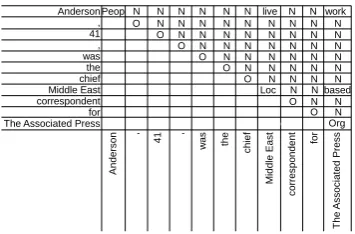
Setup 2: Table Filling. FollowingMiwa and Sasaki(2014);Gupta et al.(2016), we also model the joint task of EC and RE as a table filling
task. For a sentence with length m, we create a
quadratic table. Cell (i, j) contains the relation
between wordiand wordj(or N for no relation).
A diagonal cell(k, k) contains the entity type of
wordk. Following previous work, we only predict
classes for half of the table, i.e. form(m+ 1)/2
cells. Figure 3 shows the table for the example
sentence from Figure 1. In this setup, each cell
(i, j) withi 6= j is a separate input query to our
model. Our model outputs a prediction for cell
(i, j) (the relation between i and j) and
predic-tions for cells(i, i) and(j, j) (the types of iand
j). To fill the diagonal with entity classes, we
ag-gregate all predictions for the particular entity by
using majority vote. Section4.4shows that the
in-dividual predictions agree with the majority vote in almost all cases.
Setup 3: Table Filling Without Entity Boundaries. The table from setup 2 includes one row/column per multi-token entity, utilizing the given entity boundaries of the ERR dataset. In or-der to investigate the impact of the entity bound-aries on the classification results, we also con-sider another table filling setup where we ignore the boundaries and assign one row/column per to-ken. Note that this setup is also used by prior work
on table filling (Miwa and Sasaki, 2014; Gupta
et al.,2016). For evaluation, we followGupta et al.
(2016) and score a multi-token entity as correct if
at least one of its comprising cells has been classi-fied correctly.
Comparison. The most important difference between setup 1 and setup 2 is the number of
en-tity pairs with no relation (test set: ≈3k for setup
1, ≈121k for setup 2). This makes setup 2 more
challenging. The same holds for setup 3 which considers the same number of entity pairs with no relation as setup 2. To cope with this, we randomly subsample negative instances in the train set of setup 2 and 3. Setup 3 considers the most query
Anderson , 41 , was the chief Middle East correspondent for The Associated Press
A
nd
er
so
n , 41 ,
w
as the
ch
ie
f
M
id
dl
e
E
as
t
co
rr
es
po
nd
en
t
fo
r
T
he
A
ss
oc
ia
te
d
P
re
ss
Peop N N N N N N live N N work N O N N N N N N N N N N N O N N N N N N N N N N N O N N N N N N N N N N N O N N N N N N N N N N N O N N N N N N N N N N N O N N N N
live N N N N N N Loc N N based N N N N N N N N O N N N N N N N N N N N O N
[image:4.595.329.507.61.178.2]work N N N N N N based N N Org
Figure 3: Entity-relation table
entity pairs in total since multi-token entities are split into their comprising tokens. However, setup 3 represents a more realistic scenario than setup 1 or setup 2 because in most cases, entity boundaries are not given. In order to apply setup 1 or 2 to an-other dataset without entity boundaries, a prepro-cessing step, such as entity boundary recognition or chunking would be required.
4.3 Experimental Results
Table1shows the results of our globally
normal-ized model in comparison to the same model with locally normalized softmax output layers (one for EC and one for RE). For setup 1, the CRF layer performs comparable or better than the softmax layer. For setup 2 and 3, the improvements are more apparent. We assume that the model can benefit more from global normalization in the case of table filling because it is the more challenging setup. The comparison between setup 2 and setup 3 shows that the entity classification suffers from not given entity boundaries (in setup 3). A reason could be that the model cannot convolve the token embeddings of the multi-token entities anymore when computing the entity representation (context
B and D in Figure2). Nevertheless, the relation
classification performance is comparable in setup 2 and setup 3. This shows that the model can in-ternally account for potentially wrong entity clas-sification results due to missing entity boundaries. The overall results (Avg EC+RE) of the CRF are better than the results of the softmax layer for all three setups. To sum up, the improvements of the linear-chain CRF show that (i) joint EC and RE benefits from global normalization and (ii) our way of creating the input sequence for the CRF for joint EC and RE is effective.
Setup 1 Setup 2 Setup 3 softmax CRF softmax CRF softmax CRF Peop 95.24 94.95 93.99 94.47 91.46 92.21 Org 88.94 87.56 78.95 79.37 67.29 67.91
Loc 93.25 93.63 90.69 90.80 85.99 86.20
Other 90.38 89.54 73.78 73.97 62.67 61.19 Avg EC 91.95 91.42 84.35 84.65 76.85 76.88 Located in 55.03 57.72 51.03 55.13 44.96 52.29 Work for 71.23 70.67 52.89 61.42 52.63 65.31 OrgBased in 53.25 59.38 56.96 59.12 46.15 57.65 Live in 59.57 58.94 64.29 60.12 64.09 61.45
Kill 74.70 79.55 69.14 74.73 82.93 75.86
[image:5.595.158.440.62.204.2]Avg RE 62.76 65.25 58.86 62.10 58.15 62.51 Avg EC+RE 77.36 78.33 71.61 73.38 67.50 69.69
Table 1:F1results for entity classification (EC) and relation extraction (RE) in the three setups
Model S Feats EC RE EC+RE
R & Y 2007 1 yes 85.8 58.1 72.0 K & M 2010 1 yes 91.7 62.2 77.0 Ours (NN CRF) 1 no 92.1 65.3 78.7 Ours (NN CRF) 2 no 88.2 62.1 75.2 M & S 2014 3 yes 92.3 71.0 81.7 G et al. 2016 (1) 3 yes 92.4 69.9 81.2 G et al. 2016 (2) 3 no 88.8 58.3 73.6 Ours (NN CRF) 3 no 82.1 62.5 72.3
Table 2: Comparison to state of the art (S: setup)
(Miwa and Sasaki, 2014), (Gupta et al., 2016).5
Note that the results are not comparable because of
the different setups and different train-test splits.6
Our results are best comparable with (Gupta
et al.,2016) since we use the same setup and train-test splits. However, their model is more compli-cated with a lot of hand-crafted features and var-ious iterations of modeling dependencies among entity and relation classes. In contrast, we only use pre-trained word embeddings and train our model end-to-end with only one iteration per entity pair. When we compare with their model without ad-ditional features (G et al. 2016 (2)), our model performs worse for EC but better for RE and com-parable for Avg EC+RE.
4.4 Analysis of Entity Type Aggregation
As described in Section4.2, we aggregate the EC
results by majority vote. Now, we analyze their disagreement. For our best model, there are only 9 entities (0.12%) with disagreement in the test data. For those, the max, min and median disagreement with the majority label is 36%, 2%, and 8%, resp. Thus, the disagreement is negligibly small.
5We only show results of single models, no ensembles. Following previous studies, we omit the entity class “Other” when computing the EC score.
6Our results on EC in setup 1 are also not comparable
O Other Peop Org Loc
[image:5.595.74.288.244.342.2]N Based_in Live_in Kill Located_in Work_for
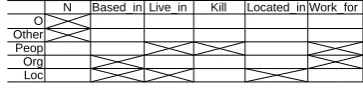
Figure 4: Most strongly correlated entity types and relations according to CRF transition matrix
4.5 Analysis of CRF Transition Matrix
To analyze the CRF layer, we extract which
tran-sitions have scores above 0.5. Figure4shows that
the layer has learned correct correlations between entity types and relations.
5 Conclusion and Future Work
In this paper, we presented the first study on global normalization of neural networks for a sentence classification task without transforming it into a token-labeling problem. We trained a convolu-tional neural network with a linear-chain condi-tional random field output layer on joint entity and relation classification and showed that it outper-formed using a locally normalized softmax layer.
An interesting future direction is the extension of the linear-chain CRF to jointly normalize all predictions for table filling in a single model pass. Furthermore, we plan to verify our results on other datasets in future work.
Acknowledgments
Heike Adel is a recipient of the Google European Doctoral Fellowship in Natural Language Process-ing and this research is supported by this fel-lowship. This work was also supported by DFG (SCHU 2246/4-2).
[image:5.595.324.506.246.290.2]References
Daniel Andor, Chris Alberti, David Weiss, Aliaksei Severyn, Alessandro Presta, Kuzman Ganchev, Slav Petrov, and Michael Collins. 2016. Globally
nor-malized transition-based neural networks. In
Pro-ceedings of the 54th Annual Meeting of the Associa-tion for ComputaAssocia-tional Linguistics (Volume 1: Long Papers), pages 2442–2452, Berlin, Germany. Asso-ciation for Computational Linguistics.
Ronan Collobert, Jason Weston, L´eon Bottou, Michael Karlen, Koray Kavukcuoglu, and Pavel Kuksa. 2011. Natural language processing (almost) from scratch. Journal of Machine Learning Research, 12:2493–2537.
Aron Culotta, Andrew McCallum, and Jonathan Betz. 2006. Integrating probabilistic extraction models and data mining to discover relations and patterns in text. InProceedings of the Human Language Tech-nology Conference of the NAACL, Main Conference, pages 296–303, New York City, USA. Association for Computational Linguistics.
Claudio Giuliano, Alberto Lavelli, and Lorenza Ro-mano. 2007. Relation extraction and the influence
of automatic named-entity recognition.ACM Trans.
Speech Lang. Process., 5(1):2:1–2:26.
Pankaj Gupta, Hinrich Sch¨utze, and Bernt Andrassy. 2016. Table filling multi-task recurrent neural net-work for joint entity and relation extraction. In Pro-ceedings of COLING 2016, the 26th International Conference on Computational Linguistics: Techni-cal Papers, pages 2537–2547, Osaka, Japan. The COLING 2016 Organizing Committee.
Rohit J. Kate and Raymond Mooney. 2010. Joint en-tity and relation extraction using card-pyramid pars-ing. InProceedings of the Fourteenth Conference on Computational Natural Language Learning, pages 203–212, Uppsala, Sweden. Association for Com-putational Linguistics.
John D. Lafferty, Andrew McCallum, and Fernando C. N. Pereira. 2001. Conditional random fields: Probabilistic models for segmenting and labeling se-quence data. InProceedings of the Eighteenth Inter-national Conference on Machine Learning, ICML ’01, pages 282–289, San Francisco, CA, USA. Mor-gan Kaufmann Publishers Inc.
Guillaume Lample, Miguel Ballesteros, Sandeep Sub-ramanian, Kazuya Kawakami, and Chris Dyer. 2016.
Neural architectures for named entity recognition. InProceedings of the 2016 Conference of the North American Chapter of the Association for Computa-tional Linguistics: Human Language Technologies, pages 260–270, San Diego, California. Association for Computational Linguistics.
Tomas Mikolov, Kai Chen, Greg Corrado, and Jeffrey Dean. 2013. Efficient estimation of word represen-tations in vector space. InProceedings of Workshop
at 1st International Conference on Learning Repre-sentations (ICLR), Scottsdale, Arizona, USA. Makoto Miwa and Yutaka Sasaki. 2014. Modeling
joint entity and relation extraction with table repre-sentation. InProceedings of the 2014 Conference on Empirical Methods in Natural Language Processing (EMNLP), pages 1858–1869, Doha, Qatar. Associa-tion for ComputaAssocia-tional Linguistics.
Fuchun Peng and Andrew McCallum. 2006. Infor-mation extraction from research papers using con-ditional random fields. Information processing & management, 42(4):963–979.
D. Roth and W. Yih. 2007. Global inference for en-tity and relation identification via a linear program-ming formulation. InIntroduction to Statistical Re-lational Learning. MIT Press.
Dan Roth and Wen-tau Yih. 2004. A linear pro-gramming formulation for global inference in nat-ural language tasks. In HLT-NAACL 2004 Work-shop: Eighth Conference on Computational Natu-ral Language Learning (CoNLL-2004), pages 1–8, Boston, Massachusetts, USA. Association for Com-putational Linguistics.
Sunita Sarawagi, William W Cohen, et al. 2004. Semi-markov conditional random fields for information extraction. InAdvances in Neural Information Pro-cessing Systems, volume 17, pages 1185–1192. Charles Sutton and Andrew McCallum. 2006. An
in-troduction to conditional random fields for relational learning.Introduction to statistical relational learn-ing, pages 93–128.
Ngoc Thang Vu, Heike Adel, Pankaj Gupta, and Hin-rich Sch¨utze. 2016.Combining recurrent and convo-lutional neural networks for relation classification. InProceedings of the 2016 Conference of the North American Chapter of the Association for Computa-tional Linguistics: Human Language Technologies, pages 534–539, San Diego, California. Association for Computational Linguistics.
Puyang Xu and Ruhi Sarikaya. 2013. Convolutional neural network based triangular crf for joint intent detection and slot filling. In 2013 IEEE Workshop on Automatic Speech Recognition and Understand-ing, pages 78–83, Olomouc, Czech Republic. IEEE. Yadollah Yaghoobzadeh, Heike Adel, and Hinrich Sch¨utze. 2016. Noise mitigation for neural entity typing and relation extraction. InProceedings of the 15th Conference of the European Chapter of the As-sociation for Computational Linguistics, Valencia, Spain. Association for Computational Linguistics. Limin Yao, Sebastian Riedel, and Andrew McCallum.
2010.Collective cross-document relation extraction
without labelled data. InProceedings of the 2010
Jun Zhu, Zaiqing Nie, Ji-Rong Wen, Bo Zhang, and Wei-Ying Ma. 2005. 2d conditional random fields for web information extraction. In Proceedings of the 22nd international conference on Machine learning, pages 1044–1051. ACM.
A Dataset Statistics
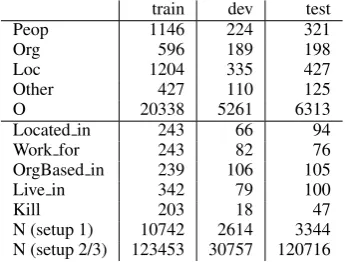
Table3provides statistics of the data composition
in our different setups which are described in the paper. The N class of setup 2 and setup 3 has been subsampled in the training and development set as described in the paper.
train dev test
Peop 1146 224 321
Org 596 189 198
Loc 1204 335 427
Other 427 110 125
O 20338 5261 6313
Located in 243 66 94
Work for 243 82 76
OrgBased in 239 106 105
Live in 342 79 100
Kill 203 18 47
N (setup 1) 10742 2614 3344 N (setup 2/3) 123453 30757 120716
Table 3: Dataset statistics for our different experi-mental setups
Note that the sum of numbers of relation labels is slightly different to the numbers reported in (Roth and Yih, 2004). According to their
web-site https://cogcomp.cs.illinois.
edu/page/resource_view/43, they have
updated the corpus.
B Hyperparameters
Setup Output layer nkC nkE hC hE
1 softmax 500 100 100 50
2 softmax 500 100 100 50
3 softmax 500 100 100 50
1 CRF 200 50 100 50
2 CRF 500 100 200 50
[image:7.595.95.268.228.359.2]3 CRF 500 100 100 50
Table 4: Hyperparameter optimization results
Table 4provides the hyperparameters we
opti-mized on dev (nkC: number of convolutional
fil-ters for the CNN convolving the contexts, nkE:
number of convolutional filters for the CNN
con-volving the entities; hC: number of hidden units
for creating the final context representation, hE:
number of hidden units for creating the final entity representation).
For all models, we use a filter width of 3 for the context CNN and a filter width of 2 for the entity
CNN (tuned in prior experiments and fixed for the
optimization of the parameters in Table4).
For training, we apply gradient descent with a batch size of 10 and an initial learning rate of 0.1. When the performance on dev decreases, we halve the learning rate. The model is trained with early stopping on dev, with a maximum number of 20 epochs. We apply L2 regularization with
[image:7.595.83.280.527.599.2]