Analysis of Minimum Numbers of Linearly Active
S
-Boxes of a Class of Generalized Feistel Block Ciphers
Xiaopei Guo ·Kejian Xu· Tongsen Sun· Xiubin Fan
Received: / Revised: c
2006 Springer Science + Business Media, Inc.
Abstract For a class of generalized Feistel block ciphers, an explicit recurrent formula for the minimum numbers of linearly activeS-boxes of any roundris presented.
Key words block cipher, generalized Feistel structure, linear spread value, the minimum number of linearly active S-boxes
1 Introduction
Linear cryptanalysis and differential cryptanalysis, the two most significant analyses meth-ods applicable to block ciphers, were introduced by Matsui [1] and Biham, Shamir [2], respec-tively. Whether a block cipher can resist the two analyses is one of basic problems of the security of block ciphers. However, in the design of block ciphers, such ability is usually measured by minimum numbers of linearly or differentially activeS-boxes. For AES, the branching number method is used to determine lower bounds for minimum numbers of linearly or differentially activeS-boxes.
The formal definition of generalized Feistel Structure(GFS) was given by Zheng et al.[3]. Several cryptographic properties of these structures were analyzed in [4][5]. In 1992, Nyberg and Knudsen [6] first proposed the conception of a provable security against differential cryptanalysis and gave a provable security for a Feistel structure. In [7], Lee et al. discussed the provable security of the standard Type-II GFS with the partitioning number dagainst differential and linear attacks, and then Shirai and Araki discussed its practical security against differential and linear attacks in [8]. They showed the lower bounds on the numbers of active S-boxes for three types of generalized Feistel Structure: Type-I, Type-II and Nyberg’s constructions [3][9]. Kanda [10] presented the minimum number of active S-boxs of Feistel ciphers with
SP N round function. Using the minimum number of active S-boxes, Nyberg and Knudsen [11] gave the upper bounds of the maximum linear spread value and maximum differential spread value of Feistel system. Recently, Suzaki and Minematsu introduced a GFS with the optimal round permutation with respect to full diffusion property, which is a property that all
Xiaopei Guo
College of mathematics, Qingdao University, Qingdao 266071,China. E-mail: [email protected]. Kejian Xu
College of mathematics, Qingdao University, Qingdao 266071,China. E-mail: [email protected]. Tongsen Sun
College of mathematics, Qingdao University, Qingdao 266071,China. E-mail: [email protected]. Xiubin Fan
outputs are affected by all inputs [12]. Their paper showed that the improved GFS can be more secure against impossible differential and saturation attacks than the standard GFS. However, they expect that the minimum numbers of active S-boxes remains about the same. Thus their structures still require at least same number of rounds as the standard GFS to be secure against differential and linear attacks.
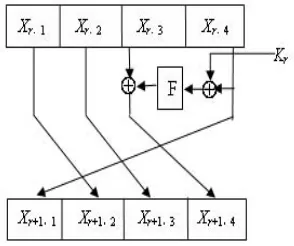
In the references [13] and [14], the authors discussed the linear cryptanalysis and differential cryptanalysis of the generalized Feistel ciphers respectively, and they gave the maximum linear spread value and differential spread value for 5–32 rounds through enumeration. Precisely, the structure discussed in [13] is as follows: The block length is 128 bits, the confusion part for the round function F is S-boxes with 8 bits input and 8 bits output, and the invertible transformationP for the diffusion part is:
P(X) =X⊕(X <<<6)⊕(X <<<14)
⊕(X <<<22)⊕(X <<<24),
whereX ∈F32 and<<<denotes the left cyclic shift. Graphically, this can be presented as:
Figure 1: Feistel Structure Figure 2: Round Function
The Feistel structure can be mathematically described as:
Xr+1:= (Xr+1,1, Xr+1,2, Xr+1,3, Xr+1,4)
:= (Xr,4, Xr,1, Xr,2, Xr,3⊕F(Xr,4⊕Kr)), (1)
whereXt,l, Kt∈F32, t≥0, l= 1,2,3,4,and ifYr:= (Yr,1, Yr,2, Yr,3, Yr,4),then
F(Yr) = (S(Yr,1), S(Yr,2), S(Yr,3), S(Yr,4))A, (2) where Yr ∈ F32;Yr,i ∈ F8, i = 1,2,3,4, and A is the invertible matrix corresponding to the
invertible linear transformation P.Clearly, (2) is a layer of SP structure, and (1) moving one time is called one round. Assume thatX0,1, X0,2, X0,3, X0,4, Kt∈F32, t= 0,1,2, . . . , N−1,are
r 5 6 7 8 9 10 11
mr 1 1 2 6 6 7 7
r 12 13 14 15 16 17 18
mr 8 9 13 14 16 17 17
r 19 20 21 22 23 24 25
mr 18 18 19 19 20 24 24
r 26 27 28 29 30 31 32
mr 25 25 26 27 31 32 34
In this table,randmrdenote the round number and the minimum active number respectively.
In this paper, we give a further discussion on this structure. Firstly, we reduce the problem to one about matrices of state transition probabilities. Then, we ”spones” matrices (”spones” means replacing all nonzero elements in a matrix by 1. See section 4 for details. ) so that we get transition character matrices and their recursive relations. Finally, by further ”spones”, we get a sequence of active numbers, from which the minimum active number could be obtained. Fol-lowing this idea, we present a general formula for calculatingLLESAr, the minimum numbers
of linearly active S-boxes for arbitrary rrounds (see Definition 2.6. Note that the minimum number here means a low bound that can be achieved.). More precisely, we proved that if the round numberr≥5, then
LLESAr=LLESA5+((r−5)mod16)+ 18[
r−5 16 ], where the symbol [ ] denotes the integral part of an integer.
In sum, we have solved the problem of describing the ability and the effectiveness for block ciphers, whose key embeddings are based only on the operator⊕, to resist linear analyses and differential analyses.
We should mention that the first version of this paper, in which the key ideas of the present paper are included, was completed in 2006.
2 Description of linear spread values
Let F : Fe
2 → Fe2 be a transformation. For any w, v ∈ Fe2, if X ∈ Fe2 is an identically distributed random variable, we define the mathematical expectation:
E((−1)wX⊕vF(X)) = 1 2e
X
X∈Fe 2
(−1)wX⊕vF(X).
Obviously,
E((−1)wX⊕vF(X)) ==
1 ifw=v= 0,
0 if only one ofw, v is zero.
Definition 2.1 For anyw0,1, w0,2, w0,3, w0,4, v0, v1,· · ·, vr−1, wr,1, wr,2, wr,3, wr,4∈F322 , let
ιr:= (w0,1, w0,2, w0,3, w0,4, v0, v1,· · ·, vr−1, wr,1, wr,2, wr,3, wr,4),
and define
ϕr:=ϕr(w0,1, w0,2, w0,3, w0,4, v0, v1,· · ·, vr−1, wr,1, wr,2, wr,3, wr,4)
= 4
X
i=1
w0,iX0,i⊕ r−1
X
i=0
viKi⊕
4
X
i=1
where X0,i, Ki, Xr,i ∈F322 . The vectorιr is called the r-round linear spread locus, the
math-ematical expectation E(ϕr) := E((−1)
ϕr) the r-round linear spread value of ι
r and LCP :=
max{|E(ϕr)|<1}the r-round maximum linear spread value,where
E((−1)ϕr) = 1 232(r+4)
X
X0,1,...,X0,4;K0,...,Kr−1∈F322 (−1)
4
P
i=1
w0,iX0,i⊕ r−1
P
i=0
viKi⊕ 4
P
i=1
wr,iXr,i .
Lemma 2.2: LetYt=Xt,4⊕Kt, t≥0. Then
ϕ1= (w0,1⊕w1,2)X0,1⊕(w0,2⊕w1,3)X0,2⊕(w0,3⊕w1,4)X0,3
⊕(w0,4⊕w1,1⊕v0)X0,4⊕v0Y0⊕w1,4F(Y0);
ϕr+1=ϕr(w0,1, w0,2, w0,3, w0,4, v0, v1,· · ·, vr−1, wr+1,2, wr+1,3, wr+1,4, wr+1,1⊕vr) ⊕vrYr⊕wr+1,4F(Yr).
Proof: We have
ϕ1= 4
X
l=1
w0,lX0,l⊕
1−1
X
t=0
vtKt⊕
4
X
l=1
w1,lX1,l
= 4
X
l=1
w0,lX0,l⊕v0K0⊕w1,1X0,4⊕w1,2X0,1
⊕w1,3X0,2⊕w1,4(X0,3⊕F(X0,4⊕K0))
= (w0,1⊕w1,2)X0,1⊕(w0,2⊕w1,3)X0,2⊕(w0,3⊕w1,4)X0,3
⊕(w04,⊕w1,1)X0,4⊕v0(X0,4⊕K0)⊕v0X0,4⊕w1,4F(X0,4⊕K0) = (w0,1⊕w1,2)X0,1⊕(w0,2⊕w1,3)X0,2
⊕(w0,3⊕w1,4)X0,3⊕(w0,4⊕w1,1⊕v0)X0,4⊕v0Y0⊕w1,4F(Y0).
ϕr+1= 4
X
l=1
w0,lX0,l⊕ r X
t=0
vtKt⊕
4
X
l=1
wr+1,lXr+1,l
= 4
X
l=1
w0,lX0,l⊕ r X
t=0
vtKt⊕wr+1,1Xr,4⊕wr+1,2Xr,1
⊕wr+1,3Xr,2⊕wr+1,4(Xr,3⊕F(Xr,4⊕Kr))
= 4
X
l=1
w0,lX0,l⊕ r−1
X
t=0
vtKt⊕wr+1,2Xr,1⊕wr+1,3Xr,2
⊕wr+1,4Xr,3⊕(wr+1,1⊕vr)Xr,4⊕vrYr⊕wr+1,4F(Yr)
=ϕr(w0,1, w0,2, w0,3, w0,4, v0, v1,· · ·, vr−1, wr+1,2, wr+1,3, wr+1,4, wr+1,1
⊕vr)⊕vrYr⊕wr+1,4F(Yr).
Lemma 2.3: We have
= (w0,1⊕wr,rmod4+1⊕ [r
4]
X
j=1
v4(j−1)+3)X0,1
⊕(w0,2⊕wr,(r+1)mod4+1⊕ [r+14 ]
X
j=1
v4(j−1)+2)X0,2
⊕(w0,3⊕wr,(r+2)mod4+1⊕ [r+24 ]
X
j=1
v4(j−1)+1)X0,3
⊕(w0,4⊕wr,(r+3)mod4+1⊕ [r+34 ]
X
j=1
v4(j−1))X0,4
⊕ r−1
X
j=0
(vjYj⊕ujF(Yj)),
where
uj =wr,((r−j)+2)mod4+1⊕ [r+2−j
4 ]
X
l=1
v4(l−1)+(j+1),
and the terms are independent of each other.
Proof: This lemma follows from Lemma 2.2 and induction. Let
vj := (vj1, vj2, vj3, vj4)∈F322 , vjk∈F82, k= 1,2,3,4,
uj := (uj1, uj2, uj3, uj4)∈F322 , ujk∈F82, k= 1,2,3,4, and let
λj:= (λj1, λj2, λj3, λj4) =ujAT,
whereAis the matrix mentioned in the introduction of this paper. Then, we have the following lemmas.
Lemma 2.4:
vjYj⊕ujF(Yj) =
4
X
k=1
(vjkYjk⊕λjkS(Yjk)).
Proof: We have
vjYj⊕ujF(Yj) =vjYj⊕uj·(S(Yj1), S(Yj2), S(Yj3), S(Yj4))A
=vjYj⊕(S(Yj1), S(Yj2), S(Yj3), S(Yj4))A
u0j1 u0
j2
u0j3 u0j4
=vjYj⊕(S(Yj1), S(Yj2), S(Yj3), S(Yj4)((uj1, uj2, uj3, uj4)AT)T
=vjYj⊕(S(Yj1), S(Yj2), S(Yj3), S(Yj4))(λj1, λj2, λj3, λj4))
= 4
X
k=1
Lemma 2.5: Assume thatE(ϕr)6= 0.
i) We have
w0,1=wr,rmod4+1⊕ [r
4]
X
j=1
v4(j−1)+3,
w0,2=wr,(r+1)mod4+1⊕ [r+14 ]
X
j=1
v4(j−1)+2,
w0,3=wr,(r+2)mod4+1⊕ [r+2
4 ]
X
j=1
v4(j−1)+1,
w0,4=wr,(r+3)mod4+1⊕ [r+34 ]
X
j=1
v4(j−1),
ii) For j = 0,1,· · ·, r−1, we havevj = 0 if and only if uj = 0, whereuj is as defined in
Lemma 2.3.
Proof: It follows from Definition 2.1 and Lemma 2.3.
From Lemma 2.5, we know that if E(ϕr) reaches its maximum value, then the conditions
i) and ii) in Lemma 2.5 hold. By the condition i) in Lemma 2.5, we haveϕr = Pr−1
j=0(vjYj⊕
ujF(Yj)),so we have |E(ϕr)|=|E((−1)
Pr−1
j=0(vjYj⊕ujF(Yj)))|=|E((−1)
Pr−1 j=0
Pk=4
k=1(vjkYjk⊕λjkS(Yjk)))| From the following Definition 2.6, it is easy to see that when the minimum number of linearly activeS-boxes of ther-round linear spread locus reaches its minimum value, the value|E(ϕr)|
reaches its maximum value.
For the convenience of analyzing numbers of linearly active S-boxes, we introduce the con-ception of character as follows.
For any vector η = (η1, η2, η3, η4)∈F322 ,withη1, η2, η3, η4∈F82, thecharacters χ ofη and ofηl(l= 1,2,3,4) are defined respectively by the functions:
χ(η) =
1 η6= 0,
0 η= 0.
and
χ(ηl) =
1 ηl6= 0,
0 ηl= 0,
wherel= 1,2,3,4.
We call the vector (χ(η1), χ(η2), χ(η3), χ(η4))the subcharacter ofη.
Definition 2.6: Letw0,1, w0,2, w0,3, w0,4, v0, v1,· · ·, vr−1, wr,1, wr,2, wr,3, wr,4∈F322 ,and
ιr= (w0,1, w0,2, w0,3, w0,4, v0, v1,· · ·, vr−1, wr,1, wr,2, wr,3, wr,4). Assume that
i)w0,1, w0,2, w0,3, w0,4are not all zero;
iii) wr,1, wr,2, wr,3, wr,4are not all zero; iv)vjl = 0 if and only ifλjl= 0, where
vj := (vj1, vj2, vj3, vj4)∈F322 , vjk∈F82, k= 1,2,3,4,
λj:= (λj1, λj2, λj3, λj4) :=
wr,((r−j)+2)mod4+1⊕ [r+24−j]
X
l=1
v4(l−1)+(j+1)
A T.
Then, the valueLESAr(ιr) = r−1
P
j=0 4
P
l=1
χ(vjl)χ(λjl) is defined to be thenumber of linearly active
S-boxes of ther-round linear spread locus, and the valueLLESAr= minιr(LESAr(ιr)>0) is defined to be theminimum number of linearly activeS-boxes of ther-round linear spread locus. Clearly, the word minimum here means the minimum number, that is, a low bound that can be achieved.
3 The minimum number of linearly active
S
-boxes
For anyaj, bj ∈F322 , j= 0,1,· · ·, r−1,we have the set of equations (E) aboutv0, v1,· · ·, vr−1,
wr,1, wr,2, wr,3, wr,4 under the condition thatE(ϕr)6= 0 as follows.
(E)
vj=aj,
wr,(r+2−j)mod4+1⊕
[r+24−j]
P
t=1
v4(t−1)+j+1=bj,
wherej= 0,1,· · ·, r−1.
Now, let
aj := (aj1, aj2, aj3, aj4)∈F322 , ajk∈F82, k= 1,2,3,4,
bj:= (bj1, bj2, bj3, bj4)∈F322 , bjk∈F82, k= 1,2,3,4,
cj= (cj1, cj2, cj3, cj4) =bjAT.
Then we have:
Lemma 3.1: The equations (E) is solvable if and only if
cj⊕aj+1AT =cj+4, j= 0,1,· · ·, r−4. Proof: We have the following computation:
bj=wr,((r−j)+2)mod4+1⊕ [r+24−j]
X
l=1
a4(l−1)+(j+1),
bj+4=wr,((r−j−4)+2)mod4+1⊕
[r+2−4j−4]
X
l=1
a4(l−1)+(j+4+1)
=wr,((r−j)+2)mod4+1⊕
[r+24−j−1]
X
l=1
=wr,((r−j)+2)mod4+1⊕
[r+24−j]
X
l=2
a4(l−1)+(j+1)
=wr,((r−j)+2)mod4+1⊕
[r+24−j−1]
X
l=1
a4(l−1)+(j+1))⊕aj+1
=bj⊕aj+1=cj(AT)−1⊕aj+1, . So we have
cj+4=bj+4AT=cj⊕aj+1AT.
Hence, the number of linearly active S-boxes of the r-round linear spread locus ιr can be
written as:
LESAr(ιr) = r−1
X
j=0 4
X
l=1
χ(ajl)χ(cjl),
whereaj, cj satisfiescj⊕aj+1AT =cj+4.
Obviously, χ(ajl)χ(cjl) = 0 when χ(ajl)6= χ(cjl). So, to obtain LESAr(ιr), it suffices to
calculate
r−1
P
j=0 4
P
l=1
χ(vjl)χ(λjl) under the conditions: cj⊕aj+1AT=cj+4 andχ(ajl) =χ(cjl).
For a vector X = (x1, x2, ..., xe)∈Fe2,the number of nonzeroxi(i= 1,2, ..., e) is called the
weightofX,denoted by WH(X).For any vectorη = (η1, η2, η3, η4)∈F322 , withη1, η2, η3, η4 ∈ F82,we write
w(η) :=WH(χ(η1), χ(η2), χ(η3), χ(η4)).
Clearly,w(η) can be regarded as an element ofF5.
Lemma 3.2: Let aj = (aj1, aj2, aj3, aj4), ajk ∈ F82, j = 0,1,2, ..., r−4;k = 1,2,3,4. If
χ(ajl) =χ(cjl) andcj⊕aj+1AT =cj+4, j= 0,1,· · ·, r−4,then
LESAr(ιr) = r−1
X
j=0 4
X
l=1
χ(ajl) = r−1
X
j=0
w(aj).
Proof: Clear.
From Lemma 3.2, to obtainLESAr(ιr), it suffices to calculate r−1
P
j=0
w(aj) under the conditions
χ(ajl) =χ(cjl) andcj⊕aj+1AT =cj+4, j= 0,1,· · ·, r−4.At first, let us analysis the case of the fifth round. In this case, we need to know that in the sequencew(a0), w(a1), w(a2), w(a3), w(a4), how the number w(a4) is depended on w(a0) and w(a1). This is given in the following two lemmas.
Lemma 3.3: (1) Ifw(aj) = 0, thenw(ajAT) = 0.
(2) Ifw(aj) = 1, thenw(ajAT) = 4.
(3) Ifw(aj) = 2, thenw(ajAT) = 3 or 4.
(4) Ifw(aj) = 3, thenw(ajAT) = 2,3 or 4.
(5) Ifw(aj) = 4, thenw(ajAT) = 1,2,3 or 4.
Proof: It can be checked by computer.
Lemma 3.4: The relations between w(a0), w(a1) andw(a4) are shown in the following table.
w(a0) w(a1) w(a4) w(a0) w(a1) w(a4)
0 0 0 2 3 0,1,2,3 or 4
0 1 4 2 4 0,1,2,3 or 4
0 2 3 or 4 3 0 3
0 3 2,3 or 4 3 1 1,2,3 or 4
0 4 1,2,3 or 4 3 2 0,1,2,3 or 4
1 0 1 3 3 0,1,2,3 or 4
1 1 3 or 4 3 4 0,1,2,3 or 4
1 2 2,3 or 4 4 0 4
1 3 1,2,3 or 4 4 1 0,1,2,3 or 4
1 4 0,1,2,3 or 4 4 2 0,1,2,3 or 4
2 0 2 4 3 0,1,2,3 or 4
2 1 2,3 or 4 4 4 0,1,2,3 or 4
2 2 1,2,3 or 4
Proof: It can be checked by computer.
Sincew(aj)∈F5,there are 624×624 cases of state transitions fromw(a0), w(a1), w(a2), w(a3) tow(a0), w(a1), w(a2), w(a3), w(a4).By Lemma 3.4, these state transitions can be expressed by five 624×624 matrices.
4 The recurrent formula for the minimum numbers of linearly active
S
-boxes
Leta0, a1,· · ·, al−1 be a sequence satisfying the condition
χ(ajl) =χ(cjl), cj⊕aj+1AT =cj+4.
Then we have the corresponding sequence w(a0), w(a1), . . . , w(al−1). For convenience, we let τk:=w(ak), k= 0,1, ..., l−1.So, we have a sequence:
τ0, τ1, . . . , τl−1. (∗)
Define the following two functions:
w(τ0, τ1, . . . , τl−1) :=τ0+τ1+. . .+τl−1,
%(τl−4, τl−3, τl−2, τl−1) :=τl−4·53+τl−3·52+τl−2·5 +τl−1.
If %(τl−4, τl−3, τl−2, τl−1) = j, we call τl−4, τl−3, τl−2, τl−1 the final state of the sequence (∗), briefly, we callj the final state of (∗).
For any integers i, j satisfying 1≤i, j≤624,if i=τl−5τl−4τl−3τl−2, j =τl−4τl−3τl−2τl−1 as 5-adic numbers and ifτl−5τl−4andτl−1 satisfy the relations in Lemma 3.4, then we say that there is a state transition relationT fromτl−5τl−4τl−3τl−2toτl−4τl−3τl−2τl−1,or, we say that there is a state transition relationT from itoj.
In order to express the sum of weightw(τ0, τ1, . . . , τl−1) of the sequence (*), we construct a (0,1)-matrix of 624×624 order as follows.
where i and j are the subscripts of rows and columns respectively, and in which for any 1≤
i, j≤624,
Hlj[i] = 1 ⇐⇒there exists a sequence (*) with final statej such thatw(τ0, τ1, . . . , τl−1) =i. Clearly, this implies that for anyHlj[i] with 1≤i, j≤624,we have
w(τ0, τ1, . . . , τl−1) =i, %(τl−4, τl−3, τl−2, τl−1) =j. Obviously, the row subscript of the first nonzero row ofHlis justLLESAr.
Now, we turn to see what happens for numbers of linearly activeS-box whenτ0, τ1, . . . , τl−1 is transferred to τ0, τ1, . . . , τl−1, τl.
At first, we construct five (0,1)-matrix of order 624C0, C1, C2, C3 andC4as follows. Let
Ck := (Ck(i, j)), k= 0,1,2,3,4,
in which for any 1≤i, j≤624,
Ck(i, j) = 1 ⇐⇒ j≡k(mod 5) andi, j have state transition relationT.
See Appendix for the generating algorithm of the matricesC0, C1, C2, C3andC4.(This program is realized by the matlab language.)
Obviously, the columns of Ck are all zero except the columnk≡j(mod 5).
Since the matrix Hl can be obtained from H4 by recurrent method, we now turn to the generation ofH4.
I. Generation of H4
(1) Take H4 to be the 624×624 zero matrix.
(2) For any 10-adic integer j (1≤j ≤624), write j as a 5-adic integer with 4-digits, that is,j=τ0τ1τ2τ3.
(3) Calculate the valuew(τ0, τ1, τ2, τ3),say,w(τ0, τ1, τ2, τ3) =i. (4) Put the number 1 on the position (i, j) ofH4.
II. Generating H5 from H4
For a matrixA= (aij),we use the symbol spones(A) to denote the matrix (a0ij), where
a0ij=
1 ifaij6= 0,
0 ifaij= 0,
that is, replace all nonzero elements ofAby the number 1.
We will use the symbolHl[i] to denote the i-th row vector of the matrixHl.
Lemma 4.1. For any integer i, j (1 ≤ i, j ≤ 624), let j = τ1τ2τ3τ4 as a 5-adic integer. Suppose that
spones(H4[i−k]Ck) = (hi−k,1, hi−k,2, ..., hi−k,624), i−k≥1, k= 0,1,2,3,4.
Then, we have
(1) ifj6=k(mod5),thenhi−k,j= 0;
(2) ifj≡k(mod5),i.e.,τ4=k,thenhi−k,j= 1 if and only if there existst=%(τ0, τ1, τ2, τ3) such that there exists a state transition relationT fromt toj andw(τ0, τ1, τ2, τ3, τ4) =i. Proof: Fork= 0,1,2,3,4,we have
= ( 624
X
t=1
H4,t[i−k]Ck(t,1),
624
X
t=1
H4,t[i−k]Ck(t,2), ...,
624
X
t=1
H4,t[i−k]Ck(t,624)).
(1) Trivial.
(2) Whenj≡k(mod 5),we have
spones( 624
X
t=1
H4,t[i−k]Ck(t, j)) = 1⇐⇒there exists at such thatH4,t[i−k]Ck(t, j) = 1,
while we have
Ck(t, j) = 1⇐⇒there exists a state transition relationT fromtto j,
H4,t[i−k] = 1⇐⇒w(τ0, τ1, τ2, τ3) =i−k⇐⇒w(τ0, τ1, τ2, τ3, τ4) =i. Hence, we have
spones( 624
X
t=1
H4,t[i−k]Ck(t, j)) = 1
if and only if there existst=%(τ0, τ1, τ2, τ3) such that there exists a state transition relationT fromt toj andw(τ0, τ1, τ2, τ3, τ4) =i.
Lemma 4.2. We have
H5[i] = spones(H4[i]C0+H4[i−1]C1+H4[i−2]C2+H4[i−3]C3+H4[i−4]C4). Fork= 1,2,3,4,ifi−k≤0,we assume thatH4[i−k] = 0 is a row of zeros.
Proof We haveH5[i] = (H5,1[i], H5,2[i], ..., H5,624[i]).Write
spones(H4[i−k]Ck) = (hi−k,1, hi−k,2, ..., hi−k,624) as in Lemma 4.1.
Form Lemma 4.1, ifjmod56=k,thenhi−k,j= 0; ifjmod5 =k(τ4=k),from the definition we know
H5j[i] = 1 ⇐⇒ there existτ0, τ1, τ2, τ3, τ4with final statej such thatw(τ0, τ1, τ2, τ3, τ4) =i
⇐⇒ there existτ0, τ1, τ2, τ3, τ4such that%(τ0, τ1, τ2, τ3) =twith a state transition relationT fromt toj andw(τ0, τ1, τ2, τ3, τ4) =i
⇐⇒ hi−k,j = 1,
which means that ifjmod5 =k(τ4=k), we haveH5j[i] =hi−k,j.
So, we obtain
(1)H5[i] and spones(H4[i]C0) have same elements on the columns 0 (mod 5),and the other elements of spones(H4[i]C0) are all zero.
(2) H5[i] and spones(H4[i−1]C1) have same elements on the columns 1 (mod 5),and the other elements of spones(H4[i−1]C1) are all zero.
(3) H5[i] and spones(H4[i−2]C2) have same elements on the columns 2 (mod 5),and the other elements of spones(H4[i−2]C2) are all zero.
(5) H5[i] and spones(H4[i−4]C4) have same elements on the columns 4 (mod 5),and the other elements of spones(H4[i−4]C4) are all zero.
Hence, we have
H5[i] = spones(H4[i]C0) + spones(H4[i−1]C1) + spones(H4[i−2]C2) + spones(H4[i−3]C3) +spones(H4[i−4]C4)
= spones(H4[i]C0+H4[i−1]C1+H4[i−2]C2+H4[i−3]C3+H4[i−4]C4). Now, fromH4 and Lemma 4.2, we getH5.
Similarly, we have Lemma 4.3. We have
Hl+1[i] = spones(Hl[i]C0+Hl[i−1]C1+Hl[i−2]C2+Hl[i−3]C3+Hl[i−4]C4).
Fork= 1,2,3,4,ifi−k≤0,we assume thatHl[i−k] = 0 is a row of zeros.
From Lemma 4.3 andH4, we can getHr, then find out the row subscriptmr corresponding
the first nonzero row inHr, and hence obtain the minimum active number mr ofS-boxes.
Lemma 4.4: The minimum numbers of linearly activeS-boxes of the first 52 rounds linear spread locus are as follows.
r 5 6 7 8 9 10 11 12 13 14 15 16
mr 1 1 2 6 6 7 7 8 9 13 14 16
r 17 18 19 20 21 22 23 24 25 26 27 28
mr 17 17 18 18 19 19 20 24 24 25 25 26
r 29 30 31 32 33 34 35 36 37 38 39 40
mr 27 31 32 34 35 35 36 36 37 37 38 42
r 41 42 43 44 45 46 47 48 49 50 51 52
mr 42 43 43 44 45 49 50 52 53 53 54 54
whererandmrdenote the round number and the minimum active number respectively.
Proof: By computer.
From the table in Lemma 4.4, we know that for every 16 rounds, the minimum numbers of linearly activeS-boxes increase by 18. Iterating 15 times the formula
Hl+1[i] = spones(Hl[i]C0+Hl[i−1]C1+Hl[i−2]C2+Hl[i−3]C3+Hl[i−4]C4),
we get
Hl+16[i] = spones(Hl[i]A0+Hl[i−1]A1+· · · +Hl[i−64]A64),
where A0, A1,· · ·, A64 are all 0,1 matrix of order 624 (The matrices A0, A1,· · ·, A64 can be obtained by computer). Calculating by computer, we know that A0, A1,· · ·, A15 are all zero matrix. Hence, we have:
Lemma 4.5: Ifi−k≤0, letHl[i−k] = 0(zero row). Then
Hl+16[i] = spones(Hl[i−16]A16+Hl[i−17]A17 +· · ·+Hl[i−64]A64).
Lemma 4.6: Letml denote the row subscript of the first nonzero row ofHl. Then
(1) the firstml+ 15 rows of Hl+16 are all zero. (2) Hl+16[ml+ 16] = spones(Hl[ml]A16).
(3) Hl+16[ml+ 17] = spones(Hl[ml+ 1]A16+Hl[ml]A17).
Proof: (1) When 1≤k≤15, (ml+k)−16< ml,so
Hl[(ml+k)−16] =Hl[(ml+k)−17] =· · ·
=Hl[(ml+k)−64] = 0.
Hence, form Lemma 4.5, we haveHl+16[ml+k] = 0, that is, the firstml+ 15 rows ofHl+16 are all zero.
(2) We have
Hl+16[ml+ 16] = spones(Hl[ml]A16+Hl[ml−1]A17+
· · ·+Hl[ml−48]A64).
SinceHl[ml−1] =Hl[ml−2] =· · ·=Hl[ml−48] = 0,we getHl+16[ml+16] = spones(Hl[ml]A16).
Similarly for (3)(4).
Whenl >20, writel =u+ 16k,u= 5,6,· · ·,20. If the first nonzero row ofHu+16k is the
m(uk)-th row, then the equalities in Lemma 4.6 can be written as:
Hu+16(k+1)[m(uk)+ 16] = spones(Hu+16k[m(uk)]A16),
Hu+16(k+1)[m(uk)+ 17] = spones(Hu+16k[m(uk)+ 1]A16 +Hu+16k[m(uk)]A17),
Hu+16(k+1)[m(uk)+ 18] = spones(Hu+16k[m(uk)+ 2]A16 +Hu+16k[m(uk)+ 1]A17+Hu+16k[m(uk)]A18).
Lemma 4.7: The matricesAi obtained above satisfy
(1) A16A16=A16A17=A17A16=A16A18=A16A19= 0. (2) A18A16=A19A16=A20A16=A17A17=A16.
(3) spones(A318) = spones(A218).
(4) spones(A17A18A17) = spones(A16+A16P), where A16P is the matrix obtained by ex-changing the 25-th column and the 500-th column ofA16.
(5) spones(A18A18A17) = spones(A18A17). Proof: By computer.
Lemma 4.8: Foru= 5,6,· · ·,20, ifmu(t)=m(ut−1)+ 18,then
(1) Hu+16(t−1)[m (t−1)
u ]A16= 0. (2) Hu+16(t−1)[m
(t−1)
u + 1]A16= 0, Hu+16(t−1)[m (t−1)
u ]A17= 0. (3) spones(Hu+16t[m
(t)
u ]A18A17) = spones(Hu+16(t−1)[m (t−1)
u ]A18A17). Proof: (1) Since
Hu+16t[m(ut−1)+ 16] = spones(Hu+16(t−1)[m(ut−1)]A16)
andm(ut)=mu(t−1)+ 18, we haveHu+16t[m
(t−1)
u + 16] = 0,that is Hu+16(t−1)[m (t−1)
u ]A16= 0. (2) Since
Hu+16t[m(ut−1)+ 17] = spones(Hu+16(t−1)[m(ut−1)+ 1]A16 +Hu+16(t−1)[m(ut−1)]A17)
andm(ut)=m
(t−1)
u + 18, we haveHu+16t[m
(t−1)
u + 17] = 0, so
Hu+16(t−1)[mu(t−1)]A17= 0. (3) We have
spones(Hu+16t[m(ut)]A18A17) = spones(Hu+16t[m(ut−1)+ 18]A18A17) = spones(spones(Hu+16(t−1)[m(ut−1)+ 2]A16
+Hu+16(t−1)[m(ut−1)+ 1]A17 +Hu+16(t−1)[mu(t−1)]A18)A18A17) = spones(Hu+16(t−1)[mu(t−1)+ 1]A17A18A17
+Hu+16(t−1)[mu(t−1)]A18A18A17) = spones(Hu+16(t−1)[mu(t−1)+ 1]A16(I+P)
+Hu+16(t−1)[mu(t−1)]A18A18A17) = spones(Hu+16(t−1)[mu(t−1)]A18A18A17)
= spones(Hu+16(t−1)[mu(t−1)]A18A17). Lemma 4.9: Foru= 5,6,· · ·,20, if
mu(t)=m(ut−1)+ 18, mu(t−1)=m(ut−2)+ 18,
then
(1) spones(Hu+16t[m
(t)
u ]A16) = 0.
(2) spones(Hu+16t[m
(t)
u + 1]A16) = 0.
(3) spones(Hu+16t[m
(t)
u ]A17) = spones(Hu+16(t−1)[m (t−1)
u ]A18A17). Proof: (1) spones(Hu+16t[m
(t)
u ]A16) = spones(Hu+16t[m
(t−1)
u + 18]A16)
= spones(spones(Hu+16(t−1)[m(ut−1)+ 2]A16
+Hu+16(t−1)[mu(t−1)+ 1]A17+Hu+16(t−1)[mu(t−1)]A18)A16) = spones(Hu+16(t−1)[mu(t−1)+ 2]A16A16
+Hu+16(t−1)[mu(t−1)+ 1]A17A16+Hu+16(t−1)[mu(t−1)]A18A16). = spones(Hu+16(t−1)[m(ut−1)]A16) = 0
(2) spones(Hu+16t[m
(t)
u + 1]A16) = spones(Hu+16t[m
(t−1)
u + 19]A16) = spones(spones(Hu+16(t−1)[m(ut−1)+ 3]A16
+Hu+16(t−1)[m(ut−1)+ 2]A17+Hu+16(t−1)[m(ut−1)+ 1]A18 +Hu+16(t−1)[mu(t−1)]A19)A16)
= spones(Hu+16(t−1)[mu(t−1)+ 1]A18A16 +Hu+16(t−1)[mu(t−1)]A19A16)
(3) spones(Hu+16t[m
(t)
u ]A17) = spones(Hu+16t[m
(t−1)
u + 18]A17)
= spones(spones(Hu+16(t−1)[m(ut−1)+ 2]A16
+Hu+16(t−1)[mu(t−1)+ 1]A17+Hu+16(t−1)[mu(t−1)]A18)A17) = spones(Hu+16(t−1)[mu(t−1)+ 2]A16A17
+Hu+16(t−1)[mu(t−1)+1]A17A17+Hu+16(t−1)[mu(t−1)]A18A17) = spones(Hu+16(t−1)[m(ut−1)+ 1]A16
+Hu+16(t−1)[mu(t−1)]A18A17) = spones(Hu+16(t−1)[mu(t−1)]A18A17).
Make all the first non zero rows of Hu(u= 5,6,· · ·,20) into the matrixE, all the second
nonzero rows intoF, and all the third nonzero rows intoG.
WriteEk, Fk, Gkfor the matrices formed of the first nonzero rows, the second nonzero rows,
and the third nonzero rows of Hu+16k, u= 5,6,· · ·,20,respectively.
Lemma 4.10: (1)EA18A17= 0.
(2) The nonzero elements of F2A17A18A18 are only at the positions with the subscripts: (12,25),(14,25) and (16,25).
(3) All rows except the 12-th row ofE2A18A18 are nonzero. The subscripts of the nonzero elements ofE2A18A18 are only as follows.
(1,5),(1,25) (2,25) (3,25)
(4,21),(4,25),(4,26),(4,105),(4,129),(4,130),(4,526) (5,105),(5,130)
(6,26),(6,105),(6,130),(6,526) (7,130)
(8,26),(8,130) (9,26)
(10,25),(10,26),(10,46),(10,130),(10,134),(10,155),(10,258),(10,382),(10,506) (11,25),(11,26),(11,46),(11,155)
(13,5),(13,25),(13,125) (14,25)
(15,5),(15,25),(15,125) (16,25)
Proof: It can be checked by computer (by the matlab language).
Theorem 4.11: Letu= 5,6,· · ·,20. Then for any integert, we havem(ut)=m(ut−1)+ 18.
Proof: It is true whent= 1,2. Now, assume that whent= 1,2,· · ·, k, we have
mu(k)=m(uk−1)+ 18, mu(k−1)=m(uk−2)+ 18.
From Lemma 4.9, we have
Hu+16(k+1)[m(uk)+ 16] = spones(Hu+16k[m(uk)]A16) = 0.
SoHu+16t[m
(t−1)
u + 16] = 0.
Now, we have
= spones(Hu+16k[m(uk)]A17)
= spones(Hu+16k[m(uk−1)+ 18]A17)
= spones(spones(Hu+16(k−1)[m(uk−1)+ 2]A16
+Hu+16(k−1)[mu(k−1)+ 1]A17+Hu+16(k−1)[mu(k−1)]A18)A17)
= spones(Hu+16(k−1)[mu(k−1)+ 2]A16A17
+Hu+16(k−1)[mu(k−1)+ 1]A17A17+Hu+16(k−1)[mu(k−1)]A18A17) = spones(Hu+16(k−1)[m(uk−1)+ 1]A16
+Hu+16(k−1)[mu(k−1)]A18A17) = spones(Hu+16(k−1)[mu(k−1)]A18A17) = spones(Hu+16(k−1)[mu(k−2)+ 18]A18A17) = spones((Hu+16(k−2)[m(uk−2)+ 2]A16
+Hu+16(k−2)[mu(k−2)+ 1]A17+Hu+16(k−2)[mu(k−2)]A18)A18A17) = spones(Hu+16(k−2)[mu(k−2)+ 1]A16(I+P)
+Hu+16(k−2)[mu(k−2)]A18A18A17) = spones(Hu+16(k−2)[mu(k−2)]A18A17)
. . . .
= spones(Hu[m(0)u ]A18A17). SinceEA18A17= 0 from Lemma 4.10, we haveHu[m
(0)
u ]A18A17= 0.Hence
Hu+16t[m(ut−1)+ 17] = 0.
Now, letMk+1= spones(GkA16+FkA17+EkA18).From the equality
Hu+16(k+1)[m(uk)+18] = spones(Hu+16k[m(uk)+2]A16+Hu+16k[m(uk)+1]A17+Hu+16k[m(uk)]A18),
we have:
Mk+1= spones(GkA16+FkA17+EkA18)
= spones(GkA16+FkA17+ spones(Gk−1A16+Fk−1A17+Ek−1A18)A18) = spones(GkA16+FkA17+Fk−1A17A18+ spones(Ek−1A18A18)). Since
spones(Ek−1A18A18) = spones((Gk−2A16+Fk−2A17+Ek−2A18)A18A18) = spones(Fk−2A17A18A18+Ek−2A18A18A18) = spones(Fk−2A17A18A18+Ek−2A18A18), recurrently, we have
=. . .= spones(Fk−2A17A18A18+Fk−3A17A18A18+. . .+F2A17A18A18+E2A18A18). Hence,
Mk+1 = spones(GkA16+FkA17+Fk−1A17A18+Fk−2A17A18A18+Fk−3A17A18A18+
. . .+F2A17A18A18+E2A18A18).
Form Lemma 4.10, we know that all rows of the matrixF2A17A18A18+E2A18A18and hence
Mk+1 are nonzero. So, we have proved that Hu+16(k+1)[m
(k)
u + 18] 6= 0 for u = 5,6, . . . ,20,
thereforeHu+16t[m
(t−1)
u + 18]6= 0,which impliesm
(t)
u =m
(t−1)
u + 18,as required.
Theorem 4.12: For any roundr, we have
LLESAr=LLESA5+((r−5)mod16)+ 18[
r−5 16 ].
Proof: For an integerr≥5, letu= (r−5) mod 16 + 5 andt = [r16−5].Then it is easy to see thatr= 16t+u.Hence
LLESAr=m(ut).
When 5≤r≤20, t= 0 andu=r= ((r−5)mod16) + 5,so we have
LLESAr=m(0)u =LLESA5+((r−5)mod16). Whenr >20, from Theorem 4.11, we have
LLESAr=m(ut)=mu(t−1)+ 18 =m(ut−2)+ 36 =. . .
=m(0)u + 18t=LLESA5+((r−5)mod16)+ 18[
r−5 16 ].
Remarks Although the discussion in this paper focuses on generalized Feistel structures, the our method is suitable to a broad picture. In fact, applying this method to those block ciphers whose key embeddings are based only the operator⊕, such as DES, 3DES, AES, CAST, SMS4, etc., we can give the following results:
(1) We can obtain the explicit formulas for the minimum numbers of both linearly and differentially activeS-boxes of arbitrary round.
(2) For different block ciphers and for arbitrary round, using the above explicit formula we can give the comparison of their abilities and effectiveness on resiting linear analysis and differential analysis.
(3) It follows from the similar formula on SMS4 (we will give in another paper) that CAST and SMS4 have the same abilities and effectiveness on resisting linear analyses and differential analyses in any round.
These results will be given in our sequel works.
5 Conclusion
6 Appendix
function ZYJZ
C0=zeros(624);C1=C0;C2=C0;C3=C0;C4=C0; for k=1:624
e=dec2base(k,5); d=length(e); for r=1:d
m(r)=str2num(e(r)); end
if d<4
m=[zeros(1,4-d),m]; end
a=m(1);b=m(2); switch a
case 0 switch b case 0
c=0; case 1
c=4; case 2
c=[3,4]; case 3
c=[2,3,4]; otherwise
c=[1:4]; end case a==1
switch b case 0
c=1; case 1
c=[3,4]; case 2
c=[2,3,4]; case 3
c=[1,2,3,4]; otherwise
c=[0:4]; end case 2
switch b case 0
c=2; case 1
case 2 c=[1:4]; otherwise
c=[0:4]; end case 3
switch b case 0
c=3; case 1
c=[1:4]; otherwise
c=[0:4]; end otherwise
switch b case 0
c=4; otherwise
c=[0:4]; end end
d1=length(c); f=zeros(d1,4); f1=zeros(d1,1); for i=1:d1
f(i,1:4)=[m(2),m(3),m(4),c(i)];
f1(i)=c(i)+m(4)*5+m(3)*5∧2+m(2)*5∧3; end
switch d1 case 2
C3(k,f1(1))=1;C4(k,f1(2))=1; case 3
C2(k,f1(1))=1;C3(k,f1(2))=1;C4(k,f1(3))=1; case 4
C1(k,f1(1))=1;C2(k,f1(2))=1; C3(k,f1(3))=1;C4(k,f1(4))=1; case 5
C0(k,f1(1))=1;C1(k,f1(2))=1;C2(k,f1(3))=1; C3(k,f1(4))=1;C4(k,f1(5))=1;
otherwise
if a==0&b==0 C0(k,f1)=1; end
if a==1&b==0 C1(k,f1)=1; end
if a==2&b==0 C2(k,f1)=1; end
if a==3&b==0 C3(k,f1)=1; end
if a==4&b==0 C4(k,f1)=1; end
end end
References
[1] Matsui M., Linear cryptanalysis method for DES cipher, Advances in Cryptology Eurocrypt’93 Proc,Springer-Verlag, 1994, pp.386-397.
[2] Biham, E.Shamir, A Differential cryptanalysis of DES-like cryptosystems,Journal of Cryptology, 1991,4(1),pp.3-72.
[3] Zheng, Y., Matsumoto, T., Imai, H.: On the construction of block ciphers provably secure and not relying on any unproved hypotheses. In: Brassard, G. (ed.) CRYPTO 1989. LNCS, vol. 435, pp. 461-480. Springer, Heidelberg (1990)
[4] Moriai, S., Vaudenay, S.: On the pseudorandomness of top-level schemes of block ciphers. In: Okamoto, T. (ed.) ASIACRYPT 2000. LNCS, vol. 1976, pp. 289-302. Springer, Heidelberg (2000)
[5] Kim, J., Hong, S., Sung, J., Lee, S., Lim, J., Sung, S.: Impossible differential cryptanalysis for block cipher structures. In: Johansson, T., Maitra, S. (eds.) INDOCRYPT 2003. LNCS, vol. 2904, pp. 82-96. Springer, Heidelberg (2003)
[6] K. Nyberg and L.R.Knudsen, Provable security against differential cryptanalysis, Advances in Cryptology C CRYPTO92, LNCS 740, pp. 566-574,Springer-Verlag, 1992.
[7] Lee, C., Kim, J., Sung, J., Hong, S., Lee, S.: Provable security for an RC6-like structure and a MISTY-FO-like structure against differential cryptanalysis. In: Gavrilova, M., et al. (eds.) ICCSA 2006. LNCS, vol. 3982, pp. 446-455. Springer, Heidelberg (2006)
[8] Shirai, T., Araki, K.: On generalized Feistel structures using the diffusion switching mechanism. IEICE Trans. Fundamentals E91-A(8), 2120-2129 (2008)
[9] Nyberg, K.: Generalized Feistel network. In: Kim, K., Matsumoto, T. (eds.) ASIACRYPT 1996. LNCS, vol. 1163, pp. 91-104. Springer, Heidelberg (1996)
[10] K.Kanda,Practical Security evaluation against differential and linear attacks for Feistel cipher with SPN round function,SAC’2000 Proc., Berlin, Springer-verlag, 2000,168-179.
[11] K.Nyberg,L.R.Kundsen,Provable Security Against a Differential Attack, Journal of Cryptology, Vol.8,No.1,27-37,1995.
[12] Suzaki, T., Minematsu, K.: Improving the generalized Feistel. In: Hong, S., Iwata, T. (eds.) FSE 2010. LNCS, vol. 6147, pp. 19-39. Springer, Heidelberg (2010)
[13] Ruwen Zhang, Linear cryptanalysis for a class of generalized Feistel ciphers,Journal of the Graduate School of the Chinese Academy of Sciences, 2003, 20(1): 31-38.