ISSN(Online): 2320-9801
ISSN (Print) : 2320-9798
I
nternational
J
ournal of
I
nnovative
R
esearch in
C
omputer
and
C
ommunication
E
ngineering
(An ISO 3297: 2007 Certified Organization)
Vol. 3, Issue 9, September 2015
Energy Efficient Data Collection Technique in
Heterogeneous Wireless Sensor Network
Using DMMS
M.Pushpa1,M.Sagarbanu 2
Assistant Professor, Dept. of Computer Science, VLB Janaki Ammal College of Arts and Science, Coimbatore,
Tamil Nadu, India1
Research Scholar, Dept. of Computer Science, VLB Janaki Ammal College of Arts and Science, Coimbatore,
Tamil Nadu, India2
Assistant Professor, Dept. of Computer Science Bharathiar University Arts and Science College Gudalur, The Nilgiris,
Tamil Nadu, India2
ABSTRACT: Wireless sensor networks are limited in energy, utilizing the sink mobility has been found a better choice to tackle the limited energy conserved environment, this also may help to balance the node energy. Data dissemination to the mobile sink is a tedious and challenging task, and this creates a scheduling problem too for the resource constrained sensor nodes. This problem has arises due to the dynamic network topology caused by the mobility model. To improve the data collection in energy constrained networks, the system proposes multiple mobile sink ability. This deploys more than one mobile sink in the network environment for optimal and different delay constrained nodes. This denotes that, a mobile sink is required to visit some sensor nodes or parts of a WSN more frequently than others while ensuring that energy usage is reduced, and all data are collected within a given deadline. There is a need to extend WRP to the multiple mobile sinks/rovers case in order to improve the scalability. While extending number of mobile sinks, it may involve with many sub problems such as interference and coordination between Mobile sinks. In this project, a novel scheme called HGRP (Hierarchical Grid based rendezvous points) with Distributed MMS (Multi Mobile Scheduling) algorithm. Unlike the existing solution, which improves content delivery by employing multiple mobile sinks and by deploying fine scheduling at strategically important points in the sensor environment, the proposed scheme does not allow packet drop at such situation. It aims to optimize the trade-off between nodes energy consumption and data delivery. Mobile sinks implicitly provide load balancing without extra effort. The hotspots around the sink change as the sink moves, and the increased energy drainage around the sink is spread through the network which helps achieving uniform energy consumption and thereby extending the network lifetime.
KEYWORDS: Wireless sensor networks, Data collection, mobile sink, Scheduling,
I. INTRODUCTION
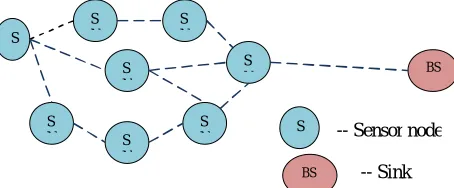
Ireless Sensor Networks (WSN) are autonomous sensors to monitor physical or environmental conditions, such as temperature, sound, pressure etc. [1], WSN is the collection of sensor nodes, which randomly deployed along with the sink. The basic structure of WSN has shown in fig 1.0.
In WSN energy efficiency is considered to be a critical problem, because the sensor nodes have limited battery power. Due to the converge cast nature of traditional WSN packet forwarding approaches resulting in the concentration of data traffic towards the sinks in WSN, the nodes in the locality of the immovable sinks are more likely to reduce their batteries. This results in data disruptions in the topology and reduction in the sensing scalability. Additionally, this problem could lead to the isolation of the sinks, hindering the delivery of the sensor data traffic. (MS) Mobile sinks are proposed and explored as a possible solution to this problem.
ISSN(Online): 2320-9801
ISSN (Print) : 2320-9798
I
nternational
J
ournal of
I
nnovative
R
esearch in
C
omputer
and
C
ommunication
E
ngineering
(An ISO 3297: 2007 Certified Organization)
Vol. 3, Issue 9, September 2015
Fig 1.0 Wireless Sensor Network structure
With the consideration of random characteristics and the number of nodes in the WSN, sink will be initiated; those mobile sinks have the ability to move near to the sensor nodes and collects data periodically. This idea is quite interesting when the number of node is small in the network. But that is very challenging at the time of data collection in heterogeneous networks. With the intension of reducing energy at each sensor node, Multi Mobile sink idea has been used.
II. PROBLEM DEFINITION
Sensor networks offer opportunities to observe/interact with physical world aiding in gathering of data that was till recently difficult, expensive, or even impossible to collect. Sensor network deployments make sense practically only if run unattended for many months/years. Among wireless sensor node performances, radio transmissions are the most expensive in consuming energy. In WSNs with a mobile sink, one fundamental problem is to determine how the mobile sink goes about collecting sensed data. One approach is to visit each sensor node to receive sensed data directly. In multi-hop infrastructure, Sensor nodes that are near a sink tend to become congested as they are responsible for forwarding data from nodes that are farther away.
This is essentially the well-known traveling salesman problem (TSP) [2], where the goal is to find the shortest tour that visits all sensor nodes. Though, with an increasing number of sensor nodes in sensory fields, this problem becomes difficult and unfeasible as the resulting tour length is likely to violate the delay bound of applications. Consider a WSN in which sensor nodes generate data packets periodically. Each data packet must be delivered to the sink node within a given deadline. In that situation, there is a mobile sink that moves around a WSN to collect data from a set of cell headers. The objective is to determine the set of CHs and associated tour that visits these CHs within the maximum allowed packet delay. The fundamental problem then becomes computing a tour that visits all these CHs within a given delay bound. This may result in data loss and improper data collection.
Existing techniques [3][4][5] failed to perform data collection with different delay requirements. This means a mobile sink is required to visit some sensor nodes or parts of a WSN more frequently than others, while ensuring that energy usage is minimized, and all data are collected within a given deadline. There is a need to extend WRP [3] to the multiple mobile sinks/rovers case in order to improve the scalability. While extending number of mobile sinks, it may involve with many sub problems such as interference and coordination between Mobile sinks. This theme was not applied in the existing work.
III. PROPOSED SYSTEM
To overcome the above stated problems, we proposed, a novel scheme called Distributed MMS (Multi Mobile Scheduling) algorithm, which handles the communication and data collection scheduling process among multi mobile sink. Unlike the existing solutions, which improve data delivery performance by employing multiple mobile sinks and by deploying fine scheduling at deliberately important points in the sensor area, the proposed scheme does not allow packet drop at such situation, this overcomes the data collection problems. It aims to optimize the trade-off between nodes energy consumption and data delivery. Mobile sinks implicitly provide load balancing without extra effort. The hotspots around the sink change as per the sensor node mobility, and the increased energy drainage around the sink is spread through the network which helps in achieving uniform energy consumption and thereby extending the network
BS S
S N
S N
S N
S N S
N
S N S
N
ISSN(Online): 2320-9801
ISSN (Print) : 2320-9798
I
nternational
J
ournal of
I
nnovative
R
esearch in
C
omputer
and
C
ommunication
E
ngineering
(An ISO 3297: 2007 Certified Organization)
Vol. 3, Issue 9, September 2015
lifetime. The proposed DMMS provides a grid based data collection with multiple mobile sink implementation, whereby each sensor node is assigned in a grid corresponding to its hop distance from the tour and the number of data packets that it forwards to the closest CH. And each CH finds the load and position of mobile sinks and re distributes to other CHs. HGRP is validated via extensive computer simulation that enables a mobile sink to retrieve all sensed data within a given deadline while conserving the energy expenditure of sensor nodes. The use of cell headers (CHs) to bound the tour length. This means a subset of sensor nodes are designated as CHs and non-CH nodes simply forward their data to CHs. A tour is then computed for the set of CHs, which is called Cell headers is designed for selecting the most suitable representative that minimize energy consumption in multi-hop communications while meeting a given packet delivery bound. A secondary problem here is to select the set of CHs that result in uniform energy expenditure among sensor nodes to maximize network lifetime. Our proposed system designed to minimize energy consumption by reducing multihop transmissions from sensor nodes to CHs. This helps to find the sensor node that forwards the highest number of data packets and have the more resources as cell headers and it reduces the network energy consumption. Finally our system achieves 56% more energy savings and 67% better distribution of energy consumption between sensor nodes.
A. HGRP:
Distance calculation of nodes in the network:
This process calculates distance between each node using the distance based algorithm. The distance-based algorithm uses absolute point-to-point distance estimates (range) or angle estimates in location calculation.
Distance (d)=dis(x1 y1 x2 y2) (1)
Where x1 is the x position of node1, y1 is the y position of node1, x2 is the x position of node2, y2 is the y position of node2. From the above function (1) the distance calculation parameter has been identified. The following formula is the detailed calculation of distance function.
distance [expr int(sqrt(pow(($x2-$x1),2)+pow(($y2-$y1),2)))] (2)
Here, the distance value stored in variable d. based on the distance the mobile sink will be selected by each CHs. Hence, distance-based methods require the additional equipment but through that we can reach much better resolution than in case of range-free ones.
Coordinates calculation for localization process:
In this process the results of the inter node distance calculation is used. The calculated distances are converted into geographic coordinates of network nodes. Different less and more complicated techniques may be used to perform calculations. The coordinates of nodes can be calculated using: geometrical techniques. The MSS is adopted to improve the accuracy of calculated estimates. This algorithm will check the calculated coordinates and distances to improve the accuracy of location and optimize the coordinates and distances. And, this transmits the position and distance details to the nearest CHs.
Deploy the Mobile sensor nodes in the estimated position:
In this process finally the Mobile sinks will be deployed in the estimated locations periodically. This helps to achieve the better optimized or accurate locations for the sensor nodes. Periodically the movement of the mobile sink will be scheduled.
Final Scheduling process:
In order to handle with dynamic network topology in wireless sensor network, this is generally caused by sink mobility. In those mobile environment every node need to setup their data delivery routes in accordance with the latest location of the mobile sink.
ISSN(Online): 2320-9801
ISSN (Print) : 2320-9798
I
nternational
J
ournal of
I
nnovative
R
esearch in
C
omputer
and
C
ommunication
E
ngineering
(An ISO 3297: 2007 Certified Organization)
Vol. 3, Issue 9, September 2015
cell header upon discovering the sink’s presence, shares this information with the rest of the cell headers in a controlled manner.
IV. RESULTS
Our system simulated using NS2 simulation tool. To evaluate the performance of the techniques, the system has developed a NS2-based simulation environment. The chapter shows the comparison study of DMSS against three methods that have the same objective as DMSS, namely WRP, CB, RD-VT, and RP-UG, using a custom simulator written in C++. This considers a connected WSN where nodes are placed uniformly on a sensor field with virtual grid environment. This note that interconnecting disconnected sensor nodes using a mobile node is a well-known and separate problem. The HGRP can be also made to interconnect disconnected nodes if the required delivery time for data packets is greater than the shortest travelling tour to visit all sensor nodes. The reason that we have assumed uniform sensor-node distribution is because energy holes are more likely to form when nodes are distributed uniformly. The proposed design is implemented using NS-2 and it is analysed by considering certain parameters like Packet lost, Packet delivery ratio, Energy consumption and End- to-end delay. In the proposed HGRP protocol selects the stable path to reduce the fake position and Packet lost and there by increases the packet delivery ratio and energy consumption. Programs in NS-2 are scripted in OTcl and results of simulations can be visualized using the Network Animator (NAM) and Xgraph.
The simulation is carried out within the Network Simulator 2. In Linux operating system with Ubuntu as the interface tool. The mobility model uses the random waypoint model. There are 50 nodes defined in a simulation area of size 1000m x1000m. The mobility of nodes is limited to 5ms. The traffic model chosen is Constant Bit Rate (CBR) connections with packet size of 1000 bytes to emulate traffic over the network. Each packet starts from a random location to a random destination with a randomly chosen speed. Once the destination is reached, another random destination is targeted after a pause. The pause time, which affects the relative speeds of the mobiles, is varied.
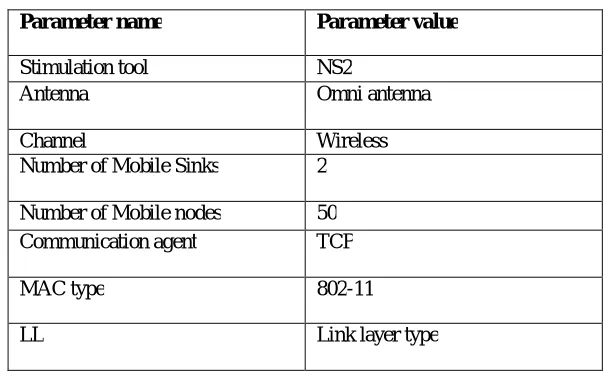
Table.1.0 Stimulation Parameters
Parameter name Parameter value
Stimulation tool NS2
Antenna Omni antenna
Channel Wireless
Number of Mobile Sinks 2
Number of Mobile nodes 50 Communication agent TCP
MAC type 802-11
LL Link layer type
ISSN(Online): 2320-9801
ISSN (Print) : 2320-9798
I
nternational
J
ournal of
I
nnovative
R
esearch in
C
omputer
and
C
ommunication
E
ngineering
(An ISO 3297: 2007 Certified Organization)
Vol. 3, Issue 9, September 2015
The fig 2.0 shows the proposed HGRP of End-to-End delay is decreased when compared with the existing protocols.
Fig.2.0. End-to-End Delay
Our analysis showed that our protocol is very robust to data collection by independent mobile nodes as well as CHs, even when they have lowest energy, so the end to end delay has been reduced see (fig 2.0). To ensure the reliability and stability of the routing process here Efficient DMSS has been proposed. First it is provide a distributed, lightweight solution to the MS position verification problem that need not require infrastructure or a priori information and it is robust against several different issues. Next, it provides best selection of MS based on the energy, distance.
V. CONCLUSION AND FUTURE WORK
InWireless sensor networks data collection from energy constrained nodes is an important task. Mobile sink based data collection techniques has been introduced to perform optimal route planning, data collection scheduling, and fast emergency message gathering by discovering the multiple mobile sinks. This avoids data loss issues in energy restricted nodes by applying grid based data collection and dissemination by sharing the positions of MS with their neighbours and also addressed the selection of energy optimized node with stable path among the neighbours which not only describes the selection of correct position neighbours but also best link stability CHs. Thus overcome the data loss and also data dissemination failures. The availability of MS has been identified with the duration probability of mobile sinks that is subject to link failures caused by node mobility. The proposed work is implemented using NS-2. The performances are analysed and addresses that HGRP scheme with DMSS has reduced the packet loss and delay and increases the packet delivery ratio and Energy of the network.
REFERENCES
1. Akyildiz, Ian F., et al. "Wireless sensor networks: a survey." Computer networks 38.4 (2002): 393-422.
Delay =
Inter arrival of 1st Packet & 2nd Packet
ISSN(Online): 2320-9801
ISSN (Print) : 2320-9798
I
nternational
J
ournal of
I
nnovative
R
esearch in
C
omputer
and
C
ommunication
E
ngineering
(An ISO 3297: 2007 Certified Organization)
Vol. 3, Issue 9, September 2015
2. Salarian, Hamidreza, Kwan-Wu Chin, and Fazel Naghdy. "An energy-efficient mobile-sink path selection strategy for wireless sensor
networks." Vehicular Technology, IEEE Transactions on 63.5 (2014): 2407-2419.
3. Xing, Guoliang, et al. "Rendezvous design algorithms for wireless sensor networks with a mobile base station." Proceedings of the 9th ACM international symposium on Mobile ad hoc networking and computing. ACM, 2008.
4. G. Xing, T. Wang, Z. Xie, and W. Jia, “Rendezvous planning in wireless sensor networks with mobile elements,” IEEE Trans. Mobile Comput.,
vol. 7, no. 12, pp. 1430–1443, Dec. 2008.
5. K. Almi’ani, A. Viglas, and L. Libman, “Energy-efficient data gathering with tour length-constrained mobile elements in wireless sensor
networks,” in Proc. 35th IEEE Conf. LCN, Denver, CO, USA,Oct. 2010, pp. 582–589.
6. G. Xing, T. Wang, W. Jia, and M. Li, “Rendezvous design algorithms for wireless sensor networks with a mobile base station,” in Proc. 9th