Faculty of Mathematics, Physics and Informatics
Cellular Automata Approach
for Crowd Simulation
Evidence number: 1fbe9db3-cbe4-471b-84ee-a4817b422da2 Computer Graphics and Geometry
9.1.1 Mathematics
Department of Algebra, Geometry and Didactics of Mathematics
Faculty of Mathematics, Physics and Informatics
Comenius University, Bratislava
Cellular Automata Approach
for Crowd Simulation
(Rigorous Thesis)
Mgr. Jana Dadov´
a
the help of referenced literature.
Abstract
This thesis sums up relevant problems and explain current existing solutions to the topic of crowd simulation, behavioral control and use of cellular automata for these problems. Some of the terms in this thesis does not have explicit definition, and we define them axiomatically.
Moreover, we propose solution using cellular automata for crowd animation in three different situations. Firstly, cellular automaton with rules similar to Conway’s Game of Life is used for the movement control of the participants in a crowd. This situation is similar to situation of dancing performance, or dancing at the disco, where motions are more random.
Secondly, we use cellular automaton for the control of the movement and behavior of the individuals in the flash mob situation, where flash mob is spread to the new participants similarly as social preferences, or disease. Rules for this automaton are unique and also simple perception system is used, where rules are view depend. Thirdly, core of this work and probably future extensions are in behavioral control over the crowd in the virtual environment, more specific, exhibition environment and population of virtual museum. Based on cellular automaton and more advanced level of behavior, such as collision detection and avoidance is possible. Therefore we use cellular automaton for behavior control and also movement in the environment. Behaviors are specific for this environment, therefore we discuss psychology based behavioral patterns for this situation and apply them for use in cellular automaton.
KEYWORDS: behavioral animation, crowd simulation, cellular automata, virtual museum
Abstrakt a Resum´e
V tejto pr´aci sa zaober´am riaden´ım a simul´aciou davu pomocou celul´arnych automa-tov. V prvej ˇcasti definujem z´akladn´e pojmy z oblasti simul´acie davov, nastavovania spr´avania a vn´ımania prostredia. Niektor´e z t´ychto pojmov s´u dobre definovan´e v inej literat´ure, ktor´u pouˇz´ıvam ako zdroj, niektor´e vˇsak nemaj´u exaktn´u defin´ıciu, s´u ch´apan´e len intuit´ıvne, preto je potrebn´e tieto pojmy dodefinovaˇt. Na toto do-definovanie pouˇz´ıvam axiomatick´y apar´at. ˇDalej vysvetˇlujem z´akladn´u problematiku celul´arnych automatov ako aj ich pouˇzitie pre simul´aciu davov. Z´aroveˇn poukazujem na niekoˇlko najviac pouˇz´ıvan´ych typov spr´avania pre simul´aciu davov.
V druhej kapitole predstavujem z´akladn´e probl´emy v tejto oblasti a ich ˇciastkov´e rieˇsenia, ktor´e pon´ukaj´u ostatn´e pr´ace. Jedn´a sa hlavne o z´akladn´e pr´ace v spr´avan´ı skup´ın, od ktor´ych sa odv´ıjaj´u ˇdalˇsie modern´e ˇcl´anky. V tejto sekci predstavu-jem aj z´akladn´e delenie pr´ıstupov pre riadenie davu. Jedn´a sa o mikroskopick´y a makroskopick´y pr´ıstup. Prv´y sa vyznaˇcuje t´ym, ˇze riadenie skupiny je spraven´e pomo-cou nastavenia spr´avania a pohybu jednotlivcov. T´ym, ˇze s´u t´ymto jednotlivcom nas-taven´e spr´avne hodnoty a spr´avanie a umoˇznen´e interagovanie s ostatn´ymi ˇclenmi a prostred´ım, je vlastne nastaven´e aj spr´avanie cel´eho davu. V tomto pr´ıpade ide hlavne o pr´ıstupy vyuˇz´ıvaj´uce tzv. agentov, kde agent predstavuje jedn´eho ˇclena skupiny, je schopn´y vn´ımaˇt okolie ako aj vykazovaˇt rˆozne modely spr´avania. Na druhej strane makroskopick´y pr´ıstup riadi jednotlivcov pomocou nastavovania hodnˆot cel´eho davu. Sem mˆoˇzme zaradiˇt celul´arne automaty a soci´alne sily. Makroskopick´y pr´ıstup je vhodn´y pre detekciu kol´ızi´ı, ako aj pre priestorovn´e vn´ımanie okolia. Z´aroveˇn prin´aˇsa manipul´aciu davu ako celku. Mikroskopick´y pr´ıstup zase na druhej strane dovoˇluje nastavenie spr´avania jednotlivca a t´ym prin´aˇsa prirodzenejˇsie spr´avanie, pretoˇze jed-notlivec mˆoˇze vykazovaˇt origin´alnu personalitu. V¨aˇcˇsinou sa tieto pr´ıstupy kombinuj´u pre vlastnosti, ktor´e s´u pop´ısane vyˇsˇsie a pr´ave toto kombinovanie mˆoˇze tieˇz prin´aˇsaˇt rˆozne probl´emy.
flocking behavior, ktor´e je z´akladn´ym modelom, ktor´y sa pouˇz´ıva nie len pre k´rdle, ale aj in´e skupiny ˇziv´ych bytost´ı. Jedn´a sa o pr´ıstup, kde je skupina riaden´a pomocou spr´avania agentov.
ˇ
Dalˇs´ım pozoruhodn´ym pr´ıstupom je nastavenia pomocou tzv. soci´alnych s´ıl[HM95], kde dav je riaden´y silami podobne ako by iˇslo o sily, ktor´e riadia pohyb vody. Tieto sily vˇsak nies´u zaloˇzen´e na fyzik´alnom svete, ale na vzˇtahoch a spr´avan´ı ˇlud´ı.
V nasleduj´ucich sekci´ach predstavujem rˆozne pr´ıstupy, ktor´e vylepˇsuj´u z´akladn´e met´ody. V pr´ıpade celul´arnych automatov sa jedn´a najm¨a rieˇsenie pohybu, ktor´y je neprirodzene diskr´etne a navyˇse sa vyskytuje probl´em s r´ychlosˇtou nakoˇlko diagon´alny smer je r´ychlejˇs´ı ako ostatn´e. Tento je moˇzn´e rieˇsiˇt zjemnen´ım mrieˇzky [SHT10]. Dalˇs´ımˇ probl´emom je nastavenie spr´avania jednotlivca, teda rˆozne pr´ıstupy k vyh´ybaniu sa zr´aˇzkam [DDW06], resp. tzv. lok´alne pravidlo, ktor´e umoˇzˇnuje pohyb jednotlivca podˇla jeho okolia a stavu jednotlivcov v tomto okol´ı. Jednotlivci sa vˇzdy snaˇzia ´ısˇt za svojim cieˇlom najvhodnejˇsou cestou a spotrebovaˇt ˇco najmenej energie, resp snahy, ˇ
co naz´yvamealgoritmom najmenˇsej snahy(least effort) [SHT09].
Nasleduj´uce dva pr´ıstupy vyuˇz´ıvaj´u v´yhody celul´arnych automatov t´ym, ˇze pouˇz´ıvaj´u delenie priestoru do pravideln´ych mrieˇzok. Jedn´a sa o tzv. podlahov´e pole (floor field) [LM03], pole potenci´alov (potential field). Oba prin´aˇsan´u davu glob´alnu inform´aciu o prostred´ı, kde v prvom pr´ıpade ide o vzdialenosti k zauj´ımav´ym bodom, napr. v´ychodom a v druhom pr´ıpade o sa k tejto inform´acii eˇste prid´avaj´u aj stopy, ktor´e zanech´avaj´u jednotlivci za sebou.
Pri simul´acii davov je viacero probl´emov ako len detekcia kol´ızi´ı a nastavenie spr´avania. Pokiaˇl chceme realistick´y dav, zauj´ıma n´as aj pohyb jednotlivcov a samotn´a vizualiz´acia davu. Castokr´ˇ at naˇsim cieˇlom je vytvoriˇt heterog´enny dav [TM07], ˇci uˇz vo vy-obrazen´ı jednotlivcov, alebo v ich pohybe. Pokiaˇl ide o pohyb, jeho ruˇcn´e generovanie by bolo ne´unosn´e. Existuj´u vˇsak met´ody na nov´e generovanie pohybov z uˇz exis-tuj´ucich pomocou ˇstrukt´ury tzv. grafov pohybu (motion graphs) [KGP02] ako aj ich prenesenie na nov´e postavy [Gle98]. Pokiaˇl ide o pohyb davu taktieˇz existuje grafov´a ˇstrukt´ura, ktor´a napom´aha sp´ajaniu viacer´ych sekvencii a naz´yvame ju graf skupinov´eho pohybu (group motion graph)[LCF05].
pre identifik´aciu problematick´ych miest pri evaku´aci´ach v ˇcase nebezpeˇcenstva, ale mˆoˇze n´am aj prin´aˇsaˇt vizu´alne zauj´ımav´e efekty vytv´aran´ım rˆoznych tvarov pomocou spr´avnych poz´ıc´ı jednotlivcov ako aj ich pohybu [TYK+09], [XJY+08].
Pokiaˇl ide o nastavenie spr´avania davu, je dˆoleˇzit´e vhodne si zvoliˇt situ´aciu, pre ktor´u chceme toto spr´avanie simulovaˇt, aby sme vedeli poskytn´uˇt jednotlivcom len tie in-form´acie, ktor´e by aj v re´alnom ˇzivote dostali. Teda zvoliˇt zhodn´y model percepcie ako aj vstupn´ych syst´emov. V modern´ych met´odach je aj snaha o simulovanie pam¨ate [SMK05]. Najˇcastie sa vyuˇz´ıva problematika chodcov [BEHG11], [SMK05], [LM03], [BKSZ01],[BA00] preto ich model spr´avania je najviac pop´ısan´y. Ostatn´e situ´acie nemaj´u dobre pop´ısan´y model spr´avania a preto simul´acia davov je vlastne multi-disciplin´arny probl´em, kde je okrem umelej inteligencie n´apomocn´a aj psychol´ogia. Rovnako ako spr´avanie, v modern´ych pr´ıstupoch je aj snada o vern´e nasimulovanie ˇludsk´ych em´oci´ı [AA02], tento probl´em vˇsak eˇste nenach´adza postaˇcuj´uce rieˇsenia.
Vo ˇstvrtej kapitole sa zober´am vysvetlen´ım troch nami navrhnut´ych celul´arnych au-tomatov, ktor´e ˇciastoˇcne rieˇsia rˆozne probl´emy v simul´acii davov. Prv´ym z nich je celul´arny automat, ktor´y riadi pohyb jednotlivcov v dave pomocou podobn´ych pra-vidiel ako sa nach´adzaj´u v hre ˇZivot [Weib]. T´ymto riaden´ım prin´aˇsa automaticky generovan´u sekvenciu pohybov, ktor´a sa d´a vyuˇziˇt napr. na rˆozne taneˇcn´e davov´e sc´eny.
Druh´y celul´arny automat riadi spr´avanie aj pohyb jednotlivcov v dave s vyuˇzit´ım jednoduch´eho percepˇcn´eho modelu, kde pravidl´a automatu s´u zav´ısl´e na uhle pohˇladu pozorovateˇla. Tento automat je vyuˇzit´y pre sc´enu, tzv. flash-mob, kde niekoˇlk´ı ´
uˇcastn´ıci zaˇcn´u na verejnom priestranstve vykon´avaˇt zrazu nieˇco ˇsialen´eho (v naˇsom pr´ıpade zaˇcn´u tancovaˇt) a ostatn´ı sa k nim zaˇcn´u prip´ajaˇt a pr´ave toto prip´ajanie je riaden´e celul´arnym automatom so ˇspeci´alnymi pravidlami.
Tret´ı celul´arny automat riadi spr´avanie a pohyb davu v prostred´ı v´ystavnej s´aly s ist´ymi predpokladmi, ako ˇze dav je riedky, ˇze ide o priestranstvo bez ´uzskych chodieb, atˇd. V tomto priestore sa n´avˇstevn´ıci automaticky pohybuj´u, snaˇzia sa dosiahnuˇt cieˇl, ktor´ym s´u v¨aˇcˇsinou expon´aty, alebo v´ychody, v pr´ıpade expon´atov sa pri nich snaˇzia
chv´ıˇlu zostaˇt. Pri t´ychto aktivit´ach sa z´aroveˇn menia hodnoty, ktor´e menia spr´avanie jednotlivcov, podˇla ich preddefinovanej personality. Pr´ave v ˇdalˇsom rieˇsen´ı tohto automatu a presunut´ım do priestoru m´uzea by sme sa chceli venovaˇt v ˇdalˇsej pr´aci. Priestor m´uzea je z hˇladska spr´avania a vyhnutia sa zr´aˇzkam zloˇzitejˇs´ı ako v´ystavn´a s´ala, lebo sa v ˇnom nach´adza viacero uˇzˇs´ıch chodieb. Z´aroveˇn bude nutn´e hlbˇsie preˇstudovanie problematiky m´uzea z pohˇladu psychol´ogie [RSS+28].
Na z´aver je nutn´e podotkn´uˇt, ˇze sme v pr´aci navrhli tri odliˇsn´e celul´arne automaty pre odliˇsn´e probl´emy riadenia davu, avˇsak vˇsetky tri s´u origin´alne vo vyuˇzit´ı celul´arnych automatov pre dan´u problematiku, preto eˇste pon´ukaj´u priestor na zlepˇsenie a v bud´ucej pr´aci by sme chceli toto zlepˇsenie priniesˇt.
KˇL ´U ˇCOV´E SLOV ´A: anim´acia pomocou spr´avania, simul´acia davu, celul´arne automaty, virtu´alne m´uzeum
conceive. This facility makes it the most versatile and explicit means of communication yet devised for quick mass appreciation.” Walt Disney
List of Figures
2.1 Horizontal perception model of a normal human. View from the top. 8 2.2 Transcription rules for Rule30 starting from the single black cell [Weia] 12 2.3 Neighborhood in regular rectangular cellular automaton. (a) Moore’s,
or 8-neighborhood [Weic], (b) von Neumann’s, or 4-neighborhood [Weid] 13
2.4 Cellular Automaton during Pedestrian Simulation [BA00] . . . 14
3.1 Difference of movement speed in diagonal direction and 4-neighborhood direction [SHT10] . . . 22
3.2 People leaving a room with one door only [BKSZ01]. . . 23
3.3 Here we see the rings of equal value (distance) propagating out from the source in (a), and how well Potential Fields apply to multiple exits (b). The lines represent contour information [LM03]. . . 24
3.4 Representation of a pedestrian and approximation in fine grid cellular automata with different orientations [SHT10] . . . 26
3.5 A group motion graph [LCF05]. A group motion graph constructed from the clip. Vertices (blue dots) are connected in two sets of edges, formation edges (colored edges in the figure) and motion edges (black edges). . . 29
3.6 Group motion stitching steps. . . 30
3.7 Formations created by positioning performer [TYK+09] . . . . 30
3.8 Shaped created from the flock [XJY+08] . . . . 32
4.1 Cellular automaton cells are mapped on the floor grid. Black cells are occupied, white are empty. Movements of robots are according to the number of neighbors. . . 45
rest of the group. . . 47 4.3 (a) Mapping of the rotation to the polar coordinates. Angles are shown,
length is set to 1. (b) Mapping to the array to easier get indices. . . 48 4.4 (a) field of view for the first group (b) neighborhood that is analyzed
(c) filed of view for the second group (d) neighborhood that is analyzed. 48 4.5 Discreet steps of the algorithm. . . 49 4.6 Flags used for the coordinates of an individual. . . 51 4.7 Coordinates of the participants related to the layout grid with flags
and neighborhood grid. . . 51 4.8 Decision process used for finding the next person for an actual cell. . 53 4.9 Number 1, 2 are detour possibilities, which one is the first, depends
on the behavior control, it is not hard coded. Number 3 is a previous location and a possible new location . . . 54 4.10 Three dimensional behavioral model. . . 55 4.11 Various stages of the simulation: (left) initial step, (right) step during
movement. Blue spheres represent participants that are interested in objects (yellow cylinders) and are grouped around these interesting objects. . . 57
Contents
1 Introduction 1
1.1 Why Crowds? . . . 1
1.2 Why Cellular Automaton? . . . 3
2 Terminology and Basics 4 2.1 Definitions and Notations . . . 4
2.1.1 Crowd . . . 4
2.1.2 Behavior . . . 6
2.1.3 Simulation . . . 9
2.1.4 Environment . . . 10
2.2 Cellular Automata . . . 10
2.3 Cellular Automata for Crowd Simulation . . . 13
2.4 Behavior Patterns . . . 15
3 Related Work 18 3.1 Classic methods . . . 18
3.1.1 Flocking behavior . . . 19
3.1.2 Social Forces . . . 21
3.2 Using Cellular Automata . . . 22
3.2.1 Local Rule . . . 23
3.2.4 Least Effort . . . 25
3.2.5 Fine Grid . . . 25
3.2.6 Conclusion . . . 26
3.3 Crowd Simulation . . . 27
3.3.1 Motion Graph . . . 28
3.3.2 Group Motion Graph . . . 28
3.3.3 Group Formation Control . . . 30
3.3.4 Shape Constrained Flock . . . 31
3.3.5 Collision . . . 34
3.3.6 Conclusion . . . 36
3.4 Behavioral Animation . . . 36
3.4.1 Perception Model . . . 37
3.4.2 Model of Emotions based on Psychology . . . 38
3.4.3 Modeling Behavior . . . 39
3.4.4 Conclusion . . . 42
4 Proposed Solutions 43 4.1 Motion control in a group . . . 43
4.1.1 Mapping . . . 44
4.1.2 Group Motion . . . 45
4.1.3 Future Work . . . 46
4.2.1 Method . . . 48
4.3 Crowd Simulation in an Exhibition Environment . . . 50
4.3.1 Spatial Relations . . . 51
4.3.2 Collision Avoidance . . . 53
4.3.3 Behavior . . . 54
4.3.4 Future Work and Results . . . 56
5 Future Work and Conclusion 58
1
Introduction
We try to answer in this chapter questions why are crowd simulations interesting, why is research in this field interesting and why we use cellular automata instead of other options. Work in crowd simulation is multidisciplinary, because for a successful simulation also psychological theories need to be incorporated. In the next chapters we explain basic terms and methods that are needed for this topic (chap. 2), describe related projects, their pros and cons (chap. 3), propose our solution (chap. 5) and in the last section we suggest possible problems that should be solved in the future (chap. 5).
1.1 Why Crowds?
Crowds are interesting from many points of view. Firstly, a crowd of human beings brings life to the scene, not only virtual, but also to real. Crowds are everywhere around us, especially in public places, humans are accustomed to perceive other hu-mans. Space that is filled with crowd is more natural and less sterile. When we see in virtual world crowd of other humans, or even other living beings we feel more comfortably, we are not alone in an empty space.
Secondly, participants in a crowd can act separately, can have own behavior, visual system. Participants can behave in a way that they seems to have their own will. On
1.1. WHY CROWDS? the other hand, crowd acts also as a whole, where behavior is similar among partic-ipants. Decision of a proper mixture of these two behavioral principles (individuals and crowd as a whole) makes crowd simulation interesting, as it is hard to measure the quality and optimize the solution to be more or less visually pleasant.
On the other hand, crowd is not only visually attractive and make observers feel more comfortably but also various crowd simulations could be use to identify emergency risks of different environments. Examples of these risky situations are emergency exit bottlenecks and weight tests. Essential in these problems is testing before emer-gency occurs, identify possible future problems and bring better solution before real emergency happens.
Many research groups are interested in crowd simulation [TM07]. There are many subproblems that should be solved and many of them have no satisfying solution. Main problems are realistic animation of human motion and realistic behavior. Both of them are hard because there is no precise model for these problems. For example dance is motion but is also a performance where dancer express emotions and feelings and it is not the same for different performers. Even walk cycle is one of the basic human motions, it is learned in basic animation classes. It also one of the hardest, because this motion is so many times seen by human eye, that even small divergence in acceleration is visible.
Moreover, human behavior understanding is not solved up to now. There are psychol-ogists that try to understand behavior in various specific situations or even in more complex way. If there is no full description of behavior, it is hard to simulate. There-fore researchers try to simulate behavior in specific situations in very constrained form, that should be sufficient for the problem. Finding new situations where it is not already simulated and try to solve the problem there is goal of many modern approaches. Holy grail in this field is to simulate very complex and universal solution of human behavior with emotions, both individual and collective.
1.2 Why Cellular Automaton?
Cellular automaton are grid based solutions that formalize certain models in the regular grid. Cells of this grid than have states that change in discreet time steps. More precise definition is in section 2.2. When space is divided in the regular grid, objects in the scene (obstacles and crowd members) are set to occupy this grid. Then it is very easy to find space relations between these objects under discreet topology with reduced neighborhood. Therefore finding neighbors in some defined proximity is easy and helps with obstacle avoidance and collision detection. Moreover when space relations are defined also behavior control is easier where other members or environment affect behavior of an individual.
These are main advantages of this approach. Conversely, there are also disadvantages, where solution is not straightforward and special techniques need to be find. This disadvantages are mainly in the motion, where motion along the grid has the same problems as other discrete solutions. This problems include smooth velocity change and smooth change in direction of movement. There are already some solutions, but these are not satisfactory. Another already known problem is using rectangular grid with Moore neighborhood (8-neighborhood), where step along horizontal or vertical direction is shorter than in diagonal directions.
Regardless the problems described here, we still think that use of cellular automata is powerful enough to solve some problems in crowd simulation control.
2
Terminology and Basics
In this chapter we would like to explain some basic terms, their definitions and expla-nation according to their use in this work. We also discuss here definition of Cellular Automata and their use for crowd simulation.
2.1 Definitions and Notations
In crowd simulation research there are some terms such ascrowd,agent,environment,
simulation and others, that are often vaguely defined, because their meaning is intu-itively understandable. Therefore, d we would like to bring more precise definitions to prevent any misunderstandings.
2.1.1
Crowd
In this subsection we explain basic terms that are related to the crowd. There are more definitions for the crowd:
Definition 1. Crowd is usually defined as a large number of things or people consid-ered together [PAB08].
Definition 2. Crowdis a large group of individuals in the same physical environment, sharing a common goal [MT97]
Definition 3. We use more exact definition and define crowd as a finite set of individuals that have defined collective behavior and share same environment. When term Crowd used in this thesis, it usually refers to a virtual crowd, see def. 4.
Definition 4. Virtual Crowd, Member, Individual, Participant are a crowd, mem-ber, individual, participant generated by computer, in computer and displayed on the display.
Definition 5. Virtual Human is computer generated representation of a real hu-man with defined huhu-man-like geometry, movement, materials, textures, behavior and emotions according to description that is based on real human geometry, movement, materials, textures, behavior and emotions.
For purposes of simulations and also of this work, sometimes Virtual Human refers to a an object without a geometry, textures, only behavior and emotions are defined. Geometry is then represented with very simple objects, such as sphere, or cube to better observe behavior.
Definition 6. For purposes of simulations and also of this work, sometimes Virtual Human refers to an object without simple geometry, textures, only behavior and emo-tions are defined, according to the definition 5. Geometry is then represented with very simple objects, such as sphere, or cube.
Definition 7. Participant, Individual, Member, Person are single objects with defined individual behavior and emotions and have visual system to percept environment. These objects also have geometry, materials, textures and animation. When in set, they have ability to create collective behavior, therefore also a crowd. These terms as used in this thesis are synonyms and usually are referred to virtual participants, individuals, members, persons respectively.
They have variety of properties that define their individuality. These properties define emotional states, behavior, but also velocity, disability, direction, goal, etc. This properties can vary depending on the situation.
2.1. DEFINITIONS AND NOTATIONS Definition 8. Groupis a finite set of individuals that have defined collective behavior. These individuals are not humans-like.
Definition 9. Pedestrian is a person who travels by foot [PAB08]
Definition 10. Flockrefers generally to a group of objects that exhibits polarized, non colliding, aggregate motion. The term polarization is from zoology, meaning alignment of animal groups [Rey87].
Definition 11. Boid simulated bird-like, bird-oid, even when they represent other sorts of creatures such as schooling fish [Rey87]. These creatures move in all three directions in 3 dimensional euclidean space and incorporate their own visual system.
Definition 12. Virtual human agents are humanoids, whose behavior is inspired by that of real humans, they are equipped with sensors, memory, perception and behav-ioral motor (enable them to act and react to events)[TMK00]
2.1.2
Behavior
In this subsection we explain basic terms that are behavior related. While familiarity with the interdisciplinary research literature on emotion and behavior is important, arriving at some definition of emotion, behavior or other affect-related terms is much less important for those who examine this phenomena in the field of psychology. As psychology is an empirical science, its practitioners are generally uninterested in definition. On the other hand, the meaning of a concept in science is determined after extensive investigation of the phenomenon the term relates to, not before such an investigation [AA02]. However this is hard problem, for purposes of this work and also for algorithms finding it is important to have some definition. There are usually more definitions for the same term in this chapter, because of the uncertainty and lack of definitions indicates that the field is very new .
Definition 13. Behavioris often defined as the way in which animals and humans act [TMK00]. Behavior may be described in a hierarchical way. A level of the hierarchy containing several behaviors to be performed sequentially is called a behavior. Each behavior of a behavior sequence is called a behavioral cell [TMK00].
• Collective Behavior Is a set of specific behaviors of participants in crowd, that satisfy following condition:
– are result of perception of the others
– are common to all participants
– result in sharing the same goal for all participants
• Emergent Behavior is a group behavior, where individuals acts in a way that will result in collective behavior.
• Steering Behavior is the ability to navigate around environment in a life-like and improvisational manner [Rey99].
• Reflexive Behavior is set of behaviors, that will result in obstacle avoidance [TT94]
• Motivational Behavior depend on the local variables of the individual (mental state, such as hunger, libido...) [TT94]
Definition 14. Behavioral Animation is an animation, where change of temporal values is defined according to the behavioral variables.
Definition 15. Many implementations of emotion are necessarily shallow because the systems in which they occur are not attempts to simulate a complete mind [AA02]. Therefore also definitions are distinct, depending on what for are emotions imple-mented.
• Emotions are a physical and psychological reactions to external and internal factors [JKF+11].
• Emotionsmay also be defined as the affective aspect of consciousness. An emo-tion is a persons reacemo-tion to a percepemo-tion [TMK00].
• Emotionis a short natural algorithm that is unique to the individual and defines reaction to the situation, which consists of the set of the input variables from sensing system.
2.1. DEFINITIONS AND NOTATIONS Definition 16. Sensing System is a set of variables that describe percept space and other behavior of other individuals. This systems and it’s setting affect individuals behavior. Mostly known example of this system is Human Visual System, but in this work is not only visual and not only human system in consideration.
detail
object
form
movement
object
form
movement
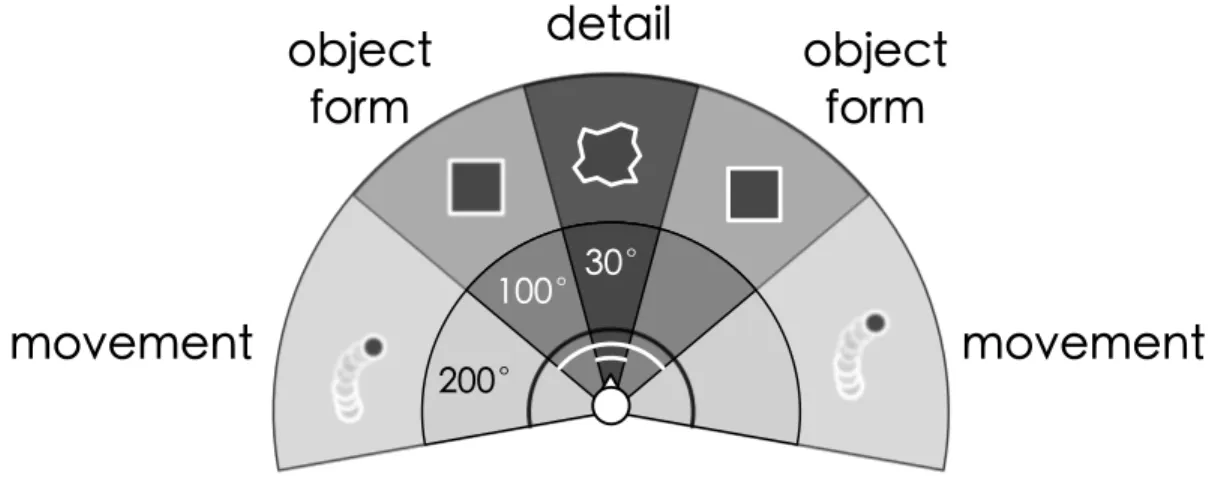
30° 100° 200°Figure 2.1: Horizontal perception model of a normal human. View from the top. Definition 17. Perception is defined as the awareness of the elements in the envi-ronment through physical sensation [TMK00].
Perception of normal humanis as follows: Human horizontal perception field is divided into three main parts. The first part is defined by a vision angle of 30 degree. In this field a human can see object in detail. The second part is defined by a vision angle of 100 degree. In this part, a human can see only object forms. In the third part (Its vision angle is 200 degree), only movements of objects are seen [BEHG11].
Above is simplified definition of Perception that is used for crowd simulation and is based on psychological studies and is shown on fig. 2.1.
Definition 18. Memory is a set of information that describes previous time related events.
2.1.3
Simulation
In this subsection we explain basic terms that are related to the simulation.
Definition 19. Simulation is algorithmic description of phenomena based on precise mathematical theories. Phenomenon here is usually behavior.
Definition 20. In computer graphics, Procedural means created by automatic gen-eration using algorithm description instead of manual input by the user. It is usually used for the modelling of well described objects, or for animation of fuzzy objects.
Definition 21. Natural Algorithms are algorithms designed by evolution over mil-lions of years [Cha09]. These algorithms from our point of view include flocking behavior, crowd motion and others.
Definition 22. Agent is virtual participant that is controlled by automaton and in-corporates sensing system, is aware of the environment and other participants, avoids collisions are acts according to the behavior. Agents and participants are usually synonyms in the crowd simulation terminology.
Definition 23. Actor is the computational abstraction that combines process, proce-dure and state [Rey87].
Definition 24. Obstacles are interactive objects in environment [TMK00].
Definition 25. Collision Avoidance is behavior that will affect motion of the partici-pant and will result in non colliding with other participartici-pants and obstacles. It consists of other behaviors:
• When participant gets output from sensing system, it incorporates information about neighborhood, and Collision Detectionbehaviors process these information and result is knowledge of collisions.
• Collision Predictionis similar to Collision Detection, difference is that collisions in this behavior are predicted with use of higher range of neighborhood.
• Obstacle Avoidance is part of the collision detection, where only obstacles are avoided.
2.2. CELLULAR AUTOMATA Definition 26. Collidee is part of a group of another actors near him with near velocity, same direction - collision avoidance of a whole group [RD05a].
2.1.4
Environment
In this subsection we explain basic terms that are related to the environment. Definition 27. Environment is in this thesis and usually in other works 3 dimen-sional euclidean space that allows members to move and occupy space. Movement can be either in all three dimensions (for example birds, fish, etc.) or only in two dimensions (for example herds, humans, etc.) This two dimensional movement could be approximated with only two dimensional space. Environment includes crowd, ob-stacles and also other properties such as wind, water, magnetic force or other forces that affect crowd.
Definition 28. Constrained Environment is environment with constraints, that are usually space constraints that allow movement only in some parts. Example of this environments are pathways, or locked spaces, etc.
Definition 29. Neighborhood is a spherical, or circular zone of sensitivity centered at the individual’s local origin [Rey87].
When grid based approach is used,neighborhood is also discreet and might be different for the cells. More about neighborhood specific for the crows simulation in the next section 2.2.
2.2 Cellular Automata
In this chapter we would like to explain basic theory of cellular automata and their use in crowd simulation. When discussing cellular automata, firstly definition of automaton is needed.
There are many different uses of automaton theory and these are mainly discussed in field of discrete mathematics and theoretical computer science. The type we use here is called cellular automata (sing. - cellular automaton, abbr. CA).
Definition 31. Cellular Automaton (Wolfram) A cellular automaton is a collection of ”colored” cells on a grid of specified shape that evolves through a number of discrete time steps according to a set of rules based on the states of neighboring cells. The rules are then applied iteratively for as many time steps as desired [Weia].
Definition 32. Cellular Automaton (Ferber) Cellular automata are discrete dy-namical systems, whose behavior is completely specified in terms of a local relation [DDW06].
Definition 33. Cellular Automaton (Weimar) Let us take into consideration four elements: (L, S, N,f ), where: L Set of cells of the lattice, S Set of states, N -Set of neighbors, f - transition function. Additionally, a configuration Ct : L → S
is defined as a function, which associates each state with a grid cell. An equation of change of a configuration is shown by the equation below with the supplement.
Ct+1(r) =f({Ct(i)ki∈N(r)}), 2.1 where:
• N(r) - set of neighbors of cells r
• r - current cell number
• t - discrete time step t=t+ 1 • i - single cell
2.2. CELLULAR AUTOMATA It seems to be a very simple model that is not suitable for solving complex phenomena. On the other hand S. Wolfram presents in his book [Wol02] a large collection of problems that could be solved using cellular automata. Mostly they are various time-depend biological systems, natural algorithms, or textures that describe various phenomena of living beings where their irregularities could be successfully represented by CA. Also crowd behavior is one of the natural algorithms and could be represented by CA in theory. The only problem is in finding a suitable definition of this special CA.
rule 30
Figure 2.2: Transcription rules for Rule30 starting from the single black cell [Weia] The simplest type of automaton is known in one dimensional space, where finite number of rectangular cells are used and colors of the cells are only black and white. Starting condition is set (values 0 for white, 1 for black coloring) and in discreet steps values of the cells are changed according to the neighborhood (neighbors are only left and right). Even such simple CA have amazing properties. There are 256 such automata, each of which can be indexed by a unique binary number whose decimal representation is known as the ”rule” for the particular automaton. An illustration of rule 30 is shown in fig. 2.2 together with the evolution it produces after 15 steps
starting from a single black cell [Weia].
(a) (b)
Figure 2.3: Neighborhood in regular rectangular cellular automaton. (a) Moore’s, or 8-neighborhood [Weic], (b) von Neumann’s, or 4-neighborhood [Weid]
Another widely used CA are in two dimensional euclidean space using regular rectan-gular grid and Moore’s (fig. 2.3(a), also known as 8-neighborhood) or von Neumann’s (fig. 2.3(b), also known as 4-neighborhood) neighborhood. For crowd simulation it is usually Moore’s neighborhood.
2.3 Cellular Automata for Crowd Simulation
Mostly when discussing Crowd Simulation and use of CA, there are properties that are similar. These are the properties:
• Space where individuals move is approximated to the plane, or positions are pro-jected to the plane (we call this part of the plane, where are positions propro-jected, in this work layout)
2.3. CELLULAR AUTOMATA FOR CROWD SIMULATION
Figure 2.4: Cellular Automaton during Pedestrian Simulation [BA00] grid.
Definition 34. Layout Gridis a finite set of regular squared cells with following properties:
– All cells have the same size
– Intersections of the two cells either vertices, or edges
– Whole layout is covered with these cells
– There are inner cells, and outer cells, inner cells share each vertex and each edge with other cells, outer cells share at least three vertices and two edges with other cells.
– if two vertices are share with two cells, also edge connecting these two vertices is shared between two cells.
• Group Member occupies one whole cell of this grid
• Size of the individual is approximated by the 0.5m x 0.5m cell and it is usually visualized by the circle that fits in this rectangle
• Rules for the CA are usually more complex than in very simple version of the automaton
• Rules affect values of crowd members (velocity, direction, atd.) and these result in movement on the grid. This movement affects values in CA (for example: occupied, unoccupied)
Crowd simulations that use CA are mostly simulating pedestrians. One of the main pedestrian properties - line forming (explained in subsection 2.4) is easily done using rectangular grid, as could be seen in fig. 2.4.
2.4 Behavior Patterns
Behavior Patterns are behaviors that were found during psychological studies of crowds. Mostly they are studies of walking pedestrians and mostly they are stud-ies of the persons without disabilitstud-ies.
Flocking
Flocking Behavior is one of the lowest forms of behavioral modeling. Members only have the most primitive intelligence that tells them how to be a member of a flock [Rey87], [Par07].
Velocity of normal person
The pedestrian velocity depends on the crowd density. Kladek function describes the variation of velocity function of density. The following equation describes the Kladek function [BEHG11] VF,hi=VF,hf ∗[1−e( −1)∗1 D− 1 Dmax]. 2.3 We note that:
• VF,hi is the velocity of the pedestrian located in a crowd with a given density [m/s]
2.4. BEHAVIOR PATTERNS • VF,hf is the pedestrian velocity with free movement [m/s]
• D is the crowd density [p/m2]
• Dmax is the crowd density within a pedestrian stop moving
Goals of a normal Person
The goals of a normal person can be classified according to their importance. For ex-ample,self-preservation and thefamily preservation are usually the two most impor-tant goals for everyone. Obstacle avoidance is a part of self-preservation [BEHG11]. Pedestrian’s preferences
A pedestrian chooses generally the fastest way to achieve his goal and tries to satisfy Law of Minimal Change and Least Effort.
Definition 35. Law of Minimal Change is satisfied when pedestrian chooses the straightest way, with the minimum of changing direction, the most attractive and the less noisy [BEHG11]. Moreover a pedestrian typically prefers not to take detours.
Definition 36. Least Effort (or Least Energy Consumption) is the easiest path or route from A to B that individuals take as they progress through an environment. This can be reduced to two simple algorithmic rules [Sti00].
1. Individuals will take the shortest available route to get from source to destina-tion.
2. Individuals try to move at their normal speed.
There are also other pedestrian’s preferences.
• He/she do not choose to move in the opposing direction to the main crowd flow, even if the direct way subsequently chosen is crowded.
• In order to avoid collisions, pedestrians try to keep a certain distance from other members of the crowd and from obstacles. This distance decreases if the pedestrian is in a hurry or if crowd density increases [BEHG11].
As a result of the pedestrian’s preferences mention above, in dense crowd, pedestri-ans usually try to form bi-directional lines on the pathways to satisfy least energy consumption. It depends on the cultural preferences if this lanes are right or left oriented.
3
Related Work
In the previous chapter 2 we explained basic definitions and terms used in the crowd simulation terminology. In this section we would like to discuss different methods used for the crowd simulation either using cellular automata or in general. Firstly, we explain basic methods that are used for these problems and that are core for the modern approaches.
3.1 Classic methods
Behavioral animation is a hot topic in computer graphics since 1985, when SIG-GRAPH video Eurythmy was presented [AGK85]. In this video group of flying vir-tual living beings is simulated with the behavior present. Moreover in 1987, Reynolds published the most cited paper in the field of behavioral animation [Rey87]. In the next paragraphs we refer to this article. He introduced the concept of a simulated birds, or boids (see definition in section 2.1.1) and also a flock, that is created from finite set of discrete boids. To simulate a flock they simulate the behavior of an individual bird and allow them to interact according to the behavioral patterns. Each simulated bird is implemented as an independent actor that navigates according to its local perception of the dynamic environment, the laws of simulated physics that rule its motion, and a set of behaviors programmed into it by the ”animator”. The
aggregate motion that we intuitively recognize as”flocking”(or schooling or herding) depends upon a limited localized view of the world. Not only is it unrealistic to give each simulated boid perfect and complete information about the world, it is just plain wrong and leads to obvious failure of the behavioral model.
Flock motion must be merely the aggregate result of the action of individual animals, each acting solely on the bases of its own local perception of the world. Natural flocks seems to consist of two balanced, opposing behaviors: a desire to stay close to the flock and desire to avoid collisions within the flock. The basic urge to join a flock seems to be the result of evolutionary pressure from several factors: protection from predators, statically improving survival of the (shared) gene pool from attacks from predators, profiting from a larger effective search pattern in the quest for food and advantages for social and matting activities. A bird might be aware of three categories: itself, its two or three nearest neighbors, and the rest of the flock.
3.1.1
Flocking behavior
Flocking behavior simulation leads to these subproblems:
• collision avoidance avoid collision with nearby flockmates
• velocity matching attempt to match velocity with nearby flockmates, where velocity is a vector quantity, referring to the combination of heading and speed • flock centeringattempt to stay close to nearby flockmates, because each boid has a localized perception of the world, ”center of flock” actually means the center of the nearby flockmates
It is simple in concept yet is so visually complex, it seems randomly arrayed and yet is magnificently synchronized and overall motion seems fluid. Extension to this approach is definition of other behaviors for the flocks, such as seeking and pursuit behavior [Rey99]. This method can be used also for simulation of other living beings even for humans. On the other hand, a flock scripted in this manner would be hard to edit (for example, to alter the course of all birds for a portion of animation).
3.1. CLASSIC METHODS Another important method in field of behavioral animation is simulation of artificial fish [TT94], where not only flocking behavior is simulated but also physical model with muscles, water dynamics, artificial water and other properties. This method proved that behavior animation could be used also for the scenes, where complete model with motion can be successfully incorporated in the environment. Even simulation of the traffic is similar to this problem [SWML10]. Modern methods try to solve the same problem, but without all predefined variables. They try to find proper algorithms or mathematical description.
Moreover also research in a field of psychology will help to improve behavioral models for simulation. Pedestrian behavior is more in the consideration as it is goal of many modern approaches to properly simulation pedestrian movement. These simulation can be used to analyze bottlenecks in emergency routes, or could be used to populate virtual spaces. Behavioral patterns that are mostly used in these simulations are [BA00]:
• pedestrians form a directional lines
• side stepping (lane changing) instead of slowing down
• forward movement (braking, acceleration), attempting to achieve desired speed • conflict mitigation (deadlock avoidance), finding optimal routes for the current
situation
Modern methods can be divided into two groups: microscopic models and macroscopic models [SHT10]. Microscopic models simulate crowd by setting the properties of the individuals. These methods include rule-based models [DDW06] and agent-based models [Rey87], sometimes these two groups are considered as one. On the other hand, macroscopic methods simulate crowd by setting the properties of the crowd as a whole. These methods include cellular automata [BA00] and social forces [HM95]. Social Force Models are used in general in public situations, obstacle avoidance is hard as distance to obstacles must be frequently computed, but behavior control is easily done. Cellular Automata Models are criticized for lacking realism, not suited for high density crowds, but easily implemented and collision detection is not time
consuming. Rule Based Models use specific finite rules for low density crowds. It produces unacceptable results for dense crowd. Agent Based Models are a collection of autonomous and intelligent agents with simple internal rules. Both of these models are good for complex behaviors and emergent phenomena. Such models can capture each persons unique situation: visibility, proximity of other pedestrians, and other local factors. On the other hand rules are difficult to develop behavioral rules that consistently produce realistic motion. Rules are based on mathematical equations [BEHG11]. Usually combination of methods is used, because microscopic models are appropriate solution for the behavior and macroscopic models are appropriate for the collision avoidance. This combination of methods can also bring some problems.
3.1.2
Social Forces
Social forces [HM95] are a measure for the internal motivation of the individuals to perform certain actions. They are analogy to fluid simulation, only here forces are not based on physical world. Social forces, such as goal, comfort and others are combined to define motion of the pedestrians. Pedestrian wants to reach a certain destinationr~0 α as comfortable as possible, without detours. This path could be described as polyline with the edges r~i
α, i∈ {0, n}. If r~kα is the next edge of this polygon to reach, desired direction~eα(t) of motion will be:
~ eα(t) = ~ rk α−~rα(t) kr~k α−~rα(t)k 3.1 where r~t
α denotes the actual position of pedestrian α at time t.
Repulsion could be simulated using social forces, for example comfort. A pedestrian normally feels increasingly uncomfortable the closer he/she gets to a strange person, who may react in an aggressive way, therefore they [HM95] set ”private sphere” to each pedestrian. Moreover they definedirection depend weightswhere objects and pedestrians that are in the moving direction of the pedestrian have higher weights than those that are behind [HM95].
3.2. USING CELLULAR AUTOMATA
3.2 Using Cellular Automata
As is discussed in section 2.2, Cellular Automata (CA) could be successfully used for the crowd simulation [BA00].
Figure 3.1: Difference of movement speed in diagonal direction and 4-neighborhood direction [SHT10]
We now explain in this section different methods how to achieve the best results. The main problems are with the behavior control and movement, as the classical definition of CA is not well suited for such complex problems as behavior, therefore extension to the definition is needed [DDW06]. And also there is a problem in the speed of movement, when using Moore’s neighborhood. Speed is different when moving in the diagonal direction and in the direction of 4-neighborhood, see in fig. 3.1. We call this problem in our workdiagonal displacement. Another problem in the movement is when cell size is that of individual and then discreet grid movement is visible. In standard methods using CA [BA00] movement is done in discrete timesteps, where in each step movement is calculated and every participant moves at the same time. Movement is possible only to unoccupied cells. As there are different speeds, problem of crossing the same cell for more participants could occur. It could be solved with proper implementation.
3.2.1
Local Rule
In this approach authors of [DDW06] extend local rule to satisfy more realistic be-havior. Firstly, we would like to define what is local rule.
Definition 37. Local Rule assignes the next state of the cell depending on the state of the cell itself and the state of the cells in neighborhood [DDW06].
Extension of this local rule is in the cells that are affected by the decision process. In this extension not only state of the cell itself is affected but also selected cells from the neighborhood. On the other hand, not only cell and the neighborhood cells define rules for the next state, but also other selected cells. Appropriate decision of the selected cells affect whole decision process and is core to this approach. For example, let environment be hall with exits, such as cinema hall and people are leaving through these exits. Then selected cells are also cells around the exits to avoid traffic jams in pedestrian traffic. There are also specific cost function defined to have better decision process [DDW06].
Figure 3.2: People leaving a room with one door only [BKSZ01].
3.2.2
Floor Field
This approach is used for simulation of pedestrian traffic and CA is used to capture dynamics of this traffic. To reproduce certain collective phenomena floor field is used. It is necessary to use this or other similar method to produce long-range
3.2. USING CELLULAR AUTOMATA interactions, such as interaction between pedestrians and geometry of the building. There are two possibilities of the floor field, first is static, which does not evolve in time and examples are walls, and emergency exits. Secondly it is dynamic field, that is modified by the presence of pedestrians. This field is usually used to model a long-ranged interaction. Example of this interaction can be a trace, that leave every pedestrian as their position changes. Both these floor fields are implemented as another special layout grid. When floor field enhancement to the standard CA is used this affects the pedestrian’s desire and state. Specially in emergency situations, when pedestrians can leave track, others can follow them and easily find way out. On the other hand also pedestrian flow and line forming behavior could be successfully captured by floor field method. Example in fig. 3.2 shows evacuation of large room [BKSZ01].
Figure 3.3: Here we see the rings of equal value (distance) propagating out from the source in (a), and how well Potential Fields apply to multiple exits (b). The lines represent contour information [LM03].
3.2.3
Potential Fields
There are many application of pedestrian simulation where flow of people through environment is needed to visualize. Therefore there must be some technique that determines direction of this flow. Potential fields provide a means of extracting
global routing knowledge, which is necessary for the flow. For every position in the environment there is a direction that provides the shortest route to the exit. A Potential Field is generated from the exit points and the shortest exit route found by choosing the direction from a pedestrian cell that has the lowest value on the Potential Field, see fig. 3.3. Simple approach of generating such a field involves each cell recursively applying its incremental count to all adjacent cells in 4-neighborhood and √2 to all diagonal cells. This recursion starts at exits. It is approximation of the shortest Euclidean distance. Extension to this approach are dynamic potential fields, when goal is changing it’s position [TCP06]. It is very powerful technique also because of the obstacle avoidance, where cells containing obstacle will not apply incremental count to the neighbors [LM03].
3.2.4
Least Effort
Least Effort is an approach that has various implementations with various enhance-ments, but the general definition is explained in section 2.4. This main idea is in many variations used in [Sti00], [SHT10], [SHT09] and others. According to the definition Least Effort approach finds optimal path to achieve a goal for pedestrian. Depending on the actual algorithm, this least effort is achieved differently. One of the imple-mentation uses basic approach and enhances it to satisfy requirements pedestrians, that move in a group [SHT09]. They use probability model, where more probable are cells from Moore’s neighborhood that are closer to the goal. This model is then enhanced to produce movement of the group where members of the group try to keep short distance with the others. To achieve this behavior, they proposed a least effort equations for the followers of the leader in a group to gather close distance for the members in a group, more details are in the paper [SHT09].
3.2.5
Fine Grid
This method of using fine grid cellular automata solves problem of unrealistic move-ment along the grid. They solve the problem by dividing space into grid with smaller
3.2. USING CELLULAR AUTOMATA
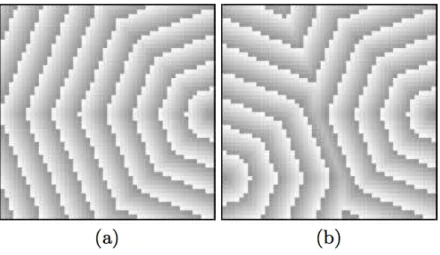
Figure 3.4: Representation of a pedestrian and approximation in fine grid cellular automata with different orientations [SHT10]
cells than 0.5m x 0.5m as it was in classical approaches. This division to smaller cells brings also problems with visualization and rotation of pedestrians. Here orientation is important, because different cells are occupied in various angles, as illustrated in fig. 3.4. When a person is represented only by one cell, orientation is not that im-portant. They applied this approach in emergency simulations, but it could be used also for another crowd simulation problems.
For the problem of optimal path finding they use Least Effort Algorithm. This algo-rithm finds optimal path to the goal position by calculating probable movement to the next cell in the Moore’s neighborhood and distance to the goal. Moreover, they also tried to solve problem of diagonal displacement with set of constraints when moving in the diagonal direction.
3.2.6
Conclusion
Cellular automata is suitable approach for easy and efficient collision detection and emergent behavior in low density situations. On the other hand, movement and
realis-tic behavior of a crowd is a problem. Methods mentioned above improve solutions for these problems, but CA are still not suitable for high density situations. Movement using Fine Grids is better, than classic approach, but still discrete movement is visible (much less than in standard methods). Behavioral control has improved using Poten-tial Fields and Least Effort methods, but still collective behavior of smaller groups is not sufficiently solved. Grid based approach as CA is, is suitable for information about environment using similar methods as Floor Field.
3.3 Crowd Simulation
In this section we would like to present various problems and methods that are con-nected to the crowd simulation, but usually are not that concerned with the psychol-ogy as this is discussed in the next section 3.4. There are various steps when creating crowd simulation and there are problems in each of the steps. These steps include [TM07]:
• Initialization of a Crowd • Animation and Motion • Behavior
• Environment • Rendering
We mainly focus in this work on Behavior, but also other problems are interesting, we briefly mention these methods in this section. For more detailed explanation refer to the source. Firstly the crowd must be initialized and there are different options how to solve this problem. To create a crowd we need to choose and set a density of members. Than we can choose positions and set personal preferences an initial values. To set these values for participants, initial values such as position, velocity, radius are centered at the actor’s face [RD05a], [BA00] . These properties are part of the agent’s external state and can be observed by others [GBLM10]. When modeling behavior
3.3. CROWD SIMULATION during the simulation also perception, motor systems [TT94], [KZ11], [SMK05] and an illusion of own will [TMK00], are set. Moreover also list of goals and interests, emotional states among others, level of relationships, level of dominance are personal values, that help to define behavior and are set before actual simulation [MT97].
3.3.1
Motion Graph
Motion Graph is the graph structure, that is used to the creating new motions from existing. Motions are from MoCap data, but could also be from manually defined data and this structure creates better usage of this data. Motion graphs transform the motion synthesis problem into one of selecting sequences of nodes, or graph walks. Definition 38. The Motion Graph is a directed graph wherein edges contain either pieces of original motion data or automatically generated transitions [KGP02].
Motion Graph is technique that could be also used for the motion retargeting problem, where data usually from Motion Capture are mapped to the new characters [Gle98], [Fra11]. New characters usually do not have same geometry as the source ones and during retargeting it is necessary to keep main motion characteristics. When this retargeting is between models with different topology this problem is even harder.
3.3.2
Group Motion Graph
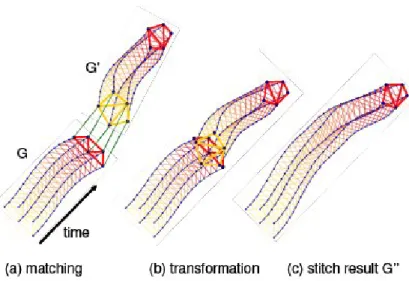
Group Motion Graph is another graph structure, that is used in crowd simulation and preserve spectral relationships between members of the crowd. It allows interactively manipulate motion of the crowd. The graph is created in a way, that each vertex represents the location of an individual at a sampled frame, edges represent moving trajectories and neighborhood formations as shown in fig. 3.5. Moreover, once a graph is created a user can manipulate vertices and by them also the whole group. Therefore graphs can be stitched together and longer motion can be achieved. Furthermore, using this motion graphs also efficient collision detection can be calculated similarly to approach proposed in [SKG05]. The key positions of individuals and poses are
Figure 3.5: A group motion graph [LCF05]. A group motion graph constructed from the clip. Vertices (blue dots) are connected in two sets of edges, formation edges (colored edges in the figure) and motion edges (black edges).
defined and then the optimal path is found. At first, probabilistic roadmaps are created for navigation and path planner. Afterward the randomized search algorithm is created for refinement.
In a method by Kwon et al. [KLLT08] the motion graph is enhanced to provide multiple motion clips in the same timeline. Either larger groups can be divided into smaller or groups can be combined together and form larger formation. In graph the edges are divided into formation and motion edges. Formation edge represents neighborhood relationship between vertices and can be useful to preserve adjacent relationship. However, these relations are usually not well defined. Formation edges define movement in the space and motion edges define movement in the time. For spatial features the whole group needs to be considered to compute movement, but for temporal features only moving paths of individuals are considered. Spatial move-ment is calculated for the keyframe. Both these edges together define spatiotemporal movement of a participant.
3.3. CROWD SIMULATION
Figure 3.6: Group motion stitching steps.
(a) finding corresponding points (b) aligning of the graphs (c) smooth blending between the graphs [KLLT08]
3.3.3
Group Formation Control
Crowd animation is used not only to model behavior and test various risky scenarios, but also to bring visually interesting scene. These scenes are used in the motion movies, where groups of creatures are very popular in the recent years [Ker05]. These groups are visually interesting not only because of the individual behavior, but also their movement and positions can create pleasant, attractive scenes.
Figure 3.7: Formations created by positioning performer [TYK+09]
Group formations in the real world situations can be found in the mass performances or tactical sports such as soccer. This situations have inspired scientists [TYK+09] to provide a mathematical description of the motion. This model allows to compute the
smooth and realistic movement of a group while respecting adjacency relationships. In mass performances relative positions between neighbors are usually kept to achieve visually pleasant movements.
Firstly, they extract positions in the formation from a captured video. Adjacency re-lationships are extracted from the formation with Delaunay triangulation and Motion Graph is created. Usually a scenario and spatiotemporal correspondence is provided beforehand by an artist or a choreographer by defining the shapes or even position of individuals. Afterward automatic calculation of smooth simulation is possible using extended Catmull-Rom splines.
Collision detection is solved in post processing because only when linear trajectory of a point is inside the obstacle, this trajectory is adjusted by moving the deepest point from collision to the boundary. This process is iterative and continues until trajectory does not penetrate obstacle. In the final graph vertices represent individuals and edges are defined by the triangulation. Edges have positive weights, that are defined as the inverse of the distance between vertices. It is also use hierarchical method, where individuals are grouped in the small group and they act as one entity. More detailed information about this approach are discussed in [TYK+09] and result are in fig. 3.7.
3.3.4
Shape Constrained Flock
Shape constrained flock is a flock in which positions are generated to satisfy pre-defined constraints. There could be different types of constraints set, one of which is shape constraint, more specifically 3D shape is set as this constraint. Moreover, this object can change it’s properties during the time, either by deformation, or by movement and the flock is modified to satisfy constraints and flocking behavior. During the simulation these steps are calculated to achieve pleasant result:
1. sample surface of large object with a set of evenly distributed sample points based on the surface mosaicing technique [LHM06]
3.3. CROWD SIMULATION
Figure 3.8: Shaped created from the flock [XJY+08] surface
3. establish correspondence in the source surface 4. simulation
Mosaicing technique assumes each flock member contains spring like energy, this en-ergy between them gives rise to a repulsive force between neighbors whose Manhattan distance is less thanA, whereA is related to the number of elementsN and the total surface area M as follows [XJY+08]:
A=k r (M N ) 3.2
where k is 2.0 in current implementation. Spring like energy between points i and j
can be defines as [XJY+08]:
Eij =e −dis2ij 2σ2 3.3
whereσ is the interaction radius. It is used to control the fall-off of potential energy, and does not affect the final pairwise distances in equilibrium. σcan be set as follows [XJY+08]: σ =wM N 3.4
They choose w as 0.9. Distance can be chosen either as Manhattan distance or Euclidean distance. Manhattan tends to produce quadrangular distribution and Eu-clidean tends to produce hexagonal ones. They define repulsive force by using a simplified version [XJY+08]:
Fi = X j∈U norm(pi−pj)×Eij 3.5
where U is neighborhood of point i, and i does not belongs to U.
There are two of agents behavior during simulation. When agent is far from source location, then Reynold’s boids behavior model is chosen [Rey87] with separation, cohesion, alignment. When agent is close to destination, additional control forces are incorporated, such as damping and homing.
When establishing correspondence between flock agents and sample points on the constraining shape a random assignment suffices in most scenarios. To achieve better temporal coherence between two overlapping constraining shapes, they obtain initial correspondences by spherically projecting source positions on the first shape onto the surface of the second shape, and let these projected points subject to energy optimization [XJY+08].
They introduced also a new steering behavior -homing, The homing behavior always drives an agent towards its own destination. Results of this approach are shown in fig. 3.8.
3.3. CROWD SIMULATION
3.3.5
Collision
There are three types of approaches concerning collisions. These approaches are Colli-sion Prediction, ColliColli-sion Avoidance and ColliColli-sion Detection. Also obstacle avoidance is part of these collision approaches, but it could be incorporated, when static objects from the scene are taken into account as actors without the position change. Differ-ence between them is discussed in section 2.1.3. Mainly, they are different in how early they prevent or detect possible collisions.
Collision Detection is a method of finding, if two actors collide when heading to the same position. Relative position of two actors after t frames are [RD05a]:
p(t) =p(0) +~v.t, 3.6
wheret are frames, p(t) is relative position aftert frames, p(0) is initial position,~v is relative velocity. Distance between themd(t) can be found using [RD05a]:
|d(t)|2 =|d(0)|2+ 2t(~v.d(0)) +t2|~v|2.
3.7
Collision will occur, when this distance is less than twice the radius (r) of an actor. Therefore the whole equation for the collision is [RD05a] :
|d(0)|2+ 2t(~v.d(0)) +t2|~v|2 = (2r)2
3.8
There are different types of collisions, depending on the type and they have to be solved differently. They are mostly:
• towards - they have almost the opposite direction, which means v~1◦v~2 < 0, where v~1 and v~2 are oriented vectors with direction of movement and length of speed for first and second actor respectively and ◦ is dot product.
• away- they have almost the same direction, different velocities, faster is behind • glancing - they are near each other, have crossing direction
To find out, which type of collision will occur, we can simple calculate direction (towards is find out), then find a vector that is perpendicular to the line that is defined by the positions of the two actors, and find out in which halfplane are direction vectors of the actors. If there is the same halfplane for both direction vectors, then it is an away type, else it is a glancing type [RD05b].
Collision Prediction is a type of approach, where actors try to predict collisions before they actually can happen. They usually use well defined extended visual system to better understand the knowledge of position of the others. There are different approaches to solve this problem. One of them stores a list of predicted collisions with in the time until they occur, based on the predicted paths on which actors will move according to their actual preferences [RD05a]. They also define 30m as a maximum distance at which collision could occur [RD05a].
Collision Avoidance is a method how to solve predicted, or detected possible col-lision. It is a method how to avoid them. There are different approaches how to solve this problem, usually they combine psychology with numerical methods. Basi-cally, there occur three simple collision avoidance behaviors, which have to be solved differently. These behaviors are [RD05a]:
• changing direction only - try detour according to shoulder overlapping, try 6 different directions (tested for collision with actual collide or nearby actors) • changing velocity only - speed change 50%, slower/faster
• changing both
Which of them is selected depends on the personal preferences and behavior of the actor [TCP06], for example if actor is in hurry, will not slow down, firstly tries detour, if detour is not possible, than he/she will temporarily slow down [RD05a]. Extension of choose the right collision behavior is adding knowledge of the neighborhood to the personal preferences. One of the methods is based on the collision type. If it is a glancing collision, temporarily slower the slow actor, if they have equal velocity then choose randomly. If it is towards collision type than change direction [MT97]. Other velocity-based approach chooses velocity of an agent from two-dimensional ”velocity
3.4. BEHAVIORAL ANIMATION space” in which certain regions are marked as forbidden because of the presence of the other agents [GBLM10].
Other division of the avoidance behavior is [SMK05]:
• urgent avoidance rapidly decelerate or sharply veer by side stepping
• smooth avoidancegradually steer to the sides when they have enough time
Where smooth avoidance uses predicted model of the actor’s paths, urgent reacts to the neighborhood that was changed immediately. Smooth avoidance can reflect personal preferences and behavior.
3.3.6
Conclusion
There are different problems in crowd simulation not only with behavior and colli-sion detection but also with movement of individuals, creating heterogeneous crowd [TM07] and others. For the movement Motion Graph method is powerful approach to find new motions and retarget them to new characters. Also shapes created from the members of a crowd are very visually interesting and useful specially for mo-tion pictures. However these methods are very interesting, we are more concerned in this work on behavioral control and collision avoidance as these two problems are connected.
3.4 Behavioral Animation
Behavioral animation is a set of animation methods that are not based on the geo-metrical transformations, but on the change in behavioral properties. Objects itself usually approximate some living beings and also behave in the same manner. If pure behavioral animation is in concern, objects are easily approximated and visualized as simple spheres, or circles, geometry is not important. Important is the change in position, other movement properties and behavioral properties.
![Figure 2.2: Transcription rules for Rule30 starting from the single black cell [Weia]](https://thumb-us.123doks.com/thumbv2/123dok_us/10010780.2899325/26.918.218.727.399.782/figure-transcription-rules-rule-starting-single-black-weia.webp)
![Figure 2.3: Neighborhood in regular rectangular cellular automaton. (a) Moore’s, or 8-neighborhood [Weic], (b) von Neumann’s, or 4-neighborhood [Weid]](https://thumb-us.123doks.com/thumbv2/123dok_us/10010780.2899325/27.918.156.788.202.555/figure-neighborhood-rectangular-cellular-automaton-neighborhood-neumann-neighborhood.webp)
![Figure 2.4: Cellular Automaton during Pedestrian Simulation [BA00]](https://thumb-us.123doks.com/thumbv2/123dok_us/10010780.2899325/28.918.334.611.163.448/figure-cellular-automaton-during-pedestrian-simulation-ba.webp)
![Figure 3.1: Difference of movement speed in diagonal direction and 4-neighborhood direction [SHT10]](https://thumb-us.123doks.com/thumbv2/123dok_us/10010780.2899325/36.918.377.565.300.487/figure-difference-movement-speed-diagonal-direction-neighborhood-direction.webp)
![Figure 3.2: People leaving a room with one door only [BKSZ01].](https://thumb-us.123doks.com/thumbv2/123dok_us/10010780.2899325/37.918.174.761.648.835/figure-people-leaving-room-door-bksz.webp)
![Figure 3.4: Representation of a pedestrian and approximation in fine grid cellular automata with different orientations [SHT10]](https://thumb-us.123doks.com/thumbv2/123dok_us/10010780.2899325/40.918.303.625.156.480/figure-representation-pedestrian-approximation-cellular-automata-different-orientations.webp)
![Figure 3.5: A group motion graph [LCF05]. A group motion graph constructed from the clip](https://thumb-us.123doks.com/thumbv2/123dok_us/10010780.2899325/43.918.349.598.166.425/figure-group-motion-graph-group-motion-graph-constructed.webp)