Tackling Sparse Data Issue in Machine Translation Evaluation
∗Ondˇrej Bojar, Kamil Kos, and David Mareˇcek
Charles University in Prague, Institute of Formal and Applied Linguistics
{bojar,marecek}@ufal.mff.cuni.cz, [email protected]
Abstract
We illustrate and explain problems of
n-grams-based machine translation (MT) metrics (e.g. BLEU) when applied to morphologically rich languages such as Czech. A novel metric SemPOS based on the deep-syntactic representation of the sentence tackles the issue and retains the performance for translation to English as well.
1 Introduction
Automatic metrics of machine translation (MT) quality are vital for research progress at a fast pace. Many automatic metrics of MT quality have been proposed and evaluated in terms of correla-tion with human judgments while various tech-niques of manual judging are being examined as well, see e.g. MetricsMATR08 (Przybocki et al., 2008)1, WMT08 and WMT09 (Callison-Burch et al., 2008; Callison-Burch et al., 2009)2.
The contribution of this paper is twofold. Sec-tion 2 illustrates and explains severe problems of a widely used BLEU metric (Papineni et al., 2002) when applied to Czech as a representative of lan-guages with rich morphology. We see this as an instance of the sparse data problem well known for MT itself: too much detail in the formal repre-sentation leading to low coverage of e.g. a transla-tion dictransla-tionary. In MT evaluatransla-tion, too much detail leads to the lack of comparable parts of the hy-pothesis and the reference.
∗
This work has been supported by the grants EuroMa-trixPlus (FP7-ICT-2007-3-231720 of the EU and 7E09003 of the Czech Republic), FP7-ICT-2009-4-247762 (Faust), GA201/09/H057, GAUK 1163/2010, and MSM 0021620838. We are grateful to the anonymous reviewers for further re-search suggestions.
1
http://nist.gov/speech/tests
/metricsmatr/2008/results/
2http://www.statmt.org/wmt08andwmt09
0.06 0.08 0.10 0.12 0.14 0.4
0.6 b
cu-bojar
b
b
uedin beurotranxp
b
pctrans
bcu-tectomt
[image:1.595.309.531.212.281.2]BLEU Rank
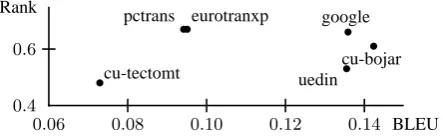
Figure 1: BLEU and human ranks of systems par-ticipating in the English-to-Czech WMT09 shared task.
Section 3 introduces and evaluates some new variations of SemPOS (Kos and Bojar, 2009), a metric based on the deep syntactic representation of the sentence performing very well for Czech as the target language. Aside from including depen-dency andn-gram relations in the scoring, we also apply and evaluate SemPOS for English.
2 Problems of BLEU
BLEU (Papineni et al., 2002) is an established language-independent MT metric. Its correlation to human judgments was originally deemed high (for English) but better correlating metrics (esp. for other languages) were found later, usually em-ploying language-specific tools, see e.g. Przy-bocki et al. (2008) or Callison-Burch et al. (2009). The unbeaten advantage of BLEU is its simplicity. Figure 1 illustrates a very low correlation to hu-man judgments when translating to Czech. We plot the official BLEU score against the rank es-tablished as the percentage of sentences where a system ranked no worse than all its competitors (Callison-Burch et al., 2009). The systems devel-oped at Charles University (cu-) are described in Bojar et al. (2009), uedin is a vanilla configuration of Moses (Koehn et al., 2007) and the remaining ones are commercial MT systems.
In a manual analysis, we identified the reasons for the low correlation: BLEU is overly sensitive tosequencesandformsin the hypothesis matching
Con- Error
firmed Flags 1-grams 2-grams 3-grams 4-grams
Yes Yes 6.34% 1.58% 0.55% 0.29%
Yes No 36.93% 13.68% 5.87% 2.69% No Yes 22.33% 41.83% 54.64% 63.88%
No No 34.40% 42.91% 38.94% 33.14%
Totaln-grams 35,531 33,891 32,251 30,611
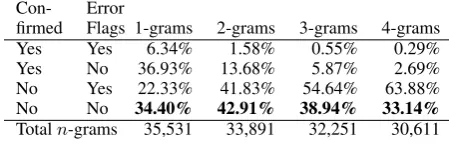
Table 1: n-grams confirmed by the reference and containing error flags.
the reference translation. This focus goes directly against the properties of Czech: relatively free word order allows many permutations of words and rich morphology renders many valid word forms not confirmed by the reference.3 These problems are to some extent mitigated if several reference translations are available, but this is of-ten not the case.
Figure 2 illustrates the problem of “sparse data” in the reference. Due to the lexical and morpho-logical variance of Czech, only a single word in each hypothesis matches a word in the reference. In the case of pctrans, the match is even a false positive, “do” (to) is a preposition that should be used for the “minus” phrase and not for the “end of the day” phrase. In terms of BLEU, both hy-potheses are equally poor but 90% of their tokens were not evaluated.
Table 1 estimates the overall magnitude of this issue: For 1-grams to 4-grams in 1640 instances (different MT outputs and different annotators) of 200 sentences with manually flagged errors4, we count how often the n-gram is confirmed by the reference and how often it contains an error flag. The suspicious cases are n-grams confirmed by the reference but still containing a flag (false posi-tives) andn-grams not confirmed despite contain-ing no error flag (false negatives).
Fortunately, there are relatively few false posi-tives inn-gram based metrics: 6.3% of unigrams and far fewer highern-grams.
The issue of false negatives is more serious and confirms the problem of sparse data if only one reference is available. 30 to 40% ofn-grams do not contain any error and yet they are not
con-3Condon et al. (2009) identify similar issues when eval-uating translation to Arabic and employ rule-based normal-ization of MT output to improve the correlation. It is beyond the scope of this paper to describe the rather different nature of morphological richness in Czech, Arabic and also other languages, e.g. German or Finnish.
4The dataset with manually flagged errors is available at
http://ufal.mff.cuni.cz/euromatrixplus/
[image:2.595.70.295.64.138.2]firmed by the reference. This amounts to 34% of running unigrams, giving enough space to differ in human judgments and still remain unscored.
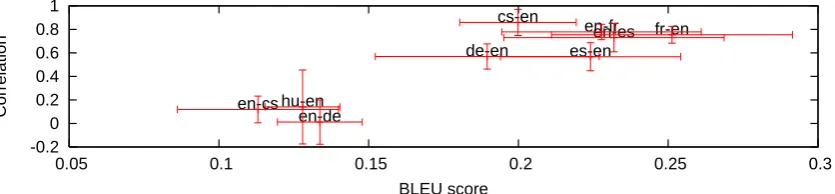
Figure 3 documents the issue across languages: the lower the BLEU score itself (i.e. fewer con-firmedn-grams), the lower the correlation to hu-man judgments regardless of the target language (WMT09 shared task, 2025 sentences per lan-guage).
Figure 4 illustrates the overestimation of scores caused by too much attention to sequences of to-kens. A phrase-based system like Moses (cu-bojar) can sometimes produce a long sequence of tokens exactly as required by the reference, lead-ing to a high BLEU score. The framed words in the illustration are not confirmed by the refer-ence, but the actual error in these words is very severe for comprehension: nouns were used twice instead of finite verbs, and a misleading transla-tion of a prepositransla-tion was chosen. The output by pctrans preserves the meaning much better despite not scoring in either of the finite verbs and produc-ing far shorter confirmed sequences.
3 Extensions of SemPOS
SemPOS (Kos and Bojar, 2009) is inspired by met-rics based on overlapping of linguistic features in the reference and in the translation (Gim´enez and M´arquez, 2007). It operates on so-called “tec-togrammatical” (deep syntactic) representation of the sentence (Sgall et al., 1986; Hajiˇc et al., 2006), formally a dependency tree that includes only au-tosemantic (content-bearing) words.5 SemPOS as defined in Kos and Bojar (2009) disregards the syntactic structure and uses the semantic part of speech of the words (noun, verb, etc.). There are 19 fine-grained parts of speech. For each semantic part of speecht, the overlappingO(t)is set to zero if the part of speech does not occur in the reference or the candidate set and otherwise it is computed as given in Equation 1 below.
5
SRC Prague Stock Market falls to minus by the end of the trading day REF praˇzsk´a burza se ke konci obchodov´an´ı propadla do minusu cu-bojar praha stock market klesne k minus na konci obchodn´ıho dne pctrans praha trh cenn´ych pap´ır˚u pad´a minus do konce obchodn´ıho dne
Figure 2: Sparse data in BLEU evaluation: Large chunks of hypotheses are not compared at all. Only a single unigram in each hypothesis is confirmed in the reference.
-0.2 0 0.2 0.4 0.6 0.8 1
0.05 0.1 0.15 0.2 0.25 0.3
Correlation
BLEU score cs-en
de-en es-en
fr-en
hu-en en-cs
en-de
en-es en-fr
Figure 3: BLEU correlates with its correlation to human judgments. BLEU scores around 0.1 predict little about translation quality.
O(t) =
X
i∈I X
w∈ri∩ci
min(cnt(w, t, ri),cnt(w, t, ci))
X
i∈I X
w∈ri∪ci
max(cnt(w, t, ri),cnt(w, t, ci))
(1) The semantic part of speech is denoted t; ci
andriare the candidate and reference translations
of sentence i, and cnt(w, t, rc) is the number of wordswwith typetinrc(the reference or the can-didate). The matching is performed on the level of lemmas, i.e. no morphological information is pre-served in ws. See Figure 5 for an example; the sentence is the same as in Figure 4.
The final SemPOS score is obtained by macro-averaging over all parts of speech:
SemPOS= 1
|T|
X
t∈T
O(t) (2)
whereTis the set of all possible semantic parts of speech types. (The degenerate case of blank candidate and reference has SemPOS zero.)
3.1 Variations of SemPOS
This section describes our modifications of Sem-POS. All methods are evaluated in Section 3.2.
Different Classification of Autosemantic
Words. SemPOS uses semantic parts of speech
to classify autosemantic words. The tectogram-matical layer offers also a feature called Functor
describing the relation of a word to its governor
similarly as semantic roles do. There are 67 functor types in total.
UsingFunctorinstead ofSemPOSincreases the number of word classes that independently require a high overlap. For a contrast we also completely remove the classification and use only one global class (Void).
Deep Syntactic Relations in SemPOS. In
SemPOS, an autosemantic word of a class is con-firmed if its lemma matches the reference. We uti-lize the dependency relations at the tectogrammat-ical layer to validate valence by refining the over-lap and requiring also the lemma of 1) the parent (denoted “par”), or 2) all the children regardless of their order (denoted “sons”) to match.
Combining BLEU and SemPOS. One of the
major drawbacks ofSemPOSis that it completely ignores word order. This is too coarse even for languages with relatively free word order like Czech. Another issue is that it operates on lemmas and it completely disregards correct word forms. Thus, a weighted linear combination of SemPOS and BLEU (computed on the surface representa-tion of the sentence) should compensate for this. For the purposes of the combination, we compute BLEUonlyon unigrams up to fourgrams (denoted BLEU1, . . . , BLEU4) but including the brevity
SRC Congress yields: US government can pump 700 billion dollars into banks REF kongres ustoupil : vl´ada usa m˚uˇze do bank napumpovat 700 miliard dolar˚u cu-bojar kongres v´ynosy : vl´ada usa m˚uˇze ˇcerpadlo 700 miliard dolar˚u v bank´ach pctrans kongres vyn´aˇs´ı : us vl´ada m˚uˇze ˇcerpat 700 miliardu dolar˚u do bank
Figure 4: Too much focus on sequences in BLEU: pctrans’ output is better but does not score well. BLEU gave credit to cu-bojar for 1, 3, 5 and 8 fourgrams, trigrams, bigrams and unigrams, resp., but only for 0, 0, 1 and 8n-grams produced by pctrans. Confirmed sequences of tokens are underlined and important errors (not considered by BLEU) are framed.
REF kongres/n ustoupit/v :/n vl´ada/n usa/n banka/n napumpovat/v 700/n miliarda/n dolar/n cu-bojar kongres/n v´ynos/n :/n vl´ada/n usa/n moci/v ˇcerpadlo/n 700/n miliarda/n dolar/n banka/n pctrans kongres/n vyn´aˇset/v :/n us/n vl´ada/n ˇcerpat/v 700/n miliarda/n dolar/n banka/n
Figure 5: SemPOS evaluates the overlap of lemmas of autosemantic words given their semantic part of speech (n, v, . . . ). Underlined words are confirmed by the reference.
SemPOS for English. The tectogrammatical
layer is being adapted for English (Cinkov´a et al., 2004; Hajiˇc et al., 2009) and we are able to use the available tools to obtain all SemPOS features for English sentences as well.
3.2 Evaluation of SemPOS and Friends
We measured the metric performance on data used in MetricsMATR08, WMT09 and WMT08. For the evaluation of metric correlation with human judgments at the system level, we used the Pearson correlation coefficientρ applied to ranks. In case of a tie, the systems were assigned the average po-sition. For example if three systems achieved the same highest score (thus occupying the positions 1, 2 and 3 when sorted by score), each of them would obtain the average rank of 2 = 1+2+33 . When correlating ranks (instead of exact scores) and with this handling of ties, the Pearson coeffi-cient is equivalent to Spearman’s rank correlation coefficient.
The MetricsMATR08 human judgments include preferences for pairs of MT systems saying which one of the two systems is better, while the WMT08 and WMT09 data contain system scores (for up to 5 systems) on the scale 1 to 5 for a given sentence. We assigned a human ranking to the systems based on the percent of time that their translations were judged to be better than or equal to the translations of any other system in the manual evaluation. We converted automatic metric scores to ranks.
Metrics’ performance for translation to English and Czech was measured on the following test-sets (the number of human judgments for a given source language in brackets):
To English: MetricsMATR08 (cn+ar: 1652),
WMT08 News Articles (de: 199, fr: 251), WMT08 Europarl (es: 190, fr: 183), WMT09 (cz: 320, de: 749, es: 484, fr: 786, hu: 287)
To Czech: WMT08 News Articles (en: 267),
WMT08 Commentary (en: 243), WMT09 (en: 1425)
The MetricsMATR08 testset contained 4 refer-ence translations for each sentrefer-ence whereas the re-maining testsets only one reference.
Correlation coefficients for English are shown in Table 2. The best metric is Voidpar closely
fol-lowed by Voidsons. The explanation is that Void
compared to SemPOS or Functor does not lose points by an erroneous assignment of the POS or the functor, and that Voidpar profits from
check-ing the dependency relations between autoseman-tic words. The combination of BLEU and Sem-POS6 outperforms both individual metrics, but in case of SemPOS only by a minimal difference. Additionally, we confirm that 4-grams alone have little discriminative power both when used as a metric of their own (BLEU4) as well as in a
lin-ear combination with SemPOS.
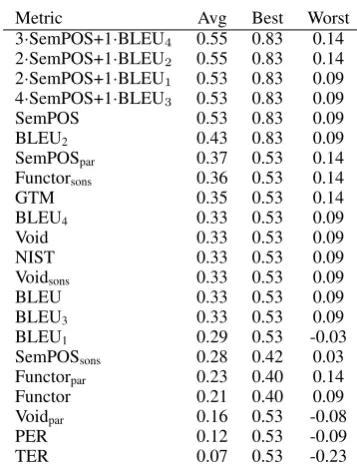
The best metric for Czech (see Table 3) is a lin-ear combination of SemPOS and 4-gram BLEU closely followed by other SemPOS and BLEUn
combinations. We assume this is because BLEU4
can capture correctly translated fixed phrases, which is positively reflected in human judgments. Including BLEU1in the combination favors
trans-lations with word forms as expected by the
Metric Avg Best Worst
Voidpar 0.75 0.89 0.60
Voidsons 0.75 0.90 0.54
Void 0.72 0.91 0.59
Functorsons 0.72 1.00 0.43
GTM 0.71 0.90 0.54
4·SemPOS+1·BLEU2 0.70 0.93 0.43 SemPOSpar 0.70 0.93 0.30 1·SemPOS+4·BLEU3 0.70 0.91 0.26 4·SemPOS+1·BLEU1 0.69 0.93 0.43
NIST 0.69 0.90 0.53
SemPOSsons 0.69 0.94 0.40
SemPOS 0.69 0.95 0.30
2·SemPOS+1·BLEU4 0.68 0.91 0.09
BLEU1 0.68 0.87 0.43
BLEU2 0.68 0.90 0.26
BLEU3 0.66 0.90 0.14
BLEU 0.66 0.91 0.20
TER 0.63 0.87 0.29
PER 0.63 0.88 0.32
BLEU4 0.61 0.90 -0.31
Functorpar 0.57 0.83 -0.03
[image:5.595.325.504.58.295.2]Functor 0.55 0.82 -0.09
Table 2: Average, best and worst system-level cor-relation coefficients for translation to English from various source languages evaluated on 10 different testsets.
ence, thus allowing to spot bad word forms. In all cases, the linear combination puts more weight on SemPOS. Given the negligible difference be-tween SemPOS alone and the linear combinations, we see that word forms are not the major issue for humans interpreting the translation—most likely because the systems so far often make more im-portant errors. This is also confirmed by the obser-vation that using BLEU alone is rather unreliable for Czech and BLEU-1 (which judges unigrams only) is even worse. Surprisingly BLEU-2 per-formed better than any othern-grams for reasons that have yet to be examined. The error metrics PER and TER showed the lowest correlation with human judgments for translation to Czech.
4 Conclusion
This paper documented problems of single-reference BLEU when applied to morphologically rich languages such as Czech. BLEU suffers from a sparse data problem, unable to judge the quality of tokens not confirmed by the reference. This is confirmed for other languages as well: the lower the BLEU score the lower the correlation to hu-man judgments.
We introduced a refinement of SemPOS, an automatic metric of MT quality based on deep-syntactic representation of the sentence tackling
Metric Avg Best Worst
3·SemPOS+1·BLEU4 0.55 0.83 0.14 2·SemPOS+1·BLEU2 0.55 0.83 0.14 2·SemPOS+1·BLEU1 0.53 0.83 0.09 4·SemPOS+1·BLEU3 0.53 0.83 0.09
SemPOS 0.53 0.83 0.09
BLEU2 0.43 0.83 0.09
SemPOSpar 0.37 0.53 0.14 Functorsons 0.36 0.53 0.14
GTM 0.35 0.53 0.14
BLEU4 0.33 0.53 0.09
Void 0.33 0.53 0.09
NIST 0.33 0.53 0.09
Voidsons 0.33 0.53 0.09
BLEU 0.33 0.53 0.09
BLEU3 0.33 0.53 0.09
BLEU1 0.29 0.53 -0.03
SemPOSsons 0.28 0.42 0.03 Functorpar 0.23 0.40 0.14
Functor 0.21 0.40 0.09
Voidpar 0.16 0.53 -0.08
PER 0.12 0.53 -0.09
TER 0.07 0.53 -0.23
Table 3: System-level correlation coefficients for English-to-Czech translation evaluated on 3 differ-ent testsets.
the sparse data issue. SemPOS was evaluated on translation to Czech and to English, scoring better than or comparable to many established metrics.
References
Ondˇrej Bojar, David Mareˇcek, V´aclav Nov´ak, Mar-tin Popel, Jan Pt´aˇcek, Jan Rouˇs, and Zdenˇek
ˇ
Zabokrtsk´y. 2009. English-Czech MT in 2008. In
Proceedings of the Fourth Workshop on Statistical Machine Translation, Athens, Greece, March. Asso-ciation for Computational Linguistics.
Chris Callison-Burch, Cameron Fordyce, Philipp Koehn, Christof Monz, and Josh Schroeder. 2008. Further meta-evaluation of machine translation. In
Proceedings of the Third Workshop on Statisti-cal Machine Translation, pages 70–106, Columbus, Ohio, June. Association for Computational Linguis-tics.
Chris Callison-Burch, Philipp Koehn, Christof Monz, and Josh Schroeder. 2009. Findings of the 2009 workshop on statistical machine translation. In Pro-ceedings of the Fourth Workshop on Statistical Ma-chine Translation, Athens, Greece. Association for Computational Linguistics.
Silvie Cinkov´a, Jan Hajiˇc, Marie Mikulov´a, Lu-cie Mladov´a, Anja Nedoluˇzko, Petr Pajas, Jarmila Panevov´a, Jiˇr´ı Semeck´y, Jana ˇSindlerov´a, Josef Toman, Zdeˇnka Ureˇsov´a, and Zdenˇek ˇZabokrtsk´y. 2004. Annotation of English on the tectogram-matical level. Technical Report TR-2006-35,
´
[image:5.595.85.509.58.309.2]Sherri Condon, Gregory A. Sanders, Dan Parvaz, Alan Rubenstein, Christy Doran, John Aberdeen, and Beatrice Oshika. 2009. Normalization for Auto-mated Metrics: English and Arabic Speech Transla-tion. InMT Summit XII.
Jes´us Gim´enez and Llu´ıs M´arquez. 2007. Linguis-tic Features for AutomaLinguis-tic Evaluation of Heteroge-nous MT Systems. In Proceedings of the Second Workshop on Statistical Machine Translation, pages 256–264, Prague, June. Association for Computa-tional Linguistics.
Jan Hajiˇc, Silvie Cinkov´a, Krist´yna ˇCerm´akov´a, Lu-cie Mladov´a, Anja Nedoluˇzko, Petr Pajas, Jiˇr´ı Se-meck´y, Jana ˇSindlerov´a, Josef Toman, Krist´yna Tomˇs˚u, Matˇej Korvas, Magdal´ena Rysov´a, Kateˇrina Veselovsk´a, and Zdenˇek ˇZabokrtsk´y. 2009. Prague English Dependency Treebank 1.0. Institute of For-mal and Applied Linguistics, Charles University in Prague, ISBN 978-80-904175-0-2, January.
Jan Hajiˇc, Jarmila Panevov´a, Eva Hajiˇcov´a, Petr Sgall, Petr Pajas, Jan ˇStˇep´anek, Jiˇr´ı Havelka, Marie Mikulov´a, Zdenˇek ˇZabokrtsk´y, and Magda ˇSevˇc´ıkov´a Raz´ımov´a. 2006. Prague Dependency Treebank 2.0. LDC2006T01, ISBN: 1-58563-370-4.
Philipp Koehn, Hieu Hoang, Alexandra Birch, Chris Callison-Burch, Marcello Federico, Nicola Bertoldi, Brooke Cowan, Wade Shen, Christine Moran, Richard Zens, Chris Dyer, Ondˇrej Bojar, Alexandra Constantin, and Evan Herbst. 2007. Moses: Open Source Toolkit for Statistical Machine Translation. InACL 2007, Proceedings of the 45th Annual Meet-ing of the Association for Computational LMeet-inguis- Linguis-tics Companion Volume Proceedings of the Demo and Poster Sessions, pages 177–180, Prague, Czech Republic, June. Association for Computational Lin-guistics.
Kamil Kos and Ondˇrej Bojar. 2009. Evaluation of Ma-chine Translation Metrics for Czech as the Target Language. Prague Bulletin of Mathematical Lin-guistics, 92.
Kishore Papineni, Salim Roukos, Todd Ward, and Wei-Jing Zhu. 2002. BLEU: a Method for Automatic Evaluation of Machine Translation. InACL 2002, Proceedings of the 40th Annual Meeting of the As-sociation for Computational Linguistics, pages 311– 318, Philadelphia, Pennsylvania.
M. Przybocki, K. Peterson, and S. Bronsart. 2008. Of-ficial results of the NIST 2008 ”Metrics for MA-chine TRanslation” Challenge (MetricsMATR08).
Petr Sgall, Eva Hajiˇcov´a, and Jarmila Panevov´a. 1986.
The Meaning of the Sentence and Its Semantic and Pragmatic Aspects. Academia/Reidel Publish-ing Company, Prague, Czech Republic/Dordrecht, Netherlands.