One Vector is Not Enough:
Entity-Augmented Distributed Semantics for Discourse Relations
Yangfeng Ji and Jacob Eisenstein School of Interactive Computing
Georgia Institute of Technology {jiyfeng, jacobe}@gatech.edu
Abstract
Discourse relations bind smaller linguistic units into coherent texts. Automatically identifying discourse relations is difficult, because it requires understanding the se-mantics of the linked arguments. A more subtle challenge is that it is not enough to represent the meaning of each argument of a discourse relation, because the rela-tion may depend on links between lower-level components, such as entity mentions. Our solution computes distributed mean-ing representations for each discourse ar-gument by composition up the syntactic parse tree. We also perform a downward compositional pass to capture the mean-ing of coreferent entity mentions. Implicit discourse relations are then predicted from these two representations, obtaining sub-stantial improvements on the Penn Dis-course Treebank.
1 Introduction
The high-level organization of text can be char-acterized in terms ofdiscourse relationsbetween adjacent spans of text (Knott, 1996; Mann, 1984; Webber et al., 1999). Identifying these relations has been shown to be relevant to tasks such as summarization (Louis et al., 2010a; Yoshida et al., 2014), sentiment analysis (Somasundaran et al., 2009), coherence evaluation (Lin et al., 2011), and question answering (Jansen et al., 2014). While the Penn Discourse Treebank (PDTB) now pro-vides a large dataset annotated for discourse re-lations (Prasad et al., 2008), the automatic identi-fication of implicit relations is a difficult task, with state-of-the-art performance at roughly 40% (Lin et al., 2009).
One reason for this poor performance is that dis-course relations are rooted in semantics
(Forbes-u(`)0
Bob u(`)1
gave u(`) 2
Tina u(`)3
the burger
u(r)0
She u(r)1
was hungry
(a) The distributed representations ofburgerandhungry are propagated up the parse tree, clarifying the implicit discourse relation betweenu(`)0 andu
(r) 0 . d(`)0
Bob d(`)1
gave d(`) 2
Tina u(`)3
the burger
d(r)0
She u(r)1
was hungry
(b) Distributed representations for the coreferent men-tionsTinaandsheare computed from the parent and sib-ling nodes.
Figure 1: Distributed representations are com-puted through composition over the parse.
Riley et al., 2006), which can be difficult to re-cover from surface level features. Consider the implicit discourse relation between the following two sentences (also shown in Figure 1a):
(1) Bob gave Tina the burger. She was hungry.
While a connector likebecauseseems appropriate here, there is little surface information to signal this relationship, unless the model has managed to learn a bilexical relationship betweenburgerand
hungry. Learning all such relationships from an-notated data — including the relationship of hun-grytoknish,pierogie,pupusaetc — would require far more data than can possibly be annotated.
329
[image:1.612.332.488.305.400.2]hungry
burger
Bob Tina
gave
she was the
[image:2.612.96.298.44.158.2]he
Figure 2: t-SNE visualization (van der Maaten and Hinton, 2008) of word representations in the PDTB corpus.
We address this issue by applying a discriminatively-trained model of composi-tional distributed semantics to discourse relation classification (Socher et al., 2013; Baroni et al., 2014a). The meaning of each discourse argument is represented as a vector (Turney and Pantel, 2010), which is computed through a series of bottom-up compositional operations over the syn-tactic parse tree. The discourse relation can then be predicted as a bilinear combination of these vector representations. Both the prediction matrix and the compositional operator are trained in a supervised large-margin framework (Socher et al., 2011), ensuring that the learned compositional operation produces semantic representations that are useful for discourse. We show that when combined with a small number of surface features, this approach outperforms prior work on the classification of implicit discourse relations in the PDTB.
Despite these positive results, we argue that bottom-up vector-based representations of dis-course arguments are insufficient to capture their relations. To see why, consider what happens if we make a tiny change to example (1):
(2) Bob gave Tina the burger.
Hewas hungry.
After changing the subject of the second sen-tence to Bob, the connective “because” no longer seems appropriate; a contrastive connector like al-thoughis preferred. But despite the radical dif-ference in meaning, the bottom-up distributed rep-resentation of the second sentence will be almost unchanged: the syntactic structure remains iden-tical, and the words he and she have very sim-ilar word representations (see Figure 2). If we
reduce each discourse argument span to a single vector, built from the elements in the argument it-self, we cannot possibly capture the ways that dis-course relations are signaled by entities and their roles (Cristea et al., 1998; Louis et al., 2010b). As Mooney (2014) puts it, “you can’t cram the meaning of a whole %&!$# sentence into a single $&!#* vector!”
We address this issue by computing vector rep-resentations not only for each discourse argu-ment, but also for each coreferent entity men-tion. These representations are meant to capture therole played by the entity in the text, and so they must take the entire span of text into account. We compute entity-role representations using a feed-forward compositional model, which com-bines “upward” and “downward” passes through the syntactic structure, shown in Figure 1b. In the example, the downward representations forTina
andsheare computed from a combination of the parent and sibling nodes in the binarized parse tree. Representations for these coreferent men-tions are then combined in a bilinear product, and help to predict the implicit discourse relation. In example (2), we resolvehetoBob, and combine their vector representations instead, yielding a dif-ferent prediction about the discourse relation.
Our overall approach combines surface fea-tures, distributed representations of discourse ar-guments, and distributed representations of entity mentions. It achieves a 4% improvement in ac-curacy over the best previous work (Lin et al., 2009) on multiclass discourse relation classifica-tion, and also outperforms more recent work on binary classification. The novel entity-augmented distributed representation improves accuracy over the “upward” compositional model, showing the importance of representing the meaning of coref-erent entity mentions.
2 Entity augmented distributed semantics
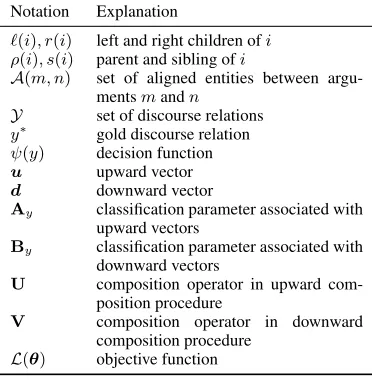
Notation Explanation
`(i), r(i) left and right children ofi ρ(i), s(i) parent and sibling ofi
A(m, n) set of aligned entities between argu-mentsmandn
Y set of discourse relations
y∗ gold discourse relation
ψ(y) decision function
u upward vector
d downward vector
Ay classification parameter associated with
upward vectors
By classification parameter associated with
downward vectors
U composition operator in upward
com-position procedure
V composition operator in downward
composition procedure
[image:3.612.102.288.44.234.2]L(θ) objective function
Table 1: Table of notation
2.1 Upward pass: argument semantics
Distributed representations for discourse argu-ments are computed in a feed-forward “upward” pass: each non-terminal in the binarized syntactic parse tree has a K-dimensional vector represen-tation that is computed from the represenrepresen-tations of its children, bottoming out in pre-trained represen-tations of individual words.
We follow the Recursive Neural Network (RNN) model of Socher et al. (2011). For a given parent nodei, we denote the left child as`(i), and the right child asr(i); we compose their represen-tations to obtain,
ui=tanh U[u`(i);ur(i)]
, (1)
where tanh(·)is the element-wise hyperbolic tan-gent function (Pascanu et al., 2012), and U ∈
RK×2Kis the upward composition matrix. We
ap-ply this compositional procedure from the bottom up, ultimately obtaining the argument-level repre-sentationu0. The base case is found at the leaves
of the tree, which are set equal to pre-trained word vector representations. For example, in the second sentence of Figure 1, we combine the word repre-sentations ofwasand hungryto obtainu(r)1 , and then combineu(r)1 with the word representation of
sheto obtain u(r)0 . Note that the upward pass is feedforward, meaning that there are no cycles and all nodes can be computed in linear time.
2.2 Downward pass: entity semantics
As seen in the contrast between Examples 1 and 2, a model that uses a bottom-up vector
representa-tion for each discourse argument would find lit-tle to distinguish betweenshe was hungryandhe was hungry. It would therefore almost certainly fail to identify the correct discourse relation for at least one of these cases, which requires tracking the roles played by the entities that are coreferent in each pair of sentences. To address this issue, we augment the representation of each argument with additional vectors, representing the seman-tics of the role played by each coreferent entity in each argument. For example, in (1a), Tina got the burger, and in (1b), she was hungry. Rather than represent this information in a logical form — which would require robust parsing to a logi-cal representation — we represent it through addi-tional distributed vectors.
The role of a constituenti can be viewed as a
combination of information from two neighboring nodes in the parse tree: its parentρ(i), and its sib-lings(i). We can make a downward pass, comput-ing the downward vectordi from the downward
vector of the parentdρ(i), and theupwardvector
of the siblingus(i):
di=tanh V[dρ(i);us(i)]
, (2)
whereV∈RK×2Kis the downward composition
matrix. The base case of this recursive procedure occurs at the root of the parse tree, which is set equal to the upward representation,d0,u0. This
procedure is illustrated in Figure 1b: forTina, the parent node isd(`)2 , and the sibling isu(`)3 .
This up-down compositional algorithm propa-gates sentence-level distributed semantics back to entity mentions. The representation of each men-tion’s role in the sentence is based on the corre-sponding role of the parent node in the parse tree, and on the internal meaning representation of the sibling node, which is computed by upward com-position. Note that this algorithm is designed to maintain thefeedforwardnature of the neural net-work, so that we can efficiently compute all nodes without iterating. Each downward nodedi
influ-ences only other downward nodesdjwherej > i,
meaning that the downward pass is feedforward. The upward node is also feedforward: each up-ward nodeuiinfluences only other upward nodes
uj where j < i. Since the upward and
com-pute all ui and di in time that is linear in the
length of the input. In Section 7.2, we compare our approach with recent related work on alterna-tive two-pass distributed compositional models.
Connection to the inside-outside algorithm
In the inside-outside algorithm for computing marginal probabilities in a probabilistic context-free grammar (Lari and Young, 1990), the inside scores are constructed in a bottom-up fashion, like our upward nodes; the outside score for nodeiis
constructed from a product of the outside score of the parentρ(i)and the inside score of the sib-ling s(i), like our downward nodes. The stan-dard inside-outside algorithm sums over all pos-sible parse trees, but since the parse tree is ob-served in our case, a closer analogy would be to the constrained version of the inside-outside algo-rithm for latent variable grammars (Petrov et al., 2006). Cohen et al. (2014) describe a tensor for-mulation of the constrained inside-outside algo-rithm; similarly, we could compute the downward vectors by a tensor contraction of the parent and sibling vectors (Smolensky, 1990; Socher et al., 2014). However, this would involveK3
parame-ters, rather than theK2parameters in our
matrix-vector composition.
3 Predicting discourse relations
To predict the discourse relation between an argu-ment pair(m, n), the decision function is a sum of bilinear products,
ψ(y) = (u(m)0 )>Ayu(n)0
+ X
i,j∈A(m,n)
(d(m)i )>Byd(n)j +by, (3)
whereAy∈RK×KandBy∈RK×Kare the
clas-sification parameters for relationy. A scalarbyis
used as the bias term for relationy, andA(m, n)is the set of coreferent entity mentions shared by the argument pair(m, n). The decision valueψ(y)of relationy is therefore based on the upward
vec-tors at the root, u(m)0 and u(n)0 , as well as on the downward vectors for each pair of aligned en-tity mentions. For the cases where there are no coreferent entity mentions between two sentences,
A(m, n) = ∅, the classification model considers only the upward vectors at the root.
To avoid overfitting, we apply a low-dimensional approximation to eachAy,
Ay=ay,1a>y,2+diag(ay,3). (4)
The same approximation is also applied to each By, reducing the number of classification
parame-ters from2×#|Y| ×K2to2×#|Y| ×3K. Surface features Prior work has identified a number of useful surface-level features (Lin et al., 2009), and the classification model can easily be extended to include them. Definingφ(m,n)as the vector of surface features extracted from the ar-gument pair (m, n), the corresponding decision function is modified as,
ψ(y) = (u(m)0 )>Ayu(n)0 +
X
i,j∈A(m,n)
(d(m)i )>Byd(n)j
+β>yφ(m,n)+by,
(5) whereβy is the classification weight on surface features for relationy. We describe these features in Section 5.
4 Large-margin learning framework There are two sets of parameters to be learned: the classification parameters θclass = {Ay,By,βy, by}y∈Y, and the
com-position parameters θcomp = {U,V}. We use
pre-trained word representations, and do not update them. While prior work shows that it can be advantageous to retrain word representations for discourse analysis (Ji and Eisenstein, 2014), our preliminary experiments found that updating the word representations led to serious overfitting in this model.
Following Socher et al. (2011), we define a large margin objective, and use backpropa-gation to learn all parameters of the network jointly (Goller and Kuchler, 1996). Learning is performed using stochastic gradient descent (Bot-tou, 1998), so we present the learning problem for a single argument pair(m, n)with the gold dis-course relationy∗. The objective function for this
training example is a regularized hinge loss,
L(θ) = X y0:y06=y∗
max0,1−ψ(y∗) +ψ(y0)+λ||θ||2 2
(6) whereθ = θclass ∪θcompis the set of learning
parameters. The regularization termλ||θ||2 2
squared Frobenius norm for the matrix parameters, and the squared Euclidean norm for the vector pa-rameters.
4.1 Learning the classification parameters
In Equation 6, L(θ) = 0, if for everyy0 6= y∗, ψ(y∗)−ψ(y0) ≥ 1 holds. Otherwise, the loss will be caused by any y0, where y0 6= y∗ and ψ(y∗)−ψ(y0) < 1. The gradient for the classi-fication parameters therefore depends on the mar-gin value between gold label and all other labels. Specifically, taking one component ofAy, ay,1,
as an example, the derivative of the objective for
y=y∗is
∂L(θ) ∂ay∗,1
=− X
y0:y06=y∗
δ(ψ(y∗)−ψ(y0)<1)·u (m)
0 , (7)
whereδ(·)is the delta function. The derivative for
y06=y∗is
∂L(θ) ∂ay0,1
=δ(ψ(y∗)−ψ(y0)<1)·u(m)0 (8)
During learning, the updating rule forAyis
Ay←Ay−η(∂L(θ)
∂Ay +λAy) (9)
whereηis the learning rate.
Similarly, we can obtain the gradient in-formation and updating rules for parameters
{By,βy, by}y∈Y.
4.2 Learning the composition parameters
There are two composition matrices U and V, corresponding to the upward and downward com-position procedures respectively. Taking the up-ward composition parameterUas an example, the derivative ofL(θ)with respect toUis
∂L(θ) ∂U =
X
y0:y06=y∗
δ(ψ(y∗)−ψ(y0)<1)
·∂ψ(y
0)
∂U −
∂ψ(y∗) ∂U
(10)
As with the classification parameters, the deriva-tive depends on the margin betweeny0andy∗.
For everyy∈ Y, we have the unified derivative form,
∂ψ(y) ∂U =
∂ψ(y) ∂u(m)0
∂u(m)0 ∂U +
∂ψ(y) ∂u(n)0
∂u(n)0 ∂U
+ X
i,j∈A(m,n) ∂ψ(y) ∂d(m)i
∂d(m)i ∂U
+ X
i,j∈A(m,n) ∂ψ(y) ∂d(n)j
∂d(n)j ∂U ,
(11)
The gradient ofUalso depends on the gradient of
ψ(y)with respect to every downward vectord, as shown in the last two terms in Equation 11. This is because the computation of each downward vector diincludes the upward vector of the sibling node,
us(i), as shown in Equation 2. For an example, see
the construction of the downward vectors forTina
andshein Figure 1b.
The partial derivatives of the decision function in Equation 11 are computed as,
∂ψ(y) ∂u(m)0
=Ayu(n)0 , ∂ψ(y) ∂u(n)0
=A>yu (m) 0 ,
∂ψ(y) ∂d(m)i
=Byd(n)j , ∂ψ(y)
∂d(n)i =B>yd
(m)
j ,hi, ji ∈ A. (12)
The partial derivatives of the upward and down-ward vectors with respect to the updown-ward composi-tional operator are computed as,
∂u(m)i ∂U =
X
u(m)k ∈T(u(m)i ) ∂u(m)i ∂u(m)k
(u(m)k )> (13)
and
∂d(m)i ∂U =
X
u(m)k ∈T(d(m)i ) ∂d(m)i ∂u(m)k
(u(m)k )
>,
(14)
whereT(um)is the set of all nodes in the upward
composition model that help to generateum. For
example, in Figure 1a, the setT(u(`)2 ) includes u(`)3 and the word representations for Tina, the, andburger. The setT(dm,i)includes all the up-wardnodes involved in the downward composi-tion model generatingd(m)i . For example, in Fig-ure 1b, the setT(d(r)she)includesu(r)1 and the word representations forwasandhungry.
The derivative of the objective with respect to the downward compositional operatorV is com-puted in a similar fashion, but it depends only on the downward nodes,d(m)i .
5 Implementation
Learning During learning, we used AdaGrad (Duchi et al., 2011) to tune the learning rate in each iteration. To avoid the exploding gradient problem (Bengio et al., 1994), we used the norm clipping trick proposed by Pascanu et al. (2012), fixing the norm threshold atτ = 5.0.
Hyperparameters Our model includes three tunable hyperparameters: the latent dimension
K for the distributed representation, the
regu-larization parameter λ, and the initial learning
rate η. All hyperparameters are tuned by
ran-domly selecting a development set of 20% of the training data. We consider the values K ∈ {20,30,40,50,60}for the latent dimensionality,
λ ∈ {0.0002,0.002,0.02,0.2} for the regular-ization (on each training instance), and η ∈ {0.01,0.03,0.05,0.09}for the learning rate. We assign separate regularizers and learning rates to the upward composition model, downward com-position model, feature model and the classifica-tion model with composiclassifica-tion vectors.
Initialization All the classification parameters are initialized to 0. For the composition param-eters, we follow Bengio (2012) and initialize U and V with uniform random values drawn from the range[−p6/2K,p6/2K].
Word representations We trained a word2vec model (Mikolov et al., 2013) on the PDTB corpus, standardizing the induced representations to zero-mean, unit-variance (LeCun et al., 2012). Exper-iments with pre-trained GloVe word vector repre-sentations (Pennington et al., 2014) gave broadly similar results.
Syntactic structure Our model requires that the syntactic structure for each argument is repre-sented as a binary tree. We run the Stanford parser (Klein and Manning, 2003) to obtain con-stituent parse trees of each sentence in the PDTB, and binarize all resulting parse trees. Argument spans in the Penn Discourse Treebank need not be sentences or syntactic constituents: they can in-clude multiple sentences, non-constituent spans, and even discontinuous spans (Prasad et al., 2008). In all cases, we identify the syntactic subtrees within the argument span, and unify them in a right branching superstructure.
Coreference The impact of entity semantics on discourse relation detection is inherently limited by two factors: (1) the frequency with which the
Dataset Annotation Training (%) Test (%)
1. PDTB Automatic 27.4 29.1
2. PDTB∩Onto Automatic 26.2 32.3
3. PDTB∩Onto Gold 40.9 49.3
Table 2: Proportion of relations with coreferent entities, according to automatic coreference reso-lution and gold coreference annotation.
arguments of a discourse relation share corefer-ent corefer-entity mcorefer-entions, and (2) the ability of au-tomated coreference resolution systems to detect these coreferent mentions. To extract entities and their mentions from the PDTB, we ran the Berke-ley coreference system (Durrett and Klein, 2013) on each document. For each argument pair, we simply ignore the non-corefential entity mentions. Line 1 in Table 2 shows the proportion of the in-stances with shared entities in the PDTB training and test data, as detected by the Berkeley system. As the system does not detect coreferent mentions in more than 70% of the cases, the performance improvements offered by distributed entity seman-tics are therefore limited. To determine whether this low rate of coreference is an intrinsic prop-erty of the data, or whether it is due to the qual-ity of state-of-the-art coreference resolution, we also consider the gold coreference annotations in the OntoNotes corpus (Pradhan et al., 2007), a portion of which intersects with the PDTB (597 documents). Lines 2 and 3 of Table 2 give the statistics for automatic and gold coreference on this intersection. These results indicate that with perfect coreference resolution, the applicability of distributed entity semantics would reach 40% of the training set and nearly 50% of the test set. Thus, improvements in coreference resolution can be expected to yield further improvements in the effectiveness of distributed entity semantics for discourse relation detection.
cluster assignments could give further improve-ments. In our implementation, we used the Brown word clusters provided by Turian et al. (2010), in which words from the Reuters Corpus (RCV1) are grouped into 3,200 clusters. The feature selection method of Lin et al. (2009) was then used to obtain a set of 600 Brown cluster features.
6 Experiments
We evaluate our approach on the Penn Discourse Treebank (PDTB; Prasadet al., 2008), which pro-vides a discourse level annotation over the Wall Street Journal corpus. In the PDTB, each dis-course relation is annotated between two argu-ment spans. Identifying the arguargu-ment spans of dis-course relations is a challenging task (Lin et al., 2012), which we do not attempt here; instead, we use gold argument spans, as in most of the rele-vant prior work. PDTB relations may beexplicit, meaning that they are signaled by discourse con-nectives (e.g.,because); alternatively, they may be
implicit, meaning that the connective is absent. Pitler et al. (2008) show that most explicit connec-tives are unambiguous, so we focus on the prob-lem of classifying implicit discourse relations.
The PDTB provides a three-level hierarchy of discourse relations. The first level consists of four major relation classes: TEMPORAL, CON
-TINGENCY, COMPARISON and EXPANSION. For
each class, a second level oftypes is defined to provide finer semantic or pragmatic distinctions; there are sixteen such relation types. A third level ofsubtypesis defined for only some types, speci-fying the semantic contribution of each argument. There are two main approaches to evaluating implicit discourse relation classification. Multi-class Multi-classification requires identifying the dis-course relation from all possible choices. This task was explored by Lin et al. (2009), who fo-cus on second-level discourse relations. More re-cent work has emphasized binary classification, where the goal is to build and evaluate separate “one-versus-all” classifiers for each discourse re-lation (Pitler et al., 2009; Park and Cardie, 2012; Biran and McKeown, 2013). We primarily focus on multiclass classification, because it is more rel-evant for the ultimate goal of building a PDTB parser; however, to compare with recent prior work, we also evaluate on binary relation classi-fication.
6.1 Multiclass classification
Our main evaluation involves predicting the cor-rect discourse relation for each argument pair, from among the second-level relation types. The training and test set construction follows Lin et al. (2009) with a few changes:
• We use sections 2-20 of the PDTB as a
train-ing set, sections 0-1 as a development set for parameter tuning, and sections 21-22 for test-ing.
• Five relation types have a combined total of only nine instances in the training set, and are therefore excluded by Lin et al. (2009): CON
-DITION, PRAGMATIC CONDITION, PRAG
-MATIC CONTRAST, PRAGMATIC CONCES
-SION and EXCEPTION. None of these rela-tions appear in the test or development data. We tried training with and without these rela-tion types in the training data, and found no difference in the overall results.
• In the main multiclass experiment, we
con-sider only the problem of distinguishing be-tween implicit relations. We perform an ad-ditional, reviewer-recommended experiment that distinguishes implicit relations from entity-based coherence relations, labeled EN -TREL. See below for more detail.
• Roughly 2% of the implicit relations in the
PDTB are annotated with more than one type. During training, each argument pair that is annotated with two relation types is consid-ered as two training instances, each with one relation type. During testing, if the classifier assigns either of the two types, it is consid-ered to be correct.
6.1.1 Baseline and competitive systems Most common class The most common class is
CAUSE, accounting for 26.03% of the
im-plicit discourse relations in the PDTB test set.
Additive word representations Blacoe and Lap-ata (2012) show that simply adding word vec-tors can perform surprisingly well at assess-ing the meanassess-ing of short phrases. In this baseline, we represent each argument as a sum of its word representations, and estimate a bilinear prediction matrix.
Model +Entity semantics +Surface features K Accuracy(%)
Baseline models
1. Most common class 26.03
2. Additive word representations 50 28.73
Prior work
3. (Lin et al., 2009) X 40.2
Our work
4. Surface features + Brown clusters X 40.66
5.DISCO2 50 36.98
6.DISCO2 X 50 37.63
7.DISCO2 X 50 43.75∗
8.DISCO2 X X 50 44.59∗
[image:8.612.99.515.52.226.2]∗signficantly better than lines 3 and 4 withp <0.05
Table 3: Experimental results on multiclass classification of level-2 discourse relations. The results of Lin et al. (2009) are shown in line 3. We reimplemented this system and added the Brown cluster features of Rutherford and Xue (2014), with results shown in line 4.
of second-level implicit discourse relations is from Lin et al. (2009), who apply feature se-lection to obtain a set of lexical and syntactic features over the arguments.
Surface features + Brown clusters To get a more precise comparison, we reimplemented the system of Lin et al. (2009). The major differences are (1) we apply our online learning framework, rather than batch clas-sification, and (2) we include the Brown cluster features described in Section 5 and originally proposed by Rutherford and Xue (2014).
Compositional Finally, we report results for the method described in this paper. Since it is a distributional compositional approach to
discourse relations, we name itDISCO2.
6.1.2 Results
Table 3 presents results for multiclass identifica-tion of second-level PDTB relaidentifica-tions. As shown in lines 7 and 8,DISCO2 outperforms both
base-line systems and the prior state-of-the-art (base-line 3). The strongest performance is obtained by includ-ing the entity distributed semantics, with a 4.4% improvement over the accuracy reported by Lin et al. (2009) (p < .05 by a binomial test). We also obtain a significant improvement over the Sur-face Feature + Brown Cluster model. Because we have reimplemented this system, we can
ob-serve individual predictions, and can therefore use the sign test for statistical significance, again find-ing thatDISCO2 is significantly better (p < .05). Even without entity semantics, DISCO2
signifi-cantly outperforms these competitive models from prior work. However, the surface features remain important, as the performance ofDISCO2 is
sub-stantially worse when only the distributed repre-sentation is included. The latent dimensionK is
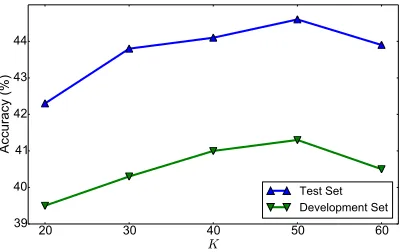
chosen from a development set (see Section 5), as shown in Figure 3.
The multiclass evaluation introduced by Lin et al. (2009) focused on classification of implicit re-lations. Another question is whether it is possi-ble to identify entity-based coherence, annotated in the PDTB as ENTREL, which is when a shared
entity is the only meaningful relation that holds between two sentences (Prasad et al., 2008). As suggested by a reviewer, we add ENTREL to the
set of possible relations, and perform an additional evaluation. Since this setting has not previously been considered, we cannot evaluate against pub-lished results; instead, we retrain and evaluate the following models:
• the surface feature baseline with Brown clus-ters, corresponding to line 4 of Table 3;
• DISCO2 with surface features but without
20 30 40 50 60 K
39 40 41 42 43 44
Accuracy (%)
Test Set Development Set
Figure 3: The performance of DISCO2 (full
model), over different latent dimensionsK.
• DISCO2 with surface features and entity
se-mantics, corresponding to line 8 of Table 3. As before, all parameters are tuned on a devel-opment set. In this evaluation, we obtain larger improvements from our approach: our full model (with entity semantics) gives47.27%accuracy, as compared to44.96%without entity semantics; the result for the surface feature baseline is41.48%. 6.1.3 Coreference
The contribution of entity semantics is shown in Table 3 by the accuracy differences between lines 5 and 6, and between lines 7 and 8. On the sub-set of relations in which the arguments share at least one coreferent entity, the difference is sub-stantially larger: the accuracy ofDISCO2 is 45.7%
with entity mention semantics, and 43.1% with-out. Considering that only 29.1% of the rela-tions in the PDTB test set include shared enti-ties, it therefore seems likely that a more sensi-tive coreference system could yield further im-provements for the entity-semantics model. In-deed, gold coreference annotation on the intersec-tion between the PDTB and the OntoNotes corpus shows that 40-50% of discourse relations involve coreferent entities (Table 2). Evaluating on just this intersection, we find that the inclusion of en-tity semantics yields an improvement in accuracy from 37.5% to 39.1%. Thus, while the overall im-provements offered by entity mention semantics are relatively small, this is due in part to the poor recall of the state-of-the-art coreference resolution system; if coreference improved, the impact of the entity mention semantics would increase cor-respondingly.
A reviewer asked whether it was necessary to have the correct coreference alignment, or whether similar improvements could be obtained by
com-puting bilinear products between all pairs of noun phrases in the two discourse arguments. In fact, this strategy of aligning all entity mentions re-sulted in a decrease in accuracy, from 44.59 to 42.14%. This is below the performance of
DISCO2 without entity semantics.
6.1.4 Examples
The following examples help highlight how entity semantics can improve the accuracy of discourse relation classification.
(3) Arg 1:The drop in profit reflected, in part, continued softness in financial advertising at [The Wall Street Journal] and Barron’s magazine.
Arg 2: Ad linage at [the Journal] fell 6.1% in the third quarter.
(4) Arg 1: [Mr. Greenberg] got out just before the 1987 crash and, to [his] re-gret, never went back even as the market soared.
Arg 2: This time [he]’s ready to buy in “when the panic wears off.”
(5) Arg 1: Half of [them]1 are really scared and want to sell but [I]2’m trying to talk them out of it.
Arg 2: If [they]1 all were bullish, [I]2’d really be upset.
In example (3), the entity-augmented model correctly identifies the relation asRESTATEMENT, due in part to the detected coreference between
The Wall Street Journaland the Journal: in both arguments, the entity experiences a drop in prof-its. Without this information,DISCO2 incorrectly
labels this relation as CAUSE. In example (4), the
entity-augmented model correctly identifies the re-lation as CONTRAST, which is reasonable given
the very different role of the shared entity Mr. Greenbergin the two arguments; without entity semantics, it is classified as CONJUNCTION.
Ex-ample (5) is more complex because it involves two entities, but again, theCONTRASTrelation is
cor-rectly detected, in part because of the differing ex-periences of the two entities in the two arguments; without entity semantics, this example is again in-correctly classified as CONJUNCTION.
6.2 Binary classification
[image:9.612.97.298.40.166.2]and evaluating separate one-versus-all classifiers for each relation type (Pitler et al., 2009; Park and Cardie, 2012; Biran and McKeown, 2013). This work has focused on recognition of the fourfirst -level relations, grouping ENTREL with the EX -PANSIONrelation. We follow this evaluation
ap-proach as closely as possible, using sections 2-20 of the PDTB as a training set, sections 0-1 as a de-velopment set for parameter tuning, and sections 21-22 for testing.
6.2.1 Classification method
We applyDISCO2 with entity-augmented
seman-tics and the surface features listed in Section 5; this corresponds to the system reported in line 8 of Table 3. However, instead of employing a multi-class multi-classifier for all four relations, we train four binary classifiers, one for each first-level discourse relation. We optimize the hyperparametersK, λ, η
separately for each classifier (see Section 5 for de-tails), by performing a grid search to optimize the F-measure on the development data. Following Pitler et al. (2009), we obtain a balanced training set by resampling training instances in each class until the number of positive and negative instances are equal.
6.2.2 Competitive systems
We compare against the published results from several competitive systems, focusing on systems which use the predominant training / test split, with sections 2-20 for training and 21-22 for test-ing. This means we cannot compare with recent work from Li and Nenkova (2014), who use sec-tions 20-24 for testing.
Pitler et al. (2009) present a classification model using linguistically-informed features, such as polarity tags and Levin verb classes.
Zhou et al. (2010) predict discourse connective words, and then use these predicted connec-tives as features in a downstream model to predict relations.
Park and Cardie (2012) showed that the perfor-mance on each relation can be improved by selecting a locally-optimal feature set.
Biran and McKeown (2013) reweight word pair features using distributional statistics from the Gigaword corpus, obtaining denser ag-gregated score features.
6.2.3 Experimental results
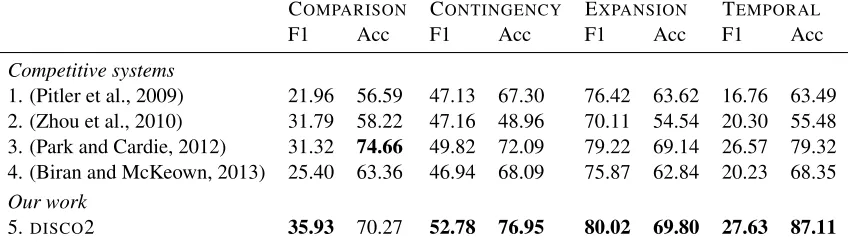
Table 4 presents the performance of the
DISCO2 model and the published results of
competitive systems. DISCO2 achieves the best
results on most metrics, achieving F-measure improvements of 4.14% on COMPARISON, 2.96%
on CONTINGENCY, 0.8% on EXPANSION, and
1.06% on TEMPORAL. These results are attained
without performing per-relation feature selection, as in prior work. While computing significance over F-measures is challenging, we can compute statistical significance on the accuracy results by using the binomial test. We find that DISCO2 is significantly more accurate than all other systems on the CONTINGENCYand TEMPORAL relations
p .001, not significantly more accurate on the EXPANSION relation, and significantly less
accurate than the Park and Cardie (2012) system on the COMPARISONrelation atp.001.
7 Related Work
This paper draws on previous work in discourse relation detection and compositional distributed semantics.
7.1 Discourse relations
Many models of discourse structure focus on re-lations between spans of text (Knott, 1996), in-cluding rhetorical structure theory (RST; Mann and Thompson, 1988), lexicalized tree-adjoining grammar for discourse (D-LTAG; Webber, 2004), and even centering theory (Grosz et al., 1995), which posits relations such as CONTINUATION
andSMOOTH SHIFTbetween adjacent spans.
Con-sequently, the automatic identification of dis-course relations has long been considered a key component of discourse parsing (Marcu, 1999). We work within the D-LTAG framework, as an-notated in the Penn Discourse Treebank (PDTB; Prasad et al., 2008), with the task of identifying
COMPARISON CONTINGENCY EXPANSION TEMPORAL
F1 Acc F1 Acc F1 Acc F1 Acc
Competitive systems
1. (Pitler et al., 2009) 21.96 56.59 47.13 67.30 76.42 63.62 16.76 63.49 2. (Zhou et al., 2010) 31.79 58.22 47.16 48.96 70.11 54.54 20.30 55.48 3. (Park and Cardie, 2012) 31.32 74.66 49.82 72.09 79.22 69.14 26.57 79.32 4. (Biran and McKeown, 2013) 25.40 63.36 46.94 68.09 75.87 62.84 20.23 68.35
Our work
[image:11.612.96.521.47.168.2]5.DISCO2 35.93 70.27 52.78 76.95 80.02 69.80 27.63 87.11
Table 4: Evaluation on the first-level discourse relation identification. The results of the competitive systems are reprinted.
research has explored feature selection (Park and Cardie, 2012; Lin et al., 2012), as well as combat-ing feature sparsity by aggregatcombat-ing features (Biran and McKeown, 2013). Our model includes sur-face features that are based on a reimplementation of the work of Lin et al. (2009), because they also undertake the task of multiclass relation classifica-tion; however, the techniques introduced in more recent research may also be applicable and com-plementary to the distributed representation that constitutes the central contribution of this paper; if so, applying these techniques could further im-prove performance.
Our contribution of entity-augmented dis-tributed semantics is motivated by the intuition that entities play a central role in discourse struc-ture. Centering theory draws heavily on referring expressions to entities over the discourse (Grosz et al., 1995; Barzilay and Lapata, 2008); similar ideas have been extended to rhetorical structure theory (Corston-Oliver, 1998; Cristea et al., 1998). In the specific case of PDTB relations, Louis et al. (2010b) explore a number of entity-based fea-tures, including grammatical role, syntactic real-ization, and information status. Despite the solid linguistic foundation for these features, they are shown to contribute little in comparison with more traditional word-pair features. This suggests that syntax and information status may not be enough, and that it is crucial to capture the semantics of each entity’s role in the discourse. Our ap-proach does this by propagating distributed se-mantics from throughout the sentence into the en-tity span, using our up-down compositional proce-dure. In recent work, Rutherford and Xue (2014) take an alternative approach, using features that represent whether coreferent mentions are
argu-ments of similar predicates (using Brown clus-ters); they obtain nearly a 1% improvement on
CONTINGENCY relations but no significant
im-provement on the other three first-level relation types. Finally, Kehler and Rohde (2013) show that information also flows in the opposite direction, from discourse relations to coreference: in some cases, knowing the discourse relation is crucial to resolving pronoun ambiguity. Future work should therefore consider joint models of discourse anal-ysis and coreference resolution.
7.2 Compositional distributed semantics
Distributional semantics begins with the hypothe-sis that words and phrases that tend to appear in the same contexts have the same meaning (Firth, 1957). The current renaissance of interest in dis-tributional and distributed semantics can be at-tributed in part to the application of discrimina-tive techniques, which emphasizepredictive mod-els (Bengio et al., 2006; Baroni et al., 2014b), rather than context-counting and matrix factoriza-tion (Landauer et al., 1998; Turney and Pantel, 2010). Recent work has made practical the idea of propagating distributed information through lin-guistic structures (Smolensky, 1990; Collobert et al., 2011). In such models, the distributed rep-resentations and compositional operators can be fine-tuned by backpropagating supervision from task-specific labels, enabling accurate and fast models for a wide range of language technolo-gies (Socher et al., 2011; Socher et al., 2013; Chen and Manning, 2014).
the sentence level back to child non-terminals in the parse tree. Their compositional procedure is different from ours: in their work, the “down-ward” meaning of each non-terminal is recon-structed from the upward and downward mean-ings of its parents. ˙Irsoy and Cardie (2013) pro-pose an alternative two-pass procedure, where the downward representation for a node is computed from the downward representation of its parent, and from its ownupward representation. A key difference in our approach is that the siblings in a production are more directly connected: the up-ward representation of a given node is used to compute the downward representation of its sib-ling, similar to the inside-outside algorithm. In the models of Paulus et al. (2014) and ˙Irsoy and Cardie (2013), the connection between siblings nodes is less direct, as it is channeled through the representation of the parent node. From this per-spective, the most closely related prior work is the Inside-Outside Recursive Neural Network (Le and Zuidema, 2014), published shortly before this paper was submitted. The compositional proce-dure in this paper is identical, although the ap-plication is quite different: rather than inducing distributed representations of entity mentions, the goal of this work is to support an infinite-order generative model of dependency parsing. While Le and Zuidema apply this idea as a generative reranker within a supervised dependency parsing framework, we are interested to explore whether it could be employed to do unsupervised syntactic analysis, which could substitute for the supervised syntactic parser in our system.
The application of distributional and distributed semantics to discourse includes the use of la-tent semantic analysis for text segmentation (Choi et al., 2001) and coherence assessment (Foltz et al., 1998), as well as paraphrase detection by the factorization of matrices of distributional counts (Kauchak and Barzilay, 2006; Mihalcea et al., 2006). These approaches essentially compute a distributional representation in advance, and then use it alongside other features. In contrast, our approach follows more recent work in which the distributed representation is driven by supervi-sion from discourse annotations. For example, Ji and Eisenstein (2014) show that RST parsing can be performed by learning task-specific word repre-sentations, which perform considerably better than generic word2vec representations (Mikolov et al.,
2013). Li et al. (2014) propose a recursive neural network approach to RST parsing, which is sim-ilar to the upward pass in our model, and Kalch-brenner and Blunsom (2013) show how a recurrent neural network can be used to identify dialogue acts. However, prior work has not applied these ideas to the classification of implicit relations in the PDTB, and does not consider the role of en-tities. As we argue in the introduction, a single vector representation is insufficiently expressive, because it obliterates the entity chains that help to tie discourse together.
More generally, our entity-augmented dis-tributed representation can be viewed in the con-text of recent literature on combining distributed and formal semantics: by representing entities, we are taking a small step away from purely vectorial representations, and towards more tra-ditional logical representations of meaning. In this sense, our approach is “bottom-up”, as we try to add a small amount of logical formalism to distributed representations; other approaches are “top-down”, softening purely logical repre-sentations by using distributional clustering (Poon and Domingos, 2009; Lewis and Steedman, 2013) or Bayesian non-parametrics (Titov and Klemen-tiev, 2011) to obtain types for entities and rela-tions. Still more ambitious would be to imple-ment logical semantics within a distributed com-positional framework (Clark et al., 2011; Grefen-stette, 2013). At present, these combinations of logical and distributed semantics have been ex-plored only at the sentence level. In generalizing such approaches to multi-sentence discourse, we argue that it will not be sufficient to compute dis-tributed representations of sentences: a multitude of other elements, such as entities, will also have to represented.
8 Conclusion
spans. Discourse arguments can then be com-pared in terms of their overall distributed represen-tation, as well as by the representations of coref-erent entity mentions. This enables the composi-tional operators to be learned by backpropagation from discourse annotations. In combination with traditional surface features, this approach outper-forms previous work on classification of implicit discourse relations in the Penn Discourse Tree-bank. While the entity mention representations offer only a small improvement in overall perfor-mance, we show that this is limited by the recall of the coreference resolution system: when eval-uated on argument pairs for which coreference is detected, the raw improvement from entity seman-tics is more than 2%. Future work will consider joint models of discourse structure and corefer-ence, and consideration of coreference across the entire document. In the longer term, we hope to in-duce and exploit representations of other discourse elements, such as event coreference and shallow semantics.
Acknowledgments This work was supported by a Google Faculty Research Award to the sec-ond author. Chris Dyer, Ray Mooney, and Bon-nie Webber provided helpful feedback, as did the anonymous reviewers and the editor. Thanks also to Te Rutherford, who both publicly released his code and helped us to use and understand it.
References
Marco Baroni, Raffaella Bernardi, and Roberto Zam-parelli. 2014a. Frege in space: A program for compositional distributional semantics. Linguistic Issues in Language Technologies.
Marco Baroni, Georgiana Dinu, and Germ´an Kruszewski. 2014b. Dont count, predict! a systematic comparison of context-counting vs. context-predicting semantic vectors. InProceedings of the Association for Computational Linguistics (ACL), Baltimore, MD.
Regina Barzilay and Mirella Lapata. 2008. Modeling local coherence: An Entity-Based approach. Com-putational Linguistics, 34(1):1–34, March.
Yoshua Bengio, Patrice Simard, and Paolo Frasconi. 1994. Learning long-term dependencies with gra-dient descent is difficult. Neural Networks, IEEE Transactions on, 5(2):157–166.
Yoshua Bengio, Holger Schwenk, Jean-S´ebastien Sen´ecal, Fr´ederic Morin, and Jean-Luc Gauvain. 2006. Neural probabilistic language models. In
Innovations in Machine Learning, pages 137–186. Springer.
Yoshua Bengio. 2012. Practical recommendations for gradient-based training of deep architectures. In
Neural Networks: Tricks of the Trade, pages 437– 478. Springer.
Or Biran and Kathleen McKeown. 2013. Agggated word pair features for implicit discourse re-lation disambiguation. InProceedings of the Asso-ciation for Computational Linguistics (ACL), pages 69–73, Sophia, Bulgaria.
William Blacoe and Mirella Lapata. 2012. A com-parison of vector-based representations for semantic composition. InProceedings of Empirical Methods for Natural Language Processing (EMNLP), pages 546–556.
L´eon Bottou. 1998. Online learning and stochastic ap-proximations. On-line learning in neural networks, 17:9.
Danqi Chen and Christopher D Manning. 2014. A fast and accurate dependency parser using neural networks. In Proceedings of Empirical Methods for Natural Language Processing (EMNLP), pages 740–750.
Freddy YY Choi, Peter Wiemer-Hastings, and Johanna Moore. 2001. Latent semantic analysis for text seg-mentation. InProceedings of Empirical Methods for Natural Language Processing (EMNLP).
Stephen Clark, Bob Coecke, and Mehrnoosh Sadrzadeh. 2011. Mathematical foundations for a compositional distributed model of meaning.
Linguistic Analysis, 36(1-4):345–384.
Shay B Cohen, Karl Stratos, Michael Collins, Dean P Foster, and Lyle Ungar. 2014. Spectral learning of latent-variable PCFGs: Algorithms and sample complexity.Journal of Machine Learning Research, 15:2399–2449.
R. Collobert, J. Weston, L. Bottou, M. Karlen, K. Kavukcuoglu, and P. Kuksa. 2011. Natural lan-guage processing (almost) from scratch. Journal of Machine Learning Research, 12:2493–2537.
Simon Corston-Oliver. 1998. Beyond string matching and cue phrases: Improving efficiency and coverage in discourse analysis. InThe AAAI Spring Sympo-sium on Intelligent Text Summarization, pages 9–15.
John Duchi, Elad Hazan, and Yoram Singer. 2011. Adaptive subgradient methods for online learning and stochastic optimization. The Journal of Ma-chine Learning Research, 12:2121–2159.
Greg Durrett and Dan Klein. 2013. Easy victories and uphill battles in coreference resolution. In Proceed-ings of the Conference on Empirical Methods in Nat-ural Language Processing.
J. R. Firth. 1957. Papers in Linguistics 1934-1951. Oxford University Press.
Peter W Foltz, Walter Kintsch, and Thomas K Lan-dauer. 1998. The measurement of textual coherence with latent semantic analysis. Discourse processes, 25(2-3):285–307.
Katherine Forbes-Riley, Bonnie Webber, and Aravind Joshi. 2006. Computing discourse semantics: The predicate-argument semantics of discourse connec-tives in d-ltag.Journal of Semantics, 23(1):55–106.
Christoph Goller and Andreas Kuchler. 1996. Learn-ing task-dependent distributed representations by backpropagation through structure. InNeural Net-works, IEEE International Conference on, pages 347–352. IEEE.
Edward Grefenstette. 2013. Towards a Formal Distri-butional Semantics: Simulating Logical Calculi with Tensors, April.
Barbara J Grosz, Scott Weinstein, and Aravind K Joshi. 1995. Centering: A framework for modeling the lo-cal coherence of discourse. Computational linguis-tics, 21(2):203–225.
Ozan ˙Irsoy and Claire Cardie. 2013. Bidirectional re-cursive neural networks for token-level labeling with structure.CoRR (presented at the 2013 NIPS Work-shop on Deep Learning), abs/1312.0493.
Peter Jansen, Mihai Surdeanu, and Peter Clark. 2014. Discourse complements lexical semantics for non-factoid answer reranking. InProceedings of the As-sociation for Computational Linguistics (ACL), Bal-timore, MD.
Yangfeng Ji and Jacob Eisenstein. 2014. Represen-tation learning for text-level discourse parsing. In
Proceedings of the Association for Computational Linguistics (ACL), Baltimore, MD.
Nal Kalchbrenner and Phil Blunsom. 2013. Recurrent convolutional neural networks for discourse compo-sitionality. InProceedings of the Workshop on Con-tinuous Vector Space Models and their Composition-ality, pages 119–126, Sofia, Bulgaria, August. Asso-ciation for Computational Linguistics.
David Kauchak and Regina Barzilay. 2006. Para-phrasing for automatic evaluation. InProceedings of NAACL, pages 455–462. Association for Compu-tational Linguistics.
Andrew Kehler and Hannah Rohde. 2013. A probabilistic reconciliation of coherence-driven and centering-driven theories of pronoun interpretation.
Theoretical Linguistics, 39(1-2):1–37.
Dan Klein and Christopher D Manning. 2003. Ac-curate unlexicalized parsing. InProceedings of the Association for Computational Linguistics (ACL), pages 423–430.
Alistair Knott. 1996. A data-driven methodology for motivating a set of coherence relations. Ph.D. the-sis, The University of Edinburgh.
Thomas Landauer, Peter W. Foltz, and Darrel Laham. 1998. Introduction to Latent Semantic Analysis.
Discource Processes, 25:259–284.
Karim Lari and Steve J Young. 1990. The estima-tion of stochastic context-free grammars using the inside-outside algorithm. Computer speech & lan-guage, 4(1):35–56.
Phong Le and Willem Zuidema. 2014. The inside-outside recursive neural network model for depen-dency parsing. InProceedings of Empirical Meth-ods for Natural Language Processing (EMNLP), pages 729–739.
Yann A LeCun, L´eon Bottou, Genevieve B Orr, and Klaus-Robert M¨uller. 2012. Efficient backprop. In
Neural networks: Tricks of the trade, pages 9–48. Springer.
Mike Lewis and Mark Steedman. 2013. Combined distributional and logical semantics. Transactions of the Association for Computational Linguistics, 1:179–192.
Junyi Jessy Li and Ani Nenkova. 2014. Reducing spar-sity improves the recognition of implicit discourse relations. InProceedings of SIGDIAL, pages 199– 207.
Jiwei Li, Rumeng Li, and Eduard Hovy. 2014. Recur-sive deep models for discourse parsing. In Proceed-ings of Empirical Methods for Natural Language Processing (EMNLP).
Ziheng Lin, Min-Yen Kan, and Hwee Tou Ng. 2009. Recognizing implicit discourse relations in the penn discourse treebank. In Proceedings of Empir-ical Methods for Natural Language Processing (EMNLP), pages 343–351, Singapore.
Ziheng Lin, Hwee Tou Ng, and Min-Yen Kan. 2011. Automatically Evaluating Text Coherence Using Discourse Relations. InProceedings of the Asso-ciation for Computational Linguistics (ACL), pages 997–1006, Portland, OR.
Annie Louis, Aravind Joshi, and Ani Nenkova. 2010a. Discourse indicators for content selection in summa-rization. InProceedings of the 11th Annual Meeting of the Special Interest Group on Discourse and Di-alogue, pages 147–156. Association for Computa-tional Linguistics.
Annie Louis, Aravind Joshi, Rashmi Prasad, and Ani Nenkova. 2010b. Using entity features to classify implicit discourse relations. InProceedings of the SIGDIAL, pages 59–62, Tokyo, Japan, September. Association for Computational Linguistics.
William C Mann and Sandra A Thompson. 1988. Rhetorical structure theory: Toward a functional the-ory of text organization.Text, 8(3):243–281.
William Mann. 1984. Discourse structures for text generation. InProceedings of the 10th International Conference on Computational Linguistics and 22nd annual meeting on Association for Computational Linguistics, pages 367–375. Association for Com-putational Linguistics.
Daniel Marcu. 1999. A decision-based approach to rhetorical parsing. InProceedings of the 37th an-nual meeting of the Association for Computational Linguistics on Computational Linguistics, pages 365–372. Association for Computational Linguis-tics.
Rada Mihalcea, Courtney Corley, and Carlo Strappa-rava. 2006. Corpus-based and knowledge-based measures of text semantic similarity. InAAAI.
Tomas Mikolov, Wen-tau Yih, and Geoffrey Zweig. 2013. Linguistic regularities in continuous space word representations. InProceedings of the North American Chapter of the Association for Com-putational Linguistics (NAACL), pages 746–751, Stroudsburg, Pennsylvania. Association for Compu-tational Linguistics.
Raymond J. Mooney. 2014. Semantic parsing: Past, present, and future. Presentation slides from the ACL Workshop on Semantic Parsing.
Joonsuk Park and Claire Cardie. 2012. Improving Implicit Discourse Relation Recognition Through Feature Set Optimization. In Proceedings of the 13th Annual Meeting of the Special Interest Group on Discourse and Dialogue, pages 108–112, Seoul, South Korea, July. Association for Computational Linguistics.
Razvan Pascanu, Tomas Mikolov, and Yoshua Bengio. 2012. On the difficulty of training recurrent neural networks.arXiv preprint arXiv:1211.5063.
Romain Paulus, Richard Socher, and Christopher D Manning. 2014. Global belief recursive neural net-works. InNeural Information Processing Systems (NIPS), pages 2888–2896, Montr´eal.
Jeffrey Pennington, Richard Socher, and Christopher Manning. 2014. Glove: Global vectors for word representation. InProceedings of Empirical Meth-ods for Natural Language Processing (EMNLP), pages 1532–1543.
Slav Petrov, Leon Barrett, Romain Thibaux, and Dan Klein. 2006. Learning accurate, compact, and in-terpretable tree annotation. In Proceedings of the Association for Computational Linguistics (ACL). Emily Pitler, Mridhula Raghupathy, Hena Mehta, Ani
Nenkova, Alan Lee, and Aravind Joshi. 2008. Eas-ily identifiable discourse relations. InColing 2008: Companion volume: Posters, pages 87–90, Manch-ester, UK, August. Coling 2008 Organizing Com-mittee.
Emily Pitler, Annie Louis, and Ani Nenkova. 2009. Automatic Sense Prediction for Implicit Discourse Relations in Text. InProceedings of the 47th An-nual Meeting of the ACL and the 4th IJCNLP of the AFNLP.
Hoifung Poon and Pedro Domingos. 2009. Unsu-pervised semantic parsing. InProceedings of Em-pirical Methods for Natural Language Processing (EMNLP), pages 1–10, Singapore.
Sameer S Pradhan, Eduard Hovy, Mitch Mar-cus, Martha Palmer, Lance Ramshaw, and Ralph Weischedel. 2007. Ontonotes: A unified relational semantic representation. International Journal of Semantic Computing, 1(04):405–419.
Rashmi Prasad, Nikhil Dinesh, Alan Lee, Eleni Milt-sakaki, Livio Robaldo, Aravind Joshi, and Bonnie Webber. 2008. The penn discourse treebank 2.0. In
Proceedings of LREC.
Attapol T Rutherford and Nianwen Xue. 2014. Discovering Implicit Discourse Relations Through Brown Cluster Pair Representation and Coreference Patterns. In Proceedings of the European Chap-ter of the Association for Computational Linguistics (EACL), Stroudsburg, Pennsylvania. Association for Computational Linguistics.
Paul Smolensky. 1990. Tensor product variable bind-ing and the representation of symbolic structures in connectionist systems. Artificial intelligence, 46(1):159–216.
Richard Socher, Cliff C. Lin, Andrew Y. Ng, and Christopher D. Manning. 2011. Parsing Natural Scenes and Natural Language with Recursive Neu-ral Networks. InProceedings of the International Conference on Machine Learning (ICML), Seattle, WA.
Richard Socher, Danqi Chen, Christopher D. Manning, and Andrew Y. Ng. 2014. Reasoning With Neural Tensor Networks For Knowledge Base Completion. InNeural Information Processing Systems (NIPS). Lake Tahoe.
Swapna Somasundaran, Galileo Namata, Janyce Wiebe, and Lise Getoor. 2009. Supervised and unsupervised methods in employing discourse rela-tions for improving opinion polarity classification. InProceedings of EMNLP.
Ivan Titov and Alexandre Klementiev. 2011. A bayesian model for unsupervised semantic pars-ing. InProceedings of the 49th Annual Meeting of the Association for Computational Linguistics: Hu-man Language Technologies-Volume 1, pages 1445– 1455. Association for Computational Linguistics. Joseph Turian, Lev Ratinov, and Yoshua Bengio.
2010. Word Representation: A Simple and General Method for Semi-Supervised Learning. In Proceed-ings of the Association for Computational Linguis-tics (ACL), pages 384–394, Uppsala, Sweden. Peter D. Turney and Patrick Pantel. 2010. From
Fre-quency to Meaning: Vector Space Models of Seman-tics.JAIR, 37:141–188.
Laurens van der Maaten and Geoffrey Hinton. 2008. Visualizing Data using t-SNE. Journal of Machine Learning Research, 9:2759–2605, November. Bonnie Webber, Alistair Knott, Matthew Stone, and
Aravind Joshi. 1999. Discourse relations: A struc-tural and presuppositional account using lexicalised tag. InProceedings of the Association for Computa-tional Linguistics (ACL), pages 41–48.
Bonnie Webber. 2004. D-LTAG: extending lexicalized TAG to discourse. Cognitive Science, 28(5):751– 779, September.
Yasuhisa Yoshida, Jun Suzuki, Tsutomu Hirao, and Masaaki Nagata. 2014. Dependency-based Dis-course Parser for Single-Document Summarization. In Proceedings of Empirical Methods for Natural Language Processing (EMNLP).