One Step Closer to Automatic Evaluation
of Text Simplification Systems
Sanja ˇStajner1 and Ruslan Mitkov1 and Horacio Saggion2
1Research Group in Computational Linguistics, University of Wolverhampton, UK 2TALN Research Group, Universitat Pompeu Fabra, Spain
[email protected], [email protected], [email protected]
Abstract
This study explores the possibility of re-placing the costly and time-consuming human evaluation of the grammaticality and meaning preservation of the output of text simplification (TS) systems with some automatic measures. The focus is on six widely used machine translation (MT) evaluation metrics and their correlation with human judgements of grammatical-ity and meaning preservation in text snip-pets. As the results show a significant cor-relation between them, we go further and try to classify simplified sentences into: (1) those which are acceptable; (2) those which need minimal post-editing; and (3) those which should be discarded. The pre-liminary results, reported in this paper, are promising.
1 Introduction
Lexically and syntactically complex sentences can be difficult to understand for non-native speak-ers (Petspeak-ersen and Ostendorf, 2007; Alu´ısio et al., 2008b), and for people with language impair-ments, e.g. people diagnosed with aphasia (Car-roll et al., 1999; Devlin, 1999), autism spectrum disorder (ˇStajner et al., 2012; Martos et al., 2012), dyslexia (Rello, 2012), congenital deafness (Inui et al., 2003), and intellectual disability (Feng, 2009). At the same time, long and complex sen-tences are also a stumbling block for many NLP tasks and applications such as parsing, machine translation, information retrieval, and summarisa-tion (Chandrasekar et al., 1996). This justifies the need for Text Simplification (TS) systems which would convert such sentences into their simpler and easier-to-read variants, while at the same time preserving the original meaning.
So far, TS systems have been developed for En-glish (Siddharthan, 2006; Zhu et al., 2010;
Wood-send and Lapata, 2011a; Coster and Kauchak, 2011; Wubben et al., 2012), Spanish (Saggion et al., 2011), and Portuguese (Alu´ısio et al., 2008a), with recent attempts at Basque (Aranzabe et al., 2012), Swedish (Rybing et al., 2010), Dutch (Ruiter et al., 2010), and Italian (Barlacchi and Tonelli, 2013).
Usually, TS systems are either evaluated for: (1) the quality of the generated output, or (2) the effec-tiveness/usefulness of such simplification on read-ing speed and comprehension of the target popula-tion. For the purpose of this study we focused only on the former. The quality of the output generated by TS systems is commonly evaluated by using a combination of readability metrics (measuring the degree of simplification) and human assess-ment (measuring the grammaticality and meaning preservation). Despite the noticeable similarity between evaluation of the fluency and adequacy of a machine translation (MT) output, and evaluation of grammaticality and meaning preservation of a TS system output, there have been no works ex-ploring whether any of the MT evaluation metrics are well correlated with the latter, and could thus replace the time-consuming human assessment.
The contributions of the present work are the following:
• It is the first study to explore the possibility of replacing human assessment of the quality of TS system output with automatic evaluation.
• It is the first study to investigate the correla-tion of human assessment of TS system out-put with MT evaluation metrics.
• It proposes a decision-making procedure for the classification of simplified sentences into: (1) those which are acceptable; (2) those which need further post-editing; and (3) those which should be discarded.
2 Related Work
The output of the TS system proposed by Sid-dharthan (2006) was rated for grammaticality and meaning preservation by three human evaluators. Similarly, Drndarevic et al. (2013) evaluated the grammaticality and the meaning preservation of automatically simplified Spanish sentences on a Likert scale with the help of twenty-five human annotators. Additionally, the authors used seven readability metrics to assess the degree of simplifi-cation. Woodsend and Lapata (2011b), and Glavaˇs and ˇStajner (2013) used human annotators’ rat-ings for evaluating simplification, meaning preser-vation, and grammaticality, while additionally ap-plying several readability metrics for evaluating complexity reduction in entire texts.
Another set of studies approached TS as an MT task translating from “original” to “simplified” language, e.g. (Specia, 2010; Woodsend and Lap-ata, 2011a; Zhu et al., 2010). In this case, the qual-ity of the output generated by the system was eval-uated using several standard MT evaluation met-rics: BLEU (Papineni et al., 2002), NIST (Dod-dington, 2002), and TERp (Snover et al., 2009).
3 Methodology
All experiments were conducted on a freely avail-able sentence-level dataset1, fully described in
(Glavaˇs and ˇStajner, 2013), and the two datasets we derived from it. The original dataset and the instructions for the human assessment are given in the next two subsections. Section 3.3 explains how we derived two additional datasets from the origi-nal one, and to what end. Section 3.4 describes the automatic MT evaluation metrics used as features in correlation and classification experiments; Sec-tion 3.5 presents the main goals of the study; and Section 3.6 describes the conducted experiments.
3.1 Original dataset
The dataset contains 280 pairs of original sen-tences and their corresponding simplified versions annotated by humans for grammaticality, meaning preservation, and simplicity of the simplified ver-sion. We used all sentence pairs, focusing only on four out of eight available features: (1) the original text, (2) the simplified text, (3) the grammaticality score, and (4) the score for meaning preservation.2
1http://takelab.fer.hr/data/evsimplify/
2The other four features contain the pairID, groupID, the
method with which the simplification was obtained, and the
Category weightedκ Pearson MAE Grammaticality 0.68 0.77 0.18 Meaning 0.53 0.67 0.37 Simplicity 0.54 0.60 0.28
Table 1: IAA from (Glavaˇs and ˇStajner, 2013)
The simplified versions of original sentences were obtained by using four different simplifi-cation methods: baseline, sentence-wise, event-wise, and pronominal anaphora. The baseline re-tains only the main clause of a sentence, and dis-cards all subordinate clauses, based on the out-put of the Stanford constituency parser (Klein and Manning, 2003). Sentence-wise simplification eliminates all those tokens in the original sentence that do not belong to any of the extracted factual event mentions, while the event-wise simplifica-tion transforms each factual event mensimplifica-tion into a separate sentence of the output. The last simplifi-cation scheme (pronominal anaphora) additionally employs pronominal anaphora resolution on top of the event-wise simplification scheme.3
3.2 Human Assessment
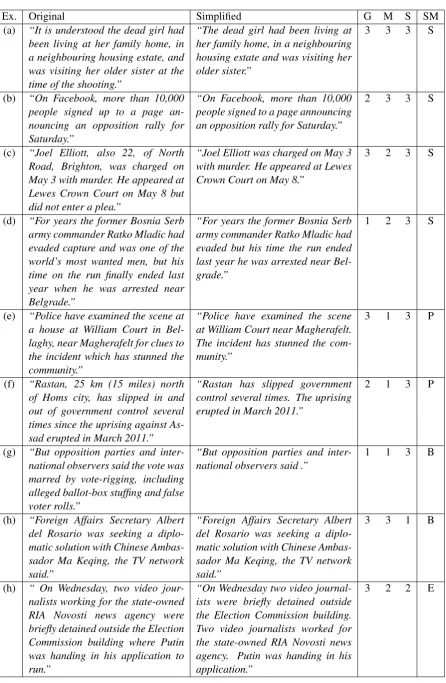
Human assessors were asked to score the given sentence pairs (or text snippets in the case of split sentences) on a 1–3 scale based on three crite-ria: Grammaticality (1 – ungrammatical, 2 – mi-nor problems with grammaticality, 3 – grammati-cal), Meaning (1 – meaning is seriously changed or most of the relevant information lost, 2 – some of the relevant information is lost but the meaning of the remaining information is unchanged, 3 – all relevant information is kept without any change in meaning), and Simplicity (1 – a lot of irrelevant in-formation is retained, 2 – some of irrelevant infor-mation is retained, 3 – all irrelevant inforinfor-mation is eliminated). The inter-annotator agreement (IAA) was calculated using weighted Kappa (weighted
κ), Pearson’s correlation (Pearson), and mean av-erage error (MAE), and the obtained results are presented in Table 1. A few examples of assigned scores are given in Table 2, where G, M, and S
denote human scores for grammaticality, meaning preservation and simplicity respectively.
score for simplicity, which are not relevant here.
3For more detailed explanation of simplification schemes
Ex. Original Simplified G M S SM (a) “It is understood the dead girl had
been living at her family home, in a neighbouring housing estate, and was visiting her older sister at the time of the shooting.”
“The dead girl had been living at her family home, in a neighbouring housing estate and was visiting her older sister.”
3 3 3 S
(b) “On Facebook, more than 10,000 people signed up to a page an-nouncing an opposition rally for Saturday.”
“On Facebook, more than 10,000 people signed to a page announcing an opposition rally for Saturday.”
2 3 3 S
(c) “Joel Elliott, also 22, of North Road, Brighton, was charged on May 3 with murder. He appeared at Lewes Crown Court on May 8 but did not enter a plea.”
“Joel Elliott was charged on May 3 with murder. He appeared at Lewes Crown Court on May 8.”
3 2 3 S
(d) “For years the former Bosnia Serb army commander Ratko Mladic had evaded capture and was one of the world’s most wanted men, but his time on the run finally ended last year when he was arrested near Belgrade.”
“For years the former Bosnia Serb army commander Ratko Mladic had evaded but his time the run ended last year he was arrested near Bel-grade.”
1 2 3 S
(e) “Police have examined the scene at a house at William Court in Bel-laghy, near Magherafelt for clues to the incident which has stunned the community.”
“Police have examined the scene at William Court near Magherafelt. The incident has stunned the com-munity.”
3 1 3 P
(f) “Rastan, 25 km (15 miles) north of Homs city, has slipped in and out of government control several times since the uprising against As-sad erupted in March 2011.”
“Rastan has slipped government control several times. The uprising erupted in March 2011.”
2 1 3 P
(g) “But opposition parties and inter-national observers said the vote was marred by vote-rigging, including alleged ballot-box stuffing and false voter rolls.”
“But opposition parties and
inter-national observers said .” 1 1 3 B
(h) “Foreign Affairs Secretary Albert del Rosario was seeking a diplo-matic solution with Chinese Ambas-sador Ma Keqing, the TV network said.”
“Foreign Affairs Secretary Albert del Rosario was seeking a diplo-matic solution with Chinese Ambas-sador Ma Keqing, the TV network said.”
3 3 1 B
(h) “ On Wednesday, two video jour-nalists working for the state-owned RIA Novosti news agency were briefly detained outside the Election Commission building where Putin was handing in his application to run.”
“On Wednesday two video journal-ists were briefly detained outside the Election Commission building. Two video journalists worked for the state-owned RIA Novosti news agency. Putin was handing in his application.”
[image:3.595.78.525.53.737.2]3 2 2 E
3.3 Derived Datasets
The original dataset (Original) contains separate scores for grammaticality (G), meaning preserva-tion (M), and simplicity (S), each of them on a 1–3 scale. From this dataset we derived two additional ones:Total3andTotal2.
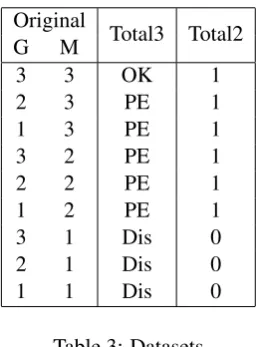
The Total3dataset contains three marks (OK– use as it is, PE – post-editing required, and Dis
– discard) derived fromGandM in theOriginal
dataset. Those simplified sentences which scored ‘3’ for both meaning preservation (M) and gram-maticality (G) are placed in theOK class as they do not need any kind of post-editing. A closer look at the remaining sentences suggests that any simplified sentence which got a score ‘2’ or ‘3’ for meaning preservation (M) could be easily post-edited, i.e. it requires minimal changes which are obvious from its comparison to the corresponding original. For instance, in the sentence (b) in Ta-ble 2 the only change that needs to be made is adding the word “up” after “signed”. Those sen-tences which scored ‘2’ for meaning need slightly more, albeit simple modification. The simplified text snippet (c) in Table 2 would need “but did not enter a plea” added at the end of the last sentence. The next sentence (d) in the same ta-ble needs a few more changes, but still very mi-nor ones: adding the word “capture” after “had evaded”, adding the preposition “on” before “the run”, and adding “when” after “last year”. There-fore, we grouped all those sentences into one class – PE (sentences which require a minimal post-editing effort). Those sentences which scored ‘1’ for meaning need to either be left in their original form or simplified from scratch. We thus classify them asDis. This newly created dataset (Total3) allows us to investigate whether we could auto-matically classify simplified sentences into those three categories, taking into account both gram-maticality and meaning preservation at the same time.
TheTotal2dataset contains only two marks (‘0’ and ‘1’) which correspond to the sentences which should be discarded (‘0’) and those which should be retained (‘1’), where ‘0’ corresponds toDisin
Total3, and ‘1’ corresponds to the union ofOKand
PE in Total3. The derivation procedure for both datasets is presented in Table 3. We wanted to in-vestigate whether the classification task would be simpler (better performed) if there were only two classes instead of three. In the case that such
clas-sification could be performed with satisfactory ac-curacy, all sentences classified as ‘0’ would be left in their original form or simplified with some dif-ferent simplification strategy, while those classi-fied as ‘1’ would be sent for a quick human post-editing procedure.
Original Total3 Total2
G M
3 3 OK 1
2 3 PE 1
1 3 PE 1
3 2 PE 1
2 2 PE 1
1 2 PE 1
3 1 Dis 0
2 1 Dis 0
[image:4.595.352.482.154.328.2]1 1 Dis 0
Table 3: Datasets
2013) for example).
3.4 Features: MT Evaluation Metrics
In all experiments, we focused on six commonly used MT evaluation metrics. These are cosine similarity (using the bag-of-words representation), METEOR (Denkowski and Lavie, 2011), TERp (Snover et al., 2009), TINE (Rios et al., 2011), and two components of TINE: T-BLEU (which differs from the standard BLEU (Papineni et al., 2002) by using 3-grams, 2-grams, and 1-grams when there are no 4-grams found, where the “original” BLEU would give score ‘0’) and SRL (which is the com-ponent of TINE based on semantic role labeling using SENNA4). Although these two components
contribute equally to TINE (thus being linearly correlated with TINE), we wanted to investigate which one of them contributes more to the cor-relation of TINE with human judgements. Given their different natures, we expect T-BLEU to con-tribute more to the correlation of TINE with hu-man judgements of grammaticality, and SRL to contribute more to the correlation of TINE with human judgements of meaning preservation.
As we do not have the reference for the simpli-fied sentence, all metrics are applied in a slightly different way than in MT. Instead of evaluating the translation hypothesis (output of the automatic TS system in our case) with the corresponding ref-erence translation (which would be a ‘gold stan-dard’ simplified sentence), we apply the metrics to the output of the automatic TS system com-paring it with the corresponding original sentence. Given that the simplified sentences in the used dataset are usually shorter than the original ones (due to the elimination of irrelevant content which was the main focus of the TS system proposed by Glavaˇs and ˇStajner (2013)), we expect low scores of T-BLEU and METEOR which apply a brevity penalty. However, our dataset does not contain any kind of lexical simplification, but rather copies all relevant information from the original sentence5.
Therefore, we expect the exact matches of word forms and semantic role labels (which are compo-nents of the MT evaluation metrics) to have a good correlation to human judgements of grammatical-ity and meaning preservation.
4http://ml.nec-labs.com/senna/
5The exceptions being changes of gerundive forms into
past tense, and anaphoric pronoun resolution in some simpli-fication schemes. See Section 3.1 and (Glavaˇs and ˇStajner, 2013) for more details.
3.5 Goal
After we obtained the six automatic metrics (co-sine, METEOR, TERp, TINE, T-BLEU, and SRL), we performed two sets of experiments, try-ing to answer two main questions:
1. Are the chosen MT evaluation metrics cor-related with the human judgements of gram-maticality and meaning preservation of the TS system output?
2. Could we automatically classify the simpli-fied sentences into those which are: (1) cor-rect, (2) require a minimal post-editing, (3) incorrect and need to be discarded?
A positive answer to the first question would mean that there is a possibility of finding an tomatic metric (or a combination of several au-tomatic metrics) which could successfully replace the time consuming human evaluation. The search for that “ideal” combination of automatic metrics could be performed by using various classification algorithms and carefully designed features. If we manage to classify simplified sentences into the three aforementioned categories with a satisfying accuracy, the benefits would be two-fold. Firstly, such a classification system could be used for an automatic evaluation of TS systems and an easy comparison of their performances. Secondly, it could be used inside a TS system to mark those sentences of low quality which need to be checked further, or those sentences whose original mean-ing changed significantly. The latter could then be left in their original form or simplified using some different technique.
3.6 Experiments
Exp. Description
1. Correlation of the six automatic MT metrics with the human scores forGrammaticality 2. Correlation of the six automatic MT metrics with the human scores forMeaningpreservation
3. Classification of the simplified sentences into 3 classes (‘1’ –Bad, ‘2’ –Medium, and ‘3’ –Good) according to theirGrammaticality
4. Classification of the simplified sentences into 3 classes (‘1’ –Bad, ‘2’ –Medium, and ‘3’ –Good) according to theirMeaningpreservation
5. Classification of the simplified sentences into 3 classes (OK,PE,Dis) according to theirTotal3score
6. Classification of the simplified sentences into 2 classes (‘1‘ –Retain, ‘0’ –Discard) according to theirTotal2score
Table 4: Experiments
as to whether we could automatically classify the simplified sentences into those which are: (1) cor-rect (OK), (2) require minimal post-editing (PE), and (3) incorrect and need to be discarded (Dis). The last experiment (Table 4) was conducted with the aim of exploring whether the classification of simplified sentences into only two classes –Retain
(for further post-editing) andDiscard– would lead to better results than the classification into three classes (OK,PE, andDis) in the fifth experiment.
All classification experiments were performed in Weka workbench (Witten and Frank, 2005; Hall et al., 2009), using seven classification algorithms in a 10-fold cross-validation setup:
• NB – NaiveBayes (John and Langley, 1995),
• SMO – Weka implementation of Support Vector Machines (Keerthi et al., 2001) with normalisation (n) or with standardisation (s),
• Logistic (le Cessie and van Houwelingen, 1992),
• Lazy.IBk – K-nearest neighbours (Aha and Kibler, 1991),
• JRip – a propositional rule learner (Cohen, 1995),
• J48 – Weka implementation of C4.5 (Quin-lan, 1993).
As a baseline we use the classifier which assigns the most frequent (majority) class to all instances.
4 Results and Discussion
The results of the first two experiments (correla-tion experiments in Table 4) are presented in Sec-tion 4.1, while the results of the other four exper-iments (classification experexper-iments in Table 4) can be found in Section 4.2. When interpreting the re-sults of all experiments, it is important to keep in
mind that human agreements for meaning preser-vation (M) and grammaticality (G) were accept-able but far from perfect (Section 3.2), and thus it would be unrealistic to expect the correlation between the MT evaluation metrics and human judgements or the agreement of the classification system with human assessments to be higher than the reported IAA agreement.
4.1 Correlation of Automatic Metrics with Human Judgements
The correlations of automatic metrics with hu-man judgements of grammaticality and meaning preservation are given in Tables 5 and 6 respec-tively. Statistically significant correlations (at a 0.01 level of significance) are presented in bold.
Metric Pearson Kendall Spearman cosine 0.097 0.092 0.115 METEOR 0.176 0.141 0.178
T-BLEU 0.226 0.185 0.234
SRL 0.097 0.076 0.095
TINE 0.175 0.145 0.181
TERp -0.208 -0.158 -0.198
Table 5: Correlation between automatic evaluation metrics and human scores for grammaticality
Metric Pearson Kendall Spearman cosine 0.293 0.262 0.334
METEOR 0.386 0.322 0.405
T-BLEU 0.442 0.382 0.475
SRL 0.348 0.285 0.356
TINE 0.427 0.385 0.447
TERp -0.414 -0.336 -0.416
Table 6: Correlation between automatic evaluation metrics and human scores for meaning preserva-tion
auto-Algorithm GrammaticalityP R F P MeaningR F P Total3R F P Total2R F NB 0.53 0.46 0.48 0.54 0.54 0.54 0.54 0.53 0.53 0.74 0.69 0.71 SMO(n) 0.39 0.63 0.48 0.52 0.49 0.45 0.43 0.53 0.44 0.55 0.74 0.63 SMO(s) 0.39 0.63 0.48 0.57 0.56 0.55 0.57 0.55 0.51 0.60 0.73 0.63 Logistic 0.45 0.61 0.49 0.57 0.57 0.56 0.61 0.60 0.59 0.75 0.77 0.74
Lazy.IBk 0.57 0.58 0.57 0.50 0.50 0.50 0.54 0.54 0.54 0.73 0.73 0.73 JRip 0.41 0.59 0.48 0.53 0.50 0.48 0.57 0.56 0.55 0.72 0.75 0.73 J48 0.45 0.61 0.49 0.48 0.47 0.47 0.59 0.57 0.54 0.68 0.71 0.69 baseline 0.39 0.63 0.48 0.17 0.41 0.24 0.21 0.46 0.29 0.55 0.74 0.63
Table 7: Classification results (the best performances are shown in bold; baseline uses the majority class)
Actual Good Med. Bad Good Med. BadGrammaticality Meaning
Good 127 21 23 50 31 7
Med. 29 19 10 24 73 16
[image:7.595.84.515.62.200.2]Bad 24 9 10 9 31 31
Table 8: Confusion matrices for the best classifications according to Grammaticality (Lazy.IBk) and
Meaning(Logistic). The number of “severe” classification mistakes (classifying Good asBad or vice versa) are presented in bold.
matic measures – METEOR, T-BLEU, and TINE, while it is negatively correlated with TERp (TERp measures the number of edits necessary to perform on the simplified sentence to transform it into its original one, i.e. the higher the value of TERp, the less similar the original and its corresponding simplified sentence are. The other five MT metrics measure the similarity between the original and its corresponding simplified version, i.e. the higher their value is, the more similar are the sentences are). All the MT metrics appear to be even bet-ter correlated with the human scores for meaning preservation (Table 6), demonstrating six positive and one (TERp) negative statistically significant correlation withM. The correlation is the highest for T-BLEU, TINE, and TERp, though closely fol-lowed by all others.
4.2 Sentence Classification
The results of the four classification experiments (Section 3.6) are given in Table 7.
At first glance, the performance of the classifi-cation algorithms seems similar for the first two tasks (classification of the simplified sentences according to their Grammaticality and Meaning
preservation). However, one needs to take into ac-count that the baseline for the first task was much much higher than for the second task (Table 7).
Furthermore, it can be noted that for the first task, recall was significantly higher than precision for most classification algorithms (all except NB and Logistic), while for the second task they were very similar in all cases. More importantly, a closer look at the confusion matrices reveals that most of the incorrectly classified sentences were assigned to the nearest class (Medium into Bad or Good;
BadintoMedium; andGoodintoMedium6) in the
second task, while it was not the case in the first task (Table 8).
Classification performed on the Total3 dataset outperformed both previous classifications – that based onGrammaticalityand that based on Mean-ing – on four different algorithms (NB, Logis-tic, JRip, and J48). Classification conducted on
Total3 using Logistic outperformed all results of classifications on eitherGrammaticalityor Mean-ingseparately (Table 7). It reached a 0.61, 0.60, and 0.59 score for the weighted precision (P), re-call (R), and F-measure (F), respectively, thus out-performing the baseline significantly. More im-portantly, classification on the Total3 dataset led to significantly fewer mis-classifications between
Good and Bad (Table 9) than the classification based on Grammaticality, and slightly less than
6Bad,Medium, andGoodcorrespond to marks ‘1’, ‘2’,
Actual OK PE Dis.Total3
OK 41 32 4
PE 17 85 12
[image:8.595.120.244.60.131.2]Dis. 6 31 28
Table 9: Confusion matrix for the best classifica-tion according toTotal3(Logistic). The number of “severe” classification mistakes (classifyingGood
asBador vice versa) are presented in bold.
Actual Retain DiscardTotal2 Retain 21 50
Discard 12 189
Table 10: Confusion matrix for the best classifi-cation according to Total2 (Logistic). The num-ber of “severe” classification mistakes (classifying
RetainasDiscard or vice versa) are presented in bold.
the classification based only onMeaning(Table 8). Therefore, it seems that simplified sentences are better classified into three classes giving a unique score for both grammaticality and preservation of meaning together.
The binary classification experiments based on the Total2 led to results which significantly out-performed the baseline in terms of precision and F-measure (Table 7). However, they resulted in a great number of sentences which should be re-tained (Retain) being classified into those which should be discarded (Discard) and vice versa (Ta-ble 10). Therefore, it seems that it would be better to opt for classification into three classes (Total3) than for classification into two classes (Total2).
Additionally, we used CfsSubsetEval attribute selection algorithm (Hall and Smith, 1998) in or-der to identify the ‘best’ subset of features. The ‘best’ subsets of features for each of the four clas-sification tasks returned by the algorithm are listed in Table 11. However, the classification perfor-mances achieved (P, R, and F) when using only the ‘best’ features did not differ significantly from those when using all initially selected features, and thus are not presented in this paper.
5 Limitations
The used dataset does not contain any kind of lexical simplification (Glavaˇs and ˇStajner, 2013).
Classification ‘Best’ features
Meaning {TERp, T-BLEU, SRL, TINE}
Grammaticality {TERp, T-BLEU}
New3 {TERp, T-BLEU, SRL, TINE}
[image:8.595.306.532.62.134.2]New2 {TERp, T-BLEU, SRL}
Table 11: The ‘best’ features (CfsSubsetEval)
Therefore, one should consider the limitation of this TS system which performs only syntactic sim-plification and content reduction. On the other hand, the dataset used contains a significant con-tent reduction in most of the sentences. If the same experiments were conducted on a dataset which performs only syntactic simplification, we would expect much higher correlation of MT evaluation metrics to human judgements, due to the lesser im-pact of the brevity penalty in that case.
If we were to apply the same MT evaluation metrics to a TS system which additionally per-forms some kind of lexical simplification (either a simple lexical substitution or paraphrasing), the correlation results for T-BLEU and cosine similar-ity would be lower (due to the lower number of exact matches), but not for METEOR, TERp and SRL (and thus TINE as well). As a similar prob-lem is also present in the evaluation of MT sys-tems where the obtained output could differ from the reference translation (while still being equally good), METEOR, TERp, and SRL in TINE ad-ditionally use inexact matching. The first two use the stem, synonym, and paraphrase matches, while SRL uses ontologies and thesaurus.
6 Conclusions and Future Work
[image:8.595.115.251.211.266.2]Acknowledgements
The research described in this paper was par-tially funded by the European Commission un-der the Seventh (FP7-2007-2013) Framework Pro-gramme for Research and Technological Develop-ment (FP7-ICT-2011.5.5 FIRST 287607).
References
D. Aha and D. Kibler. 1991. Instance-based learning algorithms.Machine Learning, 6:37–66.
S. M. Alu´ısio, L. Specia, T. A. S. Pardo, E. G. Maziero, H. M. Caseli, and R. P. M. Fortes. 2008a. A cor-pus analysis of simple account texts and the pro-posal of simplification strategies: first steps towards text simplification systems. In Proceedings of the 26th annual ACM international conference on De-sign of communication, SIGDOC ’08, pages 15–22, New York, NY, USA. ACM.
S. M. Alu´ısio, L. Specia, T. A.S. Pardo, E. G. Maziero, and R. P.M. Fortes. 2008b. Towards brazilian por-tuguese automatic text simplification systems. In
Proceedings of the eighth ACM symposium on Doc-ument engineering, DocEng ’08, pages 240–248, New York, NY, USA. ACM.
M. J. Aranzabe, A. D´ıaz De Ilarraza, and I. Gonz´alez. 2012. First Approach to Automatic Text Simplifica-tion in Basque. InProceedings of the first Natural Language Processing for Improving Textual Acces-sibility Workshop (NLP4ITA).
G. Barlacchi and S. Tonelli. 2013. ERNESTA: A sen-tence simplification tool for childrens stories in ital-ian. In Computational Linguistics and Intelligent Text Processing.
J. Carroll, G. Minnen, D. Pearce, Y. Canning, S. De-vlin, and J. Tait. 1999. Simplifying text for language-impaired readers. In Proceedings of the 9th Conference of the European Chapter of the ACL (EACL’99), pages 269–270.
R. Chandrasekar, Christine Doran, and B. Srinivas. 1996. Motivations and methods for text simplifi-cation. In In Proceedings of the Sixteenth Inter-national Conference on Computational Linguistics (COLING ’96, pages 1041–1044.
W. Cohen. 1995. Fast Effective Rule Induction. In
Proceedings of the Twelfth International Conference on Machine Learning, pages 115–123.
W. Coster and D. Kauchak. 2011. Learning to Sim-plify Sentences Using Wikipedia. In Proceedings of the 49th Annual Meeting of the Association for Computational Linguistics, pages 1–9.
M. Denkowski and A. Lavie. 2011. Meteor 1.3: Au-tomatic Metric for Reliable Optimization and Evalu-ation of Machine TranslEvalu-ation Systems. In Proceed-ings of the EMNLP Workshop on Statistical Machine Translation.
S. Devlin. 1999. Simplifying natural language text for aphasic readers. Ph.D. thesis, University of Sunder-land, UK.
G. Doddington. 2002. Automatic evaluation of ma-chine translation quality using n-gram coocurrence statistics. In Proceedings of the second interna-tional conference on Human Language Technology Research, pages 138–145. Morgan Kaufmann Pub-lishers Inc.
B. Drndarevi´c, S. ˇStajner, S. Bott, S. Bautista, and H. Saggion. 2013. Automatic Text Simplication in Spanish: A Comparative Evaluation of Com-plementing Components. In Proceedings of the 12th International Conference on Intelligent Text Processing and Computational Linguistics. Lecture Notes in Computer Science. Samos, Greece, 24-30 March, 2013., pages 488–500.
L. Feng. 2009. Automatic readability assessment for people with intellectual disabilities. InSIGACCESS Access. Comput., number 93, pages 84–91. ACM, New York, NY, USA, jan.
G. Glavaˇs and S. ˇStajner. 2013. Event-Centered Sim-plication of News Stories. In Proceedings of the Student Workshop held in conjunction with RANLP 2013, Hissar, Bulgaria, pages 71–78.
M. A. Hall and L. A. Smith. 1998. Practical feature subset selection for machine learning. In C. Mc-Donald, editor, Computer Science ’98 Proceedings of the 21st Australasian Computer Science Confer-ence ACSC’98, pages 181–191. Berlin: Springer.
M. Hall, E. Frank, G. Holmes, B. Pfahringer, P. Reute-mann, and I. H. Witten. 2009. The weka data min-ing software: an update. SIGKDD Explor. Newsl., 11:10–18, November.
K. Inui, A. Fujita, T. Takahashi, R. Iida, and T. Iwakura. 2003. Text simplification for reading assistance: a project note. In Proceedings of the second inter-national workshop on Paraphrasing - Volume 16, PARAPHRASE ’03, pages 9–16, Stroudsburg, PA, USA. Association for Computational Linguistics.
G. H. John and P. Langley. 1995. Estimating Contin-uous Distributions in Bayesian Classifiers. In Pro-ceedings of the Eleventh Conference on Uncertainty in Artificial Intelligence, pages 338–345.
D. Klein and C.D. Manning. 2003. Accurate unlex-icalized parsing. In Proceedings of the 41st An-nual Meeting on Association for Computational Lin-guistics, volume 1, pages 423–430. Association for Computational Linguistics.
S. le Cessie and J.C. van Houwelingen. 1992. Ridge Estimators in Logistic Regression. Applied Statis-tics, 41(1):191–201.
J. Martos, S. Freire, A. Gonz´alez, D. Gil, and M. Se-bastian. 2012. D2.1: Functional requirements spec-ifications and user preference survey. Technical re-port, FIRST technical report.
K. Papineni, S. Roukos, T. Ward, and W. Zhu. 2002. BLEU: a method for automatic evaluation of ma-chine translation. InProceedings of ACL.
S. E. Petersen and M. Ostendorf. 2007. Text Sim-plification for Language Learners: A Corpus Anal-ysis. In Proceedings of Workshop on Speech and Language Technology for Education.
R. Quinlan. 1993. C4.5: Programs for Machine Learning. Morgan Kaufmann Publishers, San Ma-teo, CA.
L. Rello. 2012. Dyswebxia: a model to improve ac-cessibility of the textual web for dyslexic users. In
SIGACCESS Access. Comput., number 102, pages 41–44. ACM, New York, NY, USA, January. M. Rios, W. Aziz, and L. Specia. 2011. TINE: A
met-ric to assess MT adequacy. In Proceedings of the Sixth Workshop on Statistical Machine Translation (WMT-2011), Edinburgh, UK.
M. B. Ruiter, T. C. M. Rietveld, Cucchiarini C., Krah-mer E. J., and H. Strik. 2010. Human Language Technology and communicative disabilities: Re-quirements and possibilities for the future. In Pro-ceedings of the the seventh international conference on Language Resources and Evaluation (LREC). J. Rybing, C. Smithr, and A. Silvervarg. 2010.
To-wards a Rule Based System for Automatic Simpli-fication of Texts. In The Third Swedish Language Technology Conference.
H. Saggion, E. G´omez Mart´ınez, E. Etayo, A. An-ula, and L. Bourg. 2011. Text Simplification in Simplext: Making Text More Accessible. Revista de la Sociedad Espa˜nola para el Procesamiento del Lenguaje Natural, 47:341–342.
A. Siddharthan. 2006. Syntactic simplification and text cohesion. Research on Language & Computa-tion, 4(1):77–109.
M. Snover, N. Madnani, B. Dorr, and R. Schwartz. 2009. Fluency, Adequacy, or HTER? Exploring Dif-ferent Human Judgments with a Tunable MT Metric. In Proceedings of the Fourth Workshop on Statisti-cal Machine Translation at the 12th Meeting of the European Chapter of the Association for Computa-tional Linguistics (EACL-2009), Athens, Greece.
L. Specia. 2010. Translating from complex to simpli-fied sentences. In Proceedings of the 9th interna-tional conference on Computainterna-tional Processing of the Portuguese Language, pages 30–39, Berlin, Hei-delberg.
S. ˇStajner, R. Evans, C. Orasan, and R. Mitkov. 2012. What Can Readability Measures Really Tell Us About Text Complexity? In Proceedings of the LREC’12 Workshop: Natural Language Processing for Improving Textual Accessibility (NLP4ITA), Is-tanbul, Turkey.
I. H. Witten and E. Frank. 2005. Data mining: practi-cal machine learning tools and techniques. Morgan Kaufmann Publishers.
K. Woodsend and M. Lapata. 2011a. Learning to Sim-plify Sentences with Quasi-Synchronous Grammar and Integer Programming. In Proceedings of the 2011 Conference on Empirical Methods in Natural Language Processing (EMNLP).
K. Woodsend and M. Lapata. 2011b. WikiSimple: Automatic Simplification of Wikipedia Articles. In
Proceedings of the 25th AAI Coference on Artificial Intelligence.
S. Wubben, A. van den Bosch, and E. Krahmer. 2012. Sentence simplification by monolingual machine translation. InProceedings of the 50th Annual Meet-ing of the Association for Computational LMeet-inguis- Linguis-tics: Long Papers - Volume 1, ACL ’12, pages 1015– 1024, Stroudsburg, PA, USA. Association for Com-putational Linguistics.