THE EXTENSION ASSESSMENT METHOD OF THE
AUTOMATIC VISUAL INSPECTION SYSTEM
1,2FENGHUA DING, *1,2MINGXIN LIN, 1,2JILI LU, 1,2YUE YU AND 3DE WU
1, 2 Key Laboratory of High Efficiency and Clean Mechanical Manufacture (Shandong University),
Ministry of Education
1, 2 School of Mechanical Engineering, Shandong University, Jinan, Shandong, China
3
PLA 72253, Jinan, Shandong, China
e-mail: *1,2mailto:[email protected]
ABSTRACT
The multilevel extension priority degree evaluation method is applied to the automatic visual inspection (AVI) system evaluation area, which is affected by many factors. In this paper, the AVI system for integrative hierarchical model is built, and each factor relative weigh is determined using the analytic hierarchy process (AHP). Finally, the designed AVI system is evaluated by the multilevel extension priority degree evaluation method. A combination of qualitative and quantitative evaluation method proposed in this paper effectively solves the quantitative evaluation problem of the AVI system.
Keywords: Automatic Visual Inspection (AVI), Measuring Index, Priority Degree Evaluation
1. INTRODUCTION
AVI system is a complicated system that affected by many factors. In fact, to let the AVI system achieve 100% accurate detection is impossible. Therefore, the evaluation of AVI system should be used as the target of optimization design. The extension evaluation method is widely used in evaluation areas, such as the architectural design innovation, enterprise’s independent innovation ability, urban traffic sustainable development, helicopter maintenance support capability and the scheme selection for engineering programs[1-5]. Bing Luo[6] studied the performance evaluation for AVI, proposed a improved ROC curve for multiple defect inspection. Junming Yang[7] studied the inspection and evaluation system of elevator control cabinet, developed a on-line inspection and evaluation system based on virtual instrument.
AVI evaluation problem includes the soft, hardware and other factors. In this paper, section 2 builds the the comprehensive evaluation index system, section 3 introduces the multilevel priority degree evaluation method, section 4 gives the
conclusin, and the section 5 is the
acknowledgement.
2. ESTABLISHMENT OF AVI EVALUATION SYSTEM
AVI process can be divided into the acquisition, preprocessing, segmentation, recognition and executive layers [8-9]. Because this evaluation problem has many factors, this paper adopts the analytic hierarchy process to determine the weight of each factor. The AHP basic train of thought is the same as people’s thinking and judgment process about a complex decision problem. The AHP method establishes the evaluation index hierarchy model firstly, and then determines the index weight corresponding to the highest layer.
2.1 AVI comprehensive evaluation hierarchical model
According to the characteristics of AVI system, we give the AVI model on the basis of comprehensive analysis of the layer factors. The model is shown in Figure 1, and the meaning of each index is shown in Table 1.
2.2 Determining the weight
After establishing the hierarchy model, the upper and lower subordinating relationships are
lower elements
SI
ij. Our goal is to determine thecorresponding weight according to their relative importance by constructing pairwise comparison matrix. In the pairwise comparison process, the decision maker needs to repeatedly answer the
question, which one is more important, and how much is the important number according to the
[image:2.612.142.486.170.279.2]guideline
SI
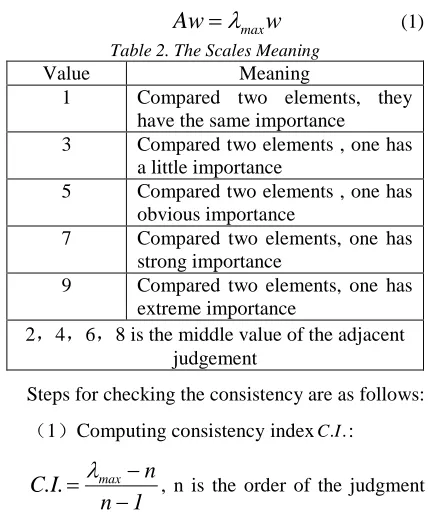
i. In this paper, we use the T.L.Saaty nine scale method[10]. The meaning of the scale is shown in Table 2.Table 1. Meaning Of Each Index
Index Meaning Index Meaning
SI1 Acquisition subsystem
SI31 The gray of the same region is uniform SI2 Preprocessing
subsystem
SI32 The inside of region is simple SI3 Segmentation
subsystem
SI33 Adjacent regions have
significant differences SI4 Recognition
subsystem
SI34 Boundary simple and
spatial position accuracy SI5 Executive
subsystem
SI41 Recognition rate SI11 Mean square
error
SI51 Rapidity
SI12 Peak signal to noise ratio
SI52 Stability
SI21 Mean square error
SI53 Accuracy
SI22 Peak signal to noise ratio
The pairwise comparison judgment matrix can be obtained by the pairwise comparison of the various elements under the same principle. Then, the eigen
vector
w
is computed in according to the formula (1) using matlab programme. Finally, we need checking the consistency of and normalizing the vector to obtain the relative weight of each element.w
[image:2.612.90.301.305.635.2]Aw
=
λ
max (1)Table 2. The Scales Meaning
Value Meaning
1 Compared two elements, they have the same importance
3 Compared two elements , one has a little importance
5 Compared two elements , one has obvious importance
7 Compared two elements, one has strong importance
9 Compared two elements, one has extreme importance
2,4,6,8 is the middle value of the adjacent judgement
Steps for checking the consistency are as follows:
(1)Computing consistency indexC.I.:
1
n
n
C.I.
max−
−
=
λ
, n is the order of the judgmentmatrix;
(2) Looking up the average random consistent index
R
.
I
.
[11]:The average random consistency index correction values as shown in Table 3.
Table 3. The Average Random Consistent Index
Order 1 2 3 4 5 6 7 8 9 10
R.I. 0 0 0.52 0.89 1.12 1.26 1.36 1.41 1.46 1.49
AVI comprehensive evaluation model
Figure 1.Comprehensive Evaluation Index Layer Model SI3
SI1 SI2 SI4 SI5
SI11 SI12 SI21 SI22
SI31 SI32 SI33 SI34
[image:2.612.91.300.310.639.2] [image:2.612.310.524.352.608.2](3) Computing consistency ratio
C
.
R
.
:R.I.
C.I.
C.R.
=
, whenC
.
R
.
<
0
.
1
, the consistencyof the judgment matrix is acceptable.
For example: Calculating the weights
α
11andα
12.Firstly, establishing judgement matrix
A
11.Through the matlab program, we can obtain the eigen vector
w
11 and the largest eigen value2
11
max
=
λ
, then normalizew
11 ,and getw
~
11.
=
1 2
2 / 1 1
A11 ,
=
9487 . 0
3162 . 0
w11 ,
=
75
.
0
25
.
0
w
~
11Secondly, checking the consistency of
A
11.Computing
C
.
I
.
andC
.
R
.
as the above consistency checking steps.0
1
2
2
2
1
n
n
C.I.
max11=
−
−
=
−
−
=
λ
,R
.
I
.
=
0
,1
.
0
0
.
I
.
R
.
I
.
C
R
.
C
=
=
<
Therefore, the matrix consistency meets the requirements.
Thus ,we get
α
11=
0
.
25
,α
12=
0
.
75
.All the other element weights can be got using the same method, and meet the condition
1
5
1 i
i
=
∑
=
α
and∑
=
=
i
m
1 k
ik
1
a
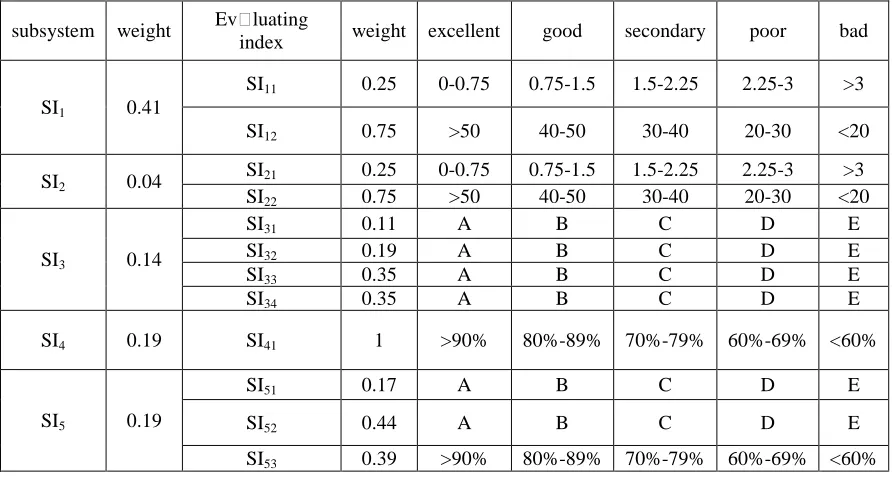
. [image:3.612.90.536.384.627.2]In addition, we also need to establish a feature set corresponding to the measuring condition set.Ⅰ, Ⅱ , Ⅲ, Ⅳand Ⅴare used to represent the feature element measuring condition of AVI system, and their value range is the same [0, 10]. Ⅰ, Ⅱ, Ⅲ, Ⅳ and Ⅴ separately represents excellent, good, secondary, poor and bad.
Table 4. Evaluating Index Value Of The AVI On The Measuring Condition Set
subsystem weight Evluating
index weight excellent good secondary poor bad
SI1 0.41
SI11 0.25 0-0.75 0.75-1.5 1.5-2.25 2.25-3 >3
SI12 0.75 >50 40-50 30-40 20-30 <20
SI2 0.04
SI21 0.25 0-0.75 0.75-1.5 1.5-2.25 2.25-3 >3
SI22 0.75 >50 40-50 30-40 20-30 <20
SI3 0.14
SI31 0.11 A B C D E
SI32 0.19 A B C D E
SI33 0.35 A B C D E
SI34 0.35 A B C D E
SI4 0.19 SI41 1 >90% 80%-89% 70%-79% 60%-69% <60%
SI5 0.19
SI51 0.17 A B C D E
SI52 0.44 A B C D E
SI53 0.39 >90% 80%-89% 70%-79% 60%-69% <60%
3. MULTISTAGE PRIORITY DEGREE EVALUATION METHOD
Priority degree evaluation method is a basic method in extension evaluation [12]. Because there are many measuring indexes in the problem of complex object evaluation, we need to adopt the multistage evaluation. The steps are as follows: building the dependent function of the lowest
measuring indexes, computing the priority degree, then computing the upper priority degree, finally obtains the comprehensive priority degree.
3.1 Building the dependent function of second level measuring index
the object degree which in line with the requirements. The dependent function is built according to the positive domain interval type, which can be classified three types, such as finite interval, infinite interval and discrete data set.
(1)Finite interval
The mean square deviation is the index that reacting the data set fluctuation. In this paper,
11
SI
is the image mean-square deviation.V
11is the finite interval, Through the experiment it can be determined that the interval [0,3] is an acceptable range and the optimal value is on the left of the interval. Therefore, building the dependent function( )
x
K
11 .SI
41is the recognition rate,SI
53 is the rate of accuracy. Ideally, recognition rate and accuracy rate are required to achieve 100%, other cases are less than 100%. According to the experimental data, the value quantity interval is[0.6,1], and the optimal value is on the right of the interval. Therefore, building the dependentfunction
k
41( )
x
andk
53( )
x
.(2)Infinite interval
The range
V
12 andV
22 of the indexSI
12 and22
SI
are defined as[
20,+∞)
according to massive experiments, and their dependent function k( )
x has not maximum value in the interval[
20,+∞)
.Therefore, building the dependent functionk
12( )
x
andk
22( )
x
.( )
x
k
( )
x
x
a
x
20
k
12=
22=
−
=
−
.(3)Discrete data set
The range
V
22of the IndexSI
31 is a set which consists of discrete data. Supposed{
A
,
B
,
C
,
D
,
E
}
V
31=
, then the dependentfunction
k
31( )
x
can can be built.51 34 33
32
,
SI
,
SI
,
SI
SI
andSI
52 are the same as31
SI
,and theV
im is also the set consisting of discrete data. Thus, we can get( )
( )
( )
( )
( )
( )
31 32 33 34
51 52
k
x
k
x
k
x
k
x
k
x
k
x
=
=
=
=
=
.( )
( )
11 , 0 3 3 , 0 31 0 1, 0
x x
x
k x x
k x ≤ − = ≥ = ∨ =
( )
( )
41 0.6 , 1 1 0.6 1 , 1 1 0.61 0 1, 1
x x
x
k x x
k x − ≤ − − = ≥ − = ∨ =
( )
31 5, 4, 3, 2, 1, x A x BK x x C
x D x E = = = = = = 3.2 Computing priority degree
The dependent functions of secondary index all have been computed in 3.1, then the priority degree
about
SI
ifor objectZ
can be obtained.∑
==
i i m 1 k im ik ik
k
α
(2)( )
=
i jk
k
k
Z
K
...
2 1(3)
( )
( )
∑
= == = n 1 i i i jj K Z k
Z
C
α
α
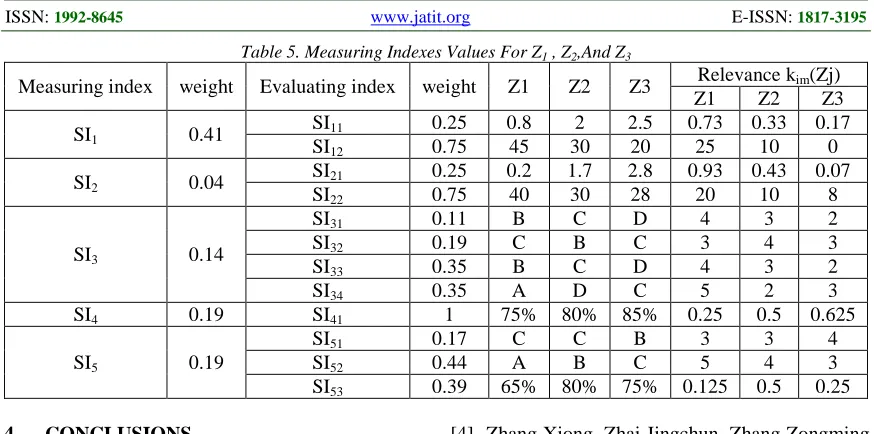
(4)Suppose there are three systems, according to the above analysis, the various index values of
3 2 1
,
Z
,
Z
Z
can be computed. Their measuringindexes values are as shown in Table 5.
According to the formula (2) and (3),
( ) ( )
Z
1,
k
Z
2k
andk
( )
Z
3 are obtained.( )
= 76 . 2 25 . 0 81 . 3 23 . 15 93 . 18 Zk 1 ,
( )
= 47 . 2 5 . 0 84 . 2 61 . 7 58 . 7 Z k 2 ,
( )
= 1 . 2 63 . 0 54 . 2 02 . 6 04 . 0 Z k 3 .According to the formula (4), C
( )
Z1 =9.47 ,( )
Z 4.37C 2 = and C
( )
Z3 =1.14 are obtained. SoTable 5. Measuring Indexes Values For Z1 , Z2,And Z3
Measuring index weight Evaluating index weight Z1 Z2 Z3 Relevance kim(Zj)
Z1 Z2 Z3
SI1 0.41
SI11 0.25 0.8 2 2.5 0.73 0.33 0.17
SI12 0.75 45 30 20 25 10 0
SI2 0.04
SI21 0.25 0.2 1.7 2.8 0.93 0.43 0.07
SI22 0.75 40 30 28 20 10 8
SI3 0.14
SI31 0.11 B C D 4 3 2
SI32 0.19 C B C 3 4 3
SI33 0.35 B C D 4 3 2
SI34 0.35 A D C 5 2 3
SI4 0.19 SI41 1 75% 80% 85% 0.25 0.5 0.625
SI5 0.19
SI51 0.17 C C B 3 3 4
SI52 0.44 A B C 5 4 3
SI53 0.39 65% 80% 75% 0.125 0.5 0.25
4. CONCLUSIONS
The extension priority degree evaluation method is discussed in this paper. The detailed steps can be found: building the AVI hierarchical model is built, determining the value range , seting up the dependent function, computing the relevance and comprehensive priority degree. Experiment shows that the proposed extension priority degree evaluation method can give direct and quantitative evaluation for the AVI system.
5. ACKNOWLEDGEMENT
This work is supported by the Natural Science Foundation of Shandong Province ( No.ZR2010EM037).
REFERENCES
[1] Ai Yingxu. Application of the Extension Method to Evaluation of the Architectural Design Innovation. Journal of Beijing University of technology.2010; 36(7):957-960. [2] Wu Xianying, Hui Xiaofeng. Research on
extension based assessment of an enterprise’s independent innovation ability. Journal of Harbin Engineering University. 2010; 31(10):1414-1418.
[3] Li Xiaowei, Chen hong, LI Congpan. Evaluation of urban traffic sustainable development based on extenics. Journal of Guangzhou University( Natural Science Edition). 2011; 10(4):77-81.
[4] Zhang Xiong, Zhai Jingchun, Zhang Zongming, Li Wu. Application of Extension Method in Evaluation of Maintenance Support Capability of Helicopter. System Simulation Technology. 2011; 7(2):163-167.
[5] Li Yi. On scheme selection for engineering programs based on extension evaluation methods. Shanxi Architecture. 2011; 37(12): 240-242.
[6] Luo Bing. Performance Evaluation for Automatic Quality Inspection. Electronics quality. 2008; (1):48-52.
[7] Junming Yang, Yanbin Liu, Yao Lin. Research on the Inspection and Evaluation System of Elevator Control Cabinet”, process automation instrumentation. 2011; 32(1):58-60, 63.
[8] Fenghua Ding, Mingxing Lin, Dawei Li. Reconfigurable Design for Automatic Visual Inspection by Extension Theory. 2010 International Conference on Electrical and Control Engineering. Wuhan.2010, 5435-5438. [9] F.-H. Ding, M.-X. Lin, De Wu, and D.-W. Li.
Research on the Automatic Visual Inspection Model based on Extenics.Proceedings of the 8th World Congress on Intelligent Control and Automation. Jinan. 2010, 6037-6041.
[10]Saaty T L. The Analytic Hierarchy Process. New York: New York McGrawHill, Lnc. 1980. [11]Shubai Xu. A practical decision method--the
principle of AHP. Tianjin: Tianjin University Press.1988.