Searchable Symmetric Encryption:
Improved Definitions and Efficient Constructions
∗Reza Curtmola † NJIT
Juan Garay ‡ AT&T Labs – Research
Seny Kamara § Microsoft Research
Rafail Ostrovsky¶ UCLA
Abstract
Searchable symmetric encryption (SSE) allows a party to outsource the storage of his data to another party in a private manner, while maintaining the ability to selectively search over it. This problem has been the focus of active research and several security definitions and constructions have been proposed. In this paper we begin by reviewing existing notions of security and propose new and stronger security definitions. We then present two constructions that we show secure under our new definitions. Interestingly, in addition to satisfying stronger security guarantees, our constructions are more efficient than all previous constructions.
Further, prior work on SSE only considered the setting where only the owner of the data is capable of submitting search queries. We consider the natural extension where an arbitrary group of parties other than the owner can submit search queries. We formally define SSE in thismulti-user setting, and present an efficient construction.
1
Introduction
Private-key storage outsourcing [30, 4, 33] allows clients with either limited resources or limited exper-tise to store and distribute large amounts of symmetrically encrypted data at low cost. Since regular private-key encryption prevents one from searching over encrypted data, clients also lose the ability to selectively retrieve segments of their data. To address this, several techniques have been proposed for provisioning symmetric encryption with search capabilities [40, 23, 10, 18]; the resulting construct is typically called searchable encryption. The area of searchable encryption has been identified by DARPA as one of the technical advances that can be used to balance the need for both privacy and national security in information aggregation systems [1].
One approach to provisioning symmetric encryption with search capabilities is with a so-called
secure index [23]. An index is a data structure that stores document collections while supporting efficient keyword search, i.e., given a keyword, the index returns a pointer to the documents that contain it. Informally, an index is “secure” if the search operation for a keyword w can only be performed by users that possess a “trapdoor” for w and if the trapdoor can only be generated with a secret key. Without knowledge of trapdoors, the index leaks no information about its contents. As shown by Goh in [23], one can build a symmetric searchable encryption scheme from a secure
∗
A preliminary version of this article appeared in the 13th ACM Conference on Computer and Communications
Security (CCS ’06) [20]. †
[email protected]. Work done in part while at Bell Labs and Johns Hopkins University. ‡
[email protected]. Work done in part while at Bell Labs. §
[email protected]. Work done in part while at Johns Hopkins University. ¶
index as follows: the client indexes and encrypts its document collection and sends the secure index together with the encrypted data to the server. To search for a keywordw, the client generates and sends a trapdoor forw which the server uses to run the search operation and recover pointers to the appropriate (encrypted) documents.
Symmetric searchable encryption can be achieved in its full generality and with optimal security using the work of Ostrovsky and Goldreich on oblivious RAMs [35, 25]. More precisely, using these techniques any type of search query can be achieved (e.g., conjunctions or disjunctions of keywords) without leaking any information to the server, not even the “access pattern” (i.e., which documents contain the keyword). This strong privacy guarantee, however, comes at the cost of a logarithmic (in the number of documents) number of rounds of interaction for each read and write. In the same paper, the authors show a 2-round solution, but with considerably larger square-root overhead. Therefore, the previously mentioned work on searchable encryption [40, 23, 10, 18] tries to achieve more efficient solutions (typically in one or two rounds) by weakening the privacy guarantees.
1.1 Our contributions
We now give an overview of the contributions of this work.
Revisiting previous definitions. We review existing security definitions for secure indexes, includ-ing indistinclud-inguishability against chosen-keyword attacks (IND2-CKA) [23] and the simulation-based definition in [18], and highlight some of their limitations. Specifically, we recall that IND2-CKA does not guarantee the privacy of user queries (and is therefore not an adequate notion of security for constructing SSE schemes) and then highlight (and fix) technical issues with the simulation-based definition of [18]. We address both these issues by proposing new game-based and simulation-based definitions that provide security for both indexes and trapdoors.
New definitions. We introduce new adversarial models for SSE. The first, which we refer to as non-adaptive, only considers adversaries that make their search queries without taking into account the trapdoors and search outcomes of previous searches. The second—adaptive—considers adversaries that choose their queries as a function of previously obtained trapdoors and search outcomes. All previous work on SSE (with the exception of oblivious RAMs) falls within the non-adaptive setting. The implication is that, contrary to the natural use of searchable encryption described in [40, 23, 18], these definitions only guarantee security for users that perform all their searchesat once. We address this by introducing game-based and simulation-based definitions in the adaptive setting.
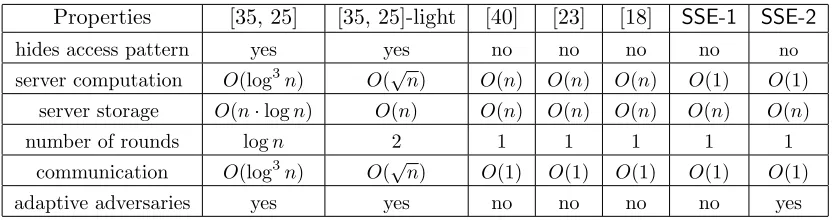
New constructions. We present two constructions which we prove secure under our new definitions. Our first scheme is only secure in the non-adaptive setting, but is the most efficient SSE construction to date. In fact, it achieves searches in one communication round, requires an amount of work from the server that is linear in the number of documents that contain the keyword (which is optimal), requires constant storage on the client, and linear (in the size of the document collection) storage on the server. While the construction in [23] also performs searches in one round, it can induce false positives, which is not the case for our construction. Additionally, all the constructions in [23, 18] require the server to perform an amount of work that is linear in the total number of documents in the collection.
Properties [35, 25] [35, 25]-light [40] [23] [18] SSE-1 SSE-2
hides access pattern yes yes no no no no no
server computation O(log3n) O(√n) O(n) O(n) O(n) O(1) O(1)
server storage O(n·logn) O(n) O(n) O(n) O(n) O(n) O(n)
number of rounds logn 2 1 1 1 1 1
communication O(log3n) O(√n) O(1) O(1) O(1) O(1) O(1)
adaptive adversaries yes yes no no no no yes
Table 1: Properties and performance (per query) of various SSE schemes. ndenotes the number of documents in the collection. For communication costs, we consider only the overhead and omit the size of the retrieved documents, which is the same for all schemes. For server computation, we show the costs per returned document. For simplicity, the security parameter is not included as a factor for the relevant costs.
to commit to a correct index before the adversary has even chosen its search queries—in other words, the simulator needs to commit to an index and then be able to perform some form of equivocation.
Table 1 compares our constructions (SSE-1 and SSE-2) with the previous SSE schemes. To make the comparison easier, we assume that each document in the collection has the same (constant) size (otherwise, some of the costs have to be scaled by the document size). The server computation row shows the costs per returned document for a query. Note that all previous work requires an amount of server computation at least linear with the number of documents in the collection, even if only one document matches a query. In contrast, in our constructions the server computation is constant per each document that matches a query, and the overall computation per query is proportional to the number of documents that match the query. In all the considered schemes, the computation and storage at the user is O(1).
We remark that as an additional benefit, our constructions can also handle updates to the docu-ment collection in the sense of [18]. We point out an optimization which lowers the communication complexity per query from linear to logarithmic in the number of updates.
Multi-user SSE. Previous work on searchable encryption only considered the single-user setting. We also consider a natural extension of this setting, namely, themulti-usersetting, where a user owns the data, but an arbitrary group of users can submit queries to search his document collection. The owner can control the search access by granting and revoking searching privileges to other users. We formally define searchable encryption in the multi-user setting, and present an efficient construction that does not require authentication, thus achieving better performance than simply using access control mechanisms.
Finally, we note that in most of the works mentioned above the server is assumed to be honest-but-curious. However, using techniques for memory checking [14] and universal arguments [7] one can make those solutions robust against malicious servers at the price of additional overhead. We restrict our attention to honest-but-curious servers as well.
1.2 On different models for private search
Common to all three models is a server (sometimes called the “database”) that stores data, and a user that wishes to access, search, or modify the data while revealing as little as possible to the server. There are, however, important differences between these three settings.
Private-key searchable encryption. In the setting of searching on private-key-encrypted data, the user himself encrypts the data, so he can organize it in an arbitrary way (before encryption) and include additional data structures to allow for efficient access of relevant data. The data and the additional data structures can then be encrypted and stored on the server so that only someone with the private key can access it. In this setting, the initial work for the user (i.e., for preprocessing the data) is at least as large as the data, but subsequent work (i.e., for accessing the data) is very small relative to the size of the data for both the user and the server. Furthermore, everything about the user’s access pattern can be hidden [35, 25].
Public-key searchable encryption. In the setting of searching on public-key-encrypted data, users who encrypt the data (and send it to the server) can be different from the owner of the decryption key. In a typical application, a user publishes a public key while multiple senders send e-mails to the mail server [15, 2]. Anyone with access to the public key can add words to the index, but only the owner of the private key can generate “trapdoors” to test for the occurrence of a keyword. Although the original work on public-key encryption with keyword search (PEKS) by Boneh, di Crescenzo, Ostrosvky and Persiano [15] reveals the user’s access pattern, Boneh, Kushilevitz, Ostrovsky and Skeith [16] have shown how to build a public-key encryption scheme that hides even the access pattern. This construction, however, has an overhead in search time that is proportional to the square root of the database size, which is far less efficient then the best private-key solutions.
Recently, Bellare, Boldyreva and O’Neill [8] introduced the notion of public key efficiently search-able encryption (ESE) and proposed constructions in the random oracle model. Unlike PEKS, ESE schemes allow anyone with access to a user’s public key to add words to the index and to generate trapdoors to search. While ESE schemes achieve optimal search time (same as our constructions – see below), they are inherently deterministic and therefore provide security guarantees that are weaker than the ones considered in this work.
Single-database PIR. In single-database private information retrieval (or PIR), introduced by Kushilevitz and Ostrovsky [31], a user can retrieve data from a server containing unencrypted data without revealing the access pattern and with total communication less then the data size. This was extended to keyword searching, including searching on streaming data [36]. We note, however, that since the data in PIR is always unencrypted, any scheme that tries to hide the access pattern must touch all data items. Otherwise, the server learns information: namely, that the untouched item was not of interest to the user. Thus, PIR schemes require work which is linear in the database size. Of course, one can amortize this work for multiple queries and multiple users in order to save work of the database per query, as shown in [27, 28], but the key feature of all PIR schemes is that the data is always unencrypted, unlike the previous two settings on searching onencrypteddata.
1.3 Versions of this Paper
This is the full version of [20] and includes all omitted proofs and several improvements. Following [19], the definition of SSE used in this version explicitly captures the encryptions of the documents. Using the terminology of [19], we considerpointer-output SSE schemes as opposed to [20] which considered
as stateful which allows us to provide a “cleaner” description of our construction. Finally, we note that the simulation-based definitions used in this work (i.e., Definitions 4.8 and 4.11) differ from the definitions that appeared in a preliminary full version of this paper (i.e., Definitions 3.6 and 3.9 in [21]). We believe that the formulations provided here are easier to work with and intuitively more appealing.
2
Related Work
We already mentioned the work on oblivious RAMs [35, 25]. In an effort to reduce the round complexity associated with oblivious RAMs, Song, Wagner and Perrig [40] showed that a solution for searchable encryption was possible for a weaker security model. Specifically, they achieve searchable encryption by crafting, for each word, a special two-layered encryption construct. Given a trapdoor, the server can strip the outer layer and assert whether the inner layer is of the correct form. This construction, however, has some limitations: while the construction is proven to be a secure encryption scheme, it is not proven to be a securesearchable encryption scheme; the distribution of the underlying plaintexts is vulnerable to statistical attacks; and searching is linear in the length of the document collection.
The above limitations are addressed by the works of Goh [23] and of Chang and Mitzenmacher [18], who propose constructions that associate an “index” to each document in a collection. As a result, the server has to search each of these indexes, and the amount of work required for a query is proportional to the number of documents in the collection. Goh introduces a notion of security for indexes (IND-CKA and the slightly stronger IND2-(IND-CKA), and puts forth a construction based on Bloom filters [13] and pseudo-random functions. Chang and Mitzenmacher achieve a notion of security similar to IND2-CKA, except that it also tries to guarantee that the trapdoors not leak any information about the words being queried. We discuss these security definitions and their limitations in more detail in Section 4 and Appendix B.
As mentioned above, encryption with keyword search has also been considered in the public-key setting [15, 2], where anyone with access to a user’s public-key can add words to an index, but only the owner of the private-key can generate trapdoors to test for the occurrence of a keyword. While related, the public-key solutions are suitable for different applications and are not as efficient as private-key solutions, which is the main subject of this work. Public key efficiently searchable encryption (ESE) [8] achieves efficiency comparable to ours, but at the price of providing weaker security guarantees. The notion of ESE, originally proposed in a public key setting was extended to the symmetric key setting [5], which views the outsourced data as a relational database and seeks to achieve query-processing efficiency comparable to that for unencrypted databases. These schemes sacrifice security in order to preserve general efficiency and functionality: Similar to our work, the efficiency of operations on encrypted and unencrypted databases are comparable; unlike our work, this comes at the cost of weakening the security definition (in addition to revealing the user’s query access pattern, the frequency distribution of the plaintext data is also revealed to the server prior to any client queries). Further, we also note that the notion of multi-user SSE—which we introduce in this work—combined with a classical public-key encryption scheme, achieves a functionality similar to that of public key ESE, with the added benefit of allowing the owner to revoke search privileges.
Whereas this work focuses on the case of single-keyword equality queries, we note that more complex queries have also been considered. This includes conjunctive queries in the symmetric key setting [26, 6]; it also includes conjunctive queries [37, 17], comparison and subset queries [17], and range queries [39] in the public-key setting.
Unlike the above mentioned work on searchable encryption that relies on computational assump-tions, Sedghiet al. [38] propose a model that targets an information theoretic security analysis.
well as efficiency considerations (e.g., [29]), mandate a specialized treatment of the problem, both at the definitional and construction levels.1
A different notion of privacy is considered by Narayanan and Shmatikov [34], who propose schemes for obfuscating a database so that only certain queries can be evaluated on it. However, their goal is not to hide data from an untrusted server, but to transform the database such that it prevents users that do not abide by the privacy policy from querying the database.
3
Notation and Preliminaries
We write x ← χ to represent an element x being sampled from a distribution χ, and x ←$ X to represent an element x being sampled uniformly from a set X. The output x of an algorithm A is denoted byx← A. We write a||b to refer to the concatenation of two stringsaandb. LetFunc[n, m] be the set of all functions from {0,1}nto{0,1}m. Throughout,k will refer to the security parameter and we will assume that all algorithms take it as input. A functionν :N→Nis negligible in kif for
every positive polynomialp(·) and sufficiently largek,ν(k)<1/p(k). Let poly(k) andnegl(k) denote unspecified polynomial and negligible functions in k, respectively.
In this work, honest users are modeled as probabilistic polynomial-time Turing machines, while adversaries and simulators are modeled as (deterministic) polynomial-size circuits. As every proba-bilistic polynomial-time algorithm can be simulated by a (deterministic) polynomial-size circuit [3], our schemes guarantee security against anyprobabilistic polynomial-time adversary.
Document collections. Let ∆ = (w1, . . . , wd) be a dictionary of d words in lexicographic order, and 2∆ be the set of all possible documents with words in ∆. We assume d = poly(k) and that all words w ∈∆ are of length polynomial in k. Furthermore, let D⊆2∆ be a collection ofn=poly(k)
documents D= (D1, . . . , Dn), each containingpoly(k) words. Letid(D) be the identifier of document D, where the identifier can be any string that uniquely identifies a document such as a memory location. We denote by D(w) the lexicographically ordered list consisting of the identifiers of all documents inD that contain the word w.
Symmetric encryption. A symmetric encryption scheme is a set of three polynomial-time algo-rithmsSKE= (Gen,Enc,Dec) such that Gentakes a security parameterkand returns a secret keyK;
Enc takes a key K and a message m and returns a ciphertext c; Dec takes a key K and a ciphertext
c and returns m ifK was the key under which c was produced. Intuitively, a symmetric encryption scheme is secure against chosen-plaintext attacks (CPA) if the ciphertexts it outputs do not leak any useful information about the plaintext even to an adversary that can query an encryption oracle. In this work, we consider a stronger notion, which we refer to as pseudo-randomness against chosen-plaintext attacks (PCPA), that guarantees that the ciphertexts are indistinguishable from random (a formal definition is provided in Appendix A). We note that common private-key encryption schemes such as AES in counter mode satisfy this definition.
Pseudo-random functions. In addition to encryption schemes, we also make use of pseudo-random functions (PRF) and permutations (PRP), which are polynomial-time computable functions that cannot be distinguished from random functions by any probabilistic polynomial-time adversary (see Appendix A for a formal definition).
1
Broadcast encryption. A broadcast encryption scheme is tuple of four polynomial-time algorithms
BE= (Gen,Enc,Add,Dec) that work as follows. Let U be BE’s user space, i.e., the set of all possible user identifiers. Genis a probabilistic algorithm that takes as input a security parameterkand outputs a master keymk. Encis a probabilistic algorithm that takes as input a master key mk, a set of users
G ⊆ U and a message m, and outputs a ciphertext c. Add is a probabilistic algorithm that takes as input a master key mk and a user identifier U ∈ U, and outputs a user key ukU. Finally, Dec is a deterministic algorithm that takes as input a user key ukU and a ciphertext c and outputs either a message m or the failure symbol ⊥. Informally, a broadcast encryption scheme is secure if its ciphertexts leak no useful information about the message to any user not inG.
4
Definitions for Searchable Symmetric Encryption
We begin by reviewing the formal definition of an index-based SSE scheme. The participants in a single-user SSE scheme include a client that wants to store a private document collection D = (D1, . . . , Dn) on an honest-but-curious server in such a way that (1) the server will not learn any useful information about the collection; and that (2) the server can be given the ability to search through the collection and return the appropriate (encrypted) documents to the client. We consider searches to be over documents but, of course, any SSE scheme as described below can be used with collections of arbitrary files (e.g., images or audio files) as long as the files are labeled with keywords.
Definition 4.1 (Searchable symmetric encryption). An index-based SSE scheme over a dictionary ∆
is a collection of five polynomial-time algorithms SSE= (Gen,Enc,Trpdr,Search,Dec) such that,
K ←Gen(1k): is a probabilistic key generation algorithm that is run by the user to setup the scheme. It takes as input a security parameterk, and outputs a secret key K.
(I,c)← Enc(K,D): is a probabilistic algorithm run by the user to encrypt the document collection. It takes as input a secret key K and a document collection D = (D1, . . . , Dn), and outputs
a secure index I and a sequence of ciphertexts c = (c1, . . . , cn). We sometimes write this as (I,c)←EncK(D).
t ← Trpdr(K, w): is a deterministic algorithm run by the user to generate a trapdoor for a given keyword. It takes as input a secret key K and a keyword w, and outputs a trapdoor t. We sometimes write this as t←TrpdrK(w).
X ← Search(I, t): is a deterministic algorithm run by the server to search for the documents in D
that contain a keyword w. It takes as input an encrypted indexI for a data collection D and a trapdoort and outputs a set X of (lexicographically-ordered) document identifiers.
Di ← Dec(K, ci): is a deterministic algorithm run by the client to recover a document. It takes as
input a secret keyK and a ciphertext ci, and outputs a document Di. We sometimes write this
as Di ←DecK(ci).
An index-based SSE scheme is correct if for allk∈N, for allK output byGen(1k), for allD⊆2∆, for all (I,c) output by EncK(D), for allw∈∆,
4.1 Revisiting searchable symmetric encryption definitions
While security for searchable encryption is typically characterized as the requirement that nothing be leaked beyond the “outcome of a search” or the “access pattern” (i.e., the identifiers of the documents that contain a keyword), we are not aware of any previous work other than that of [25, 35] that satisfies this intuition. In fact, with the exception of oblivious RAMs, all the constructions in the literature also reveal whether searches were for the same word or not. We refer to this as the search pattern
and note that it is clearly revealed by the schemes presented in [40, 23, 18] since their trapdoors are deterministic. Therefore, a more accurate characterization of the security notion achieved for SSE is that nothing is leaked beyond the access pattern and thesearch pattern (precise definitions in Section 4.2).
Having clarified our intuition, it remains to precisely describe our adversarial model. SSE schemes based on secure indexes are typically used in the following manner: the client generates a secure index from its document collection, sends the index and the encrypted documents to the server and, finally, performs various search queries by sending trapdoors for a given set of keywords. Here, it is important to note that the user may or may not generate its keywords as a function of the outcome of previous searches. We call queries that do depend on previous search outcomesadaptive, and queries that do not, non-adaptive. This distinction in keyword generation is important because it gives rise to definitions that achieve different privacy guarantees: non-adaptive definitions only provide security to clients that generate their keywords in one batch, while adaptive definitions provide privacy even to clients who generate keywords as a function of previous search outcomes. The most natural use of searchable encryption is for making adaptive queries.
Limitations of previous definitions. To date, two definitions of security have been used for SSE: indistinguishability against chosen-keyword attacks (IND2-CKA), introduced by Goh [23]2, and a simulation-based definition introduced by Chang and Mitzenmacher [18].3
Intuitively, the security guarantee that IND2-CKA achieves can be described as follows: given access to an index, the adversary (i.e., the server) is not able to learn any partial information about the underlying documents that he cannot learn from using a trapdoor that was given to him by the client, and this holds even against adversaries that can convince the client to generate indexes and trapdoors for documents and keywords chosen by the adversary (i.e., chosen-keyword attacks). A formal specification of IND2-CKA is presented in Appendix B.
We remark that Goh’s work addresses the problem of secure indexes which have many uses, only one of which is searchable encryption. And as Goh remarks (cf. Note 1, p. 5 of [23]), IND2-CKA does not explicitly require that trapdoors be secure since this is not a requirement for all applications of secure indexes.
Although one might be tempted to remedy the situation by introducing a second definition to guarantee that trapdoors not leak any information, this cannot be done in a straightforward manner. Indeed, as we show in Appendix B, proving that an SSE scheme is IND2-CKA and then proving that its trapdoors are secure (in a sense made precise in Appendix B) does not imply that an adversary cannot recover the word being queried (a necessary requirement for searchable encryption).
Regarding existing simulation-based definitions, Chang and Mitzenmacher present a security defi-nition for SSE in [18] that is intended to be stronger than IND2-CKA in the sense that it requires secure trapdoors. Unfortunately, as we also show in Appendix B, this definition can be trivially satisfied by any SSE scheme, even one that is insecure. Moreover, this definition is inherently non-adaptive.
2Goh also defines a weaker notion, IND-CKA, that allows an index to leak the number of words in the document.
3
4.2 Our security definitions
We now address the above issues. Before stating our definitions for SSE, we introduce four auxiliary notions which we make use of. The interaction between the client and server is determined by a document collection and a sequence of keywords that the client wants to search for and that we wish to hide from the adversary. We call an instantiation of such an interaction a history.
Definition 4.2 (History). Let ∆ be a dictionary and D ⊆ 2∆ be a document collection over ∆. A q-query history over D is a tuple H = (D,w) that includes the document collection D and a vector of q keywords w= (w1, . . . , wq).
Definition 4.3(Access Pattern). Let∆be a dictionary andD⊆2∆ be a document collection over∆. The access pattern induced by a q-query historyH = (D,w), is the tupleα(H) = (D(w1), . . . ,D(wq)).
Definition 4.4 (Search Pattern). Let ∆ be a dictionary and D ⊆2∆ be a document collection over
∆. The search pattern induced by aq-query history H = (D,w), is a symmetric binary matrixσ(H)
such that for1≤i, j≤q, the element in theith row and jth column is1 if wi=wj, and0 otherwise.
The final notion is that of the trace of a history, which consists of exactly the information we are willing to leak about the history and nothing else. More precisely, this should include the identifiers of the documents that contain each keyword in the history, and information that describes which trapdoors correspond to the same underlying keywords in the history. According to our intuitive formulation of security this should be no more than the access and search patterns. However, since in practice the encrypted documents will also be stored on the server, we can assume that the document sizes and identifiers will also be leaked. Therefore we choose to include these in the trace.4
Definition 4.5 (Trace). Let ∆ be a dictionary and D ⊆ 2∆ be a document collection over ∆. The trace induced by a q-query history H = (D,w), is a sequence τ(H) = (|D1|, . . . ,|Dn|, α(H), σ(H))
comprised of the lengths of the documents in D, and the access and search patterns induced by H.
Throughout this work, we will assume that the dictionary ∆ and the trace are such that all histories
H over ∆ are non-singular as defined below.
Definition 4.6 (Non-singular history). We say that a history H is non-singular if (1) there exists at least one history H0 6= H such that τ(H) = τ(H0); and if (2) such a history can be found in polynomial-time given τ(H).
Note that the existence of a second history with the same trace is a necessary assumption, otherwise the trace would immediately leak all information about the history.
4.2.1 Non-adaptive security for SSE
We are now ready to state our first security definition for SSE. First, we assume that the adversary generates the histories at once. In other words, it is not allowed to see the index of the document collection or the trapdoors of any keywords it chooses before it has finished generating the history. We call such an adversarynon-adaptive.
Definition 4.7 (Non-adaptive indistinguishability). Let SSE = (Gen,Enc,Trpdr,Search,Dec) be an index-based SSE scheme over a dictionary ∆, k∈Nbe the security parameter, and A = (A1,A2) be a non-uniform adversary and consider the following probabilistic experimentIndSSE,A(k):
4
IndSSE,A(k) K ←Gen(1k)
(stA, H0, H1)← A1(1k)
b← {$ 0,1}
parse Hb as (Db,wb) (Ib,cb)←EncK(Db)
for 1≤i≤q,
tb,i←TrpdrK(wb,i)
let tb = (tb,1, . . . , tb,q) b0 ← A2(stA, Ib,cb,tb)
if b0 =b, output 1
otherwise output 0
with the restriction thatτ(H0) =τ(H1), and wherestA is a string that capturesA1’s state. We say that
SSE is secure in the sense of non-adaptive indistinguishability if for all polynomial-size adversaries
A= (A1,A2),
Pr [IndSSE,A(k) = 1 ]≤
1
2+negl(k),
where the probability is taken over the choice of band the coins of Genand Enc.
Note that, unlike the notion of IND2-CKA [23], our definition does not give the adversary access to an Enc or a Trpdr oracle. This, however, does not weaken our security guarantee in any way. The reason oracle access is not necessary is because our definition of SSE is formulated with respect to documentcollections, as opposed to individual documents, and therefore it is sufficient for security to hold for a single use.
Our simulation-based definition requires that the view of an adversary (i.e., the index, the ci-phertexts and the trapdoors) generated from an adversarially and non-adaptively chosen history be simulatable given only the trace.
Definition 4.8 (Non-adaptive semantic security). Let SSE = (Gen,Enc,Trpdr,Search,Dec) be an index-based SSE scheme, k ∈N be the security parameter, A be an adversary, S be a simulator and consider the following probabilistic experiments:
RealSSE,A(k) K←Gen(1k) (stA, H)← A(1k) parse H as (D,w) (I,c)←EncK(D)
for 1≤i≤q, ti ←TrpdrK(wi)
let t= (t1, . . . , tq)
output v= (I,c,t) and stA
SimSSE,A,S(k)
(H, stA)← A(1k)
v← S(τ(H))
output v and stA
We say thatSSEis semantically secure if for all polynomial-size adversariesA, there exists a polynomial-size simulator S such that for all polynomial-size distinguishersD,
|Pr [D(v, stA) = 1 : (v, stA)←RealSSE,A(k) ]−Pr [D(v, stA) = 1 : (v, stA)←SimSSE,A,S(k) ]| ≤negl(k),
where the probabilities are over the coins of Genand Enc.
Theorem 4.9. Non-adaptive indistinguishability security of SSE is equivalent to non-adaptive seman-tic security of SSE.
Proof. LetSSE= (Gen,Enc,Trpdr,Search,Dec) be an index-basedSSEscheme. We make the following two claims, from which the theorem follows.
Claim. IfSSEis non-adaptively semantically secure for SSE, then it is non-adaptively indistingishable for SSE.
We show that if there exists a polynomial-size adversaryA= (A1,A2) that succeeds in anIndSSE,A(k)
experiment with non-negligible probability over 1/2, then there exists a polynomial-size adversary B
and a polynomial-size distinguisher D such that for all polynomial-size simulatorsS,D distinguishes between the output of RealSSE,B(k) andSimSSE,B,S(k).
Let B be the adversary that computes (stA, H0, H1) ← A1(1k); samplesb $
← {0,1}; and outputs the history Hb and state stB = (stA, b). LetD be the distinguisher that, given v and stB (which are
either output by RealSSE,B(k) or SimSSE,S,B(k)), works as follows:
1. it parses stB into (stA, b) and vinto (I,c,t),
2. it computesb0 ← A2(stA, I,c,t),
3. it outputs 1 ifb0 =b and 0 otherwise.
Clearly, B and D are polynomial-size since A1 and A2 are. So it remains to analyze D’s success
probability. First, notice that if the pair (v, stB) are the output of RealSSE,B(k) thenv= (Ib,cb,tb) and stB = (stA, b). Therefore, Dwill output 1 if and only if A2(stA, Ib,cb,tb) succeeds in guessing b. Notice, however, thatA1 andA2’s views while being simulated byBandD, respectively, are identical
to the views they would have during anIndSSE,A(k) experiment. We therefore have that
Pr [D(v, stB) = 1 : (v, stB)←RealSSE,B(k) ] = Pr [IndSSE,A(k) = 1 ]
≥ 1
2 +ε(k),
whereε(k) is some non-negligible function inkand the inequality follows from our original assumption about A.
LetS be an arbitrary polynomial-size simulator and consider what happens when the pair (v, stB) is output by aSimSSE,B,S(k) experiment. First, note that anyvoutput by S will be independent ofb
sinceτ(Hb) =τ(H0) =τ(H1) (by the restriction imposed in IndSSE,A(k)). Also, note that the string stA output byA1 (while being simulated by B) is independent ofb. It follows then that A2 will guess
bwith probability at most 1/2 and that,
Pr [D(v, stB) = 1 : (v, stB)←SimSSE,B,S(k) ]≤
1 2.
Combining the two previous Equations we get that,
|Pr [D(v, stB) = 1 : (v, stB)←RealSSE,B(k) ]−Pr [D(v, stB) = 1 : (v, stB)←SimSSE,B,S(k) ]|
is non-negligible ink, from which the claim follows.
Claim. IfSSE is non-adaptively indistinguishable, then it is non-adaptively semantically secure.
We show that if there exists a polynomial-size adversary A such that for all polynomial-size sim-ulators S, there exists a polynomial-size distinguisher D that can distinguish between the outputs of RealSSE,A(k) and SimSSE,A,S(k), then there exists a polynomial-size adversary B = (B1,B2) that
succeeds in anIndSSE,B(k) experiment with non-negligible probability over 1/2.
Let H and stA be the output of A(1k) and recall that H is non-singular so there exists at least
one history H0 6= H such that τ(H0) = τ(H) and, furthermore, such a H0 can be found efficiently. Now consider the simulator S∗ that works as follows:
1. it generates a keyK∗ ←Gen(1k),
2. given τ(H) it finds someH0 such thatτ(H0) =τ(H),
3. it builds an indexI∗, a sequence of ciphertextsc∗ and a sequence of trapdoorst∗ fromH0 under keyK∗,
4. it outputsv= (I∗,c∗,t∗) andst∗=stA.
Let D∗ be the polynomial-size distinguisher (which depends on S∗) guaranteed to exist by our ini-tial assumption. Without loss of generality we assume D∗ outputs 0 when given the output of a RealSSE,A(k) experiment. If this is not the case, then we consider the distinguisher that runsD∗ and
outputs its complement.
B1 is the adversary that computes (H, stA) ← A(1k), uses τ(H) to find H0 (as the simulator
does) and returns (H, H0, stA) as its output. B2 is the adversary that, given stA and (Ib,cb,tb), sets v= (Ib,cb,tb) and outputs the bit bobtained by running D∗(v, stA).
It remains to analyzeB’s success probability. Sinceb is chosen uniformly at random,
Pr [IndSSE,B(k) = 1 ] =
1 2·
Pr [IndSSE,B(k) = 1 | b= 0 ] + Pr [IndSSE,B(k) = 1 | b= 1 ]
. (1)
If b= 0 occurs thenB succeeds if and only if D∗(v, stA) outputs 0. Notice, however, that vand stA
are generated as in a RealSSE,A(k) experiment so it follows that,
Pr [IndSSE,B(k) = 1 | b= 0 ] = Pr [D∗(v, stA) = 0 : (v, stA)←RealSSE,A(k) ]. (2)
On the other hand, if b= 1 thenB succeeds if and only ifD∗(
v, stA) outputs 1. In this case, stA and
vare constructed as in a SimSSE,A,S∗(k) experiment so we have,
Pr [IndSSE,B(k) = 1 | b= 1 ] = Pr [D∗(v, stA) = 1 : (v, stA)←SimSSE,A,S∗(k) ]. (3) Combining Equations (2) and (3) with Equation (1) we get
Pr [IndSSE,B(k) = 1 ] =
1 2·
1−Pr [D∗(v, stA) = 1 : (v, stA)←RealSSE,A(k) ]
+ Pr [D∗(v, stA) = 1 : (v, stA)←SimSSE,A,S∗(k) = 1 ]
= 1 2+
1 2 ·
Pr [D∗(v, stA) = 1 : (v, stA)←SimSSE,A,S∗(k) = 1 ]
− Pr [D∗(v, stA) = 1 : (v, stA)←RealSSE,A(k) = 1 ]
≥ 1
where ε(k) is a non-negligible function in k, and where the inequality follows from our original as-sumption about A.
4.2.2 Adaptive security for SSE
We now turn to adaptive security definitions. Our indistinguishability-based definition is similar to the non-adaptive counterpart, with the exception that we allow the adversary to choose its history adaptively. More precisely, the challenger begins by flipping a coinb; then the adversary first submits two document collections (D0,D1), subject to some constraints which we describe below, and receives
the index of one of the collectionsDb; it then submits two keywords (w0, w1) and receives the trapdoor
of one of the words wb. This process goes on until the adversary has submitted polynomially-many queries and is then challenged to output the bitb.
Definition 4.10(Adaptive indistinguishability security for SSE). LetSSE= (Gen,Enc,Trpdr,Search,Dec)
be an index-basedSSE scheme,k∈Nbe a security parameter,A= (A0, . . . ,Aq+1) be such thatq ∈N and consider the following probabilistic experiment Ind?A,SSE(k):
Ind?SSE,A(k) K ←Gen(1k) b← {$ 0,1}
(stA,D0,D1)← A0(1k)
(Ib,cb)←EncK(Db)
(stA, w0,1, w1,1)← A1(stA, Ib) tb,1 ←TrpdrK(wb,1)
for 2≤i≤q,
(stA, w0,i, w1,i)← Ai(stA, Ib,cb, tb,1, . . . , tb,i−1)
tb,i←TrpdrK(wb,i)
let tb = (tb,1, . . . , tb,q) b0 ← Aq+1(stA, Ib,cb,tb)
if b0 =b, output 1
otherwise output 0
with the restriction that τ(D0, w0,1, . . . , w0,q) = τ(D1, w1,1, . . . , w1,q) and where stA is a string that captures A’s state. We say that SSE is secure in the sense of adaptive indistinguishability if for all polynomial-size adversaries A= (A0, . . . ,Aq+1) such that q=poly(k),
Pr [Ind?SSE,A(k) = 1 ]≤
1
2 +negl(k),
where the probability is over the choice of b, and the coins of Genand Enc.
We now present our simulation-based definition, which is similar to the non-adaptive definition, except that the history is generated adaptively. More precisely, we require that the view of an adversary (i.e., the index, the ciphertexts and the trapdoors) generated from an adversarially and adaptively
chosen history be simulatable given only the trace.
Real?SSE,A(k) K ←Gen(1k) (D, stA)← A0(1k)
(I,c)←EncK(D)
(w1, stA)← A1(stA, I,c) t1 ←TrpdrK(w1)
for 2≤i≤q,
(wi, stA)← Ai(stA, I,c, t1, . . . , ti−1)
ti←TrpdrK(wi)
let t= (t1, . . . , tq)
output v= (I,c,t) andstA
Sim?SSE,A,S(k)
(D, stA)← A0(1k)
(I,c, stS)← S0(τ(D))
(w1, stA)← A1(stA, I,c)
(t1, stS)← S1(stS, τ(D, w1)) for 2≤i≤q,
(wi, stA)← Ai(stA, I,c, t1, . . . , ti−1)
(ti, stS)← Si(stS, τ(D, w1, . . . , wi))
let t= (t1, . . . , tq)
output v= (I,c,t) andstA
We say thatSSEis adaptively semantically secure if for all polynomial-size adversariesA= (A0, . . . ,Aq)
such that q = poly(k), there exists a non-uniform polynomial-size simulator S = (S0, . . . ,Sq), such
that for all polynomial-size D,
|Pr [D(v, stA) = 1 : (v, stA)←Real?SSE,A(k) ]−Pr [D(v, stA) = 1 : (v, stA)←Sim?SSE,A,S(k) ]| ≤negl(k),
where the probabilities are over the coins of Genand Enc.
In the following theorem we show that adaptive semantic security implies adaptive indistinguisha-bility for SSE.
Theorem 4.12. Adaptive semantic security of SSE implies adaptive indistinguishability of SSE.
Proof. We show that if there exists a ppt adversary A = (A0, . . . ,Aq+1), where q = poly(k), that
succeeds in an Ind?SSE,A experiment with non-negligible probability over 1/2, then there exists a
polynomial-size adversary B = (B0, . . . ,Bq) and a polynomial-size distinguisher D such that for all polynomial-size simulatorsS= (S0, . . . ,Sq),Ddistinguishes between the output ofReal?SSE,B(k) and
Sim?SSE,B,S(k).
The adversary B= (B0, . . . ,Bq) works as follows:
• B0 computes (stA,D0,D1)← A0(1k), samplesb $
← {0,1} and outputs Db and stB = (stA, b),
• B1 is given (stB, I,c) and parsesstB into (stA, b), computes (w0,1, w1,1, stA)← A1(stA, I,c) and
outputswb,1 and stB = (stA, b),
• for 2≤i≤q,Biis given (stB, I,c, t1, . . . , ti−1). It parsesstBinto (stA, b), computes (w0,i, w1,i, stA)←
Ai(stA, I,c, t1, . . . , ti−1), and outputswb,i andstB = (stA, b).
Let D be the distinguisher that, given (v, stB) (which is either output by Real?SSE,B(k) or
Sim?SSE,S,B(k)) works as follows:
• it parses stB into (stA, b) and vinto (I,c,t), wheret= (t1, . . . , tq),
• it computesb0 ← Aq+1(stA, I,c,t),
• it outputs 1 ifb0 =b and 0 otherwise.
b. Notice, however, thatA0 throughAq+1’s views while being simulated byBandD, respectively, are
identical to the views they would have during anInd?SSE,A(k) experiment. We therefore have
Pr [D(v, stB) = 1 : (v, stB)←Real?SSE,B(k) ] = Pr [Ind?SSE,A(k) = 1 ]
≥ 1
2 +ε(k),
whereε(k) is some non-negligible function inkand the inequality follows from our original assumption about A.
LetS be an arbitrary polynomial-size simulator and consider what happens when the pair (v, stB)
is the output of aSim?SSE,B,S(k) experiment. First, note that anyvoutput byS will be independent of b since τ(Hb) =τ(H0) = τ(H1) (by the restriction imposed in Ind?SSE,A(k)). Also, note that the
stringstA is independent ofb. It follows then thatAq+1(stA,v) will guessb with probability at most 1/2 and that
Pr [D(v, stB) = 1 : (v, stB)←Sim?SSE,B,S(k) ]≤
1 2. Combining the two previous Equations we get that
|Pr [D(v, stB) = 1 : (v, stB)←Real?SSE,B(k) ]−Pr [D(v, stB) = 1 : (v, stB)←Sim?SSE,B,S(k) ]|
is non-negligible ink, from which the claim follows.
5
Efficient and Secure Searchable Symmetric Encryption
We now present our SSE constructions, and state their security in terms of the definitions presented in Section 4. We start by introducing some additional notation and the data structures used by the constructions. Let δ(D) ⊆ ∆ be the set of distinct keywords in the document collection D, and
δ(D) ⊆ ∆ be the set of distinct keywords in the document D ∈ D. We assume that keywords in ∆ can be represented using at most ` bits. Also, recall that n is the number of documents in the collection and that D(w) is the set of identifiers of documents inD that contain keyword w ordered in lexicographic order.
We use several data structures, including arrays, linked lists and look-up tables. Given an array
A, we refer to the element at address i in A asA[i], and to the address of element x relative toA as
addrA(x). So if A[i] =x, then addrA(x) =i. In addition, a linked list Lof nnodes that is stored in an
array Ais a sequence of nodes Ni = hvi,addrA(Ni+1)i, where 1 ≤i ≤n, and where vi is an arbitrary string and addrA(Ni+1) is the memory address of the next node in the list. We denote by #L the
number of nodes in the list L.
5.1 An efficient non-adaptively secure construction (SSE-1)
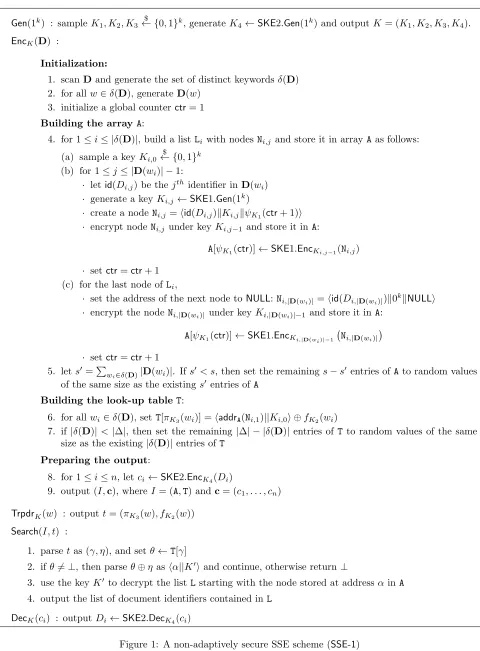
We first give an overview of our one-round non-adaptively secure SSE construction. First, each document in the collection Dis encrypted using a symmetric encryption scheme. We then construct a single indexI which consists of two data structures:
A: an array in which, for all w∈δ(D), we store an encryption of the setD(w).
For each distinct keywordwi∈δ(D), we start by creating a linked listLi where each node contains the identifier of a document in D(wi). We then store all the nodes of all the lists in the array A permuted in a random order and encrypted with randomly generated keys. Before encrypting thejth
node of listLi, it is augmented with a pointer (with respect to A) to the (j+ 1)-th node ofLi, together with the key used to encrypt it. In this way, given the location in A and the decryption key for the first node of a list Li, the server will be able to locate and decrypt all the nodes in Li. Note that by storing the nodes of all listsLi in a random order, the length of each individual Li is hidden.
We then build a look-up tableTthat allows one to locate and decrypt the first node of each listLi. Each entry inT corresponds to a keyword wi ∈δ(D) and consists of a pair <address,value>. The field value contains the location in Aand the decryption key for the first node of Li. value is itself encrypted using the output of a pseudo-random function. The other field, address, is simply used to locate an entry inT. The look-up tableTis managed using indirect addressing (described below).
The client generates both AandTbased on the plaintext document collectionD, and stores them on the server together with theencrypted documents. When the user wants to retrieve the documents that contain keywordwi, it computes the decryption key and the address for the corresponding entry in Tand sends them to the server. The server locates and decrypts the given entry of T, and gets a pointer to and the decryption key for the first node ofLi. Since each node ofLi contains a pointer to the next node, the server can locate and decrypt all the nodes ofLi, revealing the identifiers inD(wi).
Efficient storage and access of sparse tables. We describe the indirect addressing method that we use to efficiently manage look-up tables. The entries of a look-up tableTare tuples<address,value>
in which theaddressfield is used as avirtual addressto locate the entry inTthat contains somevalue
field. Given a parameter `, a virtual address is from a domain of exponential size, i.e., from {0,1}`. However, the maximum number of entries in a look-up table will be polynomial in`, so the number of virtual addresses that are used ispoly(`). If, for a tableT, theaddressfield is from{0,1}`, thevalue field is from {0,1}v and there are at most s entries in
T, then we say T is a ({0,1}` × {0,1}v ×s) look-up table.
Let Addr be the set of virtual addresses that are used for entries in a look-up table T. We can efficiently store T such that, when given a virtual address, it returns the associated value field. We achieve this by organizing Addr in a so-called FKS dictionary [22], an efficient data structure for storage of sparse tables that requiresO(|Addr|) storage and O(1) look-up time. In other words, given some virtual addressa, we are able to tell ifa∈Addrand if so, return the associatedvaluein constant look-up time. Addresses that are not in Addr are considered undefined.
Our construction in detail. We are now ready to proceed to the details of the construction. Let
SKE1 and SKE2 be PCPA-secure symmetric encryption schemes, respectively. In addition, we make use of a pseudo-random function f and two pseudo-random permutationsπ andψ with the following parameters:
f :{0,1}k× {0,1}`→ {0,1}k+log2(s);
π:{0,1}k× {0,1}` → {0,1}`;
ψ:{0,1}k× {0,1}log2(s)→ {0,1}log2(s),
wheresis the total size of the encrypted document collection in “min-units”, where a min-unit is the smallest possible size for a keyword (e.g., one byte)5. LetAbe an array withsnon-empty cells, and let Tbe a ({0,1}`× {0,1}k+log2(s)× |∆|) look-up table, managed using indirect addressing as described previously. Our construction is described in Fig. 1.
5
Gen(1k) : sampleK
1, K2, K3 $
← {0,1}k, generateK
4←SKE2.Gen(1k) and outputK= (K1, K2, K3, K4).
EncK(D) :
Initialization:
1. scan Dand generate the set of distinct keywordsδ(D) 2. for all w∈δ(D), generateD(w)
3. initialize a global counter ctr= 1
Building the arrayA:
4. for 1≤i≤ |δ(D)|, build a listLiwith nodes Ni,j and store it in array Aas follows:
(a) sample a keyKi,0 $
← {0,1}k
(b) for 1≤j ≤ |D(wi)| −1:
· letid(Di,j) be thejth identifier inD(wi)
· generate a key Ki,j ←SKE1.Gen(1k)
· create a nodeNi,j=hid(Di,j)kKi,jkψK1(ctr+ 1)i · encrypt nodeNi,j under keyKi,j−1and store it inA:
A[ψK1(ctr)]←SKE1.EncKi,j−1(Ni,j)
· set ctr=ctr+ 1 (c) for the last node ofLi,
· set the address of the next node to NULL:Ni,|D(wi)|=hid(Di,|D(wi)|)k0
kkNULLi
· encrypt the node Ni,|D(wi)|under key Ki,|D(wi)|−1 and store it inA:
A[ψK1(ctr)]←SKE1.EncKi,|D(wi)|−1 Ni,|D(wi)|
· set ctr=ctr+ 1 5. let s0=P
wi∈δ(D)|D(wi)|. Ifs
0 < s, then set the remainings−s0 entries ofAto random values
of the same size as the existings0 entries ofA
Building the look-up tableT:
6. for all wi∈δ(D), setT[πK3(wi)] =haddrA(Ni,1)||Ki,0i ⊕fK2(wi)
7. if |δ(D)|<|∆|, then set the remaining|∆| − |δ(D)| entries ofT to random values of the same size as the existing|δ(D)|entries ofT
Preparing the output:
8. for 1≤i≤n, letci←SKE2.EncK4(Di)
9. output (I,c), whereI= (A,T) andc= (c1, . . . , cn)
TrpdrK(w) : outputt= (πK3(w), fK2(w))
Search(I, t) :
1. parsetas (γ, η), and setθ←T[γ]
2. ifθ6=⊥, then parse θ⊕η as hα||K0iand continue, otherwise return⊥
3. use the keyK0 to decrypt the list Lstarting with the node stored at address αin A
4. output the list of document identifiers contained inL
DecK(ci) : outputDi ←SKE2.DecK4(ci)
Padding. Consistent with our security definitions,SSE-1reveals only the access pattern, the search pattern, the total size of the encrypted document collection, and the number of documents it contains. To achieve this, a certain amount of padding to the array and the table are necessary. To see why, recall that the array A stores a collection of linked lists (L1, . . . ,L|δ(D)|), where each Li contains the identifiers of all the documents that contain the keyword wi ∈δ(D). Note that the number of non-empty cells in A, denoted by #A, is equal to the total number of nodes contained in all the lists. In other words,
#A= X
wi∈δ(D)
#Li.
Notice, however, that this is also equal to the sum (over all the documents) of the number of distinct keywords found in each document. In other words,
#A= X
wi∈δ(D)
#Li= n
X
i=1
|δ(Di)|.
Let #D be the number of (non-distinct) words in the document collection D. Clearly, if
n
X
i=1
|δ(Di)|<#D,
then there exists at least one document inD that contains a certain word more than once. Our goal, therefore, will be to padAso that this leakage does not occur.
In practice, the adversary (i.e., the server) will not know #D explicitly, but it can approximate it as follows using the encrypted documents it stores. Recall that sis the total size of the encrypted document collection in “min-units”, where a min-unit is the smallest possible size for a keyword (e.g., one byte). Also, let s0 be the total size of the encrypted document collection in “max-units”, where a max-unit is the largest possible size for a keyword (e.g., ten bytes). It follows then that
s0 ≤#D≤s.
From the previous argument, it follows thatAmust be padded so that #Ais at leasts0. Note, however, that setting #A=s0 is not sufficient since an adversary will know that in all likelihood #D> s0. We therefore padAso that #A=s. The padding is done using random values, which are indistinguishable from the (useful) entries inA.
We follow the same line of reasoning for the look-up table T, which has at least one entry for each distinct keyword inD. To avoid revealing the number of distinct keywords inD, we add an additional
|∆| − |δ(D)|entries inTfilled with random values so that the total number of entries is always equal to|∆|.
Theorem 5.1. If f is a pseudo-random function, if π and ψ are pseudo-random permutations, and if SKE1 and SKE2 are PCPA-secure, then SSE-1 is non-adaptively secure.
Proof. We describe a polynomial-size simulatorS such that for all polynomial-size adversariesA, the outputs of RealSSE,A(k) and SimSSE,A,S(k) are indistinguishable. Consider the simulator S that,
given the trace of a historyH, generates a string v∗ = (I∗,c∗,t∗) = (A∗,T∗), c∗1, . . . , cn∗, t∗1, . . . , t∗q as follows:
1. (SimulatingA∗) ifq= 0 then for 1≤i≤s,S setsA∗[i] to a string of length log2(n) +k+ log2(s) selected uniformly at random. If q≥1, it sets |δ(D)|=q and runs Step 4 of the Enc algorithm on the setsD(w1) throughD(wq) using different random strings of size log2(s) instead ofψ(ctr).
2. (Simulating T∗) if q = 0 then for 1 ≤ i ≤ |∆|, S generates pairs (a∗i, c∗i) such that the a∗i are distinct strings of length`chosen uniformly at random, and thec∗i are strings of length log2(s)+k
also chosen uniformly at random. If q≥1, then for 1≤i≤q,S generates random values βi∗ of length log2(s) +kand a∗i of length `, and sets
T∗[a∗i] =haddrA∗(Ni,1)||Ki,0i ⊕βi∗.
It then inserts dummy entries into the remaining entries ofT∗. So, in other words, S runs Step 6 of the Enc algorithm with |δ(D)| =q, using A∗ instead of A, and using β∗i and a∗i instead of
fy(wi) andπz(wi), respectively.
3. (Simulating t∗i) it setst∗i = (a∗i, βi∗)
4. (Simulating c∗i) it sets c∗i to a |Di|-bit string chosen uniformly at random (recall that |Di| is included in the trace).
It follows by construction that searching on I∗ using trapdoors t∗i will yield the expected search outcomes.
Let v be the outcome of a RealSSE,A(k) experiment. We now claim that no polynomial-size
distinguisher D that receives stA can distinguish between the distributions v∗ and v, otherwise, by a standard hybrid argument, D could distinguish between at least one of the elements of v and its corresponding element in v∗. We argue that this is not possible by showing that each element of v∗ is computationally indistinguishable from its corresponding element in v to a distinguisherD that is given stA.
1. (Aand A∗) Recall that A consists ofs0 SKE1 encryptions ands−s0 random strings of the same size. Ifq= 0,A∗ consists of all random strings. While ifq≥1,A∗consists ofqSKE1 encryptions ands−q random strings of the same size. In either case, with all but negligible probability,stA
does not include the keysKi,j used to encrypt the list nodes stored inA. The PCPA-security of SKE1 then guarantees that each element inA∗ is indistinguishable from its counterpart inA.
2. (TandT∗) Recall thatTconsists of|δ(D)|ciphertexts,ci, generated by XOR-ing a message with the output of f, and of |∆| − |δ(D)|random values of size k+ log2(s). Ifq = 0, T∗ consists of all random values. While ifq≥1,T∗ consists ofq ciphertexts generated by XOR-ing a message with a random string βi∗ of length k+ log2(s), and |∆| −q random strings of the same length. In either case, with all but negligible probability, stA does not include the PRF key K2, and
therefore the pseudo-randomness off guarantees that each element ofTis indistinguishable from its counterpart in T∗.
3. (ti and t∗i) Recall that ti consists of evaluations of the PRP π and the PRF f. With all but negligible probability stA will not contain the keys K2 and K3, so the pseudo-randomness of π
and f then will guarantee that eachti is indistinguishable from t∗i.
4. (ci andc∗i) Recall thatci isSKE2 encryption. Since, with all but negligible probability,stA will
not contain the encryption keyK4, the PCPA-security ofSKE2 will guarantee thatci andc∗i are indistinguishable.
tableT, which has sizeO(|∆|). Since the size of the encrypted documents isO(s), accommodating the auxiliary data structures used for searching does not change (asymptotically) the storage requirements for the server. The user spends O(1) time to compute a trapdoor, while for a query for keyword w, the server spends time proportional to|D(w)|.
5.2 An adaptively secure construction
While our SSE-1 construction is efficient, it is only proven secure against non-adaptive adversaries. We now show a second construction,SSE-2, which achieves semantic security against adaptive adver-saries at the price of requiring higher communication size per query and more storage on the server. Asymptotically, however, the costs are the same.
The difficulty of proving our SSE-1construction secure against an adaptive adversary stems from the difficulty of simulating in advance an index for the adversary that will be consistent with future unknown queries. Given the intricate structure of theSSE-1construction, with each keyword having a corresponding linked list whose nodes are stored encrypted and in a random order, building an index that allows for such a simulation seems challenging. We circumvent this problem as follows.
For a keyword w and an integer j, we derive a label for w by concatenating w with j, where j
is first converted to a string of characters. So, for example, if w is the keyword “coin” and j = 1, then w||j is the string “coin1”. We define the family of a keyword w ∈δ(D) to be the set of labels famw = {w||j : 1 ≤ j ≤ |D(w)|}. So if the keyword “coin” appears in three documents, then famw = {“coin1”, “coin2”, “coin3”}. Note that the maximum size of a keyword’s family is n, i.e., the number of documents in the collection. We associate with the document collection D an index
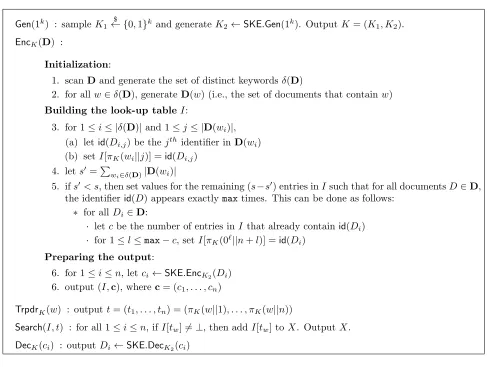
I, which is a look-up table managed using the indirect addressing technique described in Section 5.1 (thus, I has entries of the form<address, value>). For each label in a keyword’s family, we add an entry in I whose valuefield is the identifier of the document that contains an instance of w. So for eachw∈δ(D), instead of keeping a list, we simply derive the familyfamw and for each label infamw we add into the table an entry with the identifier of a document in δ(D). So if “coin” is contained in documents (D5, D8, D9), then we add the entries<address1,5>,<address2,8>,<address3,9>(in
which the address field is a function of the labels “coin1”, “coin2”, “coin3”, respectively). In order to hide the number of distinct keywords in each document, we pad the look-up table so that the identifier of each document appears in the same number of entries. To search for the documents that containw, it now suffices to search for all the labels inw’s family. Since each label is unique, a search for it “reveals” a single document identifier. Translated to the proof, this will allow the simulator to construct an index for the adversary that is indistinguishable from a real index, even before it knows any of the adversary’s queries.
Let k be security parameter and s=max·n, where n is the number of documents inD and max
is the maximum number of distinct keywords that can fit in the largest document inD (an algorithm to determine max is given below). Recall that keywords in ∆ can be represented using at most `
bits. We use a pseudo-random permutation π :{0,1}k× {0,1}`+log2(n+max) → {0,1}`+log2(n+max) and
a PCPA-secure symmetric encryption schemeSKE. Let I be a({0,1}`+log2(n+max)× {0,1}log2(n)×s) look-up table, managed using indirect addressing. The SSE-2 construction is described in Fig. 2.
Determining max. Recall thatδ(D) is the set of distinct keywords that exist in D. Assuming the minimum size for a keyword is one byte, we give an algorithm to determine max, given the size (in bytes) of the largest document inD, which we denote by MAX. In step 1 we try to fit the maximum number of distinct 1-byte keywords; there are 28 such keywords, which gives a total size of 256 bytes (28·1 bytes). IfMAX>256, then we continue to step 2. In step 2 we try to fit the maximum number
Gen(1k) : sampleK 1
$
← {0,1}k and generateK
2←SKE.Gen(1k). OutputK= (K1, K2).
EncK(D) :
Initialization:
1. scan Dand generate the set of distinct keywordsδ(D)
2. for all w∈δ(D), generateD(w) (i.e., the set of documents that containw)
Building the look-up tableI:
3. for 1≤i≤ |δ(D)|and 1≤j ≤ |D(wi)|,
(a) letid(Di,j) be thejthidentifier in D(wi)
(b) setI[πK(wi||j)] =id(Di,j)
4. let s0=P
wi∈δ(D)|D(wi)|
5. ifs0< s, then set values for the remaining (s−s0) entries inIsuch that for all documentsD∈D, the identifier id(D) appears exactlymaxtimes. This can be done as follows:
∗ for allDi∈D:
· letcbe the number of entries inI that already containid(Di)
· for 1≤l≤max−c, setI[πK(0`||n+l)] =id(Di)
Preparing the output:
6. for 1≤i≤n, letci←SKE.EncK2(Di) 6. output (I,c), wherec= (c1, . . . , cn)
TrpdrK(w) : outputt= (t1, . . . , tn) = (πK(w||1), . . . , πK(w||n))
Search(I, t) : for all 1≤i≤n, ifI[tw]6=⊥, then addI[tw] toX. OutputX.
DecK(ci) : outputDi ←SKE.DecK2(ci)
Figure 2: An adaptively secure SSE scheme (SSE-2)
keywords, which is 28·i. We continue similarly until stepiwhen MAXbecomes smaller than the total size accumulated so far. Then we go back to step i−1 and try to fit as many (i−1)-byte distinct keywords as possible in a document of size MAX. For example, when the largest document in D has sizeMAX= 1 MByte, we can fit at most max= 355349 distinct keywords (28 distinct 1-byte keywords + 216 distinct 2-byte keywords + 289557 distinct 3-byte keywords). Note that max cannot be larger than|∆|; thus, if we get a value formax(using the previously described algorithm) that is larger than
|∆|, then we set max=|∆|.
Theorem 5.2. If π is a pseudo-random permutation and SKE is PCPA-secure, then the SSE-2 con-struction is adaptively secure.
Proof. We describe a polynomial-size simulator S = (S0, . . .Sq) such that for all polynomial-size adversaries A= (A0, . . . ,Aq), the outputs of Real?SSE,A(k) andSim?SSE,A,S(k) are computationally
indistinguishable. Consider the simulator S = (S0, . . . ,Sq) that adaptively generates a string v∗ = (I∗,c∗,t∗) = (I∗, c∗1, . . . , c∗n, t∗1, . . . , t∗n) as follows:
S0(1k, τ(D)): it computes max using the algorithm described above. Note that it can do this
since it knows the size of all the documents from the trace of D. It then sets I∗ to be a ({0,1}`+log2(n+max)× {0,1}log2(n)×s) look-up table, where s=
max·n, with maxcopies of each document’s identifier inserted at random locations. S0 then includes I∗ in stS and outputs
Since, with all but negligible probability,stA does not includeK1,I∗ is indistinguishable from a
real index otherwise one could distinguish between the output of π and a random string of size
`+ log2(n+max). Similarly, since, with all but negligible probability, stA does not includeK2,
the PCPA-security ofSKE guarantees that each c∗i is indistinguishable from a real ciphertext.
S1(stS, τ(D, w1)): Recall that D(wi) = (D(wi||1), . . . ,D(wi||n)). Note that each D(wi||j), for 1 ≤ j ≤ n, contains only one document identifier which we refer to as id(Di,j). For all 1 ≤ j ≤n,
S1 randomly picks an address addrj from I∗ such that I∗[addrj] = id(Di,j), making sure that all addrj are pairwise distinct. It then sets t∗1 = (addr1, . . . ,addrn). Also, S1 remembers the
association betweent∗1 and wi by including it instS. It then outputs (t∗1, stS).
Since, with all but negligible probability,stA does not includeK1,t∗1 is indistinguishable from a
real trapdoor t1, otherwise one could distinguish between the output ofπ and a random string
of size `+ log2(n+max).
Si(stS, τ(D, w1, . . . , wi)) for 2 ≤ i ≤ q: first Si checks whether (the unknown) wi has appeared before. This can be done by checking whether there exists a 1≤j ≤i−1 such thatσ[i, j] = 1. Ifwi has not previously appeared, then Si generates a trapdoor the same wayS1 does (making
sure not to reuse any previously used addr’s). On the other hand, if wi did previously appear, thenSi retrieves the trapdoor previously used for wi and uses it as t∗i. Si outputs (t∗i, stS) and, clearly,t∗i is indistinguishable fromti(again sincestA does not includeK1with all but negligible
probability).
Just like our non-adaptively secure scheme, this construction requires one round of communication for each query and an amount of computation on the server proportional with the number of documents that contain the query (i.e.,O(|D(w)|). Similarly, the storage and computational demands on the user areO(1). The communication is equal to O(n) and the storage on the server is increased by a factor of max when compared to the SSE-1 construction. We note that the communication cost can be reduced if in each entry ofI corresponding to an element in some keywordw’s family, we also store an encryption of|D(w)|. In this way, after searching for a label in w’s family, the user will know|D(w)|
and can derivefamw. The user can then send in a single round all the trapdoors corresponding to the remaining labels inw’s family.
5.3 Secure updates
We consider a limited notion of document updates, in which new documents can beadded to the exist-ing document collection. We allow for secure updates to the document collection in the sense defined by Chang and Mitzenmacher [18]: each time the user adds a new set ζ of encrypted documents, ζ is considered a separate document collection. Old trapdoors cannot be used to search newly submitted documents, as the new documents are part of a collection indexed using different secrets. If we con-sider the submission of the original document collection an update, then afteruupdates, there will be
udocument collections stored on the server. In the previously proposed solution [18], the user sends a pseudo-random seed for each document collection, which implies that the trapdoors have lengthO(u). We propose a solution that achieves better bounds for the length of trapdoors (namelyO(logu)) and for the amount of computation at the server. For applications where the number of queries dominates the number of updates, our solution may significantly reduce the communication size and the server’s computation. A thorough evaluation of the cost of updates for real-world workloads is outside the scope of this work.