Syed Jakeer Shareef
1;
K.Jagadeesh Kumar
2&
Dr.V.Thrimurthulu
31
II M.Tech VLSI SD Student, CR Engineering College, Tirupathi, Chittoor (Dist.) A.P, India,
2Asst.prof, ECE Dept., CR Engineering College, Tirupathi, Chittoor (Dist.) A.P, India,
3Professor, Head of ECE Dept., CR Engineering College, Tirupathi, Chittoor (Dist.) A.P, India,
1
[email protected],
2[email protected],
3[email protected]
Abstract—
Carry Select Adder (CSLA) is one of the best
adders used in many data-processing processors to
perform fast arithmetic functions. From the
structure of the CSLA, it is obvious that there is
possibility for reducing the area and power
consumption in the CSLA. CSLA is used in
numerous computational systems to easy the
problem of carry propagation delay (CPD) by
autonomously generating multiple carries and then
select a carry to produce the sum. However, the
CSLA is not area competent because it uses several
pairs of Ripple Carry Adders (RCA) to generate
partial sum and carry by in view of carry input
Cin=0 and Cin=1, then thefinal-sum and carry are
selected by the multiplexers (MUX).Since the CSLA
suffering with Redundancy problem this paper
presented a novel technique to eliminate all the
redundant logic operations present in the
traditional CSLA and proposed a new encoding
technique for CSLA. In this encoding technique the
carry selection operation is done earlier than the
final sum generation. This is unlike from the
traditional approach. The Bit patterns of two
anticipating carry words (Cin = 0 and 1) and fixed
Cin bits are used for logic optimization of CS and
CG units. The optimized logic units improve the
efficiency of CSLA design.Due to the small
carry-output delay, the proposed CSLA design has
aconsiderably less area and delay than the recently
proposed CSLA’s.The proposed design is
simulated, synthesized and verified by Xilinx tools
along with Virtex – 5 FPGA board.
Index Terms —
RCA; CSLA;Square-root CSLA; Xilinx tools and Virtex -5 FPGA.
I. INTRODUCTION
A
dders are of essential substance in a wide variety of digital systems. Many fast adders exist, but adding fastusing low area and power is still challenging. Due to the fast growing mobile industry not only the faster arithmetic unit but also less area and low power arithmetic units are needed.The performance of a DSP processors is depends up on the adder efficiency. The importance of a fast, low-cost binary adder in a digital system is difficult to miscalculate. Not only are adders used in every arithmetic operation, they are also needed for computing the physical address in virtually every memory Fetch operation in most modern CPUs. Ripple CarryAdders are the smallest but also the slowest. More recently, skip adders, Carry-look-ahead and carry-select adders are very fast but far larger and consume much more power than ripple or carry-skip adders In the case of digital adders, the speed ofaddition is inadequate by the time required by the carryto propagate through the adder which is known aspropagation delay time. The sum for each bit in anadder is generated in succession only after thepreceding bits have been summed and a carry isobtained to the next position. The carry select adderis used in many digital computational systems toreduce the difficulty of propagation delay. It can bedone by in parallel generation of multiple carriesand then select a carry to generate the sum.
Yet, the CSLA is not competent in the case ofarea because it uses multiple pairs of Ripple CarryAdders (RCA) to generate partial sum and carry byconsidering carry input Cin=0 and Cin=1alone, then the final-sum and carry are selectedby the multiplexer . In the case of MCSLAthe basic idea is to use Binary to Excess-1Converter (BEC) instead of RCA with Cin = 1 inthe regular CSLA to achieve lower area and powerconsumption The main benefit of this BEC logiccomes from the lesser number of logic gates thanthe n-bit Full Adder (FA) structure.
Practical studies are observed that logicoptimization largely depends on ease of use of outmoded operationsin the formulation, whereas adder delays mainly a function of data dependence. In the active designs, logic is optimizedwithout giving any contemplation to the data dependence. Hence it is proposed to make an examination on logic operations involved inconventional and BEC-based CSLAs to swot the data dependenceand
to identify redundant logic operations. Based on thisexamination, a logic formulation for the CSLA can be suggested.The main role in this concern is to formulae logic basedon data dependence and optimized carry generator CG andCS designBecause of all the units are logic optimized, the proposed CSLA may involves appreciably less ADP thanthe active CSLAs.
The rest of this brief is organized as follows.Design developmentis presented in Section II.Modelling of proposed CSLA to overcome redundancyis presented in sectionIII.Simulation and synthesis results are presented in Section IV.Andthe conclusion is given in Section V.
II. DESIGN DEVELOPMENT
To promote low power high performance applications of computing architectures, varioushigh speed Techniques are modeled on VLSI. The VLSI architecture for the proposed method has implemented as follows.
It is very familiar that the CSLA has two major entities and they aresum and carry generatorunit (SCG) and the sum and carry selection unit (SCS). TheSCG unit consumes most of the logic utilities of CSLA andconsiderably contributes to the critical path. Meanwhile various logicdesigns have been recommended for competentexecution of theSCG unit.Therefore certain exercise is needed before implementing the techniques to the practical world. The main intention of this exercise is to recognize the redundant logic operations and data dependence. As a result,we avoided all redundant logic operations andsequence logic operations based on their data dependence.
TABLE 1
SUMMARY OF DESIGN CONSIDERATIONS
S.no Design consideration Selection 1 Compiler Xilinix14.1Vivado 2 Programming
Language Verilog
3 FPGA Virtex -5
4 Interface Digilent USB cable 5 simulator Xilinx ISIM
6 Synthesizer Xilinx ISE14.1- XST
III. MODELING OF PROPOSED CSLA TO OVERCOME REDUNDANCY
Conventional CSLA:
(a) (b)
Figure1 :(a) Conventional CSLA (b) RCA
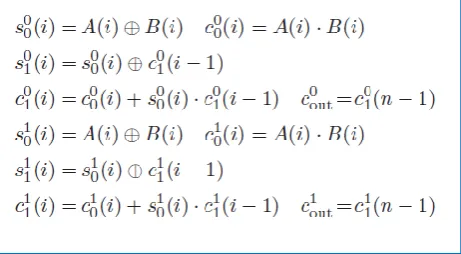
The conventional CSLA is shown in the figure1in which the Sum and Carry Generation unit consists of twon-bit RCAs, where n is the adder bit-width. The logic implementation of n-bit RCA is performed in four stages: 1) half-sum generation (HSG); 2) half-carry generation (HCG); 3) full-sum generation (FSG); and 4) fullcarry generation (FCG). Assume that two n-bit operands are added in the conventional CSLA, then RCA-1 and RCA-2 generate n-bit sum (s0 and s1) and output-carry (c0 out and c1 out) correspondingto input-carry (Cin = 0 and Cin = 1), correspondingly and whose logic expressions are shown in figure2.
Figure2: Logic Expressions of Conventional CSLA-SCG
redundancy is the root cause of loss of efficiency of the CSLA unit. The proposed architecture suggests the design with removal of this redundancy nature of the logic expressions. Theproposed system is shown in figure3.The proposed CSLA contains one HSG unit, one FSG unit, one CG unit, and one CS unit. The CG unit is composed of two CGs (CG0 and CG1) analogous to input-carry „0‟ and „1‟. The HSG receives two n-bit operands (A and B) and produce half-sum word s0 and half-carry word c0 of size n bits each. Both CG0 and CG1 receive s0 and c0 from the HSG unit and produce two n-bit full-carry words c01 and c11 resultant to input-carry „0‟ and „1‟, correspondingly.
Figure3: proposed CSLA with removal of Redundancy
The proposed logic expressions are shown in figure3 Front-End Modeling:
This phase of implementation contains the following stages simulation using Xilinx 14.1Vivado suite, synthesis using Xilinx 14.1 XST and verifying on Virtex – 5 FPGA board.
Figure4: Logic Expressions of proposed architecture
IV. SIMULATIONANDSYNTHESISRESULTS
The Verilog RTL Description of the above article is simulatedand synthesized using Xilinx14.1 (ISE-Simulator), implementation of all the above proposed
techniques are successfully synthesized and verified on Virtex -5 FPGA board and the results are shown below.
Figure5: Simulation output of proposed CSLA
Figure6: Synthesis output of proposed CSLA
The Synthesized report is summarized in the following Table2.
TABLE 2
SUMMARY OF SYNTHESIS REPORT Sno Parameter Quantification
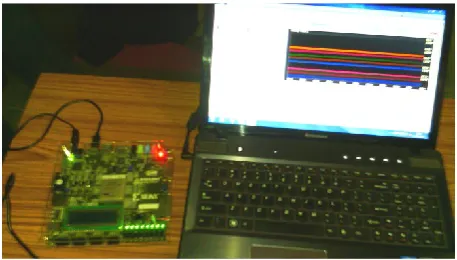
Figure 7: Proposed CSLA synthesized in Virtex-5 FPGA
TABLE 3
VERIFICATION OF POWER CONSUMPTION IN VIRTEX-5 FPGA
Figure 8: power graph analysis in Virtex-5 FPGA
V. CONCLUSION
In this paper, proposed a new encoding technique for the CSLA.In the projected system, the CS operation is planned before the calculation of final-sum, which is altered from the conventional CSLA. Carry words equivalent to input-carry „0‟ and „1‟ generated by the CSLA based on the proposed system follow a specific bit pattern, due to this the CS unit is logically optimized. For logical optimization the CS unit allowsfixed input bits. Based on this, significantly reduced design for CS and CG units are obtained. Using these optimized logic units, a competent design is obtained for the CSLA. The proposed CSLA design presents a considerably less area and delay.This paper has realized with Xilinx tools along with Virtex -5 FPGA. Such designs are suggested to exhibits a competitive performance with current work.
A
CKNOWLEDGMENTI express my sincere thanks to my guide Mr.K.JAGADEESH KUMAR Assistant Professor in ECE Dept. and Project Coordinator Mr. S.ALI ASGAR, M.Tech, Assistant Professor of ECE Dept., and to my Head of Department Dr.V.THRIMURTHULU, M.E., Ph.D., MIETE., MISTE. Professor &Head of ECE Dept. CREC, TIRUPATHI, for their valuable guidance and useful suggestions, which helped me in the project work.
REFERENCES
[1] K. K. Parhi, VLSI Digital Signal Processing. New York, NY, USA:Wiley,1998.
[2] O. J. Bedrij, “Carry-select adder,” IRE Trans. Electron. Comput.,vol. EC-11, no. 3, pp. 340–344, Jun. 1962.
[3] Y. Kim and L.-S. Kim, “64-bit carry-select adder with reduced area,”Electron.Lett., vol. 37, no. 10, pp. 614–615, May 2001.
[4] Y. He, C. H. Chang, and J. Gu, “An area-efficient 64-bit square root carryselectadder for low power application,” in Proc. IEEE Int. Symp. CircuitsSyst., 2005, vol. 4, pp. 4082–4085.
[5] A. P. Chandrakasan, N. Verma, and D. C. Daly, “Ultralow-power electronicsfor biomedical applications,” Annu. Rev. Biomed. Eng., vol. 10, pp. 247–274, Aug. 2008.
[6] B. Parhami, Computer Arithmetic: Algorithms and Hardware Designs,2nd ed. New York, NY, USA: Oxford Univ. Press, 2010.
[7] I.-C. Wey, C.-C.Ho, Y.-S. Lin, and C. C. Peng, “An area-efficient carryselect adder design by sharing the common Boolean logic term,” in Proc.IMECS, 2012, pp. 1–4.
[8] B. Ramkumar and H.M. Kittur, “Low-power and area-efficient carry-selectadder,” IEEE Trans. Very Large Scale Integr. (VLSI) Syst., vol. 20, no. 2,pp. 371–375, Feb. 2012.
[9] S.Manju and V. Sornagopal, “An efficient SQRT architecture of carry selectadder design by common Boolean logic,” in Proc. VLSI ICEVENT, 2013,pp. 1–5.
[10]Area–Delay–Power Efficient Carry-Select Adder Basant Kumar Mohanty, Senior Member, IEEE, and Sujit Kumar Patel, 2014.
[11]www.xilinx.com
AUTHORS:
SYED JAKEER SHAREEFreceived his B.Tech degree in Electronics & Communication Engineering from Shree Instuiteof Technical Education, Tirupati (A.P), India, in the year 2013. Currently pursuing his M.Tech degree in VLSI System Design at ChadalawadaRamanamma Engineering College, Tirupati (A.P), India.His area of research Includes Low power VLSI design.
K.JAGADEESH KUMARAssistant Professor in ECE Dept. He received his Graduation in Electronics & Communication Engineering in GATE institute of technical engineering college, Anantapur, Post-Graduation M.Tech in Sri KottamTulasi Reddy Memorial College of Engineering, Hyderabad.