Optimization of Granite and Iron Powder as
Partial Replacement of Fine Aggregate in
Concrete
Anu C Abraham1, Sindhu P K2
P.G. Student, Department of Civil Engineering, IIET Engineering College, Nellikuzhy, Kerala, India1
Assistant Professor, Department of Civil Engineering, IIET Engineering College, Nellikuzhy, Kerala, India2
ABSTRACT: Now a days large number of studies are going on to improve the performance of concrete with the help of innovative chemical admixtures and supplementary materials. These materials used are majority by-products or industrial waste from other processes. This paper presents experimental investigations on effect of addition of industrial by products as partial replacement of fine aggregates on the mechanical properties of concrete such as compressive strength, split tensile strength and flexural strength. The fine aggregate has been replaced by granite and iron powder accordingly in the range of 5% increment level. Optimum value is obtained at 10% replacement level. Optimization is carried by 10% granite powder and various percentages of iron powder. At 20% replacement of iron powder better strength properties were obtained.
KEYWORDS:Granite powder, Iron powder, Compressive strength, Split tensile strength, Flexural strength
I.INTRODUCTION
Fine aggregate is an essential component of concrete. The global consumption of natural river sand is very high due to the extensive use of concrete. In particular, the demand for natural river sand is quite high in developed countries owing to infrastructural growth. In this situation some developing countries are facing a shortage in the supply of natural sand. The non-availability of sufficient quantity of ordinary river sand for making cement concrete is affecting the growth of the construction industry in many parts of the country. Therefore, the construction industries in developing countries are under stress to identify alternative materials to reduce the demand on river sand. In order to reduce the dependence on natural aggregates as the main source of aggregates in concrete, artificially manufactured aggregates and artificial aggregates generated from industrial wastes provide an alternative for the construction industry . Some alternative materials have already been used in place of natural river sand. For example, fly ash, slag and lime stone, siliceous stone powder, rock dust and quarry waste were used in concrete mixture as a partial replacement of natural sand.
Fresh properties as slump can carry out. Hardened properties checked by conducting compressive strength, flexural strength test and split tensile strength.
II. LITERATURE REVIEW
III.MATERIALDETAILS 3.1 Cement
Portland pozzolana cement conforming to IS: 269-1976 and IS: 7031-1968 was used in this study. The cement is of 53grade and the tests conducted on cement are tabulated in Table No.1
Table 1.Properties of cement
Sl.No Properties Values obtained
1 Specific gravity 3.17
2 Standard consistency 30%
3 Initial setting time 71 minutes
4 Final setting time 310 minutes
5 Average compressive
strength(Mpa) 56.4
3.2 Fine aggregate
The particle whose size ranges between 4.75mm and 150 microns are termed as fine aggregate. Their particle size distribution helps in higher packing density which enhances durability of the concrete.IS 383-1970 recognize manufacture sand as 'crushed stone sand' under clause2.
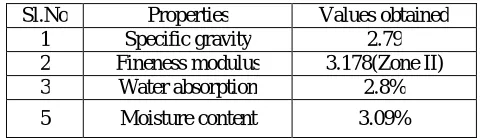
Table 2 Physical properties of fine aggregate
Sl.No Properties Values obtained 1 Specific gravity 2.79 2 Fineness modulus 3.178(Zone II) 3 Water absorption 2.8% 5 Moisture content 3.09%
3.3 Coarse aggregate
Aggregates are component of composite materials such as concrete gives strength to the overall composite material. Size of aggregate is usually greater than 4.75 mm. Nominal size of aggregate of 20 mm was used.
Table 3 Physical properties of coarse aggregate
3.4 Granite powder
Granite is a common type of igneous rock. The rest of the portion which remains inside the earth undergoes cooling at a slow rate and results in formation of rock of crystalline variety known as granite. Its main constituent minerals are quartz, felspar and mica. Its colour depends upon that of felspar. Water absorption is less than 1.6% and finely grained granite takes a fine polish. Specific gravity is 2.72 and moisture content is 1.5%.
Fig.1 Granite powder
3.5 Iron powder
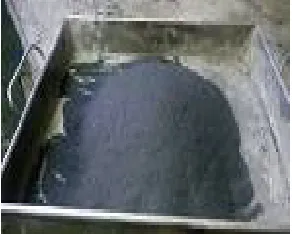
Iron slag is an industrial waste material. It is a by-product of the iron and steel making process. Specific gravity of iron powder is 2.58. Water absorption iron powder is 8.46%, higher than natural sand. Therefore mixes are weak in terms of liquidity. It confirms zone III.
Fig.2 Iron powder
3.6Mix proportion
Mix design was done as per IS 10262:1982.Using trial and error method, the water cement ratio was adopted as 0.40.The superplasticizer dosage was adopted as 1.9% weight of cement. Also M 30 mix is used for this study.
Table 4. Material for 1m3 of concrete
Cement Coarse aggregate Fine aggregate Water Admixture
IV. RESULTS AND DICUSSIONS
4.1 Compressive strength results
It has been observed that the compressive strength of concrete replaced with granite powder increases as the amount of replacement increases up to a certain percentage (10% in the present study). The mix with 10% replacement of fine aggregate with granite powder showed an increase in compressive strength by 4.2%.
Fig 4 Variation of compressive strength (replacement by granite powder)
4.2 Split tensile strength results
The determination of tensile strength of concrete is necessary to determine the load at which the concrete members may crack. The cracking is a form of tension failure. The test consists of applying a compressive line load along the opposite generators of a concrete cylinder placed with its axis horizontal between the compressive platens.
39. 5 41. 2 45. 9 44. 23 48. 9 50. 8 53. 1 52. 2 0 10 20 30 40 50 60
Control specimen 5%GP 10%GP 15%GP
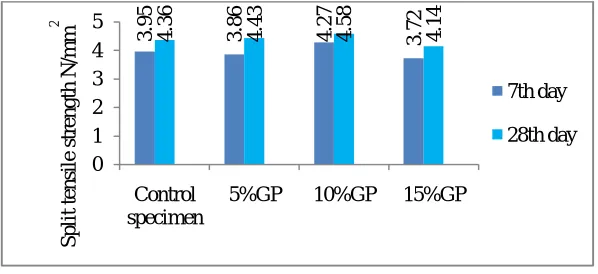
7th day Co m pr es si v e st re n gt h 3. 95 3. 86 4. 27 3. 72 4. 36 4. 43 4. 58 4. 14 0 1 2 3 4 5 Control specimen
5%GP 10%GP 15%GP
Due to addition of granite powder, there is considerable improvement in tensile strength up to certain percentage. With the replacement of fine aggregate in concrete by granite powder, the concrete prepared is eco-friendly and cost effective. Maximum split tensile strength of 4.58 N/mm2 was obtained at 10% replacement level. Even after the replacement of fine aggregate by 15%, the split tensile strength was lesser than control mix.
4.3 Flexural strength test results
The determination of flexural strength is essential to estimate the load at which the concrete members may crack. Since it is difficult to determine the strength of concrete by conducting direct tension test, it is computed by flexure testing.The flexural tensile strength or modulus of rupture is determined by testing standard beam specimens of 10 x 10 x50 cm over a span of 40 cm under symmetrical two point loading. The flexural strength is determined according to IS: 516 – 1975.
Fig.5.variation of flexural strength (replacement by granite powder)
Maximum flexural strength of 8.98 N/mm2 was obtained at 10% replacement level. Even at 15% replacement level the flexural strength was similar to that control mix.
4.4 Effect of iron powder after optimization with granite powder
In this present study, above results shows that replacement of fine aggregate using 10% granite powder shows higher strength So the optimization will carried out using 10% granite powder and varying percentages of iron powder. The replacement of iron powder varies at 5% increment level.
Evaluation of Cube compressive strength
It has been observed that the compressive strength of concrete replaced with granite and iron powder increases as the amount of replacement increases up to a certain percentage (10%GP+20%IP in the present study). Up to 20% replacement of iron powder, an increase in strength was observed, after that compressive strength decreased. The mix with 10% replacement of fine aggregate with granite powder and 20% showed an increase in compressive strength by 10.46%.The compressive strength of fine aggregate replaced with granite powder and iron powder is shown in fig 7.
5.
66 6.3 6.
58
6.
1
8.
38
7.
35 8.
98
8.
3
0 1 2 3 4 5 6 7 8 9 10
Control specimen
5%GP 10%GP 15%GP
7th day
28th day
F
le
xur
a
l
st
re
ngt
h
N
/m
m
Fig 6 Variation of compressive strength (replacement by GP and IP)
Evaluation of split tensile strength
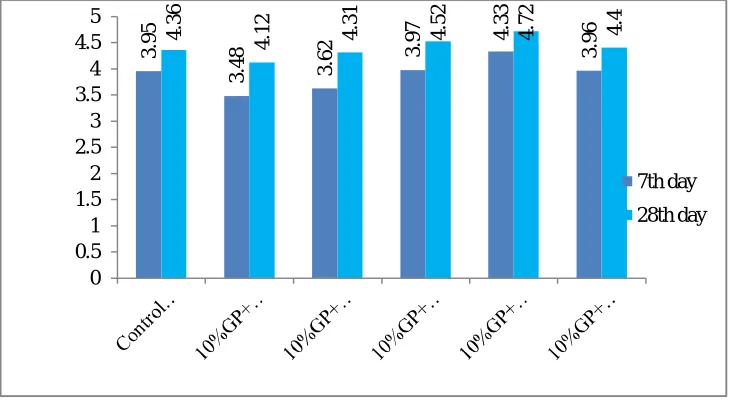
Due to optimization of granite and iron powder, there is considerable improvement in tensile strength up to certain percentages. With the replacement of fine aggregate in concrete by granite and iron powder, the concrete prepared is eco-friendly and cost effective. Maximum split tensile strength of 4.72 N/mm2 was obtained at 10% replacement with granite powder and 20% replacement with iron powder. The split tensile strength decreases after 20% replacement with iron powder.
Fig 7 Variation of split tensile strength (replacement by GP and IP)
39. 5 43. 03 46. 3 47. 8 49. 9 47. 9 48. 9 51. 8 52. 9 54. 13 56. 36 55. 81 0 10 20 30 40 50 60 7th day 28th dy 3. 95 3.
48 3.62 3.
97 4.33
3.
96
4.
36
4.
12 4.31 4.52 4.72 4.4
Evaluation of flexural strength
When concrete was tested for flexural strength maximum value of 8.75 N/mm2 was obtained at 20% replacement with iron powder. Again when the replacement level increased modulus of rupture decreased.
Fig 8 Variation of flexural strength (replacement by GP and IP)
V. CONCLUSIONS
(i) The replacement of fine aggregate is carried out at 5% increment level using granite and iron powder.
(ii) The strength of concrete increases with increase in percentage of replacement with granite powder. Optimum value is obtained at 10% replacement level since increase in percentage of granite powder strength decreases and percentage increase in strength is 4.2.
(iii) After optimization, replacement is carried out at various percentages of iron powder. The strength increases at 20% replacement and then decreases due to decrease in workability. Percentage increase in strength is 7.46.
REFERENCES
[1]. G. Raja, K. M. Ramalingam,”Experimental Study on Partial Replacement of Fine Aggregate by Granite Powder in Concrete”,
International Journal for Innovative Research in Science & Technology,Volume 2,Issue 12, 2016
[2]. Rachit Saxena1, Abhishek Singh Kushwaha,Shilpa Pal, “Effect on Compressive Strength of Concrete with Partial Replacement of Sand
using Iron Slag”, Journal of Civil Engineering and Environmental Technology, Volume 2, Issue 6,,pp-510-513, 2015
[3]. Karthik,KR.Keerthiraman,”Experimental investigation on concrete with partially replacement of cement and fully replacement of sand”,
International Journal of Advanced Research in Biology Engineering Science and Technology, Vol. 2, Issue 4, 2016
[4]. N.KiranKumar,Dr.B.DamodharaReddy,S.ArunaJyothy , “An experimental investigation on strength of granite-fines concrete” ,
International Journal of Science & Technology , Vol. 4 Issue 2, 2014
6.
66
6.
31 6.75 6.84 7.
28
7.
15
8.
38
7.
98
8.
17
8.
34 8.75
8.
45
0 1 2 3 4 5 6 7 8 9 10
[5]. Prema Kumar W.P,Mr. AnanthayyaM.B,Mr. Vijay K, “Effect of Replacing Sand by Iron Ore Tailings on the Compressive Strength of Concrete and Flexural Strength of Reinforced Concrete Beams”, International Journal of Engineering Research &Technology,Vol. 3,Issue 7, 2014
[6]. T. Felix Kala,”Effect of Granite Powder on Strength Properties of Concrete”, International Journal Of Engineering And Science , Vol.2,
Issue 12,pp 36-50, May 2013
[7]. Divakar. Y 1, Manjunath. S 2 and Dr. M.U. Aswath,“Experimental Investigation on Behaviour of Concrete With the Use of Granite
Fines”, International Journal of Advanced Engineering Research and Studies,Vol. I,Issue IV, 2012
[8]. T. Felix kalaP. Partheeban,”Granite powder concrete”, Indian Journal of Science and Technology,,Vol. 3 No. 3,2010
[9]. Manasseh Joel,”Use of Crushed Granite Fine as Replacement to River Sand in Concrete Production “Civil Engineering Department
Universtiy of Agriculture ,2010
[10]. Kanmalai Williams C, PartheebanP , Felix Kala T.”Mechanical properties of high performance concrete incorporating granite powder