EVALUATION OF MACHINE LEARNING TECHNIQUES FOR IMBALANCED DATA IN IDS
SHAHRAM MOKARAMIAN
A project submitted in partial fulfillment of the requirements for the award of the degree of Master of Computer Science (Information Security)
Faculty of Computing Universiti Teknologi Malaysia
DEDICATION
ACKNOWLEDGEMENTS
I would like to truly appreciate Dr. Anazida Zainal for taking the time out of her busy schedule to encourage and guide me through this project. Her deep knowledge and valuable experience inspired me and illuminated my path. Also for her great advices and technical points that she gave me with attractiveness.
Besides I should be appreciative of authority of Universiti Teknologi Malaysia (UTM) for providing me with a good environment and creative area.
ABSTRACT
ABSTRAK
Intrusion Detection System (IDS) Rangkaian adalah sistem automatik yang boleh mengesan trafik yang berniat jahat dan ia memainkan peranan penting dalam rangkaian. Pada tahun-tahun kebelakangan ini, algoritma pembelajaran mesin telah dibangunkan dan digunakan untuk mengesan pencerobohan rangkaian. Kebanyakkan algoritma pembelajaran mesin yang piawai sering memberi ketepatan keseluruhan yang tinggi. Namun, mereka seriang memihak kepada kelas majoriti apabila berurusan dengan data yang tidak seimbang. Malangnya, IDS menawarkan pengagihan data yang sangat tidak seimbang dan kebanyakkan algoritma pembelajaran mesin memberikan pengesanan yang rendah untuk kelas R2L dan U2R, termasuk serangan berbahaya. Oleh itu, ia memerlukan teknik persempelan semula untuk mengimbangi data tersebut. Tujuan kajian ini adalah untuk menyelidik prestasi tiga algoritma pembelajaran mesin iaitu Support Vector Machine (SVM), Decision Tree (DT) dan Fuzzy Classifier (FC) untuk ketidakseimbangan data dalam IDS dan data yang telah diseimbangkan yang dapat dicapai melalui Synthetic Minority Over-sampling TEchnique (SOMTE). Prestasi ketiga-tiga algoritma pembelajaran mesin kemudian dinilai dengan data baru yang telah diseimbangkan. Penanda aras set data DARPA KDDCup 1999 IDS telah digunakan. SMOTE telah dilaksanakan dengan dua nisbah ketidakseimbangan, iaitu 1:4 dan 1:1. Setelah menganalisis keputusan sebelum dan selepas pengsempelan semula, ia menunjukkan bahawa FC menunjukkan keputusan yang lebih baik dengan nisbah ketidakseimbangan 1:1. Ketepatan FC dengan data seimbang untuk trafik Normal adalah (99.19%), serangan Denial of Service (99,35%), serangan Probe (99,51%), serangan
Remote to Local (99.67%) dan serangan User to Root (99.41%). Di samping itu, data
TABLE OF CONTENTS
CHAPTER TITLE PAGE
DECLARATION ii
DEDICATION iii
ACKNOWLEDGEMENTS iv
ABSTRACT v
ABSTRAK vi
TABLE OF CONTENTS vii
LIST OF TABLES xi
LIST OF FIGURES xii
LIST OF ABBREVIATIONS xv
1 INTRODUCTION 1
1.1 Overview 1
1.2 Background of the Problem 1
1.3 Statement of the Problem 5
1.4 Purpose of the Research 5
1.5 Objectives of the Study 6
1.6 Scope of the Study 6
1.7 Significant of the Study 7
1.8 Research Contributions 7
1.9 Research Methodology 8
1.10 Organization of the Study 8
2.1 Introduction 10
2.2 Computer Security 10
2.3 An Overview of Intrusion Detection Systems 12 2.3.1 Taxonomy of Intrusion Detection System 12
2.3.1.1 Misuse Detection 13
2.3.1.2 Anomaly Detection 14
2.3.1.3 Host-based IDS 15
2.3.1.4 Network-based IDS 17
2.3.2 Comparison of IDS Types 18
2.4 Attack Classification 19
2.5 Machine Learning 22
2.5.1 Supervised Learning 22
2.5.1.1 Artificial Neural Networks 23 2.5.1.2 Support Vector Machines 24
2.5.1.3 Decision Trees 26
2.5.1.4 Fuzzy Classifier 27
2.5.2 Unsupervised Learning 29
2.5.2.1 K-Nearest Neighbour (KNN) 29 2.5.2.2 Self-organizing Map 30
2.6 CLASS IMBALANCE PROBLEM 31
2.6.1 Imbalance in Class Distribution 32
2.6.2 Lack of Data 33
2.6.3 Concept Complexity 34
2.6.4 Existing Approaches 35
2.6.4.1 Data Level Approaches 35 2.6.4.2 Limits of Resampling 41 2.6.4.3 Algorithm Level Approaches 41 2.6.4.4 Cost Sensitive Approaches 44 2.6.5 Multi-class Imbalance Problem 46
2.7 Related Works 49
2.8 Research Direction 49
3 RESEARCH METHODOLOGY 51
3.1 Introduction 51
3.2 Problem Situation and Solution Concept 51 3.3 An Overview of Research Framework 52
3.4 DARPA KDD99 Dataset 54
3.5 Phase I 58
3.6 Phase II 59
3.7 Phase III 59
3.8 Evaluation Metrics 60
3.9 Summary 62
4 PERFORMANCE OF MACHINE LEARNING
ALGORITHMS ON IDS DATA 63
4.1 Introduction 63
4.2 Machine Learning Algorithms On Imbalanced Data 63
4.3 Support Vector Machine (SVM) 64
4.3.1 SVM Parameters 65
4.4 Decision Tree (DT) 65
4.4.1 Decision Tree Parameters 67
4.5 Fuzzy Classifier (FC) 68
4.6 Experimental Results 71
4.7 Overall Findings 76
4.8 Summary 77
5 PERFORMANCE OF MACHINE LEARNING
ALGORITHMS ON REBALANCED IDS DATA 78
5.1 Introduction 78
5.2 Data Rebalancing 78
5.3 Synthetic Minority Over-sampling TEchnique (SMOTE) 79 5.4 Results of Two Imbalance Ratios 80
5.5 Overall Comparison 87
5.6 Overall Findings and Discussions 98
5.7 Summary 98
6.1 Concluding Remarks 100
6.2 Future Work 102
6.3 Closing Note 102
LIST OF TABLES
TABLE NO. TITLE PAGE
2.1 The advantages and disadvantages of misuse detection
methods (Chimphlee, 2008) 14
2.2 The advantages and disadvantages of anomaly detection
methods (Chimphlee, 2008) 15
2.3 Comparison of IDS types 19 2.4 Four Classes of Attacks (Zainal, 2011) 21 2.5 Related works on supervised and unsupervised learning
in IDS 31
2.6 Related works on imbalanced dataset IDS 48 3.1 Summary of problem situations and solution concepts 52 3.2 List of features along with its descriptions 56 3.3 Confusion matrix for a two-class classification task 60 4.1 SVM parameters (Lin et al., 2008) 65 4.2 Decision tree parameters (Koblar, 2012) 68
LIST OF FIGURES
FIGURE NO. TITLE PAGE
1.1 Design and development phases of the study 8
1.2 Organization of the thesis 9
2.1 Taxonomy of Intrusion Detection System 13 2.2 Host based Intrusion Detection System
(Shanmugam, 2010) 16
2.3 Network based Intrusion Detection System
(Shanmugam, 2010) 18
2.4 SVM classification (Yang et al., 2007) 25 2.5 Pseudo-code for SVM (Yu et al., 2007) 26 2.6 The effect of lack of data on classifier training 34 2.7 Randomly removes the majority sample 36 2.8 Replicate the minority class samples 37 2.9 The SMOTE Algorithm (Chawla et al., 2002) 39
2.10 Example of generation of synthetic examples
(SMOTE) (Chawla et al., 2002) 40
2.11 Taxonomy of existing approaches for imbalance
data problem 45
2.12 One-Against-One technique for a 4-class problem
(Fernández et al., 2010) 47
3.1 Research framework 53
3.2 A sample connection record 54
3.3 Distribution of IDS dataset 57
4.2 Pseudo code for compute membership for each attribute
part-1(Visa, 2006) 70
4.3 Pseudo code for compute membership for each attribute
part-2 (Visa, 2006) 70
4.4 Pseudo code for extract the fuzzy set from membership for each attribute and assign test point to the class
(Visa, 2006) 71
4.5 Imbalanced IDS dataset 72
4.6 Overall accuracy of machine learning algorithms on
imbalanced IDS data 72
4.7 Evaluation metrics of machine learning algorithms on Normal class in imbalanced IDS data 73 4.8 Evaluation metrics of machine learning algorithms on DoS class in imbalanced IDS data 74 4.9 Evaluation metrics of machine learning algorithms on
Probe class in imbalanced IDS data 74 4.10 Evaluation metrics of machine learning algorithms on U2R class in imbalanced IDS data 75 4.11 Evaluation metrics of machine learning algorithms on
R2L class in imbalanced IDS data 76 5.1 Dataset before and after rebalancing with imbalance
ratio<4 80
5.2 Evaluation metrics of three algorithms for Normal class with imbalance ratio<4 81 5.3 Evaluation metrics of three algorithms for DoS class with imbalance ratio<4 81
5.4 Evaluation metrics of three algorithms for Probe class with imbalance ratio<4 82
5.5 Evaluation metrics of three algorithms for U2R class with imbalance ratio<4 83 5.6 Evaluation metrics of three algorithms for R2L class with imbalance ratio<4 83 5.7 Dataset before and after rebalancing with
5.8 Evaluation metrics of three algorithms on Normal
class with imbalance ratio=1 85
5.9 Evaluation metrics of three algorithms on DoS
class with imbalance ratio=1 85
5.10 Evaluation metrics of three algorithms on Probe
class with imbalance ratio=1 86
5.11 Evaluation metrics of three algorithms on U2R
class with imbalance ratio=1 86
5.12 Evaluation metrics of three algorithms on R2L
class with imbalance ratio=1 87
5.13 Evaluation metrics of SVM algorithm on Normal class before and after rebalancing 88
5.14 Evaluation metrics of DT algorithm on Normal class before and after rebalancing 89 5.15 Evaluation metrics of FC algorithm on Normal
class before and after rebalancing 89 5.16 Evaluation metrics of SVM algorithm on DoS
class before and after rebalancing 90 5.17 Evaluation metrics of DT algorithm on DoS
class before and after rebalancing 91 5.18 Evaluation metrics of FC algorithm on DoS
class before and after rebalancing 91 5.19 Evaluation metrics of SVM algorithm on Probe
class before and after rebalancing 92 5.20 Evaluation metrics of DT algorithm on Probe
class before and after rebalancing 93 5.21 Evaluation metrics of FC algorithm on Probe
class before and after rebalancing 93 5.22 Evaluation metrics of SVM algorithm on U2R
class before and after rebalancing 94 5.23 Evaluation metrics of DT algorithm on U2R
class before and after rebalancing 95 5.24 Evaluation metrics of FC algorithm on U2R
5.25 Evaluation metrics of SVM algorithm on R2L class before and after rebalancing 96 5.26 Evaluation metrics of DT algorithm on R2L
LIST OF ABBREVIATIONS
ANN Artificial Neural Networks DoS Denial of Service
DT Decision Tree FAR False Alarm Rate FC Fuzzy Classifier FNR False Negative Rate FPR False Positive Rate
HIDS Host-based Intrusion Detection System IDS Intrusion Detection System
IR Imbalance Ratio KNN K-Nearest Neighbor MLP Multi-Layer Perceptron
NIDS Network-based Intrusion Detection System R2L Remote to Local
SMOTE Synthetic Minority Over-sampling TEchnique SOM Self-Organizing Map
CHAPTER 1
INTRODUCTION
1.1 Overview
The class imbalance problem is a difficult challenge faced by machine learning and data mining, and it has attracted a significant amount of research in these years. A classifier affected by the class imbalance problem for a specific dataset would see strong accuracy overall but very poor performance on the minority class. This study will evaluated three machine learning algorithms for imbalanced data problem before and after rebalancing the dataset in intrusion detection system (IDS).
1.2 Background of the Problem
important to have a detecting and monitoring system to protect important data. Intrusion detection is identifying unauthorized users in a computer system.
Intrusion Detection System (IDS) is an automated system that can detect a computer system intrusion either by using the audit trail provided by an operating system or by using the network monitoring tools. The main goal of intrusion detection is to detect unauthorized use, misuse and abuse of computers by both system insiders and external intruders. In IDS, misuse and anomaly are the two types of detection approaches. Misuse detection can detect known attacks by constructing a set of signatures of attacks while anomaly detection recognizes novel attacks by modeling of normal behaviors (Xu and Wang, 2005; Zainal, 2011).
Intrusion detection is a tool of monitoring and analyzing the events occurring in a computer system in order to detect signs of security problem. The network traffic is made up of attack and normal traffic. The number of attacks on the network is typically a very small fraction of the total traffic. On the basis of this the attacks can also be categorized into two classes, minority and majority attack class. The normal data, Denial of Service (DoS) and Probe attacks belong to majority class whereas User-to-Root (U2R) and Remote-to-Local (R2L) belong to minority class also called as rare class of attacks. In real world environment, the minority attacks are more dangerous than the majority (Sharma and Mukherjee, 2012; Lopez et al., 2012).
anomaly detection and misuse detection. Anomaly detection consists of establishing normal behavior profile for user and system activity also observing significant deviations of actual user activity with respect to the established habitual pattern. Misuse detection, refers to intrusions that follow well-defined attack patterns that exploit weaknesses in system and application software (Beghdad, 2009).
The difficulty faced by IDS is highly imbalanced data distribution (Wu and Banzhaf, 2010; Zainal, 2011). Imbalanced data further make difficult the anomaly detection cases. Most of the studies implementing supervised method like LGP (Prasad et al., 2008) and Neuro-Fuzzy (Toosi and Kahani, 2007) on KDD Cup 1999 Intrusion Detection Datasets, reported poor results especially on R2L (Remote to Local) and U2R (User to Root) attacks. This is because R2L and U2R constitute the least data in the experimental dataset (KDD Cup 1999) compared to other classes of traffic (Normal, Denial of Service (DoS) and Probe).
Network traffic contains class imbalanced problem. The class imbalanced problem arises when some particular classes are represented with too many instances and the other some classes have very few instances (Zainal, 2011). Usually the classification is biased towards the classes with majority instances (Liao, 2008). Most reported works in IDS (Hossain et al., 2003; Xu and Wang, 2005; Lee et al., 2006; Shafi and Abbass, 2009; Jemili et al., 2007; Zainal, 2011) reported poor detection on U2R and R2L classes.
As stated by Galar et al. (2012), in recent years, class imbalance problem has emerged as one of the challenges in data mining community and a number of solutions have been proposed at the data and algorithm levels and trying to address the imbalanced data problem. The problem of imbalanced data is not properly addressed. Most machine learning algorithms are influenced towards the class with more instances and give poor detection performance for minority class and give out high false alarm rate.
Fuzzy Classifier (FC) has the ability to handle datasets with overlapping and imbalancing problem that is a good potential solution since IDS datasets are usually extremely skewed (Ali et al., 2011).
The main capability of fuzzy classifier is better than the standard classifiers, which proposed by many researchers (Ali et al., 2011; Visa, 2006). When compare to other classifiers, the FC is a better candidate for classification of imbalanced data. More precisely, the fuzzy classifier recognizes better the minority class while also achieving better overall accuracy then neural network and RF (random Forest) (Ali et al., 2011).
labels.
These machine learning algorithms cannot get satisfactory results with severely imbalanced data. So, imbalanced data is needed to balance the data by using one resampling technique. One of the popular resampling approach is SMOTE (Synthetic Minority Over-sampling TEchnique), which adds information to the training set by introducing new, non-replicated minority class examples (Chawla et
al., 2002). The results show that the SMOTE approach can improve the
accuracy of classifiers for a minority class.
1.3 Statement of the Problem
One of the main challenges in intrusion detection system is that, few attacks are rarely happened. IDS deal with highly imbalanced data distribution. This would lead to significantly disparate or too small training dataset for determined classes. Most of the standard machine learning techniques are influenced towards the majority classes and give poor detection performance for classes with very less data samples during training which giving out high false alarm rate. This research gives a primary focus on this imbalanced issue.
1.4 Purpose of the Research
1.5 Objectives of the Study
The particular objectives of this study are:
i. To study and investigate performance of three machine learning algorithms (FC, SVM and DT) for imbalanced data in IDS.
ii. To rebalance the data by an up-sampling algorithm (SMOTE) to deal with severely imbalanced problem and evaluate the performance of FC, SVM and DT techniques.
iii. To compare the results of these machine learning algorithms with imbalanced data before the rebalancing and after the rebalancing dataset.
1.6 Scope of the Study
The scope of this study will be limited to following:
i. The study will use KDD Cup 1999 Intrusion Detection data set (http://kdd.ics.uci.edu/databases/kddcup99) as widely used by other researchers in the field of IDS (Jemili et al., 2007; Shafi and Abbass, 2009; Zainal, 2011; Abraham et al., 2007; Tajbakhsh et al., 2009; Farid et al., 2010).
ii. Classification of attacks are based on four established dominant categories which are Denial of Service (DoS), Probe, User to Root (U2R) and Remote to Local (R2L) as widely used in other studies in the field of IDS (Abraham et al., 2007; Shafi and Abbass, 2009; Zainal, 2011; Tajbakhsh et al., 2009; Farid et al., 2010; Teng et al., 2010).
2011).
1.7 Significant of the Study
The research is important and significant from theoretical and practical perspectives. The rationale and motivation for this research is imbalanced data, which is commonly found in intrusion detection domain, has reduced the performance of machine learning based IDS.
The research findings are expected to lead to better understanding on the nature of computer network security and provide a better approach deal with imbalanced data IDS. As such, they should benefit both researchers and practitioners.
1.8 Research Contributions
1.9 Research Methodology
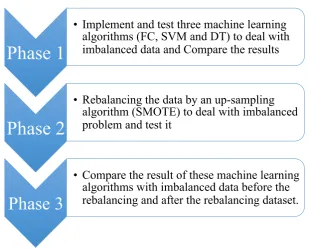
This part quickly presents the research methodology in this study. The details will be offered in Chapter 3. Phase 1 dealt with implementing and testing three machine learning algorithms (FC, SVM and DT) on imbalanced data and compare the results. In phase 2, procedures to rebalanced the data by an up-sampling algorithm and test it. Finally, Phase 3 dealt with evaluating and comparing the performance of these three techniques with rebalance data and without rebalance.
Figure 1.1: Design and development phases of the study
1.10 Organization of the Study
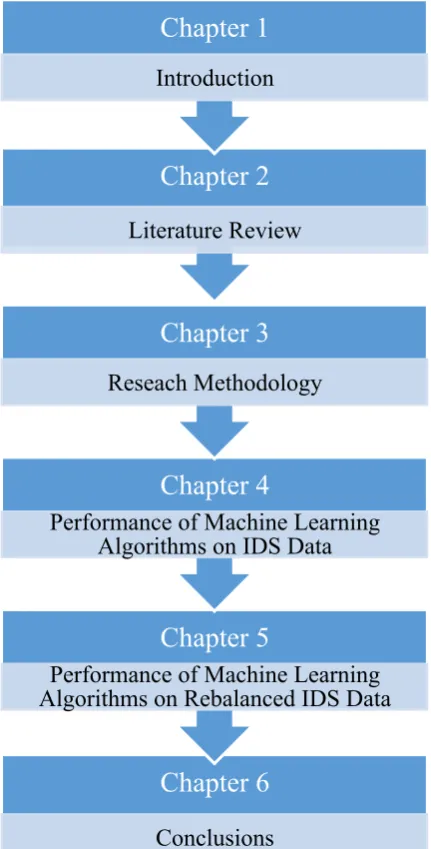
This study is organized into four chapters as shown in Figure 1.2.
Phase 1
• Implement and test three machine learning algorithms (FC, SVM and DT) to deal with imbalanced data and Compare the results
Phase 2
• Rebalancing the data by an up-sampling algorithm (SMOTE) to deal with imbalanced problem and test it
Phase 3
Figure 1.2: Organization of the thesis
Chapter 1 is an outline to this study. Chapter 2 will be provided a literature review that leads to understand the research problem and get information of related work by other researchers. Chapter 3 will provide the research methodology. Chapter 4 will be provided the performance of three machine learning algorithms which are SVM, DT and FC on IDS data. The performance of these three machine learning algorithms after rebalancing by SOMTE technique and before rebalancing will be provided in Chapter 5. Finally, Chapter 6 is the conclusion of this work.
Chapter 6
Conclusions
Chapter 5
Performance of Machine Learning Algorithms on Rebalanced IDS Data
Chapter 4
Performance of Machine Learning Algorithms on IDS Data
Chapter 3
Reseach Methodology
Chapter 2
REFERENCES
Abadeh, M. S., Habibi, J., Barzegar, Z. and Sergi, M. (2007). A Parallel Genetic Local Search Algorithm for Intrusion Detection in Computer Networks.
Engineering Applications of Artificial Intelligence. 20(8), 1058-1069.
Abraham, A., Grosan, C. and Martin-Vide, C. (2007). Evolutionary Design of Intrusion Detection Programs. International Journal of Network Security.
4(3), 328-339.
Ali, A., Shamsuddin, S. M., Ralescu, A. L. and Visa, S. (2011). Fuzzy Classifier for Classification of Medical Data. Proceedings of the 2011 IEEE nternational
Conference on Hybrid Intelligent Systems (HIS). 5-8 Dec. 2011. IEEE,
173-178.
Anderson, J. P. (1980). Computer Security Threat Monitoring and Surveillance. Fort Washington, Pennsylvania: James P. Anderson Co.
Barandela, R., Valdovinos, R. M., Sánchez, J. S. and Ferri, F. J. (2004). The Imbalanced Training Sample Problem: Under or over Sampling? In Fred, A., Caelli, T., Duin, R. W., Campilho, A. and de Ridder, D. (Eds.). Structural,
Syntactic, and Statistical Pattern Recognition. (pp. 806-814) Springer Berlin
Heidelberg.
Beghdad, R. (2009). Efficient Deterministic Method for Detecting New U2r Attacks.
Computer Communications. 32(6), 1104-1110.
Breiman, L. (1996). Bagging Predictors. Mach. Learn. 24(2), 123-140. Breiman, L. (2001). Random Forests. Mach. Learn. 45(1), 5-32.
Chandrasekhar, A. M. and Raghuveer, K. (2013). Intrusion Detection Technique by
Using K-Means, Fuzzy Neural Network and Svm Classifiers. Proceedings of
Intrusion Detection System. ACM Transactions on Information and System Security. 6(2), 173-200.
Chawla, N. V., Bowyer, K. W., Hall, L. O. and Kegelmeyer, W. P. (2002). Smote:
Synthetic Minority over-Sampling Technique. Journal of Artificial
Intelligence Research. 16, 321-357.
Chawla, N. V., Japkowicz, N. and Kotcz, A. (2004). Editorial: Special Issue on Learning from Imbalanced Data Sets. SIGKDD Explor. Newsl. 6(1), 1-6. Chen, Y., Abraham, A. and Yang, B. (2007). Hybrid Flexible Neural-Tree-Based
Intrusion Detection Systems. International Journal of Intelligent Systems.
22(4), 337-352.
Chimphlee, W. (2008). Hybrid Fuzzy Techniques for Unsupervised Intrusion
Detection System. PhD Thesis, Universiti Tecknologi Malaysia.
Chimphlee, W., Abdullah, A. H., Sap, M. N. M., Srinoy, S. and Chimphlee, S. (2006). Anomaly-Based Intrusion Detection Using Fuzzy Rough Clustering.
Proceedings of the 2006 Hybrid Information Technology (ICHIT'06).
329-334.
Crothers, T. (2002). Implementing Intrusion Detection Systems: A Hands-on Guide
for Securing the Network. Wiely.
Davis, J. J. and Clark, A. J. (2011). Data Preprocessing for Anomaly Based Network Intrusion Detection: A Review. Computers & Security. 30(6–7), 353-375. Denning, D. E. (1987). An Intrusion-Detection Model. Software Engineering, IEEE
Transactions on. SE-13(2), 222-232.
Ektefa, M., Memar, S., Sidi, F. and Affendey, L. S. (2010). Intrusion Detection Using Data Mining Techniques. Proceedings of the 2010 Information Retrieval & Knowledge Management, (CAMP), 2010 International
Conference on. 17-18 March 2010. 200-203.
Farid, D. M., Harbi, N. and Rahman, M. Z. (2010). Combining Naive Bayes and Decision Tree for Adaptive Intrusion Detection. International Journal of
Network Security and Its Applications. 2(2), 12-25.
Fraichard, T. and Garnier, P. (2001). Fuzzy Control to Drive Car-Like Vehicles.
Robotics and Autonomous Systems. 34(1), 1-22.
Galar, M., Ferna, x, ndez, A., Barrenechea, E., Bustince, H. and Herrera, F. (2012). A Review on Ensembles for the Class Imbalance Problem: Bagging-, Boosting-, and Hybrid-Based Approaches. Systems, Man, and Cybernetics,
Part C: Applications and Reviews, IEEE Transactions on. 42(4), 463-484.
Gao, M., Hong, X., Chen, S. and Harris, C. J. (2011). A Combined Smote and Pso
Based Rbf Classifier for Two-Class Imbalanced Problems. Neurocomputing.
74(17), 3456-3466.
Guan, J., Liu, D.-x. and Wang, T. (2004). Applications of Fuzzy Data Mining Methods for Intrusion Detection Systems. In Laganá, A., Gavrilova, M., Kumar, V., Mun, Y., Tan, C. J. K. and Gervasi, O. (Eds.). Computational
Science and Its Applications – Iccsa 2004. (pp. 706-714) Springer Berlin
Heidelberg.
Haykin, S. (1998). Neural Networks: A Comprehensive Foundation. Prentice Hall PTR.
Hossain, M., Bridges, S. M. and Vaughn Jr, R. B. (2003). Adaptive Intrusion Detection with Data Mining. Proceedings of the 2003 IEEE International
Conference on Systems, Man and Cybernetics. 5-8 Oct. 2003. IEEE,
3097-3103 vol.4.
Japkowicz, N. (2001). Concept-Learning in the Presence of between-Class and within-Class Imbalances. In Stroulia, E. and Matwin, S. (Eds.). Advances in
Artificial Intelligence. (pp. 67-77) Springer Berlin Heidelberg.
Japkowicz, N. and Stephen, S. (2002). The Class Imbalance Problem: A Systematic Study. Intell. Data Anal. 6(5), 429-449.
Jeatrakul, P. and Kok-Wai, W. (2012). Enhancing Classification Performance of Multi-Class Imbalanced Data Using the Oaa-Db Algorithm. Proceedings of the 2012 Neural Networks (IJCNN), The 2012 International Joint Conference on. 10-15 June 2012. 1-8.
Jemili, F., Zaghdoud, M. and Ben Ahmed, M. (2007). A Framework for an Adaptive Intrusion Detection System Using Bayesian Network. Proceedings of the
2007 IEEE Intelligence and Security Informatics. 23-24 May 2007. IEEE,
Response: A Survey. International Journal of Network Security. 1(2), 84-102.
kailashiya, D. and Jain, D. R. C. (2011). Improve Intrusion Detection for Decision Tree with Stratified Sampling. Int.J.Computer Technology & Applications.
Vol 3(3), 1209-1216.
Kendall, K. (1998). A Database of Computer Attacks for Evaluation of Intrusion
Detection Systems. PhD Thesis, Massachusetts Insitute of Technlogy,Boston.
Koblar, V. (2012). Optimizing Parameters of Machine Learning Algorithms. PhD Jozef International Postgraduate School.
Kohonen, T. (1990). The Self-Organizing Map. Proceedings of the IEEE. 78(9), 1464-1480.
Kressel, U. H. G. (1999). Pairwise Classification and Support Vector Machines. 255-268.
Kruegel, C., Mutz, D., Valeur, F. and Vigna, G. (2003). On the Detection of
Anomalous System Call Arguments. LECTURE NOTES IN COMPUTER
SCIENCE. (2808), 326-344.
Kubat, M. and Matwin, S. (1997). Addressing the Curse of Imbalanced Training Sets: One-Sided Selection. In Proceedings of the Fourteenth International
Conference on Machine Learning. (pp. 179-186) Morgan Kaufmann.
Lazarevic, A., Srivastava, J. and Kumar, V. (2005). Managing Cyber Threats.
Springer US.
Le, G. H. N. (2011). Machine Learning with Informative Samples for Large and Imbalanced
Datasets. PhD Thesis, School of Electrical, Computer and Telecommunications
Engineering, University of Wollongong.
Lecouteux, B., Linarès, G. and Oger, S. (2012). Integrating Imperfect Transcripts into Speech Recognition Systems for Building High-Quality Corpora.
Computer Speech & Language. 26(2), 67-89.
Lee, H., Chung, Y. and Park, D. (2006). An Adaptive Intrusion Detection Algorithm Based on Clustering and Kernel-Method. Proceedings of the 2006 Springer-Verlag Pacific-Asia conference on Advances in Knowledge Discovery and
Liao, T. W. (2008). Classification of Weld Flaws with Imbalanced Class Data.
Expert Systems with Applications. 35(3), 1041-1052.
Lin, S.-J., Chang, C. and Hsu, M.-F. (2013). Multiple Extreme Learning Machines for a Two-Class Imbalance Corporate Life Cycle Prediction.
Knowledge-Based Systems. 39(0), 214-223.
Lin, S.-W., Lee, Z.-J., Chen, S.-C. and Tseng, T.-Y. (2008). Parameter Determination of Support Vector Machine and Feature Selection Using Simulated Annealing Approach. Applied Soft Computing. 8(4), 1505-1512. Liu, A., Ghosh, J. and Martin, C. (2007). Generative Oversampling for Mining
Imbalanced Datasets. Dmin. (pp. 66-72).
Liu, Y., Li, N., Shi, L. and Li, F. (2010). An Intrusion Detection Method Based on Decision Tree. Proceedings of the 2010 E-Health Networking, Digital
Ecosystems and Technologies (EDT), 2010 International Conference on.
17-18 April 2010. 232-235.
Lopez, V., Fernandez, A., Jesus, M. J. d. and Herrera, F. (2012). A Hierarchical Genetic Fuzzy System Based on Genetic Programming for Addressing Classification with Highly Imbalanced and Borderline Data-Sets.
Knowledge-Based Systems. 38, 85-104.
Mitchell, T. (1997). Machine Learning. McGraw-Hill.
Murphey, Y. L., Wang, H., Ou, G. and Feldkamp, L. A. (2007). Oaho: An Effective Algorithm for Multi-Class Learning from Imbalanced Data. Proceedings of
the 2007 406-411.
Panigrahi, S., Kundu, A., Sural, S. and Majumdar, A. K. (2009). Credit Card Fraud Detection: A Fusion Approach Using Dempster–Shafer Theory and Bayesian Learning. Information Fusion. 10(4), 354-363.
Phoungphol, P., Zhang, Y., Zhao, Y. and Srichandan, B. (2012). Multiclass Svm with Ramp Loss for Imbalanced Data Classification. Proceedings of the 2012
Granular Computing (GrC), 2012 IEEE International Conference on. 11-13
Aug. 2012. 376-381.
Prasad, G. V. S. N. R. V., Dhanalakshmi, Y., Kumar, V. V. and Babu, I. R. (2008). Modeling an Intrusion Detection System Using Data Mining and Genetic Algorithms Based on Fuzzy Logic. International Journal of Computer
Using Computational Intelligence. Expert Systems with Applications. 35(4), 1721-1732.
Qureshi, A. A. (2006). Network Intrusion Detection Using an Innovative Statistical
Approach. Florida Institute of Technology.
Raskutti, B. and Kowalczyk, A. (2004). Extreme Re-Balancing for Svms: A Case Study. SIGKDD Explor. Newsl. 6(1), 60-69.
Schapire, R. E. (1990). The Strength of Weak Learnability. Mach. Learn. 5(2), 197-227.
Shafi, K. and Abbass, H. A. (2009). An Adaptive Genetic-Based Signature Learning System for Intrusion Detection. Expert Systems with Applications. 36(10), 12036-12043.
Shanmugam, B. (2010). A Hybrid Intelligent Intrusion Detection System Using Fuzzy
Logic and Improved Packet Tracing Model. PhD Thesis, Universiti
Teknologi Malaysia.
Sharma, N. and Mukherjee, S. (2012). A Novel Multi-Classifier Layered Approach to Improve Minority Attack Detection in Ids. Procedia Technology. 6(0), 913-921.
Shuo, W. and Xin, Y. (2012). Multiclass Imbalance Problems: Analysis and Potential Solutions. Systems, Man, and Cybernetics, Part B: Cybernetics, IEEE
Transactions on. 42(4), 1119-1130.
Shuo, W. and Xin, Y. (2013). Relationships between Diversity of Classification Ensembles and Single-Class Performance Measures. Knowledge and Data
Engineering, IEEE Transactions on. 25(1), 206-219.
Sun, Y., Wong, A. K. C. and Kamel, M. S. (2009). Classification of Imbalanced Data: A Review. International Journal of Pattern Recognition and Artificial
Intelligence. 23(04), 687-719.
Tahir, M., Khan, A., Majid, A. and Lumini, A. (2013). Subcellular Localization Using Fluorescence Imagery: Utilizing Ensemble Classification with Diverse Feature Extraction Strategies and Data Balancing. Applied Soft Computing.
(0).
Teng, S., Du, H., Wu, N., Zhang, W. and Su, J. (2010). A Cooperative Network
Intrusion Detection Based on Fuzzy Svms. JOURNAL OF NETWORKS. 5(4),
475-483.
Thammasiri, D., Delen, D., Meesad, P. and Kasap, N. (2013). A Critical Assessment of Imbalanced Class Distribution Problem: The Case of Predicting Freshmen Student Attrition. Expert Systems with Applications. (0).
Toosi, A. N. and Kahani, M. (2007). A New Approach to Intrusion Detection Based on an Evolutionary Soft Computing Model Using Neuro-Fuzzy Classifiers.
Computer Communications. 30(10), 2201-2212.
Valeur, F., Vigna, G., Kruegel, C. and Kemmerer, R. A. (2004). A Comprehensive Approach to Intrusion Detection Alert Correlation. IEEE Transactions on
Dependable and Secure Computing. 1(3), 146-168.
Vapnik, V. N. (1998). Statistical Learning Theory. Wiley-Interscience.
Visa, S. (2006). Fuzzy Classifiers for Imbalanced Data Sets. University of Cincinnati, Cincinnati.
Wasikowski, M. (2009). Combating the Class Imbalance Problem in Small Sample
Data Sets. Master Thesis, University of Kansas School of Engineering
Weiss, G. M. (2004). Mining with Rarity: A Unifying Framework. SIGKDD Explor.
Newsl. 6(1), 7-19.
Wu, S. X. and Banzhaf, W. (2010). The Use of Computational Intelligence in Intrusion Detection Systems: A Review. Applied Soft Computing. 10(1), 1-35.
Xu, X. and Wang, X. (2005). An Adaptive Network Intrusion Detection Method Based on Pca and Support Vector Machines. Proceedings of the 2005 Springer-Verlag international conference on Advanced Data Mining and
Applications. Wuhan, China: Springer-Verlag, 696-703.
Yang, L., Wang, R. and Zeng, Y.-S. (2007). An Improvement of One-against-One Method for Multi-Class Support Vector Machine. Proceedings of the 2007
Machine Learning and Cybernetics, 2007 International Conference on. 19-22
Aug. 2007. 2915-2920.
Imbalanced Data Issue in Functional Genomics. Neural Computing and
Applications. 16(3), 295-306.
Yu, T., Jan, T., Simoff, S. and Debenham, o. (2007). A Hierarchical Vqsvm for Imbalanced Data Sets. Proceedings of the 2007 International Joint
Conference on Neural Networks. August 12-17, 2007 Orlando, Florida, USA:
518-523.
Zadeh, L. A. (1965). Fuzzy Sets. Information and Control. 8(3), 338-353.
Zainal, A. B. (2011). An Adaptive Intrusion Detection Model for Dynamic Network
Traffic Patterns Using Machine Learning Techniques. PhD Thesis, Universiti