ABSTRACT
LEE, SANG HOON. Exploration of Fine-Grained Helper Computing Parallelism on a Chip Multiprocessor. (Under the direction of James Tuck.)
As software systems become more complicated, due to the importance of reliability and security, prior studies have proposed inlining meta-functions into applications for detecting bugs and security vulnerabilities. However, because these software techniques add frequent, fine-grained instrumentation to programs, they often incur large runtime overheads. Because they increase the critical path of the main application, they sometimes increase it by orders of magnitude. For example, Memcheck, a tool that runs using Valgrind, has been reported to slow down applications by a factor of 2× to 30× [32, 52, 45], and even then it only checks
for a subset of memory errors. Fortunately, because multicore systems become ubiquitous and there is abundant parallelism in meta-functions, many of these meta-functions can be extracted and executed in parallel with the main application. The goal of this work is to speed up main application with fine-grained meta-functions by efficiently offloading meta-functions from main application into helper threads and by efficiently communicating through queues.
This dissertation considers two systems to achieve the goal. One is a software-based tech-nique and the other is a hardware-based techtech-nique. First, in order to concurrently run meta-functions and main application in parallel on a chip multiprocessor, we propose Automatic Parallelization for Fine-Grained Meta-Functions on a CMP, which is a software-based tech-nique. We seek to understand how to extract meta-functions from a program and execute them efficiently on a multi-core processor. Our parallelization strategy automatically extracts meta-functions from the main program and executes them in customized helper threads — threads constructed to mirror relevant fragments of the main program’s behavior in order to keep com-munication and overhead low. To get good performance, we consider optimizations that reduce communication and balance work among many threads. We evaluate our parallelization strat-egy on Mudflap, a pointer-use checking tool in GCC. To show the benefits of our technique, we compare it to a manually parallelized version of Mudflap. We run our experiments on an architectural simulator with support for fast queueing operations. With static heuristics, it achieves an average 1.64×speedup using 8 cores. Compared to a manually optimized version of
the Mudflap framework, our approach is only 19% slower. With dynamic heuristics, it achieves on average 1.96× speedup using 8 cores. Our automatically parallelized code using dynamic load balance is competitive, on average, to the manually parallelized version on a simulated 8-core system. Furthermore, our approach introduces very little overhead in the main program — it is kept under 100%, which is more than a 5.3×reduction compared to serial Mudflap.
c
Copyright 2012 by Sang Hoon Lee
Exploration of Fine-Grained Helper Computing Parallelism on a Chip Multiprocessor
by Sang Hoon Lee
A dissertation submitted to the Graduate Faculty of North Carolina State University
in partial fulfillment of the requirements for the Degree of
Doctor of Philosophy
Computer Engineering
Raleigh, North Carolina
2012
APPROVED BY:
Gregory Byrd Yan Solihin
Frank Mueller James Tuck
DEDICATION
To my lovely wife, Hyunjoo Park and my precious daughter, Rebecca(Jiyoo)
BIOGRAPHY
Sang Hoon Lee was born in Seoul, Korea in 1975. He obtained his B.S. and M.S. degrees in
Electrical Engineering from Yonsei University in Seoul, Korea in 2001 and 2003, respectively.
He worked as a software engineer at Samsung Electronics in Suwon, Korea, where he developed
software for mobile phones. He joined North Carolina State University in 2007 to pursue his
Ph.D degree. During his Ph.D study, he has focused his research on computer architecture,
micro-architecture and automatic parallelization on a Chip Multiprocessor under the direction
ACKNOWLEDGEMENTS
First of all, I would like to thank my advisor Dr. James Tuck. He has always encouraged me to
continue my research. His advice and discussion with him always motivated me to continuously
focus on my work. With his encouragement and guidance, I was able to finish my dissertation.
In addition, he was my mentor in my personal life. He always gave me advice whenever I had
personal issues. I am really fortunate to have Dr. Tuck as my advisor.
I would like to thank my Ph.D committee members, Dr Gregory Byrd, Dr. Yan Solihin and
Dr. Frank Mueller for their suggestions and encouragement
I would like to thank all the CESR student colleagues. Specially, Liang Han, George
Pat-silaras, and Rajeshwar Vanka shared research ideas and personal life with me. In addition, I
would like to thank Joonmoo Huh and Ying Yu for discussion about research ideas.
I would like to thank all the Korean friends I’ve met at NC State University since 2007. I
have been so happy to enjoy my life in Raleigh with them.
Last but not least, I would like to express my sincere appreciation and gratitude to my wife
TABLE OF CONTENTS
List of Tables . . . vii
List of Figures . . . .viii
Chapter 1 Introduction . . . 1
1.1 Meta-functions . . . 2
1.2 Exploiting parallelism . . . 3
1.3 Problems . . . 4
1.4 Major Proposals of This Thesis . . . 6
1.4.1 Automatic Parallelization of Fine-Grained Meta-Functions on a Chip Multiprocessor . . . 7
1.4.2 HAQu: Hardware-Accelerated Queue . . . 8
1.5 Report Organization . . . 9
Chapter 2 Automatic Parallelization of Fine-Grained Meta-Functions on a CMP . . . 10
2.1 Fine Grained Meta-function Parallelization . . . 10
2.1.1 Our Parallelization Approach: Custom Helpers . . . 12
2.1.2 Providing Scalability . . . 12
2.1.3 Summary . . . 13
2.2 Parallelization Algorithm . . . 13
2.2.1 Helper Function Parallelization Algorithm . . . 14
2.2.2 Baseline Helper Extraction . . . 15
2.2.3 Custom Helper Extraction . . . 18
2.2.4 Example . . . 21
2.2.5 Supporting Multiple Helpers . . . 21
2.3 Case Study: Mudflap . . . 24
2.3.1 Mapping Mudflap to our Framework . . . 25
2.3.2 Manual Parallelization . . . 27
2.4 Related Work . . . 27
2.5 Summury . . . 28
Chapter 3 HAQu: Hardware-Accelerated Queueing for Fine-Grained Thread-ing on a Chip Multiprocessor . . . 30
3.1 Main Idea: Hardware Accelerated Queue . . . 30
3.1.1 Motivation . . . 30
3.1.2 Our Proposal: Hardware-Accelerated Queue . . . 32
3.2 System Architecture . . . 33
3.2.1 Allocation and Layout . . . 33
3.2.2 Enqueue and Dequeue Operations . . . 34
3.2.3 Making Fine-Grained Queueing Efficient . . . 34
3.3 Implementation . . . 43
3.3.1 Microarchitecture Description . . . 43
3.3.2 Pipelined Execution Description . . . 43
3.3.3 Managing QFU Resources . . . 45
3.3.4 Instruction Implementation Details . . . 46
3.4 Related Work . . . 46
3.5 Summary . . . 47
Chapter 4 Evaluation . . . 48
4.1 Evaluation of Automatic Parallelization . . . 48
4.1.1 Experimental Setup . . . 48
4.1.2 Baseline Helper Extraction . . . 48
4.1.3 Custom Helper Extraction . . . 49
4.1.4 Dynamic Load Balancing . . . 50
4.1.5 Optimizations . . . 53
4.1.6 Overheads . . . 56
4.2 Evaluation of HAQu . . . 57
4.2.1 Experimental Setup . . . 57
4.2.2 Micro Benchmarks . . . 58
4.2.3 Pointer-use Checking Acceleration . . . 63
4.2.4 Decoupled Software Pipelining . . . 65
Chapter 5 Conclusion and Future Work . . . 68
5.1 Conclusion . . . 68
5.1.1 Automatic parallelization of fine-grained meta-functions . . . 68
5.1.2 HAQu: Hardware-Accelerated Queue . . . 69
5.2 Future work . . . 69
LIST OF TABLES
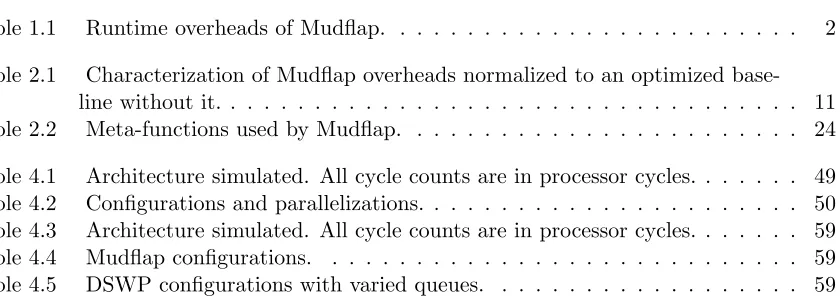
Table 1.1 Runtime overheads of Mudflap. . . 2
Table 2.1 Characterization of Mudflap overheads normalized to an optimized base-line without it. . . 11
Table 2.2 Meta-functions used by Mudflap. . . 24
Table 4.1 Architecture simulated. All cycle counts are in processor cycles. . . 49
Table 4.2 Configurations and parallelizations. . . 50
Table 4.3 Architecture simulated. All cycle counts are in processor cycles. . . 59
Table 4.4 Mudflap configurations. . . 59
LIST OF FIGURES
Figure 1.1 Bottlenecks due to workload imbalance. . . 5
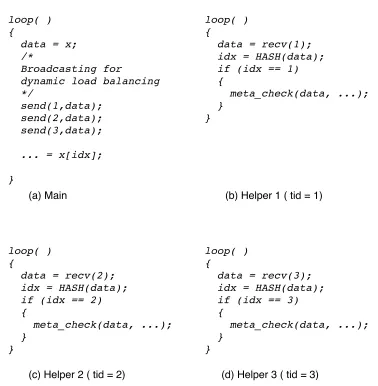
Figure 2.1 A simple example of our Helper Extraction. . . 20
Figure 2.2 Generated main and helper functions with Dynamic Load Balancing us-ing HASH. . . 22
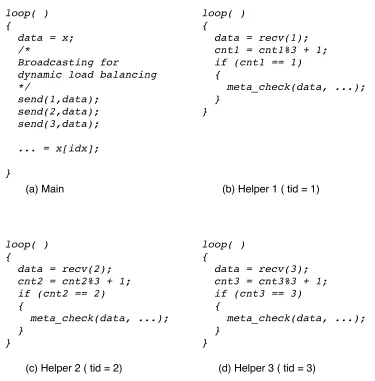
Figure 2.3 Generated main and helper functions with Dynamic Load Balancing us-ing counters. . . 23
Figure 2.4 Example code with Mudflap annotation. . . 25
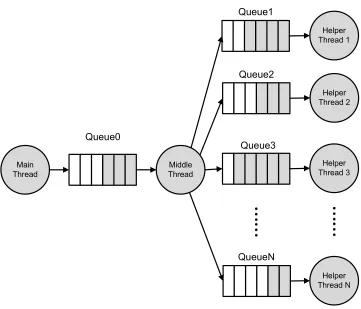
Figure 2.5 Mudflap Manual Parallelization. . . 26
Figure 3.1 Lamport’s queueing operations single-producer, single-consumer queue on a sequentially consistent processor. . . 31
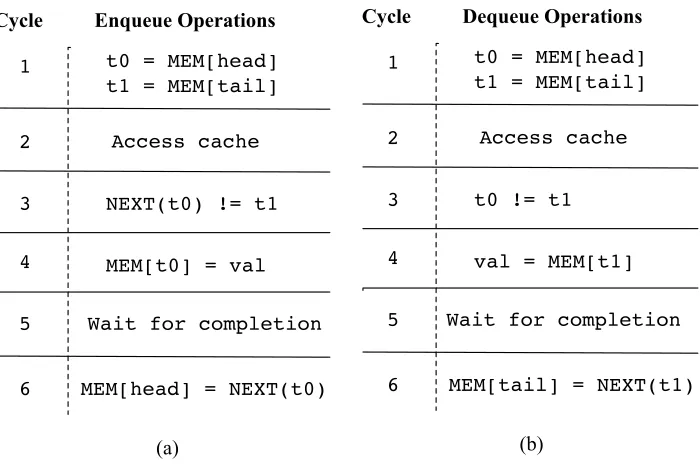
Figure 3.2 Enqueue (a) and dequeue (b) operations. Assumed cache hits with a dual-ported, 2-cycle access L1 cache. . . 35
Figure 3.3 Enqueue and dequeue instructions. . . 35
Figure 3.4 Relaxed memory ordering for queue operations. . . 36
Figure 3.5 Algorithm for reducing accesses to shared variables. . . 37
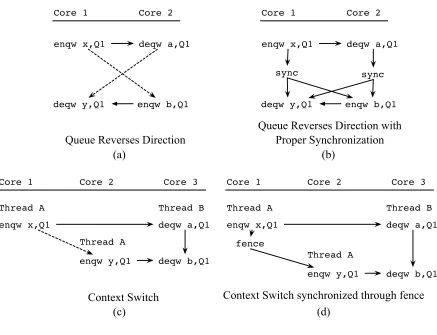
Figure 3.6 Important cases for providing OS transparency and programmability. . . 40
Figure 3.7 Memory operations through context switch. . . 41
Figure 3.8 Context switch codes of Linux Kernel 3.2.6 [1]. . . 42
Figure 3.9 Hardware Accelerated Queue added to a CMP. . . 44
Figure 4.1 Scalability of Base Helper Extraction with 4-cores and 8-cores. . . 51
Figure 4.2 Speedups of Parallelized Mudflap with empty run-time functions. . . 52
Figure 4.3 Speedups of Parallelized Mudflap. . . 53
Figure 4.4 The number of mf checks in each helper thread on 8-core CMP (gap). 53 Figure 4.5 The number of mf checks in each helper thread on 8-core CMP (gzip). 54 Figure 4.6 Speedups of Parallelized Mudflap with various load balancing techniques. 54 Figure 4.7 Speedups of pipelining communications compared to other paralleliza-tions . . . 55
Figure 4.8 Scalability of automatic parallelization using static load balance with 4-cores, 8-cores and 16 cores. . . 56
Figure 4.9 Scalability of automatic parallelization using static load balance with 4-cores, 8-cores and 16 cores. . . 57
Figure 4.10 The relative size of the binary. . . 58
Figure 4.11 The main thread’s dynamic instruction counts. . . 60
Figure 4.12 Micro benchmarks using queues on NarrowRing. . . 61
Figure 4.13 Micro benchmarks using queues on WideRing. . . 62
Figure 4.14 Parallelizing Mudflap using Hardware Accelerated Queue. . . 64
Figure 4.15 Speedup of Parallelized Mudflap. . . 65
Chapter 1
Introduction
One major trend in computing is the continuing increase in the complexity of software systems. Such an increase is motivated by the expectation of increasingly powerful hardware (faster processors, larger memory, etc.), programming environments that provide higher abstraction to the programmers, and the increasing diversity of environments in which the software runs. To ensure efficient, reliable, and secure execution of complex software systems, programmers increasingly rely on meta-functions, functionalities that do not contribute directly to the out-put of a program but help ensure efficient, reliable, and secure execution of the program. For example, software bugs are a major problem in industry. The National Institute of Standards & Technology estimated in 2002 that inadequate infrastructure for testing software cost close to $22 billion [48]. The same study predicts that if only half of the bugs that remained in post-production software were detected and eliminated, that cost could be recouped. Con-sequently, prior studies have proposed inlining meta-functions into applications for detecting bugs. However, because these software techniques add frequent, fine-grained instrumentation to programs, they often incur large runtime overheads. Because they increase the critical path of the main application, they sometimes increase it by orders of magnitudes. For example, Memcheck, a tool that runs using Valgrind, has been reported to slow down applications by a factor of 2× to 30× [32, 52, 45], and even then it only checks for a subset of memory errors.
Other than that, various forms of meta-functions are implemented today in response to the diverse requirements of software execution, ranging from garbage collection, security checks, runtime correctness verification, performance instrumentations, and so on.
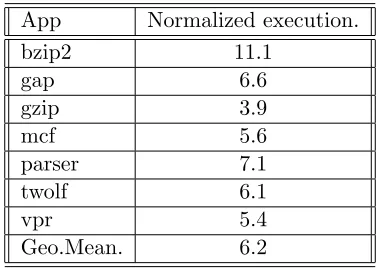
Table 1.1: Runtime overheads of Mudflap.
App Normalized execution.
bzip2 11.1
gap 6.6
gzip 3.9
mcf 5.6
parser 7.1
twolf 6.1
vpr 5.4
Geo.Mean. 6.2
efficient communication on multicore systems are required.
In the remainder of this chapter, we will consider overheads due to meta-functions and previous techniques to reduce overheads in more detail. In addition, we will consider the problems motivating our work. Finally, we will introduce one proposal based on software and the other proposal based on hardware.
1.1
Meta-functions
HardBound [8] is a hardware/software approach. SoftBound is inspired by HardBound. It pro-vides hardware bounded pointers. It checks bounds for dereferencing and propagates bounds efficiently. Chuang et al. [5] proposed a mechanism for accelerating meta data checks. They provide ISA extensions and additional hardware support to eliminate overheads due to access to meta-data. Chen et al. [3] proposed a mechanism for fine-grain instruction monitoring that supports operations similar to that of Mudflap. This system works for general instruction-grain monitoring tools. These previous works focused on accelerating meta-data use with specialized hardware supports.
1.2
Exploiting parallelism
As described in Section 1.1, while meta-functions ensure reliability and security for programs, they incur large runtime overheads because of fine-grained instrumentation to programs. Conse-quently, there have been many works to reduce runtime overheads by limiting systems’ coverages or by being supported by hardware. In addition, because multicore systems become ubiquitous and there is abundant parallelism in meta-functions, prior studies have investigated exploiting parallelism between the application and its security meta-functions.
Patil and Fischer [37] focused on parallelizing checking of pointer and array accesses on multiprocessors. However, due to the large overheads of communication and synchronization on their target systems, their approach was to replicate all code that generated pointer derefer-ences and execute it in a separate process. For work that could not be replicated, like program inputs or outputs, the two processes synchronized. They were able to achieve concurrent ex-ecution of pointer-use checking with low exex-ecution time overhead, but they replicated a large fraction of the program’s execution on an additional processor. Nightingale et al. proposed Speck [33], which exploits speculative parallelism between the application being protected with its security meta-functions. Shadow profiling [28] and SuperPin [53] execute original applica-tion with instrumented applicaapplica-tion slices in parallel. Shettyet al.[41] and Kharbutliet al. [20] parallelize memory management functionality for increased security. Plakalet al.[38] proposed parallelizing garbage collection using program slices on multiprocessors. However, they did not implement the slices, rather they only evaluated the potential.
techniques for optimizing it to run in parallel with the application. All studies employ thread-level speculation to hide the overhead of program checking. It has been applied in security by Speck [33], as discussed previously.
1.3
Problems
In Section 1.2, we reviewed various studies focusing on exploiting parallelism to reduce runtime overheads due to fine-grained meta-functions. Although all the studies show their efficiency and potentials on multicore systems. They still suffer from a variety of problems. In this section, we point out three important problems which must be solved for exploiting parallelism for fine-grained meta-functions on a chip multiprocessor.
Problem 1: Granularity of data communicationWhile a meta-function can be an ar-bitrary function, we focus on fine-grained functions. Because we focus on offloading meta-functions from a main program, fine-granularity becomes more critical. In order to concurrently run meta-functions and main program in parallel on a chip multiprocessor, meta-functions code is extracted from a program and scheduled on helper processes or thread contexts. In addition, at runtime, a large amount of data communication between main and helper processes/threads on extra cores is required because fine-grained meta-functions take inputs from main program. Although meta-functions code is extracted from a program and scheduled on helper processes or thread contexts, code for data communication between main and helpers is inserted into main program and helper processes/threads. That is, code for data communication becomes major bottleneck and incurs large runtime overheads instead of meta-functions code. Therefore, to reduce runtime overheads due to data communication, how to decrease the granularity of data communication must be considered.
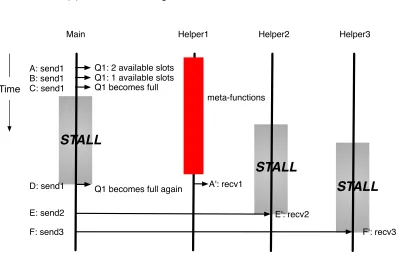
(a) Scenario causing overhead due to unbalanced workload
Time
A: send1 B: send1 C: send1 D: send1
E: send2 F: send3
Main Helper1 Helper2 Helper3
Q1: 2 available slots Q1: 1 available slots
STALL
A': recv1 Q1 becomes full
meta-functions
E': recv2 Q2: empty
Q3: empty F': recv3
Time
A: send1 B: send1 C: send1
D: send1
E: send2 F: send3
Main Helper1 Helper2 Helper3
Q1: 2 available slots Q1: 1 available slots
A': recv1 Q1 becomes full
meta-functions
F': recv3 Q1 becomes full again
E': recv2
(b) Overhead due to unbalanced workload
STALL
STALL
STALL
can not be executed until instruction D is completed. In addition, helper2 and helper3 stall because instruction E’ and F’ are blocked until helper2 and helper3 receive the data through Q2 and Q3, respectively. Figure 1.1(b) shows that how long main, helper2, and helper3 stall because of unbalanced workload among helpers.
Problem 3: Delay of data communication As described in Problem 1, code for data communication becomes major bottleneck and incurs large runtime overheads instead of meta-functions code. Therefore, we pointed out granularity of data communication as an important problem. However, there is another problem due to data communication. Because queues are a commonly used programming construct in multithreaded programs for data communication, we use queues for data communication in the work. For coarse-grained data communication, software queues are efficient programming construct. However, to support fine-grained data communication, software queues are too expensive. Because software queues consist of too many instructions, enqueue and dequeue operations are inefficient and the total latency is pretty high. In addition, they use shared memory to support data communication for multithreaded programs. Therefore, unless software queues are implemented carefully, the delay through the queue is not low enough to support concurrent execution. As an alternative to software queues, hardware queues have been proposed in some studies to support fine-grained data communication between cores because the total latency is low and the delay through the queue is low. However, they are unattractive because hardware queues require a large design cost to the processor core. In addition, it is not easy for programmers to use hardware queues because they require understanding underlying architectures. They also require modification to the existing operating systems because their state must be preserved across context switches.
1.4
Major Proposals of This Thesis
granularity of data communication and load balance, we propose Automatic Parallelization for Fine-Grained Meta-Functions on a CMP. Second, we propose HAQu: Hardware-Accelerated Queueing for Fine-Grained Threading on a CMP, which is a technique to reduce fine-grained queueing overheads in multithreaded programs as well as to support OS transparency. It will be the solution for Problem 3.
1.4.1 Automatic Parallelization of Fine-Grained Meta-Functions on a Chip Multiprocessor
Software’s increasing reliance on meta-functions present a promising source of parallelism. The predominate approach in performing metafunctions is to interleave their execution with the main application code, through direct augmentation of the metafunction code into the applica-tion code. Such an interleaved execuapplica-tion approach invariably increases the critical path of the main application, sometimes increasing it by orders of magnitudes.
The trend in microprocessor design is toward many-core systems. The performance of a single core in a many-core system will increase at a slower speed than in the past, and in some cases will stagnate. In order to exploit the performance of such a system, programmers need to exploit parallelism at various levels in their applications. Only recently has parallelism been exploited for performing metafunctions, such as memory management [20, 50], and bug detection [46, 33]. However, these techniques mainly focused on long-running, coarse-grained meta-functions.
In this work, we focus on automatic extraction of fine-grained meta-functions for parallel execution on multi-cores. Our goal is the development of a compiler which can efficiently extract meta-function level parallelism from programs in a way that provides low latency execution and is scalable on multi-core systems available today or in the near future. One of the primary challenges for fine-grained meta-functions are the abundant instructions inserted throughout the main application. Reducing this fine-grained interleaved overhead is difficult to accomplish while still providing scalability. Our strategy is the generation of customized helpers which follow the call context of the main program and replicate as much state as possible in a way that does not require communication. Using a smart task partitioning strategy, meta-function code and some of its dependences are migrated to the customized helper. This approach results in low overhead in the main thread since meta-functions and their support code need not be executed there. To provide scalability, we generate multiple customized helpers using static and dynamic load-balancing heuristics.
In our work, we make the following contributions:
• To provide scalability, we describe static and dynamic heuristics to generate multiple helpers and balance their load.
• We evaluate our framework on Mudflap, a pointer-use checking tool implemented in GCC. We run our experiments on an architectural simulator modeling an aggressive 8-core CMP with support for fast queueing operations. We show that our automatic technique is efficient and scalable; With static heuristics, it achieves an average 1.64×speedup using 8 cores. Compared to a manually optimized version of the Mudflap framework, our approach is only 19% slower. With dynamic heuristics, it achieves an average 1.96×speedup using 8
cores. Our automatically parallelized code using dynamic load balance is competitive, on average,to the manually parallelized version on a simulated 8-core system. Furthermore, our custom helpers reduce the overhead in the main thread by 5.3× compared to serial
Mudflap.
1.4.2 HAQu: Hardware-Accelerated Queue
Chip multiprocessors (CMPs) are now ubiquitous, but achieving high performance on a wide range of applications is still a big challenge. It is important to consider new architectural features that can expand the programmability and performance of CMPs. In this work, we consider such a feature by adding architectural support for a single-producer, single-consumer queue.
Queues are a commonly used programming construct in multithreaded programs for syn-chronization and communication. They are effective when the granularity of parallelism is large enough to amortize the cost of enqueueing and dequeueing. But software queues tend to be too expensive to support fine-grained parallelism. For this reason, hardware queues have been proposed to reduce the overhead of communicating between cores. However, hardware queues tend to be unattractive to designers. They come at a large design cost as they require modifica-tions to the processor core and need a custom, global interconnect. They also pose difficulties for the operating system because their state must be preserved across context switches. These challenges grow with ever increasing processor virtualization.
queue are designed to leverage low-level details of the on-chip caches and coherence protocol to provide fast communication. (3) Furthermore, the full state of the queue is stored in the application’s address space, thereby providing virtualization, queues in nearly unlimited quan-tity, and queues of a large size. On the whole, HAQu is no worse for programmability than a software queue.
We have evaluated our design in three contexts. First, we evaluate our mechanism using a micro-benchmark designed to show the peak performance of our architecture compared to state-of-the-art queueing algorithms in software. Our system is able to achieve a 6.5×speedup over an efficient software implementation proposed by Leeet al[23]. Secondly, we show how our design can facilitate fine-grained parallelization by parallelizing Mudflap, a pointer-checking utility built into GCC. Using HAQu, we can afford to parallelize fine-grained, inlined pointer checking codes. Using 16 cores, we achieve an average speedup of 1.8×, calculated using geometric mean, and a max speedup of 3.3× on a set of SPECint applications. Finally, we demonstrate the
potential of HAQu for automatic parallelization using decoupled software pipelined (DSWP). On a small set of SPECint applications, we show that our mechanism enables fully automatic parallelization.
In summary, this work makes the following contributions:
• We propose HAQu a hardware accelerated queue. HAQu is unique in its ability to accel-erate fine-grained queueing operations on a CMP in a way that is highly programmable and OS transparent. We have described in detail its overall design and microarchitecture.
• We describe two case studies in fine-grained parallelization using HAQu: fine-grained parallelization of pointer-checking codes and decoupled software pipelining. We discuss optimizations necessary to achieve high performance in this systems.
• We evaluate our proposed queue in three contexts: on micro-benchmarks that show its performance potential, on a parallelized implementation of Mudflap, and on decoupled software pipelining.
1.5
Report Organization
Chapter 2
Automatic Parallelization of
Fine-Grained Meta-Functions on a
CMP
2.1
Fine Grained Meta-function Parallelization
Meta-functions are extra functionality added to a program to augment its behavior in some useful way. While they can be an arbitrary function, we restrict their definition, somewhat, to cover common uses and to limit the scope of our study. We assume that meta-functions have the following properties. (i) They are placed at a program point, p, to compute some desired property at that location. (ii) They take as input Statep that is extracted from the main program state and MetaStatepin that is information calculated specifically by the meta-functions. A critical simplifying assumption is that MetaState is disjoint from State. (iii) They produce as output an optional error state, Errorp, and optional updates to the meta-function state, MetaStatepout. Note that none of these meta-functions update State; we do not allow meta-functions to update program state in order to narrow the scope of this work.
Table 2.1: Characterization of Mudflap overheads normalized to an optimized baseline without it.
App Norm Norm % of Dyn. Inst. Chk Exe Inst. Check Other Hash Avg bzip2 11.1 19.2 51.8 14.2 25.3 1988.2 gap 6.6 9.7 21.1 5.4 53.6 1646.0 gzip 3.9 6.2 52.0 0.0 26.7 2011.6 mcf 5.6 15.7 55.1 0.0 34.1 1945.4 parser 7.1 11.0 15.9 22.3 39.7 1871.3 twolf 6.1 10.0 12.7 12.3 53.3 1664.5 vpr 5.4 8.2 25.6 22.7 33.1 1994.7 Geo.Mean. 6.2 10.7 28.7 13.7 36.5 1868.7
There are several costs associated with inserting meta-functions into a program. First and foremost, the meta-function must be executed as part of the main program, thereby adding considerable runtime overhead. This instruction payload can increase runtime by an order of magnitude. Second, the inlining of code and function calls worsen the compiler’s ability to optimize the main program. As a result, the efficiency of the main application is much worse than it would be without meta-function instrumentation. The first two effects are clearly discernible from direct inspection of the generated code. Thirdly, the additional code competes with the main program code for critical processor resources, like issue slots, space in the cache memory hierarchy, or space in branch predictor history tables.
Table 2.1 shows some key overheads from Mudflap, a pointer-use checking tool. All percent-ages are shown relative to a binary without any Mudflap support. This data was collected using the same experimental setup described in Section 4.1. The fraction of updating and validating meta-functions combined is approximately 42% (Check + Other); this fraction represents time spent in the computational region of meta-functions. Additional inlined-code makes up another 36% (Hash) of the program. The total increase in instructions, on average, is 10.7×.
2.1.1 Our Parallelization Approach: Custom Helpers
In our approach, we want to extract meta-function code out of the main program and run it in parallel. By automatically extracting meta-function code to helper threads, we can construct highly tuned, custom helpers that match the main program’s needs. Looking at each input to a meta-function provides some insight on how to do this. Consider Statep. The same state may be needed by multiple meta-functions. Through code analysis, the compiler can generate acustom helperwhich receives the input value once and uses it in each meta-function call. Furthermore, rather than communicating just the inputs to meta-functions, main can communicate values for a code slice that the helper uses to generate the full Statep for one or more meta-function calls. By sending a only a few inputs for a slice, some work in the main thread can be eliminated and communication with the helper can be reduced. Locationp can also be handled more efficiently. If a custom helper is generated for a specific region of code, then some inputs can be embedded directly in the helper without any need for communication.
In summary, our compiler will generate a custom helper thread that is highly aware of the main program. It would be possible to generate a custom helper for the entire program (essen-tially a reduced program clone) or just for parts of it. So that we do not need to choose regions for parallelization, we generate a custom helper for the entire main program. The helper will mimic the behavior of the main program by matching its call stack dynamically. Relation-ships among multiple meta-functions will be exploited through a task selection algorithm that aggressively moves or replicates code from the main thread into the custom helper.
2.1.2 Providing Scalability
Given the large computational overhead introduced through meta-functions, multiple threads are needed to successfully parallelize them. For example, as shown in Table 2.1, there is no hope of significantly reducing the overhead inbzip2with only one helper thread. Ideally, performance should scale as additional resources are added; once enough resources are added, the impact on the main program should be minimal. Therefore, we support multiple custom helpers.
In order to support multiple threads, meta-function parallelism must be exposed to the compiler. A general way of expressing and operating on such parallelism is beyond the scope of this work. Currently, we make decisions about which meta-functions can run in parallel at compiler compile-time to narrow the scope of the work. In other words, they are fixed for a given set of meta-functions. To decide which meta-functions can run in parallel, we leveraged profiling information and our understanding of the meta-function implementation as much as possible1.
To provide scalability, multiple custom helpers can be generated for the same function. Each custom thread will receive part of the meta-function workload of a function. In order to use multiple helpers as efficient as possible, load balance must be considered. Therefore, we provide simple static algorithms and show that they work reasonably well. The two heuristics we consider are random assignment and round robin. However, load balance is challenging with only a static algorithm for a variety of reasons. First, meta-functions may have dynamically varying execution times. For example, in order to reduce the time of meta-function execution, memoizaiton is often used to significantly reduce overheads. As a result, the same meta-function can have wildly varying execution times. Second, the execution path of the program is unknown and can only be estimated. To properly balance load, you want the meta-functions that will actually execute to be distributed evenly. Finally, the structure of some program regions may not lend themselves to parallelization over many threads. For example, an inner loop may have one meta-function. If the loop is not unrolled and the trip count is high, then all executions of the inner loop body will be scheduled on the same helper resulting in imbalance. Analogous behaviors occur with many different code structures.
To compensate for all of these effects due to a static algorithm, we provide dynamic algo-rithms to balance workloads more evenly and show that the dynamic algoalgo-rithms work better than the static algorithms. Our dynamic algorithms are based on broadcasting. We describe the detailed algorithms in Section 2.2.5.
2.1.3 Summary
In summary, our overall parallelization approach aims to reduce the overhead in the main ap-plication by extracting customized helpers that provide low overhead meta-function execution. However, to combat the high overheads of meta-function’s themselves, we leverage multiple helpers to scale up to many threads and keep the overhead in the main program low. We will show that this approach is competitive with manual parallelization in our case study.
2.2
Parallelization Algorithm
2.2.1 Helper Function Parallelization Algorithm
Algorithm 1: CreateHelper
Input: f: original function
Input: P: set of statements to move to helper thread
Input: R: set of statements to replicate in helper thread
Input: tid: thread id
Result: Customized helper function,helper, and modified f as a side-effect. build PDG for f /*CDG + DDG*/ ;
1
S =P∪R ;
2
A=∅ ;
3
foreach s∈S do
4
A=A∪ {m |m is an ancestor of sin CDG subgraph} ;
5
end
6
S =S∪A ;
7
helper,map =Clone(f,S,tid) /* create clone of f restricted to S */ ;
8
foreach stmt s0 ∈helper do
9
foreach use u∈s0 do
10
M aybeInsertCommChannel(u,f,helper,map) ;
11
end
12
end
13
remove P fromf ;
14
return helper
15
We base our parallelization algorithm for a single function on the Program Dependence Graph (PDG) [11]. We include all control, register and memory dependence edges in our PDG. TheCreateHelper algorithm in Algorithm 1 shows the algorithm for creating the helper function.
The inputs toCreateHelperare the original function in SSA form (f), a subset of statements
P to include only in the helper, and a subset of statements R to include in both. We assume that extractingP andRto the helper will not result in cyclic communication between the main program and the helper thread; rather, communication flows in a single direction from the main thread to the helper. CreateHelper assumes that P and R have been selected properly, so no such check is repeated here.
helper are computed, a clone of the function can be created with only the selected statements and control predicates present (line 8). For each input or predicate value, a communication channel, in the form of a queue, is added between the function and the helper (lines 9-12). In line 14, instructions in P are removed fromf.
MaybeInsertCommChannelhas some smarts built into it that are not shown here. First, we check ifu really needs to be communicated: isdef(u) in f but not inhelper? This test covers three cases. Either the definition has been moved to helper, it has been replicated in helper, or it is only in f. We only communicate u if it is not available in helper. If we do need to communicateu, we proceed as follows. Sincef is in SSA form, we insert asend(u) just after its definition inf, and we replace its definition in helper withu=recv(). We also keep a record thatu was communicated and never insert another channel for it between f and helper.
One additional detail worth noting. Cloneforces the new helper function to have a signature with no input parameters and no return value. While this is not strictly necessary, it simplifies our implementation since all helpers will have no inputs or outputs.
2.2.2 Baseline Helper Extraction
Algorithm 2: BaseHelperThread
Input: f: original function in SSA form
Input: P: set of nodes to move into helper
Input: R: set of nodes to replicate in helper
Input: tid: custom thread id
foreach stmts∈f do
1
if sis call stmt then
2
R=R∪s;
3
end
4
end
5
f0 =CreateHelper(f, P, R, tid) ;
6
if f is externally visible then
7
insert ’send(f)’ at entry off;
8
end
9
return f0;
10
Our baseline helper is a clone of the entire main program that mimics the main application’s call stack. This ensures the helper is very lean and efficient by default. Whenever the main application calls a function the helper should call and execute an associated helper version.
(Algo-rithm 2), we accumulate all call statements into theRset for parallelization. Next, we generate the helper with those statements extracted using theCreateHelper algorithm. CreateHelper
works as previously described but we can now consider more of the details in the Clone func-tion, shown in Algorithm 3. Clone will copy the function exactly, however, it will remove all statements that are not inS, and it will replace all call statements that are not meta-functions with a code sequence that will call their associated helper.
Algorithm 3: Clone
Input: f: function in SSA form
Input: S: set of statements to be included in clone
Input: tid: custom thread id
f0 = clone off /* exact replica of f but with a new name */ ;
1
map =CreateM ap(f,f0) ;
2
foreach stmt s∈ f do
3
s0 =map[s] ;
4
if s not in S then
5
remove s0 from f0;
6
end
7
if sis a call && not a meta-function then
8
ReplaceCall(s, s0, tid) ;
9
end
10
end
11
CHHT[f, tid] =f0;
12
remove parameters and make void type ;
13
return f0 ;
14
Replacing the calls turns out to be more involved than it may appear at first. There are several cases which must be supported for this to work for arbitrary programs. First, indirect function calls through pointers can only be resolved at runtime. Therefore, the mechanism for determining which helper to run must occur at runtime (at least some of the time). Second, functions in libraries may not have a corresponding helper. Ideally, this should be prevented by providing a wrapper function for the library call that makes it compatible with our system, but this is not always possible. So, the external library call will not have a corresponding helper, but it could still call yet another function which does have an associated helper. The qsort
function is a good example; a function pointer is passed as an argument and is used to help sort the data structure. Such a function passed as an argument is now externally visible. The
Algorithm 4: CHHTLookup
Input: f unptr: function pointer to callee in main
Input: tid: custom thread id
if funptr then
1
if funptr == 1 then
2
f unptr=recv() ;
3
end
4
newptr=CHHT[f unptr, tid];
5
newptr() ;
6
else
7
repeat
8
f unptr=recv() ;
9
if funptr then
10
newptr=CHHT[f unptr, tid];
11
newptr() ;
12
end
13
untilfunptr ;
14
end
15
Custom Helper Hash Table. In order to dynamically bind a function with its customized helper, a Custom Helper Hash Table (CHHT) is constructed which creates a mapping between a function and its helper2. Since we may generate multiple custom helper threads, it also needs a thread id as input.
The CHHT Lookup function shown in Algorithm 4 is used at runtime to find the dynamic mapping of function to its custom helper. There are several cases that are required for correct-ness. We will consider each case in turn.
Direct and Indirect Function Calls. To support direct and indirect calls, at each call site we must determine the mapping from callee to helper thread. We can accomplish this with theCHHT Lookupfunction by passing the address of the callee as an argument. In the case of the indirect call, the computation of the callee’s address must be sent to the helper as a result of lines 9-12 inCreateHelper. For direct calls, the callee’s address can be encoded directly in the helper. The relevant lines of code are 5-6 in Algorithm 4, and 9 in Algorithm 5.
Externally Visible Calls. Since we cannot modify all of the call sites of externally visible functions, we must communicate with the helper from inside the function rather than at the call site. At such a call site that we can analyze, we replace the call withCHHT Lookup with a value of 1 as f unptr (6-7 in Algorithm 5). This will force CHHT Lookup to wait until it receives one function pointer (line 2) from the called function; then it uses it to perform the
2
Algorithm 5: ReplaceCall
Input: s: original stmt in f
Input: s0: cloned stmt in f’
Input: tid: custom thread id
Result: Replaces callee ins0 with call to a helper function
callee = Callee(s) ;
1
if callee is external then
2
replaces0 with call to ’CHHTLookup(0,tid)’ ;
3
insert ’send(0)’ afters;
4
else
5
if callee is externally visible then
6
replaces0 with call to ’CHHTLookup(1,tid)’ ;
7
else
8
replaces0 with call to ’CHHTLookup(callee,tid)’ ;
9
end
10
end
11
lookup and call the corresponding helper function.
When BaseHelperT hread analyzes the externally visible function, it inserts the ’send(f)’ code (lines 7-9 in Algorithm 2).
External Calls. If an externally defined function (like sort) is called and there is no wrapper function available, then it may call externally visible functions which do have helpers. In this case, we replace the external call with a call to CHHT Lookup with a 0 as its f unptr
argument. This will force the helper to wait until it receives a function pointer from an externally visible function (lines 7-14 in Algorithm 4). However, because it may never call such a function or it may call such functions repeatedly, we must identify whenCHHT Lookup terminates by sending a null pointer after the external call ends (2-4 in Algorithm 5).
Optimized Call Sequence. This mechanism works for all function calls, but it is some-times inefficient. With additional information about the function, these costs can be avoided. For example, in the case of a static function in C, we need not callCHHT Lookup at runtime to determine the mapping. Instead, we can hardcode the helper function’s location directly into its caller and allow function inlining to further optimize the code. We do not show it in our algorithm, but we do take this additional step in our full implementation.
2.2.3 Custom Helper Extraction
that meta-function calls can be identified and inserted into a set,M, of statement nodes. Using only M as the basis for helper extraction would yield an inefficient extraction with all meta-function inputs communicated explicitly to the helper. Instead, we take a smarter approach and look for additional statements to include in M that will reduce the communication overhead betweenf and the helper.
Algorithm 6: CustomHelper
Input: f: function in SSA form
Input: M: set of meta-function nodes to move into helper
Input: tid: custom thread id
Result: Custom helper function
repeat
1
foreachs∈M do
2
foreachuse u∈sdo
3
if all uses of u are in M then
4
M =M ∪def(u) ;
5
end
6
end
7
end
8
until M converges ;
9
return BaseHelperT hread(f, M,∅, tid) ;
10
Our algorithm is shown in Algorithm 6. Using SSA form, we efficiently iterate over every statementsinM. For each useuins, ifuis only used by statements inM, then the definition of u can be added to M as long as it adds no extra communication (or even reduces it). The extraction phase finishes once all members of M, both new ones and ones added along the way, have been considered. This algorithm will see to it that any data only computed for the meta-function is included in M. Finally, we use the CreateHelper function to parallelize the statements inM by setting the input argumentP =M. Note, this algorithm will never create cyclic communication betweenf and the helper.
void foo()
{
int x, y;
x = 1;
/* Static function call
*/
x = goo(x);
/* Predicate node
*/
if(x==1)
{
/* Stmts for meta-functions */
y = x + 3;
meta_check(y, __FILE__, __LINE__);
}
}
(a) Original version void foo()
{
int x, y;
/* Stmt only in Main */ x = 1;
x = goo(x); send(x);
}
(b) Main thread version
void foo.helper() {
int x, y;
/* Replace static function call */ CHHTLookup(goo,1);
/* Communication for data */ x = recv()
if(x ==1) {
y = x +3 ;
meta_check(y, __FILE__, __LINE__); }
}
2.2.4 Example
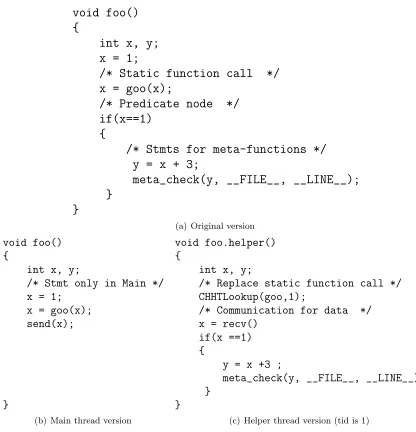
Figure 2.1 shows a simple example of our Helper Extraction. Figure 2.1(a) shows the original function. Using our algorithms, we generate functions for the main thread (Figure 2.1(b)) and the helper thread (Figure 2.1(c)), respectively. This example illustrates how our algorithm replaces a call, communicates a predicate node, and places the computation of some inputs only in the helper thread. Statement”x = goo(x)” is a direct call which must be preserved in the main thread and replaced in the helper withCHHT Lookup, as shown in Fig. 2.1(c). Next, consider the predicate node with the expression”(x==1)”. Since a meta-function depends on this predicate, it must be preserved, and our algorithm is smart enough to communicate x and compute ”(x==1)” in the helper. Note that the main thread sends the predicate value using ”send(x)”and the helper thread receives the predicate value using”x=recv()”. Both operations occur at the same program point as the original definition ofx. Finally, operations that support constant inputs of meta-functions are only placed in the helper. FILE and LINE are two such examples. However, since y is an input, we must communicate x in order to compute y. In this case, our algorithm is smart enough not to sendxtwice.
2.2.5 Supporting Multiple Helpers
First, to generate N custom helpers, we use a static load balancing algorithm to create N
unique partitions from the M set. Then, for each tid and Mtid from 1 to N, we use the CustomHelper algorithm to generate a custom helper.we have experimented with two static load balancing techniques to create the N partitions of M: round robin and random. For our round robin approach, we traverse the CFG in DFS order and assign meta-functions to a partition using round robin. This is a simple approach that we have found to work well. We also considered random assignment. We use the same basic algorithm as round robin but place meta-functions into threads randomly. Random assignment can avoid imbalance caused by systematic interactions between the code structure and round robin assignment. More sophisticated approaches are possible, but we have found that these are competitive in our current implementation.
Second, to generate N custom helpers, we use a dynamic load balancing algorithm TheM
Fig-loop( ) {
data = recv(1); idx = HASH(data); if (idx == 1) {
meta_check(data, ...); }
}
loop( ) {
data = recv(2); idx = HASH(data); if (idx == 2) {
meta_check(data, ...); }
}
loop( ) {
data = recv(3); idx = HASH(data); if (idx == 3) {
meta_check(data, ...); }
} loop( )
{
data = x; /*
Broadcasting for
dynamic load balancing */
send(1,data); send(2,data); send(3,data);
... = x[idx]; }
(a) Main (b) Helper 1 ( tid = 1)
(c) Helper 2 ( tid = 2) (d) Helper 3 ( tid = 3)
ure 2.2(b),(c), and (d), meta- functions from the main program are extracted and schedule on all the customized helper threads. However, we use a simple HASH function to select only one helper thread to execute the meta-function. With dynamic load balancing using HASH
function, we expect similar benefits of address indexing of manual parallelization described in Section 2.3.2.
loop( ) {
data = recv(1); cnt1 = cnt1%3 + 1; if (cnt1 == 1) { meta_check(data, ...); } } loop( ) {
data = recv(2); cnt2 = cnt2%3 + 1; if (cnt2 == 2) { meta_check(data, ...); } } loop( ) {
data = recv(3); cnt3 = cnt3%3 + 1; if (cnt3 == 3) { meta_check(data, ...); } } loop( ) {
data = x; /*
Broadcasting for
dynamic load balancing */
send(1,data); send(2,data); send(3,data);
... = x[idx];
}
(a) Main (b) Helper 1 ( tid = 1)
(c) Helper 2 ( tid = 2) (d) Helper 3 ( tid = 3)
Figure 2.3: Generated main and helper functions with Dynamic Load Balancing using counters.
Table 2.2: Meta-functions used by Mudflap.
Meta-function Name Inputs Insertion Point Description
mf register Pointer to buffer, Any memory Record allocated memory size, location allocation point region in a database
mf unregister Pointer to buffer, Any memory Remove previously allocated location deallocation point region from database
mf check Pointer, All memory Validate reference is for a ref. size, location references registered region of memory inlined software Pointer, All memory Checks a software cache to see if
cache lookup size references reference has already been validated
(cnt1, cnt2, and cnt3) for each helper thread instead of a simple HASH function to select only one helper thread. Because a local counter of each helper thread is incremented in a same way, we dynamically allow only one helper thread to execute the meta-function. With dynamic load balancing using local counters, we expect similar benefits of round robin of manual parallelization described in Section 2.3.2.
While we expect to balance work more evenly on each helper, we also insert more instructions in main thread by sending data to all the helper threads. With fine-grained communications among all the threads, it will add more overheads into main. In addition, by extracting all the meta-function code and scheduling them on all the customized helper threads, it will add more communication for predicate nodes among the threads because predicate nodes should be communicated with all the helper threads. With static load balancing, because each meta-function is extracted and scheduled to a specific helper thread, predicates nodes were not communicated with all the helper threads. In Section 4.1, we show trade-offs between static load balancing and dynamic load balancing due to these behaviors. Furthermore, we provide a couple of techniques to make dynamic load balancing techniques more efficient in Section 4.1.
2.3
Case Study: Mudflap
Mudflap [9] is a set of passes and libraries integrated into GCC [49] to facilitate pointer use checking. The Mudflap pass in GCC transparently adds error checking code at the dereferencing of any pointer to validate the memory access against a database of allowed memory regions in the stack, heap, static variable section, and others.
int *x; int size = 2; ...
x = WRAP_MALLOC(sizeof(int)*size);
/* the real malloc is wrapped to register the allocated region with libmudflap */ ...
if( __MF_CACHE_MISS(x+0,4) ) __mf_check(x+0,4);
x[0]=3;
if( __MF_CACHE_MISS(x+2,4) ) __mf_check(x+2,4); /* Error! */ x[2]=3;
WRAP_FREE(x); /* unregister */ ...
if( __MF_CACHE_MISS(x+1,4) ) __mf_check(x+1,4); /* Error! */ ..=x[1];
Figure 2.4: Example code with Mudflap annotation.
2.3.1 Mapping Mudflap to our Framework
Table 2.2 shows the meta-functions used by the Mudflap algorithm. mf register is an up-dating meta-function added at every memory allocation point to record a new memory region that can be accessed by the program. Such memory allocation points include malloc, stack allocation, and global variables. mf unregisteris an updating meta-functionthat is inserted at all deallocation points. And, mf check is avalidating meta-functionthat checks if a mem-ory reference falls within an allocated region. Figure 2.4 provides an example of a program annotated with Mudflap’s meta-functions.
We have studied the behavior of Mudflap to determine the appropriate strategy for paral-lelizing these meta-functions. Since mf register and mf unregister are relatively infre-quent and since the database they create is relatively small, they are always replicated across all helpers. mf check, on the other hand, is very frequent and must be balanced across the helpers to provide scalable performance improvement. Table 2.1 from Section 2.2 backs up these decisions. GCC provides a library, calledlibmudflap, that implements these metafunctions. We modified this library to support a parallel implementation. In particular, we changed the code so that a database could be created and maintained per thread.
Main Thread
Middle Thread
Helper Thread 1
Helper Thread 2
Helper Thread 3
Helper Thread N
Queue0
Queue1
Queue2
Queue3
QueueN
Figure 2.5: Mudflap Manual Parallelization.
Benefits for Mudflap. Our framework is expected to provide several useful benefits for Mudflap. Looking at the inputs for each metafunction, it is clear that two of the inputs are likely constants: size and location. These inputs will be extracted directly into the custom helper. The pointer must be communicated, but if it is used in multiple meta-functions it may only need to be communicated once. Finally, the inlined software cache lookup is directly inserted into the program to prevent redundant calls to mf check. These inlined codes add significant instruction and control flow overhead and all of these can be moved to the helper.
load on the main program. (N.B. We still register the address of the original aggregate from the main program just in case its address is ever taken.)
2.3.2 Manual Parallelization
In order to evaluate how well our automatic technique works, we also manually parallelized Mudflap for comparison. In this implementation, we just re-wrote the meta-functions to exploit parallelism explicitly.
The meta-functions implement a pipelined architecture as shown in Figure 2.5. For each meta-function in Mudflap, we created a parallel version which packs up its input and enqueues them to Queue0. Each meta-function inserts a special header at the beginning of its input so that it can be parsed properly by the Middle Thread. Also, we modified mf checkto include the software cache lookup. This modification significantly reduces the code injected into the main program. Also, to make mf check a little more efficient, we omitted the debugging location information. For every pointer use check, we insert this alternative implementation of
mf check.
The Middle Thread parses the contents of Queue0 and decides how to handle the meta-function. It must send mf register and mf unregister requests to all helpers. For -mf check requests, it applies a load balancing heuristic and sends the request to one of the Helper Threads for completion. Because the performance of the system is very sensitive to the processing rate of the Middle Thread, the load balancing heuristics are kept simple and fast. We considered two dynamic load balancing techniques: address-based balancing and round robin.
Parallelization 1: Address indexing. Because the Helpers use a software cache to filter out redundant checks, we prefer to send redundant checks to the same core so they will be filtered quickly. We use a simple hash function on the input address to select a queue.
Parallelization 2: Round-robin. We also evaluate the Middle thread using a round-robin method to select a helper thread. Using this approach, allocation is more uniform, and the Middle thread is less likely to block on a full queue.
Our round robin algorithm sends 8 consecutive operations to the same Helper. By sending 8 at a time, we exploit locality in the access stream; consecutive checks are more likely to refer to the same object in the Mudflap database. We determined a chunk size of 8 through experimentation.
2.4
Related Work
threads with Thread-Level Speculation and Runahead execution. Tiwari et al. [50] used a helper thread to accelerate memory management.
Parallelizing Security Meta-functions. While many security protection mechanisms have been proposed, few have investigated exploiting parallelism between the application and its security meta-functions, which is the focus of this proposal. Nightingale et al. proposed Speck [33], which exploits speculative parallelism between the application being protected with its security meta-functions. Shettyet al. [41] and Kharbutli et al. [20] parallelize memory management functionality for increased security. Plakalet al.[38] proposed parallelizing garbage collection using program slices on multiprocessors. However, they did not implement the slices, rather they only evaluated the potential.
Thread-Level Speculation. One alternative way to exploit parallelism between the ap-plication and its meta-functions is to use thread-level speculation (TLS). TLS allows frequent data sharing at low cost, but without a guarantee that the speculative work will be useful. Examples of work in bug detection with TLS include [34, 57, 19]. All studies employ thread-level speculation to hide the overhead of program checking. It has been applied in security by Speck [33], as discussed previously.
Memory Bugs. Detection of memory bugs also can be performed statically by utilizing explicit model checking [29, 47] and program analysis [4, 10, 14]. As software becomes more com-plex and diverse, users increasingly rely on run-time bug detection by instrumenting the code with checks, such as in Purify [40], Valgrind [44, 45], Intel thread checker [18], DIDUCE [15], Eraser [43], CCured [31], and others [2, 7, 24, 36, 37]. Such instrumentation typically introduces large performance overheads because instrumented memory references (loads and stores) are executed often, and execution of the instrumentation code is interleaved with normal program execution.
Hardware support for detecting memory bugs or to support debugging has been proposed, such as iWatcher [57], AccMon [56], SafeMem [39], DISE [6], and the scheme proposed by Oplinger et al. [34]. All three schemes (iWatcher, AccMon, and DISE) interleave application execution with bug checking, address matching, or debugging functions. In contrast, our helper computing mechanisms attempt to exploit parallelism between the helpers and the main appli-cation execution.
2.5
Summury
Chapter 3
HAQu: Hardware-Accelerated
Queueing for Fine-Grained
Threading on a Chip Multiprocessor
3.1
Main Idea: Hardware Accelerated Queue
3.1.1 Motivation
Queues that support fine-grained parallelism on chip-multiprocessors must meet several crite-ria. We have identified four that would a make a queue acceptable for a wide range of uses. Throughout this article, we restrict our discussion to single-producer/single-consumer queues. First, (Criterion I) enqueue and dequeue operations must be made as efficient as possible. Since these operations may occur frequently, it’s necessary that the total latency is low. Second, ( Cri-terion II) the delay through the queue (i.e. the time between an enqueue and dequeue of the same item) must be low enough that concurrent execution proceeds efficiently. Third, ( Crite-rion III) they should be no worse to program than software queues. For example, there should be enough queues available to support a wide variety of applications, and their synchronization constraints should be no harder to understand than for fully software implementations. Finally, (Criterion IV) the queue must work seamlessly on an unmodified operating system (OS).
struct queue { Item *head; Item *tail;
uint size; // = SIZE; Item buffer[SIZE]; }
typedef struct queue * queue_p;
(a)
int enqueue(queue_p q, Item val) {
Item *next = NEXT(q->head);
if (q->tail == next) return BLOCK;
*head = val; // memory barrier q->head = next; return SUCCESS; }
(b)
int dequeue(queue_p q, Item *val) {
Item *tail = q->tail;
if (tail == q->head) return BLOCK;
// memory barrier *val = *tail;
q->tail = NEXT(tail); return SUCCESS;
}
(c)
While these implementations are not well suited for fine-grained parallelism, they do meet most of the criteria above. In particular, they provide low latency for communicating through the queue because they often exploit the fast on-chip interconnect. This latency can be opti-mized through careful consideration of on-chip caches and the coherence protocol. They meet Criterion III trivially because they are implemented in software. Criterion IV is met trivially as a result of Criterion III; since the queues are stored in virtual memory, they are trivially virtualized by any OS. Software queues, however, do not provide enqueue and dequeue oper-ations that are efficient enough for fine-grained parallelism; so, they do not meet Criterion I. Even with efficient non-blocking and lock-free implementations for enqueue and dequeue, the cost of these operations tend to be high — 10 instructions per queue operation.
Hardware queues have appeared in a variety of proposals [41, 35, 21]. Due to the similar-ities, we will treat them the same in this discussion. These designs support Criterion I and Criterion II . Using special instructions or special hardware, data is inserted directly into the hardware queue, and this makes enqueue and dequeue highly efficient. In fact, the latency of enqueue or dequeue can be hidden by out-of-order execution. Furthermore, the storage for the queue is provided by special buffers and an interconnect between two or more cores. This provides very low latency communication. However, these mechanisms are costly, and there are practical concerns over their programmability and the limits on the number of queues that can be supported (Criterion III). Furthermore, these hardware queues have not been designed with the OS in mind, and often do not consider the challenges of context virtualization. For example, how is the state of the queue preserved when one of the threads, either the producer or consumer, is context switched. Furthermore, allocation of global queueing resources may need to be managed by the operating system. Given the complexity of a modern OS, hardware that requires such changes in the OS is considerably less desirable.
Neither software nor proposed hardware mechanisms meet all of the criteria for fine-grained threading on current CMPs. However, the shortcomings of these software and hardware mech-anisms point the way to a hybrid design that leverages strengths from each one.
3.1.2 Our Proposal: Hardware-Accelerated Queue
latency compared to optimized software implementations.
HAQu provides two new instructions for enqueue and dequeue operations to meetCriterion I. These new instructions keep the code footprint low, and their implementation will work much like software enqueue and dequeue operations. However, because they are implemented in hardware, we incorporate detailed knowledge of the memory consistency model, coherence protocol, and on-chip resources to provide a highly optimized enqueue or dequeue operation.
HAQu stores the queue’s state in the application’s address space. As a result,Criterion III and Criterion IV nearly trivially are met. This means that we can support a large number of queues efficiently, and we can design HAQu to provide synchronization semantics that pro-grammers expect. Also, since the state of the queue is held in virtual memory, a context switch poses almost no problems since the queue need not be saved or restored. Furthermore, HAQu can leverage the existing on-chip interconnect and cache coherence protocol for transfering data from producer to consumer. This usually provides low enough latencies to meetCriterion II.
Arriving at an efficient implementation is not as straightforward as it may seem. Criterion I and Criterion II are difficult to obtain without leveraging queue specific information in the hardware. We find that some information about the queue must be tracked in hardware. However, we can do so only if we preserve OS transparency and programmability concerns. Our architecture for HAQu balances the competing concerns of achieving a high-throughput implementation (Criterion I and Criterion II) while still providing an implementation that can be deployed on conventional CMPs that support a wide range of applications (Criterion III and Criterion IV) and programmability concerns.
3.2
System Architecture
To explain the overall architecture of our proposal, we will begin with a software queue and modify it to support enqueueing and dequeueing operations in hardware. There are three main components to this discussion: the allocation and layout of the queue in memory, enqueue and dequeue operations, and making these operations efficient for fine-grained threading.
3.2.1 Allocation and Layout
Our queue will reside in memory but will be operated on directly using hardware. Therefore, the layout of the queue is determined a priori1. For now, we will assume a layout similar
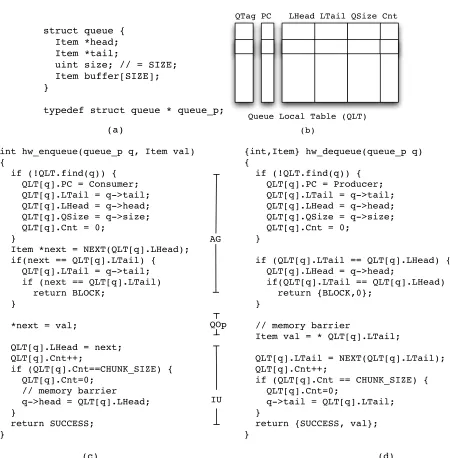
to Figure 3.1(a). This is not an optimized configuration but is sufficient for the following discussion2. A client will allocate a queue using a memory allocator like malloc (in C) and 1This is a limitation of our proposal, but a handful of layout configurations could be supported and configured with firmware with little additional cost.
prepare it for use. The head, tail, size, and buffer fields of the queue are located at fixed offsets from the beginning of the queue. We presume that the queue data structure and its initialization can be provided through a runtime library. Furthermore, since the buffer is the last field of the struct, the queue can be of arbitrary size.
3.2.2 Enqueue and Dequeue Operations
A key goal of HAQu is reducing the cost of enqueue and dequeue operations by adding two new instructions to carry out these tasks. A naive design directly implements Lamport’s algo-rithm [22] in hardware.
Consider an enqueue operation. When an enqueue instruction is executed, it is passed the base address of the queue as an input argument. Using the base address, the head and tail fields of the data structure are read. From this point on, hardware implements Lamport’s algorithm. Figure 3.2 shows a possible timeline for the execution of queue operation. Since enqueue and dequeue operations are similar, we only describe the enqueue operation in detail. In cycle 1, the head and tail are loaded into temporary registers (these are not architectural registers or part of the register file). For this example, we assume that both memory operations hit in the L1 cache and return 2 cycles later. In cycle 3, we perform the test to validate that the queue is not full. In this timeline, we assume it was not and proceed with cycle 4 to store the value in the queue. We will refer to this store as theenqueueing-storesince it actually places the value in the queue. (Similarly, we refer to the operation in cycle 4 for dequeue as the dequeueing-load.) At this point, we have to wait for the store to complete before updating the head to the next position. Note, this store ordering is required for Lamport’s algorithm to function properly and without races.
The enqueue and dequeue operations are shown in Figure 3.3. Since we target a MIPS architecture in our evaluation, these instructions are shown using MIPS-like mnemonics and implementation nuances. We support variants of these operations for each size of memory load or store supported in MIPS to ensure efficient code generation. Each enqueue instruction takes two input arguments: (1) the base address of the queue, and (2) the data to be enqueued. De-queue operations only require the base address of the De-queue as input. Non-blocking instructions return an error code in their destination register.
3.2.3 Making Fine-Grained Queueing Efficient
Cycle
1 t0 = MEM[head]
t1 = MEM[tail]
Dequeue Operations
2
3
4
5
t0 != t1
val = MEM[t1]
MEM[tail] = NEXT(t1) 6
(a) Cycle
1 t0 = MEM[head]
t1 = MEM[tail]
Enqueue Operations
2
3
4
5
NEXT(t0) != t1
MEM[t0] = val
MEM[head] = NEXT(t0) 6
(b) Access cache
Wait for completion
Access cache
Wait for completion
Figure 3.2: Enqueue (a) and dequeue (b) operations. Assumed cache hits with a dual-ported, 2-cycle access L1 cache.
Mnemonic Description
benq{b,h,w,d} Rs,QAddr EnqueueRs intoQAddr, block on queue full. bdeq{b,h,w,d} Rd,QAddr Dequeue from QAddrto
Rd,block on queue empty. enq{b,h,w,d}Rt,Rs,QAddr EnqueueRs intoQAddr,
Rt returns status. deq{b,h,w,d}Rt,Rd,QAddr Dequeue from QAddrto
Rd, returns status inRt.