Towards Semi-Supervised Learning for Deep Semantic Role Labeling
Sanket Vaibhav Mehta⇤ Jay Yoon Lee⇤
School of Computer Science, Carnegie Mellon University,
Pittsburgh, PA
{svmehta,jaylee,jgc}@cs.cmu.edu
Jaime Carbonell
Abstract
Neural models have shown several state-of-the-art performances on Semantic Role Label-ing (SRL). However, the neural models re-quire an immense amount of semantic-role corpora and are thus not well suited for low-resource languages or domains. The paper proposes a semi-supervised semantic role la-beling method that outperforms the state-of-the-art in limited SRL training corpora. The method is based on explicitly enforcing syn-tactic constraints by augmenting the train-ing objective with a syntactic-inconsistency loss component and uses SRL-unlabeled in-stances to train a joint-objective LSTM. On CoNLL-2012 English section, the proposed semi-supervised training with 1%, 10% labeled data and varying amounts of SRL-unlabeled data achieves +1.58, +0.78 F1, re-spectively, over the pre-trained models that were trained on SOTA architecture with ELMo on the same SRL-labeled data. Additionally, by using the syntactic-inconsistency loss on inference time, the proposed model achieves +3.67, +2.1 F1 over pre-trained model on 1%, 10% SRL-labeled data, respectively.
1 Introduction
Semantic role labeling (SRL), a.k.a shallow se-mantic parsing, identifies the arguments corre-sponding to each clause or proposition, i.e. its se-mantic roles, based on lexical and positional in-formation. SRL labels non-overlapping text spans corresponding to typical semantic roles such as Agent, Patient, Instrument, Beneficiary, etc. This task finds its use in many downstream applica-tions such as question-answering (Shen and La-pata, 2007), information extraction (Bastianelli et al.,2013), machine translation, etc.
Several SRL systems relying on large annotated corpora have been proposed (Peters et al., 2018; ⇤ Equal contribution, name order decided by coin flip.
He et al., 2017), and perform relatively well. A more challenging task is to design an SRL method for low resource scenarios (e.g. rare languages or domains) where we have limited annotated data but where we may leverage annotated data from related tasks. Therefore, in this paper, we focus on building effective systems for low resource sce-narios and illustrate our system’s performance by simulating low resource scenarios for English.
SRL systems for English are built using large annotated corpora of verb predicates and their ar-guments provided as part of the PropBank and OntoNotes v5.0 projects (Kingsbury and Palmer,
2002; Pradhan et al., 2013). These corpora are built by adding semantic role annotations to the constituents of previously-annotated syntactic parse trees in the Penn Treebank (Marcus et al.,
1993). Traditionally, SRL relies heavily on using syntactic parse trees either from shallow syntac-tic parsers (chunkers) or full syntacsyntac-tic parsers and
Punyakanok et al.shows significant improvements by using syntactic parse trees.
Recent breakthroughs motivated by end-to-end deep learning techniques (Zhou and Xu, 2015;
resource scenarios.
We build upon the state-of-the-art SRL system by (Peters et al.,2018;He et al.,2017), where we formulate SRL as a BIO tagging problem and use multi-layer highway bi-directional LSTMs. How-ever, we differ in terms of our training objective. In addition to the log-likelihood objective, we also include syntactic inconsistency loss (defined in Section 2.3) which quantifies the hard constraint (spans implied by syntactic parse) violations in our training objective. In other words, while training our model, we enforce the outputs of our system to agree with the spans implied by the syntactic parse of the sentence as much as possible. In summary, our contributions to low-resource SRL are:
1. A novel formulation which leverages syntac-tic parse trees for SRL by introducing them as hard constraints while training the model. 2. Experiments with varying amounts of
SRL-unlabeled data that point towards semi-supervised learning for low-resource SRL by leveraging the fact that syntactic inconsis-tency loss does not require labels.
2 Proposed Approach
We build upon an existing deep-learning approach to SRL (He et al., 2017). First we revisit defini-tions introduced by (He et al.,2017) and then dis-cuss about our formulation.
2.1 Task definition
Given a sentence-predicate pair(x, v), SRL task is defined as predicting a sequence of tagsy, where each yi belongs to a set of BIO tags (⌦). So, for an argument span with semantic role ARGi, B-ARGi tag indicates that the corresponding to-ken marks the beginning of the argument span and I-ARGi tag indicates that the corresponding token is inside of the argument span and O tag indicates that token is outside of all argument spans. Let n=|x|=|y|be the length of the sentence. Fur-ther, letsrl-spans(y)denote the set of all argument
spans in the SRL tagging y. Similarly,
parse-spans(x) denotes the set of all unlabeled parse
constituents for the given sentencex. Lastly, SRL-labeled/unlabeled data refers to sentence-predicate pairs with/without gold SRL tags.
2.2 State-of-the-Art (SOTA) Model
He et al. proposed a deep bi-directional LSTM to learn a locally decomposed scoring
func-tion condifunc-tioned on the entire input
sentence-Pn
i=1logp(yi|x). To learn the parameters of a network, the conditional negative log-likelihood L(w) of a sample of training data T = {x(t),y(t)}8tis minimized, whereL(w)is
L(w) = X
(x,y)2T |y| X
i=1
logp(yi|x;w). (1)
Since Eq.(1) does not model any dependencies between the output tags, the predicted output tags tend to be structurally inconsistent. To alleviate this problem, (He et al.,2017) searches for the best
ˆ
yover the space of all possibilities (⌦n) using the scoring function f(x, y), which incorporates log
probability and structural penalty terms. The de-tails of scoring function is on Appendix Eq.(7).
ˆ
y= arg max y02⌦n f(x,y
0) (2)
2.3 Structural Constraints
There are different types of structural constraints: BIO, SRL and syntactic constraints. BIO con-straints define valid BIO transitions for sequence tagging. For example, B-ARG0 cannot be fol-lowed by I-ARG1. SRL constraints define rules on the role level and has three particular con-straints: unique core roles (U), continuation roles (C) and reference roles (R) (Punyakanok et al.,
2008). Lastly, syntactic constraints state that srl-spans(y)have to be subset ofparse-spans(x).
(He et al., 2017) use BIO and syntactic con-straints at decoding time by solving Eq.(2) where f(x, y) incorporates those constraints and report
that SRL constraints do not show significant im-provements over the ensemble model. In partic-ular, by using syntactic constraints, (He et al.,
2017) achieves up to+2F1 score on CoNLL-2005
dataset via A* decoding.
Improvements of SRL system via use of syntac-tic constraints is consistent with other observations (Punyakanok et al.,2008). However, all previous works enforce syntactic consistency only during decoding step. We propose that enforcing syntac-tic consistency during training time would also be beneficial and show the efficacy experimentally on Section3.3.
rate,d(x,y) 2[0,1], andsyntactic inconsistency score,s(x,y)2[ 1,1], as follows:
d(x,y) = |disagreeing-spans(x,y)| |srl-spans(y)| (3) s(x,y) = 2⇥d(x,y) 1 (4)
Syntactic Inconsistency Loss (SI-Loss) For a given (x, v), let us consider yˆ(t) to be the best
possible tag sequence (according to Eq.(2) during epoch t of model training. Ideally, if our model is syntax-aware, we would haved(x,yˆ(t)) = 0or
r(x,yˆ(t)) = 1. We define a loss component due to syntactic inconsistency (SI-Loss) as follows:
SI-Loss=s(x,yˆ(t)) |ˆy(t)|
X
i=1
logp(ˆy(t)i |x;w(t)) (5)
During training, we want to minimize SI-Loss.
2.4 Training with Joint Objective
Based on Eq.(1), a supervised loss, and Eq.(5), the SI-Loss, we propose a joint training objective. For a given sentence-predicate pair(x, v)and SRL
tags y, our joint training objective (at epoch t) is defined as:
Joint loss= ↵1
|y| X
i=1
logp(yi|x;w)
+↵2r(x,yˆ(t))
|yˆ(t)|
X
i=1
logp(ˆy(t)i |x;w(t)) (6)
Here,↵1and↵2are weights (hyper-parameters) for different loss components and are tuned using a development set. During training, we minimize joint loss - i.e., negative log-likelihood (or cross-entropy loss) and syntactic inconsistency loss.
2.5 Semi-supervised learning formulation
In low resource scenarios, we have limited labeled data and larger amounts of unlabeled data. The obvious question is how to leverage large amounts of unlabeled data for training accurate models. In context of SRL, we propose to leverage SRL-unlabeled data in terms of parse trees.
Observing Eq.(5), one can notice that our formulation of SI-Loss is only dependent upon model’s predicted tag sequenceyˆ(t)at a particular
time pointtduring training and the given sentence and it does not depend upon gold SRL tags. We leverage this fact in our SSL formulation to com-pute SI-loss from SRL-unlabeled sentences.
Model/ Test F1 Average
Legend disagreement rate (%)
B100 84.40 14.69
B10 78.56 17.01
B1 67.28 21.17
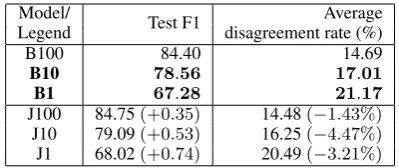
[image:3.595.315.515.61.145.2]J100 84.75(+0.35) 14.48( 1.43%) J10 79.09(+0.53) 16.25( 4.47%) J1 68.02(+0.74) 20.49( 3.21%)
Table 1: Comparison of baseline models (B) with the models trained with joint objective (J).
Letsup-sbe a batch of SRL-labeled sentences and usup-s be a batch SRL-unlabeled sentences only with parse information. In SSL setup, we propose to train our model with joint objective where sup-s only contributes to supervised loss Eq.(1) and unsup-s contributes in terms of syn-tactic inconsistency objective Eq.(5) and combine them according to Eq.(6) to train them with joint loss.
3 Experiments
3.1 Dataset
We evaluate our model’s performance on span-based SRL dataset from CoNLL-2012 shared task (Pradhan et al., 2013). This dataset con-tains gold predicates as part of the input sen-tence and also gold parse information correspond-ing to each sentence which we use for defin-ing hard constraints for SRL task. We use standard train/development/test split containing 278K/38.3K/25.6K sentences. Further, there is ap-prox. 10% disagreement between gold SRL-spans and gold parse-spans (we term these as noisy syn-tactic constraints). During training, we do not preprocess data to handle these noisy constraints but for the analysis related to enforcing syntactic constraints during inference, we study both cases: with and without noisy constraints.1
3.2 Model configurations
For the SOTA system proposed in (Peters et al.,
2018), we use code from Allen AI2 to implement
our approach. We follow their initialization and training configurations. Let BX, JX denote model trained withX% of the SRL-labeled data with cross-entropy and joint training objective, re-1We preprocessed data for inference by simply deleting
syntactic parse trees for the sentences where we have dis-agreement and perform standard Viterbi decoding for those sentences and note that this preprocessing scheme was never used during training.
Base Model/ Test F1 Average Legend disagreement rate (%)
B10 78.56 17.01
B10-SI1x 78.84 (+0.28) 16.17 ( 4.94%) B10-SI5x 78.67 (+0.11) 16.47 ( 3.17%) B10-SI10x 78.76 (+0.20) 16.09 ( 5.4%)
B1 67.28 21.17
[image:4.595.74.291.61.164.2]B1-SI1x 67.67 (+0.39) 20.14 ( 4.87%) B1-SI5x 67.74 (+0.46) 19.93 ( 5.86%) B1-SI10x 67.71 (+0.43) 20.16 ( 4.77%)
Table 2: Training with SI-loss for varying sizes of SRL-unlabeled data on top of the pre-trained baseline models (B1, B10 on Table1).
spectively. BX-SIUx and BX-JUx denote model trained with SI-loss and Joint loss, respectively, on the pre-trained BXmodel whereX⇥Uamount of SRL-unlabeled data were used for further training. To satisfy BIO constraints, we run Viterbi decod-ing by default for inference.
3.3 Results
We are interested in answering following ques-tions. (Q1) how well does the baseline model produce syntactically consistent outputs, (Q2) does our approach actually enforce syntactic con-straints, (Q3) does our approach enforce syntactic constraints without compromising the quality of the system, (Q4) how well does our SSL formu-lation perform, especially in low-resource scenar-ios, and lastly (Q5) what is the difference in using the syntactic constraints in training time compared to using it at decoding time. To answer (Q1-2) fa-vorably we report average disagreement rate com-puted over test split. To answer (Q3-5), we report overall F1-scores on CoNLL-2012 test set (using standard evaluation script). For experiments us-ing SRL-unlabeled data, we report average results after running multiple experiments with different random samples of it.
Does training with joint objective help? We trained 3 models with random 1%, 10% and
whole 100% of the training set with joint objec-tive (↵1 =↵2 =0.5). For comparison, we trained
3 SOTA models with the same training sets. All
models were trained for max150epochs and with
a patience of20epochs. Table1reports the results
of this experiment. We see that models trained with joint objective (JX) improve over baseline models (BX), both in terms of F1 and average disagreement rate. These improvements provide evidence for answering (Q1-3) favorably. Further, gains are more in low resource scenarios because
Base Model/ Test F1 Average Legend disagreement rate (%)
B10 78.56 17.01
B10-further 78.86 (+0.3) 16.25 ( 2.06%) B10-J1x 79.23 (+0.67) 16.03 ( 5.76%) B10-J5x 79.25 (+0.69) 16.01 ( 5.88%)
B10-J10x 79.34 (+0.78) 15.88 (-6.64%)
B1 67.28 21.17
B1-further 67.76 (+0.48) 20.75 ( 1.98%) B1-J1x 68.45 (+1.17) 19.57 ( 7.56%)
B1-J5x 68.86 (+1.58) 19.38 (-8.46%)
[image:4.595.308.523.61.184.2]B1-J10x 68.61 (+1.33) 19.29 ( 8.88%)
Table 3: Training with joint objective (J) on top of the baseline models (B1,B10from Table1), with the same SRL-labeled data used to train the baseline models and with varying sizes of SRL-unlabeled data.
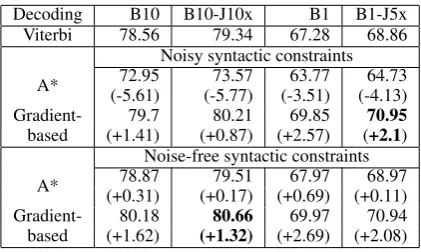
Decoding B10 B10-J10x B1 B1-J5x Viterbi 78.56 79.34 67.28 68.86
Noisy syntactic constraints A* (-5.61)72.95 (-5.77)73.57 (-3.51)63.77 (-4.13)64.73 Gradient- 79.7 80.21 69.85 70.95
based (+1.41) (+0.87) (+2.57) (+2.1) Noise-free syntactic constraints A* (+0.31)78.87 (+0.17)79.51 (+0.69)67.97 (+0.11)68.97 Gradient- 80.18 80.66 69.97 70.94 based (+1.62) (+1.32) (+2.69) (+2.08)
Table 4: Comparison of different decoding techniques: Viterbi, A* (He et al.,2017) and gradient based infer-ence (Lee et al.,2017) with noisy and noise-free syn-tactic constraints1. Note that the (+/-) F1 are reported
w.r.t Viterbi decoding on the same column.
by training models jointly to satisfy syntactic con-straints helps in better generalization when trained with limited SRL corpora.
Does SSL based training work for low-resource scenarios? To enforce syntactic constraints via SI-loss on SRL-unlabeled data, we further train pre-trained model with two objectives in SSL set up: (a) SI-loss (Table 2) and (b) joint objective (Table3)
For experiment (a), we use square loss, kW
Wpre-traink2 regularizer to keep the modelW close
to the pre-trained modelWpre-train to avoid catas-trophic forgetting ( set to 0.005). We optimize
with SGD with learning rate of0.01, ↵2 = 1.0, patience of 10 epochs. We see that with SI-loss improvements are significant in terms of average disagreement rate as compared to F1.
[image:4.595.310.521.249.375.2]B1 and B10, trained with 5% and 100% SRL-unlabeled data, respectively. Note that we can-not achieve these improvements with simply fine-tunning BX with supervised loss, as seen with BX-further on Table 3. This provides evidence to answer (Q4) favorably. In general, the per-formance gains increase as the size of the SRL-unlabeled data increases.
Is it better to enforce syntactic consistency on decoding or on training time? To answer (Q5), we conducted three experiments: using syntactic constraints on (a) inference only, i.e. structured prediction, (b) training only, and (c) both training and inference steps. For the structured prediction, we consider A* decoding, as used in (He et al.,
2017) and gradient-based inference (Lee et al.,
2017), which optimizes loss function similar to SI-loss on Eq.(5) per example basis. If neither A* decoding nor gradient-based inference is used, we use Viterbi algorithm to enforce BIO constraints. The performance is the best (bold on Table 4) when syntactic consistency is enforced both on training and inference steps, +3.67, +2.1 F1 score improvement over B1 and B10 respectively, and we conclude that the effort of enforcing syntactic consistency on inference time is complementary to the same effort on training time. However, note that the overall performance increases as the bene-fit from enforcing syntactic consistency with SSL is far greater compared to marginal decrement on structured prediction.
While syntactic constraints help both train and in-ference, injecting constraints on train time is far more robust compared to enforcing them on de-coding time. The performance of the structured prediction drops rapidly when the noise in the parse information is introduced (xcolumn of Ta-ble 4). On the other hand, SSL was trained on CoNLL2012 data where about 10% of the gold SRL-spans do not match with gold parse-spans and even when we increase noise level to 20% the performance drop was only around 0.1 F1 score.
4 Related Work
The traditional approaches for SRL (Pradhan et al., 2005; Koomen et al., 2005) constituted of cascaded system with four subtasks: pruning, ar-gument identification, arar-gument labeling, and in-ference. Recent approaches (Zhou and Xu,
2015;He et al.,2017) proposed end-to-end system for SRL using deep recurrent or bi-LSTM-based
architecture with no syntactic inputs and have achieved SOTA results on English SRL. Lastly, (Peters et al.,2018) proposed ELMo, a deep con-textualized word representations, and improved the SOTA English SRL by3.2F1-points.
Even on the end-to-end learning, inference still remains as a separate subtask and would be for-malized as a constrained optimization problem. To solve this problem ILP (Punyakanok et al.,2008),
A* algorithm(He et al.,2017) and gradient-based inference (Lee et al.,2017) were employed. Fur-ther, all of these works leveraged syntactic parse during inference and was never used during train-ing unless used as a cascaded system.
To the best of our knowledge, this work is the first attempt towards SSL span-based SRL model. Nonetheless, there were few efforts in SSL in dependency-based SRL systems (F¨urstenau and Lapata,2009;Deschacht and Moens,2009;Croce et al.,2010). (F¨urstenau and Lapata, 2009) pro-posed to augment the dataset by finding similar unlabeled sentences to already labeled set and an-notate accordingly. While interesting, the similar augmentation technique is harder to apply to span-based SRL as one requires to annotate the whole span. (Deschacht and Moens, 2009;Croce et al.,
2010) proposed to leverage the relation between words by learning latent word distribution over the context, i.e. language model. Our paper also in-corporates this idea by using ELMo as it is trained via language model objective.
5 Conclusion and Future Work
References
Emanuele Bastianelli, Giuseppe Castellucci, Danilo Croce, and Roberto Basili. 2013. Textual inference and meaning representation in human robot interac-tion. InProceedings of the Joint Symposium on Se-mantic Processing. Textual Inference and Structures in Corpora, pages 65–69.
Danilo Croce, Cristina Giannone, Paolo Annesi, and Roberto Basili. 2010. Towards open-domain seman-tic role labeling. InProceedings of the 48th Annual Meeting of the Association for Computational Lin-guistics, ACL ’10, pages 237–246, Stroudsburg, PA, USA. Association for Computational Linguistics.
Koen Deschacht and Marie-Francine Moens. 2009. Semi-supervised semantic role labeling using the la-tent words language model. InProceedings of the 2009 Conference on Empirical Methods in Natu-ral Language Processing: Volume 1 - Volume 1, EMNLP ’09, pages 21–29, Stroudsburg, PA, USA. Association for Computational Linguistics.
Hagen F¨urstenau and Mirella Lapata. 2009. Semi-supervised semantic role labeling. InProceedings of the 12th Conference of the European Chapter of the Association for Computational Linguistics, EACL ’09, pages 220–228, Stroudsburg, PA, USA. Asso-ciation for Computational Linguistics.
Luheng He, Kenton Lee, Mike Lewis, and Luke Zettle-moyer. 2017. Deep semantic role labeling: What works and whats next. InProceedings of the 55th Annual Meeting of the Association for Computa-tional Linguistics (Volume 1: Long Papers), vol-ume 1, pages 473–483.
Paul Kingsbury and Martha Palmer. 2002. From tree-bank to proptree-bank. In Proceedings of the Third International Conference on Language Resources and Evaluation (LREC’02). European Language Re-sources Association (ELRA).
Peter Koomen, Vasin Punyakanok, Dan Roth, and Wen-tau Yih. 2005. Generalized inference with multiple semantic role labeling systems. In Pro-ceedings of the Ninth Conference on Computational Natural Language Learning, pages 181–184. Asso-ciation for Computational Linguistics.
Jay Yoon Lee, Michael Wick, Sanket Vaibhav Mehta, Jean-Baptiste Tristan, and Jaime Carbonell. 2017. Gradient-based inference for networks with output constraints. arXiv preprint arXiv:1707.08608v2.
Mitchell P Marcus, Mary Ann Marcinkiewicz, and Beatrice Santorini. 1993. Building a large annotated corpus of english: The penn treebank. Computa-tional linguistics, 19(2):313–330.
Matthew E. Peters, Mark Neumann, Mohit Iyyer, Matt Gardner, Christopher Clark, Kenton Lee, and Luke Zettlemoyer. 2018. Deep contextualized word rep-resentations. InProc. of NAACL.
Sameer Pradhan, Kadri Hacioglu, Wayne Ward, James H Martin, and Daniel Jurafsky. 2005. Seman-tic role chunking combining complementary syn-tactic views. In Proceedings of the Ninth Confer-ence on Computational Natural Language Learning, pages 217–220. Association for Computational Lin-guistics.
Sameer Pradhan, Alessandro Moschitti, Nianwen Xue, Hwee Tou Ng, Anders Bj¨orkelund, Olga Uryupina, Yuchen Zhang, and Zhi Zhong. 2013. Towards ro-bust linguistic analysis using ontonotes. In Proceed-ings of the Seventeenth Conference on Computa-tional Natural Language Learning, pages 143–152. Vasin Punyakanok, Dan Roth, and Wen-tau Yih. 2008.
The importance of syntactic parsing and inference in semantic role labeling. Computational Linguistics, 34(2):257–287.
Dan Shen and Mirella Lapata. 2007. Using semantic roles to improve question answering. In Proceed-ings of the 2007 joint conference on empirical meth-ods in natural language processing and computa-tional natural language learning (EMNLP-CoNLL).