Graph Alignment for Semi-Supervised Semantic Role Labeling
Hagen F¨urstenau
Dept. of Computational Linguistics Saarland University
Saarbr¨ucken, Germany
Mirella Lapata School of Informatics University of Edinburgh
Edinburgh, UK
Abstract
Unknown lexical items present a major obstacle to the development of broad-coverage semantic role labeling systems. We address this problem with a semi-supervised learning approach which ac-quires training instances for unseen verbs from an unlabeled corpus. Our method re-lies on the hypothesis that unknown lexical items will be structurally and semantically similar to known items for which annota-tions are available. Accordingly, we rep-resent known and unknown sentences as graphs, formalize the search for the most similar verb as a graph alignment prob-lem and solve the optimization using inte-ger linear programming. Experimental re-sults show that role labeling performance for unknown lexical items improves with training data produced automatically by our method.
1 Introduction
Semantic role labeling, the task of automatically identifying the semantic roles conveyed by sen-tential constituents, has recently attracted much at-tention in the literature. The ability to express the relations between predicates and their arguments while abstracting over surface syntactic configu-rations holds promise for many applications that require broad coverage semantic processing. Ex-amples include information extraction (Surdeanu et al., 2003), question answering (Narayanan and Harabagiu, 2004), machine translation (Boas, 2005), and summarization (Melli et al., 2005).
Much progress in the area of semantic role la-beling is due to the creation of resources like FrameNet (Fillmore et al., 2003), which document the surface realization of semantic roles in real world corpora. Such data is paramount for de-veloping semantic role labelers which are usually
based on supervised learning techniques and thus require training on role-annotated data. Examples of the training instances provided in FrameNet are given below:
(1) a. If [you]Agent [carelessly]Manner chance going back there, you deserve what you get.
b. Only [one winner]Buyer purchased [the paintings]Goods
c. [Rachel]Agent injured [her friend]Victim [by closing the car door on his left hand]Means.
Each verb in the example sentences evokes aframe
which is situation-specific. For instance, chance
evokes the Daring frame, purchased the Com-merce buy frame, and injured the Cause harm
frame. In addition, frames are associated with semantic roles corresponding to salient entities present in the situation evoked by the predicate. The semantic roles for the frameDaringareAgent
andManner, whereas forCommerce buythese are
Buyer and Goods. A system trained on large amounts of such hand-annotated sentences typi-cally learns to identify the boundaries of the argu-ments of the verb predicate (argument identifica-tion) and label them with semantic roles (argument classification).
A variety of methods have been developed for semantic role labeling with reasonably good per-formance (F1measures in the low 80s on standard test collections for English; we refer the interested reader to the proceedings of the SemEval-2007 shared task (Baker et al., 2007) for an overview of the state-of-the-art). Unfortunately, the reliance on training data, which is both difficult and highly expensive to produce, presents a major obstacle to the widespread application of semantic role la-beling across different languages and text gen-res. The English FrameNet (version 1.3) is not
a small resource — it contains 502 frames cov-ering 5,866 lexical entries and 135,000 annotated sentences. Nevertheless, by virtue of being un-der development it is incomplete. Lexical items (i.e., predicates evoking existing frames) are miss-ing as well as frames and annotated sentences (their number varies greatly across lexical items). Considering how the performance of supervised systems degrades on out-of-domain data (Baker et al., 2007), not to mention unseen events, semi-supervised or unsemi-supervised methods seem to offer the primary near-term hope for broad coverage se-mantic role labeling.
In this work, we develop a semi-supervised method for enhancing FrameNet with additional annotations which could then be used for clas-sifier training. We assume that an initial set of labeled examples is available. Then, faced with an unknown predicate, i.e., a predicate that does not evoke any frame according to the FrameNet database, we must decide (a) which frames it be-longs to and (b) how to automatically annotate example sentences containing the predicate. We solve both problems jointly, using a graph align-ment algorithm. Specifically, we view the task of inferring annotations for new verbs as an in-stance of a structural matching problem and fol-low a graph-based formulation for pairwise global network alignment (Klau, 2009). Labeled and un-labeled sentences are represented as dependency-graphs; we formulate the search for an optimal alignment as an integer linear program where dif-ferent graph alignments are scored using a func-tion based on semantic and structural similarity. We evaluate our algorithm in two ways. We assess how accurate it is in predicting the frame for an unknown verb and also evaluate whether the an-notations we produce are useful for semantic role labeling.
In the following section we provide an overview of related work. Next, we describe our graph-alignment model in more detail (Section 3) and present the resources and evaluation methodology used in our experiments (Section 4). We conclude the paper by presenting and discussing our results.
2 Related Work
Much previous work has focused on creating FrameNet-style annotations for languages other than English. A common strategy is to exploit parallel corpora and transfer annotations from
English sentences onto their translations (Pad´o and Lapata, 2006; Johansson and Nugues, 2006). Other work attempts to automatically augment the English FrameNet in a monolingual setting either by extending its coverage or by creating additional training data.
There has been growing interest recently in determining the frame membership for unknown predicates. This is a challenging task, FrameNet currently lists 502 frames with example sentences which are simply too many (potentially related) classes to consider for a hypothetical system. Moreover, predicates may have to be assigned to multiple frames, on account of lexical ambiguity. Previous work has mainly used WordNet (Fell-baum, 1998) to extend FrameNet. For example, Burchardt et al. (2005) apply a word sense dis-ambiguation system to annotate predicates with a WordNet sense and hyponyms of these predi-cates are then assumed to evoke the same frame. Johansson and Nugues (2007) treat this problem as an instance of supervised classification. Using a feature representation based also on WordNet, they learn a classifier for each frame which decides whether an unseen word belongs to the frame or not. Pennacchiotti et al. (2008) create “distribu-tional profiles” for frames. Each frame is repre-sented as a vector, the (weighted) centroid of the vectors representing the meaning of the predicates it evokes. Unknown predicates are then assigned to the most similar frame. They also propose a WordNet-based model that computes the similar-ity between the synsets representing an unknown predicate and those activated by the predicates of a frame.
All the approaches described above are type-based. They place more emphasis on extending the lexicon rather than the annotations that come with it. In our earlier work (F¨urstenau and Lapata, 2009) we acquire new training instances, by pro-jecting annotations from existing FrameNet sen-tences to new unseen ones. The proposed method is token-based, however, it only produces annota-tions for known verbs, i.e., verbs that FrameNet lists as evoking a given frame.
con-ceptualized as a graph alignment problem where we seek to find a globally optimal alignment sub-ject to semantic and structural constraints. Instead of predicting the same frame for each occurence of an unknown predicate, we consider a set of candi-date frames and allow projection from any labeled predicate that can evoke one of these frames. This allows us to make instance-based decisions and thus account for predicate ambiguity.
3 Graph Alignment Method
Our approach acquires annotations for an un-known frame evoking verb by selecting sen-tences featuring this verb from a large unlabeled corpus (the expansion corpus). The choice is based upon a measure of similarity between the predicate-argument structure of the unknown verb and those of similar verbs in a manually labeled corpus (theseedcorpus). We formulate the prob-lem of finding the most similar verbs as the search for an optimal graph alignment (we represent labeled and unlabeled sentences as dependency graphs). Conveniently, this allows us to create la-beled training instances for the unknown verb by projecting role labels from the most similar seed instance. The annotations can be subsequently used for training a semantic role labeler.
Given an unknown verb, the first step is to nar-row down the number of frames it could poten-tially evoke. FrameNet provides definitions for more than 500 frames, of which we entertain only a small number. This is done using a method sim-ilar to Pennacchiotti et al. (2008). Each frame is represented in a semantic space as the cen-troid of the vectors of all its known frame evoking verbs. For an unknown verb we then consider as frame candidates thekclosest frames according to a measure of distributional similarity (which we compute between the unknown verb’s vector and the frame centroid vector). We provide details of the semantic space we used in our experiments in Section 4.
Next, we compare each sentence featuring the unknown verb in question to labeled sentences fea-turing known verbs which according to FrameNet evoke any of thekcandidate frames. If sufficiently similar seeds exist, the unlabeled sentence is anno-tated by projecting role labels from the most sim-ilar one. The simsim-ilarity score of this best match is recorded as a measure of the quality (or reliability) of the new instance. After carrying out this
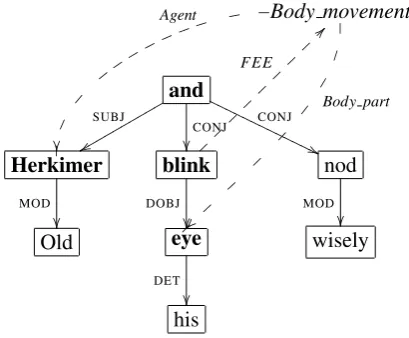
pro-Body movement FEE ? ? ~ ~ ~ ~ ~ ~ ~ ~ ~ Agent _ e i k m p r u y Body part ~ | } and SUBJ x x qqqqqq
qqqq CONJ
[image:3.595.318.523.70.239.2]CONJ ' ' O O O O O O O O O O O O O Herkimer MOD blink DOBJ nod MOD Old eye DET wisely his
Figure 1: Annotated dependency graph for the sentenceOld Herkimer blinked his eye and nodded wisely.The alignment domain is indicated in bold face. Labels in italics denote frame roles, whereas grammatical roles are rendered in small capitals. The verbblinkevokes the frameBody Movement.
cedure for all sentences in the expansion corpus featuring an unknown verb, we collect the highest scoring new instances and add them back to our seed corpus as new training items. In the follow-ing we discuss in more detail how the similarity of predicate-argument structures is assessed.
3.1 Alignment Scoring
Letsbe a semantically labeled dependency graph in which nodenFEE represents the frame evoking verb. Here, we use the term “labeled” to indi-cate that the graph contains semantic role labels in addition to grammatical role labels (e.g., sub-ject or obsub-ject). Let g be an unlabeled graph and ntarget a verbal node in it. The “unlabeled” graph contains grammatical roles but no semantic roles. We wish to find an alignment between the predicate-argument structures ofnFEE andntarget, respectively. Such an alignment takes the form of a functionσfrom a setMof nodes ofs(the align-ment domain) to a setN of nodes ofg(the align-ment range). These two sets represent the rele-vant predicate-argument structures within the two graphs; nodes that are not members of these sets are excluded from any further computations.
sim-ply define M as the set of direct dependents of the predicate, but also have to consider complex paths betweennFEE and role bearing nodes. An example is given in Figure 1, where the roleAgent
is filled by a node which is not dominated by the frame evoking verbblink; instead, it is connected toblink by the complex path (CONJ−1,SUBJ). For
a given seedswe build a list of all such complex paths and also include all nodes of s connected tonFEE by one of these paths. We thus define the alignment domainMas:
1. the predicate nodenFEE
2. all direct dependents of nFEE, except auxil-iaries
3. all nodes on complex paths originating innFEE
4. single direct dependents of any preposition or conjunction node which is in (2) or end-point of a complex path covered in (3)
The last rule ensures that the semantic heads of prepositional phrases and conjunctions are in-cluded in the alignment domain.
The alignment range N is defined in a similar way. However, we cannot extract complex paths from the unlabeled graph g, as it does not con-tain semantic role information. Therefore, we use the same list of complex paths extracted from s. Note that this introduces an unavoidable asymme-try into our similarity computation.
An alignment is a function σ:M→N∪ {ε}
which is injective for all values except ε, i.e.,σ(n1) =σ(n2)6=ε⇒n1=n2. We score the similarity of two subgraphs expressed by an align-ment functionσby the following term:
∑
n∈M
σ(n)6=ε
sem(n,σ(n)) +α·
∑
(n1,n2)∈E(M)(σ(n1),σ(n2))∈E(N)
synrn1
n2,r σ(n1) σ(n2)
(2)
Here, sem represents a semantic similarity mea-sure between graph nodes and syn a syntactic sim-ilarity measure between the grammatical role la-bels of graph edges. E(M)andE(N)are the sets of all graph edges between nodes ofMand nodes ofN, respectively, andrn1
n2 denotes the
grammati-cal relation between nodesn1andn2.
Equation (2) expresses the similarity between two predicate-argument structures in terms of the sum of semantic similarity scores of aligned graph
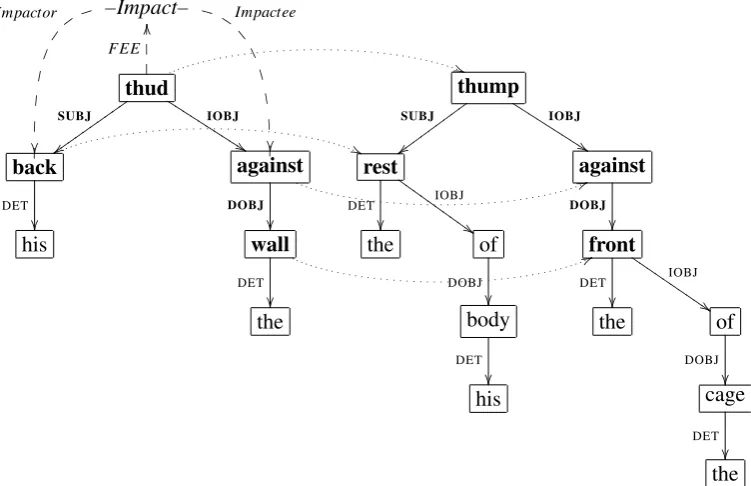
nodes and the sum of syntactic similarity scores of aligned graph edges. The relative weight of these two sums is determined by the parameterα. Fig-ure 2 shows an example of an alignment between two dependency graphs. Here, the aligned node pairsthud andthump,backandrest, against and
against, as well as wall and front contribute se-mantic similarity scores, while the three edge pairs
SUBJ and SUBJ, IOBJ and IOBJ, as well as DOBJ
andDOBJcontribute syntactic similarity scores.
We normalize the resulting score so that it al-ways falls within the interval [0,1]. To take into account unaligned nodes in both the alignment do-main and the alignment range, we divide Equa-tion (2) by:
p
|M| · |N|+αp|E(M)| · |E(N)| (3)
A trivial alignment of a seed with itself where all semantic and syntactic scores are 1 will thus re-ceive a score of:
|pM| ·1+α· |E(M)| ·1
|M|2+αpE(M)2 =1 (4)
which is the largest possible similarity score. The lowest possible score is obviously 0, assuming that the semantic and syntactic scores cannot be nega-tive.
Considerable latitude is available in selecting the semantic and syntactic similarity measures. With regard to semantic similarity, WordNet is a prime contender and indeed has been previously used to acquire new predicates in FrameNet (Pen-nacchiotti et al., 2008; Burchardt et al., 2005; Jo-hansson and Nugues, 2007). Syntactic similarity may be operationalized in many ways, for exam-ple by taking account a hierarchy of grammatical relations (Keenan and Comrie, 1977). Our experi-ments employed relatively simple instantiations of these measures. We did not make use of Word-Net, as we were interested in exploring the set-ting where WordNet is not available or has limited coverage. Therefore, we approximate the seman-tic similarity between two nodes via distributional similarity. We present the details of the semantic space model we used in Section 4.
Ifn andn0 are both nouns, verbs or adjectives,
we set:
sem(n,n0):=cos(~v
n,~vn0) (5)
where~vn and~vn0 are the vectors representing the
Impact FEE O O Impactor _ i w Impactee
_ V J9 .
( $
!
thud ((
SUBJ
z
z
vvvvvv
vvvv IOBJ
[image:5.595.121.497.66.309.2]% % K K K K K K K K K K thump SUBJ { { vvvvvv vvv IOBJ % % K K K K K K K K K back DET ' ' against DOBJ 6 6 rest DET IOBJ $ $ H H H H H H H H H H against DOBJ his wall DET 7 7 the of DOBJ front DET IOBJ $ $ I I I I I I I I I I the body DET the of DOBJ his cage DET the
Figure 2: The dotted arrows show aligned nodes in the graphs for the two sentencesHis back thudded against the wall. andThe rest of his body thumped against the front of the cage. (Graph edges are also aligned to each other.) The alignment domain and alignment range are indicated in bold face. The verb
thud evokes the frameImpact.
are identical prepositions or conjunctions we set sem(n,n0):=1. In all other cases sem(n,n0):=0.
As far as syntactic similarity is concerned, we chose the simplest metric possible and set:
syn r,r0:= 1 ifr=r0
0 otherwise (6)
3.2 Alignment Search
The problem of finding the best alignment ac-cording to the scoring function presented in Equa-tion (2) can be formulated as an integer linear pro-gram. Let the binary variablesxikindicate whether nodeniof graphsis aligned to nodenkof graphg. Since it is not only nodes but also graph edges that must be aligned we further introduce binary variables yi jkl, where yi jkl =1 indicates that the edge between nodesniandnjof graphsis aligned to the edge between nodes nk andnl of graphg. This follows a general formulation of the graph alignment problem based on maximum structural matching (Klau, 2009). In order for the xik and
yi jkl variables to represent a valid alignment, the following constraints must hold:
1. Each node ofsis aligned to at most one node ofg:∑kxik≤1
2. Each node ofgis aligned to at most one node ofs:∑ixik≤1
3. Two edges may only be aligned if their adjacent nodes are aligned: yi jkl≤xik and
yi jkl≤xjl
The scoring function then becomes:
∑
i,ksem(ni,nk)xik+α·i,
∑
j,k,lsyn
rni
nj,rnnkl
yi jkl (7)
full graphs, and the number of nodes in the aligned subgraphs is limited.
4 Experimental Design
In this section we present our experimental set-up for assessing the performance of our method. We give details on the data sets we used, describe the baselines we adopted for comparison with our ap-proach, and explain how our system output was evaluated.
Data Our experiments used annotated sentences from FrameNet as a seed corpus. These were augmented with automatically labeled sentences from the BNC which we used as our expan-sion corpus. FrameNet sentences were parsed with RASP (Briscoe et al., 2006). In addi-tion to phrase structure trees, RASP delivers a dependency-based representation of the sentence which we used in our experiments. FrameNet role annotations were mapped onto those dependency graph nodes that corresponded most closely to the annotated substring (see F¨urstenau (2008) for a de-tailed description of the mapping algorithm). BNC sentences were also parsed with RASP (Andersen et al., 2008).
We randomly split the FrameNet corpus1 into 80% training set, 10% test set, and 10% de-velopment set. Next, all frame evoking verbs in the training set were ordered by their number of occurrence and split into two groups,seenand un-seen. Every other verb from the ordered list was considered unseen. This quasi-random split covers a broad range of predicates with a varying number of annotations. Accordingly, the FrameNet sen-tences in the training and test sets were divided into the sets train seen, train unseen, test seen, and test unseen. As we explain below, this was necessary for evaluation purposes.
Thetrain seendataset consisted of 24,220 sen-tences, with 1,238 distinct frame evoking verbs, whereastrain unseencontained 24,315 sentences with the same number of frame evoking verbs. Analogously, test seen had 2,990 sentences and 817 unique frame evoking verbs; the number of sentences in test unseen was 3,064 (with 847 unique frame evoking verbs).
Model Parameters The alignment model pre-sented in Section 3 crucially relies on the
similar-1Here, we consider only FrameNet example sentences
featuring verbal predicates.
ity function that scores potential alignments (see Equation (2)). This function has a free parameter, the weight α for determining the relative contri-bution of semantic and syntactic similarity. We tuned α using leave-one-out cross-validation on the development set. For each annotated sentence in this set we found its most similar other sentence and determined the best alignment between the two dependency graphs representing them. Since the true annotations for each sentence were avail-able, it was possible to evaluate the accuracy of our method for anyα value. We did this by compar-ing the true annotation of a sentence to the anno-tation its nearest neighbor would have induced by projection. Following this procedure, we obtained best results withα=0.2.
The semantic similarity measure relies on a se-mantic space model which we built on a lemma-tized version of the BNC. Our implementation fol-lowed closely the model presented in F¨urstenau and Lapata (2009) as it was used in a similar task and obtained good results. Specifically, we used a context window of five words on either side of the target word, and 2,000 vector dimen-sions. These were the common context words in the BNC. Their values were set to the ratio of the probability of the context word given the target word to the probability of the context word over-all. Semantic similarity was measured using the cosine of the angle between the vectors represent-ing any two words. The same semantic space was used to create the distributional profile of a frame (which is the centroid of the vectors of its verbs). For each unknown verb, we consider the k most similar frame candidates (again similarity is mea-sured via cosine). Our experiments explored dif-ferent values ofkranging from 1 to 10.
Evaluation Our evaluation assessed the perfor-mance of a semantic frame and role labeler with and without the annotations produced by our method. The labeler followed closely the im-plementation described in Johansson and Nugues (2008). We extracted features from dependency parses corresponding to those routinely used in the semantic role labeling literature (see Baker et al. (2007) for an overview). SVM classifiers were trained2 with the LIBLINEAR library (Fan et al., 2008) and learned to predict the frame name, role spans, and role labels. We followed
Figure 3: Frame labeling accuracy on high, medium and low frequency verbs, before and af-ter applying our expansion method; the labeler de-cides amongk=1,...,10 candidate frames.
the one-versus-one strategy for multi-class classi-fication (Friedman, 1996).
Specifically, the labeler was trained on the
train seendata set without any access to training instances representative of the “unknown” verbs in
test unseen. We then trained the labeler on a larger set containingtrain seenand new training exam-ples obtained with our method. To do this, we used
train seenas the seed corpus and the BNC as the expansion corpus. For each “unknown” verb in
train unseenwe obtained BNC sentences with an-notations projected from their most similar seeds. The quality of these sentences as training instances varies depending on their similarity to the seed. In our experiments we added to the training set the 20 highest scoring BNC sentences per verb (adding less or more instances led to worse per-formance).
The average number of frames which can be evoked by a verb token in the set test unseen
[image:7.595.73.289.60.274.2]was 1.96. About half of them (1,522 instances) can evoke only one frame, 22% can evoke two frames, and 14 instances can evoke up to 11 differ-ent frames. Finally, there are 120 instances (4%) intest unseen for which the correct frame is not annotated on any sentence intrain seen.
Figure 4: Role labelingF1for high, medium, and low frequency verbs (roles of mislabeled frames are counted as wrong); the labeler decides among
k=1,...,10 candidate frames.
5 Results
We first examine how well our method performs at frame labeling. We partitioned the frame evok-ing verbs in our data set into three bands (High, Medium, and Low) based on an equal division of the range of their occurrence frequency in the BNC. As frequency is strongly correlated with polysemy, the division allows us to assess how well our method is performing at different degrees of ambiguity. Figure 3 summarizes our results for High, Medium, and Low frequency verbs. The number of verbs in each band are 282, 282, and 283, respectively. We compare the frame accuracy of a labeler trained solely on the annotations avail-able in FrameNet (Without expansion) against a labeler that also uses annotations created with our method (After expansion). Both classifiers were employed in a setting where they had to decide amongkcandidate frames. These were thekmost similar frames to the unknown verb in question. We also show the accuracy of a simple baseline labeler, which randomly chooses one of thek can-didate frames.
[image:7.595.306.526.61.275.2]ac-Figure 5: Hybrid frame labeling accuracy (k=1 for High frequency verbs).
curacy improves when frame selection is viewed as a classification task. The classifier trained on the expanded training set consistently outperforms the one trained on the original training set. While this is also true for the verbs in the High frequency band, labeling accuracy peaks at k=1 and does not improve when more candidate frames are con-sidered. This is presumably due to the skewed sense distributions of high frequency verbs, and defaulting to the most likely sense achieves rela-tively good performance.
Next, we evaluated our method on role label-ing, again by comparing the performance of our role labeler on the expanded and original train-ing set. Since role and frame labeltrain-ing are inter-dependent, we count all predicted roles of an in-correctly predicted frame as wrong. This unavoid-ably results in low role labeling scores, but allows us to directly compare performance across differ-ent settings (e.g., differdiffer-ent number of candidate frames, with or without expansion). Figure 4 re-ports labeled F1 for verbs in the High, Medium and Low frequency bands. The results are simi-lar to those obtained for frame labeling; the role labeler trained on the the expanded training set consistently outperforms the labeler trained on the unexpanded one. (There is no obvious baseline for role labeling, which is a complex task involv-ing the prediction of frame labels, identification of the role bearing elements, and assignment of role labels.) Again, for High frequency verbs simply defaulting tok=1 performs best.
Taken together, our results on frame and role labeling indicate that our method is not very effec-tive for High frequency verbs (which in practice should be still annotated manually). We
there-Figure 6: Hybrid role labelingF1(k=1 for High frequency verbs).
fore also experimented with a hybrid approach that lets the classifier choose among k candi-dates for Medium and Low frequency verbs and defaults to the most similar candidate for High frequency verbs. Results for this approach are shown in Figures 5 and 6. All differences be-tween the expanded and the unexpanded classi-fier when choosing between the same k>1 can-didates are significant according to McNemar’s test (p < .05). The best frame labeling accu-racy (26.3%) is achieved by the expanded classi-fier when deciding amongk=6 candidate frames. This is significantly better (p< .01) than the best performance of the unexpanded classifier (25.0%), which is achieved atk=2. Role labeling results follow a similar pattern. The best expanded classi-fier (F1=14.9% atk=6) outperforms the best un-expanded one (F1=14.1% atk=2). The difference in performance as significant at p<0.05, using stratified shuffling (Noreen, 1989).
6 Conclusions
[image:8.595.72.288.61.203.2] [image:8.595.305.528.62.204.2]objective function that takes semantic and struc-tural similarity into account.
Experimental results show that our method im-proves frame and role labeling accuracy, espe-cially for Medium and Low frequency verbs. The overall frame labeling accuracy may seem low. There are at least two reasons for this. Firstly, the unknown verb might have a frame for which no manual annotation exists. And secondly, many er-rors are due to near-misses, i.e., we assign the un-known verb a wrong frame which is nevertheless very similar to the right one. In this case, accuracy will not give us any credit.
An obvious direction for future work concerns improving our scoring function. Pennacchiotti et al. (2008) show that WordNet-based similarity measures outperform their simpler distributional alternatives. An interesting question is whether the incorporation of WordNet-based similarity would lead to similar improvements in our case. Also note that currently our method assigns unknown lexical items to existing frames. A better alterna-tive would be to decide first whether the unknown item can be classified at all (because it evokes a known frame) or whether it represents a genuinely novel frame for which manual annotation must be provided.
Acknowledgments The authors acknowledge the support of DFG (IRTG 715) and EPSRC (grant GR/T04540/01). We are grateful to Richard Jo-hansson for his help with the re-implementation of his semantic role labeler. Special thanks to Man-fred Pinkal for valuable feedback on this work.
References
Øistein E. Andersen, Julien Nioche, Ted Briscoe, and John Carroll. 2008. The BNC Parsed with
RASP4UIMA. In Proceedings of the 6th
Interna-tional Language Resources and Evaluation
Confer-ence, pages 865–869, Marrakech, Morocco.
Collin F. Baker, Michael Ellsworth, and Katrin Erk. 2007. SemEval-2007 Task 19: Frame Semantic
Structure Extraction. In Proceedings of the 4th
International Workshop on Semantic Evaluations, pages 99–104, Prague, Czech Republic.
Hans C. Boas. 2005. Semantic frames as interlingual representations for multilingual lexical databases.
International Journal of Lexicography, 18(4):445– 478.
Ted Briscoe, John Carroll, and Rebecca Watson. 2006.
The Second Release of the RASP System. In
Pro-ceedings of the COLING/ACL 2006 Interactive Pre-sentation Sessions, pages 77–80, Sydney, Australia. Aljoscha Burchardt, Katrin Erk, and Anette Frank.
2005. A WordNet Detour to FrameNet. In
Proceed-ings of the GLDV 200 Workshop GermaNet II, Bonn, Germany.
Rong-En Fan, Kai-Wei Chang, Cho-Jui Hsieh,
Xiang-Rui Wang, and Chih-Jen Lin. 2008. LIBLINEAR: A
Library for Large Linear Classification. Journal of
Machine Learning Research, 9:1871–1874.
Christiane Fellbaum, editor. 1998. WordNet: An
Elec-tronic Database. MIT Press, Cambridge, MA. Charles J. Fillmore, Christopher R. Johnson, and
Miriam R. L. Petruck. 2003. Background to
FrameNet. International Journal of Lexicography,
16:235–250.
Jerome H. Friedman. 1996. Another approach to poly-chotomous classification. Technical report, Depart-ment of Statistics, Stanford University.
Hagen F¨urstenau and Mirella Lapata. 2009.
Semi-supervised semantic role labeling. InProceedings
of the 12th Conference of the European Chapter of the Association for Computational Linguistics, pages 220–228, Athens, Greece.
Hagen F¨urstenau. 2008. Enriching frame semantic
re-sources with dependency graphs. InProceedings of
the 6th Language Resources and Evaluation
Confer-ence, pages 1478–1484, Marrakech, Morocco.
Richard Johansson and Pierre Nugues. 2006. A FrameNet-based semantic role labeler for Swedish. In Proceedings of the COLING/ACL 2006 Main Conference Poster Sessions, pages 436–443, Syd-ney, Australia.
Richard Johansson and Pierre Nugues. 2007. Using WordNet to extend FrameNet coverage. In Richard
Johansson and Pierre Nugues, editors, FRAME
2007: Building Frame Semantics Resources for Scandinavian and Baltic Languages, pages 27–30, Tartu, Estonia.
Richard Johansson and Pierre Nugues. 2008. The ef-fect of syntactic representation on semantic role
la-beling. In Proceedings of the 22nd International
Conference on Computational Linguistics, pages 393–400, Manchester, UK.
E. Keenan and B. Comrie. 1977. Noun phrase
acces-sibility and universal grammar. Linguistic Inquiry,
8:62–100.
Gunnar W. Klau. 2009. A new graph-based method
for pairwise global network alignment. BMC
Bioin-formatics, 10 (Suppl 1).
A.H. Land and A.G. Doig. 1960. An automatic method for solving discrete programming problems.
Gabor Melli, Yang Wang, Yurdong Liu, Mehdi M. Kashani, Zhongmin Shi, Baohua Gu, Anoop Sarkar,
and Fred Popowich. 2005. Description of
SQUASH, the SFU question answering summary handler for the duc-2005 summarization task. In
Proceedings of the HLT/EMNLP Document Under-standing Workshop, Vancouver, Canada.
Srini Narayanan and Sanda Harabagiu. 2004. Ques-tion answering based on semantic structures. In
Proceedings of the 20th International Conference on Computational Linguistics, pages 693–701, Geneva, Switzerland.
E. Noreen. 1989. Computer-intensive Methods for
Testing Hypotheses: An Introduction. John Wiley and Sons Inc.
Sebastian Pad´o and Mirella Lapata. 2006. Optimal constituent alignment with edge covers for
seman-tic projection. In Proceedings of the 21st
Interna-tional Conference on ComputaInterna-tional Linguistics and 44th Annual Meeting of the Association for Com-putational Linguistics, pages 1161–1168, Sydney, Australia.
Marco Pennacchiotti, Diego De Cao, Roberto Basili, Danilo Croce, and Michael Roth. 2008. Automatic
induction of FrameNet lexical units. InProceedings
of the Conference on Empirical Methods in Natu-ral Language Processing, pages 457–465, Honolulu, Hawaii.
Mihai Surdeanu, Sanda Harabagiu, John Williams, and Paul Aarseth. 2003. Using predicate-argument
structures for information extraction. In