Creating a Concurrent In-Memory B-Tree
Optimized for NUMA Systems
by
Marlon McKenzie
A thesis
presented to the University of Waterloo in fulfillment of the
thesis requirement for the degree of Master of Applied Science
in
Electrical and Computer Engineering
Waterloo, Ontario, Canada, 2015
c
I hereby declare that I am the sole author of this thesis. This is a true copy of the thesis, including any required final revisions, as accepted by my examiners.
Abstract
The size of main memory is becoming larger. With the number of Central Processing Unit (CPU) cores ever increasing in modern systems, with each of them being able to access memory, the organization of memory becomes more important. In multicore systems, there are two main architectures for memory organization with respect to the cores - Symmetric Multi-Processor (SMP) and Non-Uniform Memory Architecture (NUMA).
Prior work has focused on the improvement of the performance of B-Trees in highly concurrent and distributed environments, as well as in memory, for shared-memory mul-tiprocessors. However, little focus has been given to the performance of main memory B-Trees for NUMA systems. This work focuses on improving the performance of B-Trees contained in main memory of NUMA systems by introducing modifications that consider its storage in the physically distributed main memory of the NUMA system. The work in this thesis makes the following contributions to the development of a distributed B-Tree, specifically in a NUMA environment, modified from a B-Tree originally designed for high concurrency:
• It introduces replication of internal nodes of the tree and shows how this can improve its overall performance in a NUMA environment.
• It introduces NUMA-aware locking procedures with the aim of managing contention and exploiting locality of lock requests with reference to previous client operation request locations.
• It introduces changes in the granularity of locking, starting from the original locking of every node to the locking of certain levels of nodes, showing the tradeoff between the granularity of locking and the performance of the tree based on the workload.
• It considers the combination of the different techniques, with the aim of finding the combination which performs well overall for varying read-heavy workloads and number of client threads.
Keywords: B-Tree, in-memory, NUMA, distributed computing, concurrency control, locking, lock-free, replication
Acknowledgements
I would like to thank my supervisors, Professor Wojciech Golab and Professor Mahesh Tripunitara for their guidance in selection of a suitable topic and how to proceed with experiments to support the topic.
Dedication
This is dedicated to my parents, Roland and Marilyn McKenzie, who have always supported me in all my endeavours, and my brother Ronald McKenzie, who, although mostly reserved verbally, always managed to give some form of encouragement through good and bad times.
Table of Contents
List of Tables viii
List of Figures ix
List of Algorithms x
1 Introduction 1
2 Literature Review 7
2.1 Concurrent Operations in B-Trees . . . 8
2.1.1 Locking Techniques . . . 8 2.1.2 Lock-Free Techniques . . . 10 2.2 NUMA-Aware Techniques . . . 13 2.2.1 Locking . . . 13 2.2.2 Data Access . . . 17 2.3 Distributed B-Trees . . . 17
2.3.1 Node Replication and Placement . . . 17
2.3.2 Multiversioning . . . 21
2.4 In-Memory Indexes . . . 23
3 The Problem and Solution Implementation 27
3.1 The Problem . . . 27
3.2 The Original Code . . . 28
3.2.1 The Node and Segment . . . 28
3.2.2 The Latch Mechanism . . . 30
3.2.3 The Buffer Pool Manager . . . 32
3.3 Solution Implementation . . . 32
3.3.1 Latch Manager and Buffer Pool Manager Spinlock Removal . . . 33
3.3.2 NUMA-aware Locking . . . 34 3.3.3 Node Replication . . . 34 3.3.4 Granular Locking . . . 39 3.3.5 Lock-Free Reads . . . 40 3.3.6 Combination of Techniques . . . 47 4 Experimental Results 48 4.1 The Test Environment . . . 48
4.2 Comparing Performance: Throughput . . . 50
4.3 Choosing the Page and Segment Size . . . 50
4.4 Operation Throughput for Separate Techniques . . . 54
4.5 Retries for Lock-Free Reads with Increasing Update Proportions in the Workoad . . . 57
4.6 Operation Throughput for Techniques in Combination with Replication . . 59
5 Conclusions & Future Work 63 5.1 Future Work . . . 64
List of Tables
List of Figures
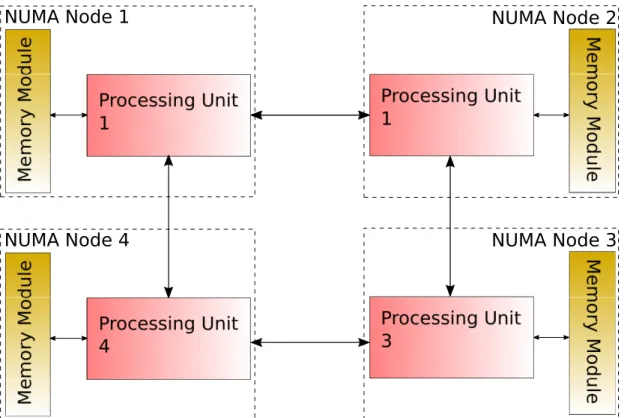
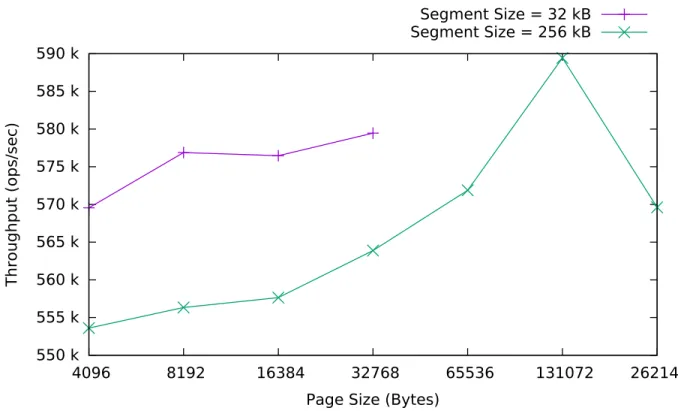
1.1 Examples of the layout of CPUs and main memory modules for SMP and NUMA systems . . . 3 3.1 Layout of a Node . . . 28 4.1 Diagram of the NUMA Node Topology of the Test System . . . 49 4.2 Throughput vs Page Size for Segment Sizes of 32 kB, 256 kB, Tree Size of
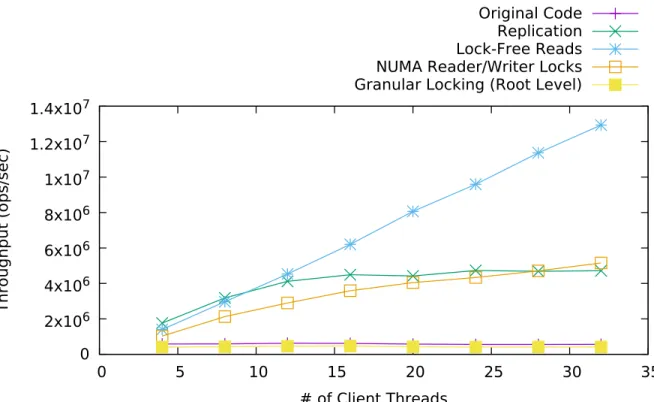
1,000,000 keys, 4 Client Threads, 100 % Reads . . . 53 4.3 Operation Throughput vs Number of Clients, Initial Number of Keys =
1,000,000 , 100% Reads, 0% Updates . . . 54 4.4 Operation Throughput vs Number of Clients, Initial Number of Keys =
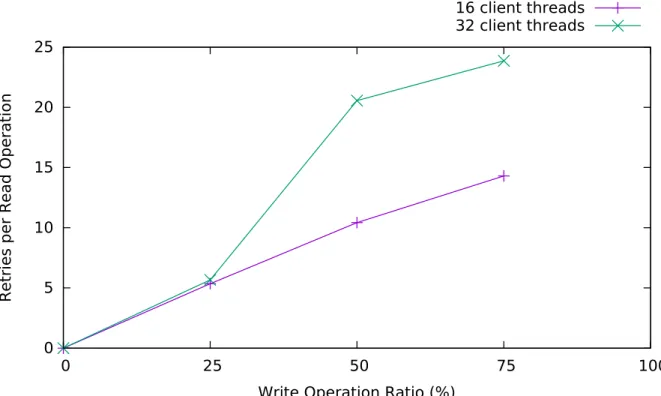
1,000,000 , 75% Reads, 25 % Updates . . . 55 4.5 Average Number of Retries per Read Operation for Varying Workload Ratios 58 4.6 Operation Throughput vs Number of Clients, Other Techniques with
Repli-cation, Initial Number of Keys = 1,000,000 , 100% Reads, 0% Updates . . . 59 4.7 Comparison of Throughput, Workload = 75% Reads, 25% Updates, 4 - 32
Client Threads, Local Insert Only vs Updating of All Replicas Immediately 61 4.8 Operation Throughput vs Number of Clients, Other Techniques with
List of Algorithms
1 Pseudocode for replicatedLoadPageRead . . . 37
2 Pseudocode for replicatedFindKey . . . 38
3 Pseudocode for loadPage with the Granular Locking Mechanism . . . 41
4 Pseudocode for loadPageInternalwith the Granular Locking Mechanism 42 5 Pseudocode for loadPageLockFreeRead . . . 44
5 Pseudocode for loadPageLockFreeRead(continued) . . . 45
6 Pseudocode for findKeyfor the Lock-Free Read Mechanism . . . 46
Chapter 1
Introduction
Modern computer systems now incorporate multiple processing cores, allowing for increas-ing parallelism of operations. The size of main memory in modern systems is becomincreas-ing larger and less expensive, with servers coming with hundreds of Gigabytes of memory. The larger size of main memory in these systems allows for storage and modification of data sets entirely in main memory, instead of entirely on disk as was previously the only way of storing the data set. Previously, the storage of data sets on slow magnetic disks resulted in the need for data structures that took this slow disk access time into account in its design. One of the focuses of data structures in relation to the shift in its location to main memory is to optimize it for use in main memory. One approach is to design entirely new data structures to organize the use of the data efficiently in main memory, but this is a difficult task. The other approach is to modify existing data structures for main memory use. The B-Tree has been used in many data stores for on-disk storage of data, and this thesis focuses on optimizing it for use in the main memory of a system with varying memory architectures.
A B-tree is a data structure that organizes data in a way that allows for search and up-date (insertions and deletions) operations in worse-case logarithmic time. It was originally created for single core systems with a memory hierarchy that includes a magnetic hard disk. The B-Tree tries to minimize the number of hard disk accesses, since such accesses are much slower than accesses to main memory. In a B-Tree, records are organized into collections of key/value pairs, called nodes, that are normally the size of a disk block. Each node can have pointers to an associated value, or to child nodes, at a new, lower level. A node that has child nodes is called an internal node. A node at the lowest level that has no child nodes is called a leaf node, and all search operations that arrive at a leaf node also terminate at that node. The root node is an internal node that has no parent, and is the
first node accessed when an operation is started. Within each node, key/value pairs are arranged in ascending order of keys. For internal nodes, keys also serve as separators for child nodes containing ranges of key/value pairs which are not contained within the node. The child node associated with a separator key contains key/value pairs within the range of the previous adjacent key separator key and the associated key. All operations begin with a search operation for a key. A search operation starts from the root node, with a search of the stored key list for the key specified. If the key is found and its associated value is not a child node pointer, its value is returned, otherwise, the search then follows a pointer to a child node that is associated with the first key that is greater than or equal to the current key being searched for. The same procedure done for the root is now done for the child node, and the process continues until the key is found or the key has not been found and the search has reached a leaf node. Inserts and updates are performed similarly to the search operation, except that for inserts, the key might not be found, and is inserted into the correct place of the node that should have it. To maintain a balanced height of nodes, a minimum and maximum number of keys per node is enforced, with merges and splits of nodes done when this key number range is violated. Variations of the B-Tree such as the B+-Tree [17] and the B*-Tree [6] add more restrictions for efficiency, such as restricting values to be found only in the leaves, adding extra pointers to certain nodes to aid in the search for keys, and restricting the allowed key space vacancy to be smaller. For more information on the basics of B-Tree structure and operations, the reader is referred to [17] and [18].
When the B-Tree data structure was created, single core, single memory architectures were the systems of the time. Modern systems now incorporate Central Processing Units (CPUs) which have multiple cores and/or processors within one system, and multiple memory modules. With this came the decision of how to interconnect the CPUs to handle cache coherency between the processing units, and how to organize the memory modules with respect to the CPUs. The aim of the organization is to allow for increase in perfor-mance through parallelism of execution, while minimizing delays due to communication between CPUs and memory modules. Two main architectures followed from the organiza-tion decisions, Symmetric Multi-Processor (SMP) and Non-Uniform Memory Architecture (NUMA).
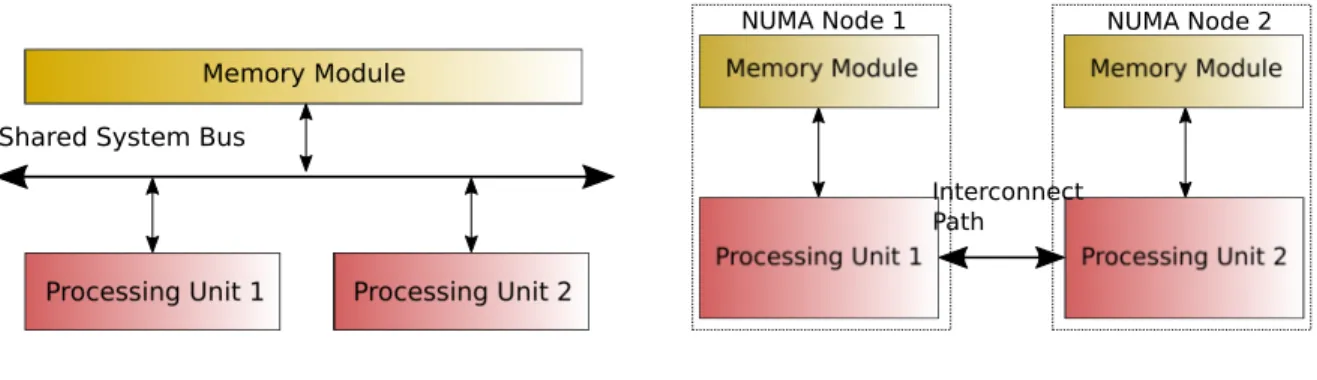
Fig. 1.1a shows an example of the layout of CPUs and main memory for a SMP system. SMP systems normally consist of a group of identical CPUs, each connected to each other via a common system bus and shared main memory. With this kind of architecture, true concurrent processing can be achieved for as many CPUs that the system has, and memory access times are about the same for each processor. However, since the main memory is a single, shared resource, it can become a bottleneck when being accessed frequently by
Shared System Bus
(a) Example SMP Architecture
Interconnect Path
NUMA Node 1 NUMA Node 2
(b) Example NUMA Architecture
Figure 1.1: Examples of the layout of CPUs and main memory modules for SMP and NUMA systems
many different CPUs. The work described in this thesis does not focus on this type of architecture.
Fig. 1.1b shows an example of the layout of the CPUs and main memory for a NUMA system. NUMA systems also consist of a group of CPUs connected to each other and to main memory. However, the connection between processors may not necessarily resemble a single, common bus line. Also, memory modules may be organized such that they may be closer, or local, to one or more CPUs, but need to be accessed across the interconnection network (remotely) by other CPUs. Note that this is different from a Shared Nothing (SN) architecture system, where there is no sharing of storage (for example, memory modules and disk storage) between nodes. In the NUMA architecture, where the data is placed, relative to a CPU that the requesting thread is run on, becomes important. Local memory accesses are memory accesses which can be satisfied entirely by any cache or main memory module directly connected to the CPU on which the executing thread is run. Remote memory accesses require accesses from a main memory module associated with another CPU. Local memory accesses would be satisfied more quickly than remote memory accesses, since remote accesses would require transferring the required main memory data from the remote memory module across the interconnect, and into the cache of the local CPU for the executing thread. Synchronization mechanisms also become an issue, since the state to be kept for a lock can be in any of caches, but need to be used by all cores at some point in execution of operations. This would require this state to be moved to other memory modules and caches, resulting in largers access delays. Local lock accesses would be faster than remote lock accesses, for the same underlying reason of local versus remote memory accesses.
The Operating System creates an abstraction of the physical memory modules as one large virtual memory, with a virtual address space, which is what is used by processes. Each memory allocation request has the potential to be satisfied by one or more of the physical memory modules, based on which CPU the thread is executing on at the time and the amount of main memory space available in each memory module. Allocation of memory and memory binding in Linux by default follows a “first touch” policy – page faults which occur for code running on a CPU are satisfied by the memory module attached to that CPU, so the first CPU to access that page will have that page allocated in its local memory module. Also, each socket’s CPU may have many cores and many levels of cache, used to store most frequently used data and instructions. Since there can be many copies of the same page in different caches, a coherence protocol has to be established between all caches, which can introduce interconnect traffic due to coherence messages crossing the interconnect. Interconnect traffic also occurs when operations initiated on one CPU have to access main memory data contained in memory modules associated with other CPUs, since this data has to be pulled into the cache hierarchy of the local processor from the memory of the containing processing unit. Given a required remote memory reference, the higher the interconnect traffic, the less bandwidth there is available to satisfy the request. Less bandwidth for a remote request causes the remote reference access to be slower. Algorithms which consider data locality in memory and more efficient cache usage are an intuitive step to improving the performance of the B-Tree.
Many works consider the use and optimization of B-Trees for use in-memory [59, 16, 42, 10, 43, 53], by considering the cache line size and temporal/spatial locality of memory data in SMP systems. These techniques, while applicable to a NUMA system, do not consider physical distance of memory modules with respect to the CPU executing the operations, and may incur heavy interconnect traffic when the number of clients per socket is large.
Other works have looked at replication in a multicomputer environment [19, 65, 39, 44, 4], where separate processors communicate by message passing across a network. The focus was mainly on smart replication with minimal extra memory usage, that is, knowing just how many nodes to replicate and where to replicate them, while still retaining good performance. In the NUMA system environment, these techniques still apply. However, it is slightly different since all of the memory is still in the same memory address space and the CPUs are all in the same system. Many of the memory abstractions used in the implementations for the multicomputer environment are not required, and the cost, in terms of time, of replica creation and retrieval is much less. If the total memory of the system is very large, there is less need for sophisticated replica placement algorithms, since all of the nodes can be replicated without worry of running out of memory.
con-current data structures [57, 50, 21, 14], and NUMA-aware organization of data among worker threads [48] for concurrent data structures. Works which focused on the former techniques assume that many different threads would compete for the lock. The works which focused on NUMA-aware data organization, considered reorganization of operations or the data structure itself for quicker access by requesting threads. The techniques from both categories do not consider how their integration affects the performance of specific data structure operations, such as B-Tree operations).
This thesis considers the replication concepts that were introduced in previous work, and combines it with previous work done on locking mechanisms for B-Trees and in NUMA environments, and techniques for improving throughput of B-Trees in memory. The aim was to find the combination of techniques that delivers the best improvement in throughput of the B-Tree, contained entirely in memory in a NUMA environment, for varying types of read-heavy workloads and number of clients per socket. The contributions of this thesis are:
• It introduces basic replication of internal nodes of the tree and shows how this can improve operation throughput of nodes in a NUMA system.
• It introduces NUMA-aware locking procedures with the aim of managing contention and exploiting locality of lock requests with reference to previous client operation request locations.
• It explores changes in the granularity of locking, starting from the original locking of every node to the locking of certain levels of nodes, investigating the tradeoff between the granularity of locking and the performance of the tree based on the workload.
• It introduces Lock-Free Read Operations and shows how they can improve overall throughput even in the presence of a relatively large number of write operations.
• It considers a combination of the different techniques, with the aim of finding the combination which performs well overall for varying read-heavy workloads and num-ber of clients.
In the body of the thesis, the challenges of introducing replication and modification of the locking used in B-Trees are addressed, and the results of these modifications are discussed.
• Chapter 2 discusses previous work done on efficient node replication, B-Tree locking mechanisms and NUMA-aware locking mechanisms.
• Chapter 3 first describes the functionality of the original B-Tree code used. It then describes the modifications done for this work — node replication, use of NUMA-aware locks and use of locking granularity in a NUMA system.
• Chapter 4 describes the results of experiments run with a various combinations of the modifications made.
• Chapter 5 states the conclusions from the the experiments and indicate areas for further work and improvement.
Chapter 2
Literature Review
Due to the trade-offs between storage speed, cost and size, computers have used storage hierarchies to reduce the average access time of data. Faster memories of smaller sizes were used higher up in the hierarchy, while slower, more expensive storage was used for larger, more long term storage lower down. In this model of storage, complete data sets were previously only able to be stored on hard disks. Hard disks store data on circular platters with a magnetic coating. Data is read or written in blocks by a read/write head attached to a mechanical arm. A location to be read or written is found by determining the proper position on a platter by rotating it and moving the read/write head over the location required, and the location is determined based on instructions provided to the storage device. This physical movement required to read or write data to the hard drive made data access from it very slow when compared to main memory, often the bottleneck for operations on the dataset.
The B-Tree data structure, first discussed by Bayer and McCreight in [5] was origi-nally created for use in single processor, single memory systems, where the aim was to store data such that inserts and updates would require minimal disk accesses. The data structure became the basis of many storage systems, such as relational databases. B-Trees are still being actively used in systems today. However, the underlying architecture has seen changes in the form of the number of processing units and memory modules they provide. Althought these changes increased the overall performance of the systems, it was quickly realized that such systems would require a different approach to algorithm design in order to fully harness the power. Many data structures, if modified appropriately for these new architectures, should see better overall performance than allowed by the original implementation.
The aim of this work is to improve the performance of the B-Tree data structure in such NUMA systems. The improvement is an increase in throughput of operations (where “Throughput” means the number of search and update operations which can be carried out per second). The improvement is achieved by reducing remote memory references by improving locality of the data, and by increasing concurrency of operations within the b-tree by considering Lock-Free and architecture aware techniques.
To improve performance of the B-Tree in a NUMA environment, two areas of the data structure will be considered — (1) location of key/value data relative to the running thread and (2) the locking mechanisms used to both protect the structure of the B-Tree and the data it contains. In this section we shall look at work which has been done on B-Trees to accommodate concurrent and distributed operations. There are two main categories of work which shall be considered - locking techniques for concurrent operations and replication/smart node placement techniques for distributed environments.
2.1
Concurrent Operations in B-Trees
Concurrent operations help obtain maximum throughput of operations for all clients of the B-Tree. Since uncontrolled concurrent update operations by different clients can cause the internal state of the B-Tree or its contents to enter different, and sometimes incorrect states (as seen by retrieval operations), care has to be taken by the data structure to ensure that the correct outcome is achieved at the end of all such update operations. To ensure correctness, update operations are serialized at some point for each operation to allow it to complete or rollback its modifications. This serialization has historically been achieved through locks, but more recently lock-free techniques have also been considered.
2.1.1
Locking Techniques
A lock is a synchronization structure that is used to limit the access of clients to a common resource. It may have rules for limiting such access based on the type of access of the client (reading versus updating) and the number of access types allowed (mutual-exclusion versus some number of concurrent clients). As stated by Graefe in [30, 65], in the case of a B-Tree, maintenance of consistency through lock-based protection can be split into two main categories, protection of the datastructure itself and protection of the data stored by the datastructure. Data structure protection is normally required for only a short time, and is provided by latches. This “lightweight” protection requires mutual exclusion with minimal
overhead, and is normally implemented by the simplest of locks, such as spin locks. Data structure content protection protects the key/value pairs from concurrent client transaction operations, for which concurrent reads are allowed, and are provided by more complex locks, such as Reader/Writer locks. Various studies have analyzed the relative performance of the different types of locks. One of the most comprehensive studies is by David et al. in [20]. The results of the study suggested the use of simplest type locks where they are suitable for protection, and in NUMA systems, keeping the lock variable information local for as long as possible. Locks applied on the B-Tree alone do not solve all concurrency problems. Concurrency of operations can cause observable inconsistencies when different nodes are being modified by different operations, and one node (from a retrieval operation) requires another node (modified by an update operation) in its traversal. Concurrent operations can also cause issues with following child pointers, if these pointers no longer point to valid information. To ensure that the transition to the child node is successful, Latch Coupling is used. Latch Coupling involves the holding of the latch on the parent node until a valid pointer on the desired child node is obtained.
Another issue is with splits/merges of nodes when and update operation violates the capacity rule for the number of keys allowed in a node. A split may necessitate one or more new nodes to be created and introduced into the tree and a merge may require one or more nodes to be removed from the tree. Any operation which arrives at nodes which are being split may have originally found that the key being searched for was in the node but is no longer there when searching through the node. Lehman and Yao in [47] suggested their modification to a B-Tree, called a Blink Tree, which uses the concept of high fence
keys and a new right node pointer, to be used with new nodes that are created when the current node is being split. All new nodes that are created are always created to the right of the older node. In this way, if an operation has found that it has reached a node that it original thought had the desired key but now doesn’t, it should be able to follow one or more right node pointers (in the case of multiple, adjacent node splits) to find the desired node with the key.
Key Range and Granularity of Locking
Apart from locking a single key-value pair, locks in the B-Tree can also be used to lock a set, or range, of key-value pairs in the tree. Such key range or value range locking is a form of logical locking, as stated by Graefe in [30], which attempts to lock a range of keys and/or values, based on some common ground, such as being in the same subtree of the associated separator key. It is a form of predicate locking, as described by [24, 41], which describes logical locking of a group of objects that satisfy some predicate, the predicate
being the common ground, such as being of the same subtree. When applied to the logical contents of the B-Tree, a lock can protect from as little as one key up to a broad range of key and value pairs, including the gaps across nodes. Key range locking including gaps can come in the form of locking the range of key-value pairs in the child node from the key after the previous key in the node being searched up to and including the current key in the node being searched, or the current key in the node being searched up to the key in the child node before the next key in the current node. This type of locking can improve the performance of the tree, depending on the workload. In the case of read only workloads, it would require fewer locks to be acquired before obtaining the required value. Workloads with conflicting operations which require the same locks would see worse performance, since there is a higher probability that the lock being acquired may be already acquired for some other operation on a key or value of the same group.
2.1.2
Lock-Free Techniques
One technique that has been suggested to improve concurrency is to use Lock-Free tech-niques to reduce or remove the use of locking in datastructures used for retrieval. As described by Fraser in [26], a Lock-Free system is one which is guaranteed to have system-wide progress (that is, progress in at least one thread of execution). In addition, the term Lock-Free is also used to describe algorithms which do not use mutually exclusive, blocking algorithms to achieve deadlock freedom. Since locks are not used, other techniques must be used to achieve synchronization of the different threads operating on the datastructure. One method is the use of the Compare-And-Swap (CAS) primitive to make atomic changes to datastructures. The idea is to make sure that a change to or read from a pointer is done atomically, to ensure that a thread executing that operation sees a consistent view of the change — either its value before modification or after. Any inconsistencies found from the use of this operation would cause the operation to retry or fail, depending on the requirements of the datastructure. Some works also provide an extension of the original CAS primitive for their purposes [26, 27]. Another technique involves Software Transactional Memory (STM) which has various implementations, including those of Shavit and Tuoitou [61], Fraser [26], Fraser and Harris [27], and Herlihy and Moss [35, 36]. STM creates an abstraction which groups related operations, giving each thread of operation the impression of having its own private memory space. Since the thread is given the memory abstraction of its own non-shared memory, it does not have to perform explicit locking. For any activity that requires updates, a commit of all the operations of the transaction is validated and done at the end of the transaction by the STM implementation. In the case of an operation A being blocked due to a conflicting operation B, the technique of
Recursive Helping is used to allow operation A to progress. In Recursive Helping [26], operation A recursively calls operation B to ensure that the task of B is done, since one call will succeed while the other will detect that the operation is already being completed and return without duplicating the modification. Some works use flag variables [8] to represent the current state of the node, simulating a lock but without the overhead of blocking the executing thread and switching to another, if the state represents a conflict with the operation being executed by the thread.
With these techniques, various Lock-Free datastructures have been created [11, 64, 26, 62, 64, 23, 13, 12, 25, 31, 34, 60]. Some works focus on providing a datastructures using Lock-Free primitives. Bender et. al. in [8] supplies extra information with the operation status so that operations which encounter any indication of the operation can help the operation to complete and eventually progress to its own completion. Other works [33] use the technique of reading, copying, updating and replacing [55] to make modifications on a copy of the data before swapping it with the oudated version.
Lehman and Yao in [47] describe their B-link Tree, which was a modification of the B-Tree to improve concurrent operation performance through changes of the locking pro-cedure. Searches were changed to be done without locks, while Updates (Insertions) were changed to only perform exclusive locking of the node that is to be modified when the update is performed. To find a key which was moved from node to an adjacent node when a concurrent insert on the same node was being performed, the node was modified to have two features, a fence key and a right node pointer. The right pointer is set to point to the newly created node from a split of a node. On each level, every node from left to right has a right pointer to its adjacent node, created from a split, and so the level itself forms a linked list of nodes. The fence key represented the highest key value contained in the node, and was checked and updated if necessary by every insert operation done on the node. Search operations consult the upper fence key as soon as the node is obtained. A search operation originally chooses a child node based on the separator key as in the original B-Tree, but if a concurrent split caused the higher half of values to be placed in the adjacent node, the fence key of the old node would be updated to be the equal to the highest value in the lower half of keys. The search operation would follow one or more right pointers until it found a node with a fence key greter than or equal to the key being searched for, and would search that node for the key. Splits of nodes would create two new fence keys, and the new fence key of the old node is inserted as the new separator key into the parent node, recursively up to the root as necessary for each split that is necessary. They did not explicilty consider deletes or merges in their work.
Fraser in [26] gives an implementation of a Binary Search Tree (BST) using an exten-sion of CAS for replacement operations and an implementation of Red-Black Tree using
an implementation of STM called FSTM. His extension, Multi-Word Compare-And-Swap (MCAS) provides the same functionality as CAS, but for multiple memory locations, which is important for relocation of objects within a datastructure, which require a removal from one pointer and an insertion into another, all done atomically to ensure consistent views among concurrent threads. To ensure that searches for contained keys always return cor-rect results in the presences of node relocations (due to deletion of other nodes), Fraser based his design of the tree on the Threaded B-Tree, as proposed by Perlis and Thornton in [56]. The Threaded B-Tree uses thread links in the place of empty subtrees, where thread links are pointers which go to the immediate parent and/or successor of the node. If the node is a leaf node, the successor is considered to be the root. Fraser also gives an implementation of a Red-Black tree using FSTM, which creates a transaction for each operation, restarting the operation if the commit done at the end of the operation fails.
Ellen et al. in [23] also describe an implementation of a non-blocking, linearizable Binary Search Tree that uses only the basic CAS mechanism, along with reads and writes. To allow for the single word CAS to be used, their tree is leaf oriented, requiring that only one pointer operation to make the structural change to the new tree. An additional flag variable per node handles peculiarities with concurrent conflicting operations. When a node is to be deleted, its state is changed to mark so none of its pointers can be changed by other operations. The node for which the pointer is to be changed is marked with a flag representative of the operation (iflag for insertion, dflag for deletion) to prevent a concurrent conflicting operation from changing that same node’s pointers concurrently and creating an inconsistent state. When the pointer is being changed, its state is changed to ichild or dchild respectively. When the operation completes, the node is marked with uiflag, udflag, and then clean to allow any operation after. Also, in addition to the state, the same node variable holds a pointer to an info record, which contains information about the operation being done, so that other concurrent, conflicting operations can help that operation to complete to ensure eventual progress.
Sewal et al. in [60] consider making a B+-Tree “Latch-Free” by considering a group of
queries at a time, and redistributing the work accordingly, so that conflicting operations are handled by the reorganization and execution of the operations, without the need for explicit locking. Reads, which do not conflict with each other, are organized to be done first and in parallel. Updates are organized are partitioned among threads so that each thread works on a specific set of tree nodes, and to ensure that serializability is still kept for the group of operations. The modifications are done at each level from the leaves up to the root, which is modified by only one thread. Locking for modifications is implicitly done by the fact that one thread is allowed to modify only its share of nodes, giving it “ownership over those nodes”.
Bronson et al. in [12] describe an implementation of a Binary Search Tree using op-timistic concurrency control techniques, based on an implementation of an External AVL Tree. To track changes occuring in a node, each node has a version number, which consists of 64 bits, of which one bit indicates that an update of the node is occuring and other bits indicate growth and shrinking of a subtree under a node due to it moving positions and whether or not the node is still contained in the tree. Traversals for all operations use hand-over-hand version reads, where the current node and child’s version number are read in, the child version’s number is validated as unchanged, and the parent’s version number is validated as unchanged afterwards, to view the traversal of the link from the parent to the child as valid. Updates lock the parent of the node to be modified, adding a child if no node for the key is present, or updating the value for the key if it is present. Deletes use the routing node feature of external B-Trees only when the node to be deleted has two children, so that traversals can still continue through to children of the removed node. Nodes with one or no children are immediately unlinked.
Braginsky and Petrank in [11] implement a Lock-Free, balanced B+-Tree using the
basic CAS operation and a method for ensuring a contiguous run of memory for a node, called chunking. The chunk consists of a linked-list of array entries, for which they impose a minimum and maximum number of entries, as well as additional pointers for use with splitting and merging when the minimum or maximum size constraint is violated. Since key and value changes must be atomic, only CAS operations are used. The chunk, and hence the node size is chosen to be a factor of the cache size, to take advantage of cache prefetching. Operations take place in the same way for all operations, except that the choice of a node to merge with is given by the structure of the tree, and is a call on the tree itself, and operations can help others to complete (Recursive helping), if the operation being helped is preventing the current operation from completing.
2.2
NUMA-Aware Techniques
2.2.1
Locking
A basic lock is represented by a value in a memory location. Locks assume that all clients which use the lock have access to the location. In SMP, there is a single memory module, and memory distance/access time is symmetric from all processing cores across a shared bus. Most works initially were concerned about keeping good performance in the cases of both low and high contention. Various categories of locks have been created, from those based simply on spinning [3], to those based on queues [54, 51], and those based on reducing
request frequencies by some appropriate amount [2]. However, in NUMA systems, each socket has its own local memory module, and an interconnect exists between the cores to allow for access of any remote memory module from any core. The operating system creates an abstraction of these memory modules as a single, contiguous memory pool, but actual access time is dependent on the executing code’s location and the location of the required memory address. If the memory address is in the memory of the local NUMA node, access is quick, since it requires no messaging across the interconnect. However, if the memory address is in a remote memory module, then messages must be sent across the interconnect to pull the information into the local memory module. Updates cause invalidation messages to be sent to all remote locations which contain the information in the cache. As stated by David et al. in [20], in such an environment, local memory accesses minimize memory access time. Locks however, may be used by code on any of the processing cores, so remote memory access cannot be avoided, only kept to a minimum.
Radovic and Hagersten in [57] describe a NUMA-aware Hierarchical Backoff lock. The lock aimed to reduce remote accesses by “handing over” locks to local threads waiting to acquire them before remote threads, and to reduce contention at lock handover time. The lock itself is represented as an integer value in a shared memory location, initialized to a value, FREE, indicating that the lock is not held. Acquisition of the lock has the thread write its NUMA node id to the shared lock location. Threads which have been denied the lock are given a backoff time to wait until retrying its request. To account for node locality, threads which read the same node id as their own are given a smaller backoff time in comparison to those which do not, to give the local threads a higher chance of obtaining the lock. To account for threads which may not have the samenode idbut may be on the same chip (and still considered neighbours), the address of the lock is copied to a local node specific storage area and neighbours instead spin on that before attempting to access the globally shared lock variable. Starvation is also taken into account by having a threshold number of lock denials and reducing backoff time and writing values to the local node specific storage of other nodes to increase their backoffs.
Luchango et al. in [50] describe a Hierarchical version of the CLH lock [51], which extends the original algorithm to be NUMA-aware. To facilitate NUMA-awareness, they extended the concept of the thread waiting queue to be of two parts, one global queue over-all, and local queues for each cluster (NUMA node). Thread nodes contained in the global queue wait to acquire the lock directly. The head thread of the global queue, when de-queued, is allowed to enter the critical section. The head thread of the local queue becomes cluster master, and is responsible for splicing the members of its local queue into the global queue. To support the distribution of queues, the node (qNode) word member variable was modified to contain two other components in addition to thesuccessor_must_wait boolean
flag – acluster_id and tail_when_spliced flag. When spinning on the predecessor’s mem-ber status a thread can tell whether it is in the local or global queue based on what flag it is spinning on. It first waits to become cluster master (at which point its tail_when_spliced flag becomes true), then it waits for acquisition of the lock (at which point the original algorithm’s variable, successor_must_wait, is false). A thread releases the lock by setting its successor_must_wait flag value to false. The algorithm gives preference to handing off the lock to local threads as much as possible, since a local cluster master attempts to splice in its entire local queue onto the global queue. Starvation was not explicitly considered, but was implicitly assumed not to be a problem since any local queue for a cluster will eventually be spliced into the global queue.
Dave Dice et al. in [21] improve upon the idea provided by [50] by the use of the Flat Combining technique in [32] in combination with the MCS queue lock of [54]. Their technique mostly agress with the HCLH algorithm in terms of using a queue based lock as the basis and having local (FCQueue) and global (GlobalQueue) queues, which uses the notion of clustering nodes and having a cluster id. However, they identified two problems in the HCLH algorithm – relatively small local queues and more potential memory access traffic generated from accessing information from predecessors. To deal with the first problem, they included in the acquiring algorithm the notion of a combiner thread, which has the job of creating a local MCS queue out of potential nodes of threads which want to access the lock (kept in a publication list) and splicing this list into the global MCS queue. To deal with the second problem, they used an MCS queue instead of the CLH queue for the basis of their work, since threads spin on their local flag values instead of their predecessor’s flag values. In acquiring the lock, the thread first tries to become a combiner by trying to acquire the localFCLock. If the thread does succeed in becoming a combiner, it performs the previously described logic of creation of the local MCS queue, reactivates itself in the publication list, releases the FCLock and restarts the lock acquire operation. If it fails (another thread is a combiner), it first spins on requestReady. If requestReady is true, it continues spinning, adding itself to the publication list if it was removed. When requestReady becomes false, the thread goes on to spinning onisOwner for the actual lock acquisition, waiting for it to be set by its predecessor thread. isOwner being set as true for a thread indicates that the thread has acquired the lock. A thread releases the lock by setting the isOwner flag of the next node in the global list (for the successor thread) to false. A check for if the node could potentially be the tail is done to prevent the extra potential remote access from setting the global tail to null in the original MCS algorithm. Diceet al. in [22] describe Lock Cohorting, their technique of building a NUMA-aware lock from more basic locks. The idea is to have one Global, NUMA-oblivious lock and a set of NUMA-aware locks, one for each NUMA node. The lock has three states, Locked, Global
Release, Local Release. To obtain the lock, a thread first checks the state of the local lock variable. If it is Locked, then it will wait to obtain the local lock using the technique of the local lock type. If it is Local Release, then it knows that a local thread had the lock before, the global lock is still Locked, and it only acquires the local lock variable. If it is Global Release it must try to acquire the local then the global lock, to continue. When releasing the lock, a thread checks to see if there are other threads blocked on the local lock. If there are, it does a local release, else, it does a global release. Starvation is addressed using a threshold count and forcing a thread to do a global release for other nodes to have a chance, when the number of local threads have already acquired the lock, is equal to the threshold count.
Calciu et al. in [14] build upon the Cohort lock by making a reader/writer variant. They aim to expand Cohort Locks to conform to the multiple reader/single writer access model of a regular reader/writer lock, but also increasing throughput for NUMA architec-tures using the cohorting mechanism and increasing the average response time by clustering writer requests from the same node whenever possible, which would in turn allow reader requests to be batched as well, happening in preference to writers. Readers update local read indicator count variables to access the lock while Writers check these variables on all nodes to determine if the lock can be accessed exclusively. Writers preferentially hand off the exclusive lock to other writers on the same node using the same technique of Lock Co-horting. Neutral Preference, Reader Preference and Writer Preference versions of the lock are described. The Neutral Preference performs similarly to the PThread Reader/Writer lock, by allowing multiple simultaneous readers but having exclusive writers. The other preferences build on this to provide faster lock acquisition for readers or writers. The Reader Preference allows for readers to more quickly obtain the lock by avoiding locking the shared global Cohort lock but being able to check it locally. The writers always try to acquire the global Cohort lock directly. If there are readers present, the writer unlocks the global cohort lock and waits for the readers to finish, then tries to reacquire it. Starvation of Writer threads is avoided by only allowing a maximum (threshold) number of Reader thread acquisitions before allowing Writers to acquire the lock. The Writer Preference al-lows for writers to have preference over the readers by making readers increment the reader counter before checking the cohort lock status, and immediately decrementing the reader counter if the global cohort lock is locked and waiting for writers to finish. Starvation is also prevented using a similar barrier strategy to the reader preference case.
2.2.2
Data Access
Besides the lock structure, other aspects of the data structure can be modified to improve the performance of the data structure in a NUMA system.
Li et al. in [48] improve the performance of datastructures in a NUMA system by organizing the accesses to data among threads to reduce interconnect bottlenecks due to overuse of some of the connections by shuffling the data among threads which produce and consume common data. For N threads distributed evenly among cores on S sockets, the data for each thread is broken into N partitions. By considering each thread’s thread number (ti) and socket number (si), the accesses to data by each thread are organized so that each thread obtains all of the partitions it needs to complete its operation, while the overall set of operations utilize each interconnect connection path almost uniformly.
2.3
Distributed B-Trees
The need for very large amounts of storage and processing power has become too much for single machine processing to handle. Distributed and parallel computing has become a very important paradigm in satisfying such needs. The distribution can be on the level of multiple cores in different machines or multiple cores within the same machine. The distribution of resources for storage requires the data being stored to be distributed as well. However, this has resulted in new issues as it relates to the relationship between the logical and physical representation of data, and the placement of data to support retrieval and storage requirements of clients. With distribution there can also be a choice of where operation requests will be directed to and a protocol for communicating with all machines which are participating in the storage of the data. When the fundamental components of communication protocol and storage are being considered, performance becomes impor-tant. Due to distribution, the physical components of the storage can be varying distances apart, being as close as separate memory modules in the same machine as in the NUMA architectures, and as far apart as separate storage devices (disks and/or memory) in sepa-rate machines, geographically far from other. One of the normal requirements of a client of the datastore is that the data requested or being stored be done so as quickly as possible.
2.3.1
Node Replication and Placement
One of the ways to obtain better operation performance is to keep the data being operated on as close to the client as possible. Since clients can be located anywhere in relation to
the data this would require a copy of the data to be stored locally at every possible access point for the datastore. Unreliability of the network can cause the communication between storage nodes to fail, resulting in unavailability of the required data. Replication of the data can help to combat this, since having multiple copies of the data can maximize the chances of the data being available to a client upon request from any of the access point to the datastore. However, the replication of data comes with other problems. Once such problem is that such replication of data may be contrary to original resource management requirements – one wants to add more resources to improve performance, but in an efficient manner, and if efficient use of storage space (a resource) is a requirement, then this duplica-tion of the informaduplica-tion stored actually works against the requirement. There must therefore be a tradeoff between this improvement in operation performance and increase in storage space usage. Another problem is that with duplication of the data comes the requirement to maintain consistency of the data stored among the many copies that exist when updates occur. The level of consistency required is dictated also by client requirements and can be very strong (all updates must be reflected in all copies before the operation returns to the client), or varying levels of weak (clients can read varying data depending on where it was retrieved from). Other classifications of consistency consider the time it takes for all copies to receive updates from an updated copy (Eventual Consistency) and the sequence in which consecutive conflicting operations occur (Sequential Consistency, Serializability and Linearizability [37]). Many methods of measuresurement and benchmarks have also been developed to try to quantify the various levels of consistency [9, 58, 29]. Also, repli-cation used to combat network partition has a problem – the data accessible due to the partition may not always be the most updated version. How up-to-date this information being retrieved from the partition is depends on the consistency model used, and there are principles such as Brewer’s Consistency-Availiability-Partition (CAP) principle [28] and Abadi’s modification of the principle, called Partition Availiability/Consistency, Else -Latency/Consistency (PACELC)[1] which elaborate on the tradeoffs of performance in the presence/absence of this network unreliability. Good replication algorithms therefore take all of these tradeoffs into account, as well as the client requirements in order to provide an acceptable level of performance from the perspective of the client, while still making efficient use of resources.
Wang in [65] describes how replication can improve the performance of the implemen-tations of the memory models of coherent shared memory and multi-version memory. The concept of the replication factor is introduced and used to describe the number of copies of a node to be made on a processor. Number of copies of each node are chosen based on the height of the node in the tree, with the guiding reasoning being the higher the node is in the tree, the more chance it has to be accessed (as a path to lower nodes in the tree) and
the higher its copy count should be, with the minimum being one copy, and the maximum being the number of processors that can access the tree. By this reasoning, the number of copies of the root was set to be equal to the total number of accessing processors, and the replication factor of all leaves was set to be one. The number of copies of each internal node was determined to be the minimum of the total number of copies of the root and the number of copies of the nodes in the level above the node multiplied by a constant factor, called theReplication Factor.
Johnson and Colbrook in [39, 40] describe the dB-Tree, which uses a Blink Tree as a
base and replication to improve its performance. The focus of the replication is on the inner nodes in relation to the leaf nodes that are contained in the memory associated with the processor, so that for every leaf node in that processor’s memory, there is a complete path from the root node to that leaf node in that processor’s memory. This would ensure that a read operation to a key contained on a specific processor would not have to leave that processor once it has arrived at it. The distribution of leaves are tracked byextents, which are the group of leaves contained by a processor. The group of leaves for an extent is selected so that the leaves are neighbours in the logical structure of the tree. Using the collection of processor extents, the number of leaves are balanced as evenly as possible among the processors. If one processor has too many leaves in its extent, excess leaves from that processor are sent to another processor with an extent of neighbouring leaves, which can accept more leaves for its extent.
Krishna and Johnson in [44] also describe the use of replication and load balancing to manage the performance of a Blink-Tree in a Distributed environment. Nodes are identified
with a logical pointer that is unique among all processors. The internal nodes are replicated based on a strategy called “Path to Root”. For every leaf node contained on a processor, all of the nodes along the path to that node have a local copy on that processor. One copy of a node serves as the primary copy, and it initiates all update synchronization messages to the other copies when an update operation occurs. Leaf nodes are not replicated, but are allowed to migrate to more lightly used processors to reduce the load. Nodes are grouped on each processor with their siblings as much as possible to reduce communication among nodes. Nodes also contain pointers to all their siblings, parents and children, which are used for regular traversal on one node, or to redirect the traversal to another node, if the leaf node being searched for is not contained on the current node.
Cosway in [19] also suggested improvements to a distributed Blink Tree using static
and dynamic techniques for replication. The observations for static replication were that the frequency of access of nodes was dependent on the level of the node in the tree, withe root node always being accessed, and all other nodes in increasingly lower levels being accessed less frequently due to the route taken by the operation being focused on
a specific node of the level. From this two rules were developed, one for basic replication of frequently accessed nodes (with access above a certain threshold), and another for load balancing capacity, with the capacity being probabilistically defined based on the number of processing cores, the number of copies required per node and the number of nodes on the level. The latter rule aimed to find the number of copies required for an acceptable capacity, based on space requirements. A hybrid of the two rules was used to determine how many node replicas to create. Each replica was placed uniformly at random on one of the processors that did not already contain a copy of the node. The dynamic version built on top of the static replication by giving the nodes the ability to keep track of their access frequencies and to request replication if necessary. Each node was made to keep track of access counts and previous access time. On every access, the time difference between the current access time and the last access was found. If the time difference was greater than a threshold time, the access count was incremented, else it was decremented. After a certain observed time, if the frequency count was above a threshold, the node would send a replication request and number (based on the hybrid technique of the static replication technique) to the processor holding the master copy. Each processor has a fixed size cache for replicas, and uses cache replacement algorithms for replicas if it is full, sending the evicted replica back to the processor holding the original copy.
Asaduzzaman and Bochmann in [4] describe the construction of a replicated B-Tree with a focus on high throughput and elimination of bottlenecks, when operations on the tree can be initiated from any of the participating storage processors. Similar to Krishna and Johnson in [44], they realized the need for replication of nodes to increase operation throughput. A similar decision to replicate internal nodes was made, by distributing leaf nodes among participating processors, and replicating only the internal nodes on the path to each leaf node on the processor. The tracking of the replication was done differently. Each node had an associated Routing Table and a Backward Pointer table. The Routing table maintained information for each processor known to contain nodes for each child node range in the tree. The Backward Pointer table maintained a pointer back to all processors which are known to contain a local version of the same node. It was noted that the replication of internal became a bottleneck for strongly consistent updates as the number of participating processors increased. To address this, the consistency require-ments were relaxed, and synchronizing updates were treated as separate, atomic updates, which were performed after the update on the local processor was completed. Optimistic concurrency control in the form of a version number, checked before and after operations and incremented after update operations, maximized concurrency.
2.3.2
Multiversioning
When replication is used in a distributed datastore, multiple physical copies of the same logical data may exist and the issue of consistency arises. Different clients may have different consistency requirements, and may be tolerant to having slightly stale versions of the data, but have strict constraints on operation response time. With these types of constraints the technique of management and serving of multiple versions of the data becomes acceptable.
Lomet and Salzberg in [49] describe their use of multiversioning in a B-Tree, which they called the Time-Split B-Tree. The idea was to split the content stored by the tree into a current version, which was stored on multiple-write secondary storage (such as a regular hard disk), and to push historical versions of the data onto another, possibly write-once, secondary storage device (such as an optical disk). The versioning was done on the key level, with each key having a timestamp indicating its insertion time, and with updates to the same key represented as inserting a new version of the key into the node with a more current timestamp. The splitting of the node was always done on the mutable storage holding the current version of the data before pushing the historical content to the archiving device. This was done to allow for the current versions of nodes to accept current changes (by keeping it on the multiple-write storage) and to make the most efficient use of the archival storage device (which could possibly be write-once), by writing a full node of past key value content to it. A choice between splitting by time or by key could be done for all nodes, with the choice being made by minimizing a cost function which includes total space and version space requirements. Split by a key value works as in the regular B-Tree case, with keys lower than the split key being put into the left node and all keys larger than or equal to the split key being put into the new right node. Split based on a time would put all versions of a key with a timestamp less than the split value into the historical node (for archiving) and the most current versions of keys, as well as versions greater than the split value into the current node (and kept on the multiple-write disk).
Weihl and Wang in [66] discussed an implementation of multiversion memory for B-Trees (their change being based on the Blink Tree), as well as a general transformation of
current dictionary based algorithms to support the multiversion memory, in a distributed environment. Each node of storage was assigned a counter, the version number, which starts at an initial version and is incremeted for each update operation performed. The tree itself has a copy of the most current data for each node, and a fixed-size cache of previous versions for various different nodes. Readers perform the following steps in order –read_pin andread_unpin. read_pin searches the cache for a copy of the requested node, creating a locally cached version if necessary. The reader then sets this cached copy to
pinned to prevent it from being removed from the local cache, and reads the information. read_unpinned sets the node as unpinned. Readers can (and must) request any cached version, including the current version. Writers perform the following operations which correspond to the relevant reader operations – write_pin and write_unpin. write_pin performs the same operation as read_pin, except that it changes the local copy to be the current one and attempts to acquire the lock on the node’s mutex. write_unpin, in addition to what is done forread_pin, writes the updated copy back to the base copy (with all necessary communication for notification of updates), and unlocks the mutex.
Becker et al. in [7] describe a general algorithm to convert a single-version B-Tree to a multiversion B-Tree for which the resulting regular operations (insert, delete and search) are asymptotically comparable to the single-version operations in terms of time and space. The tree itself is partitioned into differerent version ranges, which are each their own tree, with their own root. Search operations are directed by both a key and a required version, while update operations are restricted to only the most current version of the tree. Versioning is done at the key/value entry level, where a record would be represented by the key, insertion version number, deletion version number and the value (data for a leaf node and a pointer to a child node if an internal node). To handle structural changes caused by updates (splits and merges), two satisifactory conditions were defined, both based on the number of entries a Node block could hold, after the space occupied by its accounting structure is considered (defined as the block capacity b) – Weak versioning and Strong versioning. These two conditions guaranteed a minimum/maximum number of entries contained in a node and a minimum number of operations which would occur until the next structural change. Node overflow is always initially handled by a current version split. If this initial split results in a violation of any of the two conditions, another restructuring operation restores the conditions. In the case of an underflow, merging with another sibling is done, and in the case of an overflow, a key split is done.
Twigg et al. in [63] describe their Stratified B-Tree as a replacement of the Copy-on-Write (CoW) versioned tree. The aim of the Stratified B-Tree with the aim of reducing the space usage of the entire structure by reducing query performance. The tree is represented as a collection of arrays of (key-version-value) tuples, arranged into levels. Arrays hold keys with an assigned range of version numbers, and arrays at one level are roughly twice as large as those at the level below it. All arrays at a certain level contain disjoint sets of versions, and merges are used to correct overlaps. Any array that is too large for its level may have parts promoted to higher levels. Array density is the condition which manages storage within the array. Every version contained in an array must have a subset of all keys contained in that array. Manipulation of the fraction allows for adjustment of space and performance characteristics of the tree. Inserts are buffered in memory and then flushed
to an array of the lowest level. Deletes are handled like updates, except that tombstone elements are used, which are removed when merges occur. Lookups query a Bloom Filter on each array with the required version and then look into those arrays which satisfy the filter.
2.4
In-Memory Indexes
The size of main memory contained in machines have been increasing steadily over the years, and there are now machines with total main memory size comparable to the size of secondary storage drives. Because of this, more of the data that is needed to be accessed can be kept in main memory, with less need to access long-term storage drives for current data and instead using them for periodic checkpointing. As a result, various datastructures that have existed before the modern shift have been revised and updated and new datastructures have been proposed for use with the data now being accessed and maintained mainly in memory.
Rao and Ross in [59] describe their efforts to make the B+-Tree more efficient in memory
and cache, in their CSB+-Tree. They realized from previous work that B-Trees performed
very well in memory when the size of the node is equal to the size of the cache line, but a lot of the space of a node was still used for keeping track of the structure of the tree with child pointers, rather that keeping track of data. To reduce this overhead, adjacent sibling nodes on each level were grouped and stored in a contiguous segment of memory, and the starting address of the group was stored as a child pointer in the parent node. Traversal operations proceeded as before, with the required node address being calculated as an offset from the starting address of the group known to contain the child node. Storing only one pointer to the start of the group allows nodes to have more space for data and enables the use of a cache line for data, instead of structure overhead. Updates tried to use adjacent, non-used nodes for splits/merges. Splits causing the number of nodes in a group to be greater than allowed in the leaf level caused reallocation of a new group of size larger than the previous by one node, the copying of all of the information of the previous group into the new one, and updating of the parent pointer if necessary. Similar splits in internal nodes cause allocation of another group, redistribution of contained nodes between the groups and updating of the corresponding child pointers.
Chenet al. in [16] describe their Fractal-Prefetching B+-Tree, which aimed to optimize the performance for the tree for both disk I/O and cache operations, by building upon the their prefetching techniques for nodes and pages[15], used to improve search and range-scan operation performance. The prefetching technique uses a node size that is a multiple of
the cache line size, with all cache lines associated with a node being prefetched before the node is accessed. Range scans are performed by finding the node for the starting key using the regular search operation and the other nodes, prefetched sufficiently before needed, are found by following sibling pointers maintained between nodes which are parents of leaf nodes. To further include optimizations for disk operations, the tree is considered in two parts. The tree is organized into a “tree of trees”, organized according to disk optimization first or cache optimization first. Disk-First organization arranges the tree first according to the regular disk page size, then within each page, the keys are organized into an internal, cache-optimized tree. Cache-First organization optimizes the structure of the tree for the cache, then groups an integral number of nodes into a disk page for storage on the disk. Nodes are selected for a group to enhance locality, by grouping neighbouring leaf and parent nodes as much as possible.
Kimet al. in [42] considers the optimization of Binary Trees in memory by taking into account processors which include Single Instruction Multiple Data (SIMD) instructions, as well as the other memory characteristics (page size, cache line size and cache sharing). Hierarchical blocking is used to choose node size of nodes as well as their locations, relative to the size of the SIMD data register and the size of cache lines, so that groups of nodes can be pulled into the cache and executed on by SIMD when needed. Nodes are clustered so that a group would contain siblings and parent nodes for multiple levels to minimize cache misses. Key compression is used to handle variable length keys, by compressing longer keys to be of a fixed size. This translated to bounds on the minimum number of nodes (and levels of nodes) which would be contained in a cache line, and a reduction in cache misses due to longer keys and variable numbers of keys contained in each node.
Boehmet al. in [10] consider the use of prefix trees for in-memory storage and retrieval of data. They presented a generalized prefix tree, used for storage of arbitrary data of fixed and variable length keys. The keys are used in terms of byte representation. To ensure that the tree was balanced, the maximum length of a key used was fixed, and the prefix length used was a factor of the the maximum prefix length, ensuring that all of the leaves of the tree were at the same level. Variable length keys with a length less that the maximum were padded with zeroes. They identify two problems with the regular prefix tree that pose problems for in-memory usage – large tree height based on the prefix length, and potential for large memory consumption due to full tree expansion when more keys than the key space currently provides are inserted. To deal with these problems, a few optimizations were introduced. The bypass jumper array technique was introduced to deal with potentially large tree height by skipping leading zero prefixes in the key (and bypassing the associated level search) by counting how many leading zeroes were present. All the childnodes with zero prefixes were preallocted and associated with the array. Keys
smaller than the maximum key length were padded with zeros at the beginning to make the maximum length. The dynamic trie expansion technique was introduced to reduce memory usage by trees that are sparsely populated as well as the time taken to retrieve the data, by allowing nodes of inner levels to point to actual data, provided that there is only one data node associated with the prefix at the time. Padding for keys smaller than the maximum is done at the end for this technique to preserve order. Optimization of memory usage was also considered with techniques such as preallocation of node arrays, reducing pointers to offsets and using a node size aligned to the size of a cache line.
Kissinger et al. in [43] describe their KISS-Tree, which was an adaptation of the generalized prefix-tree for in-memory indexing, with the aim of minimizing memory accesses for operations and memory consumption by the Tree structure and data. The tree consists of three levels, and operations use a key size of 32 bits, with each level of the tree indexed using a different fragment of the key with a different length. The first level, called the Virtual Level, uses the first 16 bits of the key to directly access thee nodes of the second level, for which the nodes are stored in order of their content. The second level uses node sizes which are equal to the memory page size, and uses the virtual memory assignment by the operating system to only allow consumption of memory when a page is accessed for writing. Since this level uses the next 10 bits of the key, each node contains 210 entries.
With an expected page size of 4 KB, this allows for 4 Byte pointers to the third level. This pointer is broken into a bucket offset (6 bits) and the block num
![Table 3.1: Latch Compatibility Matrix for the Original Code, from [52] Latch Requested AI ND RL WL PM LatchHeld AccessIntent (AI) Y N Y Y YNodeDelete (ND)NNYYYReadLock (RL)YYYNYWriteLock (WL)YYNNY ParentModification (PM) Y Y Y Y N](https://thumb-us.123doks.com/thumbv2/123dok_us/61162.2507207/41.918.225.706.223.377/compatibility-requested-latchheld-accessintent-ynodedelete-nnyyyreadlock-yyynywritelock-parentmodification.webp)