108
© Global Society of Scientific Research and Researchers http://asrjetsjournal.org/
A Study on Multiresolution based Image Fusion Rules
using Intuitionistic Fuzzy Sets
Tania Sultana
a*, B. M Ashiqur Rahman
b, Mohammad Motiur Rahman
ca,cDepartment of CSE, MBSTU,Tangail,Bangladesh bDepartment of Textile, MBSTU,Tangail,Bangladesh
aEmail: [email protected]
Abstract
The purpose of image fusion is to create a single image that optimizes the amount of data also highlight the necessary information from two or more source images. There are various types of pixel based image fusion methods such as AVG, Principle Component Analysis (PCA), Intensity Hue Saturation (IHS), Brovey Transform (BT), Discrete Wavelet Transform (DWT) etc. But Stationary wavelet Transform (SWT) based fusion method provides better fusion result with less color distortion. On the other-hand, Intuitionistic Fuzzy Set (IFS) helps to remove the barrier of vagueness and uncertainties from the fused image. That is why; this paper focus several types of fusion methods using SWT with different IFS operations for find the better one that is helpful for human perception also for next generation image processing.
Keywords: Image fusion; wavelet transform; Intuitionistic fuzzy set; image analysis.
1. Introduction
Image fusion plays an efficient role in the field of image processing. According to the traditional definition, ‘image fusion is the combination of two or several images into a single one that is more informative in compared with input images’. In medical science, remote sensing, robotics or these types of sector only single image is not enough to represent appropriate information. In this case, image fusion provides better solution to capture highest relevant information from source images. Similarly, the combination of high resolution panchromatic (PAN) image with low spatial resolution multispectral (MS) image provides high spatial resolution fused image.
--- * Corresponding author.
109
The goal of image fusion is to reduce redundancy, optimize the errors from the fused image. It has three individual levels such as pixel level, decision level and feature level. Pixel level image fusion is more popular to the researchers because of its simple structure easy implementation procedure. Now a day’s wavelet transform specially, Stationary Wavelet Transform (SWT) is more popular among all of the pixel based image fusion techniques because of its linear structure, simplicity and shift invariance capacity.
Wavelet based pixel level maximum selection rules are used to instigate two or more different images into single one [1]. Combination of neural network and fuzzy logic provide improved fusion results [2]. Wu and his colleagues compare different methods of image enhancement using wavelet [3]. Pixel level image fusion gives better image quality with minimum noise [4]. Complex intuitionistic fuzzy set with generalized form in addition to membership function is introduced by Abdulazeez and his colleagues [5]. Membership and non-membership functions are the part of intuitionistic fuzzy set [6]. Comparison of various fusion method is important to evaluate the better fusion method [7]. Said and his colleagues has shown some new operations based on intuitionistic fuzzy soft sets and its applications [8]. In urban environment image fusion plays an important role [9]. Necessity ,probability ,closure operators makes the intuitionistic fuzzy sets more popular [10]. Various multi-resolution based fusion algorithm provides different fusion results with respect to their decomposition level [11]. Image fusion plays a vital role in medical images. Wavelet transform based fusion methods for medical images provides better result than other methods [12]. Several pixel level image fusion algorithms discussed by K.P summon and his colleagues [13].
1. SWT based image fusion :
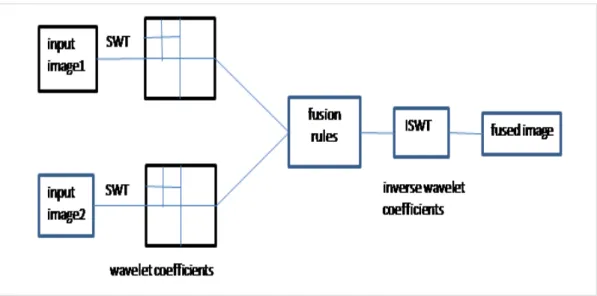
Figure 1: General diagram for image fusion using SWT
In image processing, Stationary Wavelet Transform (SWT) gives productive outcomes in the barrier of image contrast, quality, image resolution etc. SWT provides improved approximation because of its shift invariance capacity in compared with traditional Discrete Wavelet Transform (DWT). SWT is linear, easy to implement and provides the same number of output at each level in compared with the inputs. In this fusion methods, input images decomposed by (SWT) into particular sub-bands such as Approximation (A),Vertical (V),Horizontal
110
(H),Diagonal (D) details. Fusion is performed by using the Intuitionistic Fuzzy Sets (IFS) rules with respective sub-bands. Then apply inverse stationary wavelet transform to get to final fused image that is more informative, high image quality with less noise. Various types of image fusion rules using SWT with Intuitionistic Fuzzy Sets (IFS) is discusses in below.
2. Various intuitionistic fuzzy Sets based (IFS) fusion rules:
According to Atanassov, IFS is mention as follows [10].
If X is a non-empty set then a fuzzy set A from x defined as,
𝑨𝑨 = {𝒙𝒙, 𝝁𝝁𝑨𝑨(𝒙𝒙), 𝑽𝑽𝑨𝑨(𝒙𝒙), 𝒙𝒙 ∈ 𝑿𝑿}
Where 𝜇𝜇𝐴𝐴(𝑥𝑥) is the membership function and its value is defined as 𝜇𝜇𝐴𝐴(𝑥𝑥) → [0,1] and the non-membership function is described as 𝑉𝑉𝐴𝐴(𝑥𝑥) → [0,1]. The degree of non-membership and membership function is always
0 ≤ 𝜇𝜇𝐴𝐴(𝑥𝑥) + 𝑉𝑉𝐴𝐴(𝑥𝑥) ≤ 1 for all values of x ∈ X. In IFS, 𝜋𝜋𝐴𝐴(𝑥𝑥) is defined as hesitation of x in A.
𝜋𝜋𝐴𝐴(𝑥𝑥) = 1 − 𝜇𝜇𝐴𝐴(𝑥𝑥) − 𝑉𝑉𝐴𝐴(𝑥𝑥), the range of mention as 𝜋𝜋𝐴𝐴(𝑥𝑥) ∈ [0,1] and 0 ≤ 𝜋𝜋𝐴𝐴(𝑥𝑥) ≤ 1.
If I (m,n) and J (m,n) are the two different images and 𝜇𝜇𝐼𝐼(𝑥𝑥), 𝜇𝜇𝐽𝐽(𝑥𝑥) are the membership functions, 𝑉𝑉𝐼𝐼(𝑥𝑥), 𝑉𝑉𝐽𝐽(𝑥𝑥) are the non-membership functions then some fusion rules can be express as-
Avg 𝑜𝑜𝑜𝑜𝑜𝑜𝑜𝑜𝑜𝑜𝑜𝑜𝑜𝑜𝑜𝑜𝑜𝑜 = ��𝜇𝜇𝐼𝐼(𝑥𝑥)+𝜇𝜇𝐽𝐽(𝑥𝑥)� 2 , �𝑉𝑉𝐼𝐼(𝑥𝑥)+𝑉𝑉𝐽𝐽(𝑥𝑥)� 2 � 𝑈𝑈𝑜𝑜𝑜𝑜𝑜𝑜𝑈𝑈 𝑜𝑜𝑜𝑜𝑜𝑜𝑜𝑜𝑜𝑜𝑜𝑜𝑜𝑜𝑜𝑜𝑜𝑜 = �𝑚𝑚𝑜𝑜𝑥𝑥 �𝜇𝜇𝐼𝐼(𝑥𝑥), 𝜇𝜇𝐽𝐽(𝑥𝑥)� , 𝑚𝑚𝑜𝑜𝑜𝑜 �𝑉𝑉𝐼𝐼(𝑥𝑥), 𝑉𝑉𝐽𝐽(𝑥𝑥)�� intersection 𝑜𝑜𝑜𝑜𝑜𝑜𝑜𝑜𝑜𝑜𝑜𝑜𝑜𝑜𝑜𝑜𝑜𝑜 = �𝑚𝑚𝑜𝑜𝑜𝑜 �𝜇𝜇𝐼𝐼(𝑥𝑥), 𝜇𝜇𝐽𝐽(𝑥𝑥)� , 𝑚𝑚𝑜𝑜𝑥𝑥 �𝑉𝑉𝐼𝐼(𝑥𝑥), 𝑉𝑉𝐽𝐽(𝑥𝑥)�� 𝐴𝐴𝐴𝐴𝐴𝐴𝑜𝑜𝑜𝑜𝑜𝑜𝑜𝑜𝑜𝑜 = �𝜇𝜇𝐼𝐼(𝑥𝑥) + 𝜇𝜇𝐽𝐽(𝑥𝑥) − 𝜇𝜇𝐼𝐼(𝑥𝑥)𝜇𝜇𝐽𝐽(𝑥𝑥), 𝑉𝑉𝐼𝐼(𝑥𝑥), 𝑉𝑉𝐽𝐽(𝑥𝑥)� 𝑀𝑀𝑈𝑈𝑀𝑀𝑜𝑜𝑜𝑜𝑜𝑜𝑀𝑀𝑜𝑜𝑀𝑀𝑜𝑜𝑜𝑜𝑜𝑜𝑜𝑜𝑜𝑜 = �𝜇𝜇𝐼𝐼(𝑥𝑥)𝜇𝜇𝐽𝐽(𝑥𝑥), 𝑉𝑉𝐼𝐼(𝑥𝑥) + 𝑉𝑉𝐽𝐽(𝑥𝑥) − 𝑉𝑉𝐼𝐼(𝑥𝑥), 𝑉𝑉𝐽𝐽(𝑥𝑥)� 𝑚𝑚𝑜𝑜𝐴𝐴𝑜𝑜𝑜𝑜𝑜𝑜𝑜𝑜𝑜𝑜 𝑜𝑜𝑜𝑜𝑜𝑜𝑜𝑜𝑜𝑜𝑖𝑖𝑜𝑜𝑀𝑀𝑜𝑜𝑜𝑜𝑜𝑜𝑜𝑜 = �𝑚𝑚𝑜𝑜𝑜𝑜�(1 − 𝑉𝑉𝐼𝐼(𝑥𝑥)), (1 − 𝑉𝑉𝐽𝐽(𝑥𝑥))�, 𝑚𝑚𝑜𝑜𝑥𝑥�(1 − 𝜇𝜇𝐼𝐼(𝑥𝑥)), (1 − 𝜇𝜇𝐽𝐽(𝑥𝑥))�� 𝑁𝑁ew 𝑜𝑜𝑜𝑜𝑜𝑜𝑜𝑜𝑜𝑜𝑜𝑜𝑜𝑜𝑜𝑜𝑜𝑜 = �𝑚𝑚𝑜𝑜𝑥𝑥�𝑉𝑉𝐼𝐼(𝑥𝑥), min (𝜇𝜇𝐼𝐼(𝑥𝑥), 𝜇𝜇𝐽𝐽(𝑥𝑥))�, 𝑚𝑚𝑜𝑜𝑜𝑜�𝜇𝜇𝐼𝐼(𝑥𝑥), max (𝑉𝑉𝐼𝐼(𝑥𝑥), 𝑉𝑉𝐽𝐽(𝑥𝑥))�� 3. Experimental results and comparative analysis :
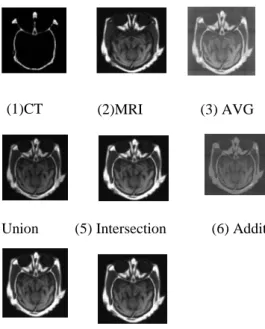
Experiment applied on various types of images such as medical images, multi-clock images, aircraft images etc. The visual result of medical image fusion shown in Figure 2 and Figure 5 represents the fusion results of multi-clock images. Standard deviation (SD) is the measurement component of image contrast. Highest value of SD mentions the superior image contrast. Spatial frequency (SF) is used to represent the universal activity of the
111
fused image. Massive SF results provide better image fusion results. On the other hand, huge amount of Mutual Information (MI) gives the improved image quality. Fusion results of various IFS rules for medical image shown in below-
(1)CT (2)MRI
(3) AVG
(4) Union (5) Intersection (6) Addition
(7) Moderate
Intersection
(8) New operation
Figure 2: Output results of different IFS fusion methods for medical images.
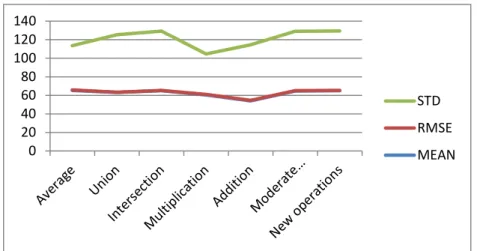
Table-1 shows that, according to the experimental results among all of the IFS operations ‘New operations’ provide better fusion results in compared with other IFS rules. Intersection and Moderate intersections outputs are very closure to the ‘New operations’. ‘New operations’ have high values of SF, that indicate the fused image has more functional activity compared with others. It has also high values of STD and MEAN and lowest value of RMSE that represents better image quality with optimum error level.
Table1: Experimental results comparison of Medical images for various IFS rules.
Fusion methods MEAN c STD RMSE
Average 65.2105 2.07 47.8329 0.5571 Union 63.0943 2.40 61.9395 0.3327 Intersection 64.9986 2.49 63.8943 0.3026 Multiplication 60.3642 1.95 43.6279 0.6962 Addition 54.0943 2.06 59.8895 0.4683 Moderate intersection 64.7239 2.50 64.0312 0.3024 New operations 65.0204 2.68 64.1030 0.3022
112
Figure 3: Performance analysis of SF values for medical images.
Figure 4: Performance analysis of MEAN, RMSE and STD values for medical images.
Visual outcomes of multi-clock also shows that the ‘New operation’ provides better fusion result in compared with Union, Intersection, Moderate Intersection and other IFS rules.
(a1) (b1)
Figure 5: Experimental outcome of (a1) Union, (b1) Intersection, (c1): Moderate intersection, (d1): New operation of different IFS methods for multi-clock images.
0 0.51 1.52 2.53
SF
SF 0 20 40 60 80 100 120 140 STD RMSE MEAN113
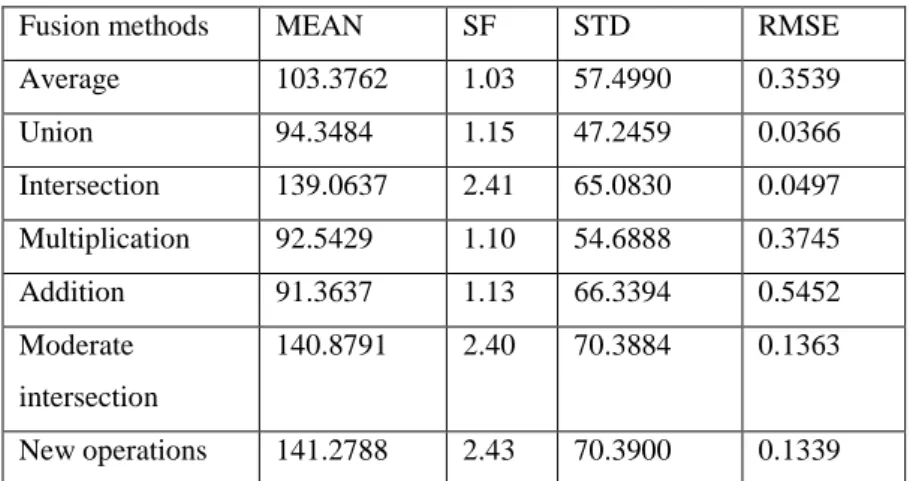
Table2: Experimental results comparison of multi-clock images for different IFS rules
Fusion methods MEAN SF STD RMSE
Average 103.3762 1.03 57.4990 0.3539 Union 94.3484 1.15 47.2459 0.0366 Intersection 139.0637 2.41 65.0830 0.0497 Multiplication 92.5429 1.10 54.6888 0.3745 Addition 91.3637 1.13 66.3394 0.5452 Moderate intersection 140.8791 2.40 70.3884 0.1363 New operations 141.2788 2.43 70.3900 0.1339
The fusion result for multi-clock images using SWT with different IFS rules also shows that three methods are almost same in compared with other methods. But ‘New operation’ provides highest value of SF, STD and lowest value of RMSE that means it gives best solution from other rules.
Figure 6: Performance analysis of SF values for Multi-clock images.
Figure 7: Performance analysis of MEAN, STD and RMSE values for Multi-clock images.
0 0.51 1.52 2.53
SF
SF 0 50 100 150 MEAN RMSE STD114
4. ConclusionAccording to experimental results and overall performance it is clear that three methods are almost similar to each other. But after carefully observation, it is proof that the ‘New operation’ of IFS using SWT provide better fusion results in compared with other methods because of its less complex structure with simple shape of membership and non-membership function. That means, SWT with IFS ‘New operation’ fusion method capture highest amount of information from source images with slight error.
Reference
[1] O. Prakash, A. kumar, A. khare,“Pixel-level image fusion scheme based on steerable pyramid wavelet transform using absolute maximum selection fusion rule”, International Conference on Issues and Challenges in Intelligent Computing Techniques (ICICT),IEEE,2014.
[2] S. Dammavalam, Seetha,H. Munaga,“ Iterative Image Fusion using Neuro Fuzzy Logic and Applications”,IEEE,2012.
[3] Feng, gang, Jin, ming, jun,“Comparative analysis of different methods for image enhancement”, springer, PP- 4563−4570,2014.
[4] N. Kathiresan , J. Samuel Manoharan,“ A Comparative Analysis of Fusion Techniques Based on Multi Resolution Transforms”,springer, PP- 61-65,2015.
[5] Abdulazeez,A. Razak Salleh,“ Complex Intuitionistic Fuzzy Sets”,International conference on fundamental and applied science, PP- 464-470,2012.
[6] P. A.Ejegwa, S.O. Akowe, P.M. Otene, J.M. Ikyule,“ An Overview On Intuitionistic Fuzzy Sets”, international journal of scientific & technology research volume 3, issue 3, march 2014.
[7] Z. Wang, D. Ziou, C. Armenakis, D. Li, and Q. Li,“ A Comparative Analysis of Image Fusion Methods”, IEEE transactions on geoscience and remote sensing, vol. 43, no. 6, June 2005.
[8] S. Broumi,P. Majumdar,F. Smarandache,“ New Operations on Intuitionistic Fuzzy Soft Sets based on Second Zadeh's logical Operators”, I.J. Information Engineering and Electronic Business, PP-25-31,2014.
[9] S. Dahiya, P. K. Garg, M. K. Jat ,“ A comparative study of various pixel based image fusion techniques as applied to an urban environment”, International Journal of Image and Data Fusion,Vol-4,No-3, PP-197-213,2013.
[10] K.T. Atanassov,“ intuitionistic fuzzy sets”, Fuzzy Sets and Systems, Elsevier ,PP-87-96,1986.
115
fusion”, Elsevier,2014.[12] M.D. Nandeesh and Dr.M. Meenakshi ,“Image Fusion Algorithms for Medical Images-A Comparison”, Bonfring International Journal of Advances in Image Processing, Vol. 5, No. 3, July 2015.
[13] S. Krishnamoorthy, K P Soman,“Implementation and Comparative Study of Image Fusion Algorithms”, International Journal of Computer Applications (0975 – 8887) Volume 9– No.2, November 2010.