for
Computer Vision
Dr. Nazli Farajidavar
July 2015
for
Computer Vision
Nazli Farajidavar
Submitted for the Degree of
Doctor of Philosophy
from the
University of Surrey
Centre for Vision, Speech and Signal Processing
Faculty of Engineering and Physical Sciences
University of Surrey
Guildford, Surrey GU2 7XH, U.K.
July 2015
© Nazli Farajidavar 2015
Artificial intelligent and machine learning technologies have already achieved significant
suc-cess in classification, regression and clustering. However, many machine learning methods
work well only under a common assumption that training and test data are drawn from the
same feature space and the same distribution. A real-world applications is in sports footage,
where an intelligent system has been designed and trained to detect score-changing events in
a Tennis single match and we are interested to transfer this learning to either Tennis doubles
game or even a more challenging domain such as Badminton. In such distribution changes,
most statistical models need to be rebuilt, using newly collected training data. In many real
world applications, it is expensive or even impossible to collect the required training data and
rebuild the models. One of the ultimate goals of the open ended learning systems is to take
ad-vantage of previous experience/ knowledge in dealing with similar future problems. Two levels
of learning can be identified in such scenarios. One draws on the data by capturing the pattern
and regularities which enables reliable predictions on new samples. The other starts from an
acquired source of knowledge and focuses on how to generalise it to a new target concept; this
is also known as
transfer learning
which is going to be the main focus of this thesis. This
work is devoted to a second level of learning by focusing on how to transfer information from
previous learnings, exploiting it on a new learning problem with not supervisory information
available for new target data. We propose several solutions to such tasks by leveraging over
prior models or features.
In the first part of the thesis we show how to estimate reliable transformations from the source
domain to the target domain with the aim of reducing the dissimilarities between the source
class-conditional distribution and a new unlabelled target distribution. We then later present a
fully automated transfer learning framework which approaches the problem by combining four
types of adaptation: a projection to lower dimensional space that is shared between the two
domains, a set of local transformations to further increase the domain similarity, a classifier
parameter adaptation method which modifies the learner for the new domain and a set of
class-We conduct experiments on a wide range of image and video classification tasks. class-We test our
proposed methods and show that, in all cases, leveraging knowledge from a related domain can
improve performance when there are no labels available for direct training on the new target
data.
Key words:
Machine Learning, Classification, Transfer Learning, Domain Adaptation.
Email:
WWW: http://www.surrey.ac.uk/cvssp
Foremost, I would like to express my sincere gratitude to my advisors Dr. Teofilo deCampos
and Prof. Josef Kittler for the continuous support of my Ph.D study and research, for their
patience, motivation, enthusiasm, and immense knowledge. Their guidance helped me in all
the time of research and writing of this thesis. I could not have imagined having better advisors
and mentors for my Ph.D study.
Besides my advisor, I would like to thank the rest of my thesis committee: Dr. Timothy
Hospedales, Dr. Janko Calic, Dr. Walterio Mayol-Cuevas and Dr. Terry Windeatt for their
encouragement, insightful comments, and helpful questions.
My sincere thanks also goes to Dr. John Collomosse for offering me a research opportunity in
his group and guiding my work on his project.
I thank my fellow labmates in the Center for Vision, Speach and Signal Processing Group: Dr.
Chi Ho Chan, Dr. Paul Koppen, Dr. Cemre Zor and Dr. Pouria Mortazavian for stimulating
discussions and for all the fun we have had in the last four years.
Last but not the least, I would like to thank my family: my partner Dr. Luca Remaggi, my
parents Vida Khalilian and Dr. Mansour Farajidavar and my beloved brother Dr. Armin
Fara-jidavar for supporting me spiritually throughout my life.
1 Introduction
1
1.1 Problem: Transfer Learning for Computer Vision . . . .
3
1.2 Contributions . . . .
6
1.3 Outline . . . .
8
1.4 List of Publications . . . .
8
2 Background
11
2.1 Notation . . . 13
2.2 Feature Extraction Methods for Image and Video in Computer Vision . . . 14
2.2.1 Histograms of Oriented Gradients in 3D Space-time Blocks (HOG3D) . 15
2.2.2 Bag of Visual Words . . . 17
2.2.3 Deep Convolutional Activation Feature (DeCAF) . . . 17
2.3 Feature Selection . . . 20
2.3.1 Principal Component Analysis . . . 21
2.3.2 Linear Discriminant Analysis . . . 22
2.4 Classification . . . 24
2.4.1 Nearest Neighbor . . . 24
2.4.2 Logistic Regression . . . 25
2.4.3 Support Vector Machines (SVM) . . . 26
2.4.4 Gaussian Classifier . . . 29
2.4.5 Kernel Discriminant Analysis . . . 30
2.5 Transfer Learning . . . 31
2.5.1 Inductive Transfer Learning . . . 33
2.5.2 Transductive Transfer Learning . . . 37
2.5.3 Unsupervised Transfer Learning . . . 43
2.6 Summary . . . 43
3 Databases
45
3.1 ACASVA: Player Actions Database . . . 46
3.1.1 ACASVA System . . . 46
3.1.2 Player Action Dataset and Ground-truth Annotation . . . 52
3.1.3 Tennis and Badminton Ground Truth Annotation System . . . 56
3.1.4 Feature Space Visualisations . . . 57
3.2 Chars74K Digit Dataset . . . 61
3.3 MNIST-USPS Database . . . 62
3.4 Caltech+Office Database . . . 64
3.5 COIL20 Dataset . . . 65
4 Posterior Adaptation via Feature Space Transformation
71
4.1 Introduction . . . 72
4.2 Related Work . . . 73
4.3 Feature Space Class-conditional Transformations . . . 75
4.3.1 Arnold
et al. ’s Method and Proposed Modifications (Reweight) . . . . 76
4.3.2 Translating and Scaling Features (TST) . . . 79
4.4 Experiments and Results . . . 81
4.4.1 Synthetic 3-Class Dataset Experiment . . . 81
4.4.2 Transfer from Tennis Single to Double Matches . . . 81
4.4.3 Badminton Dataset Experiment . . . 85
4.4.4 Transductive Transfer with Additional Target Adaptation Set . . . 86
4.5 Summary . . . 90
5 Transductive Transfer Machine
95
5.1 Related work . . . 97
5.2 Marginal and conditional distribution adaptation . . . 97
5.2.1 Shared space detection with MMD . . . 100
5.2.2 Sample-based adaptation with TransGrad . . . 102
5.2.3 Conditional distribution adaptation with TST . . . 104
5.2.4 Iterative refinement of the conditional distribution . . . 106
5.2.5 Stopping criterion . . . 106
5.2.7 The TTM algorithm and its computational complexity . . . 109
5.3 Experimental Evaluation . . . 110
5.3.1 Experiments and Results . . . 111
5.4 Summary . . . 120
6 Conclusions and Future work
123
6.1 Conclusion . . . 124
6.2 Future Work . . . 126
A Transductive Random Forest
129
A.1 Related Work . . . 130
A.2 Decision Trees . . . 131
A.2.1 Tree training (off-line) . . . 132
A.2.2 Tree testing (runtime) . . . 135
A.3 Random Forest . . . 135
A.3.1 The training objective function of Random Forest . . . 136
A.3.2 The randomness model . . . 136
A.3.3 The ensemble model: RF . . . 137
A.4 Semi-supervised Random Forest . . . 137
A.4.1 The Training objective function for Semi-supervised Random Forest . . 138
A.4.2 Label propagation for SSRF . . . 139
A.4.3 The ensemble model: SSRF . . . 140
A.5.1 The training objective function . . . 140
A.5.2 The randomness model . . . 142
A.6 Adaptive Transductive Random Forest . . . 143
A.7 Experiments and Results . . . 143
A.7.1 Two-Moons Synthetic Dataset Experiments . . . 144
A.7.2 Experiments on the Chars74K Dataset . . . 153
A.8 Summary . . . 162
B Additional Results
165
B.1 Iterative Algorithms for TST Domain Adaptation . . . 165
1.1 Traditional Machine Learning vs. Transfer Learning . . . .
4
1.2 TTL Applications . . . .
7
2.1 HOG3D Diagram . . . 16
2.2 SURF BoW Diagram . . . 18
2.3 CNN structure . . . 19
2.4 PCA . . . 22
2.5 Transfer Learning Diagram . . . 33
3.1 A detailed diagram of the tennis video analysis system . . . 48
3.2 A simplified diagram of the tennis video analysis system (taken from [85]). . . 49
3.3 An illustrative example of the composition of a tennis video. The length of
each shot is proportional to the width of the corresponding block in the figure
(taken from [85]). . . 49
3.4 Shot types: (a) crowd (b) close-up (c) play (d) commercial. . . 50
3.5 The GUI of the tennis video annotation system [85]. . . 51
3.6 Tennis Data: Player-Actions Samples . . . 53
3.7 Badminton Data: Player-Actions Samples . . . 54
3.8 Tennis and Badminton Annotation Tool . . . 56
3.9 Tennis Data HoG3D Correlation Matrix . . . 58
3.10 Tennis Data Projection in LDA Space . . . 59
3.11 Tennis Data: Source and Target Kernels . . . 60
3.12 Chars74k Database . . . 62
3.13 USPS Database . . . 63
3.14 MNIST . . . 64
3.15 Caltech+Office Database . . . 66
3.16 COIL20 Dataset-1 . . . 67
3.17 COIL20 Dataset2 . . . 68
4.1 Linear source clusters scaling: the binary classification task where the squares
and crosses are representing the samples of each class; the source clusters in
the left panel are scaled to better demonstrate the target distribution of the right
panel. . . 79
4.2 Linear source clusters translation and scaling: he binary classification task
where the squares and crosses are representing the samples of each class; the
source clusters in the left panel are scaled and translated to better demonstrate
the target distribution of the right panel. . . 80
4.4 Distance Metric Evaluations for KDA Kernels . . . 82
4.6 Tennis Data: Badminton vs Different Tennis Singles Datasets . . . 85
4.7 Serve detection failure in transfer from Badminton to Tennis, due to their
dif-ferent visual appearance. . . 88
4.3 Synthetic Data: Graphical Results . . . 92
4.5 Tennis Data: Numerical Results vs Transfer Rate Variations . . . 93
4.8 Tennis Data: Single vs Double New Results . . . 93
5.1 Public Data: 2D Projected Graphs of TTM Performance . . . 98
5.2 TTM Diagram . . . 110
5.3 Bar chart demonstrating the same results of Table5.4. . . 114
5.4 Bar chart demonstrating the same results of Table5.6 . . . 118
5.5
D
clusters
vs. averaged accuracy enhancement over the PCA baseline graph for
Table5.3 transfer tasks. . . 119
5.6
D
global
vs. averaged accuracy enhancement over the PCA baseline graph for
Table5.3 transfer tasks. . . 120
5.7 The effect of different
00
values and number of GMM clusters in the
Trans-Grad step of our framework on the final performance of the pipeline for three
cross- domain experiments. Constant lines show the baseline accuracy for each
experiment. . . 121
6.1 Future Work Diagram1 . . . 128
A.1 Decision Tree Flowchart . . . 132
A.2 Tree Testing (runtime Phase) . . . 133
A.3 Twisted Moons: Graphical Results with DT, RF and SSRF . . . 145
A.4 Translated and Scaled Moons: Data Representations . . . 148
A.5 Translated and Scaled Data: Transfer Parameter Estimation Graphs . . . 149
A.7 Char74 Data: Noise Insertion Images . . . 154
A.8 Char74: Transductive-SSRF Results . . . 155
A.9 Char74: Transductive-SSRF Results (Futher Experiments) . . . 156
A.10 Char74: Fine Evaluations of the Transductive-Tree Failure Case (Graphical
Representation) . . . 158
A.11 Char74: Transformation Estimation with Transductive-SSRF (Failure
Case-Study) . . . 159
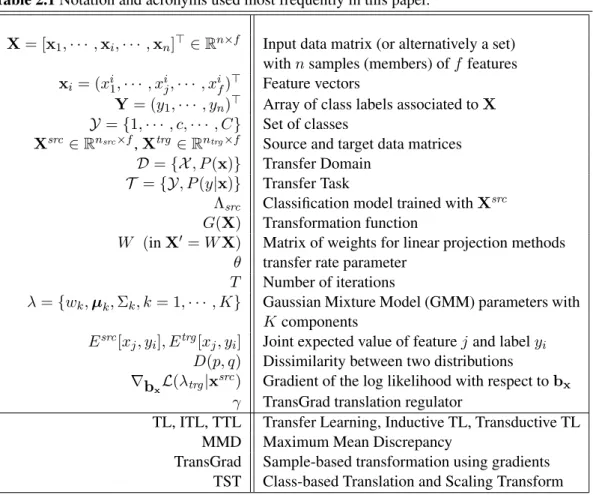
2.1 Notation and acronyms used most frequently in this paper. . . 15
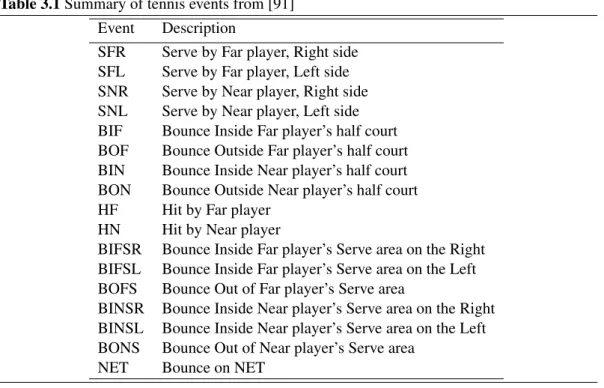
3.1 Summary of tennis events from [91] . . . 52
3.2 Tennis Data: Clusters Data-Distributions . . . 53
3.3 Comparison between Tennis and Badminton. Note that, in the table, match
intensity refers to the actual time the ball/shuttle was in flight, divided by the
length of the match. . . 55
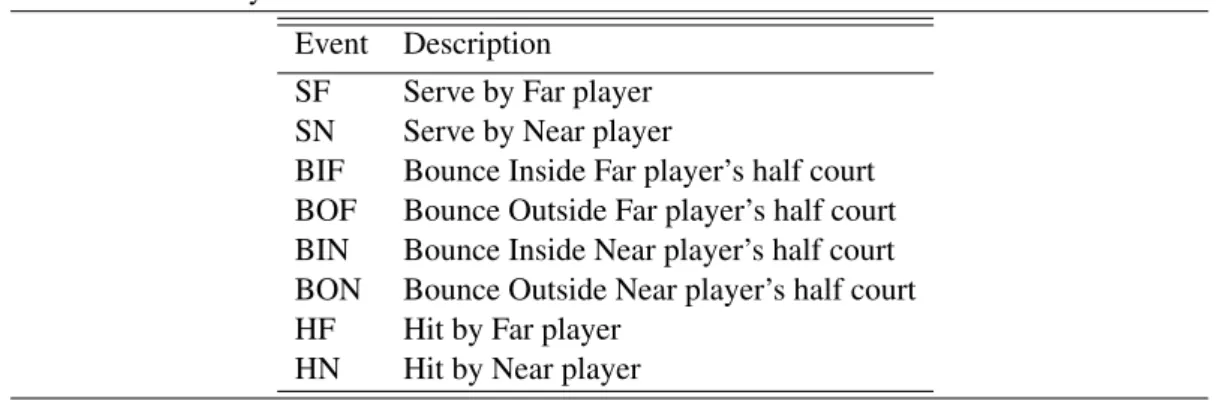
3.4 Summary of Badminton events . . . 57
3.5 USPS data distribution [31]. . . 63
4.1 Tennis Data: semi-Supervised Domain Adaptation Exp.1 . . . 87
4.2 Tennis Data: semi-Supervised Domain Adaptation Exp.2 . . . 89
5.1 Classifier selection and model adaptation . . . 108
5.2 Classifiers evaluations on individual domains: 5-fold cross validation accuracy
of a nearest neighbour classifier. All the datasets are
l2-normalized. . . 111
5.3 Cross-domain dissimilarities between domains (src
!
trg
), with datasets
ab-breviated as M: MNIST, U: USPS, C: Caltech, A: Amazon, W: Webcam, and
D: DSLR. . . 112
5.4 Recognition accuracies with datasets abbreviated as M: MNIST, U: USPS, C:
Caltech, A: Amazon, W: Webcam, and D: DSLR. Comparisons start the
base-line accuracy with NN and PCA followed by the results of the discussed TTL
algorithms. The last two columns show the effect of the classifier selection and
model adaptation techniques (5.2.6) on JDA and TTM algorithms. . . 113
5.5 Recognition accuracies with NN classifiers on target domains using differnet
shared subspace projection methods. . . 116
5.6 Results on Caltech+office dataset using DeCAF features. . . 117
A.1 Twisted Moons: Numerical Results . . . 146
A.2 Moons: DT, RF and SSRF Numerical Performance Comparisons . . . 153
A.3 Char74: DT vs Transductive-SSRF Numerical Results . . . 160
A.4 Char74: Effect of PCA Dimensionality Reduction before Applying the TL
Al-gorithm . . . 161
A.5 Char74: ERF, TRf and ATRF Performance Evaluations . . . 161
A.6 Public Data: JDA, Transductive-SSRF and NN-TST Performance Evaluations . 162
A.7 Public Data: Transductive-RF vs Transdutive-SSRF and NN . . . 162
Introduction
As human beings, our learning capacity develops progressively in time as we grow. At the age
of six, we recognise around 104 object categories and we keep learning more throughout our
life [13]. Moreover we tend to semantically organise all our knowledge into meaningful
tax-onomies: concepts and categories are grouped on the basis of the common properties acquired
through our five senses [3, 32, 55]. This intrinsically means that any new concept is not learned
in isolation, but considering connections to what is already known, which makes analogical
reasoning (the skill of building analogies) one of the cores of human intelligence [71]. This
results in practical advantages: it might be easier to learn French if one already knows Italian
and English and it might be easier to learn playing badminton if one already knows tennis.
In the context of computer vision, an image in the most basic representation is defined through a
matrix of its pixels intensity values and the semantic organisation of an image database is know
as classification where an ideal image classifier should be able to exploit complex high
dimen-sional feature representations even when only a few labelled training samples are available. In
most classification scenarios, it is expensive to acquire vast amounts of labelled training
sam-ples in order to provide classifiers with a good coverage of the feature space. One possible way
of dealing with this problem is to synthesise images of training objects using computer graphics
techniques (e.g. [147]), but their appearance may not be realistic and it is not possible to model
all possible backgrounds. Practitioners often resort to crowd sourcing [19], but the annotations
obtained are either costly or unreliable. Ideally, an image classifier should be initially capable
of detecting similarities between data distributions and subsequently facilitates the exploitation
of the required knowledge from all the previously trained reliable models, just as human can
exploit previous experience when learning some similar concepts.
For example, when a child learns to recognise a new letter of the alphabet he will use
exam-ples provided by people with different hand-writing styles, using pens of different colors and
thicknesses. Without any prior knowledge a child would need to consider a large set of
fea-tures as potentially relevant for learning the new concept, so we would expect the child to need
a large number of examples. But if the child has previously learnt to recognise other letters,
he can probably discern the relevant attributes (e.g. number of lines, line curvatures) from the
irrelevant ones (e.g. the colour of the lines) and learn the new concept with fewer examples.
This observation suggests that a sample efficient image classification algorithm might need to
exploit knowledge gained from related tasks.
In the absence of such prior knowledge, a typical image classification task would require the
exploration of a large and complex feature space. In such high dimensional feature spaces
some features will be discriminative while most probably a large number of them are irrelevant.
Additionally, out of this set of discriminative features some might help in detecting the relations
in between similar tasks and hence be beneficial for a new related concept classification. While
we do not know a-priori what features are irrelevant, related tasks might share these features
and we can use training data from these tasks to discover them.
An initial step to this task and feature relevancy discovery is to first be able to tell which tasks
can be classified as similar. While many recent works [53, 52, 138] studied this as zero-shot
learning, in this thesis we assumed that our system is already aware of the task similarities
between the two training (source) data an a given new unlabelled test (target) data.
The goal of this thesis is to develop efficient transfer learning algorithms for image
classifica-tion that can exploit rich feature representaclassifica-tions.
1.1 Problem: Transfer Learning for Computer Vision
Recently, there has been a significant growth in multimedia data production. This data exists
in various different forms such as broadcast content (including television, DVDs, BluRays and
Internet) and personal content (e.g. uploads from hand-held devices); it can also be recorded
interviews or meetings, or footage from surveillance cameras. Most of this data is intended
for general viewing and hence basic labelling (Date, Time and Title etc.) is attached to it
which is often inaccurate. However in many cases it would be useful to add additional labels
to retrieve information in a more flexible and systematic fashion (e.g. a Tennis sports video can
potentially be labelled with match-events description). Such meta-data will assist in finding
material within the multimedia footage via browsing, querying or searching.
For easy retrieval of information from a very large quantity of archived images of videos, it
would be very useful to have them annotated
automatically i.e. to create a system that could
understand the visual content (manual annotation being too unwieldy). The annotation task can
become even more challenging when the new test data does not follow the same distribution
as of the initial training data. Unlike traditional machine learning methods, transfer learning
methods do not assume that training and test data are drawn from the same distribution [123],
hence fitting well to this annotation problem.
Traditionally, machine learning algorithms were training models separately even for similar
training domains. Transfer Learning algorithms try to alleviate the training by benefiting from
the relations between similar domains. Figure 1.1 illustrates the difference between the
learn-ing process of traditional machine learnlearn-ing and transfer learnlearn-ing. As we can see, traditional
machine learning techniques try to learn each task from scratch, while transfer learning
tech-niques try to transfer the knowledge from some previous task(s) to a target task when the latter
has fewer high-quality or labelled training data [123].
⇥⇤⌅⇧⌃⇧⌥ ⇤ ⌦↵ ⌦ ✏⌦
⇥⇤⌅⇧⌃⇧⌥ ⇤ ⌦↵ ⌦ ✏⌦
⇥⇤⌅⇧⌃⇧⌥ ⌅⌦↵⇥
⌦
⇥⇤⌅⇧⌃⇧⌥ ⌅⌦↵⇥
⌦
⌅⇤✏⌃⇣⌃⌦⇧⇤⌘ ✓
⌅⇤✏⌃⇣⌃⌦⇧⇤⌘ ✓
⇥⇤⌅⇧⌃⇧⌥ ⌅⌦↵⇥
⌦
⇥⇤⌅⇧⌃⇧⌥ ⌅⌦↵⇥
⌦
⌅⇤⇧ ⇥⌅ ⇥⇤⌅⇧⌃⇧⌥
⌅⇤⇧ ⇥⌅ ⇥⇤⌅⇧⌃⇧⌥
⇣⌅⇤⌃⇧⌃⇧⌥ ⌃⇣⇥◆
⇣⌅⇤⌃⇧⌃⇧⌥ ⌃⇣⇥◆
⇣⇤⇥ ⇧ ⌘⌦✓◆ ⌃⇣
⇣⇤⇥ ⇧ ⌘⌦✓◆ ⌃⇣
⇣⌅⇤⌃⇧⌃⇧⌥ ⌃⇣⇥◆
⇣⌅⇤⌃⇧⌃⇧⌥ ⌃⇣⇥◆
⇣⇤⇥ ⇧ ⌘⌦✓◆ ⌃⇣
⇣⇤⇥ ⇧ ⌘⌦✓◆ ⌃⇣
⇥⇤⌅⇧⌃⌥ ⌃
⇥⇤⌅⇧⌃⌥ ⌃
The field of transfer learning includes a range of problems in which there is a change of domain
or task between source and target sets. Transfer learning techniques are becoming more popular
in Computer Vision, particularly after Torralba and Efros [151] discovered significant biases in
object classification datasets.
Based on Pan and Yang’s survey [123], Transfer Learning (TL) can be categorised into three
types of approaches; Inductive Transfer Learning (ITL) where some labelled data in the
tar-get domain are required to induce an objective predictive model for use in the tartar-get domain,
Transductive Transfer Learning (TTL) where no labelled data in the target domain are available
at the training time, and finally Unsupervised Transfer Learning (UTL) where no labelled data
is available in source or target domains. While much of the work focuses on
inductive
transfer
learning problems, which assume that labelled samples are available both in the training/source
and test/target domains, in this thesis we focus on the case in which only unlabelled samples are
available in the test/target domain. This is a
transductive
transfer learning (TTL) problem, i.e.,
the joint probability distribution of samples and classes in the source domain,
P
(X
src
,
Y
src
), is
assumed to be different, but related to that of a target domain joint distribution,
P
(X
trg
,
Y
trg
),
but labels
Y
trg
are not available in the target set. We follow a similar notation to that of [123]
(see Table 2.1).
Transductive transfer learning methods can potentially improve a very wide range of
classifica-tion tasks, as it is often the case that a domain change happens between training and applicaclassifica-tion
of algorithms, and it is also very common that unlabelled samples are available in the target
domain.
The main focus of this thesis is then in looking for a common latent representation and data
transformation techniques which reduce the dissimilarities of the data configuration in the
source (training) and the target (test) domains after transformation.
Recent advances in computer vision and machine learning as well as the exponential growth
in the processing capacity and memory of computer technology have created the conditions
where it becomes timely to investigate the possibility of designing such systems.
One of the applications is in sports footage which provides a useful test-ground given its fixed,
rule-governed content. To date, there have been several annotation systems developed for
different sports such as football [164], Formula 1 [128], snooker [40] and Tennis [39]. As
part of the work on video data, we focus specifically on court-based games, such as Tennis and
Badminton. We build upon the outcome of a previous project ACASVA (Adaptive Cognition
for Automated Sports Video Annotation) to perform automatic adaptation of the trained system
so that it can be applied to a different game. For instance if the main system has been trained to
interpret a Tennis single match, we aim to transfer this learning to either Tennis doubles game
or even a different domain such as Badminton.
Another example is in image classification where the training set may come from high quality
images (e.g. from DSLR cameras) and the target test set may come from mobile devices.
Fig-ure 1.2 demonstrates instances from three different classes obtained from these two relevant
domains. As one can note the image quality, illumination level and background varies from
one domain to other. TTL methods can potentially generalise classification methods for a wide
range of domains and make them scalable for big data problems.
In this thesis, we employ transformative approaches for solving the transductive transfer
learn-ing problem in which feature transformations are used to adapt the source domain feature
dis-tributions to the target domain. In essence, linear and non-linear joint adaptation of marginal
and conditional distributions of the source and target data are introduced.
1.2 Contributions
The main contribution of this thesis can be listed as follows:
•
Unsupervised adaptation of the conditional distributions:
We propose unsupervised
class-specific transformations for domain adaptation. The technique is based on
estimat-ing linear transformations to adapt the source domain features in order to maximise the
similarity between posterior probability distribution functions (PDF) for each class in
Figure 1.2: Sample images with varying image acquisition quality. Right: sample images
captured by a Webcam camera, Left: images obtained from Amazon webpage .
the source domain and the expected posterior PDF for each class in the target domain
(Chapter 4).
•
Joint adaptation of the marginal and conditional distributions:
We propose Transductive Transfer Machine (TTM) algorithms which combine methods
that adapt the marginal and the conditional distribution of the samples, so that source and
target datasets become more similar, facilitating classification (Chapter 5).
•
Two unsupervised dissimilarity measures for automating the parameter setting of
the proposed data processing pipeline for a new transfer task:
Two dissimilarity measures are devised which enable the proposed pipeline to
automat-ically readjust its parameters for a new transductive transfer task where the source and
target distributions are from different environments (Chapter 5).
•
A classifier selection and model parameter adaptation algorithm:
We proposed Adaptive Transductive Transfer Machine (ATTM) which uses the afore
mentioned dissimilarity measures to select the right classifier and to optimise its
param-eters for a new target domain. We show that our method obtains state-of-the-art results
in cross-domain vision datasets using na¨ıve features, with a significant gain in
computa-tional efficiency in comparison to related methods (Chapter 5).
•
Assessment of semi-supervised random forest for transductive transfer learning:
We have also constructed a transductive transfer version of random forest and study its
performance on unsupervised/ semi-supervised domain adaptation problems (Appendix
A).
1.3 Outline
The structure of the thesis is as follows: Chapter 2 provides the necessary background on
fea-ture extraction methods and classification algorithms. Chapter 3 describes the databases with
their common protocols used in our experiments. In Chapter 4 two transfer learning
meth-ods are proposed and some modifications to the existing methmeth-ods are suggested (published in
[47, 49]). A novel transductive transfer learning pipeline is introduced in Chapter 5, published
in [48, 46]. Finally, in Chapter 6 we draw conclusions and discuss future lines of research. In
addition, in Appendix A we study the semi-supervised random forest and propose a
transduc-tive transfer random forest approach.
1.4 List of Publications
Parts of this thesis appeared in conference proceedings. The list of publications is as follows:
• N. FarajiDavar and T. deCampos and J. Kittler and F.Yang Transductive Transfer
Learn-ing for Action Recognition in Tennis Games (Poster) In 3rd International Workshop on
Video Event Categorization, Tagging and Retrieval for Real-World Applications
(VEC-TaR), in conjunction with 13th International Conference on Computer Vision(ICCV),
Barcelona, Spain 2011 [47]
• N. FarajiDavar and T. deCampos and D. Windridge and J. Kittler and W. Christmas
Do-main Adaptation in the Context of Sport Video Action Recognition (Poster) In DoDo-main
Adaptation Workshop, in conjunction with NIPS, Sierra Nevada, Spain 2011 [49]
• N. Farajidavar, T. de Campos, D. Windridge, J. Kittler, W. Christmas. Domain
Adapta-tion in the Context of Sport Video AcAdapta-tion RecogniAdapta-tion (Poster), 4th UK Computer Vision
Student Workshop (BMVW), in conjunction with the British Machine Vision Conference
(BMVC), Guildford, September 2012 [50]
• N. Farajidavar, T. de Campos, J. Kittler. Transductive Transfer Machine, In Proceedings
of Asian Conference on Computer Vision (ACCV), Singapore, 01 November 2014 [48]
• N. Farajidavar, T. de Campos, J. Kittler. Adaptive Transfer Machine, In Proceedings of
Background
In this chapter, we review the theoretical concepts, technical ideas and background knowledge
on feature extraction, classification and transfer learning. We also give a brief review of some
of the apparatus used in the rest of this thesis.
The goal of classification is to take an input vector
x
2
X
and to assign to it a discrete class
label
y
2
Y
, where the number of classes is
C
=
|Y|
. In the most common scenario, the
classes are taken to be exclusive, so that each input is assigned to one and only one class. The
input space
X
is thereby divided into decision regions whose boundaries are called decision
boundaries or decision surfaces.
The first step is to describe the data in an appropriate manner. In the case of video, a space-time
descriptor is used for that, generating a vectorial representation
x. This may be followed by a
feature extraction and feature selection method to reduce the dimensionality and improve the
discrimination power.
Data sets and parameters can easily get outdated or the training data may not always facilitate
a direct generalisation to the test data. Also, one may need to use knowledge from one domain
for application in another domain (e.g. detection of Spam learnt in English applied to French
emails). Such issues are addressed by transfer learning techniques which are motivated by the
fact that people can intelligently apply knowledge learned previously to solve new problems
faster or with better solutions in different (but related) domains.
The focus of this work is on transfer learning, which is reviewed in Chapter 4 . But before
that, in order to provide background for our experiments, we briefly review the methods used
for feature extraction and classification in Sections 2.2 and 2.4, respectively. In Section 2.5
we define the Transfer Learning in mathematical terms and briefly review the litreture of its
taxnomy and variations.
2.1 Notation
This section is a reference for the remaining of this thesis, where we introduce some
nota-tion and defininota-tions. In image and acnota-tion classificanota-tion, as in most classificanota-tion problems,
systems are trained with samples from one set up and often expected to be applied to
an-other set up. Given a sample
x
and a class label
y, the standard statistical classification
task is to assign a probability,
p(y
|
x), to the event of
x
belonging to class
y. In the binary
classification case the labels are
y
2
{
0,
1
}
. Typically, each example
x
i
is represented as
a vector of features
(x
1
i
,
· · ·
, x
f
i
,
· · ·
, x
F
i
)
where
F
is the number of features or
dimen-sions of the feature space (e.g.
X
=
R
F
). The data consists of two disjoint subsets; the
training set
(Xtrain, Ytrain) =
{
(x1, y1),
· · ·
,
(xntrain
, yntrain
)
}
, (e.g. sample feature vectors
obtained from a set of people in a set of environments, illumination conditions, camera
config-urations/types and with certain types of background) available to the model for its training and
the test set
Xtest
=
{
x1, ...,
xntest}
, upon which we want to use our trained classifier to make
predictions. A pattern recognition system is expected to perform well if the test samples
X
test
are obtained in the same conditions as
X
train
,
e.g. if they are new videos of the same people
performing the same actions in the same environments as before.
However, in most application scenarios there is a change of scene, video/image quality,
per-forming actors
etc., so although the domain representation and the label set are the same,
i.e.
X
train
=
X
test
and
Y
train
=
Y
test
, the data distributions are different,
i.e.
p(X
train
)
6
=
p(X
test
).
The two most important definitions in the transfer learning paradigm are those of
Domain
and
Task. A domain is composed of two components: a feature space
X
and a marginal probability
distribution
P
(x), where
x
=
{
x
1
,
· · ·
, x
F
}
2
X. Given a specific domain,
D
=
{X
, P
(x)
}
,
a task
T
consists of two components: a label space
Y
and an objective predictive function
P
(y
|
x). Generally in transfer learning the knowledge obtained from one or more source
do-mains can be used for classification in a new target domain. In the simplest mode we assume
that there exist two domains and two tasks, consisting of source domain,
D
src
and target
do-main,
D
trg
and similarly source and target tasks,
T
src
and
T
trg
respectively. In such
circum-stances transfer learning is proposed as a solution.
For ease of notation,
x
i
j
is the feature
j
of sample
x
i
and
E
src
[x
j
, y]
is used to represent
E
X
src
[x
j
, y]
which is the expected value of the feature
x
j
with label equal to
y,
8
x
2
X
src
and
n
src
train
is the number of labelled training data in the source domain.
The usual traditional machine learning approach is to assume
D
train
⇡
D
test
, and treat this as a
classical generalisation problem in machine learning by means of classifier regularisation [14].
In our problem
D
train
6
=
D
test
. It characterises a special case of
transductive transfer
learn-ing
which has not been covered by Pan and Yang [123] transfer learning survey where both
domain and task are differing from source to target and we do not have access to any labels in
the new target domain: we then aim to improve the learning of the target predictive function
P
(Y
trg
|
X
trg
)
in
D
trg
using the knowledge in
D
src
and
T
src
, where
D
src
6
=
D
trg
.
The solution to such a task will be either transforming the domains in a way that both domains
become more similar or introducing some adaptive classifier which can be generative enough
to fit well the new target domain. For that, we evaluate two methods that transform the features
of
X
src
so that they become more similar to
X
trg
and the classifier is re-trained using the
transformed samples.
The most frequently used notation of this work is summarised in Table 2.1.
2.2 Feature Extraction Methods for Image and Video in Computer
Vision
As in any machine learning architecture, the first step in learning is to efficiently represent
interesting parts of an image (or video) as a compact feature vector which ins known as
feature
extraction
[155]. The goal is to come up with a vectorial representation that is discriminative
enough for a later classification purpose.
Table 2.1
Notation and acronyms used most frequently in this paper.
X
= [x1,
· · ·
,
xi,
· · ·
,
xn]
>
2
R
n
⇥
f
Input data matrix (or alternatively a set)
with
n
samples (members) of
f
features
x
i
= (x
i
1
,
· · ·
, x
j
i
,
· · ·
, x
i
f
)
>
Feature vectors
Y
= (y
1
,
· · ·
, y
n
)
>
Array of class labels associated to
X
Y
=
{
1,
· · ·
, c,
· · ·
, C
}
Set of classes
X
src
2
R
nsrc
⇥
f
,
X
trg
2
R
ntrg
⇥
f
Source and target data matrices
D
=
{X
, P
(x)
}
Transfer Domain
T
=
{Y
, P
(y
|
x)
}
Transfer Task
⇤
src
Classification model trained with
X
src
G(X)
Transformation function
W
(in
X
0
=
W
X)
Matrix of weights for linear projection methods
✓
transfer rate parameter
T
Number of iterations
=
{
w
k
,
µ
k
,
⌃
k
, k
= 1,
· · ·
, K
}
Gaussian Mixture Model (GMM) parameters with
K
components
E
src
[x
j
, y
i
], E
trg
[x
j
, y
i
]
Joint expected value of feature
j
and label
y
i
D(p, q)
Dissimilarity between two distributions
r
bx
L
(
trg
|
x
src
)
Gradient of the log likelihood with respect to
b
x
TransGrad translation regulator
TL, ITL, TTL
Transfer Learning, Inductive TL, Transductive TL
MMD
Maximum Mean Discrepancy
TransGrad
Sample-based transformation using gradients
TST
Class-based Translation and Scaling Transform
In this section we will provide a brief background on the feature extraction methods which has
been utilised in this thesis. In summary, for Player Action (video) datasets we used HoG3D
which is a three dimensional generalisation of SIFT or local histograms of oriented gradients
(HOG). As for the image datasets, we utilised two types of feature extractions: Bag-of-SURF
and Convolutional Neural Network features.
2.2.1 Histograms of Oriented Gradients in 3D Space-time Blocks (HOG3D)
In order to extract a feature vector
x
to describe a video segment a range of methods are
available in literature. We used HOG3D [89] descriptors for our task because it was among the
top performing method according to Wang
et al.’s survey [153].
HOG3D is a three dimensional generalisation of SIFT [108] or local histograms of oriented
gradients (HOG) [35]. It uses polyhedral structures for the quantisation of the 3-D
spatio-temporal edge orientations to avoid the singularities in the use of polar coordinate systems (as
advocated in [145]). Another advantage of HOG3D [89] is its computational efficiency due to
the use of three-dimensional integral images.
Given a spatio-temporal block, HOG3D splits it into
M
⇥
M
⇥
N
sub-regions (M
for spatial
and
N
for temporal splits). Within each region, this method counts how many 3D gradients
are roughly aligned with each of the directions of a polyhedral structure. Figure 2.1 illustrates
the spatio-temporal divisions of the HOG3D descriptors. In [89] the authors claim that the best
performance in the validation set of the KTH [95] dataset was obtained with an icosahedron
(i.e., 20 orientations),
M
= 4
and
N
= 3, giving a total of 960 dimensions. The temporal
and spatial support of such descriptors were also optimised in [89], using the validation set of
KTH.
Figure 2.1: Kl¨aser
et al.’s HOG3D Diagram, ©authors of [89].
In this work HOG3D is used as a descriptor for STS-based action matching (STS:
Spatio-Temporal Shapes). But, in contrast to STS introduced in [65], HOG3D extracts information
from within the foreground gray-scale patches, rather than only describing the outline of binary
blobs. Since it describes 3D bounding boxes, it is also less affected by fragmentation problems
in segmentation.
In the STS-based experiments of de Campos
et al
. [37], a single HOG3D descriptor is extracted
for each detected actor at the time instance in which the action is classified. The extracted 960D
vector is then passed directly to a classifier instead of using bags-of-visual-words. For problems
in which the aim is to classify the activity in a video sequence rather than an instantaneous
action, they use HOG3D at a number of temporal windows within a video sequence. The
classification results are then combined using a voting scheme.
2.2.2 Bag of Visual Words
The bag-of-visual-words uses a simple assumption from natural language processing and
in-formation retrieval, and has been widely applied in computer vision. In general, there are three
main steps for the model: (i) initially the local SURF [11] descriptors are obtained to describe
the interest points; (ii) these descriptors are then quantised by K- means clustering to form
a codebook; (iii) images are eventually represented as the K-dimensional histograms of the
visual words [76]. The procedure includes two parts: learning and recognition.
For each image, interest points are sampled and the local descriptors are extracted. While any
existing interest point detectors and descriptors can be used for this step, a common approach
proposed in [11] is to use the SURF descriptor.
Inspired by SIFT [109], the SURF descriptors are claimed to be faster and more robust against
different image transformations. It is based on an integer approximation of the determinant of
the Hessian blob detector which can be computed extremely quickly with an integral image.
Secondly, these descriptors are quantised by K-means clustering to form a codebook. Finally,
images can be represented as the K-dimensional histograms of the visual words.
2.2.3 Deep Convolutional Activation Feature (DeCAF)
In order to better evaluate our proposed approaches, we have also utilised the state-of-the-art
CCN [41, 93, 27] features for representing our image data.
Figure 2.2: A typical processing pipeline for a bag-of-word category recognition system
re-produced from [125]. Features are first extracted at key-points and then quantised to get a
distribution (histogram) over the learned
visual words
(feature cluster centers). The feature
distribution histogram is used to learn a decision surface using a classification algorithm such
as support vector machines [150].
Natural images have the property of being stationary, meaning that the statistics of one part of
the image are the same as any other part. This suggests that the features that we learn at one
part of the image can also be applied to other parts of the image, and we can use the same type
of feature at all locations.
More precisely, having learned features over small (
i.e
.
8
⇥
8) patches sampled randomly from
larger image, we can apply this learned
8
⇥
8
feature detector anywhere in the image.
Specif-ically, we can take the learned
8
⇥
8
features and convolve them with the larger image, thus
obtaining a different feature activation value at each location in the image.
A typical Convolutional Neural Network (CNN) architecture is shown in Figure 2.3. In a
fully-connected network, the output of each hidden activation unit
h
i
is computed by multiplying the
entire input
x
by weights
W
in that layer. However, in a CNN, each hidden activation output
is computed by multiplying a small local input (i.e.
[x1, x2, x3]) against the weights
W
. The
weights
W
are then shared across the entire input space. After computing the output of the
hidden units, a max-pooling layer helps to remove variability in location, scale and orientation
of image content. Specifically, each max-pooling unit receives activations from a bank of
convolutional bands, and outputs the maximum of the activations from these bands.
Figure 2.3: Convolutional Neural network structure (©Torch7 documentation [27]): A CNN
is a trainable architecture composed of multiple convolution and pooling stages.
For example, if the input is a colour image, each feature map would be a 2D array containing a
colour channel of the input image (i.e. for a video or volumetric image, it would be a 3D array).
At the output, each feature map represents a particular feature extracted at all locations on the
input. Each layer in the network is composed of three steps: a filter bank step, a non-linearity
step, and a feature pooling step. A typical CNN is composed of one, two or more such 3-step
layers, followed by a classification module. The steps are further described for the case of
image recognition:
•
Filter bank step
: the input is a 2D array feature map denoted as
x
i
. The output is also
a 2D array feature map,y. A trainable filter (kernel)
kij
in the filter bank connects input
feature map
xi
to output feature map
yj. The module computes
yj
=
bj
+
Wkij
⇤
xi
where * is the 2D discrete convolution operator and
b
j
is a trainable bias parameter.
Each filter detects a particular feature at every location on the input. Hence spatially
translating the input of a feature detection layer will translate the output but leave it
otherwise unchanged.
•
Non-linearity step: In traditional CNN this simply consists in a pointwise hyperbolic
tangent (tanh()) sigmoid function applied to each site (x
ijk
). However, recent
imple-mentations have used more sophisticated non-linearities. A useful one for natural image
recognition is the rectified sigmoid Rabs:
|
gi.tanh()
|
where
gi
is a trainable gain
pa-rameter. The rectified sigmoid is sometimes followed by a subtractive and divisive local
normalisation, which enforces local competition between adjacent features in a feature
map, and between features at the same spatial location.
•
Feature pooling step: This step treats each feature map separately. In its simplest
in-stance, it computes the average values over a neighborhood in each feature map. Recent
work [154, 29] has shown that more selective poolings, based on the LP-norm, tend to
work best with a
2
⇥
2
subsampling or alternatively by max pooling instead of
averag-ing. The later approach forces the network to capture the most useful local features that
are produced by the convolutional layers. The neighborhoods are stepped by a stride
larger than one (but smaller than or equal the pooling neighborhood). This results in a
reduced-resolution output feature map which is robust to small variations in the location
of features in the previous layer.
The output of this 3-step image alterations is known as the feature map of the
l
th
layer in the
network. According to the granularity level of interest in terms of the substructures within an
image, the output of different stages of the network can be selected as the image descriptors.
In our experiments we confined ourself to using the output of the
6
th
network layer.
2.3 Feature Selection
Feature selection methods evaluate an optimality criterion for combinations of
f
variables and
select that combination for which this criterion is maximised. The goal is to disregard those
variables that do not contribute to class separability to speed up the final training process. In
our experiments, we have used a range of dimensionality reduction algorithms to enhance our
final training. In this section, we will briefly describe these techniques.
2.3.1 Principal Component Analysis
Principal component analysis (PCA) tries to derive new variables that is a linear combination of
the original ones and are uncorrelated. The most common definition of PCA, by Hotelling [74],
is that, for a given set of data vectors
x
i
, i
2
1
, ..., n
the
k
principal axes are those orthonormal
axes onto which the variance retained under projection is maximal. Geometrically, PCA can
be thought of as a rotation of the axes of the original coordinate system to this new set of
orthogonal axes that are ordered in terms of the amount of variation of the original data they
account for [155].
In order to capture as much of the variability as possible, let us choose the first principal
com-ponent, denoted by
U
1
[60]. Suppose that all centred observations are stacked into the columns
of an
f
⇥
n
matrix
X
>
, where each column corresponds to an f-dimensional observation and
there are
n
observations. Under this notation principal components can be described as linear
projections of
X
defined by weight vector
w
i
.
We choose
W
to maximise
W
>
⌃
W
while constraining
W
to have unit length where
⌃
is the
f
⇥
f
sample covariance matrix of
X
observations.
max
W
>
⌃
W
subject to
W
>
W
= 1
(2.1)
The solution can be expressed as the singular value decomposition (SVD) of the covariance
matrix,
⌃
:
⌃
=
U SV
>
(2.2)
where matrix
S
contains the eigenvalues of the covariance matrix of the observations on its
orthogonal and the columns of
U
in the SVD contain the eigenvectors of
⌃
. The training data
can be reconstructed as:
ˆ
X
=
U U
>
X
(2.3)
space where the data variance is maximised. A distribution of points drawn from a bivariate
Gaussian and centered on the origin of x-axis and y-axis is illustrated in Figure 2.4.
Figure 2.4: PCA projection defines a rotation such that the new axes (x’ and y’ corresponding
to
U1
and
U2
eigenvectors respectively) are aligned along the directions of maximal variance
(the principal components) with zero covariance. This is equivalent to minimizing the square
of the perpendicular distances between the points and the principal components.
Note that PCA does not take class labels into account. In the next section we will introduce the
Linear Discriminant Analysis (LDA) method which does it.
2.3.2 Linear Discriminant Analysis
Linear discriminant analysis (LDA), also known as Fisher’s linear discriminant, tries to find a
linear combination of features which separates two or more classes of objects or events.
From geometrical point of view the Fisher strategy is a projection of a high dimensional data
X
into a low dimensional space
R
C
1
. In the case of
C
-class problems the criterion is:
J
F
(
W
) =
W
>
§
B
W
W
>
S
w
W
(2.4)
where
S
B
is the between classes scatter (covariance) matrix and
S
w
is the within class
covari-ance matrix which are given by:
S
B
=
C
X
c
=1
n
i
n
(
µ
i
µ
)(
µ
i
µ
)
>
,
(2.5)
S
w
=
C
X
i
=1
n
i
n
⌃
i
(2.6)
where
c
= 1
,
· · ·
, C
and,
µ
i
and
⌃
i
are the sample means and covariance matrices of each
class and
µ
is the mean of all samples ignoring the class labels. The transformation matrix
W
can be found by solving the eigenvalues problem:
S
w
1
S
B
W
=
⇤
W
(2.7)
This
W
is a matrix of eigenvectors of
S
w
1
S
B
and
⇤
is a diagonal matrix of eigenvalues. This
means that when
W
i
is an eigenvector of
S
w
1
S
B
, the separability will be equal to the
corre-sponding eigenvalue. Since the rank of
S
B
is at most
C
1, then the eigenvectors associated
with non-zero eigenvalues identify the vector subspace containing the data.
In summery, the LDA dimensionality reduction can be achieved by:
• Compute the
f
-dimensional mean vectors for the different classes from the dataset.
• Compute the scatter matrices (between-class and within-class scatter matrix).
• Compute the eigenvectors and corresponding eigenvalues for the scatter matrices.
• Sort the eigenvectors by decreasing eigenvalues and choose k eigenvectors with the
rep-resents an eigenvector).
• Use this
f
⇥
k
eigenvector matrix to transform the samples onto the new subspace. This
can be summarised by the mathematical equation:
y
=
W
T
⇥
x
(where
x
is a
f
⇥
1
-dimensional vector representing one sample, and y is the transformed
f
0
⇥
1
-dimensional
sample in the new subspace).
2.4 Classification
The final step in supervised machine learning is training a classifier. Given a sample
x
and
a class label
y
, the standard statistical classification task is to assign a probability,
p
(
y
|
x)
or
alternatively a label,
y
ˆ
to the event of
x
where
y
denotes class membership. In the binary
classification case the labels are
Y
2
{
0
,
1
}
. Typically, each example
x
i
is represented as an
f
-dimensional vector of features. Below, we will brief the classification algorithms which we
utilised in this thesis.
2.4.1 Nearest Neighbor
Among the various methods of supervised statistical pattern recognition, the Nearest Neighbour
classifier achieves consistently high performance, without requiring any a priori assumptions
about the distributions from which the training examples are drawn. Given a training set of
both positive and negative samples, a new test sample,
x
, is classified by searching for the
nearest training point and assigning it the same label.
The k-NN classifier extends this idea by taking the
k
nearest points and assigning the label of
the majority. It is common to select
k
small and odd to break ties (typically 1, 3 or 5). Larger
k
values help to reduce the effect of outliers within the training data set, and the choice of
k
is
often performed through cross-validation.
As the size of training data set approaches infinity, the one nearest neighbour classifier
guar-antees an error rate of no worse than twice the Bayes error rate (the minimum achievable error
rate given the distribution of the data) [141].
2.4.2 Logistic Regression
Logistic regression is a probabilistic, linear classifier. It is parametrised by a weight vector
w
,
and a bias scaler
b
.
Given a data set
{
y
i
, x
i
1
, . . . , x
i
f
}
n
i
=1
of
n
statistical samples, a linear regression model assumes
that the relationship between the dependent variable
y
i
and the
f
-dimensional vector of
regres-sors
x
i
is linear. This relationship is modelled through a disturbance term or error variable
b
an
unobserved random variable that adds noise to the linear relationship between the dependent
variable and regressors. Thus the model takes the form
y
i
=
w
1
x
i
1
+
· · ·
+
w
f
x
i
f
+
b
= (xi)
>
w
+
b,
i
= 1
, . . . , n,
(2.8)
A large number of solutions have been developed for estimating the weight parameters out of
which the Ordinary Least Squares (OLS) is the simplest and thus the most common estimator. It
minimises the sum of squared residuals, and leads to a closed-form expression for the estimated
value of the unknown parameter
w
:
ˆ
w
= (X
>
X)
1
X
>
y
=
1
n
X
n
x
i
x
>
i
!
1
1
n
X
n
x
i
y
i
!
(2.9)
The estimator is unbiased and consistent if the errors have finite variance and are uncorrelated
with the regressors [98]. Alternatively maximum-likelihood estimation can be performed when
the distribution of the error terms is known to belong to a certain parametric family of
proba-bility distributions [124]. When this distribution is a normal distribution with zero mean and
variance , the resulting estimate is identical to the OLS estimate.
As for the logistic counterpart, the outputs of this linear layer are then fed to a softmax layer,
which produces a properly normalised probability distribution. Mathematically for a binary
classification task, it can be defined as:
P
(
y
i
= 1
|
x
i
,
w,
b
) =
1
1 +
e
(
x
>
i
w
+b)
(2.10)
The final prediction is typically done by choosing the label which maximises this distribution:
yi
= arg max
c
P
(
yi
=
c
|
xi,
w,
b
)
(2.11)
2.4.3 Support Vector Machines (SVM)
Support Vector Machines (SVM) algorithm invented by Vladimir N. Vapnik and Alexey Ya.
Chervonenkis are supervised learning models with associated learning algorithms that analyse
data and recognise patterns. Given a set of
n
training points of the form:
n
(
x
i
, y
i
)
|
x
i
2
R
f
, y
i
2
{
1
,
1
}
o
n
i=1
(2.12)
where the
yi
is either 1 or 1, indicating the class to which the point
xi
belongs. Each
xi
is an
f-dimensional real vector and the SVM classifier aims to find the maximum-margin hyperplane
which separates the points having
y
i
= 1
from those of class
y
i
=
1
. Any hyperplane can be
written as the set of points
x
satisfying
w
·
x
b
= 0
,
(2.13)
where ’
·
’ denotes the dot product and
w
the (not necessarily normalised) normal vector to the
hyperplane. The parameter
b
k
w
k
determines the offset of the hyperplane from the origin along
the normal vector
w.
If the training data are linearly separable, we can select two hyperplanes in a way that they
separate the data and there are no points between them, and then try to maximise their distance.
The region bounded by them is called
the margin. These hyperplanes can be described by the
equations
w
·
x
b
= 1
for
y
i
= 1
w
·
x
b
=
1
for
y
i
=
1
,
By using geometry, we find the distance between these two hyperplanes as
2
k
w
k
. In order to
maximise this distance we need to minimise
k
w
k
. As we also have to prevent data points from
falling into the margin, we add the following constraint: for each
i
either
w
·
x
i
b
1
for
y
i
= 1
w
·
x
i
b
1
for
y
i
=
1
,
This can be rewritten as:
y
i
(w
·
x
i
b
)
1
,
8
i,
1
i
n
(2.14)
We can put this together to get the optimisation problem:
min
w
,b
k
w
k
2
,
subject to
y
i
(w
·
x
i
b
)
1
.
(2.15)
This is a quadratic optimisation problem which assumes that the data is perfectly separable. To
deal with the non-separable case one can rewrite the optimisation problem as:
min
w
,b
k
w
k
2
+
C
n
X
i
=1
⇠
i
,
subject to
y
i
(w
·
x
i
b
)
1
⇠
i
.
(2.16)
where
⇠
i
0
and
C
is known as the margin parameter. The second term in eq. 2.16 can be
formulated as a training error function known as the Hinge Loss:
⇠
i
=
H
1
[
y
i
,
(w
·
x
i
b
)]
(2.17)
Quadratic Programming (QP) techniques.
While linear separation models are not always complex enough to describe the data, the
non-linear SVM maps data to a richer feature space including non-non-linear features, then constructs a
hyperplane in that space. Formally, we can pre-process the data by mapping it via a non-linear
function :
x
7!
(x)
(2.18)
and then learn the map from
(x)
to
y
subject to:
y
i
(w
·
(x
i
)
b)
1
⇠
i
,
8
i,
1
i
n
(2.19)
The dimensionality of
(x)
can be very large, making
w
hard to represent explicitly in
mem-ory, and hard for the QP to solve. The representer theorem [87] shows that for SVM as a special
case:
w
=
n
X
i
=1
↵i
(x)
(2.20)
for some variables
↵. Instead of optimising
w
directly we can thus optimise
↵. The decision
rule is now:
f
(x) =
n
X
i
=1
↵
i
T
(x
i
)
·
(x)
b
(2.21)
where
K(x
i
,
x) =
T
(x
i
)
·
(x)
is known as the
kernel function
and the whole solution is
coined as
kernel trick
.
The effectiveness of SVM depends on the selection of kernel type, the kernel parameters, and
soft margin parameter
C
. A common choice is a Gaussian kernel also known by Radial Basis
function (RBF), which has a single parameter . The Gaussian kernel for
f-dimensional feature
vector
x
can be computed by:
G
(x,
) =
1
(
p
2⇡
)
f
e
|
x
|
2
The best combination of
C
and
is often selected by a grid search using a validation set.
Typically, each combination of parameter choices is checked using cross validation, and the
parameters with best cross-validation accuracy are picked. The final model, which is used for
testing and for classifying new data, is then trained on the whole training set using the selected
parameters [75].
2.4.4 Gaussian Classifier
Suppose
f
c
(
x
)
is the class conditional density of
X
in class
c
, and let
p
(
y
=
c
)
be the prior
probability of class
c
, with
P
C
c=1
p
(
y
=
c
) = 1
. A simple application of Bayes’ theorem gives
us:
P
(
y
=
c
|
x
) =
P
C
f
c
(
x
)
p
(
y
=
c
)
c=1
f
c
(
x
)
p
(
y
=
c
)
(2.23)
where the
P
(
y
=
c
|
x
)
is the posterior probability of class
c
given
x. Notice that having
quantities
f
c
(
x
)
is almost equivalent to having the
p
(
y
=
c
|
x
)
provided by Bayes’ rule.
As-suming that the data are normally distributed, with equal covariance matrices in each class
where
⌃
c
=
⌃
and denoting class mean vectors by
µ
c, one can model each class conditional
density as a multivariate Gaussian:
f
c
(
x
) =
1
(2
⇡
)
f /2
|
⌃
1
![Figure 2.3: Convolutional Neural network structure (©Torch7 documentation [27]): A CNN is a trainable architecture composed of multiple convolution and pooling stages.](https://thumb-us.123doks.com/thumbv2/123dok_us/356310.2539203/38.892.192.760.244.463/convolutional-structure-documentation-trainable-architecture-composed-multiple-convolution.webp)
![Figure 2.5: Taxonomy of transfer learning methods from [123], showing the relation with traditional machine learning problems](https://thumb-us.123doks.com/thumbv2/123dok_us/356310.2539203/52.892.168.762.337.685/figure-taxonomy-transfer-learning-relation-traditional-learning-problems.webp)
![Figure 3.5: The GUI of the tennis video annotation system [85].](https://thumb-us.123doks.com/thumbv2/123dok_us/356310.2539203/70.892.168.760.241.1021/figure-gui-tennis-video-annotation.webp)

![Figure 3.9: Absolute values of the correlation matrix [42] of the HOG3D feature space (960 dimensions), obtained from the 1230 action samples of TWSA03 dataset](https://thumb-us.123doks.com/thumbv2/123dok_us/356310.2539203/77.892.192.619.487.816/figure-absolute-correlation-feature-dimensions-obtained-samples-dataset.webp)