Economic Load Dispatch with Valve-Point Loading Effect by Using Differential
Evolution Immunized Ant Colony Optimization Technique
N. A. Rahmat, I. Musirin, A. F. Abidin, M. R. Ahmad Centre for Power Engineering Studies
Faculty of Electrical Engineering Universiti Teknologi MARA, Malaysia
ABSTRACT: Economic load dispatch is performed by the utilities in order to determine the best generation level at the most feasible operating cost. In order to guarantee satisfying energy delivery to the consumer, a precise calculation of generation level is required. In order to achieve accurate and practical solution, several considerations such as prohibited operating zones, valve-point effect and ramp-rate limit need to be taken into account. However, these considerations cause the optimization to become complex and difficult to solve. This research focuses on the valve-point effect that causes ripple in the fuel-cost curve. This paper also proposes Differential Evolution Immunized Ant Colony Optimization (DEIANT) in solving economic load dispatch problem with valve-point effect. Comparative studies involving DEIANT, EP and ACO are conducted on IEEE 30-Bus RTS for performance assessments. Results indicate that DEIANT is superior to the other compared methods in terms of calculating lower operating cost and power loss.
Keywords: Ant Colony Optimization (ACO), Differential Evolution (DE), Differential Evolution Immunized Ant Colony Optimization (DEIANT), Economic Load Dispatch (ELD)
Received: 10 April 2014, Revised 19 May 2014, Accepted 27 May 2014
© 2014 DLINE. All Rights Reserved.
1. Introduction
Generating the correct amount of electric supply to the consumers is crucial among energy providers. By doing so, the utilities will enjoy maximized profits at a feasible operating cost and consumers will receive satisfying amount of energy. The utilities mainly use economic load dispatch to strategize their energy dispatching program [1]. Economic load dispatch (ELD) aims for producing the correct amount of energy among the available generating units to serve the load demand at the most feasible cost [2], [3] and presented as a quadratic mathematic equation. In order to feasibly generate the correct amount of electrical energy, several considerations is taken into account when solving ELD problem, including the prohibited operating zones, valve-point effect, ramp-rate limits, and emission constraints [4] – [7]. Neglecting these considerations will cause inaccurate ELD. Nonetheless, these considerations will cause ELD to become complex in terms of mathematical modelling and challenging to solve [8]. For example, prohibited operating zones will cause the fuel-cost curve to separate into several segments and form multiple decision spaces [9]. Valve-point effect will cause ripples to the fuel-cost curve and increase the non-linearity of ELD problem [10]. Ramp-rate is the rate of a generator changing its output. It requires a dynamic process of economic dispatch that varies with time and causes the curve to become non-convex curve [11], [12].
method, Lagrangian multiplier method and dynamic programming [13]. However, some of these methods suffer dimensionality problem and long computation time is experienced when solving large system. Later on, several artificial intelligence based and heuristic techniques have been implemented into the problem such as simulated annealing [14], [15], artificial neural networks [16], evolutionary programming [17], [18], and genetic algorithm [19]. However, recent researches indicate that some of these techniques have several drawbacks. Simulated annealing (SA) is developed by Kirkpatrick, Gelatt and Vechhi [20] that was based on iterative approach. Although it can solve large and complex problem, it requires long computation time [14]. Evolutionary programming is a stochastic optimization that only produces near-optimal solution that is unsuitable for precise calculation. The algorithm also requires long computation time and have convergence problem [21].
This paper presents solving economic load dispatch with valve-point effect by using Differential Evolution Immunized Ant Colony Optimization (DEIANT) technique. DEIANT is the improvement of the original Ant Colony Optimization (ACO) algorithm by imposing mutation, crossover, selection and cloning processes from Differential Evolution (DE) and Artificial Immune (AIS) algorithm. The combination of ACO, DE and AIS aims for improving ACO in terms of computation time and prevents stagnation. Performance assessments were conducted by conducting a comparative study among DEIANT, EP and ACO. The study was conducted on the IEEE 30-Bus RTS. The study indicates that DEIANT outperforms EP and ACO in terms of computing lower operating cost and power loss.
2. ELD with Valve-point Loading Effect Formulation
Economic load dispatch is used to calculate the operating cost of a particular generator with respect to the generated power. ELD with valve-point effect equation is shown by equation (1):
Ci (Pi) = (ai Pi2 + bi Pi + ci) + | di sin {ei (Pimax− Pi)}|
Where the cost function, Ci is the quadratic function of cost coefficients ai , bi , ci , di and ei with respect to the output power, Pi. Pimax is the upper limit of generator i. Based on equation (1), the objective of ELD is to find the total operating cost, Ctot as in equation (2):
CTotal =
Σ
Ng
i
Ci (Pi)
The inequality constraint of each generator is presented by equation (3):
Pimin≤ Pi ≤ Pimax
Where Pimin and Pimax is the lower and upper generation limit, respectively. The equality constraint or power balance equation for ELD is shown by equation (4). The equation formulates the total generation Pgi as the summation of power demand, Pd and total loss, Ploss.
Σ
Pgi = PD + PlossNg
i
The total loss is calculated by using equation (5):
Σ
B0i Pi + B00i n
Σ
jn Pi Bij Pj +Σ
i n
Ploss=
Where Bij, B0i and B00 is the elements of loss coefficient matrix.
3. Differential Evolution Immunized Ant Colony Optimization Formulation
Ant Colony Optimization technique was developed by Marco Dorigo. ACO has been used in solving various problem such as the travelling salesman problem [22].
Since then, ACO has been attracting many researchers to implement it into various problems including maximum loadability in voltage control study [23], transformer tap setting [24] and optimal power flow problem [25]. However, deeper studies into the algorithm expose the fact that ACO is suffering from several disadvantages. H. B. Duan et al [26] stated that the positive
(1)
(2)
(4)
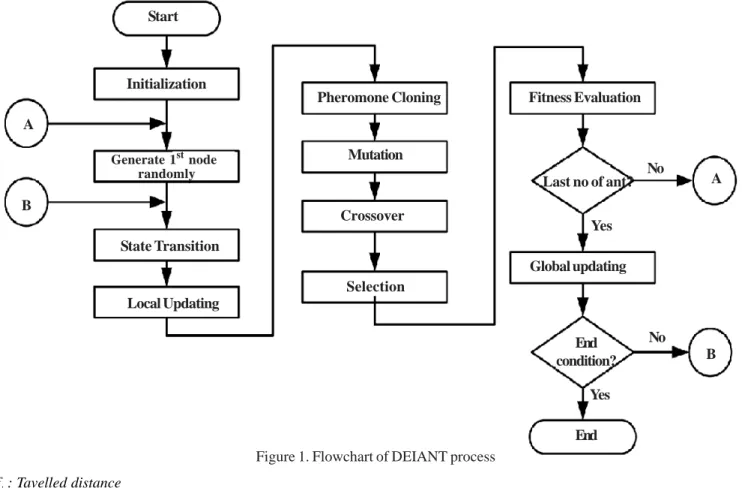
feedback strategy and random selection strategy causes its algorithm to slow down and stagnate. In [27], the researcher stated that ACO was discovered to have slow convergence rate. Therefore, in order to overcome ACO drawbacks, a hybrid technique of ACO, DE and AIS is developed by combining several processes from DE and AIS including mutation, crossover, selection and cloning [28], [29] into ACO algorithm. DEIANT process is shown in Figure 1. The process is briefly discussed as follows:
3.1 Initialization
All parameters included in ACO namely the number of ants, number of nodes, pheromone decay factor, cloning factor, pheromone mutation factor, and crossover constant are initialized in this stage. The population number is heuristically set. Most of the parameters are adopted from ACO and DE.
3.2 Transition Rule
Ant will go for a random tour among the given node, ultimately creating a path between its nest and food source. The next node is selected based on the transition rule. Equation (6) presents the transition rule equation:
Pk (r, s) =
[τ (r, s)] . [η (r, s)β ] µ ε Jk (r)[τ (r, s)] . [η (r, s)β ]
Σ
⎧ ⎩ ⎨
Where:
r : Current node
s : Next node
u : Unvisited node
3.3 Local Updating Rule
A thin layer of pheromone trace is added to the path as the ant move from one node to another. The most favoured path will have its pheromone layer gradually increased. The pheromone level is varied according to the evaporation coefficient; ρ. Evaporation coefficient is set between 0 and 1. Equation (7) presents the local updating rule equation.
ρ (mn, nn) ← (1 −ρe) τ (m, n) + ρ (m, n) Where:
ρ (m, n) : current pheromone level ρ (mn, nn) : Updated pheromone level ρe : Pheromone evaporation rate
3.4 Pheromone Cloning
The cloning process is adopted from the Artificial Immune System (AIS) algorithm in order to duplicate the original pheromone matrix. The original and the duplication matrix will proceed to the mutation process.
3.5 Pheromone Mutation
The Gaussian distribution function is the base of pheromone mutation equation. Pheromone matrix will be subjected to the mutation process. The mutated Gaussian distribution equation was shown by equation (8) as follow:
Xi + m = Xi, j + N (0, β (Xjmax− Xjmin). fi
fmax) Where
Xi + m : Pheromone mutation function
Xjmin : Smallest node number
Xjmax : Largest node number
(6)
(7)
fi : Tavelled distance
fmax : Maximum distance
The Gaussian distribution function will diversify the pheromone layer by mutating the elements inside the pheromone matrix
3.6 Crossover
The diversification of the pheromone is determined by the crossover process that was developed based on a binomial distribution. A new matrix termed as the crossover matrix is produced by the combination of the original and the mutated pheromone matrix.
Figure 2 depicts the crossover matrix. The elements inside the matrix are sorted in a descending order.
3.7 Selection
Roulette-wheel selection technique is used as the selection technique. The selection process will pick the fittest crossover matrix. Equation (9) presents the selection process as a piecewise function:
Start
Initialization
Generate 1st node
Pheromone Cloning
Mutation
State Transition
Local Updating
Selection Crossover
Fitness Evaluation
Last no of ant?
Global updating
A
End
condition? B
End A
B
Yes
Yes
No
No
Figure 1. Flowchart of DEIANT process
X=
X m Xm−1
. . .
Xm − n
Figure 2. Crossover matrix descending order
ρsel =
ρsel if, Pheromone Level, ρ < ρsel
ρ otherwise
⎧
⎩
⎨
(9)3.7 Control Variable
Equation (10) is used to calculate the control variable, x [23]:
x = d dmax. xmax
where:
d : Distance of ant tour
dmax : Maximum distance
xmax : Maximum value of x
3.8 Global Updating Rule
The global updating rule will determine the best solution. The ant that carries the fittest solution will be selected and its first node will be assigned as the first node for the next tour. Equation (11) presents the global updating rule:
ρ (mg, ng) ← (1 − ρα) ρ (m, n) + ρα. ∆ρ (m, n)
ρ(mg, ng)
:
Global pheromone level ρ(m, n):
Updated pheromone level ρe:
Pheromone evaporation rate3.9 Termination
DEIANT algorithm terminates all its process either when it discovers the best solution or when it reaches the maximum number of iteration (Itmax).
4. Results & Discussion
The template is used to format your paper and style the text. All margins, column widths, line spaces, and text fonts are prescribed; please do not alter them. You may note peculiarities. For example, the head margin in this template measures proportionately more than is customary. This measurement and others are deliberate, using specifications that anticipate your paper as one part of the entire proceedings, and not as an independent document. Please do not revise any of the current designations.
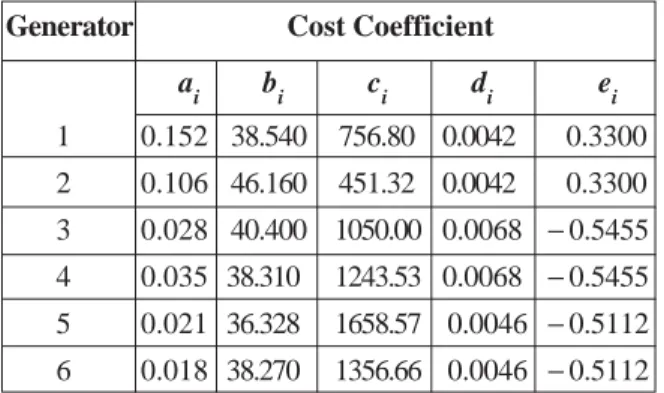
Economic load dispatch problem with valve-point effect was implemented in MATLAB. The optimization problem was solved by the proposed Differential Evolution Immunized Ant Colony Optimization (DEIANT) technique. The research was performed on IEEE 30-Bus RTS with 6 generators. Table 1 and Table 2 tabulate the cost coefficient and generation limits for each generator, respectively. The optimization results are tabulated in Table 2:
Table 3 indicates the optimization results of ELD by using EP, ACO and DEIANT. Significant differences are observed in the ELD results before and after considering the valve-point loading effect. Based on this research, valve-point loading causes the power loss and operating cost to be higher than before. However, these results are practically more accurate as the results are considering the ripples effect on the cost curve due to the valve-point loading.
For example, by using DEIANT technique, the total operating cost for ELD is 15271.24 $/hr. The valve-point loading causes the operating cost to escalate to 15324.69 $/hr. The power loss increases from 1.9861 MW to 6.4136 MW. Moreover, due to the non-smooth cost curve, the optimization techniques
In terms of performance comparison, DEIANT is observed to perform the best among other techniques. Considering the ELD with valve-point loading, DEIANT computed the lower operating cost (15324.69 $/hr) than EP (15471.33 $/hr) and ACO (15454.68 $/hr). According to the equation (4), in order to have lower losses, the generators are required to produce electrical power according to the demand level. Based on the comparative study, DEIANT computed a significantly lower loss (6.4136 MW) compared to EP (18.5605 MW) and ACO (17.1814 MW).
where:
(10)
Cost Coefficient
ai bi ci di ei 1 0.152 38.540 756.80 0.0042 0.3300 2 0.106 46.160 451.32 0.0042 0.3300 3 0.028 40.400 1050.00 0.0068 − 0.5455 4 0.035 38.310 1243.53 0.0068 − 0.5455 5 0.021 36.328 1658.57 0.0046 − 0.5112 6 0.018 38.270 1356.66 0.0046 − 0.5112
Generator
Table 1. Cost Coefficient For IEEE 30-bus Rts
GenerationLimit
Pmin (MW) Pmax(MW)
10 125
10 150
35 225
35 210
130 325
125 315
Generator
1 2 3 4 5 6
Table 2. Generation Limit For IEEE 30-bus Rts
P1 448.0583 449.6265 447.0094 448.5739 445.4923 447.0515 P2 173.26 173.8664 172.6971 173.3015 171.4931 172.0933 P3 263.6265 264.5492 261.5588 262.4743 262.4199 263.3384 P4 138.8548 139.3408 138.3676 138.8519 135.6211 136.0958 P5 166.2653 166.8472 168.9724 169.5638 165.4634 166.0425 P6 87.02574 87.33033 87.1111 87.41599 84.4963 84.79204 15463.17 15471.33 15446.28 15454.68 15271.24 15324.69 12.82761 18.56046 12.7164 17.18141 1.9861 6.413551 12.3309 16.0923 10.3471 14.3033 1.2674 1.8347
Without Valve-Point
EP ACO DEIANT
With Valve-Point
Without Valve-Point
With Valve-Point
Without Valve-Point
With Valve-Point
Output Power (MW)
Ploss (MW)
Time (s)
Ctot ($/hr)
Technique
5. Conclusion
This paper pointed out Differential Evolution Immunized Ant Colony Optimization (DEIANT) technique in solving economic load dispatch by considering valve-point loading effect. The valve-point loading generates ripples at the non-linear cost-curve, thus inflicting higher operating cost and power loss. Nonetheless, the solutions are practically more accurate. DEIANT is the improvement of the basic ACO technique. Comparative studies involving ELD with valve-point loading among DEIANT, ACO and EP indicates that the proposed technique is superior in terms of achieving lower operating cost and power loss.
6. Acknowledgment
The authors would like to acknowledge The Research Management Institute (RMI) UiTM Shah Alam and Ministry of Higher Education Malaysia (MOHE) for the financial support of this research. This research is partly supported by MOHE under the Research Acculturation Grant Scheme (RAGS) with project code: 600-RMI/RAGS 5/3(49/2012).
References
[1] Aganagic, M., et al. (1997). Economic dispatch with generation contingency constraints, Power Systems, IEEE Transactions
on, 12, p. 1229-1236.
[2] Adler, R. B., Fischl, R. (1977). Security constrained economic dispatch with participation factors based on worst case bus load variations, Power Apparatus and Systems, IEEE Transactions on, 96, p. 347-356.
[3] Norhamimi, et al., (2004). Costs optimization for unit commitment and economic load dispatch in large scale power systems, in Power and Energy Conference. PECon 2004. In: Proceedings. National, p. 190-194.
[4] Neto, J. X. V., et al. (2011). Improved quantum-inspired evolutionary algorithm with diversity information applied to economic dispatch problem with prohibited operating zones, Energy Conversion and Management, 52, p. 8-14.
[5] Coelho, L. d. S., Mariani, V. C. (2010). An efficient cultural self-organizing migrating strategy for economic dispatch optimization with valve-point effect, Energy Conversion and Management, 51, p. 2580-2587.
[6] Singh, N., Kumar, Y.,Y. (2012). Economic Load Dispatch Using MRPSO with Generator Ramp Rate Limits Constraint, in Computational Intelligence and Communication Networks (CICN), 2012 Fourth International Conference on, p. 632-637. [7] Hemamalini, S., Simon, S. P. (2008). Emission constrained economic dispatch with valve-point effect using particle swarm optimization, in TENCON 2008 - 2008 IEEE Region 10 Conference, p. 1-6.
[8] Hemamalini, S. P. S. S. (2008). Emission Constrained Economic Dispatch With Valve-point Effect Using Particle Swarm Optimization, in TENCON 2008, p. 1-6.
[9] Chandram, K., et al. (2009). Secant method combined with PSO for Economic Dispatch with prohibited operating zones, in Power Systems Conference and Exposition. PSCE ’09. IEEE/PES, p. 1-7.
[10] Niu, Q., et al. (2011). An Efficient Cultural Particle Swarm Optimization for Economic Load Dispatch with Valve-point Effect, Procedia Engineering, 23, p. 828-834.
[11] Wang, C., Shahidehpour, S. M. (1993). Effects of ramp-rate limits on unit commitment and economic dispatch, Power
Systems, IEEE Transactions on, 8, p. 1341-1350.
[12] Agrawal, N., et al. (2012). Economic Load Dispatch Problem with Ramp Rate Limit Using BBO, International Journal of
Information and Education Technology, 2, p. 7, October.
[13] Wood, A. J., Wollenberg, B. F. (2005). Power Generation, Operation and Control. New York: John Willey & Sons, Inc. [14] Simopoulos, D., Kavatza, S. (2005). Consideration of ramp rate constraints in unit commitment using simulated annealing, in Power Tech, IEEE Russia, p. 1-7.
[15] Avinaash, M. R., et al. (2013). Simulated annealing approach to solution of multi-objective optimal economic dispatch, in Intelligent Systems and Control (ISCO), 2013 7th International Conference on, p. 127-132.
[16] Abdul Hamid, M. B., Abdul Rahman, T. K. (2010). Short Term Load Forecasting Using an Artificial Neural Network Trained by Artificial Immune System Learning Algorithm, in Computer Modelling and Simulation (UKSim), 12th International Conference on, p. 408-413.
[17] Joned, A. M. A. A., et al. (2006). Solving Dynamic Economic Dispatch Using Evolutionary Programming, in Power and Energy Conference. PECon ’06. IEEE International, p. 144-149.
[19] Jain, P., et al. (2012). Prohibited Operating Zones Constraint with Economic Load Dispatch Using Genetic Algorithm,
International Journal of Engineering and Innovative Technology (IJEIT), 1, p. 5, March.
[20] Vecchi, M. P. , Kirkpatrick, S. (1983). Global Wiring by Simulated Annealing, Computer-Aided Design of Integrated
Circuits and Systems, IEEE Transactions on, 2, p. 215-222.
[21] Pandian, S. M. V. , Thanushkodi, K. (2010). Solving Economic Load Dispatch Problem Considering Transmission Losses by Hybrid EP-EPSO Algorithm for Solving Both Smooth and Non-Smooth Cost Function, International Journal of Computer
and Electrical Engineering, 2, p. 9, June.
[22] Gambardella, L. M., Dorigo, M. (1996). Solving symmetric and asymmetric TSPs by ant colonies, in Evolutionary Computation,
In: Proceedings of IEEE International Conference on, p. 622-627.
[23] Kalil, M. R., et al. (2006). Ant Colony Optimization for Maximum Loadability Search in Voltage Control Study, in Power and Energy Conference. PECon ’06. IEEE International, p. 240-245.
[24] Mustafar, M. F., et al. (2007). Ant Colony Optimization (ACO) Based Technique for Voltage Control and Loss Minimization Using Transformer Tap Setting, in Research and Development, 2007. SCOReD 2007. 5th Student Conference on, p. 1-6. [25] Soares, J., et al. (2011). Ant Colony Search algorithm for the optimal power flow problem, in Power and Energy Society General Meeting, IEEE, p. 1-8.
[26] Duan, H. B., Wang, D. B. (2004). A Novel Ant Colony Algorithm With Fast Global Optimization and Its Simulation, Information and Control, 33, p. 241-244.
[27] Bhavani, R., et al. (2011). A novel parallel hybrid K-means-DE-ACO clustering approach for genomic clustering using MapReduce, in Information and Communication Technologies (WICT), 2011 World Congress on, p. 132-137.
[28] Storn, R., Price, K. (1997). Differential Evolution - A Simple and Efficient Heuristic for Global Optimization over Continuous Spaces, Journal of Global Optimization, 11, p. 341-359.
[29] Yanfang, B., Yuanguo, Z. (2009). Artificial Immune Ant Colony Algorithm and its application, in Intelligent Computing and Intelligent Systems. ICIS. IEEE International Conference on, p. 75-80.
Author Biographies
Nur Azzammudin Rahmat
Received Diploma in Electrical (Communication) Engineering in 2008 and Bachelor (Hons) of Electrical Engineering in 2011 from Universiti Teknologi MARA, Malaysia. He is currently pursuing his doctorate degree in Electrical Engineering at the same institution. His research field covers power system, economic dispatch and optimization techniques.
Associate Professor Dr. Ismail Musirin
Obtained Diploma of Electrical Power Engineering in 1987, Bachelor of Electrical Engineering (Hons) in 1990; both from Universiti Teknologi Malaysia, MSc in Pulsed Power Technology in 1992 from University of Strathclyde, United Kingdom and PhD in Electrical Engineering from Universiti Teknologi MARA, Malaysia in 2004. His research interest includes power system stability, optimization techniques, distributed generator and artificial intelligence. He is also a member of IEEE, IEEE Power Engineering Society and Artificial Immune System Society (ARTIST).
Ahmad Farid Abidin
Mohd Redzuan Ahmad