Proceedings of the 2012 Workshop on Biomedical Natural Language Processing (BioNLP 2012), pages 73–81,
Active Learning for Coreference Resolution
Timothy A. Miller and Dmitriy Dligach and Guergana K. Savova
Children’s Hospital Boston and Harvard Medical School
300 Longwood Ave. Enders 141
Boston, MA 02115, USA
{Timothy.Miller,Dmitriy.Dligach,Guergana.Savova}@childrens.harvard.edu
Abstract
Active learning can lower the cost of anno-tation for some natural language processing tasks by using a classifier to select informa-tive instances to send to human annotators. It has worked well in cases where the training in-stances are selected one at a time and require minimal context for annotation. However, coreference annotations often require some context and the traditional active learning ap-proach may not be feasible. In this work we explore various active learning methods for coreference resolution that fit more realisti-cally into coreference annotation workflows.
1 Introduction
Coreference resolution is the task of deciding which entity mentions in a text refer to the same entity. Solving this problem is an important part of the larger task of natural language understanding in gen-eral. The clinical domain offers specific tasks where it is easy to see that correctly resolving coreference is important. For example, one important task in the clinical domain is template filling for the Clinical El-ements Model (CEM).1This task involves extracting various pieces of information about an entity and fit-ting the information into a standard data structure that can be reasoned about. An example CEM tem-plate is that forDiseasewith attributes forBody Lo-cation,Associated Sign or Symptom,Subject, Nega-tion,Uncertainty, andSeverity. Since a given entity may have many different attributes and relations, it
1
http://intermountainhealthcare.org/cem
may be mentioned multiple times in a text. Coref-erence resolution is important for this task because it must be known that all the attributes and relations apply to the same entity so that a single CEM tem-plate is filled in for an entity, rather than creating a new template for each mention of the entity.
2 Background
2.1 Coreference Resolution
Space does not permit a thorough review of coref-erence resolution, but recent publications covered the history and current state of the art for both the general domain and the clinical domain (Ng, 2010; Pradhan et al., 2011; Zheng et al., 2011).
The system used here (Zheng et al., 2012) is an end-to-end coreference resolution system, mean-ing that the algorithm receives no gold standard in-formation about mentions, named entity types, or any linguistic information. The coreference res-olution system is a module of the clinical Tex-tual Analysis and Knowledge Extraction System (cTAKES) (Savova et al., 2010) that is trained on clinical data. It takes advantage of named entity recognition (NER) and categorization to detect en-tity mentions, and uses several cTAKES modules as feature generators, including the NER module, a constituency parser module, and a part of speech tagging module.
The system architecture is based on the pairwise discriminative classification approach to the coref-erence resolution problem. In that paradigm, pairs of mentions are classified as coreferent or not, and then some reconciliation must be done on all of the
links so that there are no conflicts in the clusters. The system uses support vector machines (SVMs) as the pairwise classifiers, and conflicts are avoided by only allowing an anaphor to link with one an-tecedent, specifically that antecedent the classifier links with the highest probability.
There are separate pairwise classifiers for named entity and pronominal anaphor types. In the domain of clinical narratives, person mentions and personal pronouns in particular are not especially challeng-ing – the vast majority of person mentions are the patient. In addition, pronoun mentions, while im-portant, are relatively rare. Thus we are primarily interested in named entity coreference classification, and we use that classifier as the basis of the work de-scribed here.
The feature set of this system is similar to that used by Ng and Cardie (2002). That system in-cludes features based on surface form of the men-tions, shallow syntactic information, and lexical se-mantics from WordNet. The system used here has a similar feature set but uses Unified Medical Lan-guage System (UMLS)2 semantic features as it is
intended for clinical text, and also incorporates sev-eral syntactic features extracted from constituency parses extracted from cTAKES.
To generate training data for active learning simu-lations, mention detection is run first (cTAKES con-tains a rule-based NER system) to find named en-tities and a constituency parser situates enen-tities in a syntax tree). For each entity found, the system works backwards through all other mentions within a ten sentence window. For each candidate anaphor-antecedent pair, a feature vector is extracted using the features briefly described above.
2.2 Active Learning
Active Learning (AL) is a popular approach to se-lecting unlabeled data for annotation (Settles, 2010) that can potentially lead to drastic reductions in the amount of annotation that is necessary for train-ing an accurate statistical classifier. Unlike passive learning, where the data is sampled for annotation randomly, AL delegates data selection to the clas-sifier. AL is an iterative process that operates by first training a classifier on a small sample of the
2
http://www.nlm.nih.gov/research/umls/
data known as the seed examples. The classifier is subsequently applied to a pool of unlabeled data with the purpose of selecting additional examples the classifier views as informative. The selected data is annotated and the cycle is repeated, allowing the learner to quickly refine the decision boundary be-tween classes. One common approach to assessing the informativeness isuncertainty sampling(Lewis and Gale, 1994; Schein and Ungar, 2007), in which the learner requests a label for the instance it is most uncertain how to label. In this work, we base our instance selection on the distance to the SVM de-cision boundary (Tong and Koller, 2002), assuming that informative instances tend to concentrate near the boundary.
Most AL work focuses on instance selection
where the unit of selection is one instance repre-sented as a feature vector. In this paper we also attempt document selection, where the unit of se-lection is a document, typically containing multi-ple coreference pairs each represented as a feature vector. The most obvious way to extend a sin-gle instance informativeness metric to the document scenario is to aggregate the informativeness scores. Several uncertainty metrics have been proposed that follow that route to adapt single instance selection to multiple instance scenarios (Settles et al., 2008; Tomanek et al., 2009). We borrow some of these metrics and propose several new ones.
To the best of our knowledge only one work exists that explores AL for coreference resolution. Gasperin (2009) experiments with an instance based approach in which batches of anaphoric pairs are se-lected on each iteration of AL. In these experiments, AL did not outperform the passive learning baseline, probably due to selecting batches of large size.
3 Active Learning Configurations
3.1 Instance Selection
have a human expert annotate only a single instance at a time when a given instance may require many sentences of reading in order to contextualize the in-stance and properly label it. Moreover, even if such an annotation scheme proved viable, it may result in an annotated corpus that is only valuable for one type of coreference system architecture.
Nonetheless, active learning for coreference at the instance level is still useful. First, since this method most closely follows the successful active learning literature by using the smallest discrete problems, it can serve as a proof of concept for active learning in the coreference task – if it does not work well at this level, it probably will not work at the document level. Previous results (Gasperin, 2009) have shown that certain multiple instance methods do not work for coreference resolution, so testing on smaller se-lection sizes first can ensure that active learning is even viable at that scale. In addition, though in-stance selection may not be feasible for real world annotations, individual instances and metrics for se-lecting them are usually used as building blocks for more complex methods. In order for this to be pos-sible it must be shown that the instances themselves have some value.
3.2 Document Selection
Active learning with document selection is a much more realistic representation of conventional anno-tation methods. Conventionally, a set of documents is selected, and each document is annotated exhaus-tively for coreference (Pradhan et al., 2011; Savova et al., 2011). Document selection fits into this work-flow very naturally, by selecting the next document to annotate exhaustively based on some metric of which document has the best instances. In theory, this method can save annotation time by only anno-tating the most valuable documents.
Document selection is somewhat similar to the concept of batch-mode active learning, wherein multiple instances are selected at once, though batch-mode learning is usually intended to solve a different problem, that of an asymmetry between classifier training speed and annotation speed (Set-tles, 2010). A more important difference is that doc-ument selection requires that all of the instances in the batch must come from the same document. Thus, one might expect a priori that document selection
for active learning will not perform as well as in-stance selection. However, it is possible that even smaller gains will be valuable for improving annota-tion time, and the more robust nature of a corpus an-notated in such a way will make the long term bene-fits worthwhile.
In this work, we propose several metrics for se-lecting documents to annotate, all of which are based on instance level uncertainty. In the fol-lowing descriptions, D is the set of documents, d
is a single document, dˆis the selected document,
I nstances(d)is a function which returns the set of
pair instances in documentd,iis an instance,dist(i)
is a function which returns the distance of instancei
from the classification boundary, andIis the
indica-tor function, which takes the value 1 if its argument is true and 0 otherwise. Note that high uncertainty occurs whenAbs(dist(i))approaches 0.
• Best instance – This method uses the un-certainty sampling criteria on instances, and selects the document containing the in-stance the classifier is least certain about.
ˆ
d= argmin
d∈D
[mini∈I nstances(d)Abs(dist(i))]
• Highest average uncertainty – This method computes the average uncertainty of all instances in a document, and selects the document with the highest average uncertainty.
ˆ
d= argmin
d∈D
1
|I nstances(d)|
P
i∈I nstances(d)Abs(dist(i))
• Least bad example – This method uses uncertainty sampling criteria to find the document whose most certain example is least certain, in other words the document whose most useless example is least useless.
ˆ
d= argmin
d∈D
maxi∈I nstances(d)Abs(dist(i))
• Narrow band – This method creates an un-certainty band around the discriminating boundary and selects the document with the most examples inside that narrow band.
ˆ
d= argmax
d∈D
P
i∈I nstances(d)I(Abs(dist(i)<0.2))
ˆ
d= argmin
d∈D
[maxi∈I nstances(d)(Abs(dist(i)))−
mini∈I nstances(d)(Abs(dist(i)))]
• Most positives – This method totals the number of positive predicted instances in each document and selects the doc-ument with the most positive instances.
ˆ
d= argmax
d∈D
P
i∈I nstances(d)I(dist(i)>0)
• Positive ratio – This method calculates the percentage of positive predicted in-stances in each document and selects the document with the highest percentage.
ˆ
d= argmax
d∈D P
i∈I nstances(d)I(dist(i)>0)
|I nstances(d)|
Many of these are straightforward adaptations of the instance uncertainty criteria, but others deserve a bit more explanation. Themost positivesand pos-itive ratiometrics are based on the observation that the corpus is somewhat imbalanced – for every posi-tive instance there are roughly 20 negaposi-tive instances. These metrics try to account for the possibility that instance selection focuses on positive instances. The
average uncertaintyis an obvious attempt to turn in-stance metrics into document metrics, but narrow bandandsmallest spreadmetrics attempt to do the same thing while accounting for skew in the distri-bution of “good” and “bad” instances.
3.3 Document-Inertial Instance Selection
One of the biggest impracticalities of instance se-lection is that labeling any given instance may re-quire reading a fair amount of the document, since the antecedent and anaphor can be quite far apart. Thus, any time savings accumulated by only anno-tating an instance is reduced since the reading time per instance is probably increased.
It is also possible that document selection goes too far in the other direction, and requires too many useless instances to be annotated to achieve gains. Therefore, we propose a hybrid method of document-inertial instance selection which attempts to combine aspects of instance selection and docu-ment selection.
This method uses instance selection criteria to se-lect new instances, but will look inside the current document for a new instance within an uncertainty
threshold rather than selecting the most uncertain in-stance in the entire training set. Sticking with the same document for several instances in a row can potentially solve the real world annotation problem that marking up each instance requires some knowl-edge of the document context. Instead, the context learned by selecting one instance can be retained if useful for annotating the next selected instance from the same document.
This also preserves one of the biggest advantages of instance selection, that of re-training the model after every selected instance. In batch-mode selec-tion and document selecselec-tion, many instances are se-lected according to criteria based on the same model starting point. As a result, the selected instances may be redundant and document scores based on accumulated instance scores may not reflect reality. Re-training the model between selected instances prevents redundant instances from being selected.
4 Evaluation
Evaluations of the active learning models described above took place in a simulation context. In active learning simulations, a labeled data set is used, and the unlabeled pool is simulated by ignoring or “cov-ering” the labels for part of the data until the selec-tion algorithm selects a new instance for annotaselec-tion. After selection the next data point is simply put into the training data and its label is uncovered.
The data set used was the Ontology Development and Information Extraction (ODIE) corpus (Savova et al., 2011) used in the 2011 i2b2/VA Challenge on coreference resolution.3 We used a set of 64 docu-ments from the training set of the Mayo Clinic notes for our simulations.
Instances were created by using the training pipeline from the coreference system described in Section 2.1. As previously mentioned, this work uses the named entity anaphor classifier as it con-tains the most data points. This training set resulted in 6820 instances, with 311 positive instances and 6509 negative instances. Baseline ten-fold cross val-idation performance on this data set using an SVM with RBF kernel is an F-score of 0.48.
Simulations are performed using ten fold cross-validation. First, each data point is assigned to one
3
of ten folds (this is done randomly to avoid any auto-correlation issues). Then, for each iteration, one fold is made the seed data, another fold is the validation data, and the remainder are the unlabeled pool. Ini-tially the labeled training data contains only the seed data set. The model is trained on the labeled train-ing data, tested on the validation set, then used to select the next data point from the pool data set. The selected data point is then removed from the pool and added to the training data with its gold stan-dard label(s), and the process repeats until the pool of unlabeled data is empty. Performance is averaged across folds to minimize the effects of randomness in seed and validation set selection. Typically, active learning is compared to a baseline of passive learn-ing where the next data point to be labeled is selected from the unlabeled pool data set randomly.
4.1 Instance Selection Experiments
Instance selection simulations follow the general template above, with each instance (representing a putative antecedent-anaphor pair) randomly as-signed to a fold. After scoring on the validation set, uncertainty sampling is used to select a single in-stance from the unlabeled pool, and that inin-stance is added to the training set.
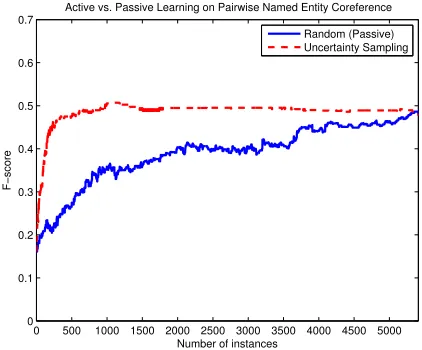
Figure 1 shows the results of active learning using uncertainty selection on instances versus using pas-sive learning (random selection). This makes it clear that if the classifier is allowed to choose the data, top performance can be achieved much faster than if the data is presented in random order. Specifically, the performance for uncertainty selection levels off at around 500 instances into the active learning, out of a pool set of around 5500 instances. In contrast, the passive learning baseline takes basically the entire dataset to reach the same performance.
This is essentially a proof of concept that there is such a thing as a “better” or “worse” instance when it comes to training a classifier for coreference. We take this as a validation for attempting a document selection experiment, with many metrics using in-stance uncertainty as a building block.
4.2 Document Selection Experiments
Document selection follows similarly to the instance selection above. The main difference is that instead of assigning pair vectors to folds, we assign
docu-0 500 1000 1500 2000 2500 3000 3500 4000 4500 5000 0
0.1 0.2 0.3 0.4 0.5 0.6 0.7
Active vs. Passive Learning on Pairwise Named Entity Coreference
Number of instances
F−score
[image:5.612.327.538.77.252.2]Random (Passive) Uncertainty Sampling
Figure 1: Instance selection simulation results. The x-axis is number of instances and the y-x-axis is ten-fold av-eraged f-score of the pairwise named entity classifier.
ments to folds. To make a selection, each instance is labeled according to the model, document level met-rics described in Section 3.2 are computed per docu-ment, and the document is selected which optimizes the metric being evaluated. All of that document’s instances and labels are added to the training data, and the process repeats as before.
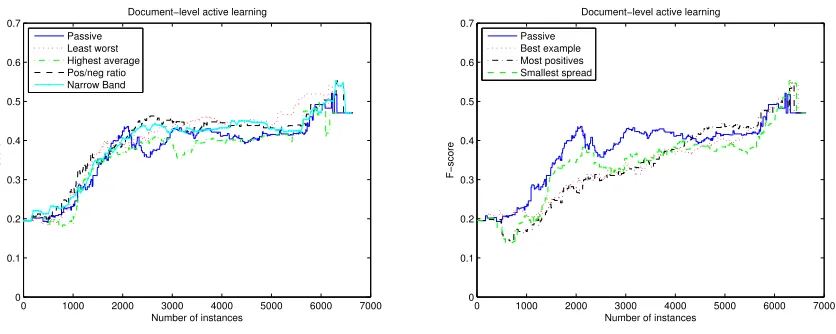
The results of these experiments are divided into two plots for visual clarity. Figure 2 shows the results of these experiments, roughly divided into those that work as well as a random baseline (left) and those that seem to work worse than a random baseline (right). The best performing metrics (on the left side of the figure) are Positive Ratio, Least Worst,Highest Average, andNarrow Band, although none of these performs noticeably better than ran-dom. The remaining metrics (on the right) seem to do worse than random, taking more instances to reach the peak performance near the end.
The performance of document selection suggests that it may not be a viable means of active learn-ing. This may be due to a model of data distribution in which useful instances are distributed very uni-formly throughout the corpus. In this case, an aver-age document will only have 8–10 useful instances and many times as many that are not useful.
0 1000 2000 3000 4000 5000 6000 7000 0
0.1 0.2 0.3 0.4 0.5 0.6 0.7
Number of instances
F−score
Document−level active learning
Passive Least worst Highest average Pos/neg ratio Narrow Band
0 1000 2000 3000 4000 5000 6000 7000 0
0.1 0.2 0.3 0.4 0.5 0.6 0.7
Number of instances
F−score
Document−level active learning
[image:6.612.98.516.73.240.2]Passive Best example Most positives Smallest spread
Figure 2: Two sets of document selection experiments.
document each instance came from. The experi-ments tracked the first 500 instances only, which is roughly the number of instances shown in Figure 1 to reach peak performance. Figure 3 (left) shows a histogram with document indices on the x-axis and normalized instance counts on the y-axis. The counts are normalized by total number of document vectors. In other words, we wanted to show whether there was a distinction between “good” documents containing lots of good instances and “bad” docu-ments with few good instances.
The figure shows a few spikes, but most docu-ments have approximately 10% of their instances sampled, and all but one document has at least one instance selected. Further investigation shows that the spikes in the figure are from shorter documents. Since shorter documents have few instances overall but always at least one positive instance, they will be biased to have a higher ratio of positive to negative instances. If positive instances are more uncertain (which may be the case due to the class imbalance), then shorter documents will have more selected in-stances per unit length.
We performed another follow-up experiment along these lines using the histogram as a measure of document value. In this experiment, we took the normalized histogram, selected documents from it in order of normalized number of items selected, and used that as a document selection technique. Ob-viously this would be “cheating” if used as a metric for document selection, but it can serve as a check on
the viability of document selection. If the results are better than passive document selection, then there is some hope that a document level metric based on the uncertainty of its instances can be successful.
In fact, the right plot on Figure 3 shows that the “cheating” method of document selection still does not look any better than random document selection.
4.3 Document-Inertial Instance Selection Experiments
The experiments for document-inertial instance se-lection were patterned after the instance sese-lection paradigm. However, each instance was bundled with metadata representing the document from which it came. In the first selection, the algorithm selects the most uncertain instance, and the document it comes from is recorded. For subsequent selections, the document which contained the previously selected instance is given priority when looking for a new instance. Specifically, each instance in that docu-ment is classified, and the confidence is compared against a threshold. If the document contains stances meeting the threshold, the most uncertain in-stance was selected. After each inin-stance, the model is retrained as in normal instance selection, and the new model is used in the next iteration of the selec-tion algorithm. For these experiments, the threshold is set at 0.75, where the distance between the classi-fication boundary and the margin is 1.0.
Per-0 10 20 30 40 50 60 0
0.1 0.2 0.3 0.4 0.5 0.6 0.7 0.8 0.9 1
Normalized document selection counts
Document index
% of vectors selected
0 1000 2000 3000 4000 5000 6000 7000 0
0.1 0.2 0.3 0.4 0.5 0.6 0.7
Number of instances
F−score
Document−level active learning
[image:7.612.101.516.73.240.2]Passive Cheating
Figure 3: Left: Percentage of instances selected from each document. Right: Performance of a document selection algorithm that can ‘cheat’ and select the document with the highest proportion of good instances.
0 500 1000 1500 2000 2500 3000 3500 4000 4500 5000 0
0.1 0.2 0.3 0.4 0.5 0.6 0.7
Active vs. Passive Learning on Pairwise Named Entity Coreference
Number of instances
F−score
Random (Passive) Uncertainty Sampling Sticky Instance Sampling
Figure 4: Document-inertial instance selection results.
formance using this algorithm is clearly better than passive learning and is similar to standard uncer-tainty selection ignoring document constraints.
5 Discussion and Conclusion
The results of these experiments paint a complex picture of the way active learning works for this do-main and model combination. The first experiments with uncertainty selection indicate that the number of instances required to achieve classifier perfor-mance can be compressed. Selecting and training on all the good instances first leads to much faster convergence to the asymptotic performance of the
classifier given the features and data set.
Attempting to extend this result to document se-lection met with mediocre results. Even the best per-forming of seven attempted algorithms seems to be about the same as random document selection. One can interpret these results in different ways.
The most pessimistic interpretation is that docu-ment selection simply requires too many useless in-stances to be annotated, good inin-stances are spread too evenly, and so document selection will never be meaningfully faster than random selection. This in-terpretation seems to be supported by experiments showing that even if document selection uses a “cheating” algorithm to select the documents with the highest proportion of good instances it still does not beat a passive baseline.
One can also interpret these results to inspire fur-ther work, first by noting that all of the selection techniques attempt to build on the instance selec-tion metrics. While our document selecselec-tion metrics were more sophisticated than simply taking the n
[image:7.612.86.297.305.481.2]before any research use, and so it is not simply a matter of querying all records in an entire electronic medical record system.
The document-inertial instance selection showed that the increase in training speed can be matained without switching documents for every stance. This suggests that while good training in-stances may be uniformly distributed, it is usually possible to find multiplegood enough instances in the current document, and they can be found despite not selecting instances in the exact best order that plain instance selection would suggest.
Future work is mainly concerned with real world applicability. Document level active learning can probably be ruled out as being non-beneficial despite being the easiest to work into annotation work flows. Instance level selection is very efficient in achieving classifier performance but the least practical.
Document-inertial seems to provide some com-promise. It does not completely solve the prob-lems of instance selection, however, as annotation will still not be complete if done exactly as simu-lated here. In addition, the assumption of savings is based on a model that each instance takes a con-stant amount of time to annotate. This assumption is probably true for tasks like word sense disambigua-tion, where an annotator can be presented one in-stance at a time with little context. However, a better model of annotation for tasks like coreference is that there is a constant amount of time required for read-ing and understandread-ing the context of a document, then a constant amount of time on top of that per instance.While modeling annotation time may pro-vide some insight, it will probably be most effective to undertake empirical annotation experiments to in-vestigate whether document-inertial instance selec-tion actually provides a valuable time savings.
The final discussion point is that of producing complete document annotations. For coreference systems following the pairwise discriminative ap-proach as in that described in Section 2.1, a corpus annotated instance by instance is useful. However, many recent approaches do some form of document-level clustering or explicit coreference chain build-ing, and are not natively able to handle incompletely annotated documents.4
4
Other recent unsupervised graphical model approaches
us-Future work will investigate this issue by quan-tifying the value of complete gold standard annota-tions versus the partial annotaannota-tions that may be pro-duced using document-inertial instance selection. One way of doing this is in simulation, by training a model on the 500 good instances that document-inertial instance selection selects, and then classify-ing the rest of the trainclassify-ing instances usclassify-ing that model to create a “diluted” gold standard. Then, a model trained on the diluted gold standard will be used to classify the validation set and performance com-pared to the version trained on the full gold standard corpus. Similar experiments can be performed using other systems. The logic here is that if an instance was not in the top 10% of difficult instances it can be classified with high certainty. The fact that positive instances are rare and tend to be most uncertain is a point in favor of this approach – after all, high accu-racy can be obtained by guessing in favor of negative once the positive instances are labeled. On the other hand, if document-inertial instance selection simply amounts to labeling of positive instances, it may not result in substantial time savings.
In conclusion, this work has shown that instance selection works for coreference resolution, intro-duced several metrics for document selection, and proposed a hybrid selection approach that preserves the benefits of instance selection while offering the potential of being applicable to real annotation. This work can benefit the natural language processing community by providing practical methods for in-creasing the speed of coreference annotation.
Acknowledgments
The project described was supported by award number NLM RC1LM010608, the Strategic Health IT Advanced Research Projects (SHARP) Program (90TR002) administered by the Office of the Na-tional Coordinator for Health Information Technol-ogy, and Integrating Informatics and Biology to the Bedside (i2b2) NCBO U54LM008748. The content is solely the responsibility of the authors and does not necessarily represent the official views of the NLM/NIH/ONC.
References
Caroline Gasperin. 2009. Active learning for anaphora resolution. InProceedings of the NAACL HLT Work-shop on Active Learning for Natural Language Pro-cessing, pages 1–8.
Aria Haghighi and Dan Klein. 2007. Unsupervised coreference resolution in a nonparametric bayesian model. In Proceedings of the 45th Annual Meeting of the Association of Computational Linguistics, pages 848–855.
David D. Lewis and William A. Gale. 1994. A sequential algorithm for training text classifiers. InProceedings of the ACM SIGIR Conference on Research and Devel-opment in Information Retrieval, pages 3–12.
Vincent Ng and Claire Cardie. 2002. Improving machine learning approaches to coreference resolution. In Pro-ceedings of the 40th Annual Meeting of the Association for Computational Linguistics (ACL).
Vincent Ng. 2010. Supervised noun phrase coreference research: The first fifteen years. InProceedings of the 48th Annual Meeting of the Association for Computa-tional Linguistics (ACL-10).
Sameer Pradhan, Lance Ramshaw, Mitchell Marcus, Martha Palmer, Ralph Weischedel, and Nianwen Xue. 2011. CoNLL-2011 shared task: Modeling unre-stricted coreference in OntoNotes. InProceedings of the 15th Conference on Computational Natural Lan-guage Learning: Shared Task, pages 1–27.
Guergana K. Savova, James J. Masanz, Philip V. Ogren, Jiaping Zheng, Sunghwan Sohn, Karin C. Kipper-Schuler, and Christopher G. Chute. 2010. Mayo clinical text analysis and knowledge extraction sys-tem (cTAKES): architecture, component evaluation and applications. J Am Med Inform Assoc, 17(5):507– 513.
Guergana K. Savova, Wendy W. Chapman, Jiaping Zheng, and Rebecca S. Crowley. 2011. Anaphoric relations in the clinical narrative: corpus creation. J Am Med Inform Assoc, 18:459–465.
A.I. Schein and L.H. Ungar. 2007. Active learning for logistic regression: an evaluation. Machine Learning, 68(3):235–265.
B. Settles, M. Craven, and S. Ray. 2008. Multiple-instance active learning. Advances in Neural Informa-tion Processing Systems (NIPS), 20:1289–1296. Burr Settles. 2010. Active learning literature survey.
Technical report, University of Wisconsin–Madison. Katrin Tomanek, Florian Laws, Udo Hahn, and Hinrich
Sch¨utze. 2009. On proper unit selection in active learning: co-selection effects for named entity recog-nition. InHLT ’09: Proceedings of the NAACL HLT 2009 Workshop on Active Learning for Natural Lan-guage Processing, pages 9–17, Morristown, NJ, USA. Association for Computational Linguistics.
S. Tong and D. Koller. 2002. Support vector machine active learning with applications to text classification.
The Journal of Machine Learning Research, 2:45–66. Jiaping Zheng, Wendy Webber Chapman, Rebecca S.
Crowley, and Guergana K. Savova. 2011. Coreference resolution: A review of general methodologies and ap-plications in the clinical domain. Journal of Biomedi-cal Informatics, 44:1113–1122.