Auxiliary Objectives for Neural Error Detection Models
Marek Rei
The ALTA Institute Computer Laboratory University of Cambridge
United Kingdom
Helen Yannakoudakis
The ALTA Institute Computer Laboratory University of Cambridge
United Kingdom
Abstract
We investigate the utility of different aux-iliary objectives and training strategies within a neural sequence labeling ap-proach to error detection in learner writ-ing. Auxiliary costs provide the model with additional linguistic information, al-lowing it to learn general-purpose com-positional features that can then be ex-ploited for other objectives. Our experi-ments show that a joint learning approach trained with parallel labels on in-domain data improves performance over the pre-vious best error detection system. While the resulting model has the same number of parameters, the additional objectives al-low it to be optimised more efficiently and achieve better performance.
1 Introduction
Automatic error detection systems for learner writing need to identify various types of error in text, ranging from incorrect uses of function words, such articles and prepositions, to seman-tic anomalies in content words, such as adjective– noun combinations. To tackle the scarcity of error-annotated training data, previous work has inves-tigated the utility of automatically generated un-grammatical data (Foster and Andersen,2009; Fe-lice and Yuan,2014), as well as explored learning from native well-formed data (Rozovskaya and Roth,2016;Gamon,2010).
In this work, we investigate the utility of sup-plementing error detection frameworks with addi-tional linguistic information that can be extracted from the available error-annotated learner data. We construct a neural sequence labeling system for error detection that allows us to learn better representations of language composition and
de-tect errors in context more accurately. In addition to predicting the binary error labels, we experi-ment with also predicting additional information for each token, including token frequency and the specific error type, which can be extracted from the existing data, as well as part-of-speech (POS) tags and dependency relations, which can be gen-erated automatically using readily available toolk-its.
These auxiliary objectives provide the sequence labeling model with additional linguistic informa-tion, allowing it to learn useful compositional fea-tures that can then be exploited for error detec-tion. This can be seen as a type of multi-task learning, where the model learns better composi-tional features via shared representations with re-lated tasks. While common approaches to multi-task learning require randomly switching between different tasks and datasets, we demonstrate that a joint learning approach trained on in-domain data with parallel labels substantially improves error detection performance on two different datasets. In addition, the auxiliary labels are only required during the training process, resulting in a better model with the same number of parameters.
In the following sections, we describe our ap-proach to the task, systematically compare the in-formativeness of various auxiliary loss functions, investigate alternative training strategies, and ex-amine the effect of additional training data.
2 Error Detection Model
In addition to the scarcity of errors in the train-ing data (i.e., the majority of tokens are correct), recent research has highlighted the variability in manual correction of writing errors: re-annotation of the CoNLL 2014 shared task test set by 10 annotators demonstrated that even humans have great difficulty in agreeing how to correct
ing errors (Bryant and Ng,2015). Given the chal-lenges of the all-errors correction task, previous research has demonstrated that detection models can detect more errors than systems focusing on correction (Rei and Yannakoudakis, 2016), and therefore provide more extensive feedback to the learner.
Following Rei and Yannakoudakis (2016), we treat error detection as a sequence labeling task – each token in the input sentence is assigned a label, indicating whether it is correct or incorrect given the current context – and construct a bidirectional recurrent neural network for detecting writing er-rors. The model is given a sequence of tokens as input, which are then mapped to a sequence of dis-tributed word embeddings[x1, ..., xT]. These em-beddings are then given as input to a bidirectional LSTM (Hochreiter and Schmidhuber,1997) mov-ing through the sentence in both directions. At each step, the LSTM calculates a new hidden rep-resentation based on the current token embedding and the hidden state from the previous step.
h(tf)=LSTM(xt, h(tf−)1) (1)
h(tb)=LSTM(xt, h(tb+1) ) (2)
Next, the network includes a tanh-activated feedforward layer, using the hidden states from both LSTMs as input, allowing the model to learn more complex higher-level features. By combin-ing the hidden states from both directions, we are able to have a vector that represents a specific to-ken but also takes into account context on both sides:
dt=tanh(Wfht(f)+Wbh(tb)) (3)
whereWf andWbare fully-connected weight ma-trices.
The final layer calculates label predictions based on the layerdt. The softmax activation func-tion is used to output a normalised probability dis-tribution over all the possible labels for each to-ken:
yt=softmax(Wydt) (4)
where Wy is a weight matrix and yt is a vector with a position for each possible label. In order to find the predicted label, we return the element with the highest predicted value.
The model is optimised using cross entropy, which is equivalent to optimising the negative log-likelihood of the correct labels:
E =−X
t
X
k
e
yt,klog(yt,k) (5)
whereyt,k is the predicted probability of tokent having labelk, andyet,khas the value1if the cor-rect label for tokent isk, and the value 0 other-wise.
We also make use of the character-level exten-sion described byRei et al.(2016). Each token is separated into individual characters and mapped to character embeddings. Using a bidirectional LSTM and a hidden feedforward component, the character vectors are composed into a character-based token representation. Finally, a dynamic gating function is used to combine this represen-tation with a regular token embedding, taking ad-vantage of both approaches. This component al-lows the model to capture useful morphological and character-based patterns, in addition to learn-ing individual token-level vectors of common to-kens.
3 Auxiliary Loss Functions
The model in Section2learns to assign error labels to tokens based on the manual annotation available in the training data. However, there are nearly lim-itless ways of making writing errors and learning them all explicitly from hand-annotated examples is not feasible. In addition, writing errors can be very sparse, leaving the system with very little use-ful training data for learning error patterns. In or-der to train models that generalise well with lim-ited training examples, we would want to encour-age them to learn more generic patterns of lan-guage, grammar, syntax and composition, which can then be exploited for error detection.
experi-words My husband was following a course all the week in Berne .
target c c c i c c c i c c c c
freq 5 3 8 4 8 5 7 9 5 8 0 10
lang fr fr fr fr fr fr fr fr fr fr fr fr
error c c c RV c c c UD c c c c
POS APP$ NN1 VBDZ VVG AT1 NN1 DB AT NNT1 II NP1 .
[image:3.595.329.504.177.291.2]GR det ncsubj aux null det dobj ncmod det ncmod ncmod dobj null Table 1: Alternative labels for an example sentence from the FCE training data.
ment with a larger set of possible objectives. In-stead of only predicting the correctness of each token in context, we extend the system to predict additional information and labels for every token. The information from these auxiliary objectives is propagated into the weights of the model dur-ing traindur-ing, without requirdur-ing the extra labels at testing time. While common neural approaches to multi-task learning switch randomly between dif-ferent tasks and datasets, we use a joint learning approach trained on in-domain data only.
The lower parts of the model function similarly to the system described in Section2. Token repre-sentations are first passed through a bidirectional LSTM in order to build context-specific represen-tations. After that, each separate objective is as-signed an individual hidden layer:
dt(n)=Wf(n)ht(f)+Wb(n)h(tb) (6)
where Wf(n) and Wb(n) are weight matrices spe-cific to then-th task. While the recurrent compo-nents are shared between all objectives, the hid-den layers allow parts of the model to be cus-tomised for a specific task, learning higher-level features and controlling how the information from forward- and backward-moving LSTMs is com-bined.
Next, a task-specific output distribution is cal-culated based ond(tn):
yt(n) =softmax(W(n)
y d(tn)) (7)
whereWy(n)is a weight matrix andy(tn)has the di-mensionality of the total number of labels for the
n-th task. Figure1presents a diagram of the net-work withn= 2, although the number of possible auxiliary tasks can also be larger.
The whole model is optimised by minimising the cross-entropy for every task and every token:
E =−X
t
X
n
X
k
αn·ey(t,kn)·log(y(t,kn)) (8)
Figure 1: The bidirectional recurrent architecture for one time-step, using one main objective and one auxiliary objective.
wherey(t,kn) is the predicted probability of thet-th token having label k for the n-th task; yet,k(n) has value 1 only if that label is correct, and 0 oth-erwise; αn is the weight for task n. Since our main goal is to develop more accurate error de-tection models,αnallows us to control how much the model depends on then-th auxiliary task. For example, setting the value ofαnto0.1means any updates for then-th task will have 10 times less importance. We tune a specific weight for each task by trying values [0.05,0.1,0.2,0.5,1.0] and choosing the ones that achieved the highest result on the development data.
The main goal of our system is to classify to-kens as being correct or incorrect, and this objec-tive is included in all configurations. In addition, we experiment with a number of auxiliary loss ob-jectives that are only required during training:
• frequency: Plank et al. (2016) propose us-ing word frequency as an additional objec-tive for POS tagging, since words with cer-tain POS tags can be more likely to belong to specific frequency groups. The frequency of a tokenwin the training corpus is discretized as int(log(freqtrain(w))and used as an auxil-iary label.
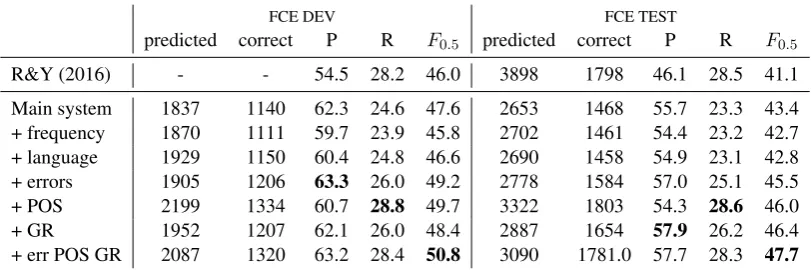
FCE DEV FCE TEST
predicted correct P R F0.5 predicted correct P R F0.5
R&Y (2016) - - 54.5 28.2 46.0 3898 1798 46.1 28.5 41.1
Main system 1837 1140 62.3 24.6 47.6 2653 1468 55.7 23.3 43.4
+ frequency 1870 1111 59.7 23.9 45.8 2702 1461 54.4 23.2 42.7
+ language 1929 1150 60.4 24.8 46.6 2690 1458 54.9 23.1 42.8
+ errors 1905 1206 63.3 26.0 49.2 2778 1584 57.0 25.1 45.5
+ POS 2199 1334 60.7 28.8 49.7 3322 1803 54.3 28.6 46.0
+ GR 1952 1207 62.1 26.0 48.4 2887 1654 57.9 26.2 46.4
[image:4.595.96.502.64.199.2]+ err POS GR 2087 1320 63.2 28.4 50.8 3090 1781.0 57.7 28.3 47.7
Table 2: Error detection results on the FCE dataset using different auxiliary loss functions.
contains more fine-grained labels per error. For example, the FCE (Yannakoudakis et al.,
2011) training set has 75 different labels for individual error types, such as missing deter-miners or incorrect verb forms. By giving the model access to these labels, the system can learn more fine-grained error patterns that are based on the individual error types.
• first language: Previous work has experi-mentally demonstrated that the distribution of writing errors depends on the first language (L1) of the learner (Rozovskaya and Roth,
2011; Chollampatt et al., 2016). We inves-tigate the usefulness of L1 as an auxiliary ob-jective during training.
• part-of-speech: POS tagging is a well-established sequence labeling task, requiring the model to disambiguate the word types based on their contexts. We use the RASP (Briscoe et al.,2006) parser to automatically generate POS labels for the training data, and include them as additional objectives. • grammatical relations: We include as an
auxiliary objective the type of the Grammat-ical Relation (GR) in which the current to-ken is a dependent, in order to incentivise the model to learn more about semantic composi-tion. Again we use the RASP parser, which is unlexicalised and therefore more suitable for learner data where spelling and grammatical errors are common.
Table 1presents the labels for each of the auxil-iary tasks for an example sentence from the FCE training data.
The auxiliary objectives introduce additional parameters into the model, in order to construct the
hidden and output layers. However, these compo-nents are required only during the training process; at testing time, these can be removed and the re-sulting model has the same architecture and num-ber of parameters as the baseline, with the only difference being in how the parameters were opti-mised.
4 Evaluation setup and datasets
Rei and Yannakoudakis(2016) investigate a num-ber of compositional architectures for error detec-tion, and present state-of-the-art results using a bidirectional LSTM. We follow their experimen-tal setup and investigate the impact of auxiliary loss functions on the same datasets: the First Cer-tificate in English (FCE) dataset (Yannakoudakis et al., 2011) and the CoNLL-14 shared task test set (Ng et al.,2014b).
FCE contains texts written by non-native learn-ers of English in response to exam prompts elic-iting free-text answers. The texts have been manually annotated with error types and error spans by professional examiners, which Rei and Yannakoudakis (2016) convert to a binary cor-rect/incorrect token-level labeling for error detec-tion. For missing-word errors, the error label is assigned to the next word in the sequence. The re-leased version contains 28,731 sentences for train-ing, 2,222 sentences for development and 2,720 sentences for testing. The development set was randomly sampled from the training data, and the test set contains texts from a different examination year.
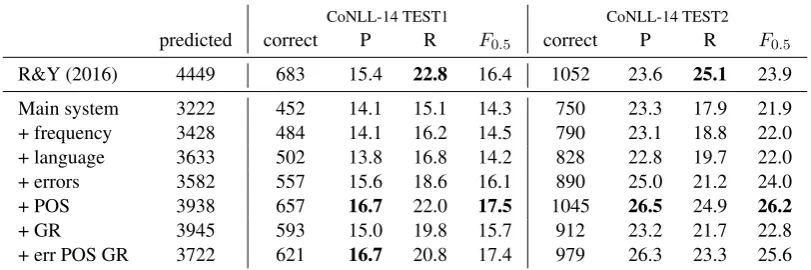
CoNLL-14 TEST1 CoNLL-14 TEST2
predicted correct P R F0.5 correct P R F0.5
R&Y (2016) 4449 683 15.4 22.8 16.4 1052 23.6 25.1 23.9
Main system 3222 452 14.1 15.1 14.3 750 23.3 17.9 21.9
+ frequency 3428 484 14.1 16.2 14.5 790 23.1 18.8 22.0
+ language 3633 502 13.8 16.8 14.2 828 22.8 19.7 22.0
+ errors 3582 557 15.6 18.6 16.1 890 25.0 21.2 24.0
+ POS 3938 657 16.7 22.0 17.5 1045 26.5 24.9 26.2
+ GR 3945 593 15.0 19.8 15.7 912 23.2 21.7 22.8
[image:5.595.96.502.64.199.2]+ err POS GR 3722 621 16.7 20.8 17.4 979 26.3 23.3 25.6
Table 3: Error detection results on the CoNLL-14 test set using different auxiliary loss functions.
also evaluate our models on the two CoNLL-14 test annotations and train our models only on the public FCE dataset. This corresponds to theirFCE-publicmodel that treats the CoNLL-14 dataset as an out-of-domain test set corpus.
Following the CoNLL-14 shared task, we also report F0.5 as the main evaluation metric. How-ever, while the shared task focused on correction and calculated F0.5 over error spans using multi-ple annotations, we evaluate token-level error de-tection performance. Following recommendations byChodorow et al.(2012), we also report the raw counts for predicted and correct tokens.
For pre-processing, all the texts are lowercased and digits are replaced with zeros for the token-level representations, although the character-based component has access to the original version of each token. Tokens that occur only once are mapped to a singleOOVtoken, which is then used to represent previously unseen tokens during test-ing. The word embeddings have size 300 and are initialised with publicly available word2vec (Mikolov et al., 2013) embeddings trained on Google News. The LSTM hidden layers have size 200 and the task-specific hidden layers have size 50 withtanh activation. The model is opti-mised using Adadelta (Zeiler, 2012) and training is stopped based on the error detectionF0.5 score on the development set. We implement the pro-posed framework using Theano and make the code publicly available online.1
5 Results
Table 2 presents the results for different sys-tem configurations trained and tested on the FCE dataset. The first row contains results from the current state-of-the-art system by Rei and
Yan-1http://www.marekrei.com/projects/seqlabaux
nakoudakis (2016), trained on the same FCE data. The main system in our experiments is the bi-directional LSTM error detection model with character-based representations, as described in Section2. We then use this model and test the ef-fect on performance when adding each of the aux-iliary loss functions described in Section3to the training objective.
The auxiliary frequency loss improves perfor-mance for POS tagging (Plank et al.,2016); how-ever in error detection the same objective does not help. While certain POS tags are more likely to be-long to specific frequency classes, there is less rea-son to believe that word frequency provides a use-ful cue for error detection. A similar drop in per-formance is observed for the auxiliary loss involv-ing the first language of the learner. It is likely that the system learns specific types of features for the L1 identification auxiliary task (such as the pres-ence of certain words or phrases), and these are not directly useful for error detection. Investigat-ing different architectures for incorporatInvestigat-ing the L1 as an auxiliary task is an avenue for future work.
The integration of fine-grained error types through an auxiliary loss function gives an abso-lute improvement of 2.1% on the FCE test set. While the baseline only differentiates between correct and incorrect tokens, the auxiliary loss al-lows the system to learn feature detectors that are specialised for individual error types, thereby also making these features available to the binary error detection component.
ar-FCE CoNLL-14 CoNLL-14
Aux dataset TEST TEST1 TEST2
None 43.4 14.3 21.9
CoNLL-00 42.5 15.4 22.3
CoNLL-03 39.4 12.5 20.0
PTB-POS 44.4 14.1 20.7
Table 4: Results on error detection when the model is pre-trained on different tasks.
chitecture is able to predict the POS tags or GR type based on context, then it can use the same features to identify irregular sequences for error detection. The added advantage of these loss func-tions over the L1 and the fine-grained error types is that they can be automatically generated and re-quire no additional manual annotation. As far as we know, this is the first time automatically gen-erated GR labels have been explored as objectives in a multi-task sequence labeling setting.
Finally, we evaluate a combination system, inte-grating the auxiliary loss functions that performed the best on the development set. The combina-tion architecture includes four different loss func-tions: the main binary incorrect/correct label, the fine-grained error type, the POS tag and the GR type. We left out frequency and L1, as these low-ered performance on the development set. The resulting system achieves 47.7% F0.5, which is a 4.3% absolute improvement over the baseline without auxiliary loss functions, and a6.6% abso-lute improvement over the current state-of-the-art error detection system byRei and Yannakoudakis
(2016), trained on the same FCE dataset.
Table3contains the same set of evaluations on the two CoNLL-14 shared task annotations. Word frequency and L1 have nearly no effect, whereas the fine-grained error labels lead to roughly 2% absolute improvement over the basic system. The inclusion of POS tags in the auxiliary objective consistently leads to the highestF0.5. While GRs also improve performance over the main system, their overall contribution is less compared to the FCE test set, which can be explained by the differ-ent writing style in the CoNLL data.
6 Alternative Training Strategies
In contrast to our approach, most previous work on multi-task learning has focused on optimising the same system on multiple datasets, each annotated with one specific type of labels. To evaluate the
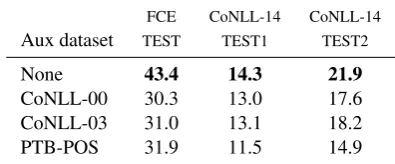
FCE CoNLL-14 CoNLL-14
Aux dataset TEST TEST1 TEST2
None 43.4 14.3 21.9
CoNLL-00 30.3 13.0 17.6
CoNLL-03 31.0 13.1 18.2
PTB-POS 31.9 11.5 14.9
Table 5: Results on error detection when training is alternated between the two tasks (e.g., error de-tection and POS tagging) and datasets.
effectiveness of our approach, we implement two alternative multi-task learning strategies for error detection. For these experiments, we make use of three established sequence labeling datasets that have been manually annotated for different tasks:
• The CoNLL 2000 dataset (Tjong Kim Sang and Buchholz,2000) for chunking, contain-ing sections of the Wall Street Journal and annotated with 22 different labels.
• The CoNLL 2003 corpus (Tjong Kim Sang and De Meulder, 2003) contains texts from the Reuters Corpus and has been annotated with 8 labels for named entity recognition (NER).
• The Penn Treebank (PTB) POS corpus ( Mar-cus et al.,1993) contains texts from the Wall Street Journal and has been annotated with 48 POS tags.
The CoNLL-00 dataset was identified by Bingel and Søgaard(2017) as being the most useful ad-ditional training resource in a multi-task setting; The CoNLL-03 NER dataset has a similar label density as the error detection task; and the PTB corpus was chosen as POS tags gave consistently good performance for error detection on both the development and test sets, as demonstrated in the previous section.
[image:6.595.317.515.64.146.2]compared to the results in Section5. One of the main advantages of multi-task learning is regular-isation, actively encouraging the model to learn more general-purpose features, something which is not exploited in this setting since the training happens in separate stages.
In the second set of experiments, we explore the possibility of training on the second domain and task at the same time as error detection. Similar to
Collobert and Weston(2008), we randomly sam-ple a sentence from one of the datasets and update the model parameters for that specific task. By al-ternating between the two tasks, the model is able to retain the regularisation benefits. However, as shown in Table5, this type of training does not im-prove error detection performance. One possible explanation is that the domain and writing style of these auxiliary datasets is very different from the learner writing corpus, and the model ends up op-timising in an unnecessary direction. By includ-ing alternative labels on the same dataset, as in Section 5, the model is able to extract more in-formation from the domain-relevant training data and thereby achieve better results.
7 Additional Training Data
The main benefits of multi-task learning are ex-pected in scenarios where the available task-specific training data is limited. However, we also investigate the effect of auxiliary objectives when training on a substantially larger training set. More specifically, we follow Rei and Yan-nakoudakis (2016), who also experimented with augmenting the publicly available datasets with training data from a large proprietary corpus. In total, we train this large model on 17.8M to-kens from the Cambridge Learner Corpus (CLC,
Nicholls 2003), the NUS Corpus of Learner En-glish (NUCLE, Dahlmeier et al. 2013), and the Lang-8 corpus (Mizumoto et al.,2011).
We use the same model architecture asRei and Yannakoudakis(2016), adding only the auxiliary objective of predicting the automatically gener-ated POS tag, which was the most successful ad-ditional objective based on the development ex-periments. Table6contains results for evaluating this model, when trained on the large training set. On the FCE test data, the auxiliary objective does not provide an improvement and the model per-formance is comparable to the results byRei and Yannakoudakis(2016) (R&Y). Since most of the
R&YF0.5 P R F0.5
[image:7.595.318.518.63.134.2]FCE DEV 60.7 75.1 35.1 61.2 FCE TEST 64.3 78.4 37.0 64.1 CoNLL TEST1 34.3 44.7 20.5 36.1 CoNLL TEST2 44.0 63.8 20.8 45.1
Table 6: Error detection results using auxiliary ob-jectives, trained on additional data.
large training set comes from the CLC, which is quite similar to the FCE dataset, it is likely that the available training data is sufficient and the auxil-iary objective does not offer an additional benefit. However, there are considerable improvements on the CoNLL test sets, with1.8%and1.1%absolute improvements on the corresponding benchmarks. Only small amounts of the training data are simi-lar to the CoNLL dataset, and including the aux-iliary objective has provided a more robust model that delivers better performance on different writ-ing styles.
8 Previous Work
Error detection: Early error detection systems were based on manually constructed error gram-mars and mal-rules (e.g.,Foster and Vogel 2004). More recent approaches have exploited error-annotated learner corpora and primarily treated the task as a classification problem over vectors of contextual, lexical and syntactic features extracted from a fixed window around the target token. Most work has focused on error-type specific detec-tion models, and in particular on models detecting preposition and article errors, which are among the most frequent ones in non-native English learner writing (Chodorow et al.,2007;De Felice and Pul-man,2008;Han et al.,2010;Tetreault et al.,2010;
Han et al., 2006;Tetreault and Chodorow, 2008;
Gamon et al., 2008;Gamon, 2010;Kochmar and Briscoe, 2014; Leacock et al., 2014). Maximum entropy models along with rule-based filters ac-count for a substantial proportion of utilized tech-niques. Error detection models have also been an integral component of essay scoring systems and writing instruction tools (Burstein et al.,2004; An-dersen et al.,2013;Attali and Burstein,2006).
the HOO 2012 shared task only focused on cor-recting preposition and determiner errors (Dale et al., 2012). The recent CoNLL shared tasks (Ng et al., 2013, 2014a) focused on error cor-rection rather than detection: CoNLL-13 targeted correcting noun number, verb form and subject-verb agreement errors, in addition to preposition and determiner errors made by non-native learners of English, whereas CoNLL-14 expanded to cor-rection of all errors regardless of type. Core com-ponents of the top two systems across the CoNLL correction shared tasks include Average Percep-trons, L1 error correction priors in Naive Bayes models, and joint inference capturing interactions between errors (e.g., noun number and verb agree-ment errors) (Rozovskaya et al.,2014), as well as phrase-based statistical machine translation, under the hypothesis that incorrect source sentences can be “translated” to correct target sentences (Felice et al.,2014;Grundkiewicz,2014).
The work that is most closely related to our own is the one byRei and Yannakoudakis(2016), who investigate a number of compositional architec-tures for error detection, and propose a framework based on bidirectional LSTMs. In this work, we used their system architecture as a baseline, com-pared our model to their results in Sections5and
7, and showed that multi-task learning can further improve performance and allow the model to gen-eralise better.
Multi-task learning:Multi-task learning was first proposed by Caruana(1998) and has since been applied to many language processing tasks and neural network architectures. For example, Col-lobert and Weston(2008) constructed a convolu-tional architecture that shared some weights be-tween tasks such as POS tagging, NER and chunk-ing. Whereas their model only shared word em-beddings, our approach focuses on learning better compositional features through a shared bidirec-tional LSTM.
Luong et al.(2016) explored a multi-task archi-tecture for sequence-to-sequence learning where encoders and decoders in different languages are trained jointly using the same semantic represen-tation space.Klerke et al.(2016) used eye tracking measurements as a secondary task in order to im-prove a model for sentence compression. Bingel and Søgaard(2017) explored beneficial task rela-tionships for training multitask models on differ-ent datasets. All of these architectures are trained
by randomly switching between different tasks and updating parameters based on the correspond-ing dataset. In contrast, we treat alternative tasks as auxiliary objectives on the same dataset, which is beneficial for error detection (Section6).
There has been some research on using aux-iliary training objectives in the context of other tasks. Cheng et al. (2015) described a system for detecting out-of-vocabulary names by also pre-dicting the next word in the sequence.Plank et al.
(2016) predicted the frequency of each word to-gether with the POS, and showed that this can im-prove tagging accuracy on low-frequency words. However, we are the first to explore the auxiliary objectives described in Section3in the context of error detection.
9 Conclusion
We have described a method for integrating aux-iliary loss functions with a neural sequence label-ing framework, in order to improve error detec-tion in learner writing. While predicting binary error labels, the model also learns to predict addi-tional linguistic information for each token, allow-ing it to discover compositional features that can be exploited for error detection. We performed a systematic comparison of possible auxiliary la-bels, which are either available in existing annota-tions or can be generated automatically. Our ex-periments showed that POS tags, grammatical re-lations and error types gave the largest benefit for error detection, and combining them together im-proved the results further.
We compared this training method to two other multi-task approaches: learning sequence labeling models on related tasks and using them to initialise the error detection model; and training on multiple tasks and datasets by randomly switching between them. Both of these methods were outperformed by our proposed approach using auxiliary labels on the same dataset – the latter has the benefit of regularising the model with a different task, while also keeping the training data in-domain.
functions and better word representations. The error detection model, which also learns to pre-dict automatically generated POS tags, achieved improved performance on both CoNLL-14 bench-marks. A useful direction for future work would be to investigate dynamic weighting strategies for auxiliary objectives that allow the network to ini-tially benefit from various available labels, and then specialise to performing the main task.
References
Øistein E Andersen, Helen Yannakoudakis, Fiona Barker, and Tim Parish. 2013. Developing and test-ing a self-assessment and tutortest-ing system. In Pro-ceedings of the Eighth Workshop on Innovative Use
of NLP for Building Educational Applications, BEA.
Association for Computational Linguistics, pages 32–41.
Yigal Attali and Jill Burstein. 2006. Automated essay scoring with e-rater v. 2. The Journal of Technology,
Learning and Assessment4(3).
Joachim Bingel and Anders Søgaard. 2017. Identi-fying beneficial task relations for multi-task learn-ing in deep neural networks. In arXiv preprint.
http://arxiv.org/abs/1702.08303.
Ted Briscoe, John Carroll, and Rebecca Watson. 2006.
The Second Release of the RASP System. In Pro-ceedings of the COLING/ACL on Interactive
pre-sentation sessions.. Association for Computational
Linguistics, Sydney, Australia, July, pages 77–80.
https://doi.org/10.3115/1225403.1225423.
Christopher Bryant and Hwee Tou Ng. 2015. How far are we from fully automatic high quality grammati-cal error correction? InProceedings of the 53rd An-nual Meeting of the Association for Computational Linguistics and the 7th International Joint
Confer-ence on Natural Language Processing. Association
for Computational Linguistics, pages 697–707.
Jill Burstein, Martin Chodorow, and Claudia Leacock. 2004. Automated essay evaluation: The Criterion online writing service. AI Magazine25(3):27.
Rich Caruana. 1998. Multitask Learning. Learning to
learn.
Hao Cheng, Hao Fang, and Mari Ostendorf. 2015. Open-Domain Name Error Detection using a Multi-Task RNN. InProceedings of the 2015 Conference on Empirical Methods in Natural Language
Pro-cessing.
Martin Chodorow, Markus Dickinson, Ross Israel, and Joel Tetreault. 2012. Problems in evaluating gram-matical error detection systems. InCOLING 2012.
Martin Chodorow, Joel R. Tetreault, and Na-Rae Han. 2007. Detection of grammatical er-rors involving prepositions. In Proceedings of
the 4th ACL-SIGSEM Workshop on Prepositions.
https://doi.org/10.3115/1654629.1654635.
Shamil Chollampatt, Duc Tam Hoang, and Hwee Tou Ng. 2016. Adapting Grammatical Error Correction Based on the Native Language of Writers with Neu-ral Network Joint Models. Proceedings of the 2016 Conference on Empirical Methods in Natural
Lan-guage Processing (EMNLP-16)pages 1901–1911.
Ronan Collobert and Jason Weston. 2008. A Unified Architecture for Natural Language Pro-cessing: Deep Neural Networks with Multitask Learning. Proceedings of the 25th interna-tional conference on Machine learning (ICML ’08)
https://doi.org/10.1145/1390156.1390177.
Daniel Dahlmeier, Hwee Tou Ng, and Siew Mei Wu. 2013. Building a large annotated corpus of learner English: The NUS corpus of learner English. Pro-ceedings of the Eighth Workshop on Innovative Use
of NLP for Building Educational Applications.
Robert Dale, Ilya Anisimoff, and George Narroway. 2012. HOO 2012: A report on the preposition and determiner error correction shared task. In Pro-ceedings of the Seventh Workshop on Building
Ed-ucational Applications Using NLP. Association for
Computational Linguistics, pages 54–62.
Robert Dale and Adam Kilgarriff. 2011. Helping our own: The HOO 2011 pilot shared task. In Pro-ceedings of the 13th European Workshop on
Natu-ral Language Generation. Association for
Compu-tational Linguistics, pages 242–249.
Rachele De Felice and Stephen G Pulman. 2008. A classifier-based approach to preposition and deter-miner error correction in L2 English. In Proceed-ings of the 22nd International Conference on
Com-putational Linguistics. Association for
Computa-tional Linguistics, pages 169–176.
Mariano Felice and Zheng Yuan. 2014. Generating ar-tificial errors for grammatical error correction. In Proceedings of the Student Research Workshop at the 14th Conference of the European Chapter of the
Association for Computational Linguistics. pages
116–126.
Mariano Felice, Zheng Yuan, Øistein E. Ander-sen, Helen Yannakoudakis, and Ekaterina Kochmar. 2014. Grammatical error correc-tion using hybrid systems and type filtering. Conference on Computational Natural
Lan-guage Learning: Shared Task (CoNLL-2014)
http://www.comp.nus.edu.sg/ nlp/conll14st/conll14st-book.pdf#page=25.
error detection. InProceedings of the fourth Work-shop on Innovative use of NLP for Building
Educa-tional Applications. Association for Computational
Linguistics, pages 82–90.
Jennifer Foster and Carl Vogel. 2004. Parsing ill-formed text using an error grammar. Artificial
In-telligence Review21(3-4):269–291.
Michael Gamon. 2010. Using mostly native data to correct errors in learners’ writing: a meta-classifier approach. In Human Language Technologies: The 2010 Annual Conference of the North American Chapter of the Association for Computational
Lin-guistics. Association for Computational Linguistics,
pages 163–171.
Michael Gamon, Jianfeng Gao, Chris Brockett, Alexandre Klementiev, William B Dolan, Dmitriy Belenko, and Lucy Vanderwende. 2008. Using con-textual speller techniques and language modeling for ESL error correction. InIJCNLP. volume 8, pages 449–456.
Marcin Junczys-Dowmunt Roman Grundkiewicz. 2014. The AMU system in the CoNLL-2014 shared task: Grammatical error correction by data-intensive and feature-rich statistical machine translation. In Proceedings of the Eighteenth Conference on Com-putational Natural Language Learning: Shared Task. Association for Computational Linguistics, pages 25–33.
Na-Rae Han, Martin Chodorow, and Clau-dia Leacock. 2006. Detecting errors in English article usage by non-native
speak-ers. Natural Language Engineering 12.
https://doi.org/doi:10.1017/S1351324906004190. Na-Rae Han, Joel Tetreault, Soo-Hwa Lee, and
Jin-Young Ha. 2010. Using error-annotated ESL data to develop an ESL error correction system. InIn Pro-ceedings of LREC. Emi Izumi, Kiyotaka Uchimoto
and Hitoshi Isahara.
Sepp Hochreiter and J¨urgen Schmidhuber. 1997. Long Short-term Memory. Neural Computation 9.
https://doi.org/10.1.1.56.7752.
Sigrid Klerke, Yoav Goldberg, and Anders Søgaard. 2016. Improving sentence compression by learn-ing to predict gaze. In The Annual Confer-ence of the North American Chapter of the
As-sociation for Computational Linguistics (NAACL).
http://arxiv.org/abs/1604.03357.
Ekaterina Kochmar and Ted Briscoe. 2014. Detecting learner errors in the choice of content words using compositional distributional semantics. In Proceed-ings of the 25th International Conference on Com-putational Linguistics (COLING 2014): Technical
Papers. pages 1740–1751.
Claudia Leacock, Martin Chodorow, Michael Gamon, and Joel Tetreault. 2014. Automated grammatical error detection for language learners, second edition.
Synthesis lectures on human language technologies 7(1):1–170.
Minh-Thang Luong, Quoc V. Le, Ilya Sutskever, Oriol Vinyals, and Lukasz Kaiser. 2016. Multi-task Sequence to Sequence Learning. ICLR 2017
http://arxiv.org/abs/1511.06114.
Mitchell P. Marcus, Beatrice Santorini, and Mary Ann Marcinkiewicz. 1993. Building
a large annotated corpus of English: The
Penn Treebank. Computational Linguistics 19.
https://doi.org/10.1162/coli.2010.36.1.36100.
Tom´aˇs Mikolov, Kai Chen, Greg Corrado, and Jeffrey Dean. 2013. Efficient Estimation of Word Representations in Vector Space. In Proceedings of the International Conference
on Learning Representations (ICLR 2013).
https://doi.org/10.1162/153244303322533223.
Tomoya Mizumoto, Mamoru Komachi, Masaaki Na-gata, and Yuji Matsumoto. 2011. Mining Revi-sion Log of Language Learning SNS for Auto-mated Japanese Error Correction of Second Lan-guage Learners. Proceedings of the 5th Interna-tional Joint Conference on Natural Language
Pro-cessing 2011https://doi.org/10.1527/tjsai.28.420.
Hwee Tou Ng, Siew Mei Wu, Ted Briscoe, Christian Hadiwinoto, Raymond Hendy Susanto, and Christo-pher Bryant. 2014a. The CoNLL-2014 shared task on grammatical error correction. InProceedings of the Eighteenth Conference on Computational
Natu-ral Language Learning: Shared Task. Association
for Computational Linguistics, Baltimore, Mary-land, pages 1–14.
Hwee Tou Ng, Siew Mei Wu, Ted Briscoe, Christian Hadiwinoto, Raymond Hendy Susanto, and Christo-pher Bryant. 2014b. The CoNLL-2014 Shared Task on Grammatical Error Correction. InProceedings of the Eighteenth Conference on
Computa-tional Natural Language Learning: Shared Task.
http://www.aclweb.org/anthology/W/W14/W14-1701.
Hwee Tou Ng, Siew Mei Wu, Yuanbin Wu, Chris-tian Hadiwinoto, and Joel Tetreault. 2013. The CoNLL-2013 shared task on grammatical error cor-rection. InProceedings of the Seventeenth Confer-ence on Computational Natural Language
Learn-ing: Shared Task. Association for Computational
Linguistics, pages 1–12.
Diane Nicholls. 2003. The Cambridge Learner Cor-pus - error coding and analysis for lexicography and
ELT. Proceedings of the Corpus Linguistics 2003
Conference.
54th Annual Meeting of the Association for
Com-putational Linguistics (ACL-16). pages 412–418.
http://arxiv.org/abs/1604.05529.
Marek Rei. 2017. Semi-supervised Multitask Learn-ing for Sequence LabelLearn-ing. InProceedings of the 55th Annual Meeting of the Association for
Compu-tational Linguistics (ACL-2017).
Marek Rei, Gamal K. O. Crichton, and Sampo Pyysalo. 2016. Attending to Characters in Neural Sequence Labeling Models. InProceedings of the 26th Inter-national Conference on Computational Linguistics
(COLING-2016).http://arxiv.org/abs/1611.04361.
Marek Rei and Helen Yannakoudakis. 2016.
Compositional Sequence Labeling Models
for Error Detection in Learner Writing. In Proceedings of the 54th Annual Meeting of
the Association for Computational Linguistics.
https://aclweb.org/anthology/P/P16/P16-1112.pdf. Alla Rozovskaya, Kai-Wei Chang, Mark Sammons,
Dan Roth, and Nizar Habash. 2014. The Illinois-Columbia system in the CoNLL-2014 shared task.
In Proceedings of the Eighteenth Conference on
Computational Natural Language Learning: Shared Task. Association for Computational Linguistics, pages 34–42.
Alla Rozovskaya and Dan Roth. 2011. Algorithm Selection and Model Adaptation for ESL Correc-tion Tasks. Proceedings of the 49th Annual Meet-ing of the Association for Computational LMeet-inguis-
Linguis-tics (ACL-2011)
http://www.aclweb.org/anthology-new/P/P11/P11-1093.pdf.
Alla Rozovskaya and Dan Roth. 2016. Grammati-cal error correction: Machine translation and clas-sifiers. In Proceedings of the 54th Annual Meet-ing of the Association for Computational LMeet-inguis- Linguis-tics. pages 2205–2215.
Joel Tetreault, Jennifer Foster, and Martin Chodorow. 2010. Using parse features for preposition selection and error detection. InProceedings of the acl 2010
conference short papers. Association for
Computa-tional Linguistics, pages 353–358.
Joel R Tetreault and Martin Chodorow. 2008. The ups and downs of preposition error detection in ESL writing. InProceedings of the 22nd International
Conference on Computational Linguistics.
Associa-tion for ComputaAssocia-tional Linguistics, pages 865–872. Erik F. Tjong Kim Sang and Sabine Buchholz.
2000. Introduction to the CoNLL-2000 shared task: Chunking. Proceedings of the 2nd Workshop on Learning Language in Logic and the 4th Confer-ence on Computational Natural Language Learning 7. https://doi.org/10.3115/1117601.1117631. Erik F. Tjong Kim Sang and Fien De Meulder.
2003. Introduction to the CoNLL-2003 Shared Task: Language-Independent Named Entity Recog-nition. In Proceedings of the seventh conference
on Natural language learning at HLT-NAACL 2003.
http://arxiv.org/abs/cs/0306050.
Helen Yannakoudakis, Ted Briscoe, and Ben Medlock. 2011. A New Dataset and Method for Automati-cally Grading ESOL Texts. InProceedings of the 49th Annual Meeting of the Association for Com-putational Linguistics: Human Language Technolo-gies.http://www.aclweb.org/anthology/P11-1019. Matthew D. Zeiler. 2012. ADADELTA: An
Adap-tive Learning Rate Method. arXiv preprint