ISSN: 2231-5381
http://www.ijettjournal.org
Page 4466Design & Implementation Of 32-Bit Risc (MIPS) Processor
*Marri Mounika1 Aleti Shankar 2
1PG Student (M. Tech-ECE), Dept. of ECE, Geetanjali College Of Enginnering & Technology, Hyderabad, AP. 2Associate Professor, Dept. of ECE, Geetanjali College Of Engineering & Technology, Hyderabad, AP.
Abstract: In this paper we propose a novel technique of run-time loading of machine code for MIPS-32 soft-core processor. As we know, implementing fewer instructions and addressing modes on silicon reduces the complexity of the instruction decoder, the addressing logic, and the execution unit. This allows the machine to be clocked at a faster speed, since less work needs to be done each clock period. Our proposed RISC MIPS Processor technique sends the machine code to the instruction memory of the soft-core from the software tool through UART. The user should use that software tool to write MIPS assembly code, debug the code and generate the machine code. Also, the software tool is used for establishing UART connection. Keywords: MIPS, Data Flow, Data Path, Pipeline, RISC, CISC.
1.
IntroductionProcessors are regarded as one of the most important devices in our everyday machines called computers. Before we start, we need to understand what exactly processors are and their appropriate implementations. Processor is an electronic circuit that functions as the central processing unit (CPU) of a computer, providing computational control. Processors are also used in other advanced electronic systems, such as computer printers, automobiles, and jet airliners, Calculators and etc.
Typical processors incorporate arithmetic and logic functional units as well as the associated control logic, instruction processing circuitry, and a portion of the memory hierarchy. Portions of the interface logic for the input/output (I/O) and memory subsystems may also be infused, allowing cheaper overall systems. While many processors and
single-chip designs, some high-performance designs rely on a few chips to provide multiple functional units and relatively large caches.
Processors have been described in many different ways. They have been compared with the brain and the heart of humans. Their operation has been liked to a switched board, and to the nervous system in an animal. They have often been called microcomputers. The original purpose of the processor was to control memory. That is what they were originally designed to do, and that is what they do today. Specifically, a processor is “a component that implements memory.”
ISSN: 2231-5381
http://www.ijettjournal.org
Page 4467 So, the processor ends up waiting duringeach memory access, wasting execution cycles.
To reduce the number of accesses to main memory, designers added instruction and data cache to the processors. A cache is a special type of high speed RAM where data and the address of the data are stored. Whenever the processor tries to read data from main memory, the cache is examined first. If one of the addresses stored in the cache matches the address being used for the memory read (called a hit), the cache will supply the data instead. Cache is commonly ten times faster than main memory, so you can see the advantage of getting data in 10 nanoseconds instead of 60 nanoseconds. Only when we miss (i.e., do not find the required data in the cache), does it take the full access time of 60 nanoseconds. But this can only happen once. Since a copy of the new data is written into the cache after a miss. The data will be there the next time we need it. Instruction cache is used to store frequently used instructions. Data cache is used to store frequently used data.
Implementing fewer instructions and addressing modes on silicon reduces the complexity of the instruction decoder, the addressing logic, and the execution unit. This allows the machine to be clocked at a faster speed, since less work needs to be done each clock period.
RISC typically has large set of registers. The number of registers available in a processor can affect
performance the same way a memory access does. A complex calculation may require the use of several data values. If the data values all reside in memory during the calculations, many memory accesses must be used to utilize them. If the data values are stored in the internal registers of the processor instead, their access during calculations will be much faster. It is good then to have lot of internal registers.
2.
THE MIPS PROCESSOR The MIPS instruction set architecture (ISA) is a RISC based microprocessor architecture that was developed by MIPS Computer Systems Inc. in the early 1980s. MIPS is now an industry standard and the performance leader within the embedded industry. Their designs can be found in Canon digital cameras, Windows CE devices, Cisco Routers, Sony Play Station 2 game consoles, and many more products used in our everyday lives. By the late 1990s it was estimated that one in three of all RISC chips produced was a MIPS-based design.Architecture of MIPS RISC microprocessor includes, fix-length straightforward decoded instruction format, memory accesses limited to load and store instructions, hardwired control unit, a large general purpose register file, and all operations are done within the registers of the microprocessor.
ISSN: 2231-5381
http://www.ijettjournal.org
Page 4468 architecture. One of the most widely usedtools that helps students understand MIPS is SPIM (MIPS spelled backwards) a software simulator that enables the user to read and write MIPS assembly language programs and execute them. SPIM is a great tool because it allows the user to execute programs one step or instruction at a time. This then allows the user to see exactly what is happening during their program execution. SPIM also provides a window displaying all general purpose registers which can also be used during the debug of a program. This simulator is another impressive tool that gives the computer architecture students an opportunity to visually observe how the MIPS processor works.
I - Type instruction
31 6 5 5 16 0
Opcode rs1 rt n/offset
R - Type
6 5 5 5 5 6
Opcode rs rt rd shamt func
J - Type
6 26
Opcode raddr
Figure 1 Instruction Formats
As mentioned before MIPS is a RISC microprocessor architecture. The MIPS Architecture defines 32-bit general purpose registers (GPRs). Register $r0 is hard-wired
and always contains the value zero. The CPU uses byte addressing for word accesses and must be aligned on a byte boundary divisible by four (0, 4, 8, …). MIPS only has three instruction types: I-type is used for the Load and Stores instructions, R-type is used for Arithmetic instructions, and J-type is used for the Jump instructions as shown in Figure 1 which provides a description of each of the fields used in the three different instruction types.
ISSN: 2231-5381
http://www.ijettjournal.org
Page 44693.
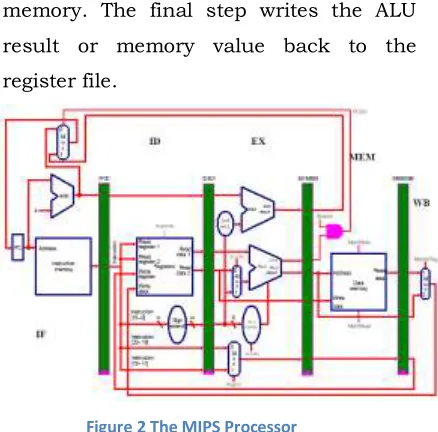
MIPS SINGLE-CYCLE PROCESSOR IMPLEMENTATIONThe MIPS single-cycle processor performs the tasks of instruction fetch, instruction decode, execution, memory access and write-back all in one clock cycle. First the PC value is used as an address to index the instruction memory which supplies a 32-bit value of the next instruction to be executed. This instruction is then divided into the different fields shown in fig. 1. The instructions opcode field bits [31-26] are sent to a control unit to determine the type of instruction to execute. The type of instruction then determines which control signals are to be asserted and what function the ALU is to perform, thus decoding the instruction. The instruction register address fields rs bits [25 - 21], rt bits [20 - 16], and rd bits [15-11] are used to address the register file. The register file supports two independent register reads and one register write in one clock cycle. The register file reads in the requested addresses and outputs the data values contained in these registers. These data values can then be operated on by the ALU whose operation is determined by the control unit to either compute a memory address (e.g. load or store), compute an arithmetic result (e.g. add, and or slt), or perform a compare (e.g. branch). If the instruction decoded is arithmetic, the ALU result must be written to a register. If the instruction decoded is a load or a store, the ALU result is then used to address the data
memory. The final step writes the ALU result or memory value back to the register file.
Figure 2 The MIPS Processor
The initial task of this paper was to implement in VHDL the MIPS single-cycle processor .A good VHDL reference and tutorial can be found in the appendices to the book Fundamentals of Digital Logic with VHDL Design by Stephen Brown and Zvonko Vranesic [2]. The IEEE Standard VHDL Language Reference Manual [3], also helped in the overall design of the VHDL implementation. The first part of the design was to analyze the single-cycle datapath and take note of the major function units and their respective connections.
ISSN: 2231-5381
http://www.ijettjournal.org
Page 4470 state element has at least two inputs andone output. The two inputs are the data value to be written and a clock signal. The output signal provides the data values that were written in an earlier clock cycle. State elements in the MIPS implementation include the Register File, Instruction Memory, and Data Memory as seen in Figure 2. While many of logic units are straightforward to design and implement in VHDL, considerable effort was needed to implement the state elements.
It was determined that the full 32-bit version of the MIPS architecture would not fit onto the chosen FLEX10K70 FPGA. The FLEX10K70 device includes nine embedded array blocks (EABs) each providing only 2,048 bits of memory for a total of 2 KB memory space. The full 32-bit version of MIPS requires no less than twelve EABs to support the processor’s register file, instruction memory, and data memory. In order for our design to model that in [1], the data width was reduced to 8-bit while still maintaining a full 32-bit instruction. This new design allows us to implement all of the processor’s state elements using six EABs, which can be handled by the FLEX10K70 FPGA device. Even though the data width was reduced, the design has minimal VHDL source modifications from the full 32-bit version, thus not impacting the instructional value of the MIPS VHDL model.
With our new design, the register file is implemented to hold thirty-two, 8-bit general purpose registers amounting to
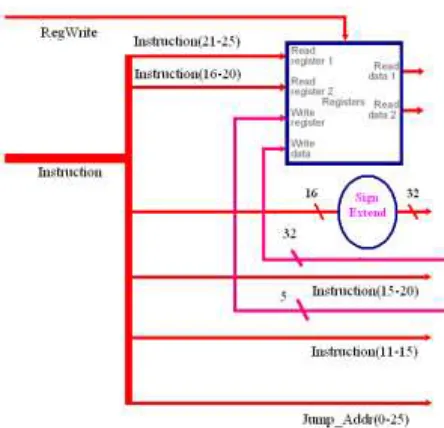
32 bytes of memory space. This easily fits into one 256 x 8 EAB within the FPGA. The full 32-bit version of MIPS will require combining four 256 x 8 EABs to implement the register file. The register file has two read and one write input ports, meaning that during one clock cycle, the processor must be able to read two independent data values and write a separate value into the register file. Figure 3 shows the MIPS register file. The register file was implemented in VHDL by declaring it as a one-dimensional array of 32 elements or registers each 8-bits wide. (e.g. TYPE register_file IS ARRAY (0 TO 31) OF STD_LOGIC_VECTOR (7 DOWNTO 0) ) By declaring the register file as a one-dimensional array, the requested register address would need to be converted into an integer to index the register file.(e.g. Read_Data_1 <= register_file ( CONV_INTEGER (read_register_address1 (4 DOWNTO 0))) Finally, to save from having to load each register with a value, the registers get initialized to their respective register number when the Reset signal is asserted. (e.g. r1 = 1, r2 = 2, etc.)
Figure 3 MIPS Register File
ISSN: 2231-5381
http://www.ijettjournal.org
Page 4471 The function of the instruction fetchunit is to obtain an instruction from the instruction memory using the current value of the PC and increment the PC value for the next instruction as shown in Figure 4. Since this design uses an 8-bit data width we had to implement byte addressing to access the registers and word address to access the instruction memory. The instruction fetch component contains the following logic elements that are implemented in VHDL: 8-bit program counter (PC) register, an adder to increment the PC by four, the instruction memory, a multiplexer, and an AND gate used to select the value of the next PC.
Figure 4 Instruction Fetch Unit
INSTRUCTION DECODE UNIT
The main function of the instruction decode unit is to use the 32-bit instruction provided from the previous instruction fetch unit to index the register file and obtain the register data values as seen in Figure 5. This unit also sign extends instruction bits [15 - 0] to 32-bit. However with our design of 8-bit data width, our implementation uses the instruction bits [7 – 0] bits instead of sign extending the value. The logic elements to
be implemented in VHDL include several multiplexers and the register file that was described earlier.
Figure 5 Instruction Decoding Unit
THE CONTROL UNIT
ISSN: 2231-5381
http://www.ijettjournal.org
Page 4472 determine the function the ALU performs.(e.g. and, or, add, sbu, slt) The MemWrite control signal is asserted when during a store instruction when a registers value is stored in the data memory. The ALUSrc control signal determines if the ALU second operand comes from the register file or the sign extend. The RegWrite control signal is asserted when the register file needs to be written. Table 1 shows the control signal values from the instruction decoded.
Figure 6 MIPS Control Unit
Table 1 MIPS Control Signals
Execution Unit
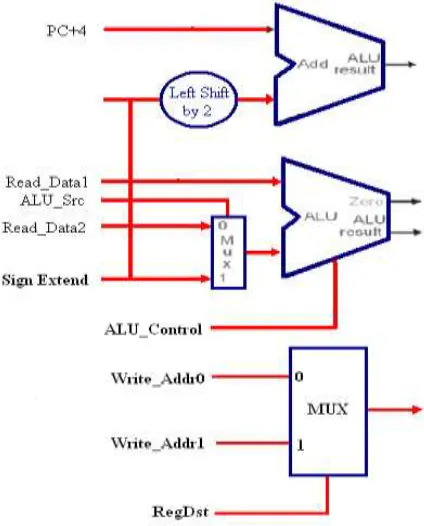
The execution unit of the MIPS processor contains the arithmetic logic unit (ALU) which performs the operation determined by the ALUop signal. The branch address is calculated by adding the PC+4 to the sign extended immediate field shifted left 2 bits by a separate adder. The logic elements to be implemented in VHDL include a
multiplexer, an adder, the ALU and the ALU control as shown in Figure 2 & 7
Figure 7 MIPS Execution Unit
DATA MEMORY UNIT
ISSN: 2231-5381
http://www.ijettjournal.org
Page 4473Figure 8 MIPS Data Memory Unit
4. Results and Conclusions
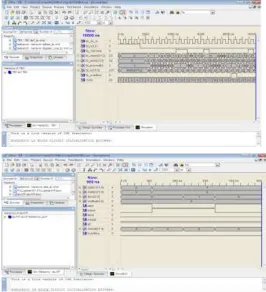
The work presented in this paper describes a functional implementation design of a MIPS single cycle and pipelined processor designed using VHDL. The VHDL designs of the MIPS processor were all simulated to ensure that the processors were functional and operated just as described by Patterson and Hennessy. The results show first the instruction memory initialization, which is used to fill the instruction memory with the instructions to be executed, which are indexed by the program counter (PC). The second is the actual 32-bit instruction represented using hexadecimal numbers. The third is the PC value used to index the instruction memory to retrieve an instruction. The next four columns are the MIPS instruction’s mnemonic description. Finally last columns are the pseudo instructions using the actual values used during the simulation.
From This Work it is observed that the MIPS based system is simulated using VHDL. The overall system is simulated and synthesized, after synthesizing the
system we could get a statistical data about the number of input-output buffers, the number of registers, number of flip-flops and latches were used .The modules simulated are Accumulator, Buffer, Clock Generator, Instruction Register, Multiplexer, Program Counter, Reset, Control Logic Decoder, Arithmetic Logic Unit and the overall system. Few instructions were executed and their timing sequences were analyzed. It is found that an each instruction taken 100ps.
It shows that the different operation of the instruction including the decoding and execution comes to 40ns in the overall system. Therefore we conclude that the behavior shows, the system is working as MIPS as instruction will be executed within a single clock cycle.
ISSN: 2231-5381
http://www.ijettjournal.org
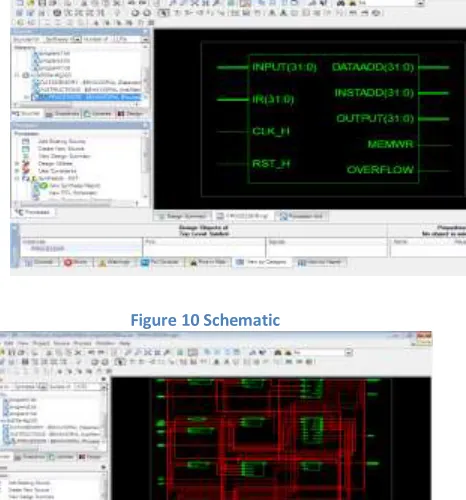
Page 4474Figure 10 Schematic
Figure 11 RTL Schematic
Acknowledgements
The authors would like to thank the anonymous reviewers for their comments which were very helpful in improving the quality and presentation of this paper.
References:
[1]Zheng-WeiMin, Tang-ZhiZhong. Computer System Structure (The second edition), Tsinghua University Press, 2006.
[2] Pan-Song, Huang-JiYe, SOPC Technology Utility Tutorial, Tsinghua University Press, 2006.
[3]Ramdas, T. Li-Minn Ang and Egan, G., "FPGA implementation of an integer MIPS processor in Handel-C and its application to human face detection," in Proc. of IEEE Region 10 Conference, Vol. 1, pp. 36-39, 2004.
[4]Xizhi Li and Tiecai Li, "ECOMIPS: an economic MIPS CPU design on FPGA," in Proc. of the 4th IEEE International Workshop on System-on- Chip for Real-Time Applications, pp. 291-294, 2004. [5]D. M. Harris and S. L. Harris, Digital
Design and Computer Architecture,1st edition, Morgan Kaufmann, 2007, USA. [6] Balpande, R.S. and Keote, R.S., "Design of
FPGA based Instruction Fetch & Decode Module of 32-bit RISC (MIPS) Processor," in Proc. of International Conference on Communication Systems and Network Technologies, pp. 409-413, 2011.
[7]MIPS Technologies, Inc. MIPS32™ Architecture For Programmers Volume II: The MIPS32™ Instruction Set June 9, 2003.
Authors Profile:
Marri Mounika is Pursuing M. Tech from Geetanjali College Of Enginnering & Technology, JNTUH with specialization in Electronics & Communications Engineering (ECE).