571
FORAGING OPTIMIZATION FOR CLUSTER HEAD
SELECTION
1G. KAVITHA, 2 Dr. R. S. D. WAHIDABANU
1Excel Engineering College, Department of Computer Science and Engineering, Kumarapalayam, INDIA 2Government College of Engineering, Salem, INDIA
E-mail: 1 [email protected]
ABSTRACT
Wireless sensor networks (WSN) are popular as they are potentially low cost solutions to various real-world challenges. WSNs consist of autonomous nodes to monitor an environment. WSN developers face challenges from communication link failures, memory/computational constraints, and limited energy. Many WSN issues are formulated as multidimensional optimization problems and solved through bio-inspired techniques. Clustering divides a network into interconnected substructures, called clusters with each cluster having a cluster head (CH) as coordinator in the substructure. Each CH is a temporary base station in its zone/cluster communicating with other CHs. This study proposes an improved cluster head selection for efficient data aggregation in sensor networks. The proposed algorithm is based on LEACH incorporated Bacterial Foraging Optimization (BFO).
Keywords: Wireless sensor networks (WSN), Clustering, Data-Aggregation, Localization, Optimal Deployment, Bacterial Foraging Optimization (BFO)
1. INTRODUCTION
WSN combines sensing, computation, and communication in a single tiny device forming a sea of connectivity extending cyberspace reach into the physical world, through advanced mesh networking protocols formed. As water fills all rooms in a submerged ship, mesh network connectivity seeks out and exploits possible communication paths by hopping data from node to node searching for its destination. While single device capabilities are minimal, composition of hundreds of devices offers radically new technological possibilities [1].
A sensor network comprises of large number of sensor nodes densely deployed inside or close to a phenomenon. Sensor nodes position need not be engineered/pre-determined due to its deployment in inaccessible terrains/disaster relief operations. It also means that sensor network protocols and algorithms should have self-organizing capabilities. Another unique feature of theirs is sensor nodes cooperation. Sensor nodes have on-board processors. Instead of forwarding raw data to nodes, responsible for fusion, sensor nodes use processing abilities for simple computations locally; transmitting only required and partially processed data [2].
Adhoc network nodes are considered to have limited resources, but sensor nodes are more constrained. Of all the resource constraints, limited energy is most pressing. After deployment, many sensor networks are unattended for long periods with battery recharging/replacement being infeasible or impossible [3].
Data aggregation algorithms goal is in gathering and aggregating data energy efficiently so that network life is enhanced. WSN offers an attractive data gathering method in distributed system architectures with dynamic access through wireless connectivity.
Data aggregation is a process of aggregating sensor data through aggregation approaches use. General data aggregation algorithm work as shown in the figure below. It uses sensor data from sensor node and aggregates data using aggregation algorithms like centralized approach, low energy adaptive clustering hierarchy (LEACH) and Tiny Aggregation (TAG). Aggregated data is shifted to sink node through a selected path [4].
572 according to network structure, according to
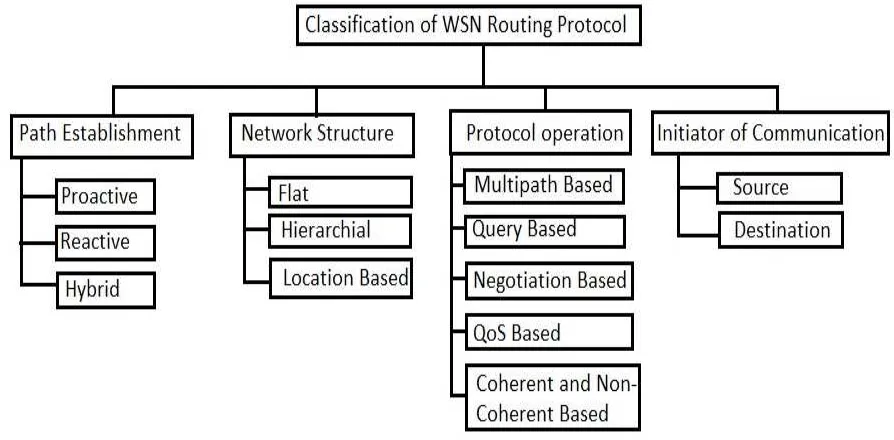
[image:2.595.97.544.185.405.2]protocol operation, according to path establishment, and according to communications initiator. Figure 1 shows WSN routing protocols classification.
Figure 1: Classification of Routing Protocols in Wireless Sensor Network
Routing paths are established in one of 3 ways, namely proactive, reactive or hybrid. Proactive protocols compute all routes before they are needed with the routes being stored in a node’s routing table. When a route changes, the change is propagated through the network. As a WSN consists of 1000’s of nodes, each node’s routing tables will therefore be huge. Hence, proactive protocols are unsuited for WSNs. Reactive protocols compute routes only when needed. Hybrid protocols combine both ideas [5].
Considering their procedures, routing protocols are classified according to following criteria.
Hierarchy Role of Nodes in Network: In flat
schemes, sensor nodes participate with same role in routing procedures, but, hierarchical routing protocols classify sensor nodes based on their functions [6]. The network is divided into groups/clusters. A leader/cluster head is selected in a group to coordinate the activities in a cluster and communicate with nodes outside the cluster. Node differentiation is either static or dynamic.
Data Delivery Model: Depending on application,
data gathering and WSN interaction is accomplished in many ways. Data delivery model
indicates information flow between sensor nodes and sink. Data delivery models are divided into following classes: event-driven, continuous, hybrid or query-driven. In continuous model, nodes periodically transmit information their sensors detect at a pre-specified rate. In contrast, query-driven approaches make nodes wait to be demanded to inform about sensed data. Sensors emit collected data when an event occurs in event-driven models. Finally, hybrid schemes combine earlier strategies so sensors inform collected data periodically, but also respond to queries. They are also additionally programmed to inform on interesting events.
Grouping sensor nodes into clusters was adopted by the research community to satisfy scalability objectives and achieve high energy efficiency to
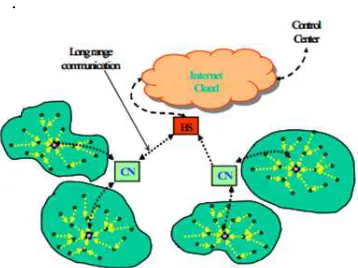
573 Cluster formation process leads to two-level hierarchy where CH nodes form higher level and cluster-member nodes the lower level. Sensor nodes periodically transmit data to corresponding CH nodes. CH nodes aggregate data (decreasing the number of relayed packets) and transmit them to Base Station (BS) directly or via intermediate communication with CH nodes. As CH nodes send data all the time to longer distances than common (member) nodes, they spend more energy. A solution to balance energy consumption among network nodes is through periodic reelection of new CHs (rotating CH role among all nodes over time) in every cluster [7].
Comparison of cluster head selection strategies regarding their assistance in Cluster Head Selection (CSA), parameters used, required Re-Clustering (RC), required Cluster Formation (FC), even or fair distribution of cluster heads (DCH) and balanced clusters creation (BCC) is meaningful, to have a broader understanding.
Sensor nodes satisfying fixed node degree criterion select themselves as cluster heads in communication range. Existence of one cluster head in a communication range is ensured by disallowing sensor nodes receiving setup broadcast to rebroadcast. Sensor nodes receiving setup broadcast send joining requests and cluster heads on receipt of these requests confirms joining, prepares and distributes time schedule to cluster members.
• Base Station Assisted Adaptive Schemes: The base station depending on node deployment information either priori or from sensor nodes, clusters network and informs it to nodes. Either base station elects clusters or sensor nodes select them.
• Fixed parameter probabilistic schemes: Cluster heads are chosen for initial and subsequent data gathering by evaluating an expression involving probabilistic requirements, using fixed parameters like cluster heads number and round number.
• Resource adaptive probabilistic schemes : Here information about available node resources is used, while choosing cluster heads for subsequent rounds
• Cluster head Selection in Hybrid Clustering (Combined Metric) Schemes: In cluster based data gathering literature, hybrid approaches combining clustering with, one or more of other architectures are suggested and increased energy
efficiency claimed. In M-LEACH Threshold function, when non-cluster heads choose optimal cluster-head, considering comprehensive nodes' residual energy and distance to base-station, compare performance with simulation showing that the new cluster-heads election strategy achieves great advance in sensor and ACAER which periodically selects cluster nodes according to coverage rate and residual energy [8].
.
Figure 2: A modified cluster-based architecture for wireless sensor networks where sensor nodes send the sensed information to the cluster –heads through multi hop routing. CHs aggregate the received information and transmit it to the Coordinator Node (CN), which then forward it to the base station
As swarm intelligence techniques are useful in optimization problems they are candidates for load balancing, with the aim of lowering load difference between heaviest and lightest nodes. These techniques benefit stems from their capacity to search large search spaces, arising in many combinatorial optimization problems, efficiently
[9]. Load balancing is NP-complete when solving problem with a single processor. Hence, use of heuristics is necessary to cope and practice with this difficulty
This study proposes an improved cluster head selection for efficient sensor networks data aggregation. The proposed Bacterial Foraging Optimization (BFO) based algorithm is incorporated in LEACH. The rest of the study is organized as follows: section 2: literature survey, section 3: Methodology, Section 4: results and discussion and section 5: conclusion.
2. RELATED WORKS
[image:3.595.309.488.238.372.2]574 [10] where the authors proposed a derivative free technique. BFOA was accepted as a global optimization algorithm for optimization and control. BFOA was inspired by Escherichia coli’s social foraging behavior. BFOA drew researcher’s attention due to its efficiency in solving real-world optimization problems in many application domains. This study provides a detailed explanation of this algorithm. A comparative analysis of BFOA with GA was presented.
An efficient node partition clustering protocol using Niching Particle Swarm Optimization (NPSO) was proposed by Ma, et al., [11], which analysed ENPC-NPSO, a protocol that partitions network field, and cluster heads selection considered the network state’s information. Performance evaluation showed that ENPC-NPSO improved system life and data delivery by distributing network energy dissipation evenly.
A comparative study of various WSN cluster formation algorithms was done by Siew, et al., [12] to achieve an energy efficient clustering protocol, with CH selection considering various parameters. A few CH formation methods like LEACH protocol randomly rotate CHs, fuzzy logic in BS for suitable CH selection and PSO to select suitable CH set. Simulation results for LEACH protocol, fuzzy logic based clustering protocol and adaptive PSO based clustering protocol were demonstrated and analyzed. Performance metrics comparison like network life, energy consumed per round and data received by BS were discussed in this study.
Maximization of Data Gathering in Clustered WSN was investigated by Wang, et al., [13]. Gathered data was maximized by choosing optimal transmit power, and selecting optimal cluster head. Iterations were avoided in the proposed algorithms to significantly lower algorithms complexity compared to traditional iteration based numerical optimization algorithms, making them suitable for use in energy constrained WSNs. The optimization gain was significant.
Dynamic clustering using binary multi objective PSO for WSN was proposed by Latiff, et al., [14], which presented a dynamic clustering method with multi objectives automatically determining optimum clusters in a network. Additionally, a multi objective approach was used in cluster head selection algorithm to select best cluster heads set. Simulation demonstrated the proposed protocol could achieve optimal clusters and prolong network life and increase data delivery at base station compared to other clustering algorithms.
Sensor node deployment using Bacterial Foraging Optimization was proposed by Gaba, et al., [15], which was considered as a clustered approach and solution to optimal co-ordinates of sensor deployment was obtained using Bacterial Foraging Optimization.
Wang Secure LEACH routing protocol based on low power cluster head selection algorithm for WSN was proposed by Wang, et al., [16] which forwarded a type of low-power cluster-head selection algorithm based Secure LEACH routing protocol (SC-LEACH). This protocol got all the nodes by their collaboration in calculating present thresholds with which cluster-heads were generated. Consequently, probability of optimal cluster-heads production in each round was the biggest, and variance was smallest, helping a network reach optimal energy cost. Adoption of pre-shared key pair dispatch improved routing security effectively. Simulation validated effectiveness of SC- LEACH compared to LEACH protocol using symmetric keys to dispatch.
Optimizing WSN cluster-head selection using GA and Harmony Search Algorithm was proposed by Karimi, et al., [17] where 2 algorithms, GP-Leach and HS-GP-Leach were suggested. It improved energy consumption by partitioning network and using evolutionary algorithms for optimized cluster head selection considering WSN nodes position information and residual energy. Simulation performed in MATLAB showed that the new algorithms to be more efficient, increasing network life.
Cluster based WSN routings using Artificial Bee Colony (ABC) Algorithm was proposed by Karaboga, et al., [18], which suggested a new hierarchical WSN clustering approach to keep network energy depletion to a minimum using ABC Algorithm, a new swarm based heuristic algorithm. The authors presented Artificial Bee Colony Algorithm, which attempts to provide optimum cluster organization to minimize energy consumption. Selection of cluster heads and its members is an essential process in cluster based networks which affects energy consumption. Simulation demonstrated that the new approach ensures promising solutions for WSNs.
575 approach to cluster based network organization was based on a coverage aware cost metrics set that favored nodes in densely populated network areas as better candidates for cluster head nodes, active sensor nodes and routers. Compared to traditional energy based selection methods, use of coverage aware selection of cluster head nodes, active sensor nodes and routers in clustered sensor network increased time during which coverage of specific area could be maintained from 25% to 4.5 times, based on application scenario.
Cluster size optimization in sensor networks with decentralized cluster based protocols was proposed by Amini, et al., [20], which analytically provided optimal cluster size minimizing total energy expenditure in such networks, where sensors communicated data through elected cluster heads to base station in a decentralized fashion. LEACH, LEACH-Coverage, and DBS were 3 cluster based protocols investigated here that did not need any centralized support from specific nodes. Analytical outcomes were given as a form of closed form expressions for varied network configurations. Simulations on different networks confirmed analytical results based expectations. To understand results, cluster number variability problem was identified and inspected from an energy consumption view point.
A new, stable selection and reliable transmission protocol for clustered heterogeneous WSN was proposed by Zhou, et al., [21], which looked at their energy and computational heterogeneity. HWSNs energy dissipation structure and optimum clusters were obtained under a mathematical model, providing guidance to design clustering protocols where cluster head selection algorithm was based on a method of EDFCM. EDFCM considered residual energy and energy consumption rate in nodes. Simulation showed that EDFCM balanced energy consumption better than conventional routing protocols and prolonged network life.
A systematic review on clustering and routing techniques based on LEACH protocol for WSN was proposed by Tyagi and Kumar [22] which suggested WSNs were developed having in mind energy minimization when extracting essential data from environments where SNs were deployed. The reason for this was due to SNs being operated on batteries that discharged quickly in each operation. According to literature clustering was a common technique in WSNs energy aware routing. The text provided a comprehensive discussion highlighting advantages and disadvantages of many prominent proposals in this category that helped designers
select a specific proposal based on its merits over others.
WSN secure and reliable clustering through a critical survey was proposed by Schaffer, et al., [23] which reviewed state of the art WSN clustering protocols with emphasis on security and reliability. First, it defined security and reliability taxonomy for WSN’s cluster head election and clustering. It then described and analyzed relevant secure and reliable clustering protocols. Finally, it suggested counter measures against typical attacks showing how they improved discussed protocols.
3. METHODOLOGY
This study proposes an improved cluster head selection for efficient sensor networks data aggregation. The new Bacterial Foraging Optimization (BFO) based algorithm is incorporated in LEACH. 40 nodes with single base station in a 2 sq. km area are tested.
3.1 Bacterial Foraging Optimization (BFO)
Bacterial Foraging Optimization (BFO) is a new class of biologically encouraged stochastic global search technique mimicking E. coli bacteria’s foraging behavior. This method locates, handles and ingests food. During foraging, a bacterium exhibits two actions: tumbling or swimming [24].
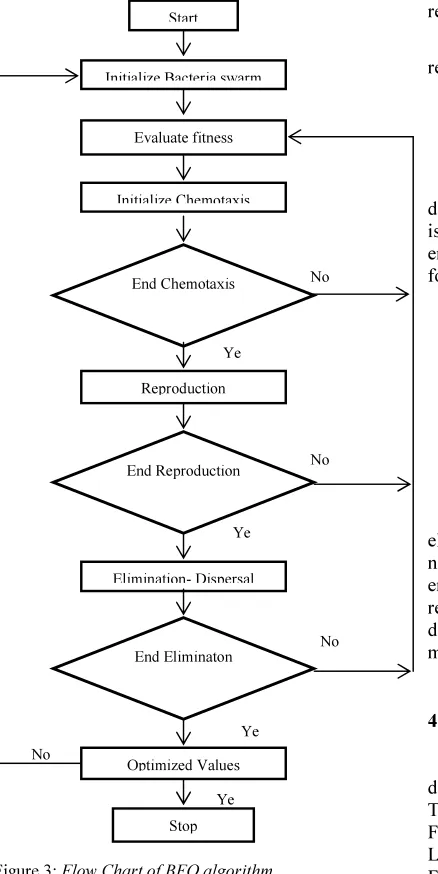
Chemotaxis movement continues till a bacterium goes to positive-nutrient gradient. After specific complete swims, the population’s best half undergoes reproduction eliminating the rest of the population. An elimination-dispersion event is carried out to escape local optima, where some bacteria are liquidated randomly with very small probability and new replacements initialized at random locations of search space. Figure 1 shows the BFO algorithm’s flow chart.
E. coli bacteria’s Chemotaxis foraging behavior has a common type of bacteria with a diameter of 1 µm and length of about 2 µm and which under appropriate circumstances reproduces in 20 min. It is this ability to move which is from a set of up to six rigid 100–200 rps spinning flagella, each driven by a biological motor. When flagellas rotate clockwise, they operate as propellers and so an E.Coli can run or tumble.
The Chemotaxis Actions are as follows:
576 (A2) If swimming (up in a nutrient of gradient or out of noxious substances), swim longer (climb up nutrient gradient or down noxious gradient) ⇒ seek
increasingly favorable environments.
[image:6.595.94.517.201.673.2](A3) If swimming down nutrient of gradient (or up noxious substance gradient), then search ⇒ to avoid unfavorable environments.
Figure 3: Flow Chart of BFO algorithm
The bacteria swarm S behaves as follows [25]: 1) Bacteria are randomly distributed in nutrients map.
2) Bacteria move to high-nutrient regions in the map. Those located in noxious substances regions
or low-nutrient regions die and disperse, respectively. Bacteria in convenient regions reproduce (split).
3) Bacteria are located in promising regions of nutrients map as they try to attract other bacteria by generating chemical attractants.
4) Bacteria are now located in highest-nutrient region.
5) Bacteria now disperse to look for new nutrient regions in map.
The procedures implemented are:
(
)
. 1 1
. 2
f
=
β
f
+
−
β
f
where f1 is maximum average Euclidean distance of nodes to associated cluster heads and f2 is ratio of total initial energy of nodes to total energy of cluster-head candidates expressed as follows:
(
)
.
,
1 1,1,3 .
,
,
i p k
i p k k k
n c
p k
d n CH
f
MAX
C
= …
∀ ∈
=
∑
( )
(
)
1 2
1 ,
N
i i
N
i p k
E n
f
E C
=
=
∑
=
∑
Here, N is number of nodes of which K will be elected as cluster-heads. |C_(p,k) | is number of nodes that belong to cluster Ck in particle p, ensuring that only nodes with above average energy resources are elected as cluster-heads, and average distance between nodes and cluster-heads is minimum.
4. EXPERIMENTS AND RESULTS
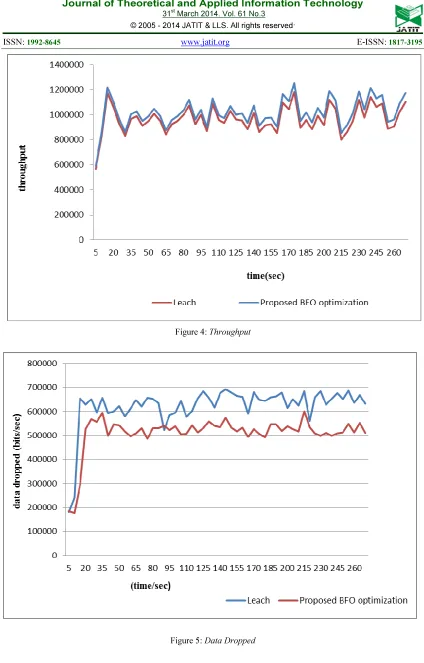
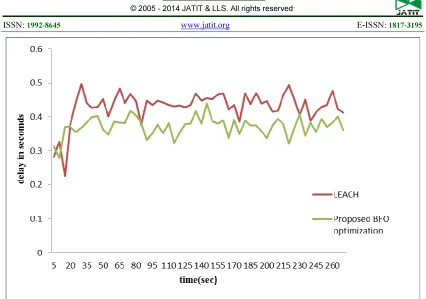
An improved cluster head selection for efficient data aggregation in sensor networks is proposed. The proposed algorithm is based on Bacterial Foraging Optimization (BFO) and incorporated in LEACH. The results are shown graphically in Figure 4-6.
Start
Initialize Bacteria swarm
Evaluate fitness
Initialize Chemotaxis
Reproduction
Elimination- Dispersal
Optimized Values
Stop End Chemotaxis
End Reproduction
End Eliminaton
Ye s No
Ye s
No Ye
s
No Ye
s
[image:6.595.91.310.217.654.2]577 Figure 4: Throughput
578
Figure 6: Delay in Seconds
Figure 4 shows that the proposed BFO optimization has high throughput compared to the LEACH method. Proposed BFO optimization is better by an average of 4.92% than LEACH.
Figure 5 shows that the proposed BFO optimization has low data dropping compared to the LEACH method. Proposed BFO optimization is less by an average of 17.95% than LEACH.
Figure 6 shows that the proposed BFO optimization has low delay in seconds compared to the LEACH method. Proposed BFO optimization is less by an average of 13.56% than LEACH.
5. CONCLUSION
Problems of node deployment, localization, energy-aware clustering, and data-aggregation are formulated as optimization problems. Most analytical methods suffer from slow/lack of convergence to final solutions calling for fast optimization algorithms to produce quality solutions using less resources. PSO is a popular technique to solve WSN optimization problems due to its simplicity, high solution quality, fast convergence, and less computational burden. But, PSO’s iterative nature prohibits its use for high-speed real-time applications, especially if
optimization was needed frequently. PSO needs huge memory, which limits its implementation to resource-rich base stations. This study proposed an improved cluster head selection for efficient data aggregation in sensor networks. The new Bacterial Foraging Optimization (BFO) based algorithm is incorporated in LEACH. The new BFO has 4.92% high average throughput, 13.56% low delay in seconds and 17.95% low DATA dropping compared to LEACH implemented.
REFRENCES
[1] Hill, J. L. (2003). System architecture for wireless sensor networks (Doctoral dissertation, University of California).
[2] Akyildiz, I. F., Su, W., Sankarasubramaniam, Y., & Cayirci, E. (2002). Wireless sensor networks: a survey. Computer networks, 38(4), 393-422.
[3] Karlof, C., & Wagner, D. (2003). Secure routing in wireless sensor networks: Attacks and countermeasures. Ad hoc networks, 1(2), 293-315.
579 [5] Kumar, P., Singh, M. P., & Triar, U. S. (2012).
A Review of Routing Protocols in Wireless Sensor Network. International Journal of Engineering Research & Technology (IJERT) Vol, 1.
[6] García Villalba, L. J., Sandoval Orozco, A. L., Triviño Cabrera, A., & Barenco Abbas, C. J. (2009). Routing protocols in wireless sensor networks. Sensors,9(11), 8399-8421.
[7] Mamalis, B., Gavalas, D., Konstantopoulos, C., & Pantziou, G. (2009). Clustering in wireless sensor networks. Zhang/RFID and Sensor Networks.
[8] Ramesh, K., & Somasundaram, D. K. (2012). A comparative study of clusterhead selection algorithms in wireless sensor networks. arXiv preprint arXiv:1205.1673.
[9] Ludwig, S. A., & Moallem, A. (2011). Swarm intelligence approaches for Grid load balancing. Journal of Grid Computing, 9(3), 279-301.
[10] Jhankal, N. K., & Adhyaru, D. (2011, December). Bacterial foraging optimization algorithm: A derivative free technique. In Engineering (NUiCONE), 2011 Nirma University International Conference on (pp. 1-4). IEEE.
[11] Ma, D., Xu, P., & Ma, J. (2013, May). An efficient node partition clustering protocol using Niching Particle Swarm Optimization. In Software Engineering and Service Science (ICSESS), 2013 4th IEEE International Conference on (pp. 644-647). IEEE.
[12] Siew, Z. W., Chin, Y. K., Kiring, A., Yoong, H. P., & Teo, K. T. K. Comparative Study of Various Cluster Formation Algorithms in Wireless Sensor Networks.
[13] Wang, T., Heinzelman, W., & Seyedi, A. (2010, December). Maximization of Data Gathering in Clustered Wireless Sensor Networks. In Global Telecommunications Conference (GLOBECOM 2010), 2010 IEEE (pp. 1-5). IEEE.
[14] Abdul Latiff, N. M., Tsimenidis, C. C., Sharif, B. S., & Ladha, C. (2008, September). Dynamic clustering using binary multi-objective Particle Swarm Optimization for wireless sensor networks. In Personal, Indoor and Mobile Radio Communications, 2008. PIMRC 2008. IEEE 19th International Symposium on(pp. 1-5). IEEE.
[15] Gaba, G. S., Singh, K., & Dhaliwal, B. S. (2011, December). Sensor node deployment using Bacterial Foraging Optimization. In
Recent Trends in Information Systems (ReTIS), 2011 International Conference on (pp. 73-76). IEEE.
[16] Wang, J., Yang, G., Chen, S., & Sun, Y. (2007, November). Secure LEACH routing protocol based on low-power cluster-head selection algorithm for wireless sensor networks. In Intelligent Signal Processing and Communication Systems, 2007. ISPACS 2007. International Symposium on (pp. 341-344). IEEE.
[17] Karimi, M., Naji, H. R., & Golestani, S. Optimizing Cluster-Head selection in Wireless Sensor Networks using Genetic Algorithm and Harmony Search Algorithm.
[18]Karaboga, D., Okdem, S., & Ozturk, C. (2012). Cluster based wireless sensor network routing using artificial bee colony algorithm. Wireless Networks, 18(7), 847-860.
[19] Soro, S., & Heinzelman, W. B. (2009). Cluster head election techniques for coverage preservation in wireless sensor networks. Ad Hoc Networks, 7(5), 955-972.
[20] Amini, N., Vahdatpour, A., Xu, W., Gerla, M., & Sarrafzadeh, M. (2012). Cluster size optimization in sensor networks with decentralized cluster-based protocols.Computer communications, 35(2), 207-220.
[21] Zhou, H., Wu, Y., Hu, Y., & Xie, G. (2010). A novel stable selection and reliable transmission protocol for clustered heterogeneous wireless sensor networks.Computer Communications, 33(15), 1843-1849.
[22] Tyagi, S., & Kumar, N. (2012). A systematic review on clustering and routing techniques based upon LEACH protocol for wireless sensor networks. Journal of Network and Computer Applications.
[23] Schaffer, P., Farkas, K., Horváth, Á., Holczer, T., & Buttyán, L. (2012). Secure and reliable clustering in wireless sensor networks: A critical survey. Computer Networks, 56(11), 2726-2741.
[24] Thomas, R. M. Survey of Bacterial Foraging Optimization Algorithm.