ISSN(Online): 2319-8753 ISSN (Print): 2347-6710
International Journal of Innovative Research in Science,
Engineering and Technology
(An ISO 3297: 2007 Certified Organization) Website: www.ijirset.com
Vol. 6, Issue 4, April 2017
Column Capital and Drop Panel Optimization
of Flat Slab Using Genetic Algorithm
Samruddha S.Raje1, Dr R. B. Patel2
P.G. Student, Department of Civil Engineering, SVIT, Vasad, Gujarat, India1
HOD, Department of I& C Engineering, SVIT, Vasad Gujarat, India2
ABSTRACT: Flab slab optimization using genetic algorithm is worked out using various trial error based thickness criterion. An initiation of main depth has been taken from two way shear based on IS:456-2002 using necessary guidelines. The mathematical curve of shape profile for the flat slab is initiated mathematically which gives corrolary idea of an angle section with prisamtic shape throughout. By modifying proper mathematical order of curvature based criterion each thickness are optimized with number of cycles. Safety and servicibililty of regular design criterion also fully checked for each optimized depth. The prime criterion to optimize the mimumum cost and weight design of optimied depth
KEYWORDS: Profile, Genetic Algorithm, Optimization, Economy, GUI based Programming
I. INTRODUCTION
Optimization of structure has been area of interest of researches in recent decade, as major duty of structural engineer deals with design of most optimum structure without imparting with its structural poperies of strength and stability. Optimization of RC structure differs from optimization of other structure due to its characteristics. Cost of RC structure is summation of cost of Cost of concrete, cost of Reinforcement and cost of form work. In the design optimization of RC structures, we have to determine dimensions of element and reinforcement, e.g. quantity and dimension of steel bars, need to be determined. Also serviceability and strength criteria increases design constraints in optimization of RC structures.
Optimization & Genetic Algorithm: Optimization can be characterized as the strategy of finding the circumstances that add to amazing or base estimation of a capacity or the benetltfavored in any pragmatic circumstance have the capacity to understandable as a motivation behind guaranteed Optimum design of structures has been the point of numerous studies in the field of structural engineering. Structural designer will probably build up an “most optimal practical solution” for the auxiliary configuration under thought. As there are an unbounded number of structural dimensions, support that resist same moment, it gets to be hard to accomplish the minimum cost plan by customary iterative techniques.
Genetic algorithms belong to the family of evolutionary algorithms (EA). Evolutionary strategies (ES), evolutionary programming (EP) and genetic programming (GP) are some of the other major algorithms of this family. Evolutionary algorithms have been inspired by the principles of evolution in nature.
Hatindera Singh.et al. (2014) carried out analysis and optimization of one-way slab carried as per IS 456:2000 taking into account only Vertical static loads using Genetic Algorithm. It is assumed that all columns are Rectangular and cost optimization is carried meeting strength and serviceability requirement as per IS 456:2000 and concluded that optimized is achieved at span to depth ratio of 29 to 30 and using M20 and Fe 415 steel.
Kiran S. Patil (2013) carried out analysis of flat slab using D.D.M Using IS:456:2000 accommodation only Vertical static loads. It is assumed that all column is of rectangular cross sections are considered for analysis and concluded that optimized design for flat slab depends upon the number of bay, grade of reinforcing steel and characteristics strength of concrete Cost of flat slab is reduced by 33.91% in case of flat slab with drop. Using M20 and Fe415 yields in most optimized design.
ISSN(Online): 2319-8753 ISSN (Print): 2347-6710
International Journal of Innovative Research in Science,
Engineering and Technology
(An ISO 3297: 2007 Certified Organization) Website: www.ijirset.com
Vol. 6, Issue 4, April 2017
level optimization procedure is presented. Optimum column layout, cross-sectional dimensions and reinforcement of concrete elements is found out. The design optimization of two RC flat slab buildings with different plan and number of storey was illustrated.
Vikunjetal. (2011) presented comparison of cost between flat slabs without drop panel and with drop panel in four storey considering lateral load. A four storey building (having 6mx6m panel is subjected to gravity load + lateral load in ETABS (Extended 3D Analysis of Building Systems) software and then each storey is exported to SAFE (Slab Analysis by the Finite Element Method) software for analysis of two-way shear due to lateral loads. On the basis of permissible two-way shear criteria as stated in IS 456-2000, optimized depth of flat slab with drop panel and without drop panel are found and monetary analysis is done by using S.O.R. (Schedule of Rates 2008-09).
II. GENETICALGORITHMPROCEDURE
Initialization of genetic algorithm: At to start with, numerous individual arrangements are by and large created haphazardly to frame an Initial population. The populace size ought to be reliant on the problem nature, however for the most part contains various hundreds or a huge number of promising solutions. Ordinarily, the arbitrary population is created, letting the entire differing qualities of possible solution.
Selection: All through each back to back era, a small amount of the present population is assigned to breed a fresh generation. Individual solution stays chose through a fitness based technique, where best solution are normally more probable to be nominated. The fitness function remains depend over the hereditary representation and measures the nature of the portrayed solution. The fitness function is always subject to the solution. For representation, on account of rucksack issue, one yearning to augment the aggregate size of items that can be put in a backpack of some static ability. A delineation of an outcome may be a variety of bits, in which every piece means an alternate item, and the estimation of the bit (0 or 1) connotes regardless of whether the article is in the rucksack.
Genetic Algorithm Operators
Number of Iterations: The quantity of redundancy distinguishes the quantity of circles that the model must keep running with a specific end goal to locate the best arrangement. Utilizing next to no number of emphasis may permit little use of the fundamental administrators of the GA on the population, so the model won't have the capacity to find extensive variety of created populations (arrangements) and the model may get adhered to a problematic or infeasible arrangement. In the interim, utilizing high estimation of the emphasis may back off particularly the model which is not proffered much of the time.
Population size: The population greatness characterizes the quantity of starting (practical and infeasible) solutions which are made toward the start of the GA model work. These underlying arrangements are made considering the variables' limits which are expressed in the Genetic Algorithm model. Restricting the population size to almost no underlying arrangements will keep the advancement of much better arrangements since the connection between the underlying arrangements are constrained to a slender extent. In the meantime, as we expand the population estimate, the hereditary calculation looks more indicates and empower hunt down a superior arrangement. In any case, on the off chance that we build the population size, then hereditary calculation expends more opportunity to Figureure every era.
Crossover Type: Crossover allows the algorithm to get the finest genes from individual and recombine the chose individual to shape best unrivaled youngsters. Three sorts of crossover are found in the books of the GA, two of them are considered in this concentrate, to be specific: single point crossover and two-point crossover.
Mutation: Mutation upgrades to the assortment of a population and along these lines builds the likelihood that the algorithm will create individuals with enhanced fitness. Diverse estimations of the mutation rate are considered in the models so as to inspect the best mutation rate that will prompt the ideal arrangement.
Penalty function :As on account of penalty technique, a constrained optimization issue got changed over to an unconstrained issue by expansion of penalty for every constraint violation to the cost function, two distinctive penalty functions are utilized as a part of the two models, the first is the basic penalty capacity and the second is the strategy that is proposed by Deb, (1998).
ISSN(Online): 2319-8753 ISSN (Print): 2347-6710
International Journal of Innovative Research in Science,
Engineering and Technology
(An ISO 3297: 2007 Certified Organization) Website: www.ijirset.com
Vol. 6, Issue 4, April 2017
fitness esteem, it should consequently take positive qualities. In common cost enhancement issues, minimization of some cost function is completed instead of boost of utility or benefit.
III. RESULTSANDTABLES
1Assumption and Limitation
Slab Panel Is Rectangular in Cross Section.
Column Are Rectangular.
Only Vertical Static Loads Are Acting.
M25 and fe415 is adopted throughout.
Design as per IS: 456:2000 DDM
Floor finish of 1kN/m2 and live load of 4kN/m2 is considered.
2 Terminology
ly = Longer span. lx = Shorter span.
cl = Column dimension in longer span.
cs = column dimension in shorter span.
ds = effective depth of slab.
Cases for Optimization Problem
For every case two type of optimization is followed 1. Unconstrained Minimization
2. Constrained Maximization
Case-1Finding Most Optimum Column Spacing in Longer and Shorter Direction.
Unconstrained Minimization
Variables = ly lx.
Constants = cl = 400 mm cs = 300 mm
Objective Function = Vu =((x(1) * x(2)) - (((cl + ds) / 1000) *((cs + ds) / 1000)))*(fl)
ISSN(Online): 2319-8753 ISSN (Print): 2347-6710
International Journal of Innovative Research in Science,
Engineering and Technology
(An ISO 3297: 2007 Certified Organization) Website: www.ijirset.com
Vol. 6, Issue 4, April 2017
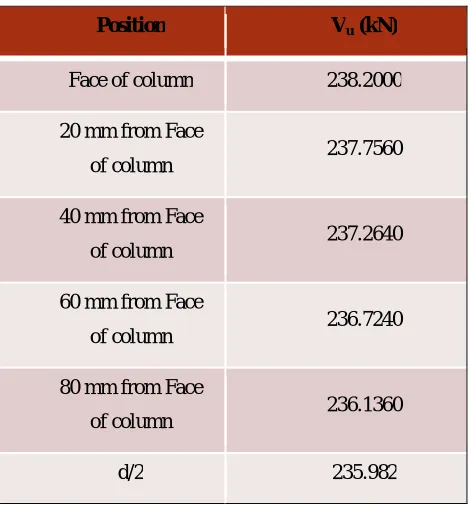
RESULT - Ly(optimum) = 4 m Lx(optimum) = 3.5 m Shear Force = 235.982 kN
So Drop Panel and Column Head Not Required.
Position Vu (kN)
Face of column 238.2000
20 mm from Face
of column 237.7560
40 mm from Face
of column 237.2640
60 mm from Face
of column 236.7240
80 mm from Face
of column 236.1360
d/2 235.982
Table :1 Shear Force of Case Finding Most Optimum Column Spacing In Longer And Shorter Direction.
CONTRAINED MAXIMIZATION
Variables = ly lx
Constants = cl = 400 mm cs = 300 mm
Objective Function = Vu = ((x(1) * x(2)) - (((cl + ds) / 1000) * ((cs + ds) / 1000))) * (fl)
Constraints=vc = [((((((x(1) * x(2))- (((cl + ds) / 1000) * ((cs + ds) /1000))) * (fl)) * 1000)) / ((2 * (a1 + a2) * (ds)))) - (0.5 * ((x(1) / 3)/(x(2)) / 3)) * (0.25 * sqrt(fck))
ISSN(Online): 2319-8753 ISSN (Print): 2347-6710
International Journal of Innovative Research in Science,
Engineering and Technology
(An ISO 3297: 2007 Certified Organization) Website: www.ijirset.com
Vol. 6, Issue 4, April 2017
Figure 1 .Profile for Case Finding Most Optimum Column Spacing in Longer and Shorter Direction by Constrained Maximization
Figure.2 Diagrammatic Representation of Curve Case Finding Most Optimum Column Spacing in Longer and Shorter Direction.
IV.CONCLUSION
Following are points:
1. In maximization process by increasing shear stress in slab to permissible limit longer span can and shorter column dimensions can be provided resulting in more column to column spacing.
2. There in minimum 20-30% approximately saving in material by optimization process.
ISSN(Online): 2319-8753 ISSN (Print): 2347-6710
International Journal of Innovative Research in Science,
Engineering and Technology
(An ISO 3297: 2007 Certified Organization) Website: www.ijirset.com
Vol. 6, Issue 4, April 2017
VI. ACKNOWLEDGEMENT
I would like to thank DR. G.S.Doiphode, Associate Professor ,MSU Vadodara without whose help and guidance it would have not been possible to complete my thesis.I am highly indebted to my professors Dr. D. P. Soni, Head of Department, Civil Engineering, SVIT Vasad.
REFERENCES
[1]. Ronaldo B. Gomes and Paul E. Regan (1999),” Punching Resistance of RC Flat Slabs with Shear Reinforcement”, Journal of Structural Engineering,Vol.125 (6),pp-684-692.
[2]. K. Pilakoutas and X. Li (2003) “Alternative Shear Reinforcement for Reinforced Concrete Flat Slabs” Journal of Structural Engineering Vol. 129(9), pp. 1340-1352.
[3]. M.G. Sahaba, A.F. Ashourb, V.V. Toropovc “Cost optimisation of reinforced concrete flat slab buildings” Engineering Structures 27 (2005) 313–322.
[4]. Alaa C. Galeb, Zainab F. Atiyah (2011) “Optimum design of reinforced concrete waffle slabs”international journal of civil and structural engineeringVol.1(4).pp.862-869.
[5]. Vikunjk.TilvaProf.B.A.Vyas and Assit.Prof. ParthThaker (2011) “Cost comparison between flat slabs with drop and without drop in four storey lateral load resisting building” National Conference on Recent Trends in Engineering & Technology pp1-5.
[6]. Yousef Zandi,2 Roza Naziri,and3 R Hamedani “Effect of Layout and Size Optimization Conditions in Architectural Design of reinforced Concrete Flat Slab Buildings” Bull.Env. Pharmacol. Life Sci., Vol 2 (5) April 2013: 62-68 ©2013 Academy for Environment and Life Sciences, India.
[7]. Kiran S. Patil, N.G.Gore, P.J.Salunke “Optimum Design of Reinforced Concrete Flat Slab with Drop Panel” International Journal of Recent Technology and Engineering (IJRTE) ISSN: 2277-3878, Volume-2, Issue-4, September 2013.
[8]. Hatindera Singh1, Hardeep Singh Rai2, Jagbir Singh3 “Discrete Optimisation of One way Slab using Genetic Algorithm” International Association of Scientific Innovation and Research (IASIR) (An Association Unifying the Sciences, Engineering, and Applied Research. [9]. Babiker S.A., Adam F.M., and Mohamed A.E., (2012) “Design Optimization of Reinforced Concrete Beams Using Artificial Neural Network” International Journal of Engineering Inventions ISSN: 2278-7461, Volume 1, Issue 8 (October2012) PP: 07-13.