A STUDY OF PARENTAL MODIFICATION OF VARIEGATED POSITION EFFECTS',
*
ANITA Y. HESSLER3
Department of Zoology, Uniuersity of Chicago, Chicago 37, Illinois
Received February 19, 1960
H E study of genetic modification of the interruptions in homogeneous devel- opment of pigment which characterize white-variegated position effects in
Drosophila melanogaster produces a variety of information. The compound eyes, testis sheath, and malpighian tubules in the mutant white ( w , 1-1.5) are color- less, whereas the eyes are red and the sheath and tubules uniformly yellow in wild-type flies. White variegated flies possess at least one W + allele which, through a chromosomal rearrangement R ( w + )
,
is associated with hetero- chromatin (see review on position effect by LEWIS 1950) and accompanies the development of the variegated pigmentation. A R ( w + ) /w fly will develop eyes wherein only part of the pigment cells form the products associated with visible pigment; some cells20
not, and appear colorless. The other two tissues have patches of yellow or colorless cells (DEMEREC and SLYZINSKA 1937). The wallele completely blocks production of both brown pigment components (om- mochromes) and red pigment components (drosopterins) of the wild-type eye. In the testis sheath of wild-type
D.
melanogaster certain pteridines develop, whereas the ommochromes and drosopterins do not. As the yellow pigment of the testis sheath is thought to be mainly sepia pteridine (GRAF and HADORN1959) which is regarded as a substance produced in the synthetic chain leading to formation of drosopterins in eyes (FORREST and MITCHELL 1955), a com- parison of the pteridines in these two tissues in white-variegated flies with their characteristically variable pigmentation might indicate the extent of correlation of pigment development in eyes and testis sheath.
The cause of the cell-to-cell somatic variation is unknown, although certain environmental and genetic factors can modify the variegation toward either a preponderance of unpigmented tissue or of pigmented tissue. For example, by adding heterochromatin to the genome in the form of fragments or whole Y chromosomes, genetic modification is realized which usually results in more pigmentation (GOWEN and GAY 1933; SCHULTZ 1936; BAKER and SPOFFORD 1959). This phenomenon was utilized here in analyzing the development of eye and testis sheath pigment simultaneously in males with one or two Y chromosomes.
1 Accomplished on Contract No. AT( 11-1)-431 for the Atomic Energy Commission.
2 Submitted in partial fulfillment of requirements f o r the degree of Doctor of Philosophy in
3 Present address: Marine Biological Laboratory, Woods Hole, Massachusetts. Zoology at the University of Chicago.
464 ANITA HESSLER
BAKER and SPOFFORD (1959) and SPOFFORD (1959) in their studies of white variegation found unusual parental effects on the amount of pigmentation in eyes of variegated offspring. The studies being reported in particular amplify, quantitate, and extend the unusual findings.
MATERIALS A N D METHODS
Stocks: The w + allele employed in this study is the same one used by BAKER and SPOFFORD ( 1959), Dp ( wm) 264-58a. This duplication is a 20-band segment of the X chromosome containing w+ (close to one end) which has been relocated in inverted order within the proximal heterochromatin of 3L (SUTTON 1940). Although originally carried in a free X stock by DR. EILEEN S. GERSH, the duplication was introduced by DRS. BAKER and SPOFFORD in 1956 into two lines which have been kept separate since that time-one had free X chromosomes, the other attached-XY, attached-X chromosomes. The duplication in the former line is denoted by Dp'; in the latter line, by Dp". The distinction implied by these symbols represents certain highly significant differences in behavior or state between Dpf and Dp" which were discovered during the course of this investigation.
I n the experiments detailed below the Dp" and Dpf were contributed initially by one yw/Y; Dpa/Dpa female and one yw/yw; Dpf/Dp' female respectively. The inbGd white stock which were employed for testcrosses were (1) attached-
X, attached-XY stock; yw/Y ~ females, f Y w / Y males, and (2) a free-X yw stock
( y = yellow body, 1-0.0; w = white eye, 1-1.5; yw = attached-X; XYw = YsX.YL,Zn(l)EN = Ysw y.YLy+, see LINDSLEY and
GVITSKI
1959).Flies were reared at 2 3 a l "C on a culture medium modified slightly from that described by CARPENTER (1950). Pair matings of genotypes being compared were made up simultaneously on medium from the same batch. One or two replicates of each set of matings were made, each replication in sufficient num- bers to yield at least ten fertile sets of parents. Two sets of smaller size, five and seven pairs, were obligatory in two cases because of infertility. The males used for chromatography were obtained by sampling the progeny of each pair in each replication at least once in the course of making daily collections. Sampling was random in the sense that the flies collected were simply those which eclosed in a given two-hour period after clearing of culture vials. The number of progeny produced by each pair mating was 50-60 regardless of the combination of parents used except MP-13 as noted later.
Chromatographic techniques: The eye pteridines which were measured are the drosopterins (DP)
,
sepia pteridine (SP),
and 2-amino-4-hydroxypteridine plus biopterin (HB, and HB,). I n the testis sheath SP, HB,+
HB,, and isoxanthop- terin (IX) were measured (abbreviations as in ZIEGLER-GUNDER and HADORN 1958). The drosopterins refer to a complex of at least three compounds which comprise the red pigment (VISCONTINI, LOESER and KARRER 1958). Sepia pteri- dine is probably responsible for yellow pigment of the testis sheath; at least it is the major constituent (GRAF and HADORN 1959). I n my experiments HB, andWHITE-VARIEGATION I N DROSOPHILA 465
HB, were inseparable on one-way chromatograms. Their identity and relative abundance in eyes or testis were determined by running two-way descending chromatograms of samples of either ten heads or 12 testes (first solvent: pro- panol-7 percent NH,OH, 2: 1 ; second solvent: butanol-glacial acetic acid-water, 4: 1 : 5). Comparisons were then made between the location of known 2-amino-4- hydroxypteridine added as a pure substance and the location of biopterin as
accumulated in the eyes of the mutant sepia. It was found that the major part of the HB fluorescence in eyes and testis sheath was contributed by HB,-biopterin. In variegated eyes HB, was distinctly in execess of the normal wild type amount
(BAKER and SPOFFORD 1959), whereas 2-amino-4-hydroxypteridine was some- what reduced. Sepia pteridine is present in excessive amounts, and drosopterin and isoxanthopterin are present in general in lower amounts in variegated eyes as compared with wild type. (For studies on the pteridines of Drosophila, see
HADORN and MITCHELL 1951; FORREST and MITCHELL 1954a, 1954b, 1955;
FORREST, GLASSMAN and MITCHELL 1956; FORREST,
HATFIELD
and VAN BAALEN1959; VISCONTINI, LOESER and EGELHAAF 1956; VISCONTINI, LDESER and KARRER 1958; VISCONTINI and RASCHIG 1958; VISCONTINI 1958. For more general papers see Ciba Foundation Symposium on Chemistry and Biology of Pteridines, 1954; ALBERT 1954; ZIEGLER-GUNDER 1956;
HADORN
1959).The males chromatographed were aged four to five days, dissected in Drosophila saline solution, and the samples-heads and testes-placed on What- man No. 1 filter paper (46 cm
x
57 cm) prepared for descending chromatog- raphy. Fifteen to 20 heads were crushed individually 1 cm apart, and the testes corresponding to the heads were placed in the same order on the same sheet of paper. Paper blanks were also run on each sheet. The solvent was normal propanol:7% NH,OH ( 2 : l ) . The paper was equilibrated with this solvent mixture for two to three hours prior to the chromatographic run of 16 hours in the dark which achieved adequate separation of the fluorescent components. The paper was air-dried in a laboratory hood and observed under UV light emitted by a Shannon lamp. The appropriate spots were marked, cut out, and eluted separately in 1 ml of dilute ammonia (1%
) in individual stoppered vials for two hours; then the papers were removed.466 A N I T A HESSLER
RESULTS
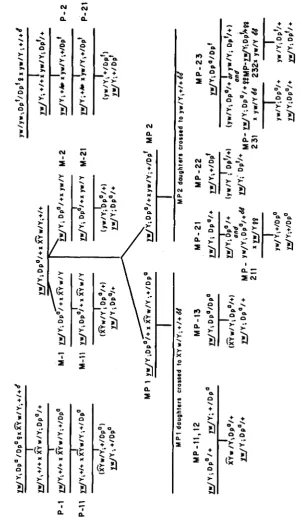
Mating plan: A detailed diagram of the mating scheme is presented in Figure 1. In order to distinguish the immediate parental source of the Dp (w'")
,
the convention was employed of placing a maternally-inherited duplication to the left of the diagonal and a paternally-inherited duplication to the right, e.g. yw/Y; Dp"/+ or yw/Y;
+
/Dp".T h e expressionof white-variegated position effects can be modified in many ways. The mating plan outlined in Figure 1 was designed to provide an organized framework for observing the operation of three particular modifying eff ects-the parental source effect, the effect of extra heterochromatin, and the effect of homozygous us. heterozygous mothers. The plan was designed to produce in- formation which might clarify the relationship of one modifying effect to another. In order to follow readily the various sets of comparisons being made, the chart has been labeled in this manner: the P and M series refer to patrilineal and matrilineal stocks where the Dp is maintained in either males or females, respectively, by crossing each generation to appropriate white stocks. The numerals designating series 1 and series 2 divide the M and P series of f Y w J Y
(series 1 ) from the M and P series employing yw/Y males (series 2), thus distinguishing the effect of extra heterochromatin. Finally, MP-1 and MP-2 identify lines established by certain deliberate combinations of the M and P
lines to produce females homozygous for the duplication. The reasons for this plan will now be explained.
It is known that white-variegated progeny of the same genotype may have drastically different phenotypic expression depending upon whether the Dp was contributed by the mother or by the father. This effect of parental source of Dp is illustrated by the variegated progeny of yw/Y; Dp"/+ 0 0 and X^uw/Y;
+/+
8 8. which develop far less pigment in their eyes than do the progeny of __ rw/Y;+/+
P P x x^Yw/Y; + / D p 8 8 (SPOFFORD 1959). In addition, daughters of these two crosses show significant differences in penetrance of Dp". Chromat- ographic assays of pteridines in eye and testis tissues of males from these re- ciprocal crosses were made. Are the quantitative differences exhibited in the eyes of the two kinds of sons paralleled by differences in testis sheath pteridines? It is of interest from a developmental standpoint to find whether both tissues are being similarly affected by the parental source of the duplication.(U
I
a
-
a ??.
t
\
a
-
I\
.L
5
(U
I
I
c
(U
I
a
c
a 0
\
t
\ s
*,
-a
?*
I
\
k
c (U
f
N
n I
c
n I
0 a
e
t
-
(C
I
+
468 ANITA HESSLER
The mating plan provides for testing of a third modifying effect-that of augmented pigment production in progeny (heterozygous f o r Dp) of a y w / Y ;
Dp/Dp mother compared with the progeny of a y w / Y ; Dp/+ mother.Series MP-1 and MP-2 in Figure 1 denote the deliberatexcombination of matrilineal and patrilineal stocks to produce homozygous Dp females whose progeny could be compared with those of heterozygous Dp females. As in the case of other modifiers, inspection of progeny for penetrance of the duplication is an important criterion; and employment of chromatography of males proved especially useful, since phenotypic differences otherwise difficult to characterize without a large number of progeny could be easily detected and more subtly analyzed.
In summary, the mating plan was to provide simultaneous samples of all the kinds of flies to be compared. However, the experimental results also disclosed what appear to be real and significant differences between the way Dp" and Dpf act. Thus, the plan did not accomplish all that was intended. Sufficient data were accumulated to check the parental source effect completely in the x^uw/Y
series, but not in the y w / Y series. Comparative effectiveness of extra hetero- chromatin could be examined in both X%w/Y and y w / Y matrilineal series (M-1 1 and M-21, respectively), but it could not be examined in corresponding patrilineal matings (P-11 and P-21), where the difference between Dp" and Dp' invalidates such comparison. The desired comparisons of effects of homozygous Dp mothers uersus mothers heterozygous f o r Dp are valid only in the Dp" series (MP-1). Although the data collected from the MP-2 series are not directly comparable, they provide strong evidence that the original duplication now exists in two states, Dp" and Dp'.
Modifying efJects associated with Dpn: The parental source effect of Dp" may be best described in two ways: the difference in penetrance of Dp" in daughters and the difference in degree of expression in sons as determined chromato- graphically. As shown in Table 1, the mottled daughters of P-l 1 ( y w / Y ; +/Dp") comprise a far larger percentage (47.7%) of the total female progeny (white plus mottled) than do yw/Y; Dp"/+ daughters of M-11 (29.4%). I n addition, more pigment developedin P-11 than in M-11 daughters. Mottled sons from both crosses occurred in numbers insignificantly different from the expected 50 percent, but, as in their female siblings, M-11 sons (X^uw/Y; Dpa/+) exhibit markedly reduced pigment development compared to the X^uw/Y; +/Dp" P-1 1
sons. (This will be elaborated on later in the paper.)
When the MP-1 matings were made, a number of variegated females were produced which may have received Dp" from either a mother or a father. (Note also that this group differs from the M-I 1 and P-1 1 ones in that the egg or sperm bearing the wild-type third chromosome is contributed by a Dp"-bearing parent rather than by a homozygous testcross stock of y w / Y ;
+/+,
X^YwIY;+/+.)
WHITE-VARIEGATION I N DROSOPHILA 469
d
'9
+I
9 M W
Lo
-
G
2
tl
0
W
0
M
8
2
2
b
+
>
a
?
f
a8
2"
N*
W Q, M
w
+
z
el
e
f
aB
*
Lo
h h M
+
2-
a
*
a\
470 ANITA HESSLER
more fully pigmented as a group than were the heterozygotes. As noted in Table 1, the daughters of the females which turned out to be heterozygous (MP-11, 12) resemble those of NI-11 in that the penetrance of the duplication is essentially identical. Also, the expression of pigment in general among the progeny of NIP-11. 12 was more similar to that of M-11 progeny than to P-11 progeny, with only a few exceptions showing much pigment. Thus, there is no evidence of a grandparental source effect.
Unlike similar tests on the M-11 and P-11 progeny, a chi-square test for heterogeneity within the 41 pairs comprising MP-11, 12 reveals very significant heterogeneity as to percentages of variegated flies from one mating to another, which could be largely accounted for by four exceptional pairs. Out of a total of 90 female progeny produced by these four pairs 55 were mottled, whereas 95 of the 99 sons were mottled. These numbers yield percentages (61% female, 96% male which are significantly different from the percentage of mottled progeny of the other 37 pairs (26.2% female, 43.8% male). The progeny of the exceptional pairs also developed more pigment. It is not known if these four exceptional pairs represent matings of mothers homozygous f o r Dp" (MP-13) wherein a portion of the daughters and four of the sons are actually heterozygous for Dp" but unpigmented or whether the exceptional progeny are actually from heterozygous mothers and the white-eyed progeny are not being recovered as adults in the usual numbers. Excluding these four exceptions, it may be said that most of the heterozygous daughters of the MP-1 mating seem to produce progeny which are indistinguishable from matrilineal (M-1 1 ) crosses and thus show no grandparental source effect attributable to having a yw/Y; Dp"/+ rather than an X^Yw/Y; +/Dp" grandparent.
Characterization of the quantitative differences in pteridines between sons of M-11 and those of P-11 was deemed of possible value in determining whether both eye and testis sheath, which are quite different from one another in de- velopmental origin (POULSON 1950), are affected similarly by the parental source effect. Highly significant quantitative differences in amounts of drosop- terin (DP)
.
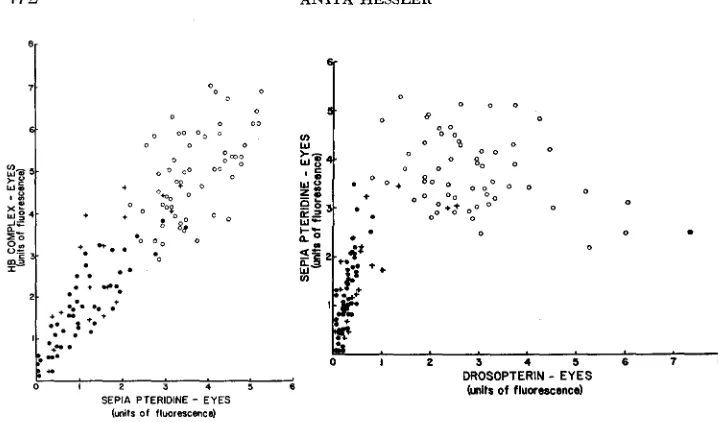
sepia pteridine (SP) and the HB complex (biopterin and 2-amino-4- hydroxypteridine) in eyes distinguish the two types of sons, although n o qualita- tive differences were observed (see Table 1 ) . The amount of SP and HB (which is mainly biopterin) in the eyes bore a positive correlation, and there was lessof both substances in M-11 than in P-11 sons (See Figure 2 ) . The essentially straight line of Figure 2 leads one to infer that the parental source effect is acting on one process. However, the relation of both SP and HB to drosopterin differs in that M-11 sons show a positive correlation of both SP and HB to DP, whereas P-11 sons show negative correlation (Figures 3, 4). This may mean that at least two processes are being affected. Perhaps the M-11 sons character- istically never form enough precursors of drosopterin to make more than a small amount of visible pigment, whereas the P-11 sons accumulate excesses of the drosopterin precursors which are not converted into DP at a normal rate. The general shape of the curves in Figures 3 and 4 is reminiscent of the observation
WHITE-VARIEGATION I N DROSOPHILA 471
of BAKER and SPOFFORD (1959) that the sepia and HI3 pteridines accumulate at intermediate values of visible pigmentation.
Highly significant differences in amounts of SP and the HB complex, as well as isoxanthopterin ( I X )
,
were observed also in the testis sheath, depending upon the parental source of Dpa. Again, no qualitative differences distinguished the two kinds of sons. The relation of SP to HB was a direct positive one (Figure 5). Zsoxanthopterin likewise showed a range of low values in M-11 sons, high values in P-11 sons (Table 1).Within neither the X?fzu/Y; Dpa/+ sons nor the X?fw/Y; +/Dpa sons was there a correlation observed between the amount of SP of the eyes and in testis sheaths (Figure 6 ) nor between the amount of HB in eyes and sheaths (Figure 7). Moreover, the values for M-11 sons as a group were for both tissues lower than the values for P-11 sons. The relative lack of overlap between the two groups of points representing the two kinds of sons gives an indication of the genetic homogeneity within each group.
Direct examination of the source effect in free X males is impossible since no
y w / Y ; +/Dpa males from a patrilineal line were produced at the same time the M-21 matings were made. However, daughters of M-21 (yw/Y; Dpa/+) showed nearly identical penetrance and expression of Dp" to t h a a daughters of M-11 and also daughters of MP-11, 12 and MP-21. Thus the expression of variegation in daughters appears to depend only on the source of Dpa and not on the structure of their father's X chromosome. It seems legitimate, therefore, to compare the progeny of MP-211 ( y w / Y ; +/Dpa 0 0 , y w / Y ; +/Dpa 8 8) with NI-21 and MP-21. When 59 white-eyed sons of MP-21 were individually crossed to y w / Y females, 50 percent produced mottled progeny, establishing the fact that theTathers actually carried the duplication. The daughters of MP-211 appeared as the daughters of P-1 1 paternal source matings, 48.2 percent being pigmented, and the character of pigmentation was similar to the enhanced amount which develops in daughters of the patrilineal line. More sons (four percent) had pig- mented eyes than ever occurred among sons of M-21 and MP-21 (zero percent). Thus it is suggested that the parental source effect of Dp" is maintained in free X males.
The effect of added heterochromatin on pigment development of males in the Dp" framework is drastic. The penetrance in y w / Y ; Dp"/+ males is at best about 30 percent of the expected 100 percent as determined by examining testes and malpighian tubules for pigment. Only progeny testing, such as was done in MP-211, reveals that Dpa is actually present in about half of the white-eyed sons. In addition to poor penetrance of Dp" in y w / Y males, the amount of pig- ment developed in such males showing variegation is markedly less than that developed in M-11 sons (see pteridine analysis, Table 1). Both kinds of sons had exactly the same kind of mother. This leads to the conclusion that additional Y
heterochromatin in the genome is associated with development of far more variegated flies with more pigment in both the tissues inspected.
472 ANITA HESSLER
I
0 0
P
0 1 2 3 4 1 6
DROSOPTtKll
W t r of fluorescence)
FIGURE 2.-Positive correlation of S P and HB,
+
HB? in eyes of M-11 sons (gYw/Y;Dpa/+, black circles), P-11 sons (XYw/Y; +/Dp", open circles), and MP-I3 SOIS (XYw/Y; h a / + , plus signs). The units of measure are arbitrary units of fluorescence as explained in Materials and Methods. These units are employed in all the figures which follow.FIGURE 3.-Positive correlation of D P and S P in the eyes of M-11 sons (XYw/Y; Dpa/+, black circles); negative correlation in eyes of P-11 sons (XYw/Y; +/Dpa, open circles). Note intermediate values fo'r variegated sons of p / Y ; Dpa/Dpa, MP-I3 (plus signs).
r\
r\
r\
00 0
71 0
:.
0e 0 .
c
i i 3 4 5 6 ; i O 1 2 3 4 5SEPIA PTERIDINE - TESTES DROSOPTERIN
-
EYESOnits of fluorescence) (units of fluorescence)
FIGURE 4.-Relation of DP to the HB complex. Symbols are the same as in Figure 3. FIGURE 5.-Positive correlation of SP to HB complex in the testes. (Black circles = M-I1
n n
WHITE-VARIEGATION I N DROSOPHILA 473
t J Y 4
k?
5
0 0
E!
0
0 2
0 0 0 OO O nSEPIA PTERIDINE
-
EYES (units of fluorescence)FIGURE 6.-Lack of correlation between eye and testis values of SP of M-11 sons (XYw/Y; CI
Dpa/+, black circles) as well as P-11 sons (x^Yyw/Y; +/Dpa, open circles).
1
0
D O
0 0 0
0 0
0
0 0 0
0
0
0
h
..
0 I 2 3 4 5 6 7
HB COMPLEX
-
EYES (units of fluorescence)FIGURE 7.-Lack of correlation between eye and testis values of the HB complex of NI-I 1 sons
A r\
(XYw/Y; Dpa/+, black circles) as well as P-l 1 sons (XYw/Y; +/Dp", open circles).
4744 ANITA HESSLER
penetrance and expression of the duplication than the daughters of a Dpf father. Actually, however, mottled-eyed sons (yw/Y; Dp'/+) of a Dpr mother (sons of MP-22) numbered 45 percent of the total male progeny, whereas only 23 percent of the sons of a Dpr father (mating P-21) had pigmented eyes. Although dissection of white-eyed flies for evidence of pigmented testis sheaths showed that the duplication is present in 48 percent of the sons in the latter case, similar dissection of the sons of a maternal source revealed that 58 percent had pig- mented testes. Table 1 shows that the amount of drosopterin is significantly higher in MP-22 than in P-21 sons, but there is no significant difference in the amounts of SP or the HB complex, although they are slightly higher in MP-22 sons.
The variegated daughters (yw/Y; D p f / + ) of the maternally contributed Dp' (MP-22) number about 60 percent of the total female progeny, whereas mottled daughters of P-21 comprise 50 percent of the total female progeny. The ab- normally high recovery of the Dpf-bearing sons and daughters when the mother carries Dpf (MP-22 and MP-232) is also unique to the Dpf state and may be suggestive of a maternal influence of a Dpf mother on her nonduplication bear- ing eggs. At any rate, it provides additional evidence supporting a distinction between Dp" and Dp'.
Maternal homozygosity effect: Let us first consider the matings using the Dpa state of the duplication. The seven MP-13 matings (yw/Y; Dp"/Dp" 0 P
x XYw/Y;
+/+
8 8 ) were discernible because no whiteoffspring were re- covered. Homozygous females were as a rule darker than heterozygous females of the M-I 1 kind but not surely distinguishable from MP-11, 12 females. Progeny of MP-13 had distinctly more pigment than progeny of MP-11, 12. A chromat- ographic analysis of pteridines in MP-13 (XYw/Y; Dpa/+) sons reveals higher values for all eye and testis pteridines than found in M-11 sons. The difference in drosopterin values is highly significant; the difference in HB complex values for eyes is barely significant at the five percent level; the differences between the means for all the other substances are not significant at this level. It would appear that in variegated sons, heterozygous for the duplication, from yw/Y; Dpa/Dpa mothers, the development of pigments is improved over that ofdentical sons from yw/Y; Dp"/f mothers.Female progeny produced as a result of the MP-2 series of matings (which will include yw/Y; Dpa/Dpf females) could be of three genotypes-yw/Y; Dpa/+, yw/YF+/Dpl, and yw/Y; Dp"/Dp'. There were in fact only two pheno- types recovered, lightly m o t z d females and females with a great deal more pig- ment, with essentially no intermediate phenotypes. A sample of 15 of the lightly mottled females and 75 darkly mottled ones were individually mated to yw/Y males; five of the 15 were fertile, while about one half of the 75 were fertile. Samples of the fertile females were studied. Ten of the darker females were identified as being Dpa/Dpf because they produced no white female off spring, although some of the male progeny were white-eyed; 12 dark-eyed females were heterozygous and identified tentatively as yw/Y; +/Dpf . Five lightly mottled
WHITE-VARIEGATION I N DR(XSOPH1LA 475
females were heterozygous and identified as supposedly yw/Y; Dp"/+. Thus, unlike the MP-1 matings, heterozygous daughters of MP-2were capable of being distinguished phenotypically. The testcross series MP-21, MP-22, and MP-23 thus are of unusual interest since these crosses could confirm the differences between Dp" and Dp' and provide evidence of the stability of these differences. MP-21, a mating between supposed yw/Y; Dpa/+ and yw/Y;
+/+
males produced progeny showing the penetrance and pigmentation characteristic of a maternal duplication of the Dp" state (M-21). About 30 percent of the females were pigmented, but only slightly; all the males were white-eyed. Dissection of 96 of the males failed to reveal any with pigmented testes, but progeny testing of 59 (mating MP-221) revealed the presence of Dp" in one half of the white-eyed males. The lack of pigment in any of the testes points to a possible difference between these sons and those of M-21.Progeny of MP-22 were entirely different from those of MP-21. Nearly 60 percent of the females were well pigmented, a highly significant difference from the daughters of MP-21 (30 percen'). Also. the male proqeny (yw/Y; Dpf/+) of MP-22 differed significantly from MP-21 sons (yw/Y; Dpa/+) in that 45 percent of the former had pigmented eyes. A sample of the yw/Y; D p f / + sons selected for dissection showed that 58 percent had well-pigmented testes and that considerable amounts of isoxanthopterin had formed.
The progeny of MP-23 individual matings of YW/Y: Dpa/Dpf x yw/Y;
+/+
males showed a striking dichotomy in appearance of females, one half being lightly pigmented and one half more fully pigmented. Of the 168 female progeny of these ten Dpa/Dpf testcrosses, 90 were pair-mated to yw/Y;+/+
males, to check whether or not genetic evidence supported phenotypic evidence of persistence of a Dpa:Dpf dichotomy.
Of the 90 pair matings, 38 were fertile-26 mothers were lightly mottled, and 12 darkly mottled, thus giving a n indication that the latter class was less fertile. However, since this particular set of matings was not repeated, it is not possible to say whether this difference is significant. All 38 mothers produced variegated daughters, but only the darkly mottled ones had variegated sons. Considering first the suspected Dpa mothers, the lightly mottled ones, it is seen from the results of mating MP-231 (yw/Y; Dp"/+ ? 0 x yw/Y;
+/+
8 8 ) that no varie- gated sons were produced, 'mly white-eyed ones, and only 15.6 percent of the daughters were variegated. Although these results closely resemble those of other series of vw/Y; Dpa/+ x yw/Y;+/+
matings, the penetrance of Dp" in daughters of MT231 is significantly lower (15.6 percent us. 29 percent). The meaning and significance of this difference is unknown as yet, but the MP-231 results are regarded as providing strong support for the identification of these lightly mottled females as Dp".476 ANITA HESSLER
Dpf is unknown. Nevertheless, the penetrance is significantly higher than was observed in sons of P-21 where the source of Dpf was paternal. This further supports the conclusion that the parental source effect with Dpf does act in the direction opposite to that with Dp".
Among the sons of MP-23, there would be expected a yw/Y; Dp"/+ and
yw/Y; Dpf/+ class because there is evidence of Dp" and Dpf daughters. How- ever, the genotype of the white and mottled sons cannot be deduced from the phenotypic percentages (34 percent white, 66 percent mottled) since the white- eyed males which have mottled testes might represent either Dp" or Dpf. The fact that all the testes are variegated does, however, give confirmation of the identity of the MP-23 mothers as homozygous. Note that the expression in these sons is even higher than in the yw/Y; Dpf/+ males from MP-22, indicat- ing an enhancement of pigmentation in the sons from a mother that carried two doses of the duplication, albeit in different states.
It is stressed that the maternal effect whereby progeny of a homozygous mother show better penetrance and expression than do progeny of a heterozygous mother is a one-generation effect. Progeny testing in series MP-231 and MP-232 re-establishes the differences as observed in the MP-21 and MP-22 progeny of heterozygous mothers.
It may be of interest to introduce data on the results of crossing other daughters
of MP-2 to x^uw/Y males. MP-2 daughters of the two phenotypes-lightly mottled and darkly mottled-were crossed individually to x^Yw/Y males, and progeny of 24 fertile pairs established the existence of three groups of mothers:
(1) 12 darkly mottled and homozygous for the duplication, (2) eight darkly mottled and heterozygous, and (3) four lightly mottled and heterozygous. The figures given (Table 2) are the total progeny of each of the three groups, whereas all other sets of progeny discussed in this paper were first tested for within-group heterogeneity and then pooled. if appropriate. It is of interest to compare these results with both the MP-11, 12,13 series of crosses and the MP-21,22,23 series. Let us first compare the phenotypic data in Table 2 with the results of MP-1 1, 12, 13. The heterozygous daughters of the MP-1 matings could not be distin- guished phenotypically, whereas the heterozygous daughters of the MP-2 mat-
TABLE 2
Progeny of X Y w / Y ; n
+/+
8 8 x 0 0 of three possible genotypes resulting from IMP-2 crossDaughters Slrns
White-variegated White-variegated Genotype of mother White Red B r o w - r e d White Red Brown-red
(1) r&Y;Dpa/Dpf
(2) yw/Y;Dpf ?/+
( 3 ) y-/Y;Dpa?/+
darkly mottled 0 97 92 0 160 0
darkly mottled 81 74 0 1 03 86 0
WHITE-VARIEGATION I N DROSOPHILA 477
ings (yw/Y; Dp"/+ P 0 x yw/Y;+/Dpf 8 8 ) can be distinguished and these distinctions are supported by progeny tests to x^uw/U males. Also, the daughters of MP-13, where the mother was homozygous for Dp", although showing some variation as to pigmentation did not show the dichotomy of phenotypes that daughters of Dpa/Dpf do (Table 2). Although no measurements were made, chromatographs of some white-mottled "red" and some white-mottled "brown- red" daughters of the homozygous females (Table 2) showed much more drosopterin in the "red" group than in the "brown-red", with the latter accumu- lating distinctively more HB and SP. It is believed that these two phenotypic classes correspond to the darkly mottled and lightly mottled daughters, respec- tively, of yw/Y; Dpa/Dpf 0 X yw/Y;
+/+
8 . The distinction here made between the two k z d s of mottled progeny must be tentatively assigned to the contribu- tions of the f Y w / Y paternal genome versus that of yw/Y males, a point which was not resolved in this study. Also, the supposed yw/Y; Dpf/+ mothers recorded in Table 2 did not produce a preponderance ofmottled daughters, as did the MP-22 females with which they are being compared, another difference which may be attributable to the paternal genomes. The essentially wild-type pigmen- tation of sons of Dpa/Dpf mothers (when fathers are X^uw/Y) is considered very different from the measured values of MP-13 sons, which were only partly pig- mented. The most important characteristic brought out by the data in Table 2 is that the daughters of MP-2 matings when crossed to f Y w / Y males produce off- spring which fall into three genotypic groups comparable to MP-21, 22, 23, but distinctly unlike MP-11, 12, 13.In X^uw/Y and yw/Y sons of Dpa/Dpf mothers there cannot be distinguished two phenotypic classes which can be said to correspond to Dpa or Dpf7 although the female siblings in both cases do display this dichotomy, which seems to correspond genetically to Dp" and Dpf (MP-231, MP-232). Therefore, one must assume in the case of presumed fYw/Y; Dpa/+ sons of Dpa/Dpf females that such males have their pigmentation raised to a level higher than that observed when genetically identical sons come from mothers which were homozygous for Dp".
Deuelopment of pigment and precursors: In order to evaluate the generality of the conclusions reached concerning pigmentation in variegated eyes and testes, a comparative study was made of the pteridines in eyes and testes of X?w/Y;
f / D p a males and Oregon-R wild type males at a series of different times in development from two days before eclosion to 12 days after eclosion. The measurements presented in Table 3 are in terms of the arbitrary fluorescent units described earlier in the paper. These developmental studies were done on flies
reared at 252.5"C after the completion of the studies discussed previously. The relatively larger standard errors registered for the mottled males is a reflection
of the more heterogeneous nature of their pigmentation compared to more uni- formly pigmented wild-type males.
0 2 ti In
*
-
9 41 v) m. +I h U7 M v) U) 0 ti W U)*
h M 10 1. tI a! 0 0 Y) M m ti N N*
9 ir: ti 0 W 9 d M c? +I*
2
r .'?5
5
3 9 tl gl 1 m 9 +I Y)8
-
*
m 9 tI 92
-
W2 ti
2
a! 4) U? 9 +I @i M M-
2 9 tI "1 h W 00 h 9 ti h M W 0 h 9 +I m 0 (D 9 tI "1 0 5 EE
3 1 0c? +I
*
m m. 01 M3
2
tI W 0 (D 2ti
1 (D U? N (0 M .-..ti
M m 2 ti 2 h 1 1 'I +I8
1 W 9 tls
e
-1;
?
(E
fi a 3 2 ti2
1 Y) W 1 00 'I m N 1-13
v) m 9 +I ir: m' h M*
Y +I 05 4) h-
v)*
'I +I m m2
M m 9 +I 9 0 c 1 01 c? +I 012
h 9 +Ik SI
4
3
F3
h a 'I 0 0 w +I c? (D Q, " ti2
a W Y) v) 1ti
2
a, M ,i? tic;:
1 M M m h 9 $1 L? W M 1 N c? $1 h M 1 m 9 $109 .-..
6 a
e
(E
+
$- 3 \ m U-, 9 +I U? 0 01 " M E! ti Q, v) 9 1 v) h 9 tIg
4 0 Y) 9 +Ie
$ 0 W (D 9 +I m "1 4) 03
2
9 $1 02 ms
9 +I 09 0 v) 4 9 +I h U, W " Y) Q, 9 tl 12
x
ti ? a " 1 0 0 ? tl h (02
8
9 tl ". N M 0 10 h 9 +I "1 0 (D 0 U, 9 tl h Y) M Q,8
+I a! (0 0 1 Q, Ln 9 tl m K! W 1 1 2 ti2
h (08
9a
$
0 W 2 ti 2 c j h ol 01 'I +I 22
M 2 ti %z
M 2 ti2
(D Y) W CC 1 ti (D CDa
* e8
tI In W 0 U? 0 (0 a +I M 103
0 h e$
9 2 (0 ha
tI Lc ol2
1 00 W h +I 0 02
1*
W "1 +I a h (0 m 08
8
2
tI a, 2 c: 3 01 m 5 Y z 6 M5
% +I 9 fz
"! +I5
a 9 01 4) v) 3 CC M h +I 03
In 4 U) M K! tl 0 02
5
2
b tI W (0 t . 1 1 ti2
0 0 Wa
+I 9 0 " 2 ti M K! 6 ae
tr
e
WHITE-VARIEGATION I N DROSOPHILA
2 . 5 -
2.0
1.0 1.5-
0 . 5 -
479
)/'-I.
r - - H O
HB
-
-
I[--
Eyes
16
12
0 -
4 - 6
3
2 -
0 ' 1 ' ' ' I I
',r-
-
-
/
c '
-2 -I 0 2 4 9 12 D a y s
sp
9
I I
9 12 D a y s
n . : 6
3
-
5 -
4 -
3 -
2 -
I -
c
1
9 12
D a y s
Testes
2.5
r
-
O - 2 - 1 0 2 4 9 12 Days
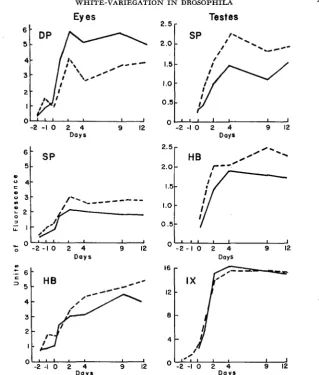
FIGURE 8.-Comparison of eye and testis pteridines developed in Oregon-R males (-) and
XYw/Y; +/Dpa males (---) which were reared concurrently. Day 0 is the time of eclosion.
DP = drosopterin; SP =sepia pteridine; HB = biopterin
+
2-amino-4hydroxypteridine; IX =isoxanthopterin.
plex were usually higher in mottled than in wild-type males in both testes and eye tissue. If sepia pteridine is the main constituent of visible pigment in the testis sheath, it is of interest that the pigmented sheath cells of variegated testes accumulate more sepia pteridine than do the sheath cells of wild-type flies, which are completely pigmented. The isoxanthopterin content of the testes of the two kinds of males is essentially identical, except that the X^Yw/Y males exhibit somewhat more variability. Since the synthetic pathways relating the various pteridines are not as yet known, the significance of these differences remains obscure. Apparently in males showing white-variegation, the partial blockage of red pigment formation in the eyes is accompanied by the accumulation of pre- cursors (SP and the HB complex) in testis sheath as well as in eyes.
480 A N I T A HESSLER
The values represented by the means, plotted in Figure 8, for imagoes fit very well the curves established in previous figures for 5-day-old flies. The extensive measurements made on 5-day-old flies reflect, at least in the case of X^Yw/Y;
+/Dpa males, a difference from the wild-type condition which is characteristic throughout most of the pupal period and up to 12 days after eclosion.
DISCUSSION
Certain of the parental effects which have been described can most economi- cally be interpreted as one-generation maternal effects. In the case of Dp", the progeny of a female homozygous for the duplication quantitatively express the pigment-forming action of Dpa more strongly than do progeny of a heterozygous female. The pteridine analyses of the two sets of heterozygous sons, as well as the penetrance of Dpa, support this statement. Implicit in such a conclusion is the assumption that one dose of Dpa produces less pigment forming action in the egg than do two doses. Also it is possible that mutant white alleles and Dp" are interacting such that two white alleles and one Dp" in a heterozygous mother result in production of quantitatively less maternal pigment-forming substances than does the interaction of two white alleles with two Dpa's in a homozygous mother. The most obvious pathway available in females for conveying mater- nally formed products into eggs is the transfer of nurse cell products into the developing oocyte. The egg is a closed metabolic system for the period from its fertilization until the hatching of the first larval instar. During this time
(about 24 hours) differentiation is extremely rapid, and even the anlagen of imaginal gonads and eyes are laid down (POULSON 1950). Thus, there is a mechanism for the incorporation of maternal products into the cells of the imaginal anlagen. W e do not know how these maternal products are maintained in the developing embryo and how they influence, eight to ten days later, the differentiation of pigment in an imaginal organ.
The other case in which a maternal effect may be tentatively invoked as an explanation of the results is the behavior of Dpf in progeny of a maternal com- pared with a paternal source. It will be recalled that the progeny, heterozygous for Dpf, produced by a Dp' mother showed better penetrance and expression of pigmentation than progeny of a Dpf father. This difference can be explained by assuming that the heterozygous Dpf female adds pigment-forming substances to her eggs which are not added by white females to their eggs. Therefore, eggs ready for fertilization in a Dpf mother would be, in a sense, conditioned for pig- ment development, whereas eggs of a mutant white mother would not.
Other cases of maternal influence on eggs have been noted from time to time (see CASPARI 1948). For example, in Ephestia kynurenine was demonstrated to be present in the homozygous recessive eggs (./a) of a cross between an a+/a 0 x a/ad
,
whereas this substance is lacking in such eggs from a n a / a 9 x a+/adcross. We have no knowledge of the chemical nature of the postulated sub- stances accounting for the supposed maternal effects on white variegation in
D. melanogaster.
WHITE-VARIEGATION I N DRCSOPHILA 481
far more pigment development than do progeny of a maternal source. This is not in accord with expectations based on the postulated maternal action of the duplication. From the viewpoint of finding a consistent explanation accounting
for all the phenomena observed, this is an exception which cannot be reconciled. Data are lacking which will permit critical judgment of this exception, until, for example, crosses between yw/Y; Dpa/+ and X^Yw/Y; Dp"/+ are made, with a marked third chromosomeTn either the male or the female. Thereby male progeny coming from the same type of mother and carrying either a maternally or paternally contributed Dp" can be studied simultaneously. This study has been postponed because the addition of a newly marked third chromosome would tend to destroy the isogenicity of the stocks.
The Dpa/Dpf females, when crossed to either XYw/Y or yw/Y males produced offspring with more pigment than offspring from mothers heterozygous for either Dp" or Dpf. This is consistent with an explanation in terms of maternal effect. This observation implies that there is no complementation between the function
of Dp" and Dpf insofar as the maternal homozygous effect is concerned. In other words, although these two states of the duplication may be distinguished by the particular criteria previously enumerated, they behave as functionally the same state in the maternal homozygous effect.
Since all the fYw/Y sons of both Dpa/Dpa and Dp"/Dpf mothers are pig- mented, it is of interest that the sons of Dpa/Dpf developed nearly wild-type pigmentation whereas sons of Dp"/Dp" developed only partially pigmented eyes. Since the Dpa/Dpf female is expected to yield both Dp" and Dpf sons, it would appear that the Dp" sons look like Dpf ones. Since any egg of Dpa/DpP mothers has an equal probability of developing into a male or female, potential daugh- ters and sons would be expected to receive the same kinds and amounts of maternally contributed substances prior to fertilization. Yet the daughters of Dpa/Dpf show divergent phenotypes, and the sons do not. The most obvious difference between the daughters and sons is, of course, the yw versus the XYw condition; both sexes have a free Y in addition. Perhaps theassociation of the extra heterochromatin of XYw in the sons results in the passing of some crucial threshold in pigment formation which is not surpassable in the yw daughters. While both sons and daughters have one duplication-bearing chromosome, the sons have only one white allele, whereas the attached-X daughters have two white alleles. Whether either of these factors influences the differences observed between sons and daughters of Dp"/Dpf females is not known.
The fact that phenotypically distinguishable and genetically distinct Dp" and Dpe categories could be established certainly supports the notion that the differ- ence in state is a stable one. The difference reported is substantiated by an inde- pendent study by DR. JANICE B. SPOFFORD (unpublished). The characteristics of
482 A N I T A HESSLER
suppressing ( D p f ) pigment development, with crossing over in females and lack of crossing over in males to account for the parental effects described. However, since the duplication was maintained in matrilineal lines, there is always the possibility that such modifiers would eventually cross out, resulting in progressive change in the character of mottling. Such progressive alteration was not observed. The most compelling argument against two systems of modifier genes is the observation that Dp" and Dp' as extracted from Dpa/Dpr females were unchanged in their respective actions.
S U M M A R Y
The study disclosed the existence of two states, Dpa and Dpf, of the duplication Dp(wm)264-58a in Drosophila melanogasier which produces position-effect var- iegation of the pigments in the eyes and testis sheaths. Dp" flies as a rule develop less pigment than Dpf flies when white-variegated stocks are compared. The var- iegated progeny heterozygous for Dp" were more heavily pigmented if their mottled mothers were homozygous for Dp" than if they were heterozygous for Dp". Variegated progeny of heterozygous Dpa males, however, have significantly more pigmentation than do progeny of Dpa females. Dp' females. on the contrary, produce more heavily pigmented progeny than do Dp' males. Also. the number
of mottled progeny recovered from a Dpf/+ female may be significantly higher than the number of white progeny recovered. This distorted ratio is not observed with Dpa/+ mothers. The differences in penetrance and expression accompany- ing the parental source effects and maternal homozygosity effect in Dp" or Dpf are considered to be one-generation effects.
The homozygous versus heterozygous maternal effect is observed by comparing progeny of Dpa/Dpf females with progeny of either Dpa/+ or Dpf/+ females; thus there is n o evidence for distinguishing a difference in action of Dp" from Dpc in terms of the homozygous maternal effect.
Chromatographic analysis of eye and testis sheath pteridines has demonstrated no correlation between sepia pteridine or HB,
+
HB, in these two tissues ofX^Yzu/Y males bearing Dp". A comparative developmental study showed that
X%w/Y; +/Dp" males as a rule developed less drosopterin in their eyes but more sepia pteridine and HB,
+
HB, in both eyes and testis sheaths than did Oregon-R wild-type males.ACKNOWLEDGMENTS
The writer takes pleasure in acknowledging the valuable criticism and advice
of DR. WILLIAM K. BAKER, under whose patient sponsorship this work was accomplished. Appreciation is also expressed for the time spent in especially pleasant and stimulating discussions with DR. JANICE B. SPOFFORD and DR. JACK L. HUBBY.
LITERATURE CITED
ALBERT, A., 1954
BAKER, W. K., and J. B. SPOFFORD, 1959
The pteridines. Fortschr. Chem. or. Naturstoffe 1 1 : 351-403.
WHITE-VARIEGATION I N DROSOPHILA 483
CARPENTER, J. M., 1950 A new semisynthetic food medium for Drosophila. Drosophila Inform. Serv. 24: 96-97.
CASPARI, E., 1948
DEMEREC, M., and H. SLIZYNSKA, 1937
Cytoplasmic inheritance. Advances in Genet. 2: 1-66.
Mottled white 258-18 of Drosophila melanogaster. Ge- netics 22 : 6 4 4 4 . 9 .
FORREST, H. S., and H. K. MITCHELL, 1954a The pteridines of Drosophila melanogaster. pp. 143- 158. Ciba Foundation Symposium on Chemistry and Biology of Pteridines. Little, Brown and Co., Boston.
Pteridines from Drosophila. I. Isolation of a yellow pigment. J. Am. Chem. SOC. 76:
5656-5658.
Pteridines from Drowphila. 111. Isolation and identification of three more pteridines. J. Am. Chem. Soc. 77: 4865-4869.
Conversion of 2-amino-4-hydroxypteri-
Characterization of a second yellow 1954b
1955
FORREST, H. S., E. GLASSMAN, and H. K. MITCHELL, 1956
FORREST, H. S., D. HATFIELD, and C. VAN BAALEN, 1959
dine to isoxanthopterin in D. melamgaster. Science 124: 725-726. '
compound from Drosophila melanogaster. Nature 183 : 1269-1270.
GOWEN, J. W., and E. H. GAY, 1933 Eversporting as a function of the Y chromosome in Dro-
Untersuchungen uber fluoreszierende Stoffe der Hoden von sophila melanogaster. Proc. Natl. Acad. Sci. U.S. 19: 122-126.
GRAF G. E., and E. HADORN, 1959
Drosophila. Z. Naturforsch. 14b: 14 -17.
HADORN, E., 1959 Contribution to the physiological and biochemical genetics of pteridines and pigments in insects. Proc. 10th Intern. Congr. Genet. (1958, Montreal), 337-354.
H4DORN, E., and H. K. MITCHELL, 1951 Properties of mutants of Drosophila m e h o g a s t e r and changes during development as revealed by paper chromatography. Proc. Natl. Acad. Sci.
U.S. 37: 650-665.
LEWIS, E. B.. 1950
LINDSLEY, D. L., and E. NOVITSKI, 1959
The phenomenon of position effect. Advances in Genet. 3: 73-115.
Compound chromosomes involving the X and Y
chromosomes of Drosophila melanogaster. Genetics 44 : 187-196.
POULSON, D. F.. 1950 Histogenesis, organogenesis, and differentiation in the embryo of Drosophila melanogaster Meigen. T h e Biology of Drosophila. Edited by M. DEMEREC. John Wiley and Sons, Inc. New York.
SCHULTZ, J., 1936 Variegation in Drosophila and the inert chromosome regions. Proc. Natl. Acad. Sci. U.S. 22: 27-33.
SPOFFORD, J. B., 1959 Parental control of position effect variegation. I. Parental heterochromatin and expression of the white locus in compound X Drosophila melanogaster. Proc. Natl. Acad. Sci. U.S. 45: 1003-1007.
SUTTON, E., 1940 The structure of salivary gland chromosomes of Drosophila melanogaster in
VISCONTINI, M., 1958 Fluoreszierende Stoffe aus Drosophila melanogaster, 9th Mitteilung.
Oxydation des Pterins HB, aus Drosophila exchanges between euchromatin and heterochromatin. Gsnetics 25 : 534-544).
Helv. Chim. Acta 41 : 922-925.
VISCONTINI, M., E. LOESER, and A. EGELHAAF, 1956
und Ephestia durch UV-Bestrahlung. Naturwiss. 16 : 379-380.
484 ANITA HESSLER
~ I S C O N T I N I , M., and H. RASCHIG, 1958 Fluoreszierende Stoffe aus Drosophila melanOgaSter.
7th Mitteilung. Helv. Chim. Acta 41: 108.
ZIEGLER-GUNDER, I., 1956 Pterine: Pigmente und Wirkstoffe im Tierreich. Biol. Revs. Cam- bridge Phil. Soc. 31: 313-348.