BIROn - Birkbeck Institutional Research Online
Davies, M.N. and Hattotuwagama, C.K. and Moss, David S. and Drew,
M.G.B. and Flower, D.R. (2006) Statistical deconvolution of enthalpic
energetic contributions to MHC-peptide binding affinity.
BMC Structural
Biology 6 (articl), ISSN 1472-6807.
Downloaded from:
Usage Guidelines:
Please refer to usage guidelines at
or alternatively
Birkbeck ePrints: an open access repository of the
research output of Birkbeck College
http://eprints.bbk.ac.uk
Davies, Matthew N.; Hattotuwagama, Channa K.; Moss,
David S.; Drew, Michael G.B.; and Flower, Darren R.
(2006). Statistical deconvolution of enthalpic energetic
contributions to MHC-peptide binding affinity.
BMC
Structural Biology
6
, article 5.
This is an exact copy of a paper published in BMC Structural Biology (ISSN
1472-6807). Copyright and all rights therein are retained by authors or by
other copyright holders. All persons downloading this information are
expected to adhere to the terms and constraints invoked by copyright. © 2006
Davies et al; licensee BioMed Central Ltd. This is an Open Access article
distributed under the terms of the Creative Commons Attribution License
(
http://creativecommons.org/licenses/by/2.0
) ,which permits unrestricted use,
distribution, and reproduction in any medium, provided the original work is
properly cited.
Citation for this copy:
Davies, Matthew N.; Hattotuwagama, Channa K.; Moss, David S.; Drew,
Michael G.B.; and Flower, Darren R. (2006). Statistical deconvolution of
enthalpic energetic contributions to MHC-peptide binding affinity. London:
Birkbeck ePrints. Available at:
http://eprints.bbk.ac.uk/archive/00000508
Citation as published:
Davies, Matthew N.; Hattotuwagama, Channa K.; Moss, David S.; Drew,
Michael G.B.; and Flower, Darren R. (2006). Statistical deconvolution of
enthalpic energetic contributions to MHC-peptide binding affinity. BMC
Structural Biology
6
, article 5.
http://eprints.bbk.ac.uk
BioMedCentral
BMC Structural Biology
Open Access
Research article
Statistical deconvolution of enthalpic energetic contributions to
MHC-peptide binding affinity
Matthew N Davies*
†1, Channa K Hattotuwagama
†1, David S Moss
2,
Michael GB Drew
3and Darren R Flower
1Address: 1Edward Jenner Institute for Vaccine Research, Compton, Newbury, RG20 7NN, UK, 2School of Crystallography, Birkbeck College,
London WC1E 7HX, UK and 3Structural and Computational Chemistry Group, University of Reading, Reading RG6 6AH, UK
Email: Matthew N Davies* - [email protected]; Channa K Hattotuwagama - [email protected];
David S Moss - [email protected]; Michael GB Drew - [email protected]; Darren R Flower - [email protected] * Corresponding author †Equal contributors
Abstract
Background: MHC Class I molecules present antigenic peptides to cytotoxic T cells, which forms an integral part of the adaptive immune response. Peptides are bound within a groove formed by the MHC heavy chain. Previous approaches to MHC Class I-peptide binding prediction have largely concentrated on the peptide anchor residues located at the P2 and C-terminus positions.
Results: A large dataset comprising MHC-peptide structural complexes was created by re-modelling pre-determined x-ray crystallographic structures. Static energetic analysis, following energy minimisation, was performed on the dataset in order to characterise interactions between bound peptides and the MHC Class I molecule, partitioning the interactions within the groove into van der Waals, electrostatic and total non-bonded energy contributions.
Conclusion: The QSAR techniques of Genetic Function Approximation (GFA) and Genetic Partial Least Squares (G/PLS) algorithms were used to identify key interactions between the two molecules by comparing the calculated energy values with experimentally-determined BL50 data. Although the peptide termini binding interactions help ensure the stability of the MHC Class I-peptide complex, the central region of the I-peptide is also important in defining the specificity of the interaction. As thermodynamic studies indicate that peptide association and dissociation may be driven entropically, it may be necessary to incorporate entropic contributions into future calculations.
Background
Major Histocompatibility Complex (MHC) molecules play a central role in the adaptive immune system, form-ing a complex with foreign antigenic peptides and dis-playing them on the cell surface for inspection by receptors of cytotoxic and helper T cells. In consort with the T cell receptor, the repertoire of MHC-peptide
com-plexes shapes the specificity of the T cell response. Two different types of MHC molecules – Class I and Class II – are recognized by distinct sets of T-cells: CD8+ and CD4+ respectively. MHC Class I molecules, which predomi-nantly present antigenic material derived from the cytosol, are composed of an α heavy chain, a light chain (β2-microglobulin or β2m) and a peptide between 8–15
Published: 20 March 2006
BMC Structural Biology2006, 6:5 doi:10.1186/1472-6807-6-5
Received: 03 October 2005 Accepted: 20 March 2006 This article is available from: http://www.biomedcentral.com/1472-6807/6/5
© 2006Davies et al; licensee BioMed Central Ltd.
BMC Structural Biology 2006, 6:5 http://www.biomedcentral.com/1472-6807/6/5
Page 2 of 13
(page number not for citation purposes)
amino acids in length. The peptide is bound within a groove formed by the MHC heavy chain.
Analysis of MHC Class I-peptide binding interactions together with specific peptide-MHC crystal structures reveals several common trends. A conserved cluster of tyrosine residues are present at the N terminus of the pep-tide while a different set of MHC Class I residues form a series of hydrogen bonds and ionic interactions with the C terminus and peptide backbone. Previous attempts to predict potential epitopes have concentrated on binding motifs. Such motifs greatly emphasize so-called 'anchor' residues at peptide position P2 and the peptide C-termi-nus, which occupy the B and F pocket of the MHC Class I binding groove respectively [1,2]. The B pocket is com-posed of eight α heavy chain residues (9, 24, 45, 66, 67, 70 and 99) and the F pocket is composed of four (77, 80, 81 and 116). Previous analysis of HLA-A*0201 [3] found that residues such as leucine, isoleucine, valine and methionine are favoured for the P2 position while the optimal residues for the C-terminus are leucine and valine (although methionine, isoleucine, alanine and threonine can also occupy this position). In some cases, contribu-tions made by the peptide residues at posicontribu-tions 1, 3, 6 and 7 can compensate for the presence of unfavoured residues at the P2 and C-terminal positions). In an attempt to dis-cover novel T cell epitopes, many motif-based techniques have been used to predict the affinity of MHC-peptide interactions. Diverse methods, such as EpiVax [4], Artifi-cial Neural Networks [5], Hidden Markov Models [6], Support Vector Machines [7] and Profiles [8], have all been used to create T-cell epitope prediction programs. Typically, prediction techniques have been calibrated by using experimentally-determined IC50 and BL50 data [9], at least indirectly. Purely motif-based analysis of binding, however, may be too simplistic to accurately detect the effect of non-anchor residues within the groove. This is because changes in the peptide sequence may introduce subtle structural variations into the binding which can greatly influence peptide binding affinity [10]. These interactions can be partially accounted for by the additive effect of the binding. The calculation of the additive effect is based upon the method first introduced by Free and Wilson whereby each substitute makes additive and con-stant contributions to biological activity regardless of sub-stituent variation. This assumes that peptide binding affinity can be decomposed into the sum of contributions from residues at each position and the interaction between those residues. The QSAR (Quantitative Struc-ture-Activity Relationship)-based additive technique [10-16] is based on a more sophisticated approach than motifs and uses additive technique in the calculation. The additive QSAR model therefore accounts for the sum of amino acid interactions, the sum of adjacent peptide side
chain interactions, and the sum of every second side chain interaction, and so on.
A possible way to full incorporate the additive effects into the prediction is to derive the affinities based on structural data. The COMBINE (COMparative BINding Energy) method does this by creating a model which estimates binding free energy differences based on energy-mini-mised structures of ligand-receptor complexes [17-19]. The model is fitted to a set of experimental binding parameters and is used to predict the affinity of novel lig-ands. This technique assumes that the free energy of bind-ing correlates with a subset of energy components determined from the structure. In this paper, a technique similar to COMBINE is developed which incorporates both structural and data-driven methods in order to create a novel method for the analysis of peptide-MHC binding. This new method seeks to better understand the atomic interactions that determine binding affinities: static energy analysis calculations combined with QSAR analy-sis are used to calculate the relative contribution of inter-actions between the MHC Class I allele A*0201 and bound peptide residues, thus generating an accurate and predictive system for the A2 supertype.
Results
QSAR analysis was carried out on three individual mod-els: total/electrostatic/van der Waals energy descriptors; electrostatic/van der Waals energy descriptors and total non-bonded energy descriptors. The matrix consisted of 118 peptide rows and 4860 descriptor (energy, electro-static and van der Waals) columns. To make this analysis tractable, any columns consisting entirely of values of ~0 kcal mol-1 (signifying that no contributions were made
between the peptide and binding site) were omitted from the dataset, yielding a final matrix of 1504 descriptor col-umns (454 total energy descriptors, 331 electrostatic energy descriptors and 719 van der Waals energy descrip-tors). The resulting regression equation modeled the binding affinities of a training set of 83 peptides and was used to predict the binding affinities of an independent test set of 35 peptides.
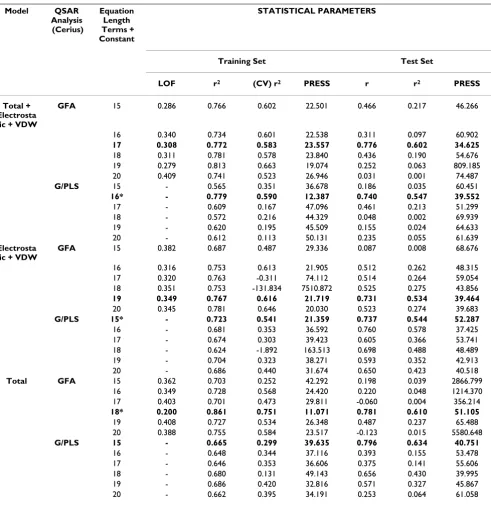
The GFA and G/PLS algorithms were used to select the optimum number of descriptors for use in the regression analysis. Although the methods are similar, the applica-tion of G/PLS often allows the construcapplica-tion of larger QSAR equations while still avoiding over-fitting and elim-inating most variables. Within the Cerius2 software, the
BMC Structural Biology 2006, 6:5 http://www.biomedcentral.com/1472-6807/6/5
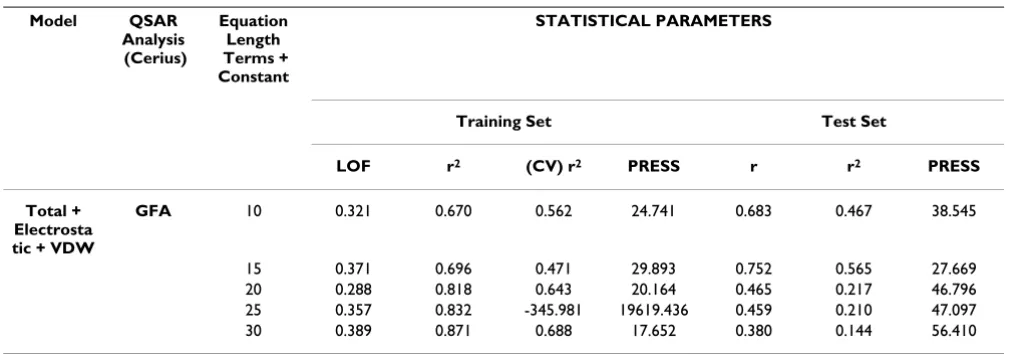
the number of terms in the initial and final equations was varied between 15–20 descriptors. It was found that rais-ing or lowerrais-ing the number of descriptors outside of this range caused a steady increase in the PRESS value and a lowering of the r2. Models were created with 10, 25 and 30
descriptors and all exhibited a decrease in the quality of the model. The GFA Total + Electrostatic + VDW model is shown in Table 2 as example. It is likely that the use of too
many descriptors or too few will cause overfitting or underfitting of the model respectively. 15–20 descriptors may represent a range where there is sufficient informa-tion to build a model without overemphasising specific interactions that do not represent general trends within the dataset. The best model was chosen based on both the r2 value of the test set and also on the (CV)r2 value from
the training set. All selected models had the highest avail-Table 1: QSAR Results Based on full binding groove for GFA and G/PLS Total, Electrostatic + VDW and Total + Electrostatic + VDW models.
Model QSAR
Analysis (Cerius)
Equation Length Terms + Constant
STATISTICAL PARAMETERS
Training Set Test Set
LOF r2 (CV) r2 PRESS r r2 PRESS
Total + Electrosta tic + VDW
GFA 15 0.286 0.766 0.602 22.501 0.466 0.217 46.266
16 0.340 0.734 0.601 22.538 0.311 0.097 60.902
17 0.308 0.772 0.583 23.557 0.776 0.602 34.625
18 0.311 0.781 0.578 23.840 0.436 0.190 54.676 19 0.279 0.813 0.663 19.074 0.252 0.063 809.185 20 0.409 0.741 0.523 26.946 0.031 0.001 74.487
G/PLS 15 - 0.565 0.351 36.678 0.186 0.035 60.451
16* - 0.779 0.590 12.387 0.740 0.547 39.552
17 - 0.609 0.167 47.096 0.461 0.213 51.299 18 - 0.572 0.216 44.329 0.048 0.002 69.939 19 - 0.620 0.195 45.509 0.155 0.024 64.633 20 - 0.612 0.113 50.131 0.235 0.055 61.639
Electrosta tic + VDW
GFA 15 0.382 0.687 0.487 29.336 0.087 0.008 68.676
16 0.316 0.753 0.613 21.905 0.512 0.262 48.315 17 0.320 0.763 -0.311 74.112 0.514 0.264 59.054 18 0.351 0.753 -131.834 7510.872 0.525 0.275 43.856
19 0.349 0.767 0.616 21.719 0.731 0.534 39.464
20 0.345 0.781 0.646 20.030 0.523 0.274 39.683
G/PLS 15* - 0.723 0.541 21.359 0.737 0.544 52.287
16 - 0.681 0.353 36.592 0.760 0.578 37.425 17 - 0.674 0.303 39.423 0.605 0.366 53.741 18 - 0.624 -1.892 163.513 0.698 0.488 48.489 19 - 0.704 0.323 38.271 0.593 0.352 42.913 20 - 0.686 0.440 31.674 0.650 0.423 40.518
Total GFA 15 0.362 0.703 0.252 42.292 0.198 0.039 2866.799
16 0.349 0.728 0.568 24.420 0.220 0.048 1214.370 17 0.403 0.701 0.473 29.811 -0.060 0.004 356.214
18* 0.200 0.861 0.751 11.071 0.781 0.610 51.105
19 0.408 0.727 0.534 26.348 0.487 0.237 65.488 20 0.388 0.755 0.584 23.517 -0.123 0.015 5580.648
G/PLS 15 - 0.665 0.299 39.635 0.796 0.634 40.751
16 - 0.648 0.344 37.116 0.393 0.155 53.478 17 - 0.646 0.353 36.606 0.375 0.141 55.606 18 - 0.680 0.131 49.143 0.656 0.430 39.995 19 - 0.686 0.420 32.816 0.571 0.327 45.867 20 - 0.662 0.395 34.191 0.253 0.064 61.058
[image:5.612.63.554.107.611.2]BMC Structural Biology 2006, 6:5 http://www.biomedcentral.com/1472-6807/6/5
Page 4 of 13
(page number not for citation purposes)
able test set r2 value, except for the G/PLS Electrostatic +
VDW model where the 15 descriptor model was chosen as it has a (CV)r2 value significantly higher than the 16
descriptor model. Marked equations had a few anoma-lous outliers removed to consolidate the model.
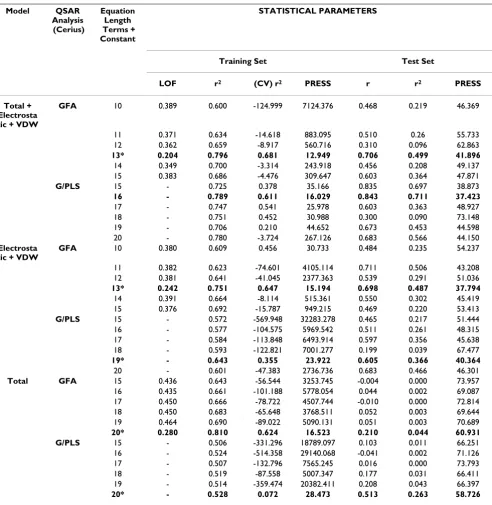
Further analysis was also carried out limiting the potential descriptors to those amino acids comprising previously-defined MHC anchor pockets: P2 and the C terminus [1]. In that model, a total of 138 residues were used (46 energy terms, 46 electrostatic terms and 46 van der Waals terms). Despite the reduced population size, the optimal number of descriptors still occurred within the 10–20 descriptor range (see Table 3). The reduced number of descriptors generally seems to decrease the predictivity of the models significantly. However, one exception (the G/PLS Total + Electrostatic + VDW model) did produce a test set r2 value
of 0.711, which is higher than any model produced using the full range of descriptors. The GFA and G/PLS Total models produced extremely poor results with a test set r2
value of 0.044 and 0.263 respectively. The best individual models for both the GFA and G/PLS algorithms taken from both Tables 1 and 3 are presented in Table 4 and 5 respectively. Descriptor sets taken from the best models generated by the GFA and G/PLS calculations were used to validate the QSAR analysis using the PLS module in SYBYL 6.9. The predictivity of GFA and G/PLS models compares well with the PLS method, indicating that the predictive ability of the models is consistent in terms of descriptor choice, despite differences in the form of the predictive equation in each case.
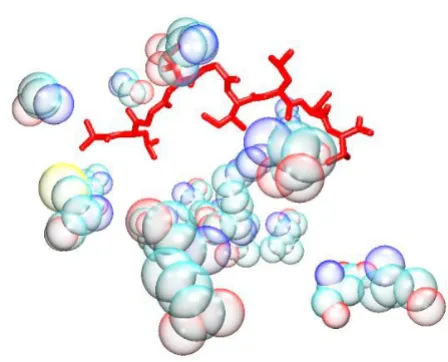
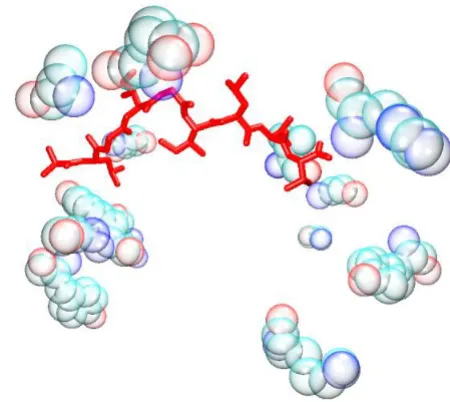
Table 6 shows the residues that make up the descriptors for each of the six Cerius2 QSAR models presented in Table 3. Each model's residue distributions around the peptide are shown in Figures 1, 2, 3, 4, 5, 6. The selected coefficients are generated from those residues which make a consistent contribution over the entire training set. An
overview of the QSAR models would suggest that although specific MHC-peptide interactions are difficult to identify, certain regions of the α heavy chain seem to relate to specific peptide residues. P2 is associated with the
[image:6.612.53.568.98.275.2]α60–70 region while the α160–170 region is associated with P2-P4. The α150–160 and α140–145 regions relate to P5 and P7 specifically. These associations may be fun-damental to the binding and are maintained irrespective of the sequence of the peptide. In several cases, the MHC residues interact with the main chain atoms of the peptide and therefore make energetic contributions independent of the peptide sequence. Conversely, regions α1–4, α26– 33, α46–58, α101–111 and α168–180 all make little or no energetic contribution due to their distance from the peptide residues. It is difficult to identify specific interac-tions from MHC residues, however, the following associ-ations between specific MHC and peptide residues are all represented in three out of the six models: Met 5 ing with P3, Asp 77 interacting with P9, Thr 143 interact-ing with P9, Val 152 interactinteract-ing with P6 and Leu 156 interacting with P5. This might suggest that those five interactions all have an effect in determining the specifi-city of the interaction. Of the B pocket residues, Tyr 99 is the only residue to appear in two models while B pocket residues Ala 24, Met 45, Lys 66 and Tyr 116 only appear in one model each. Asp 77 appears in three models as is the only one of the four residues lining the F pocket which is used as a descriptor. Both Lys 66 and Asp 77 have been identified as forming conserved hydrogen bonds within the groove, respectively with the oxygen of the P2 residue and the nitrogen of the P9 residue [1]. Lys 66 is of partic-ular interest as it has been identified as being a functional "hotspot" due to the formation of an ion pair with Glu 63 and an apparent dual role in both peptide binding and T cell receptor interaction [20-22]. In spite of this the resi-due is only used as a descriptor by G/PLS Total + Electro-static + VDW model. The conserved bonds, Glu 63- P2 amide nitrogen and Tyr 99-P3 amide nitrogen, are not Table 2: QSAR Results for GFA Total + Electrostatic + VDW model based on 10, 20 25, 30 descriptors.
Model QSAR
Analysis (Cerius)
Equation Length Terms + Constant
STATISTICAL PARAMETERS
Training Set Test Set
LOF r2 (CV) r2 PRESS r r2 PRESS
Total + Electrosta tic + VDW
GFA 10 0.321 0.670 0.562 24.741 0.683 0.467 38.545
BMC Structural Biology 2006, 6:5 http://www.biomedcentral.com/1472-6807/6/5
represented at all. Both residues, however, are used as descriptors in relation to P1 and in relation to P2 and P4 respectively in separate models. Previous work [10] has identified residues 9, 97, 114 and 116 as key to defining the A2-supertype, hence representative of vital points of interaction within the groove. They are poorly represented by the QSAR models, the only equation that incorporates one of them is the G/PLS Electrostatic + VDW model,
where 116 interacts with P5. However, they do all occur within regions of the groove identified as important to the binding, again suggesting that it is regions rather than spe-cific residues that determine the stability of the complex.
Discussion
[image:7.612.62.554.107.611.2]Overall, within our models, the distribution of the descriptors does not lend support to the view that burial Table 3: QSAR Results Based on Binding Pockets for GFA and G/PLS Total, Electrostatic + VDW and Total + Electrostatic + VDW models.
Model QSAR
Analysis (Cerius)
Equation Length Terms + Constant
STATISTICAL PARAMETERS
Training Set Test Set
LOF r2 (CV) r2 PRESS r r2 PRESS
Total + Electrosta tic + VDW
GFA 10 0.389 0.600 -124.999 7124.376 0.468 0.219 46.369
11 0.371 0.634 -14.618 883.095 0.510 0.26 55.733 12 0.362 0.659 -8.917 560.716 0.310 0.096 62.863
13* 0.204 0.796 0.681 12.949 0.706 0.499 41.896
14 0.349 0.700 -3.314 243.918 0.456 0.208 49.137 15 0.383 0.686 -4.476 309.647 0.603 0.364 47.871
G/PLS 15 - 0.725 0.378 35.166 0.835 0.697 38.873
16 - 0.789 0.611 16.029 0.843 0.711 37.423
17 - 0.747 0.541 25.978 0.603 0.363 48.927 18 - 0.751 0.452 30.988 0.300 0.090 73.148 19 - 0.706 0.210 44.652 0.673 0.453 44.598 20 - 0.780 -3.724 267.126 0.683 0.566 44.150
Electrosta tic + VDW
GFA 10 0.380 0.609 0.456 30.733 0.484 0.235 54.237
11 0.382 0.623 -74.601 4105.114 0.711 0.506 43.208 12 0.381 0.641 -41.045 2377.363 0.539 0.291 51.036
13* 0.242 0.751 0.647 15.194 0.698 0.487 37.794
14 0.391 0.664 -8.114 515.361 0.550 0.302 45.419 15 0.376 0.692 -15.787 949.215 0.469 0.220 53.413
G/PLS 15 - 0.572 -569.948 32283.278 0.465 0.217 51.444
16 - 0.577 -104.575 5969.542 0.511 0.261 48.315 17 - 0.584 -113.848 6493.914 0.597 0.356 45.638 18 - 0.593 -122.821 7001.277 0.199 0.039 67.477
19* - 0.643 0.355 23.922 0.605 0.366 40.364
20 - 0.601 -47.383 2736.736 0.683 0.466 46.301
Total GFA 15 0.436 0.643 -56.544 3253.745 -0.004 0.000 73.957
16 0.435 0.661 -101.188 5778.054 0.044 0.002 69.087 17 0.450 0.666 -78.722 4507.744 -0.010 0.000 72.814 18 0.450 0.683 -65.648 3768.511 0.052 0.003 69.644 19 0.464 0.690 -89.022 5090.131 0.051 0.003 70.689
20* 0.280 0.810 0.624 16.523 0.210 0.044 60.931
G/PLS 15 - 0.506 -331.296 18789.097 0.103 0.011 66.251
16 - 0.524 -514.358 29140.068 -0.041 0.002 71.126 17 - 0.507 -132.796 7565.245 0.016 0.000 73.793 18 - 0.519 -87.558 5007.347 0.177 0.031 66.411 19 - 0.514 -359.474 20382.411 0.208 0.043 66.397
20* - 0.528 0.072 28.473 0.513 0.263 58.726
BMC
Structu
ral
Biol
ogy
200
6,
6
:5
http://www.bi
omedcen
tr
al
.co
m
/14
72-68
07/6/5
Pa
ge 6 of
1
3
(page nu
mber not
for
cit
a
tion pur
[image:8.612.77.731.85.535.2]poses)
Table 4: Best QSAR models for GFA and G/PLS based on full binding groove in comparison with the PLS method. *PLS Models based on Cerius GFA & G/PLS Models respectively.
Model QSAR Analysis
1Cerius 2SYBYL
Equation Length Terms + Constant
STATISTICAL PARAMETERS
TRAINING SET TEST SET
LOF SEP r2 (CV) r2 SEE PRESS r r2 PRESS
Total + Electrostatic
+ VDW
GFA1 17 0.308 0.772 0.583 23.557 0.776 0.602 34.625
G/PLS1 16 0.779 0.590 12.387 0.740 0.547 39.552
PLS2 (GFA) 17 0.604 0.630 0.521 0.531 20.526 0.734 0.539 34.247
PLS2 (G/PLS) 16 0.571 0.615 0.438 0.473 15.869 0.708 0.501 41.424
Electrostatic + VDW
GFA1 19 0.349 0.767 0.616 21.719 0.731 0.534 39.464
G/PLS1 15 0.723 0.541 21.359 0.737 0.544 52.287
PLS2(GFA) 19 0.675 0.194 -0.055 0.611 25.038 0.613 0.376 66.115
PLS2 (G/PLS) 15 0.558 0.669 0.526 0.466 15.863 0.803 0.645 48.045
Total GFA1 18 0.200 0.861 0.751 11.071 0.781 0.610 51.105
G/PLS1 15 0.665 0.299 39.635 0.796 0.634 40.751
PLS2 (GFA) 18 0.654 0.496 0.350 0.576 23.550 0.777 0.604 58.579
BMC
Structu
ral
Biol
ogy
200
6,
6
:5
http://www.bi
omedcen
tr
al
.co
m
/14
72-68
07/6/5
Pa
ge 7 of
1
3
(page nu
mber not
for
cit
a
tion pur
[image:9.612.82.732.85.515.2]poses)
Table 5: Best QSAR models for GFA and G/PLS based on binding Pockets in comparison with the PLS method. * PLS Models based on Cerius GFA & G/PLS Models respectively.
Model QSAR Analysis
1Cerius 2SYBYL
Equation Length Terms + Constant
STATISTICAL PARAMETERS
TRAINING SET TEST SET
LOF SEP r2 (CV) r2 SEE PRESS r r2 PRESS
Total + Electrostatic +
VDW
GFA1 13 0.204 0.796 0.681 12.949 0.762 0.499 41.896
G/PLS1 16 - 0.789 0.611 16.029 0.843 0.711 37.423
PLS2 (GFA) 13 0.593 0.546 0.439 0.533 19.349 0.714 0.510 41.707
PLS2 (G/PLS) 16 0.704 0.432 0.284 0.628 30.279 0.818 0.699 42.235
Electrostatic + VDW
GFA1 13 0.242 0.751 0.647 15.194 0.698 0.487 37.794
G/PLS1 19 - 0.643 0.355 23.922 0.605 0.366 40.364
PLS2 (GFA) 13 0.548 0.659 0.528 0.466 14.709 0.344 0.118 51.406
PLS2 (G/PLS) 19 0.729 0.523 0.254 0.583 25.187 0.480 0.230 45.155
Total GFA1 20 0.280 0.810 0.624 - 0.210 0.044 60.931
G/PLS1 20 - 0.528 0.072 28.473 0.513 0.263 58.726
PLS2 (GFA) 20 0.627 0.539 0.369 0.536 19.527 0.636 0.405 47.833
BMC
Structu
ral
Biol
ogy
200
6,
6
:5
http://www.bi
omedcen
tr
al
.co
m
/14
72-68
07/6/5
Pa
ge 8 of
1
3
(page nu
mber not
for
cit
a
tion pur
[image:10.612.83.725.79.536.2]poses)
Table 6: Residue descriptors for the Best QSAR Results based on full binding groove.
Total + Electrostatic + VDW
GFA Peptide Pos. P1 P3 P7 P9 P9 P2 P9 P1 P2 P5 P5 P5 P6 P6 P7 P9
MHC Residue No. 63 5 141 14 48 39 115 51 69 130 133 144 75 148 140 115
MHC Residue Glu Met Gln Arg Arg Asp Gln Trp Ala Leu Trp Lys Val Ala Ala Gln
G/PLS Peptide Pos. P1 P4 P5 P6 P8 P8 P9 P9 P1 P3 P2 P3 P4 P7 P7
MHC Residue No. 171 164 157 66 19 72 77 123 171 156 99 66 66 73 155
MHC Residue Tyr Cys Arg Lys Glu Gln Asp Tyr Tyr Leu Tyr Lys Lys Thr Gln
Electrostatic + VDW GFA Peptide Pos. P1 P5 P7 P8 P8 P9 P9 P9 P2 P2 P2 P4 P4 P5 P7 P9 P9 P9
MHC Residue No. 10 35 21 99 117 95 126 153 60 73 160 45 99 130 23 8 117 134
MHC Residue Thr Arg Arg Tyr Ala Val Leu Ala Trp Thr Leu Met Tyr Leu Ile Phe Ala Thr
G/PLS Peptide Pos. P1 P1 P7 P9 P2 P2 P2 P4 P5 P5 P5 P6 P7 P9
MHC Residue No. 43 115 22 159 24 68 167 163 116 156 158 152 143 93
MHC Residue Gln Gln Phe Tyr Ala Lys Trp Thr Tyr Leu Ala Val Thr His
Total GFA Peptide Pos. P1 P1 P1 P2 P2 P2 P2 P3 P3 P3 P3 P5 P5 P6 P6 P9 P9
MHC Residue No. 25 61 156 33 64 68 163 5 34 162 168 152 156 115 152 77 143
MHC Residue Val Asp Leu Phe Thr Lys Thr Met Val Gly Leu Val Leu Gln Val Asp Thr
G/PLS Peptide Pos. P1 P2 P2 P2 P3 P3 P3 P5 P6 P7 P9 P9 P9 P9
MHC Residue No. 25 33 62 119 5 74 98 156 152 143 14 74 77 83
BMC Structural Biology 2006, 6:5 http://www.biomedcentral.com/1472-6807/6/5
of anchor residues, within defined cavities, are mainly responsible for stabilising the peptide within the groove. Rather it indicates a fairly even distribution of MHC resi-due interactions along the length of the peptide. Attempts to improve the QSAR model by focusing on the MHC res-idues associated with the anchor resres-idues were largely unsuccessful (see Table 3 and Table 5), in spite of the pre-dictive accuracy of the G/PLS Total + Electrostatics + VDW model. Despite the fact that the anchor models generate a similar number of descriptors to those of the full groove, focusing the interaction towards the peptide termini at the expense of the variable region generally reduces the algo-rithm's predictivity. It is possible that this reflects the com-parative dominance of electrostatic interactions in determining binding affinity within both of the anchor pockets. Model predictivity also deteriorates after removal of each descriptor type compared to the full residue model, particularly in the case of models based on Total energy. Moreover, attempts to split the interaction energy into long range electrostatic and short range van der Waals forces also decreases correlation in the full residue model, suggesting that a single residue's total energy contribution is primarily enthalpic in character. It should be noted that several of the residues highlighted by the models are dis-tant from the peptide (see Figures 1, 2, 3, 4, 5, 6), demon-strating the importance of long-range electrostatic interactions, which can be up to 8Å length, in stabilizing the complex. This could also be an effect of superadditiv-ity correlation (SAC) [23] where correlation between var-iables between two sites does not imply that the two sites directly interact. Mutational data has indicated that long range non-causal interactions can be stronger in
magni-tude than causal correlations induced by direct interac-tions [24,25].
The Total energy models showed the highest correlation in the test set for both the GFA and G/PLS model although the (CV)r2 value of the G/PLS model dropped sharply in
the training set. Both models placed great emphasis on the conserved P1-P3 region of the MHC Class I groove at the expense of the central and C-termini regions. The key interaction of Asp 77 with the P9 residue was incorpo-rated into both the GFA and G/PLS model, indicating that it may be a vital descriptor for a successful predictive algo-rithm. Both sets of models where the energetic contribu-tions were broken down into the electrostatic and van der Waals contributions showed a lower degree of correlation (although the PRESS values for the Test Set compared favourably with the Total Energy Models). Building com-parative models using the program SYBYL (see Table 4 and 5) produced a consistently lower level of correlation compared to the Cerius2 model but the apparent trends are
comparable. The QSAR models also show a similar degree of correlation to models generated by the additive method [10] which produced a higher r2value of 0.954 but an
equivalent (CV)r2 value of 0.602 from a model containing
only 6 components.
The limitations of motif-based methods and the potential of structural analysis may be in part due to the variable nature of the binding with the central region of the pep-tide. Where as the termini regions (P1-P3 and P8-P9) are heavily constrained by interactions with conserved MHC residues, the central region (P4-P7) typically exhibits a far
G/PLS Total + Electrostatic + VDW model
Figure 2
G/PLS Total + Electrostatic + VDW model. The bound peptide (red) is surrounded by the descriptor peptides (bub-ble opaque). Despite the apparent distance in some
instances, it is established that long range interactions can be as important to the specificity of the binding as short range ones.
GFA Total + Electrostatic + VDW model
Figure 1
GFA Total + Electrostatic + VDW model. The bound peptide (red) is surrounded by the descriptor peptides (bub-ble opaque). Despite the apparent distance in some
BMC Structural Biology 2006, 6:5 http://www.biomedcentral.com/1472-6807/6/5
Page 10 of 13
(page number not for citation purposes)
more variable conformation. Analysis of the MHC Class I structure [1] has shown that the central region is less con-strained within the groove than the termini and can dra-matically alter its conformation in response to the peptide sequence. It is also the region which is most exposed to the T cell receptor and because of this may arch away from the floor of the groove. The conformational variability of the central region means that definite contacts with spe-cific MHC residues are not obvious. This makes predicting the contribution to affinity of that region of the ligand for the MHC molecule difficult. Nevertheless, the models demonstrate that the central region does make an impor-tant contribution to the specificity of the interaction.
It is also possible that static energy analysis overlooks sig-nificant energetic interactions occurring during binding. The thermodynamic property, which we are trying to esti-mate with our scoring function, is the energy released when ligand and receptor bind; the so-called Gibbs free energy of binding: ∆Gbind. It can be represented as ∆Gbind = ∆H - T∆S where ∆H is the enthalpic (internal) energy and T∆S is an entropy term which is indicative of the rel-ative gain or loss of disorder upon binding [26]. The bind-ing groove is hydrophobic in character, particularly in the region of the anchor residues, and the calculated energy interactions reflect this, particularly with the high inci-dence of charge-charge interactions within the groove. It is necessary for the solvent entropy from the burial of hydro-phobic groups to offset the reduction in peptide confor-mational entropy that occurs upon binding. The
measured interactions therefore reflect the hydrogen bonds and salt bridges that are formed when the peptide moves from the loosely packed, partially bound state to a being fully bound into a complex. Water is stripped from partial and full charges on the MHC and peptide residues and there is a reduction in the favourable hydrogen bond enthalpy associated from interactions with bound water molecules. In taking our work forward, it is therefore nec-essary to incorporate the entropic contribution to the energetic calculation into the descriptors in order to create a more accurate representation of the free energy change between the MHC molecules bound and unbound states. This may be done by use of the computationally efficient MM_PBSA/GBSA method which combines the molecular mechanical energies with the continuum solvent approaches [27,28]. It is hoped that the inclusion of these entropic terms may significantly increase the predictive capability of future QSAR analysis. However, the local interactions have always proved to be more relevant to determining the affinity of a given peptide than the gen-eral properties of the ligand-receptor interaction [29].
Previous work [10-16] has already indicated that motif-based analysis of the anchor residues within the MHC Class I binding groove can only provide limited accuracy in determining potential T-cell epitopes. Thus the QSAR models presented here strongly challenge the assumption that only the P2 and P9 residues of a nonameric peptide make a significant contribution to binding. While the majority of the descriptors do concentrate on the termini regions of the peptide, there is a clear, and substantial, energetic contribution made by the structurally variable central region. It is possible that more detailed free energy calculations of the MHC Class I-peptide binding
[image:12.612.64.288.94.275.2]interac-G/PLS Electrostatic + VDW model
Figure 4
G/PLS Electrostatic + VDW model. The bound peptide (red) is surrounded by the descriptor peptides (bubble opaque). Despite the apparent distance in some instances, it is established that long range interactions can be as impor-tant to the specificity of the binding as short range ones.
[image:12.612.314.557.106.236.2]GFA Electrostatic + VDW model
Figure 3
BMC Structural Biology 2006, 6:5 http://www.biomedcentral.com/1472-6807/6/5
tions, whereby the entropic contribution to the associa-tion of the peptide to the MHC Class I molecule is incorporated into the model, will, in the future, lead to the generation of more accurate predictive algorithms.
Methods
Energy minimization of HLA-A*0201 structure
An HLA-A*0201 dataset, consisting of 118 peptides of known sequence, was obtained from Doytchinova et al. [10]. The structure of the MHC Class I allele HLA-A*0201 bound to a nonameric melanocyte-melanoma tumor-antigen peptide elucidated by X-ray diffraction at a resolu-tion of 2.15Å [2] (pdb code: 1JHT) was used as the tem-plate. Residues of the bound peptide were remodeled using the crystallographic modeling program 'O' [29] to generate 118 MHC Class I-peptide structures equivalent to the data set. Energy minimization was carried out on the structures using AMBER Version 8 [30]. The interatomic potential energy function uses the AMBER forcefield 03 for parameterisation. Hydrogen atoms were added to the structure, and the system was fully solvated using TIP3 waters [31]. This function was performed by the LEaP pro-gram [30]. The full structure of the HLA-A*0201-peptide complex was explicitly represented within the simulation. The energy of the solvated molecular complex was mini-mized using a steepest descent method that continued for 20,000 1 fs time steps or until the root mean square devi-ation between successive time steps had fallen below 0.01Å. The peptides were then remodeled and annealed by raising the temperature of the system from 0 to 500 K for a period of 8 picoseconds and maintaining the system at that temperature for a further 6 picoseconds. The sys-tem was cooled to 0.2 K over a period of 33 picoseconds
before being rested at 1 K for a further 30 picoseconds. Both the minimization and the annealing were performed using the sander program and static energy analysis was then carried out on the minimised structures using the
anal program [30]. Anal calculates the group-group inter-action energies between different parts of the system based upon the position of their composite atoms. The interaction energies, which are measured in kcal mol-1,
between the nine peptide residues and the first 180 resi-dues of the MHC Class I heavy chain (which incorporates the entire MHC Class I binding groove) were calculated. Three values were generated for each interaction; the elec-trostatic interaction energy, the van der Waals interaction energy and the total non-bonded interaction energy. Total energies are the sum of electrostatic and van der Waals terms; since these values can have different signs and be significantly different in magnitude, their sum gives rise to a non-trivial and informative descriptor.
QSAR regression
The BL50 binding affinities for the dataset, were extracted
from the AntiJen database [32-34]. The half-maximal binding level (BL50) is the peptide concentration yielding the half-maximal Fluorescence Index (FI) of the reference peptide in each assay. These values were converted to pBL50 (-logBL50) and used as the dependent variables in the QSAR regression. Peptides were partitioned between training and test datasets in a ratio of 70:30. A program was developed which transformed the nine amino acid
[image:13.612.326.551.89.290.2]G/PLS Total model
Figure 6
G/PLS Total model. The bound peptide (red) is sur-rounded by the descriptor peptides (bubble opaque). Despite the apparent distance in some instances, it is established that long range interactions can be as important to the specificity of the binding as short range ones.
[image:13.612.66.294.94.232.2]GFA Total model
Figure 5
BMC Structural Biology 2006, 6:5 http://www.biomedcentral.com/1472-6807/6/5
Page 12 of 13
(page number not for citation purposes)
peptide sequence into rows of a table. When choosing a test set, the program omits rows that contain the least con-tributing amino acid starting at position 1 and working systematically to positions 2, 3, through to position 9 until 30% of the dataset remains. Three different QSAR techniques were employed during the study: the Genetic Function Approximation (GFA) algorithm [35], Genetic Partial Least Squares (G/PLS)[36], which were both car-ried out using Cerius2[37], and Partial Least Squares (PLS),
carried out using SYBYL 6.9 [37]. The genetic algorithm first selects equations that contain a randomly chosen subset of dependent variables (or descriptors) and, subse-quently, improved equations are 'evolved' using a genetic crossover operation, which selects the best descriptors using multiple linear regression, and finally uses a least squares technique to produce the final model. G/PLS, an alternative to the GFA algorithm, uses GFA to select appro-priate basis functions and PLS regression as the fitting technique to weight the basis functions' relative contribu-tions in the final model. In the case of both algorithms, the population size of the initial equation set was fixed at 100 while the number of generations of equations (genetic crossovers) was set at 5000. Once a QSAR calcu-lation has been completed, a list of outliers is generated by the GFA and G/PLS algorithms. Outliers are removed from the training set, the QSAR is repeated again and new equations are generated, until, at most, 10–15% of the training set outliers are removed.
Within Cerius2 the validation terms used were correlation
coefficient (r2), Friedman's Lack of Fit (LOF)[38] and the
Cross-Validation correlation coefficient ((CV)r2) using
the Leave-One-Out (LOO) procedure [39]. Adding more terms to the regression model always reduces the normal least squares error (LSE) but does not necessarily reduce the LOF measure. Thus, as a new term reduces the LSE, it also tends to increase the value of LOF. Within SYBYL, the predictive power of the PLS Cross-Validation Leave-One-Out (CV-LOO) model is assessed using the following parameters: cross-validated coefficient (q2) and the
Stand-ard Error of Prediction (SEP) [10-16]. The optimal number of components (NC) resulting from the CV-LOO is then used in the non-cross validated model which was assessed using standard Multiple Linear Regression (MLR) validation terms: explained variance (r2) and Standard
Error of Estimate (SEE) [10-16]. Increasing the number of components improves the fit between target and explana-tory properties and corresponds to the best q2.
Abbreviations
GFA – Genetic Function Approximation
G/PLS – Genetic Partial Least Squares
MHC – Major Histocompatibility Complex
COMBINE – COMparative BINding Energy
SAC – Superadditivity Correlation
PLS – Partial Least Squares
LOF – Lack of Fit
(CV)r2 – Cross-Validation correlation coefficient
LOO – Leave-One-Out
SEP – Standard Error of Prediction
NC – Number of Components
SEE – Standard Error of Estimate
MLR – Multiple Linear Regression
Authors' contributions
Matthew Davies remodelled the MHC Class I structures, carried out the energy minimisation simulations and cal-culated the static energy interactions between the MHC molecule and its bound peptide
Channa Hattotuwagama carried out the QSAR analysis of the static energy interactions data using of Genetic Func-tion ApproximaFunc-tion (GFA) and Genetic Partial Least Squares (G/PLS) algorithms
David Moss supervised the molecular modeling work at Birkbeck College
Michael Drew supervised the QSAR analysis at the Univer-sity of Reading
Darren Flower co-ordinated the analysis of the static energy interactions by QSAR methods and helped to inter-pret the data in an immunological context as well as over-seeing the whole project
Acknowledgements
The authors would like to thank Dr. Mark T. Storr and Roger Robinson at the University of Reading for general help, advice, time and use of computer facilities in Computational Group as well as Dr Andy Purkiss and Dr David Houldershaw of Birkbeck Crystallography Department for their assistance with the energy minimisation simulations.
References
1. Saper MA, Bjorkman PJ, Wiley DC: Refined structure of the human histocompatibility antigen HLA-A2 at 2.6Å resolu-tion. J Mol Biol 1991, 219:277-319.
BMC Structural Biology 2006, 6:5 http://www.biomedcentral.com/1472-6807/6/5
3. Sidney J, Southwood S, Mann DL, Fernandez-Vina MA, Newman MJ, Sette A: Majority of peptides binding HLA-A*0201 with high affinity crossreact with other A2-supertype molecules. Hum Immunol 2001, 62:1200-1216.
4. De Groot AS, Sbai H, Aubin CS, McMurry J, Martin W: Immunoin-formatics: mining genomes for vaccine components. Immunol Cell Biol 2002, 80:255-269.
5. Brusic V, Rudy G, Honeyman MC, Hammer J, Harrison LC: Predic-tion of MHC class-II binding peptides using an evoluPredic-tionary algorithm and artificial neural network. Bioinformatics 1998,
14:121-130.
6. Udaka K, Mamitsuka H, Nakaseko Y, Abe N: Prediction of MHC class I binding peptides by a query learning algorithm based on hidden Markov models. J Biol Phys 2002, 28:183-194. 7. Donnes P, Elofsson A: Prediction of MHC class I binding
pep-tides, using SVMHC. BMC Bioinformatics 2002, 3:25.
8. Reche PA, Glutting JP, Reinherz EL: Prediction of MHC class I binding peptides using profile motifs. Hum Immunol 2002,
63:701-709.
9. Sette A, Sidney J: Nine major HLA class I supertypes account for the vast preponderance of HLA-A and -B polymorphism. Immunogenetics 1999, 50:201-212.
10. Doytchinova IA, Walshe VA, Jones NA, Gloster SE, Borrow P, Flower DR: Coupling in silico and in vitro analysis of peptide-MHC binding: a bioinformatic approach enabling prediction of superbinding peptides and anchorless epitopes. J Immunol
2004, 172:7495-7502.
11. Doytchinova IA, Guan P, Flower DR: Coupling identifiying human MHC supertypes using bioinformatic methods. J Immunol
2004, 172:4314-4323.
12. Hattotuwagama CK, Toseland CP, Guan P, Taylor PJ, Hemsley SL, Doytchinova IA, Flower DR: Class II Mouse Major Histocompat-ibility Complex Peptide Binding Affinity: In Silico bioinfor-matic prediction using robust multivariate statistics. Bioinformatics in press.
13. Hattotuwagama CK, Doytchinova IA, Flower DR: In Silico predic-tion of peptide binding affinity to class I mouse major histo-compatibility complexes: A Comparative Molecular Similarity Index Analysis (CoMSIA) study. J Chem Inf Mod in press.
14. Hattotuwagama CK, Guan P, Doytchinova IA, Flower DR: In Silico QSAR-Based Predictions of Class I and Class II MHC Epitopes. Immunoinformatics: Opportunities and Chal-lenges of Bridging Immunology with Computer and Informa-tion Sciences. in press.
15. Hattotuwagama CK, Guan P, Doytchinova IA, Flower DR: New Horizons in Mouse Immunoinformatics: Reliable In Silico Prediction of Mouse Class I Histocompatibility Major Com-plex Peptide Binding Affinity. Org Biomolec Chem 2004,
2:3274-3283.
16. Hattotuwagama CK, Guan P, Doytchinova IA, Zygouri C, Flower DR:
Quantitative online prediction of peptide binding to the major histocompatibility complex. J Mol Graph Model 2004,
22:195-207.
17. Wang R, Wade R: Comparative binding energy (COMBINE) analysis of OppA-peptide complexes to relate structure to binding thermodynamics. J Med Chem 2002, 45:4828-4837. 18. Wang R, Wade R: Comparative binding energy (COMBINE)
analysis of influenza neuraminidase-inhibitor complexes. J Med Chem 2002, 6:961-971.
19. Tokarski JS, Hopfinger AJ: Prediction of ligand-receptor binding thermodynamics by free energy force field (FEFF) 3D-QSAR analysis: application to a set of peptidometic renin inhibitors. J Chem Inf Comput Sci 1997, 37:792-811.
20. Madden DR, Garboczi DN, Wiley DC: The antigenic identity of peptide-MHC complexes: a comparison of the conforma-tions of five viral peptides presented by HLA-A2. Cell 1993,
75:693-708.
21. Baker BM, Turner RV, Gagnon SJ, Wiley DC, Biddison WE: Identifi-cation of a crucial energetic footprint on the alpha1 helix of human histocompatibility leukocyte antigen (HLA)-A2 that provides functional interactions for recognition by tax pep-tide/HLA-A2-specific T cell receptors. J Exp Med 2001,
193:551-562.
22. Baxter TK, Gagnon SJ, Davis-Harrison RL, Beck JC, Binz AK, Turner RV, Biddison WE, Baker BM: Strategic mutations in the class I
major histocompatibility complex HLA-A2 independently affect both peptide binding and T cell receptor recognition. J Biol Chem 2004, 279:29175-29184. Giraud BG, Heumann JM, Lapedes AS: Superadditive correlation. Phys Rev E Stat Phys Plas-mas Fluids Relat Interdiscip Topics 1999, 59:4983–4991
23. Oelschlaeger P, Mayo SL, Pleiss J: Impact of remote mutations on metallo-{beta}-lactamase substrate specificity: Implications for the evolution of antibiotic resistance. Protein Sci 2005,
14:765-774.
24. Marvin JS, Hellinga HW: Manipulation of ligand binding affinity by exploitation of conformational coupling. Nat Struct Biol
2001, 8:795-798.
25. Binz AK, Rodriguez RC, Biddison WE, Baker BM: Thermodynamic and kinetic analysis of a peptide-class I MHC interaction highlights the noncovalent nature and conformational dynamics of the class I heterotrimer. Biochemistry 2003,
42:4954-4961.
26. Honig B, Nicholls A: Classical electrostatics in biology and chemistry. Science 1995, 268:1144-1149.
27. Sitkoff D, Sharp KA, Honig B: Accurate calculation of hydration free energies using macroscopic solvent models. J Phys Chem
1994, 98:1978-1988.
28. Doytchinova IA, Walshe VA, Borrow P, Flower DR: Towards the chemometric dissection of peptide – HLA-A*0201 binding affinity: comparison of local and global QSAR models. J Com-put Aided Mol Des 2005, 19:203-212.
29. Kleywegt GJ, Jones TA: Model-building and refinement prac-tice. Methods Enzymol 1997, 277:208-230.
30. Case DA, Pearlman DA, Caldwell JW, Cheatham III TE, Ross WS, Simmerling C, Darden T, Merz KM, Stanton RV, Cheng A, Vincent JJ, Crowley M, Ferguson DM, Radmer R, Seibel GL, Singh UC, Weiner P, Kollman PA: AMBER 6. Univ of California, San Francisco. 31. Jorgensen WL, Chandrasekhar J, Madura JD, Impey RW, Klein ML:
Comparison of simple potential functions for simulating liq-uid water. J Chem Phys 1983, 79:926-935.
32. Blythe MJ, Doytchinova IA, Flower DR: JenPep: a database of quantitative functional peptide data for immunology. Bioinfor-matics 2002, 18:434-439.
33. Sette A, Sidney J, del Guercio M-F, Southwood S, Ruppert J, Dalberg C, Grey HM, Kubo RT: Peptide binding to the most frequent HLA-A class I alleles measured by quantitative molecular binding assays. Mol Immunol 1994, 31:813-822.
34. McSparron H, Blythe MJ, Zygouri C, Doytchinova IA, Flower DR: Jen-Pep: A novel computational information resource for immu-nology and vacciimmu-nology. J Chem Inf Comput Sci 2003,
43:1276-1287.
35. Cerius2. © Molecular Simulations/Biosym inc. San Diego, USA; 1998.
36. Rogers D, Hopfinger AJ: Application of Genetic Function Approximation to Quantitative Structure-Activity Relation-ships and Quantitative Structure-Property RelationRelation-ships. Chem Inf Comput Sci 1994, 34:854-866.
37. SYBYL 6.7. Tripos Inc., 1699 Hanley Road, St. Louis, MO 63144; 1988.
38. Friedman J: Multivariate Adaptive Regression. In Spline Technical Report No. 102 Stanford University, Stanford, CA; 1988.