Proceedings of the 55th Annual Meeting of the Association for Computational Linguistics, pages 1756–1765
Vancouver, Canada, July 30 - August 4, 2017. c2017 Association for Computational Linguistics
Proceedings of the 55th Annual Meeting of the Association for Computational Linguistics, pages 1756–1765
Vancouver, Canada, July 30 - August 4, 2017. c2017 Association for Computational Linguistics
Semi-supervised sequence tagging with bidirectional language models
Matthew E. Peters, Waleed Ammar, Chandra Bhagavatula, Russell Power Allen Institute for Artificial Intelligence
{matthewp,waleeda,chandrab,russellp}@allenai.org
Abstract
Pre-trained word embeddings learned from unlabeled text have become a stan-dard component of neural network archi-tectures for NLP tasks. However, in most cases, the recurrent network that oper-ates on word-level representations to pro-duce context sensitive representations is trained on relatively little labeled data. In this paper, we demonstrate a general semi-supervised approach for adding pre-trained context embeddings from bidi-rectional language models to NLP sys-tems and apply it to sequence labeling tasks. We evaluate our model on two stan-dard datasets for named entity recognition (NER) and chunking, and in both cases achieve state of the art results, surpassing previous systems that use other forms of transfer or joint learning with additional labeled data and task specific gazetteers.
1 Introduction
Due to their simplicity and efficacy, pre-trained word embedding have become ubiquitous in NLP systems. Many prior studies have shown that they capture useful semantic and syntactic information (Mikolov et al., 2013; Pennington et al., 2014) and including them in NLP systems has been shown to be enormously helpful for a variety of downstream tasks (Collobert et al., 2011).
However, in many NLP tasks it is essential to represent not just the meaning of a word, but also the word in context. For example, in the two phrases “A Central Bank spokesman” and “The Central African Republic”, the word ‘Central’ is used as part of both an Organization and Location. Accordingly, current state of the art sequence tag-ging models typically include a bidirectional
re-current neural network (RNN) that encodes token sequences into a context sensitive representation before making token specific predictions (Yang et al., 2017; Ma and Hovy, 2016; Lample et al., 2016; Hashimoto et al., 2016).
Although the token representation is initialized with pre-trained embeddings, the parameters of the bidirectional RNN are typically learned only on labeled data. Previous work has explored meth-ods for jointly learning the bidirectional RNN with supplemental labeled data from other tasks (e.g., Søgaard and Goldberg, 2016; Yang et al., 2017).
In this paper, we explore an alternate semi-supervised approach which does not require ad-ditional labeled data. We use a neural language model (LM), pre-trained on a large, unlabeled cor-pus to compute an encoding of the context at each position in the sequence (hereafter anLM embed-ding) and use it in the supervised sequence tag-ging model. Since the LM embeddings are used to compute the probability of future words in a neu-ral LM, they are likely to encode both the semantic and syntactic roles of words in context.
Our main contribution is to show that the con-text sensitive representation captured in the LM embeddings is useful in the supervised sequence tagging setting. When we include the LM embed-dings in our system overall performance increases
from 90.87% to 91.93%F1 for the CoNLL 2003
NER task, a more then 1% absolute F1 increase, and a substantial improvement over the previous state of the art. We also establish a new state of the art result (96.37% F1) for the CoNLL 2000
Chunking task.
As a secondary contribution, we show that us-ing both forward and backward LM embeddus-ings boosts performance over a forward only LM. We also demonstrate that domain specific pre-training is not necessary by applying a LM trained in the news domain to scientific papers.
2 Language model augmented sequence taggers (TagLM)
2.1 Overview
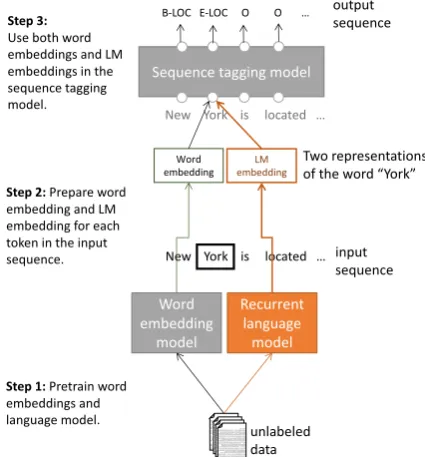
The main components in our language-model-augmented sequence tagger (TagLM) are illus-trated in Fig. 1. After pre-training word embed-dings and a neural LM on large, unlabeled corpora (Step 1), we extract the word and LM embeddings for every token in a given input sequence (Step 2) and use them in the supervised sequence tagging model (Step 3).
2.2 Baseline sequence tagging model
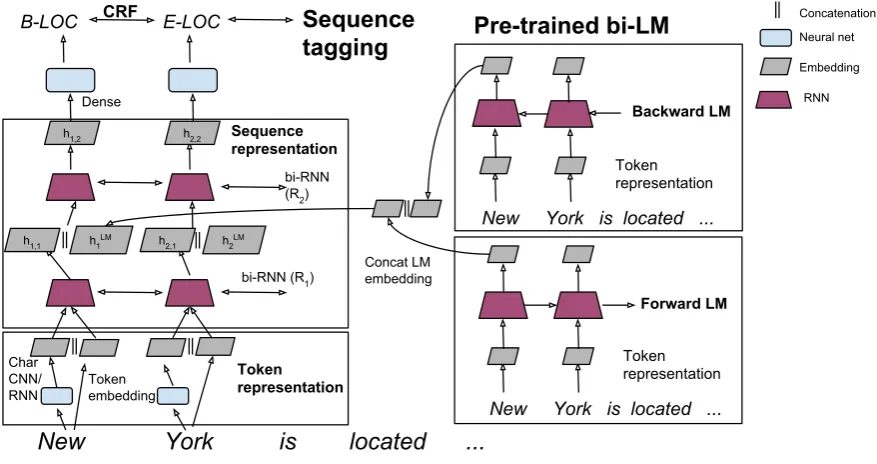
Our baseline sequence tagging model is a hierar-chical neural tagging model, closely following a number of recent studies (Ma and Hovy, 2016; Lample et al., 2016; Yang et al., 2017; Chiu and Nichols, 2016) (left side of Figure 2).
Given a sentence of tokens (t1, t2, . . . , tN) it first forms a representation,xk, for each token by concatenating a character based representationck with a token embeddingwk:
ck=C(tk;θc) wk=E(tk;θw)
xk= [ck;wk] (1)
The character representationckcaptures morpho-logical information and is either a convolutional neural network (CNN) (Ma and Hovy, 2016; Chiu and Nichols, 2016) or RNN (Yang et al., 2017; Lample et al., 2016). It is parameterized by
C(·, θc) with parameters θc. The token embed-dings,wk, are obtained as a lookupE(·, θw), ini-tialized using pre-trained word embeddings, and fine tuned during training (Collobert et al., 2011). To learn a context sensitive representation, we employ multiple layers of bidirectional RNNs. For each token position, k, the hidden state hk,i of RNN layeriis formed by concatenating the hid-den states from the forward (−→hk,i) and backward (←h−k,i) RNNs. As a result, the bidirectional RNN is able to use both past and future information to make a prediction at tokenk. More formally, for the first RNN layer that operates onxk to output hk,1:
− →
hk,1=−→R1(xk,→−hk−1,1;θ−→R1) ←−
hk,1=←R−1(xk,←h−k+1,1;θ←R−1)
hk,1= [−→hk,1;←h−k,1] (2)
Step 2: Prepare word embedding and LM embedding for each token in the input sequence.
The need to capture future context in the LM embed dingssugg ests and naltothe ackward ackward ted in an beddingsof the beddingsof the bedding LM predicts the } LM in additionaltoext in the LM in additioer a bf{h}}^{LM}_k$, for bf{h}}^{LM}_k$, for kwarday to a forward LMe traditional \textit{forward} s way to a forward LM and ext. Given a sentence with $N$ ext. Given a sentence with $N$ beddingsof the top layer LSTM. The analogous wcontext in the LM embeddingssuggests itis bf{h}}^{LM}_k$, for the sequence $(t_k, ard} LM. A backward LM predicts the ted in an analogoueneed to capture future cont predicts the previous token given the future t{forward} LM. A backward ng $\overleftarrow{\math ng $\overleftarrow{\math t{forwtes\[P(t_{k-1} | t_k, t_{k+1}, ..., t_N).\]A b future tes\[P(t_{k-1} | t_k, t_{k+1}, ..., t_N).\]A b o a forward LM and produces an em ests itis beneficial to also consid to also consider a \textit{bac l \textikward} LM in additionaltoth es an embeddies an embeddidingssugg}, ..., t_N)$, the output em productop layer LSTM.entedin an the traditional \textitokens, it computhe sequence $(t_k, t_{k+1}, ..., t_N)$, the output em the sequence $(t_k, t_{k+1}, ..., t_N)$, the output em previous token given the future cont LM. A backward LMembedproducLM can be implemThLM can be implementokens, it compuprevious token given the future cont traditionabeneficial to also consider a \textit{backward} LM need to capture itis beneficial t_{k+1$\overleftarrow{\math\textit{bacanalogous way tt_k, t_{k+1}, ..., t_N).\]A backward LM can be implemen context. Given a sentence with $N$ tokens, it computes\[P(t_{k-1} | top layer LSTM.
The need to capture future context in the LM em beddingssuggests kward} LM in additionalto . A backward LM predicts the context. Given a sentence w given the future itis beneficial to also consider a \textit{bac the traditional \textit{forward} LM previous token ith $N$ t{forw]A backward nsider a future context in the LM t_k, t_{k+1}, ..., t_N).\naltothe traditional \texti mTheneed to capture dingssuggests itis beneficial to also co tokens, it computes\[P(t_{k-1} | LM can be impleembed\textit{backward} LM in additio ard} ture k, {k-1} | ests itis the fuyer LSTM. The plemented in an embedding ken givenkward} LM in additionaltoth can be imbeddingsof the top la and produces anith $N$ tokens, it computes\[P(t_ bf{h}}^{LM}_k$, for the sequence $(t_ output emd LM predicts the previous to )$, theure future context in the LM embeddingssugg s way to a forward LM LM. A backwart_k, t_{k+1}, ..., t_N).\]A backward LM $\overleftarrow{\matht_{k+1}, ..., t_Nanalogoucontext. Given a sentence w need to captbeneficial to also consider a \textit{bac e ith $N$ }_k$, for }_k$, for d LM and ]A backward beddingsof the beddingsof the }}^{LM}}^{LMard LM predicts the mathbf{hmathbf{hus way to a forwar t_k, t_{k+1}, ..., t_N).\context. Given a sentence w \overleftarrow{\\overleftarrow{\in an analogogiven the future es an embedding $es an embedding $ top layer LSTM.entedthe sequence $(t_k, t_{k+1}, ..., t_N)$, the output em traditional \textit{forward} LM. A backw producproducLM can be implemented in an analogous way to a forward LM and tokens, it computes\[P(t_{k-1} | the sequence $(t_k, t_{k+1}, ..., t_N)$, the output em previous token top layer LSTM. The nee d to capture future context in the LM em beddingssuggests xtit{backward} LM consider a \te itis beneficial to also in additio naltonaltothe dingsof thence with $N$ ence with $N$ yer LSTM. The putes\[P(t_{k-1} | al \textit{forward} bf{h}}^{LM}_k$, for e top lansider a embeddingssuggests itis }_k$, for the sequence $(t_k, and produces an embedding naltothe tradition} LM. A backward LM predicts the . A backward LM predicts the ext in the LM backward LM can be implemented in an ed to capture future context in the LM r a \textit{backward} LM in additio in additiong $\overleftarrow{\math t{forwardk, t_{k+1}, ..., t_N)$, the output embed mathbf{h}}^{LMmThene}, ..., t_N).\]Ace $(t_o also consideitional \textiious token given the future context. Given a sent an be implean be implemented in an analogous way to a forward LM and gous way to a forward LM t_{k+1ficial tes an embeddidingssuggests itis beneficial to also co to capture future contious token given the future context. Given a sent A backward LM predicts the previous token given the future erleftarrow{\tokens, it computes\[P(t_{k-1} | t_k, t_{k+1}, ..., t_N).\]A backward producthe sequenanaloprevLM ctokens, it computes\[P(t_{k-1} | t_k, t_{k+1}, ..., t_N).\]A backward t_k, LM cprevtraditional \textit{forward} LM the tradbeneembedneed \textit{backward} LMLM. t_{k+1}, ..., t_N)$, the output embeddingsof th context. Given a sentence with $N$ tokens, it com $\ov e dingsof thbf{h}}^{LM}_k$, for ay to a forward LM and us wng $\overleftarrow{\math k, t_{k+1}, ..., t_N)$, the output embed .entedin an analogoce $(t_es an embedditop layer LSTMproducthe sequen e top layer LSTM.
The need to capture future context in the LM embed dingssugg ests and naltothe ackward ackward ted in an beddingsof the beddingsof the bedding LM predicts the } LM in additionaltoext in the LM in additioer a bf{h}}^{LM}_k$, for bf{h}}^{LM}_k$, for kwarday to a forward LMe traditional \textit{forward} s way to a forward LM and ext. Given a sentence with $N$ ext. Given a sentence with $N$ beddingsof the top layer LSTM. The analogous wcontext in the LM embeddingssuggests itis bf{h}}^{LM}_k$, for the sequence $(t_k, ard} LM. A backward LM predicts the ted in an analogoueneed to capture future cont predicts the previous token given the future t{forward} LM. A backward ng $\overleftarrow{\math ng $\overleftarrow{\math t{forwtes\[P(t_{k-1} | t_k, t_{k+1}, ..., t_N).\]A b future tes\[P(t_{k-1} | t_k, t_{k+1}, ..., t_N).\]A b o a forward LM and produces an em ests itis beneficial to also consid to also consider a \textit{bac l \textikward} LM in additionaltoth es an embeddies an embeddidingssugg}, ..., t_N)$, the output em productop layer LSTM.entedin an the traditional \textitokens, it computhe sequence $(t_k, t_{k+1}, ..., t_N)$, the output em the sequence $(t_k, t_{k+1}, ..., t_N)$, the output em previous token given the future cont LM. A backward LMembedproducLM can be implemThLM can be implementokens, it compuprevious token given the future cont traditionabeneficial to also consider a \textit{backward} LM need to capture itis beneficial t_{k+1$\overleftarrow{\math\textit{bacanalogous way tt_k, t_{k+1}, ..., t_N).\]A backward LM can be implemen context. Given a sentence with $N$ tokens, it computes\[P(t_{k-1} | top layer LSTM.
unlabeled data Recurrent
language model Word
embedding model
Step 1: Pretrain word embeddings and language model.
New York is located …
Sequence tagging model
B-LOC E-LOC O O …
input sequence output sequence
Word
embedding embeddingLM
Two representations of the word “York” Step 3:
Use both word embeddings and LM embeddings in the sequence tagging model.
New York is located …
Figure 1: The main components in TagLM, our language-model-augmented sequence tagging system. The language model component (in or-ange) is used to augment the input token represen-tation in a traditional sequence tagging models (in grey).
The second RNN layer is similar and useshk,1 to
output hk,2. In this paper, we use L = 2
lay-ers of RNNs in all experiments and parameterize
Ri as either Gated Recurrent Units (GRU) (Cho
et al., 2014) or Long Short-Term Memory units (LSTM) (Hochreiter and Schmidhuber, 1997) de-pending on the task.
[image:2.595.309.522.85.314.2]New York is located ...
Neural net
Char CNN/ RNN
Embedding
Token embedding
RNN Dense
E-LOC B-LOC CRF
bi-RNN (R2)
Token representation
New York is located ...
Forward LM Backward LM
h 1
LM
Concat LM embedding Sequence
tagging Pre-trained bi-LM
bi-RNN (R1) Sequence representation
Concatenation
Token representation
New York is located ...
Token representation
h
1,1 h2
LM h
2,1
[image:3.595.75.514.71.303.2]h1,2 h2,2
Figure 2: Overview of TagLM, our language model augmented sequence tagging architecture. The top level embeddings from a pre-trained bidirectional LM are inserted in a stacked bidirectional RNN sequence tagging model. See text for details.
2.3 Bidirectional LM
A language model computes the probability of a token sequence(t1, t2, . . . , tN)
p(t1, t2, . . . , tN) = N
Y
k=1
p(tk|t1, t2, . . . , tk−1).
Recent state of the art neural language models (J´ozefowicz et al., 2016) use a similar architec-ture to our baseline sequence tagger where they pass a token representation (either from a CNN over characters or as token embeddings) through multiple layers of LSTMs to embed the history
(t1, t2, . . . , tk) into a fixed dimensional vector −
→
hLMk . This is the forward LM embeddingof the
token at position k and is the output of the top
LSTM layer in the language model. Finally, the language model predicts the probability of token
tk+1 using a softmax layer over words in the
vo-cabulary.
The need to capture future context in the LM embeddings suggests it is beneficial to also con-sider a backward LM in additional to the
tradi-tional forward LM. A backward LM predicts the
previous token given the future context. Given a sentence withN tokens, it computes
p(t1, t2, . . . , tN) = N
Y
k=1
p(tk|tk+1, tk+2, . . . , tN).
A backward LM can be implemented in an anal-ogous way to a forward LM and produces the
backward LM embedding←h−LM
k , for the sequence
(tk, tk+1, . . . , tN), the output embeddings of the top layer LSTM.
In our final system, after pre-training the for-ward and backfor-ward LMs separately, we remove the top layer softmax and concatenate the for-ward and backfor-ward LM embeddings to form
bidirectional LM embeddings, i.e., hLMk =
[−→hLMk ;←h−LMk ]. Note that in our formulation, the
forward and backward LMs are independent, with-out any shared parameters.
2.4 Combining LM with sequence model Our combined system, TagLM, uses the LM em-beddings as additional inputs to the sequence tag-ging model. In particular, we concatenate the LM embeddingshLM with the output from one of the
bidirectional RNN layers in the sequence model. In our experiments, we found that introducing the LM embeddings at the output of the first layer per-formed the best. More formally, we simply replace (2) with
hk,1 = [−→hk,1;←−hk,1;hLMk ]. (3)
pos-sibility adds a non-linear mapping after the con-catenation and before the second RNN (e.g. re-placing (3) with f([−→hk,1;←−hk,1;hLMk ]) where f is a non-linear function). Another possibility in-troduces an attention-like mechanism that weights the all LM embeddings in a sentence before in-cluding them in the sequence model. Our ini-tial results with the simple concatenation were en-couraging so we did not explore these alternatives in this study, preferring to leave them for future work.
3 Experiments
We evaluate our approach on two well bench-marked sequence tagging tasks, the CoNLL 2003 NER task (Sang and Meulder, 2003) and the CoNLL 2000 Chunking task (Sang and Buch-holz, 2000). We report the official evaluation met-ric (micro-averaged F1). In both cases, we use
the BIOES labeling scheme for the output tags, following previous work which showed it out-performs other options (e.g., Ratinov and Roth, 2009). Following Chiu and Nichols (2016), we use the Senna word embeddings (Collobert et al., 2011) and pre-processed the text by lowercasing all tokens and replacing all digits with 0.
CoNLL 2003 NER. The CoNLL 2003 NER task consists of newswire from the Reuters RCV1 corpus tagged with four different entity types (PER, LOC, ORG, MISC). It includes standard train, development and test sets. Following pre-vious work (Yang et al., 2017; Chiu and Nichols, 2016) we trained on both the train and develop-ment sets after tuning hyperparameters on the de-velopment set.
The hyperparameters for our baseline model are similar to Yang et al. (2017). We use two bidirec-tional GRUs with 80 hidden units and 25 dimen-sional character embeddings for the token charac-ter encoder. The sequence layer uses two bidirec-tional GRUs with 300 hidden units each. For reg-ularization, we add 25% dropout to the input of each GRU, but not to the recurrent connections.
CoNLL 2000 chunking. The CoNLL 2000 chunking task uses sections 15-18 from the Wall Street Journal corpus for training and section 20 for testing. It defines 11 syntactic chunk types (e.g., NP,VP, ADJP) in addition toother. We randomly sampled 1000 sentences from the train-ing set as a held-out development set.
The baseline sequence tagger uses 30 dimen-sional character embeddings and a CNN with 30 filters of width 3 characters followed by a tanh non-linearity for the token character encoder. The sequence layer uses two bidirectional LSTMs with 200 hidden units. Following Ma and Hovy (2016) we added 50% dropout to the character embed-dings, the input to each LSTM layer (but not re-current connections) and to the output of the final LSTM layer.
Pre-trained language models. The primary bidirectional LMs we used in this study were trained on the 1B Word Benchmark (Chelba et al., 2014), a publicly available benchmark for large-scale language modeling. The training split has approximately 800 million tokens, about a 4000X increase over the number training tokens in the CoNLL datasets. J´ozefowicz et al. (2016) ex-plored several model architectures and released their best single model and training recipes. Fol-lowing Sak et al. (2014), they used linear projec-tion layers at the output of each LSTM layer to reduce the computation time but still maintain a large LSTM state. Their single best model took three weeks to train on 32 GPUs and achieved 30.0 test perplexity. It uses a character CNN with 4096 filters for input, followed by two stacked LSTMs, each with 8192 hidden units and a 1024
dimen-sional projection layer. We useCNN-BIG-LSTM
to refer to this language model in our results.
In addition to CNN-BIG-LSTM from
J´ozefowicz et al. (2016),1 we used the same
cor-pus to train two additional language models with
fewer parameters: forward LSTM-2048-512
and backwardLSTM-2048-512. Both language
models use token embeddings as input to a single layer LSTM with 2048 units and a 512 dimension projection layer. We closely followed the proce-dure outlined in J´ozefowicz et al. (2016), except we used synchronous parameter updates across four GPUs instead of asynchronous updates across 32 GPUs and ended training after 10 epochs. The test set perplexities for our forward and backward
LSTM-2048-512language models are 47.7 and 47.3, respectively.2
1https://github.com/tensorflow/models/ tree/master/lm_1b
2Due to different implementations, the perplexity of the
Model F1±std
Chiu and Nichols (2016) 90.91±0.20
Lample et al. (2016) 90.94
Ma and Hovy (2016) 91.37
Our baseline without LM 90.87±0.13
[image:5.595.80.282.61.149.2]TagLM 91.93±0.19
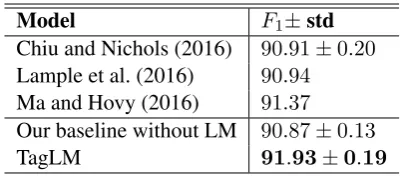
Table 1: Test setF1 comparison on CoNLL 2003
NER task, using only CoNLL 2003 data and unla-beled text.
Model F1±std
Yang et al. (2017) 94.66
Hashimoto et al. (2016) 95.02
Søgaard and Goldberg (2016) 95.28
Our baseline without LM 95.00±0.08
TagLM 96.37±0.05
Table 2: Test setF1 comparison on CoNLL 2000
Chunking task using only CoNLL 2000 data and unlabeled text.
Training. All experiments use the Adam opti-mizer (Kingma and Ba, 2015) with gradient norms clipped at 5.0. In all experiments, we fine tune the pre-trained Senna word embeddings but fix all weights in the pre-trained language models. In ad-dition to explicit dropout regularization, we also use early stopping to prevent over-fitting and use the following process to determine when to stop training. We first train with a constant learning rateα = 0.001on the training data and monitor
the development set performance at each epoch. Then, at the epoch with the highest development performance, we start a simple learning rate an-nealing schedule: decreaseα an order of
magni-tude (i.e., divide by ten), train for five epochs, de-creaseαan order of magnitude again, train for five
more epochs and stop.
Following Chiu and Nichols (2016), we train each final model configuration ten times with dif-ferent random seeds and report the mean and stan-dard deviationF1. It is important to estimate the
variance of model performance since the test data sets are relatively small.
3.1 Overall system results
Tables 1 and 2 compare results from TagLM with previously published state of the art results without additional labeled data or task specific gazetteers. Tables 3 and 4 compare results of
TagLM to other systems that include additional la-beled data or gazetteers. In both tasks, TagLM es-tablishes a new state of the art using bidirectional
LMs (the forwardCNN-BIG-LSTMand the
back-wardLSTM-2048-512).
In the CoNLL 2003 NER task, our model scores 91.93 mean F1, which is a statistically
signifi-cant increase over the previous best result of 91.62
±0.33 from Chiu and Nichols (2016) that used
gazetteers (at 95%, two-sided Welch t-test, p = 0.021).
In the CoNLL 2000 Chunking task, TagLM achieves 96.37 meanF1, exceeding all previously
published results without additional labeled data
by more then 1% absoluteF1. The improvement
over the previous best result of 95.77 in Hashimoto et al. (2016) that jointly trains with Penn Treebank (PTB) POS tags is statistically significant at 95% (p <0.001assuming standard deviation of0.1).
Importantly, the LM embeddings amounts to an average absolute improvement of 1.06 and 1.37F1
in the NER and Chunking tasks, respectively.
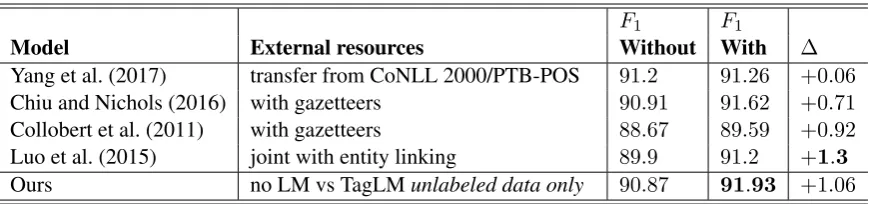
Adding external resources. Although we do not use external labeled data or gazetteers, we found that TagLM outperforms previous state of the art results in both tasks when external re-sources (labeled data or task specific gazetteers) are available. Furthermore, Tables 3 and 4 show that, in most cases, the improvements we obtain by adding LM embeddings are larger then the im-provements previously obtained by adding other forms of transfer or joint learning. For example, Yang et al. (2017) noted an improvement of only 0.06 F1 in the NER task when transfer learning
from both CoNLL 2000 chunks and PTB POS tags and Chiu and Nichols (2016) reported an increase of 0.71F1 when adding gazetteers to their
base-line. In the Chunking task, previous work has re-ported from 0.28 to 0.75 improvement inF1when
including supervised labels from the PTB POS tags or CoNLL 2003 entities (Yang et al., 2017; Søgaard and Goldberg, 2016; Hashimoto et al., 2016).
3.2 Analysis
To elucidate the characteristics of our LM aug-mented sequence tagger, we ran a number of addi-tional experiments on the CoNLL 2003 NER task.
dif-F1 F1
Model External resources Without With ∆
Yang et al. (2017) transfer from CoNLL 2000/PTB-POS 91.2 91.26 +0.06
Chiu and Nichols (2016) with gazetteers 90.91 91.62 +0.71
Collobert et al. (2011) with gazetteers 88.67 89.59 +0.92
Luo et al. (2015) joint with entity linking 89.9 91.2 +1.3
[image:6.595.82.518.61.163.2]Ours no LM vs TagLMunlabeled data only 90.87 91.93 +1.06
Table 3: Improvements in test setF1 in CoNLL 2003 NER when including additional labeled data or
task specific gazetteers (except the case of TagLM where we do not use additional labeled resources).
F1 F1
Model External resources Without With ∆
Yang et al. (2017) transfer from CoNLL 2003/PTB-POS 94.66 95.41 +0.75
Hashimoto et al. (2016) jointly trained with PTB-POS 95.02 95.77 +0.75
Søgaard and Goldberg (2016) jointly trained with PTB-POS 95.28 95.56 +0.28
Ours no LM vs TagLMunlabeled data only 95.00 96.37 +1.37
Table 4: Improvements in test setF1 in CoNLL 2000 Chunking when including additional labeled data
(except the case of TagLM where we do not use additional labeled data).
Use LM embeddings at F1±std
input to the first RNN layer 91.55±0.21
output of the first RNN layer 91.93±0.19
output of the second RNN layer 91.72±0.13
Table 5: Comparison of CoNLL-2003 test setF1
when the LM embeddings are included at different layers in the baseline tagger.
ferent locations in the baseline sequence tagger. In particular, we used the LM embeddingshLMk to:
• augment theinputof thefirstRNN layer; i.e., xk= [ck;wk;hLMk ],
• augment the output of the first RNN layer;
i.e.,hk,1= [−→hk,1;←h−k,1;hLMk ],3and
• augment theoutputof thesecondRNN layer; i.e.,hk,2= [−→hk,2;←h−k,2;hLMk ].
Table 5 shows that the second alternative per-forms best. We speculate that the second RNN layer in the sequence tagging model is able to cap-ture interactions between task specific context as expressed in the first RNN layer and general con-text as expressed in the LM embeddings in a way that improves overall system performance. These
3This configuration the same as Eq. 3 in§2.4. It was
re-produced here for convenience.
results are consistent with Søgaard and Goldberg (2016) who found that chunking performance was sensitive to the level at which additional POS su-pervision was added.
Does it matter which language model to use? In this experiment, we compare six different con-figurations of the forward and backward language models (including the baseline model which does not use any language models). The results are re-ported in Table 6.
We find that adding backward LM embeddings consistently outperforms forward-only LM
em-beddings, with F1 improvements between 0.22
and 0.27%, even with the relatively small back-wardLSTM-2048-512LM.
LM size is important, and replacing the forward
LSTM-2048-512 with CNN-BIG-LSTM (test perplexities of 47.7 to 30.0 on 1B Word
Bench-mark) improves F1 by 0.26 - 0.31%, about as
much as adding backward LM. Accordingly, we hypothesize (but have not tested) that replacing
the backwardLSTM-2048-512with a backward
LM analogous to theCNN-BIG-LSTMwould
fur-ther improve performance.
Forward language model Backward language model LM perplexity F1±std
Fwd Bwd
— — N/A N/A 90.87±0.13
LSTM-512-256∗ LSTM-512-256∗ 106.9 104.2 90.79±0.15
LSTM-2048-512 — 47.7 N/A 91.40±0.18
LSTM-2048-512 LSTM-2048-512 47.7 47.3 91.62±0.23
CNN-BIG-LSTM — 30.0 N/A 91.66±0.13
CNN-BIG-LSTM LSTM-2048-512 30.0 47.3 91.93±0.19
Table 6: Comparison of CoNLL-2003 test setF1 for different language model combinations. All
lan-guage models were trained and evaluated on the 1B Word Benchmark, exceptLSTM-512-256∗which
was trained and evaluated on the standard splits of the NER CoNLL 2003 dataset.
set, we decreased the model size to 512 hidden units with a 256 dimension projection and normal-ized tokens in the same manner as input to the se-quence tagging model (lower-cased, with all dig-its replaced with 0). The test set perplexities for the forward and backward models (measured on the CoNLL 2003 test data) were 106.9 and 104.2, respectively. Including embeddings from these
language models decreased performance slightly
compared to the baseline system without any LM. This result supports the hypothesis that adding lan-guage models help because they learn composi-tion funccomposi-tions (i.e., the RNN parameters in the lan-guage model) from much larger data compared to the composition functions in the baseline tagger, which are only learned from labeled data.
Importance of task specific RNN. To under-stand the importance of including a task specific sequence RNN we ran an experiment that removed the task specific sequence RNN and used only the LM embeddings with a dense layer and CRF to predict output tags. In this setup, performance was very low, 88.17F1, well below our baseline. This
result confirms that the RNNs in the baseline tag-ger encode essential information which is not en-coded in the LM embeddings. This is unsurprising since the RNNs in the baseline tagger are trained on labeled examples, unlike the RNN in the lan-guage model which is only trained on unlabeled examples. Note that the LM weights are fixed in this experiment.
Dataset size. A priori, we expect the addition of LM embeddings to be most beneficial in cases where the task specific annotated datasets are small. To test this hypothesis, we replicated the setup from Yang et al. (2017) that samples 1% of the CoNLL 2003 training set and compared
the performance of TagLM to our baseline with-out LM. In this scenario, testF1 increased 3.35%
(from 67.66 to 71.01%) compared to an increase of 1.06%F1for a similar comparison with the full
training dataset. The analogous increases in Yang et al. (2017) are 3.97% for cross-lingual trans-fer from CoNLL 2002 Spanish NER and 6.28%
F1 for transfer from PTB POS tags. However,
they found only a 0.06%F1 increase when using
the full training data and transferring from both CoNLL 2000 chunks and PTB POS tags. Taken together, this suggests that for very small labeled training sets, transferring from other tasks yields a large improvement, but this improvement almost disappears when the training data is large. On the other hand, our approach is less dependent on the training set size and significantly improves perfor-mance even with larger training sets.
Number of parameters. Our TagLM formula-tion increases the number of parameters in the sec-ond RNN layerR2due to the increase in the input
dimensionh1if all other hyperparameters are held
constant. To confirm that this did not have a ma-terial impact on the results, we ran two additional experiments. In the first, we trained a system with-out a LM but increased the second RNN layer hid-den dimension so that number of parameters was the same as in TagLM. In this case, performance
decreasedslightly (by 0.15%F1) compared to the
baseline model, indicating that solely increasing parameters does not improve performance. In the second experiment, we decreased the hidden di-mension of the second RNN layer in TagLM to give it the same number of parameters as the base-line no LM model. In this case, testF1increased
slightly to 92.00±0.11 indicating that the
performance.4
Does the LM transfer across domains? One artifact of our evaluation framework is that both the labeled data in the chunking and NER tasks and the unlabeled text in the 1 Billion Word Benchmark used to train the bidirectional LMs are derived from news articles. To test the sensitiv-ity to the LM training domain, we also applied TagLM with a LM trained on news articles to the SemEval 2017 Shared Task 10, ScienceIE.5
Scien-ceIE requires end-to-end joint entity and relation-ship extraction from scientific publications across three diverse fields (computer science, material sciences, and physics) and defines three broad en-tity types (Task, Material and Process). For this task, TagLM increasedF1on the development set
by 4.12% (from 49.93 to to 54.05%) for entity ex-traction over our baseline without LM embeddings and it was a major component in our winning sub-mission to ScienceIE, Scenario 1 (Ammar et al., 2017). We conclude that LM embeddings can im-prove the performance of a sequence tagger even when the data comes from a different domain.
4 Related work
Unlabeled data. TagLM was inspired by the widespread use of pre-trained word embeddings in supervised sequence tagging models. Besides pre-trained word embeddings, our method is most closely related to Li and McCallum (2005). In-stead of using a LM, Li and McCallum (2005) uses a probabilistic generative model to infer context-sensitive latent variables for each token, which are then used as extra features in a supervised CRF tagger (Lafferty et al., 2001). Other semi-supervised learning methods for structured pre-diction problems include co-training (Blum and Mitchell, 1998; Pierce and Cardie, 2001), expec-tation maximization (Nigam et al., 2000; Mohit and Hwa, 2005), structural learning (Ando and Zhang, 2005) and maximum discriminant func-tions (Suzuki et al., 2007; Suzuki and Isozaki, 2008). It is easy to combine TagLM with any of the above methods by including LM embed-dings as additional features in the discriminative components of the model (except for expectation maximization). A detailed discussion of semi-supervised learning methods in NLP can be found
4A similar experiment for the Chunking task did not
im-proveF1so this conclusion is task dependent.
5https://scienceie.github.io/
in (Søgaard, 2013).
Melamud et al. (2016) learned a context en-coder from unlabeled data with an objective func-tion similar to a bi-direcfunc-tional LM and applied it to several NLP tasks closely related to the unlabeled objective function: sentence completion, lexical substitution and word sense disambiguation.
LM embeddings are related to a class of meth-ods (e.g., Le and Mikolov, 2014; Kiros et al., 2015; Hill et al., 2016) for learning sentence and document encoders from unlabeled data, which can be used for text classification and textual en-tailment among other tasks. Dai and Le (2015) pre-trained LSTMs using language models and se-quence autoencoders then fine tuned the weights for classification tasks. In contrast to our method that uses unlabeled data to learn token-in-context embeddings, all of these methods use unlabeled data to learn an encoder for an entire text sequence (sentence or document).
Neural language models. LMs have always been a critical component in statistical machine translation systems (Koehn, 2009). Recently, neu-ral LMs (Bengio et al., 2003; Mikolov et al., 2010) have also been integrated in neural machine trans-lation systems (e.g., Kalchbrenner and Blunsom, 2013; Devlin et al., 2014) to score candidate trans-lations. In contrast, TagLM uses neural LMs to encode words in the input sequence.
Unlike forward LMs, bidirectional LMs have received little prior attention. Most similar to our formulation, Peris and Casacuberta (2015) used a bidirectional neural LM in a statistical ma-chine translation system for instance selection. They tied the input token embeddings and soft-max weights in the forward and backward direc-tions, unlike our approach which uses two distinct models without any shared parameters. Frinken et al. (2012) also used a bidirectional n-gram LM for handwriting recognition.
of interpreting what they learn.
Other sequence tagging models. Current state of the art results in sequence tagging problems are based on bidirectional RNN models. However, many other sequence tagging models have been proposed in the literature for this class of problems (e.g., Lafferty et al., 2001; Collins, 2002). LM em-beddings could also be used as additional features in other models, although it is not clear whether the model complexity would be sufficient to effec-tively make use of them.
5 Conclusion
In this paper, we proposed a simple and general semi-supervised method using pre-trained neural language models to augment token representations in sequence tagging models. Our method signifi-cantly outperforms current state of the art models in two popular datasets for NER and Chunking. Our analysis shows that adding a backward LM in addition to traditional forward LMs consistently improves performance. The proposed method is robust even when the LM is trained on unlabeled data from a different domain, or when the base-line model is trained on a large number of labeled examples.
Acknowledgments
We thank Chris Dyer, Julia Hockenmaier, Jayant Krishnamurthy, Matt Gardner and Oren Etzioni for comments on earlier drafts that led to substan-tial improvements in the final version.
References
Waleed Ammar, Matthew E. Peters, Chandra Bhaga-vatula, and Russell Power. 2017. The AI2 sys-tem at SemEval-2017 Task 10 (ScienceIE): semi-supervised end-to-end entity and relation extraction. InACL workshop (SemEval).
Rie Kubota Ando and Tong Zhang. 2005. A high-performance semi-supervised learning method for text chunking. InACL.
Yoshua Bengio, R´ejean Ducharme, Pascal Vincent, and Christian Jauvin. 2003. A neural probabilistic lan-guage model. InJMLR.
Avrim Blum and Tom Mitchell. 1998. Combining la-beled and unlala-beled data with co-training. InCOLT. Ciprian Chelba, Tomas Mikolov, Mike Schuster, Qi Ge, Thorsten Brants, and Phillipp Koehn. 2014. One bil-lion word benchmark for measuring progress in sta-tistical language modeling. CoRRabs/1312.3005.
Jason Chiu and Eric Nichols. 2016. Named entity recognition with bidirectional LSTM-CNNs. In TACL.
Kyunghyun Cho, Bart van Merrienboer, Dzmitry Bah-danau, and Yoshua Bengio. 2014. On the properties of neural machine translation: Encoder-decoder ap-proaches. InSSST@EMNLP.
Michael Collins. 2002. Discriminative training meth-ods for hidden markov models: Theory and experi-ments with perceptron algorithms. InEMNLP.
Ronan Collobert, Jason Weston, L´eon Bottou, Michael Karlen, Koray Kavukcuoglu, and Pavel P. Kuksa. 2011. Natural language processing (almost) from scratch. InJMLR.
Andrew M. Dai and Quoc V. Le. 2015. Semi-supervised sequence learning. InNIPS.
Jacob Devlin, Rabih Zbib, Zhongqiang Huang, Thomas Lamar, Richard M Schwartz, and John Makhoul. 2014. Fast and robust neural network joint models for statistical machine translation. InACL.
Volkmar Frinken, Alicia Forn´es, Josep Llad´os, and Jean-Marc Ogier. 2012. Bidirectional language model for handwriting recognition. In Joint IAPR International Workshops on Statistical Techniques in Pattern Recognition (SPR) and Structural and Syn-tactic Pattern Recognition (SSPR).
Kazuma Hashimoto, Caiming Xiong, Yoshimasa Tsu-ruoka, and Richard Socher. 2016. A joint many-task model: Growing a neural network for multiple nlp tasks.CoRRabs/1611.01587.
Felix Hill, Kyunghyun Cho, and Anna Korhonen. 2016. Learning distributed representations of sentences from unlabelled data. InHLT-NAACL.
Sepp Hochreiter and J¨urgen Schmidhuber. 1997. Long short-term memory.Neural Computation9.
Rafal J´ozefowicz, Oriol Vinyals, Mike Schuster, Noam Shazeer, and Yonghui Wu. 2016. Exploring the lim-its of language modeling. CoRRabs/1602.02410.
Nal Kalchbrenner and Phil Blunsom. 2013. Recurrent continuous translation models. InEMNLP.
Andrej Karpathy, Justin Johnson, and Li Fei-Fei. 2015. Visualizing and understanding recurrent networks. InICLR workshop.
Diederik P. Kingma and Jimmy Ba. 2015. Adam: A method for stochastic optimization. InICLR.
Jamie Ryan Kiros, Yukun Zhu, Ruslan Salakhutdinov, Richard S. Zemel, Raquel Urtasun, Antonio Tor-ralba, and Sanja Fidler. 2015. Skip-thought vectors. InNIPS.
John D. Lafferty, Andrew McCallum, and Fernando Pereira. 2001. Conditional random fields: Prob-abilistic models for segmenting and labeling se-quence data. InICML.
Guillaume Lample, Miguel Ballesteros, Sandeep Sub-ramanian, Kazuya Kawakami, and Chris Dyer. 2016. Neural architectures for named entity recognition. InNAACL-HLT.
Quoc V. Le and Tomas Mikolov. 2014. Distributed rep-resentations of sentences and documents. InICML. Wei Li and Andrew McCallum. 2005. Semi-supervised
sequence modeling with syntactic topic models. In AAAI.
Tal Linzen, Emmanuel Dupoux, and Yoav Goldberg. 2016. Assessing the ability of LSTMs to learn syntax-sensitive dependencies. InTACL.
Gang Luo, Xiaojiang Huang, Chin-Yew Lin, and Za-iqing Nie. 2015. Joint entity recognition and disam-biguation. InEMNLP.
Xuezhe Ma and Eduard H. Hovy. 2016. End-to-end sequence labeling via bi-directional LSTM-CNNs-CRF. InACL.
Oren Melamud, Jacob Goldberger, and Ido Dagan. 2016. context2vec: Learning generic context em-bedding with bidirectional lstm. InCoNLL. Tomas Mikolov, Martin Karafi´at, Lukas Burget, Jan
Cernock`y, and Sanjeev Khudanpur. 2010. Recur-rent neural network based language model. In Inter-speech.
Tomas Mikolov, Ilya Sutskever, Kai Chen, Greg S Cor-rado, and Jeff Dean. 2013. Distributed representa-tions of words and phrases and their compositional-ity. InNIPS.
Behrang Mohit and Rebecca Hwa. 2005. Syntax-based semi-supervised named entity tagging. InACL. Kamal Nigam, Andrew Kachites McCallum, Sebastian
Thrun, and Tom Mitchell. 2000. Text classification from labeled and unlabeled documents using em. Machine learning.
Jeffrey Pennington, Richard Socher, and Christo-pher D. Manning. 2014. Glove: Global vectors for word representation. InEMNLP.
´Alvaro Peris and Francisco Casacuberta. 2015. A bidi-rectional recurrent neural language model for ma-chine translation. Procesamiento del Lenguaje Nat-ural.
David Pierce and Claire Cardie. 2001. Limitations of co-training for natural language learning from large datasets. InEMNLP.
Lev-Arie Ratinov and Dan Roth. 2009. Design chal-lenges and misconceptions in named entity recogni-tion. InCoNLL.
Hasim Sak, Andrew W. Senior, and Franoise Beaufays. 2014. Long short-term memory recurrent neural network architectures for large scale acoustic mod-eling. InINTERSPEECH.
Erik F. Tjong Kim Sang and Sabine Buchholz. 2000. Introduction to the CoNLL-2000 shared task chunk-ing. InCoNLL/LLL.
Erik F. Tjong Kim Sang and Fien De Meulder. 2003. Introduction to the CoNLL-2003 shared task: Language-independent named entity recognition. In CoNLL.
Anders Søgaard. 2013. Semi-supervised learning and domain adaptation in natural language processing. Synthesis Lectures on Human Language Technolo-gies.
Anders Søgaard and Yoav Goldberg. 2016. Deep multi-task learning with low level tasks supervised at lower layers. InACL.
Jun Suzuki, Akinori Fujino, and Hideki Isozaki. 2007. Semi-supervised structured output learning based on a hybrid generative and discriminative approach. In EMNLP-CoNLL.
Jun Suzuki and Hideki Isozaki. 2008. Semi-supervised sequential labeling and segmentation using giga-word scale unlabeled data. InACL.