Structured Learning for
Temporal Relation Extraction from Clinical Records
Artuur Leeuwenberg and Marie-Francine Moens
Department of Computer Science KU Leuven, Belgium
{tuur.leeuwenberg, sien.moens}@cs.kuleuven.be
Abstract
We propose a scalable structured learning model that jointly predicts temporal rela-tions between events and temporal expres-sions (TLINKS), and the relation between these events and the document creation time (DCTR). We employ a structured per-ceptron, together with integer linear pro-gramming constraints for document-level inference during training and prediction to exploit relational properties of temporal-ity, together with global learning of the re-lations at the document level. Moreover, this study gives insights in the results of in-tegrating constraints for temporal relation extraction when using structured learning and prediction. Our best system outper-forms the state-of-the art on both theCON -TAINSTLINK task, and the DCTR task. 1 Introduction
Temporal information is critical in many clinical areas (Combi and Shahar, 1997). A big part of this temporal information is captured in the free text of patient records. The current work aims to im-prove temporal information extraction from such clinical texts. Extraction of temporal information from clinical text records can be used to construct a time-line of the patient’s condition (such as in Figure 1). The extracted time-line can help clini-cal researchers to better select and recruit patients with a certain history for clinical trials. Moreover, the time-line is crucial for making a good patient prognosis and clinical decision support (Onisko et al., 2015; Stacey and McGregor, 2007).
Temporal information extraction can be divided into three sub-problems: (1) the detection of events (Ee); (2) the detection of temporal expres-sions (Et); and (3) the detection of temporal
rela-tions between them. In the clinical domain, events include medical procedures, treatments, or symp-toms (e.g. colonoscopy,smoking,CT-scan). Tem-poral expressions include dates, days of the week, months, or relative expressions likeyesterday,last week, orpost-operative. In this work, we focus on the last sub-problem, extraction of temporal rela-tions (assuming events and temporal expressions are given). As a small example of the task we aim to solve, given the following sentence:
In 1990 the patient was diagnosed and received surgery directly afterwards.
in which we assume that the events diagnosed andadenocarcinoma, and the temporal expression 1990are given, we wish to extract the following relations:
• CONTAINS(1990, diagnosed)
• CONTAINS(1990, surgery)
• BEFORE(diagnosed, surgery)
• BEFORE(diagnosed,d)
• BEFORE(surgery,d)
wheredstands for the document creation time. Our work leads to the following contributions: First, we propose a scalable structured learning model that jointly predicts temporal relations be-tween events and temporal expressions (TLINKS), and the relation between these events and the doc-ument creation time (DCTR). In contrast to ex-isting approaches which detect relation instances separately, our approach employs a structured per-ceptron (Collins, 2002) for global learning with joint inference of the temporal relations on a document level. Second, we ensure scalability through using integer linear programming (ILP)
Figure 1: Fragment of a (partial) patient time-line.
constraints with fast solvers, loss augmented sub-sampling, and good initialization. Third, this study leads to valuable insights on when and how to make inferences over the found candidate rela-tions both during training and prediction and gives an in-depth assessment of the use of additional constraints and global features during inference. Finally, our best system outperforms the state-of-the-art of both theCONTAINSTLINK task, and the DCTR task.
2 Related Work
There have been two shared tasks on the topic of temporal relation extraction in the clinical domain: the I2B2 Temporal Challenge (Sun et al., 2013), and more recently the Clinical TempEval Shared Task with two iterations, one in 2015 and one in 2016 (Bethard et al., 2014; Bethard et al., 2015; Bethard et al., 2016). In the I2B2 Temporal Chal-lenge eight types of relations were initially anno-tated. However, due to low inter-annotator agree-ment these were merged to three types of temporal relations, OVERLAP, BEFORE, and AFTER. Good annotation of temporal relations is difficult, as an-notators frequently miss relation mentions. In the Clinical TempEval Shared tasks the THYME cor-pus is used (Styler IV et al., 2014), with a dif-ferent annotation scheme that aims at annotating those relations that are most informative w.r.t. the time-line, and gives less priority to relations that can be inferred from the others. This results in two categories of temporal relations: The rela-tion between each event and the document crearela-tion time (DCTR), dividing all events in four temporal buckets (BEFORE, BEFORE/OVERLAP,OVERLAP, AFTER). These buckets are called narrative con-tainers (Pustejovsky and Stubbs, 2011). And sec-ond, relations between temporal entities that both occur in the text (TLINKS). TLINKS may occur between events (Ee ×Ee), and between events
and temporal expressions (Ee×EtandEt×Ee). The TLINK types (and their relative frequency in the THYME corpus) are CONTAINS(64,42%), OVERLAP(15,19%),BEFORE(12,65%),BEGINS -ON (6.15%), and ENDS-ON (1.59%). The rela-tionsAFTER, andDURINGare expressed in terms of their inverse,BEFORE, and CONTAINS respec-tively. In our experiments, we use the THYME corpus for its relatively high inter-annotator agree-ment (particularly forCONTAINS).
To our knowledge, in all submissions (4 in 2015, and 10 in 2016) of Clinical TempEval the task is approached as a classical entity-relation ex-traction problem, and the predictions for both cat-egories of relations are made independently from each other, or in a one way dependency, where the containment classifier uses information about the predicted document-time relation. Narrative con-tainment, temporal order, and document-time rela-tion have very strong dependencies. Not modeling these may result in inconsistent output labels, that do not result in a consistent time-line.
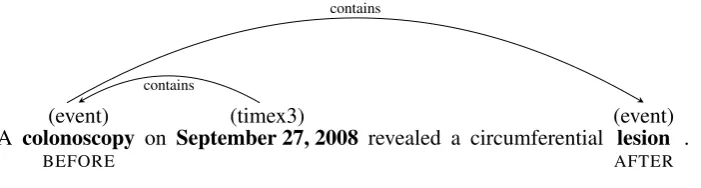
An example of inconsistent labeling is given in Figure 2. The example is inconsistent when as-signing theAFTER label for the relation between
lesion and the document-time. It is inconsis-tent because we can also infer that lesion occurs BEFORE the document-time, as the colonoscopy event occurs before the document-time, and the le-sionis contained by thecolonoscopy.
Juraf-(event) (timex3) (event) A colonoscopy on September 27, 2008 revealed a circumferential lesion .
BEFORE AFTER
contains
[image:3.595.127.478.68.162.2]contains
Figure 2: Example of inconsistent output labeling. Containment is indicated by directed edges, and the relation to the document-time by small caps below the events.
sky, 2008) and (Do et al., 2012) modeled label de-pendencies when predicting TimeBank TLINKS (Pustejovsky et al., 2003). They trained local classifiers and used a set of global temporal label constraints. Integer linear programming was em-ployed to maximize the score from the local clas-sifiers, while satisfying the global label constraints at prediction time. For both, this gave a significant increase in performance, and resulted in consistent output labels.
(Yoshikawa et al., 2009) modeled the label dependencies between TLINKS and DCTR with Markov Logic Networks (MLN), allowing for soft label constraints during training and prediction. However, MLN can sometimes be sub-optimal for text mining tasks w.r.t. time efficiency (Mojica and Ng, 2016). Quite recently, for a similar prob-lem, spatial relation extraction, (Kordjamshidi et al., 2015) used an efficient combination of a struc-tured perceptron or strucstruc-tured support vector ma-chine with integer linear programming. In their experiments, they compare a local learning model (LO), a local learning model with global inference at prediction time (L+I), and a structured learn-ing model with and without inference durlearn-ing train-ing (IBT+I, and IBT-I respectively). In their ex-periments L+I gave better results than LO, but a more significant improvement was made when us-ing structured learnus-ing in contrast to local learn-ing.
In this work, we aim to jointly predict TLINKS and DCTR in a structured learning model with in-ference during training and prediction, to assess inference with temporal constraints of (Cham-bers and Jurafsky, 2008; Do et al., 2012) for the THYME relations, and to experiment with both local, and document-level inference for temporal information extraction in the clinical domain.
3 The Model
For jointly learning both tasks on a document level, we employ a structured perceptron learning paradigm (Collins, 2002). The structured percep-tron model uses a joint feature functionΦ(X, Y)
to represent a full input documentXwith a label assignmentY. During training the model learns a weight vector λ to score how good the label as-signment is. Predicting label asas-signment Y for a documentX corresponds to finding theY with the maximal score. In the following sub-sections we define the joint feature function Φ, describe the prediction procedure of the model, and provide how we train the model (i.e. learn a goodλ).
3.1 Joint Features
To compose the joint feature function, we first de-fine two local feature functions: φtl : (x, y) →
Rp assigns features for the local classifications regarding TLINKS (with possible labels Ltl =
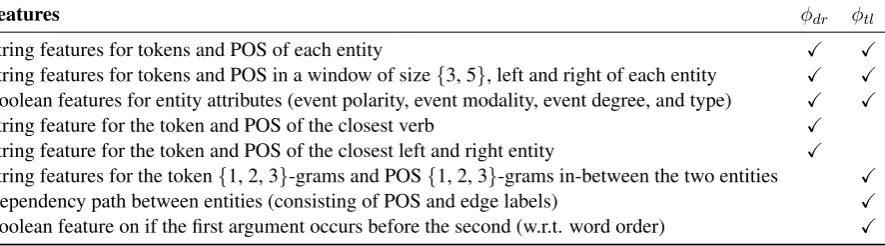
{CONTAINS, BEFORE, OVERLAP, BEGINS-ON, ENDS-ON, NO LABEL}), and a second local fea-ture function φdr : (x, y) → Rq, for local features regarding document-time relation clas-sification (with labels Ldr = {BEFORE, BE -FORE OVERLAP, OVERLAP, AFTER}. The fea-tures used by these local feature functions are given in Table 1.
Features φdr φtl String features for tokens and POS of each entity X X
String features for tokens and POS in a window of size{3, 5}, left and right of each entity X X
Boolean features for entity attributes (event polarity, event modality, event degree, and type) X X
String feature for the token and POS of the closest verb X
String feature for the token and POS of the closest left and right entity X
String features for the token{1, 2, 3}-grams and POS{1, 2, 3}-grams in-between the two entities X
Dependency path between entities (consisting of POS and edge labels) X
Boolean feature on if the first argument occurs before the second (w.r.t. word order) X
Table 1: Features of the local feature functions of each sub-task,φtlfor TLINKS, andφdr for DCTR.
Φjoint(X, Y) =
X
x∈Cdr(X) X
l∈Ldr
φdr(x, l)
⊕ X
x∈Ctl(X) X
l∈Ltl
φtl(x, l) (1)
3.2 Local Candidate Generation
For each document X, we create local candi-dates for both sub-tasks. In this work, we as-sume that event (Ee) and temporal expression (Et) annotations are provided in the input. The DCTR-candidates in documentX are then given by Cdr(X), which returns all events in the docu-ment, i.e. Ee(X). Ctl(X)returns all TLINK can-didates, i.e. Ee(X) ∪Et(X)×Ee(X). In our experiments we usually restrict the number of can-didates generated byCtl to gain training and pre-diction speed (without significant loss in perfor-mance). This is explained further in Section 4.3.
3.3 Global Features
We also experiment with a set of global features, by which we mean features that are expressed in terms of multiple local labels. The global features are specified in Table 2. Global features are de-fined by a feature function Φglobal(X, Y) → Rr and have their corresponding weights in weight vector λ. When using global features Φglobal is concatenated with the joint feature functionΦjoint to form the final feature functionΦ, as show in in Equation 2.
Φ(X, Y) = Φjoint(X, Y)⊕Φglobal(X, Y) (2) When not using global features, we use only the joint features, as shown in Equation 3.
Φ(X, Y) = Φjoint(X, Y) (3)
Feature Description
Φsdr Bigram and trigram counts of subsequent
DCTR-labels in the document
Φdrtl Counts of DCTR-label pairs of the
[image:4.595.82.525.65.188.2]entities of each TLINK
Table 2: Global (document-level) features.
3.4 Prediction
The model assigns a score to each input document X together with output labeling Y. The score for(X, Y) is defined as the dot product between the learned weight vector λ and the outcome of the joint feature function Φ(X, Y), as shown in Equation 4.
S(X, Y) =λΦ(X, Y) (4)
The prediction problem for an input documentX is finding the label assignmentY that maximizes the scoreS based on the weight vectorλ, shown in Equation 5.
ˆ
Yk= arg max
Y S(X, Y) (5)
We use integer linear programming (ILP) to solve the prediction problem in Equation 5. Each pos-sible local decision is modeled with a binary de-cision variable. For each local relation candidate inputxi,j (for the relation betweeniandj) a bi-nary decision variablewl
ex-actly one label, for each sub-task.
O= arg max
W
X
xi,d∈Cdr(X) X
l∈Ldr
wli,d·S(xi,d, yli,d)
+ X
xi,j∈Ctl(X) X
l∈Ltl
wl
i,j·S(xi,j, yli,j) (6)
∀i :
X
l∈Ldr
wi,dl = 1 (7)
∀i,j :
X
l∈Ltl
wi,jl = 1 (8)
For solving the integer linear program we use Gurobi (Gurobi Optimization, 2015).
3.4.1 Temporal Label Constraints
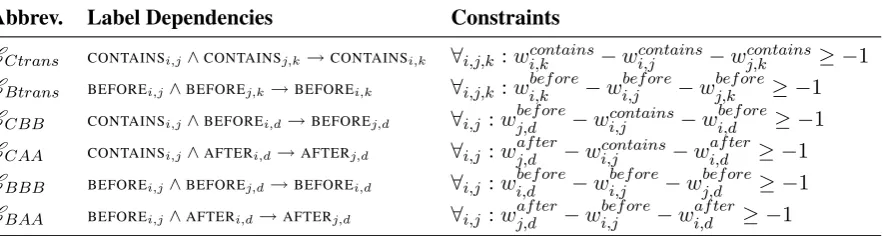
Because temporal relations are interdependent, we experimented with using additional constraints on the output labeling. The additional temporal con-straints we experiment with are shown in Table 3. Constraints are expressed in terms of the binary decision variables used in the integer linear pro-gram.
In Table 3, constraints CCtrans, and CBtrans model transitivity ofCONTAINS, and BEFORE re-spectively. Constraints CCBB, andCCAA model the consistency between TLINK relation CON -TAINS and DCTR relations BEFORE, andAFTER respectively (resolving the inconsistent example of CCBB in section 1, and Figure 2). Similarly, CBBB, andCBAAmodel the consistency between TLINK relationBEFOREand DCTR relationsBE -FORE, andAFTER.
Constraints can be applied during training and prediction, as Equation 5 is to be solved for both. If not mentioned otherwise, we use constraints both during training and prediction.
3.5 Training
The training procedure for the averaged structured perceptron is given by Algorithm 1, for I itera-tions, on a set of training documents T. Notice that the prediction problem is also present during training, in line 6 of the algorithm. Weight vec-torλis usually initialized with ones, and updated when the predicted label assignmentYˆk for input documentXkis not completely correct. The struc-tured perceptron training may suffer from over-fitting. Averaging the weights over the training ex-amples of each iteration is a commonly used way to counteract this handicap (Collins, 2002; Freund
and Schapire, 1999). In Algorithm 1,cis used to count the number of training updates, andλaas a cache for averaging the weights. We also employ local loss-augmented negative sub-sampling, and local pre-learning to address class-imbalance and training time.
Algorithm 1Averaged Structured Perceptron
Require: λ, λa, c, I, T 1: c←0
2: λ← h1, . . . ,1i 3: λa← h1, . . . ,1i 4: foriinIdo
5: forkinTdo
6: Yˆk←arg max
Y λΦ(Xk, Y) 7: ifYˆk6=Ykthen
8: λ←λ+ Φ(Xk, Yk)−Φ(Xk,Yˆk) 9: λa←λa+c·Φ(Xk, Yk)−c·Φ(Xk,Yˆk)
10: c←c+ 1
returnλ−λa/c
3.5.1 Loss-augmented Negative Sub-sampling
For the TLINK sub-task, we have a very large neg-ative class (NO LABEL) and a relatively small pos-itive class (the other TLINK labels) of training ex-amples. To speed up training convergence and ad-dress class imbalance at the same time, we sub-sample negative examples during training. Within a document X, for each positive local training example (xpositive, ypositive) we take 10 random negative examples and add the negative example
(xnegative, yno label)with the highest score for re-lation ypositive, i.e. S(xnegative, ypositive). This cutting plane optimization gives preference to neg-ative training examples that are more likely to be classified wrongly, and thus can be learned from (in an online manner), and it provides only one negative training example for each positive train-ing example, balanctrain-ing the TLINK classes.
3.5.2 Local Initialization
To reduce training time, we don’t initializeλwith ones, but we train a perceptron for both local sub-tasks, based on the same local features mentioned in Table 1, and use the trained weights to initial-izeλfor those features. A similar approach was used by (Weiss et al., 2015) for dependency pars-ing. Details on the training parameters of the per-ceptron are given in Section 4.3.
4 Experiments
Abbrev. Label Dependencies Constraints
CCtrans CONTAINSi,j∧CONTAINSj,k→CONTAINSi,k ∀i,j,k :wcontainsi,k −wi,jcontains−wcontainsj,k ≥ −1 CBtrans BEFOREi,j∧BEFOREj,k→BEFOREi,k ∀i,j,k :wbeforei,k −wi,jbefore−wj,kbefore≥ −1 CCBB CONTAINSi,j∧BEFOREi,d→BEFOREj,d ∀i,j :wbeforej,d −wcontainsi,j −wi,dbefore≥ −1 CCAA CONTAINSi,j∧AFTERi,d→AFTERj,d ∀i,j :wafterj,d −wcontainsi,j −wi,dafter ≥ −1 CBBB BEFOREi,j∧BEFOREj,d→BEFOREi,d ∀i,j :wbeforei,d −wbeforei,j −wj,dbefore≥ −1 CBAA BEFOREi,j∧AFTERi,d→AFTERj,d ∀i,j :wafterj,d −wbeforei,j −wi,dafter ≥ −1
Table 3: Temporal label dependencies expressed as integer linear programming constraints. The vari-ablesi, jandkrange over the corresponding TLINK arguments, and constantdrefers to the document-creation-time. CONTAINSi,jindicates that entityicontains entityj.
1. Document-level learning in contrast to pair-wise entity-relation learning.
2. Joint learning of DCTR and TLINKS. 3. Integrating temporal label constraints.
4. Using global structured features.
We will discuss our results in Section 4.4. But first, we describe how we evaluate our system, and provide information on our baselines, and the pre-processing and hyper-parameter settings used in the experiments.
4.1 Evaluation
We evaluate our method on the clinical notes test set of the THYME corpus (Styler IV et al., 2014), also used in the Clinical TempEval 2016 Shared Task (Bethard et al., 2016). Some statistics about the dataset can be found in Table 4. F-measure is used as evaluation metric. For this we use the evaluation script from the Clinical TempEval 2016 Shared Task. TLINKS are evaluated under the temporal closure (UzZaman and Allen, 2011).
Section Documents TLINKS EVENTS Train 440 17.109 38.872
Test 151 8.903 18.989
Table 4: Dataset statistics for the THYME sec-tions we used in our experiments.
4.2 Baselines
Our first baseline is a perceptron algorithm, trained for each local task using the same local features as used to compose the joint feature func-tionΦjointof our structured perceptron. We have
two competitive state-of-the-art baselines, one for the DCTR task, and one for the TLINK sub-task. The first baseline is the best performing system of the Clinical TempEval 2016 on the DCTR task (Khalifa et al., 2016). They exper-iment with a feature rich SVM and a sequential conditional random field (CRF) for the prediction of DCTR and report the – to our knowledge – highest performance on the DCTR task. The com-petitive TLINK baseline is the latest version of the cTAKES Temporal system (Lin et al., 2016b; Lin et al., 2016a). They employ two SVMS to pre-dict TLINKS, one for TLINKS between events, and one for TLINKS between events and tempo-ral expressions and recently improved their sys-tem by generating extra training data using ex-tracted UMLS concepts. They report the – to our knowledge – highest performance on CONTAINS TLINKS in the THYME corpus.
4.3 Hyper-parameters and Preprocessing
In all experiments, we preprocess the text by us-ing a very simple tokenization procedure consid-ering punctuation1 or newline tokens as
individ-ual tokens, and splitting on spaces. For our part-of-speech (POS) features, and dependency parse path features, we rely on the cTAKES POS tag-ger and cTAKES dependency parser respectively (Savova et al., 2010). After POS tagging and pars-ing we lowercase the tokens. As mentioned in Section 3.2, we restrict our TLINK candidate gen-eration in two ways. First, both entities should occur in a token window of 30, selected from
{20,25,30,35,40}based on development set per-formance. And second, both entities should occur in the same paragraph (paragraphs are separated
[image:6.595.83.525.64.182.2]by two consecutive newlines). Our motivation for not using sentence based candidate generation is that the clinical records contain many ungrammat-ical phrases, bullet point enumerations, and tables that may result in missing cross-sentence relation instances (Leeuwenberg and Moens, 2016). In all experiments, we train the normal perceptron for 8 iterations, and the structured perceptron for 32 it-erations, both selected from{1,2,4,8,16,32,64}
based on best performance on the development set. The baseline perceptron is also used for the initial-ization of the structured perceptron. Moreover, we apply the transitive closure ofCONTAINS, andBE -FOREon the training data.
4.4 Results
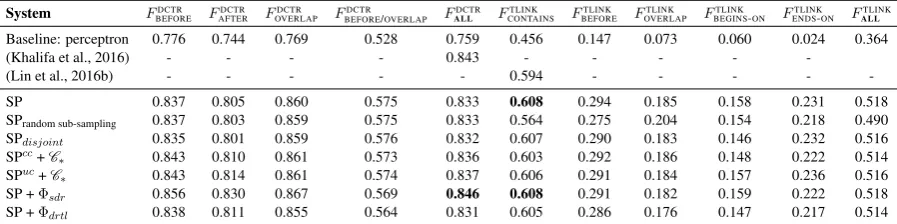
Our experimental results on the THYME test set are reported in Table 5. In the table, the abbrevia-tion SP refers to the structured perceptron model described in Section 3 but without temporal la-bel constraints or global features, i.e. the joint document-level unconstrained structured percep-tron, using local initialization, and loss-augmented negative sub-sampling. We compare this model with a number of modified versions to explore the effect of the modifications.
4.4.1 Document-Level Learning
When we compare the local perceptron base-line with any of the document-level models (any SP variation), we can clearly see that learning the relations at a document-level im-proves our model significantly2 (P<0.0001 for
both DCTR and TLINKS). Furthermore, when comparing loss-augmented sub-sampling (SP) with random sub-sampling of negative TLINKS (SPrandom sub-sampling) it can be seen that a good
selection of negative training instances is very important for learning a good model (again P<0.0001), and resulted in our model to im-prove the state-of-the-art by 1.4 on theCONTAINS TLINK task3.
4.4.2 Jointly Learning DCTR and TLINKS
When comparing the disjoint model (SPdisjoint) with our joint model (SP) it can be noticed that joint prediction gives only a very small improve-ment (P=0.0768 for TLINKS, and P=0.0451 for
2Significance is based on a document-level paired t-test. 3OnlyCONTAINSis generally reported for the THYME
corpus, as the other TLINKS are less frequent, and the inter-annotator agreement for them is very low. We included them just for completeness in our experiments.
DCTR). However, joint learning on a document level provides the flexibility to formulate con-straints connecting the labels of both tasks, such as the last four constraints in Table 3, resulting in a more consistent labeling over both tasks. Sim-ilarly, in the joint learning setting, we can define global features that connect both tasks (likeΦdrtl).
4.4.3 Integrating Temporal Constraints
We experimented with integrating label con-straints in two ways (1) both during training and prediction (SPcc+C∗), or (2) only during predic-tion (SPuc + C∗). In general it can be noticed that in our experiments using the temporal label constraints from Table 3 slightly increases DCTR performance, but slightly decreases TLINK per-formance. A reason for this can be that the model generally gives better predictions for DCTR, that might result in providing a better alternative to a constraint violating solution. A difference in consistency of the annotation between both tasks could also be a reason. Furthermore, we can see that integrating the constraints both during training and prediction gives slightly lower per-formance compared only integrating them during prediction.
4.4.4 Using Global Structured Features
System FDCTR
BEFORE FAFTERDCTR FOVERLAPDCTR FBEFOREDCTR /OVERLAP FALLDCTR FCONTAINSTLINK FBEFORETLINK FOVERLAPTLINK FBEGINSTLINK-ON FENDSTLINK-ON FALLTLINK
Baseline: perceptron 0.776 0.744 0.769 0.528 0.759 0.456 0.147 0.073 0.060 0.024 0.364
(Khalifa et al., 2016) - - - - 0.843 - - - -
-(Lin et al., 2016b) - - - 0.594 - - - -
-SP 0.837 0.805 0.860 0.575 0.833 0.608 0.294 0.185 0.158 0.231 0.518
SPrandom sub-sampling 0.837 0.803 0.859 0.575 0.833 0.564 0.275 0.204 0.154 0.218 0.490
SPdisjoint 0.835 0.801 0.859 0.576 0.832 0.607 0.290 0.183 0.146 0.232 0.516
SPcc+C∗ 0.843 0.810 0.861 0.573 0.836 0.603 0.292 0.186 0.148 0.222 0.514
SPuc+C∗ 0.843 0.814 0.861 0.574 0.837 0.606 0.291 0.184 0.157 0.236 0.516
SP +Φsdr 0.856 0.830 0.867 0.569 0.846 0.608 0.291 0.182 0.159 0.222 0.518
SP +Φdrtl 0.838 0.811 0.855 0.564 0.831 0.605 0.286 0.176 0.147 0.217 0.514
Table 5: Results on the THYME test set. SP refers to our structured perceptron model, without con-straints or global features, using local initialization and loss-augmented negative sub-sampling.C∗refers to using all constraints. Superscript CC and UC refer to using constraints at training and prediction time, or only at prediction time respectively.
5 Conclusions
In this work, we proposed a structured per-ceptron model for learning temporal relations between events and the document-creation time (DCTR), and between temporal entities in the text (TLINKS) in clinical records. Our model efficiently learns and predicts at a document level, exploiting loss-augmented negative sub-sampling, and uses global features allowing it to exploit relations between local output la-bels. For construction of a consistent output labeling, needed for time-line construction, we formulated a number of constraints, including those from (Chambers et al., 2007; Do et al., 2012), and assessed them during inference. Our best system outperforms the state-of-the-art of both the CONTAINS TLINK task, and the DCTR task. Our code for this work is available at
https://github.com/tuur/SPTempRels. Acknowledgment
The authors would like to thank the reviewers for their constructive comments which helped us to improve the paper. Also, we would like to thank the Mayo Clinic for permission to use the THYME corpus. This work was funded by the KU Leuven C22/15/16 project ”MAchine Read-ing of patient recordS (MARS)”, and by the IWT-SBO 150056 project ”ACquiring CrUcial Medical information Using LAnguage TEchnology” (AC-CUMULATE).
References
Steven Bethard, Leon Derczynski, James Pustejovsky, and Marc Verhagen. 2014. Clinical tempeval. arXiv preprint arXiv:1403.4928.
Steven Bethard, Leon Derczynski, Guergana Savova, Guergana Savova, James Pustejovsky, and Marc Verhagen. 2015. Semeval-2015 task 6: Clinical tempeval. InProceedings of SemEval, pages 806– 814. Association for Computational Linguistics. Steven Bethard, Guergana Savova, Wei-Te Chen, Leon
Derczynski, James Pustejovsky, and Marc Verha-gen. 2016. Semeval-2016 task 12: Clinical tem-peval. pages 1052–1062. Association for Computa-tional Linguistics.
Nathanael Chambers and Dan Jurafsky. 2008. Jointly combining implicit constraints improves temporal ordering. In Proceedings of EMNLP, pages 698– 706. Association for Computational Linguistics. Nathanael Chambers, Shan Wang, and Dan
Juraf-sky. 2007. Classifying temporal relations between events. InProceedings of ACL, pages 173–176. As-sociation for Computational Linguistics.
Michael Collins. 2002. Ranking algorithms for named-entity extraction: Boosting and the voted perceptron. InProceedings of ACL, pages 489–496. Association for Computational Linguistics.
Carlo Combi and Yuval Shahar. 1997. Temporal rea-soning and temporal data maintenance in medicine: issues and challenges. Computers in Biology and Medicine, 27(5):353–368.
Harold Charles Daume. 2006. Practical Structured Learning Techniques for Natural Language Process-ing. ProQuest.
Quang Xuan Do, Wei Lu, and Dan Roth. 2012. Joint inference for event timeline construction. In Pro-ceedings of EMNLP, pages 677–687. Association for Computational Linguistics.
Yoav Freund and Robert E Schapire. 1999. Large margin classification using the perceptron algorithm.
Machine Learning, 37(3):277–296.
[image:8.595.75.524.63.175.2]Abdulrahman Khalifa, Sumithra Velupillai, and Stephane Meystre. 2016. Utahbmi at SemEval-2016 task 12: Extracting temporal information from clinical text. Proceedings of SemEval, pages 1256– 1262.
Parisa Kordjamshidi, Dan Roth, and Marie-Francine Moens. 2015. Structured learning for spatial in-formation extraction from biomedical text: bacteria biotopes. BMC Bioinformatics, 16(1):1.
Hee-Jin Lee, Yaoyun Zhang, Jun Xu, Sungrim Moon, Jingqi Wang, Yonghui Wu, and Hua Xu. 2016. UTHealth at SemEval-2016 task 12: an end-to-end system for temporal information extraction from clinical notes. Proceedings of SemEval, pages 1292–1297.
Artuur Leeuwenberg and Marie-Francine Moens. 2016. KULeuven-LIIR at SemEval 2016 task 12: Detecting narrative containment in clinical records.
Proceedings of SemEval, pages 1280–1285. Chen Lin, Dmitriy Dligach, Timothy A Miller, Steven
Bethard, and Guergana K Savova. 2016a. Multi-layered temporal modeling for the clinical domain.
Journal of the American Medical Informatics Asso-ciation, 23(2):387–395.
Chen Lin, Timothy Miller, Dmitriy Dligach, Steven Bethard, and Guergana Savova. 2016b. Improving temporal relation extraction with training instance augmentation. Proceedings of ACL, page 108. Inderjeet Mani, Marc Verhagen, Ben Wellner,
Chong Min Lee, and James Pustejovsky. 2006. Ma-chine learning of temporal relations. InProceedings of COLING–ACL, pages 753–760. Association for Computational Linguistics.
Luis Gerardo Mojica and Vincent Ng. 2016. Markov logic networks for text mining: A qualitative and empirical comparison with integer linear program-ming. InProceedings of LREC, pages 4388–4395. Agnieszka Onisko, Allan Tucker, and Marek J.
Druzdzel, 2015. Prediction and Prognosis of Health and Disease, pages 181–188. Springer International Publishing, Cham.
James Pustejovsky and Amber Stubbs. 2011. Increas-ing informativeness in temporal annotation. In Pro-ceedings of the 5th Linguistic Annotation Workshop, pages 152–160. Association for Computational Lin-guistics.
James Pustejovsky, Patrick Hanks, Roser Sauri, An-drew See, Robert Gaizauskas, Andrea Setzer, Dragomir Radev, Beth Sundheim, David Day, Lisa Ferro, et al. 2003. The TimeBank corpus. In Cor-pus Linguistics, volume 2003, page 40.
Guergana K Savova, James J Masanz, Philip V Ogren, Jiaping Zheng, Sunghwan Sohn, Karin C Kipper-Schuler, and Christopher G Chute. 2010. Mayo
clinical text analysis and knowledge extraction sys-tem (cTAKES): architecture, component evaluation and applications. Journal of the American Medical Informatics Association, 17(5):507–513.
Michael Stacey and Carolyn McGregor. 2007. Tempo-ral abstraction in intelligent clinical data analysis: A survey. Artificial Intelligence in Medicine, 39(1):1– 24.
William F Styler IV, Steven Bethard, Sean Finan, Martha Palmer, Sameer Pradhan, Piet C de Groen, Brad Erickson, Timothy Miller, Chen Lin, Guergana Savova, et al. 2014. Temporal annotation in the clinical domain. Transactions of the Association for Computational Linguistics, 2:143–154.
Weiyi Sun, Anna Rumshisky, and Ozlem Uzuner. 2013. Evaluating temporal relations in clinical text: 2012 i2b2 challenge. Journal of the American Med-ical Informatics Association, 20(5):806–813. Naushad UzZaman and James F Allen. 2011.
Tempo-ral evaluation. InProceedings of ACL–HLT, pages 351–356. Association for Computational Linguis-tics.
David Weiss, Chris Alberti, Michael Collins, and Slav Petrov. 2015. Structured training for neu-ral network transition-based parsing. arXiv preprint arXiv:1506.06158.